I’m not a fan of human physiology. Given a Cartesian outlook toward life, I’d rather not think about or acknowledge my physicality even exists.
Yet there it is, influencing my daily affairs in ways I don’t comprehend. The physicality of others impacts everything I do in public and in private. My physicality — driving a lift truck, operating a bar code scanner, lifting bags of feed, sitting in meetings with other humans — impacts others as well as myself. For at least a moment, I should consider and endeavor to understand physiology.
Maybe in another life.
“I think, therefore I am” has been my beacon since I was a grader. I call it Cartesian now but its roots are in serving as an altar boy a few blocks from home in the Catholic Church and in the convent located on the upper floor of our elementary school. I’d come home from daily Mass and read what today is called juvenile literature printed on cheap paper and mailed from places of which I’d never heard. I became fixated on my own awareness and with the fact that other people, places and things existed and had impact on me. I felt separate from their reality, connected only by ink on paper, conversation, and radio and television. I became aware that in fact it was a reality.
The origins of a Cartesian outlook have roots further back in my hospitalization for a head injury at age three.
“What I learned through the injury and recovery in the hospital was that there is an infrastructure of knowledge and caring to support us when things happen,” I wrote in 2009. “This experience assured me that although we are vulnerable, we are not alone.”
Four physicians ago, when we first moved to Big Grove, my doctor laid me back on the examination table and rested his left hand on my naked belly and held it for a moment.
“This is not normal,” he said, referring to excess weight layered between my guts and skin. I agreed, respecting his training and experience in physiology, something about which I cared little. One would have thought it easy to improve my Body Mass Index given the intellectual provenance awareness can bring.
But no.
It has been especially hard to exercise since developing plantar fasciitis. Given my love of jogging, I tend to avoid thinking about exercise now, hoping gardening and the physicality of work at the home, farm and auto supply store compensates. I don’t know if it does and am reluctant to do the type of analysis I did with other life schemes.
If mine is a life of the imagination, that’s where I’d prefer to live. Yet reality beckons: in the form of news stories of horrible things happening to people the world over; in the work required to put a balanced meal on the table; or in staying awake during the 25 minute commute to the home, farm and auto supply store. Who wouldn’t want to live in the imagination? There is an unparalleled comfort there.
Whatever I am, physically or intellectually, I go on looking.
I look through a window where spiders persistently weave and reweave a web to catch insects drawn to the warmth and light of our home;
I look through eyeglasses the prescription of which needs an upgrade;
I look through the car windshield alert for the sudden appearance of deer during the rut;
I look through the fog of morning to see what each day brings;
I look for things I recognize more than for discovery and that’s regrettable.
After college I vowed to read every book in our Carnegie library. At the time that may have been possible. I didn’t get past the religion section of the Dewey Decimal System-organized stacks. I don’t read as much today as I did then.
Now the veil of Maya wears thin.
Everything I believed upon retirement from my transportation career has been called into question. I was hopeful the long, difficult work of electing a Democratic president was finished and that common sense would dominate public discourse. It turned out to be too much imagining as we were struck in the tuchus by the physicality of modern politics.
As if awakening from a dream, it will soon be time again to get dressed and find my running shoes. Not because my plantar fasciitis is in abeyance, but because the built in arch support will comfort my aging feet as I re-engage in society. I didn’t imagine I’d have to do that again in this life. It turns out I was wrong and Frederick Douglass was right:
It is in strict accordance with all philosophical, as well as experimental knowledge, that those who unite with tyrants to oppress the weak and helpless, will sooner or later find the groundwork of their own liberties giving way. “The price of liberty is eternal vigilance.” It can only be maintained by a sacred regard for the rights of all men.
I imagine it’s time to get back to work in the physical world.
At 11:21 p.m. yesterday the U.S. Senate Finance Committee voted to pass a tax reform bill on a partisan vote, according to Senator Tim Kaine (D-Virginia). Note well, it was during the dark of night.
No Congressional Budget Office scoring, no hearings, no nothing. It was an indication that nothing we once thought mattered about legislating matters. Wealthy donors have an agenda and through the Republican Congress they are having their way with the American people.
My spouse and I were discussing the situation a few hours later and I concluded my part of the conversation by saying, “They are all a bunch of assholes.” I’ve calmed a little since then.
It is probably just as well the Congress rip the bandage off this live wound of a government, exposing its interest in perpetuating narrow views of governance and increasingly becoming a voice for the richest Americans. They go on because few citizens are engaged beyond headlines in the news.
While the federal government set me off this morning, Iowa Republicans are waiting to see if the Senate’s tax bill gets 50 votes plus the vice president and goes to reconciliation with the House version. If the president signs a tax bill into law, that will set the stage for the Iowa legislature, now controlled by Republicans, to take their own, reflective actions.
Here’s the exchange between Senators Sherrod Brown (D-Ohio) and Orrin Hatch (R-Utah) making news this morning. I watched it twice and can’t do it again.
Sherrod Brown really takes the fight to Orrin Hatch here. No Trumpian namecalling or low blows. Instead focusing on the GOP helping only the ultra-rich. Judging by how mad Hatch got, Brown hit a soft spot. pic.twitter.com/WxDFb8ipHB
In the meanwhile, I’ll go to work at the home, farm and auto supply store where I’ll take home another $54 after deductions for a day’s work and try to sustain our lives. It’s clear nothing matters in our politics. That is, nothing except our own engagement to repair the wound and protect the commons.
Group of captured Allied soldiers on the western front during World War I representing eight nationalities: Anamite (Vietnamese), Tunisian, Senegalese, Sudanese, Russian, American, Portuguese and English. Photo Credit – Library of Congress
Most of Armistice Day was at home.
The forecast had been rain, however, a clear fall day unfolded and I planted garlic. Pushing cloves into the ground with my thumb and index finger, I made two rows and covered them with mulch retrieved from the desiccated tomato patch. It doesn’t seem like much, it’s my first garlic planting ever. If it fails to winter I have plenty of seed to replant in the spring.
Had I been more prescient about the weather I would have spent more time outside: mowing, trimming oak trees and lilacs, clearing more of the garden, and burning the burn pile. Neighbors were mowing. The mother of young children piled up leaves from the deciduous trees at the end of a zip line portending great fun. Instead, I spent the morning cooking soup, soup broth, rice and a simple breakfast.
Leaves of scarlet kale were kissed by frost leaving a bitter and sweet flavor. I harvested the crowns and bagged the leaves to send to town for library workers. Usable kale remains in the garden. It will continue to grow with mild temperatures. Leaves of celery grow where I cut the bunches. There is plenty of celery in the ice box so I didn’t harvest them and won’t until dire cold is in the forecast. An earlier avatar of gardener wouldn’t have done anything in the garden during November.
I picked up provisions at the orchard: 15 pounds of Gold Rush apples, two gallons of apple cider, two pounds of frozen Montmorency cherries, packets of mulling spices and 10 note cards. Sara, Barb and I had a post-season conversation about gardening, Medicare and living in 2017.
The morning’s main accomplishment was clearing the ice box of aging greens by producing another couple gallons of vegetable broth. I lost count of how many quart jars of canned broth wait on pantry shelves. For lunch I ate a sliced apple with peanut butter.
We live in a time when favorite foods are under pressure from climate change. Chocolate, coffee and Cavendish bananas each see unique challenges from global warming. In addition, recent studies show the higher concentration of carbon dioxide in the atmosphere is reducing the nutrient value of common foods. Our way of life has changed and will continue to change as a result of what Pope Francis yesterday called shortsighted human activity. He was immediately denounced in social media by climate deniers.
This week, Congressman Ron DeSantis (R-FL) introduced the HERO Act which purports to reform higher education. Specifically, the bill would open up accreditation for Title IV funding to other than four-year colleges and universities. In an effort to break up the “college accreditation cartel” DeSantis would keep current Title IV funding but add eligibility for other post K-12 institutions. States could accredit community colleges and businesses to be recipients of federal loans for apprenticeships and other educational programs.
Telling in all of this is that as soon as he introduced the bill, DeSantis made a beeline for the Heritage Foundation for an interview about it with the Daily Signal. Does higher education funding need reform? Yes. What are Democrats doing to effect change in higher education? That’s unclear. A key problem is progressives don’t have a network of think tanks and lobbying groups funded by dark money to counter the HERO act or the scores of other conservative initiatives gaining traction in the Trump administration.
Even though the 45th president seems an incompetent narcissist, the influence of a conservative dark money network within his administration is clear: in appointments to the Supreme Court and judiciary; in dismantling the Environmental Protection Agency, in undoing progress in national monuments and parks, in weakening the State Department, in potentially politicizing the 2020 U.S. Census, and much more. The reason for his success is his close relationship with wealthy dark money donors and the agenda they sought to implement since World War II.
Today is the 39th anniversary of my return to garrison from French Commando School. I returned with a clear mind, physically fit, and an awareness of my place in the world.
“I am ready to experience the things of life again,” I wrote on Nov. 12, 1978. “The time at CEC4 has cleansed me of all things stagnant. I will pursue life as I see it and make it a place where I pass with love and peace for all.”
We work for peace on the 99th anniversary of the Armistice. If people are not unsettled by evidence of climate change and a Congress that ignores it in favor of pet projects designed to please the wealthiest Americans, we haven’t been paying attention. The need to sustain our lives in a global society has never been clearer.
The president of the Gallery Acres West home owners association invited me to attend Wednesday’s city council meeting and I did. I was amazed.
It was amazing that council gave such thoughtful and considerate deliberation to a request by the rural subdivision to hook up to city water.
Running a three-mile water line from Solon to Gallery Acres West would help resolve a public health issue for about 50 residents who have elevated arsenic levels in their drinking water. They have been consuming non-compliant water since 2001 when the Environmental Protection Agency standard for arsenic changed from 50 to 10 parts per million.
The history of this public water system (No. 5282306) and its failure to comply with the arsenic standard is available on line. In 2015 the Iowa Department of Natural Resources threatened legal action over non-compliance. DNR should not back down from enforcing public water system standards in this or any other case.
Whether running a three-mile water line from Solon to Gallery Acres West is a good or fair idea is for others to say. That council is willing to consider this proposal, even though they are under no legal or moral obligation to do so, reflects well on them and the City of Solon.
Wednesday’s council meeting was a living demonstration of what it means to be a good neighbor and Iowa nice.
~ Published in the Nov. 9 edition of the Solon Economist
Never mistake absence of political noise for lack of a campaign. In both Solon and West Branch, the number of write-in votes in yesterday’s city elections was substantial. West Branch write-ins may make a difference in the outcome of one city council seat.
In West Branch there were 105 write-in votes of 213 cast (49 percent) with Andrew Mundell getting 91 of those and 14 remaining unresolved on election night. That makes Mundell competitive with Jodee Stoolman who received 93. Nicholas Goodweiler received 163 votes for councilperson and is safely elected to one of the two open seats.
In Solon there were 94 write-in ballots for city councilor of 214 cast (44 percent). The Johnson County auditor has not identified the write-in candidate(s) and those votes won’t change the election outcome of Steve Duncan, Lynn Morris and Lauren Whitehead being safely re-elected. One suspects a sub rosa write-in campaign for Dale Snipes who lost to Whitehead in a May 30 special election. I asked the auditor’s office for the names of write-in candidates once they are tabulated.
In low turnout elections a write-in campaign can make a difference by activating voters. I decided to run for township trustee only after casting my ballot in the 2012 general election when only one candidate for two township trustee seats was listed. It took some work to activate my network to vote for me, but not that much for an easy win.
These elections highlight the importance of local political engagement.
On Nov. 2, Dallas County Republicans heard how important they are. Acting Lieutenant Governor Adam Gregg and Republican Party of Iowa chair Jeff Kaufmann extolled local political activists saying their county effort was essential to implementing the Republican agenda.
“This is where so much energy is, and this is where the work that gets done to elect conservative candidates really happens,” Gregg said. “This is where the organization happens, this is where the get-out-the vote effort happens, this is where the door knocking happens, and it’s so critical and it’s so important.”
“Electorally, there’s only one way that we counter a Johnson County, and that is for a Dallas County to run up the total,” Kaufmann said. “That’s the numbers game, how that does that.”
Elections matter and there is no denying Lauren Whitehead confirmed her credibility with last night’s solid win. However, when 12.4 percent of registered voters show up for a city election it also indicates people are engaged. In the 2013 Solon city election only 63 voters (4.5 percent) cast a ballot. By tripling voter participation in an uncontested city election last night, Solon voters set the stage for further electoral wins.
It’s a year until the 2018 general election and last night’s results indicate we’re off to a good start.
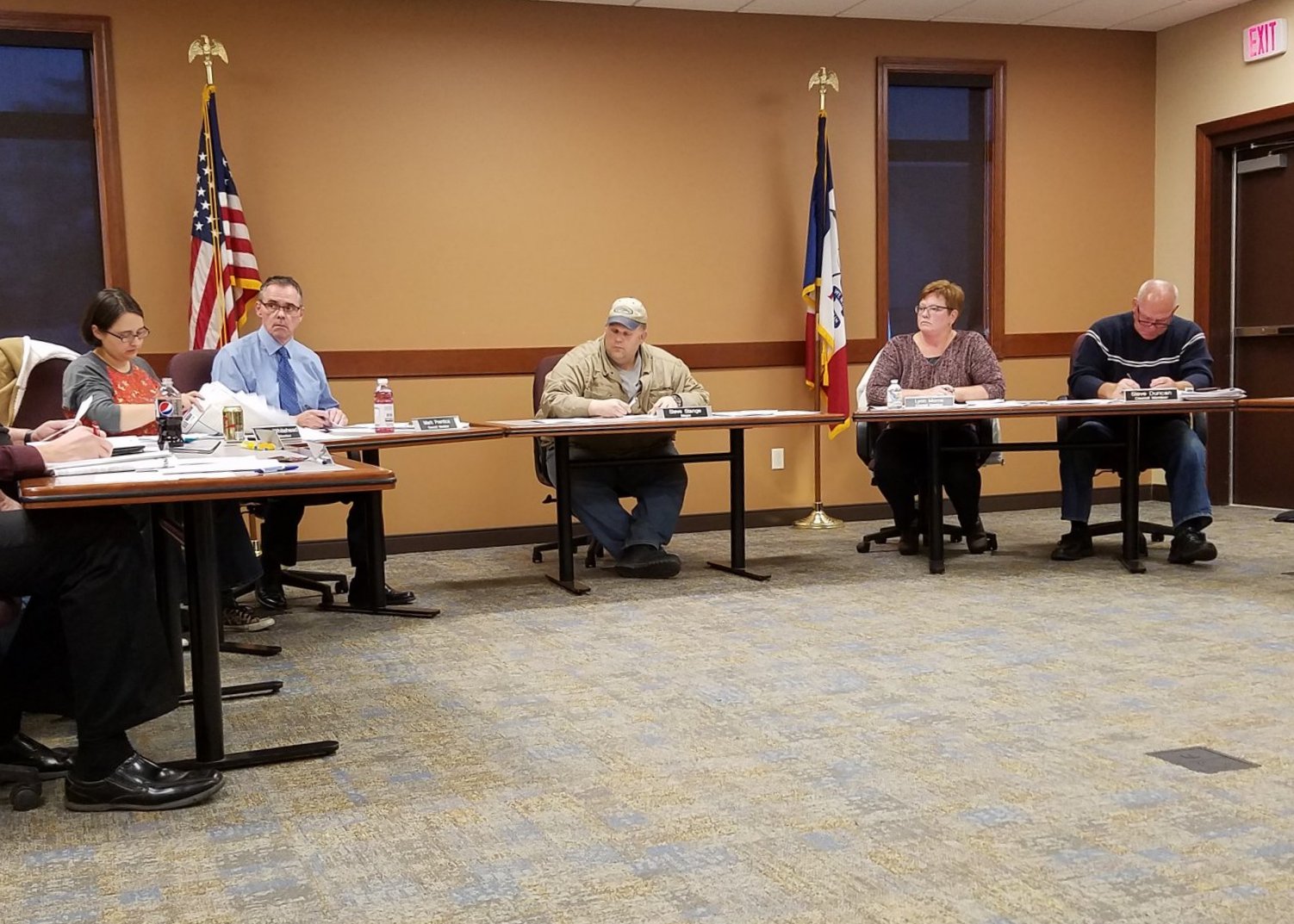
Solon City Council Nov. 1, 2017 left to right Lauren Whitehead, Mark Prentice, Mayor Steve Stange, Lynn Morris and Steve Duncan. Councilor Shawn Mercer participated via video conference.
My reaction to the Nov. 1 Solon City Council meeting was amazement.
I was amazed at how helpful council was being — a living demonstration of being good neighbors and Iowa nice.
Gallery Acres West requested a hook up to the city water supply. The City of Solon has no obligation to provide the service. Despite the fact Gallery Acres West has been delinquent in complying with the 2001 arsenic standards for public water systems, council politely and professionally is hearing them out. Councilors want additional information before making a decision. Mayor Stange said he would like a decision by the end of the year. Whether council votes for the final proposal is an open question.
Information of varying quality has come out over the subdivision’s proposal and related issues. Council is smart to sort through what’s been presented before deciding. However, the bottom line is leadership of Gallery Acres West decided homes could use high arsenic drinking water since 2001. It’s not the city’s problem.
Why didn’t the subdivision comply? During an Oct. 30 phone call with the president of their home owners association, who recently moved to the subdivision, I asked him that question. He told me it was the cost of compliance. With only 14 homes in their association compliance would run thousands of dollars per household. Who wants an unexpected expense like that? At the same time, who wants to risk public health because a community believes they can’t afford it?
In 2015, the Iowa Department of Natural Resources threatened legal action if Gallery Acres West did not comply with arsenic standards for their public water system. By then it had been 13 years since their first violation. Push has come to shove and Iowa DNR shouldn’t back down.
If Solon decides to help Gallery Acres West I hope council gets all the information they need. Based on Wednesday’s meeting it appears they will. In the meanwhile, 14 homes continue to use high arsenic drinking water.
Water is life. We take its quality for granted if the source is a public water system.
Consumers rely on drinking water standards developed by the U.S. Environmental Protection Agency and enforced by the Iowa Department of Natural Resources. Where we live municipalities do a good job of compliance with drinking water standards. There are few standards for private wells and the experience is uneven at best in unincorporated areas with public water permits.
In January 2001 the U.S. Environmental Protection Agency issued a reference guide for compliance with the new standard for arsenic in public drinking water, reducing the allowable amount from 50 parts per billion to ten.
Arsenic is a naturally occurring element in many water systems. Neither number in the range seems like much, and at 10 ppb it isn’t. Public water systems have been required to comply with the new standard and if EPA persists in enforcing the new standard, all public water systems should be in compliance eventually.
Not so with private wells where testing and compliance is voluntary. A study published this month in Environmental Science and Technology estimates about 2 million people in the Unites States drink water from private wells with arsenic concentrations exceeding 10 ppb.
The change, initiated during the Bill Clinton administration, took time to develop and more time for communities to implement. The idea was to bring the United States into compliance with the World Health Organization standard for arsenic in drinking water. There are currently communities where the public water system does not meet the new arsenic standard, including one that has been the source of news here in Big Grove. Hopefully they are all working on complying.
There have been at least two deaths caused by cancer among the 85 homes on our public water system. Whether this experience is or isn’t connected to historic arsenic levels is a question that hasn’t been asked. I’m not sure of the merit of asking it, although there are studies with evidence supporting such a connection in larger communities. It is also unclear whether two deaths from anything would be statistically significant in a population of 300. In any case, our public water system has been in compliance with arsenic standards since the new treatment facility was brought on line more than ten years ago.
I doubt many home buyers look at public water or sewer records when considering buying a home even though the data is easily available on line. The proliferation of development in unincorporated areas raises an issue of the quality of management in home owners associations. The arsenic compliance experience demonstrates it is uneven at best.
People seek to escape municipalities. Gasoline remains inexpensive relative to average household income and there are perceived freedoms in living in a small, insular community away from city life. Commuting to a job within an hour’s drive from home is common in Iowa. There is a cost. Things that could be taken for granted in a municipality require attention and potential action in rural Iowa. Who has time for that?
The presence of arsenic in ground water is just one example of the issues of living in an unincorporated area. In a culture of affluence, the quality of water does not often come to the forefront. When it does there is a perception that money and technology will resolve it. That’s mostly true but it requires our engagement, something many people are unwilling to give.
It’s part of sustaining a life in a turbulent world.
Some of my friends and acquaintances are women who carry handguns.
I’m not worried about getting shot by my lunch partner. I also don’t feel more secure knowing she has a handgun in her purse. It used to be a bit jarring to see weapons unexpectedly in everyday places. Not any more. I’m confident in studies that show women are not the main problem with gun violence, it’s the men.
A common social behavior among men particularly, but with women also, is to assert their gun ownership into a conversation as a way of launching a comfortable jeremiad about why they own them, the positive features of gun ownership, and as a way of testing the waters in social relationships to identify where people stand. This is at the heart of what elected Trump, Ernst and others. Gun ownership and discussions about it are a way to sort people in society into “us” and “them” categories. It has consequences in the electorate, so it is important to discuss and understand.
Data shows gun violence is disproportionately a male problem. Of the 91 mass shootings in which four or more victims died since 1982, only three were committed by women, according to a database from the liberal-leaning news outlet Mother Jones. Men also accounted for 86% of gun deaths in the United States, according to an analysis by the non-partisan non-profit Kaiser Family Foundation.
Men are more likely to own a gun — three times more, according to a 2017 survey from the Pew Research Center. This, despite marketing from gun manufacturers and groups such as the National Rifle Association to lure women.
Fast forward to Dastagir’s conclusion that to understand gun violence we must examine the cultural forces that equate being a man with violence.
Financial inequality is impacting society by making men protectors of what limited resources each family has.
I know few people who are increasing their wealth in the post-Reagan era. The rich get richer and the rest of us pay for it as dollars systematically, relentlessly find their way to the richest one percent of the population. Families struggle to get a share of societal wealth and if they do, feel privileged enough to say, “I’ve got mine.”
The struggle to provide for a family is getting harder with the transformation of American business to globalization, government efforts to eliminate regulations, and the current administration’s tampering with healthcare, defense, foreign policy, energy, education, immigration and more.
The impact of financial inequality on the role of men in society has been to make it more difficult for them to provide for their families. That said, I don’t know many families where a male is the sole provider. Women began moving to the paid work force in large numbers decades ago. The idea women wouldn’t seek paid work is a social legacy of male dominance. The male narrative lacks proper consideration for the value of work by women. That seems obvious in workplaces where women earn a fraction of a dollar men do for the same work, and also in homes where a male provides money and resources for the family and women work unpaid.
Men are challenged to be providers so their role shifted to being protectors of what they have. The rise in gun ownership in the United States is directly related to income inequality and the diminished role of men as providers. Let’s talk about that.
Some of my friends and acquaintances are women who carry handguns.
It’s no big deal. The banal and ubiquitous presence of guns is part of living in the United States.
I’m not worried about getting shot over lunch or at an event. I also don’t feel any more secure knowing she has a handgun in her purse. It used to be a bit jarring to see weapons unexpectedly in everyday places. Not any more. I’m confident in studies that show women are not the main problem with gun violence, it’s the men.
Data shows gun violence is disproportionately a male problem. Of the 91 mass shootings in which four or more victims died since 1982, only three were committed by women, according to a database from the liberal-leaning news outlet Mother Jones. Men also accounted for 86% of gun deaths in the United States, according to an analysis by the non-partisan non-profit Kaiser Family Foundation.
Men are more likely to own a gun — three times more, according to a 2017 survey from the Pew Research Center. This, despite marketing from gun manufacturers and groups such as the National Rifle Association to lure women.
Fast forward to Dastagir’s conclusion that to understand gun violence we must examine the cultural forces that equate being a man with violence. Read her information-packed article here.
What is it to be a man? It’s no secret having a Y chromosome is less important than the culture in which boys are nurtured to adulthood. There remains a significant, lingering perception that procreation is part of being a man even though wombs are more important than sperm. Only primitives continue to believe having a large family is a sign of manhood. At the same time male sexual dominance often trumps a woman’s right to choose. We read news daily about sexual predators, soldiers raping villagers, and widespread sexual harassment. Even so, something more powerful than traditional views about the role of men in procreation is at work.
After my first year in college (1971) I went home for the summer. I met with a number of male friends from high school and we each had been able to apply for work at manufacturing plants in the Quad Cities and find a summer job. Some literally went from business to business until they found a job and everyone who wanted one got one. It was easy. That changed.
The jobs environment has gotten very scrappy in Iowa and well-paid jobs with benefits are difficult to find and secure. Such jobs exist, however, the rise of professional human resources consultants has businesses seeking employees who meet very specific “profiles.” Don’t meet the profile or offer something unique to the position? Applicants will politely be sent on their way. If an applicant is lucky enough to be hired, human resource consultants have structured pay and benefits to meet the company’s minimum needs more than the needs of employees. Under the guise of taking inefficiencies out of business operations well-paid jobs with benefits are hard to get for almost anyone. It is worse with large companies who have the capitalization and scale to hire human resources consulting firms.
The transformation from manufacturing jobs to service jobs has not gone well from the standpoint of men seeking work. Retail, lawn care, janitorial, restaurant, banking, accounting, health care, sales, and other low-skill level employment performs necessary work in the economy. Such jobs are far from adequately compensated. Our education system increasingly fails to prepare students for jobs in a service economy. I’m not talking about adding a STEM curriculum in K-12 classrooms, but simple things like how to make a decision to start a business, work for a service company, or get a government job. Provider males are increasingly on their own when it comes to crafting a career, if that’s even possible in the 21st Century. Most I know get by, just barely.
In a society of income inequality, limited resources, women’s rights, and unsatisfactory job options, men get stymied in traditional roles of procreation and providing. They turn to protecting what they have, and that often includes buying guns. It is a predictable reaction in a society with a legacy of male dominance with no outlet.
A focus on resolving gun violence in the United States without considering the changing role of men in society isn’t going anywhere.
The following message was sent to Senators Joni Ernst and Chuck Grassley, and to Congressman Dave Loebsack:
I urge you to protect and support the 2015 nuclear agreement between Iran and the P5+1 nations. Please refrain from any actions that would undermine it and encourage your Senate colleagues to do likewise.
I understand President Trump is expected to declare the Iran Deal is not in the U.S. national interest and withhold re-certification before the Oct. 15 deadline. If he does so, he would increase the threat of nuclear proliferation in an already dangerous world.
Four brief points:
1. A deal is a deal. There is no realistic option for renegotiating the current agreement, which is working effectively to block Iran’s pathways to a nuclear weapon.
2. Congress should not re-impose nuclear-related sanctions so long as the International Atomic Energy Agency confirms Iran is meeting its commitments under the agreement.
3. President Trump should focus on solving the North Korean nuclear crisis rather than provoking a proliferation crisis with Iran.
4. The administration should also focus efforts toward strengthening the Iran/P5+1 agreement with our international partners.
Thanks in advance for considering my message. Good luck with your deliberations on this complex topic.
Regards, Paul
Response from Senator Joni Ernst on Oct. 25, 2017:
Dear Mr. Deaton,
Thank you for taking the time to contact me about the Joint Comprehensive Plan of Action (JCPOA), commonly referred to as the “Iran deal.” It is important for me to hear from folks in Iowa on policy matters such as this.
On July 14, 2015, the Obama Administration announced they had reached a final deal with Iran on its nuclear program. At the time, I expressed concern that this agreement, which was reached as sanctions were crippling the Iranian economy, capitulated to Iran’s demands and threatened the security of the United States and our allies.
Overtly, the Iranian regime continues to exploit loopholes in JCPOA to advance its ballistic missile capability. Covertly, Iranian weaponization efforts are unknown, as military leaders have stated publicly they will refuse to allow International Atomic Energy Agency (IAEA) inspections of their sites. All the while, sanctions relief has fueled Iran’s support for its terrorist organization proxies engaged in malign activities in Iraq, Syria, Lebanon, Yemen, Afghanistan, and elsewhere – places where these groups are engaged in direct combat with American service members or our partners. Indisputably the JCPOA failed to meet its requirements to appropriately and proportionally contain Iran’s nefarious activities – the original purpose of the agreement.
As you may know, President Trump decided not to certify the deal under the Iran Nuclear Agreement Review Act on October 13, 2017. This action does not withdraw the U.S. from the JCPOA, but rather, it provides an opportunity for Congress to work with the Trump administration and our allies to fix the failures of the original agreement. I support the president’s decision and believe we will maintain a position of global leadership by upholding our obligations, while finally beginning to hold Iran accountable for not meeting the expectations of the international community.
I look forward to working with the Trump administration, my congressional colleagues and overseas partners to formalize a strategy that prevents Iran from obtaining a nuclear weapon and protects American interests. Feel free to contact my office with any further information, as I always enjoy hearing from Iowans.
Sincerely,
Joni K. Ernst
United States Senator
Response from Senator Chuck Grassley on Nov. 8, 2017
Dear Mr. Deaton:
Thank you for taking the time to contact me with your concerns. As your senator, it is important to me that I hear from you.
I appreciate hearing of your support for maintaining the Joint Comprehensive Plan of Action (JCPOA), otherwise known as the Iran nuclear deal. First, I’d like to take this opportunity to discuss the tenants of the Iran nuclear deal and why I have been against it from the beginning.
On April 2nd, 2015, President Obama and Secretary of State John Kerry announced the parameters for a potential deal with the Iranian government to end the country’s nuclear enrichment capabilities and attempts to obtain a nuclear weapon.
President Obama and Secretary Kerry both made important statements about the goal of negotiations leading to the conclusion of the JCPOA – the goal was to dismantle Iran’s nuclear program. Secretary Kerry himself said, in the fall of 2013, that Iran has “no right to enrich” and that a good deal with Iran “would help dismantle its nuclear program.”
In reality, the deal has failed to achieve its key objective of a denuclearized Iran. This deal, as it stands, puts Iran in a position of strength – economically and militarily – from which to further destabilize the Middle East.
The nuclear deal granted Iran a series of continuous sanctions relief in exchange for a reduction in nuclear enrichment capabilities while requiring the access of international inspectors to certify the country’s compliance with the deal’s terms. However, although the United States has granted Iran sanctions relief upwards of $160 billion dollars, the architecture of the agreement only requires Iran to temporarily reduce its nuclear weapons program. This temporary reduction in activities grants massive sanctions relief to a country which could ultimately decide to pursue its threatening activities once the agreement’s sunset clauses expire without any additional punishment.
Despite assurances that the deal would include “anytime, anywhere” inspections, the Obama administrated negotiated away from these provisions and provided Iran with a 24-day inspection delay following an announcement from International Atomic Energy Agency (IAEA) investigators of intent to inspect a site. Furthermore, the IAEA has not been able to conduct adequate inspections of Iranian Military sites where nuclear research is conducted. To a large extent, this deal requires the United States to accept, without good reason, that the Iranians are engaged in a good faith effort to not cheat.
On May 7th, 2015, the Senate passed the Iran Nuclear Agreement Review Act by a vote of 98-1 which provided an opportunity for Congress to express its approval or disapproval of the deal. Despite 98 Senators voting in favor of reviewing the agreement, a minority of Senators lead by then minority leader Senator Reid, voted to block debate, consideration and a vote on a resolution of disapproval.
Following the JCPOA’s implementation on January 16th, 2016, Iran has continued to engage in a number of activities violating key provisions of the agreement. Most notably, these include cheating on provisions requiring the country to limit its nuclear enrichment activities through centrifuge development, prohibitions on research technology procurement, and not adhering to limitations on the amount of heavy water that the JCPOA sets forth for Iran’s nuclear reactors.
On October 13th, 2017, President Trump announced his decision to decertify the JCPOA. President Trump asserted that the JCPOA does not address the full range of potential threats posed by Iran, or permanently ensure that Iran cannot develop a nuclear weapon. In short, Iran is not living up to the spirit of the deal and that continued sanctions relief provided to Iran is not “appropriate and proportionate” to the measures taken by Iran to terminate its illicit nuclear program.
President Trump’s decision to decertify the Iranian nuclear deal is in full accordance with the statutory requirements imposed on the deal by Congress under the Iran Nuclear Review Act. Under the Iran Nuclear Review Act, the President is required to recertify Iran’s compliance with the JCPOA every 90 days. The Iran Nuclear Review Act provides Congress 60 days to consider whether to re-impose sanctions waived under the JCPOA and or to modify the deal to ensure Iran’s compliance.
The United States has not formally withdrawn from the Iran nuclear deal. Rather, President Trump’s decision to decertify the deal now puts the onus on congress to address the shortcomings of the deal. Iran continues to be the world’s leading state sponsor of terrorism, and President Trump is right to point out the failings of the deal. I look forward to working with my colleagues to further curtail Iran’s dangerous and destabilizing behavior.
Rest assured, that as your senator I will continue to follow these developments.
Again, thank you for taking the time to contact me. Please keep in touch.
Sincerely,
Chuck Grassley
Response from Congressman Dave Loebsack on Nov. 2, 2017
Dear Mr. Deaton,
Thank you for contacting me about the Iran Nuclear Agreement, also known as the Joint Comprehensive Plan of Action (JCPOA). Your opinion is very important to me and my priority is to provide Iowa’s Second District with the best representation possible.
From the beginning, I have made it clear that I believe it is unacceptable for Iran to be allowed to develop nuclear weapons. Today, it is more important than ever that we continue to work towards that commonly held goal and ensure the safety of the American people.
Under the Iran Nuclear Agreement Review Act of 2015 (INARA), the President is required to publicly certify every 90 days that Iran is complying with the terms of the JCPOA. On Friday, October 13, 2017, President Trump announced that he is formally decertifying the nuclear deal with Iran. Decertification does not put the U.S. in violation of the JCPOA, but it does give Congress a 60-day window to reimpose the sanctions that were suspended by the deal.
I believe that the administration should be focusing its efforts on ensuring the conditions of the agreement are being thoroughly enforced. Instead, the administration has chosen to ignore the warnings of the White House’s own national security staff, sow uncertainty, and undermine our national security. I appreciate you reaching out to share your thoughts with me on the importance of the U.S. remaining part of the JCPOA. Please be assured that I will continue to monitor the situation closely, and will keep your thoughts in mind should legislation related to the JCPOA come before the House of Representatives for a vote.
Thank you again for contacting me about this important issue. I encourage you to visit my website at http://www.loebsack.house.gov and sign up for my e-newsletters to stay informed of the work I’m doing in Congress. I am proud to serve Iowa’s Second District, and I am committed to working hard for you.






 Journey Home
You must be logged in to post a comment.