Categories
Writing

Growing a Story for the Long Haul

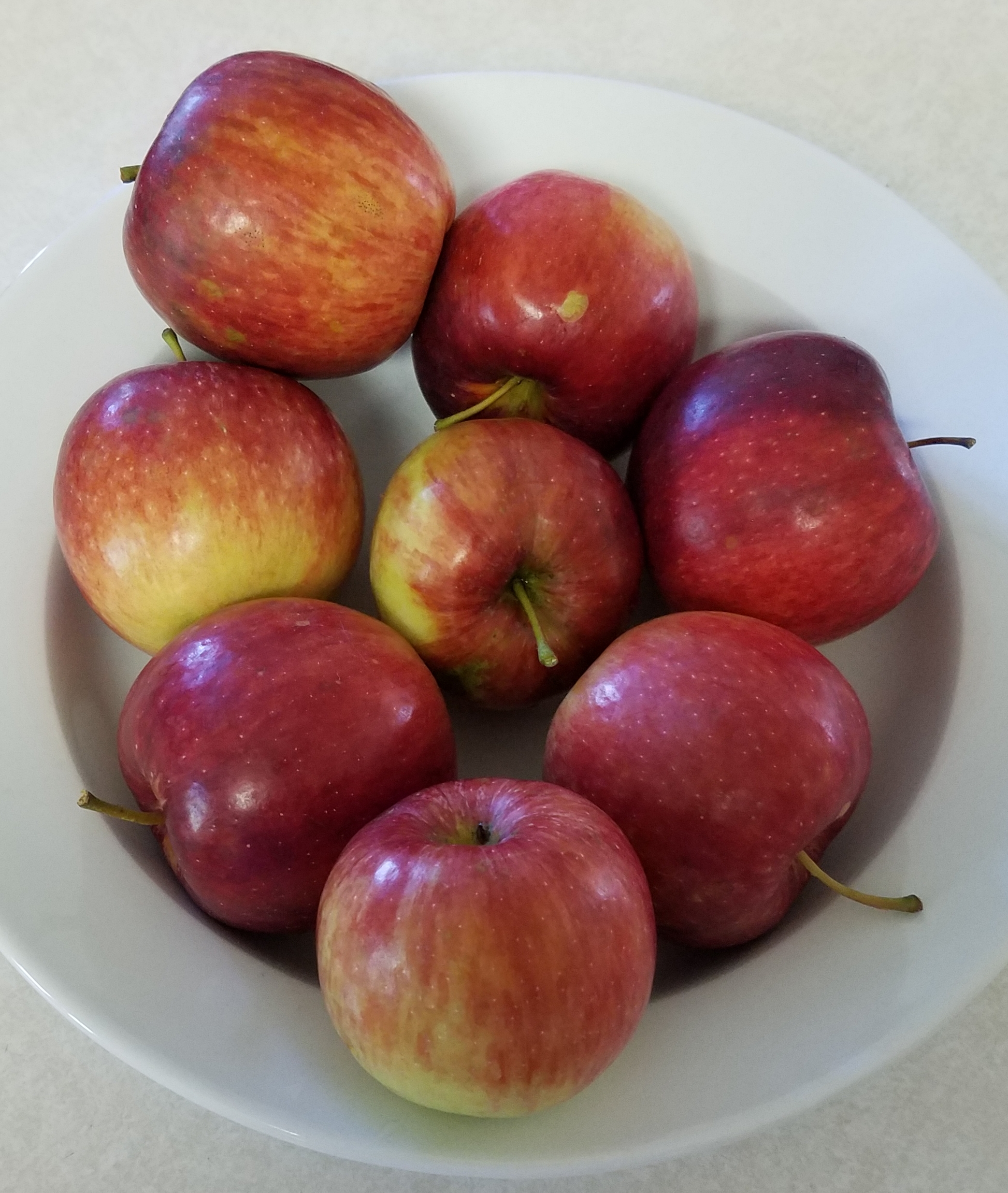
Bowl of Earliblaze Apples

Monday afternoons my spouse and I devote time to organizing the household, reducing clutter, and cleaning.

It’s a long-term project we do together. We schedule it on the calendar. Sometimes it means working together on a household issue. Sometimes it means moving boxes and furniture. It definitely means cleaning. Yesterday I spent an hour shredding personal papers. There’s is a lot to do.

We each have reasons for the project. Mine is to eliminate belongings accumulated in 67 years so when I’m gone those left don’t have to deal with them. In particular, I don’t want our daughter to have to spend weeks doing work I should have done. I also want a more comfortable place to live.

The project conflicts with my desire to produce new work. Yet a few hours a week won’t kill me as I slow down into retirement. As the work gets organized, there is a lot to like about it. Now or never is the time to consider all this stuff.
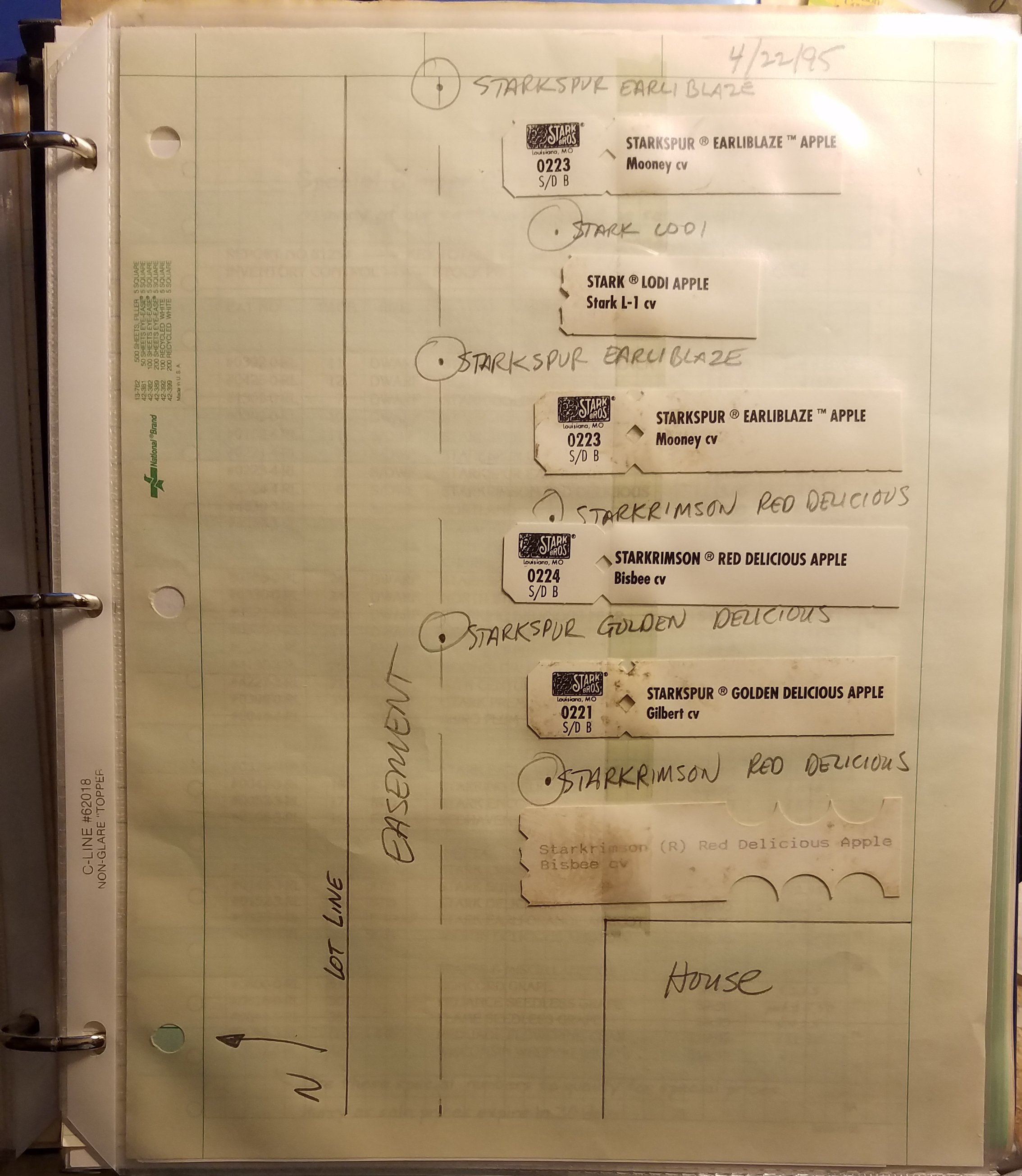
1995 Apple Tree Planting Record

Among recent findings was the planting record for our grove of fruit trees. Planted on April 22, 1995, I began with six varieties of trees, which over the years has been reduced to three: one Red Delicious and two Earliblaze apple trees.

Yesterday I ordered two new apple trees: one Zestar! and one Crimson Crisp. I’ll take out one of the Earliblaze trees and increase the distance between plantings. The idea is to get a succession of ripening fruit — the same thing I originally intended. The new ripening order will be Zestar!, Earliblaze, Crimson Crisp, then Red Delicious. I plan to plant one or two Gold Rush Trees, but the nursery is sold out this year. Gold Rush is a late apple that stores exceptionally well. Planting trees is a longer term commitment than a couple of seasons so I don’t mind waiting until 2021 for those.

I know more about apples today than I did when we moved to Big Grove. That’s mostly due to working at a local orchard during apple season. It changed how we view them dramatically, introducing new flavors and varieties. Whatever apples we have in our home orchard, we’ll supplement them with other local fruit. I probably think about apples more than most people.

If I were to tell my story, the seven seasons of working on farms and at the orchard would be part of it. Not only is the work a source of food, it is about culture and learning. It is about integrating our kitchen with an ecology of food that includes fewer items from the grocery store and more I grow or have a hand in growing.

Producing a crop of apples is a sign of something. To begin with, it is a long-term commitment to growing. The rest is about how the trees are cultivated and apples are used. If all I did was make hard cider with them, that would be something. I want more from life than that. I’m in it for the long haul.

Categories
Kitchen Garden

Tomatoes 2019

Tomato Plant

This year has been an amazing year for garden tomatoes.

21 varieties with a total of 47 plantings produced beyond expectations and our household’s ability to use them. There are so many I took two crates to the orchard for folks to can, freeze, eat and share. I took flats of them to meet ups and shared them with neighbors and friends via Facebook.

Here are some tomato notes for fans.

Deer

As we reach peak tomato season neighbors complain about deer. This comment from a friend in our township is typical,

How do you keep the deer away. They graze on ours. They take a bite, decide they don’t like it and drop it on the ground. Then onto the next tomato. Bite, pick, yuk, drop, and repeat until no tomatoes are left.

My symbiotic relationship with deer includes a custom designed deer fence using common materials. I install a 4-foot chicken wire enclosure mounted on posts so the top of the wire is 5 feet from the ground. I plant the rows 36 inches apart — close enough for me to get in, and close enough together to discourage deer from jumping five feet high to get in. I leave enough space so I can move between the fence and the tomatoes. This is my second or third year of using the method and it works keeping the deer from ripe tomatoes, leaving more for humans.

Pre-season

There are so many varieties of tomatoes! I listed seeds planted in this earlier post. The selection process was intended to produce plenty in three categories: cherry, slicers and canning tomatoes. I had plenty of seedlings from the greenhouse, allowing selection of the best starts. If three trays of 120 blocks seemed like a lot at the time, it produced what was needed for the beds.

Canning tomatoes for work colleagues.

Plot preparation

For the second year I dug 3-foot trenches for tomato planting instead of digging and breaking up entire plots. I conditioned the soil with composted chicken manure and finished with a sprinkling of diatomaceous earth. The latter was intended to retard progress of tomato-loving insects.

Moisture

When there wasn’t rain, I watered with a garden hose daily, mostly in the morning. Half a dozen plantings on the north side of the plot developed blossom end rot. I suspect the problem was a mineral deficiency in the soil rather than inconsistent moisture. I had enough grass clippings to mulch the tomatoes to prevent weeds and retain excess moisture.

Stars of the show

Tomatoes with the best results and great flavor included,

Cherries: Clementine, Grape, Matt’s Wild, Jasper, Taxi and White Cherry. The sweetest were White Cherry, Jasper and Matt’s Wild.

Canning: Granadero produced many perfectly shaped, flavorful plum tomatoes. Amish Paste was also a strong performer. Speckled Roma was the most flavorful in this category. Other varieties of small, round tomatoes filled out the crop for canning needs.

Slicers: German Pink and Martha Washington produced the best large slicers. Black Krim was unique with its dark color and tasty flesh. The Abe Lincoln plants produced consistent small round tomatoes which I used to dice for tacos and for canning.

Homemade Tomato Sauce

Uses

Eating and cooking fresh: What else is there to say but tomatoes on or in everything!

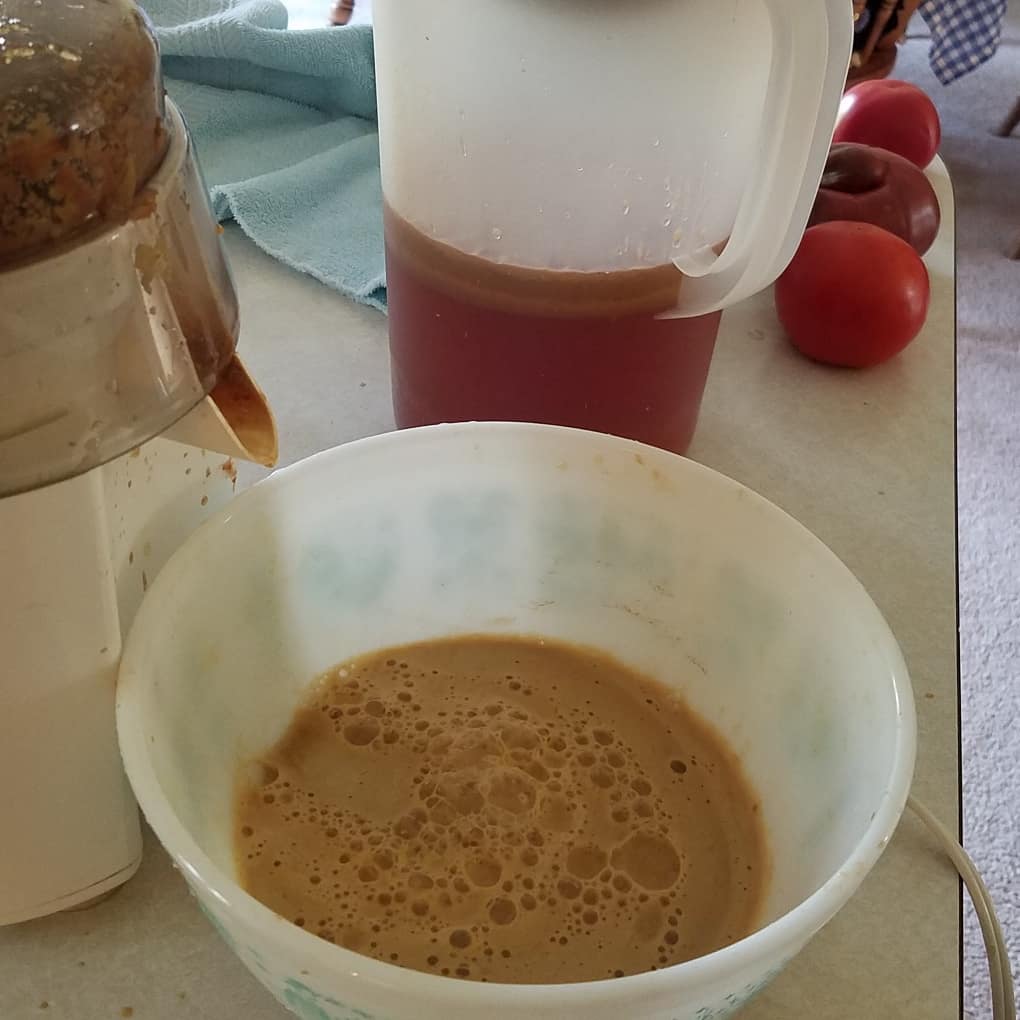
Sauce: With so many tomatoes in the house they had to be culled every couple of days for bad spots. These were trimmed and cut into large chunks to simmer until the flesh was soft and skin loosened. Next I put the whole lot into a funnel strainer and drained out tomato water. The garden produced a lot of this by-product so after canning 24 quarts of tomato water to use mostly in soups and for cooking rice, I discarded the rest. Once the water drained out, I used the wooden mallet to press out tomato sauce which I froze in one quart zip top bags to use later for pasta sauce and chili.

Diced tomatoes: I canned enough pint and quart jars of diced tomatoes to get us through the next year. I rotate stock so oldest ones are used first and still have a couple of jars from 2016 and 2017 to use first. Diced tomatoes include the skin for its nutrients.

Whole tomatoes: This year I took the skin off small round and plum tomatoes and canned them whole. There are about 24 quarts and 24 pints to last a year or more.

The 2019 garden was an unmitigated success in the tomato category. It is a feature of late summer in our household.

Categories
Kitchen Garden

Couldn’t Face the Gumbo

Slicers waiting for gumbo, sandwiches and conversion to sauce.

I had planned gumbo for a few weeks. Yesterday was the day.

Gumbo is a natural dish for our kitchen in late summer. There are plenty of onions, celery stalks, bell peppers, tomatoes, garlic and okra available from the garden. It is an easy dish to prepare after learning how to make a roux. Ingredient availability was not the issue.

I bought veggie sausages from the local food coop, harvested enough tender okra pods, and opened the hand-written recipe book to the page. I was ready.

I couldn’t, then sliced the okra, put it in a zip-top bag and tucked it in the freezer along with too many other bags of okra already there.

Not sure why I couldn’t, I recalled T.S. Eliot who put it thusly in “The Hollow Men:”

Between the conception
And the creation
Between the emotion
And the response
Falls the Shadow

Life is very long

During a month of reminders about end of life, my retort, “it’s not that damn long.”

My work cycle begins again this afternoon with a shift at the orchard for family night. After taking off work there, and at the home, farm and auto supply store, for a week, I’m ready to be among co-workers and guests again.

One hopes I will make gumbo before the end of summer vegetables. Maybe not yesterday, but it’s the best time of year for it. It would be a shame to waste our brief time among the living without it.

Categories
Kitchen Garden

2019 Gardening Season

Sundog Farm under clouds

I want to write a nice summary of this year’s garden including successes, failures and lessons learned.

Instead of crafting something usable, I visited two of the farms where I work.

Knowledge lives within us more than in written words. Life doesn’t always proceed in a linear manner despite predictable changes in season.

Yesterday was about dealing with the abundance of Red Delicious apples ripening on the tree. I plan to give excess — about 350 pounds — to my friend Carmen for the winter share in her CSA.

At the orchard we did a taste test: the apples were too starchy. Then to Sundog Farm where we discussed how much for each share and a process for delivery once they ripen. I think we are set.

Over the years I’ve been able to develop a network of master gardeners, farmers and growers to provide feedback on what happens in our garden. I am a better gardener because of this work. I’ve come a long way since getting started with the process in 2013.

Two things added a unique layer to summer gardening: my spouse’s five-week trip to her sister’s home in July, and the 26-day interim between Mother’s death Aug. 15 and her funeral Monday. Both were unexpected and made a unique mental frame for what was already a weird gardening season.

While Carmen and I walked about her farm she showed off her lettuce patch in a high tunnel, and the abundance of tomatoes a crew was harvesting. We had a conversation about diversification. This year was a big tomato year for both of us, although that’s not been the case for everyone. We planted many varieties of tomatoes and while she has members to take the excess, my canning, freezing and eating has physical limits which will soon be reached.

I moved the cherry tomatoes to their own patch this year and it’s a better idea. They are all good, but my favorites were Jasper, Matt’s Wild Cherry and white cherry. I planted two rows of four plants and next year I will only plant one row to make it easier to harvest.

Among my trials this year were okra (easy to grow and a little goes a long way in our kitchen), Guajillo chilies (if they ripen well I’ll get a crop for making pepper sauce for tacos), Poblano chilies (did not produce much), red beans (I mistook pole beans for bush beans so they had trouble), and planting beets in flats before transplanting them to the ground (produced much better beets than sown seeds). I planted two types of broccoli in succession, but the second variety (Imperial) didn’t produce.

We had basil, parsley and cilantro in abundance. Basil goes into tomato dishes and parsley and cilantro are for eating fresh. Fresh cilantro is an important addition to tacos. I made a good amount of basil pesto and froze it. Even with lots of uses for basil, I let the second raft of plants go to seed because there was too much.

If there was a single most important lesson in gardening this year, it was to better tune what I grow to our cuisine. I’m not exactly sure what that means but Carmen and I discussed and agreed that is important for a gardener. As our family cuisine makes a transition, this will gain relevance when planning next year’s garden.

So that’s the story of the 2019 garden, which isn’t done.

Categories
Writing

Shared Culture by the Lake

Making apple cider vinegar.

When we moved to Big Grove Township we had expectations about building a life here. These expectations spoke to our shared culture.

We built a new home, settled into the public school community and began getting to know people as I worked a career that would eventually take me to a job in Eldridge, Iowa where I managed a dedicated fleet operation for a large steel service company. At the time I thought the 55-minute drive was a reasonable commute.

While there, in a staff meeting, news of the planes hitting the World Trade Center and the Pentagon, and crashing in a field in Somerset County, Pennsylvania began to emerge. I was scheduled to fly to Philadelphia that morning but the flight would be delayed. That day became part of an American cultural heritage.

The events of Sept. 11, 2001 were an opportunity for the country to pull together, to unite in shared values. It was squandered by our national leaders who used the terrorist attacks as sufficient reason to invade Iraq. Our disdain for the national culture has increased since then.

Participating in a national culture is made worse by growing income and wealth inequality. If comparisons of modern capitalism with the Gilded Age and the rise of Rockefeller, Morgan, Vanderbilt, Carnegie and others is apples to oranges, Republican leadership of the U.S. government is systematically undoing every constraint on wealth and business implemented since the 1890 Sherman Antitrust Act. This is intentional, and under a government subject to the unlimited financial contributions of businesses. In part, we can thank the U.S. Supreme Court decision in Citizens United v. FEC for unleashing the power of the wealthy in our governance.

Not only do we view the rise of the wealthy into power over our lives with disdain, we spend more time thinking about it because of new media available to us 24/7. We tend to forget our local culture, the culture we share with family, friends and neighbors — things that are shared, yet personal to us.

Mom’s funeral on Monday started an immersion into cultures I forgot existed. Greeting people from every part of Mom’s life at the visitation taxed my ability to remember. I don’t believe I come up short. At the Knights of Columbus Hall after interment I sat with three of my cousins and talked about things I’d forgotten existed. Aunt Wini’s wringer washing machine, Orsinger’s ice cream, Uncle Vince’s photography culture, Chicago steel mill culture, and more. I was able to keep up even though it has been years since I’d seen any of them. I could keep up because it is our shared culture.

Yesterday I took the crate of apples from the summer trees in our backyard and made a gallon of apple cider vinegar. By this morning the brewers yeast was working. After skimming the scum, I put the two half gallon jars on the pantry shelf to ferment. I got the mother of vinegar from a neighbor. His family had been making vinegar with it since the 19th century. The distribution of our vinegar is in a short radius with most of it used in our kitchen. I’d be willing to bet I’m one of a very small number of people fermenting vinegar in our township.

The point is we have shared cultures and the only way they exist, now and into the future, is by participating in them. The sad occasion of Mom’s passing was made better by the celebration of her life by the living. Our cuisine is made better by making our own vinegar for pickles and salad dressings. Eventually our national culture will regain its value but we are not there yet.

We chose this township based on the logistics of living. To make it meaningful we’ve had to participate in local cultures. As bad as the national culture is now, we can’t stop participating because so much is at stake. What happens near the lake ripples throughout society. If enough people engage, that could be life-changing for us, and for us all.

Categories
Kitchen Garden

Tomatoes on Everything!

Slicers, plum, paste, cherry and grape tomatoes.

The 2019 tomato harvest has begun.

We have fresh tomatoes with every meal, for snacks, and with everything.

We aren’t sick of them yet and work to preserve some of them is imminent. There’s a lot going on in the kitchen garden this August.

Sweet corn is in. Our local farm has had a spotty year, yet we’ve been able to freeze enough two-cup bags to make it until next year. Last night for dinner we had corn on the cob with sliced tomatoes — a classic summer combination.

First up in tomato preservation is to make a dozen pints of diced. This, combined with a backlog from previous years is enough to run the kitchen. I’ll also make as much tomato sauce as I can. Last year I froze it and that worked well. The freezer is filling up already so I may have to can some of it this year. Last year I froze small tomatoes whole and used them during the year to make sauce. I may try canning them whole to supplement the diced.

Yesterday I picked about two bushels of the first apples. A lot more wait on the trees. Our early apple is sweet and makes a great base for apple cider vinegar. I make a couple of gallons each year and the jars to do so are empty and just need cleaning. Our cupboard remains full of apple butter and apple sauce, so maybe a few jars of each is all I’ll make this year. They are good for out of hand eating as well. I’ll need to find a home for some of them or leave them to wildlife.

I froze enough kale for the year early in the season. What I harvest the rest of the year will be to give away or eat fresh. There is enough vegetable broth for the year, frozen jars of pesto, frozen okra, frozen celery, grated and frozen zucchini,  and the hot peppers are beginning to come in. It’s been a good year so far.

The garden didn’t produce green beans. The plants look healthy and there have been flowers. Almost no beans have been produced.

The variety of red beans planted needs to climb and I thought they were bush beans. There are bean pods forming, so there will be some harvest. Next year they need a fence to climb on, if I plant them again. I planted beans mostly to fix nitrogen in the soil.

It seems like there can never be enough beets. I started some in trays and those fared much better than the ones sown in the ground. Will do more of that next year. For now I have one jar of pickled beets to last the year.

The tomato and apple harvest signal the garden’s impending end. There’s a lot of work to be done, but we enjoy the taste of fresh tomatoes as much as anything we grow.

Categories
Home Life

Lifestyle Changes

Breakfast – Aug. 9, 2019

I took five sessions with a nutritionist and wellness professional, once individually and four times as part of a group. I email her questions and she quickly emails answers back.

Based mostly on blood test results, the clinic diagnosed me with Type II diabetes in May and like many, I immediately went into denial.

Listening to the professional — a person with lots of letters following her name on the business card she handed me — I’ve been able to lose 10 percent of body weight, exercise more, and feel better. Monday is a reality check as I have blood drawn for another test and a meeting with my care-giving team the following week.

Whether my diabetes can be controlled through lifestyle changes is an open question, the answer to which is I hope to avoid diabetes’s advancement and physiological deterioration. By finding it early, the diagnosis may be beaten back. Included in this sentiment is a bit of lingering denial that I have it, but I am less worried about that than other things.

When my then septuagenarian grandmother was diagnosed with diabetes I was in the U.S. Army, stationed in Mainz, Germany. One day without warning I received a large box from her with all of the instant pudding and gelatin desserts from her cupboard. She accumulated a trove of these small boxes during her food stamps shopping trips and felt she could no longer eat it and I could. Cookery was not my specialty then. I made and ate some of it, favoring the pudding. I don’t remember how much. I am about ten years younger than she was when she had her diagnosis.

The physician’s assistant made a short list of things I should do. I followed them as best I was able: a diabetes screening from an ophthalmologist, the nutrition classes, more exercise, and regular checkups. I avoided taking regular self-administered blood tests and medication, except for a daily low-dose aspirin. Based on the nutritionist’s recommendation, I started taking vitamin B-12, which seems to have improved my sleep. As a mostly ovo-lacto vegetarian I probably get enough B-12, but the supplement is inexpensive and the downside of taking it minimal. The nutritionist taught us about the USP label for dietary supplements and what it means.

The focus of counseling has been to count carbs and establish a carbohydrate budget for each meal, snacks, and for each day. Enjoy food more, including things culturally favored, but stay within the budget. That means one ear of sweet corn, two ounces of pasta, smaller portions of rice and noodles for meals. Nearly complete avoidance of simple sugars is recommended. When one of the group asked about something else — BMI, protein, weight loss or whatever — she steadfastly returned to the need to control glucose when diagnosed with diabetes. She acknowledged there were other weight and nutrition aspects to life, but we were there to learn about how to eat with our diagnosis. I’m trying to own “my diagnosis” but am not there yet.

I’m modifying my behavior although I could relapse at any moment. It hasn’t been easy. It may continue to be not-easy. As a gardener I have access to fresh vegetables that can fill my plate as in the photo of Friday morning’s breakfast. When I returned to work at the orchard, I told my supervisor I had to refrain from eating almost everything we make with the exception of apples. What will I do when winter comes? Near yesterday’s anniversary of the atomic bombing of Nagasaki, I’m thinking if it’s a nuclear winter I may not have to worry about it. However, using that as an excuse for denial of my diabetes diagnosis is pretty lame.

I’m pretty sure this won’t be the last impactful lifestyle change I have to make as I age. Big picture? I’m okay with that. It’s better than the alternative.

Categories
Environment Kitchen Garden Writing

Summer Hump, August Heat

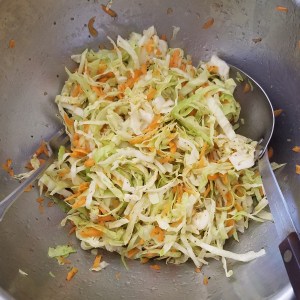
Mixing bowl with summer coleslaw made of local produce and my fermented apple cider vinegar.

Six weeks into summer 2019 we are over a hump, if not the halfway point.

I visited Paris in August 1974. It was hard to find a business open. Eschewing air conditioning we Americans find ubiquitous, Parisians fled the heat of August for the Mediterranean Coast and other breezy spots.

We could learn from that society.

My spouse visited her sister for the month of July. While she was gone I set the thermostat at 84 degrees compared to doing what we wanted in July 2018. The average monthly ambient temperature increased from 75 to 76 degrees Fahrenheit. Between running the air conditioner less and only one person active in the house, our electricity usage dropped by 37 percent in terms of kWh used. I appreciate the savings but I’d like her to return home more.

Summer in Big Grove Township has been reasonably nice with plenty of warm, sunny days, not enough rain, and an abundance from the garden. Friday the ditch had dried out enough I could mow the tall grass and get it looking more normal. The rabbit that lived there this year is likely frowning as rabbits do.

The yard grasses are in transition and need mowing, but not that much. I thought to do it yesterday and rolled up the garden hose near the house after watering in the morning. Not yet. Maybe today after my shift at the orchard. Maybe not as it is a low priority.

We planted our first garden in 1982 and grew or harvested something from our yard in the five places we lived since then. I’m getting better at it.

Cucumbers

We produced more cucumbers this year than we could eat and preserve. I determined a process using four varieties of seeds: two pickling, a Japanese-style cucumber and the utilitarian Marketmore. I made a gallon of fermented dill pickles as dill came in from my barter arrangement with Farmer Kate. The key to good pickles is the cucumber size. Once cucumbers get an inch in diameter they are too large for pickle making. Just don’t do it.

I made dishes of sliced cucumbers for potluck dinners, gave them away, and ate them as much as I could stand sliced raw, in mixed salads, and with lettuce greens when they were in season. There were plenty for sweet pickles but I overdid it last year and have more than a dozen leftover jars. I struck balance between the desire to use every bit of produce in the garden and how we eat them in season.

Tomatoes

As I posted a couple days ago, we are waiting for tomatoes. The cherries are coming in Jasper, Taxi, Matt’s Wild, Grape, White Cherry and Clementine. The White Cherry, Jasper and Matt’s Wild are surprisingly sweet and delicious. The single Early Girl and Black Krim plants produced fruit. I’ve had a couple Speckled Roma which I found to have tough skin.

This year as last, I planted the rows too close together. I crawled under the seven-foot indeterminate vines and inspected. A lot of good sized fruit waits to ripen under the foliage.

The plants have less blight this year than last. I don’t know why but two things are different. We had extremely cold weather last winter. Perhaps the cold killed some of it off. I also applied diatomaceous earth to the ground after tilling to keep down the crawling bugs that love tomatoes. Perhaps it had an effect on the blight. So far, so good and if all continues to go well, we will have plenty of tomatoes for fresh eating, canning and gifts to friends.

Green Beans

By now we’ve usually had green beans but there are hardly any on the plants. The foliage looks great. There are flowers. No beans. Other area gardeners are experiencing the same thing with a reduction in yield. I picked exactly two beans from a 15-foot row.

Apples

After nearly perfect pollination and fruit setting the invasion of Japanese beetles has the apple trees looking like dirty brown lace. I wait for the fruit’s background color to get right and have been tasting them every other day. The first of two varieties is getting close. Fingers crossed.

A friend sprayed his apple tree with Sevin to kill a Japanese Beetle infestation. The pesticide works although it contains carbaryl, a known carcinogen banned in some European countries. “Aren’t you worried about eating the fruit?” I asked. “Nah!” he said. I continue to refrain from using insecticides, which offer a temporary abatement to the detriment of the environment and apple eaters.

It’s a race to ripeness with popilla japonica. If bugs eat too many tree leaves, inadequate sugar is produced for fruit to ripen. If fruit gets ripe on the tree and they can penetrate the skin, they will mass on it and eat it. There appears to be enough green leaf left to absorb sunlight adequately to ripen the apples. I plan to pick them the minute I find them ripe and ferment the juice to make apple cider vinegar. The second variety, Red Delicious, is for eating out of hand, and everything else apple-related.

The Joni Mitchell song comes to mind, “Give me spots on my apples but leave me the birds and the bees.” In our garden there are plenty of apples and an abundance of birds and bees with whom I enjoy co-existing.

Categories
Kitchen Garden

Waiting for Tomatoes

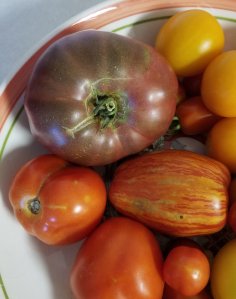
Bowl of Tomatoes July 30, 2019.

With late planting and heavy spring rain the garden has been a mixed bag. A highlight of every year is arrival of tomato season and planning the use of what I expect will be a good crop.

The first tomatoes have ripened, and now we wait for the slicers and plums.

We eat them fresh, give some away, and prepare canned sauce, juice and diced with the rest.

As my worklife slows down, it seems there is more work to do in the yard and garden. Growing tomatoes doesn’t seem like work.

My last summer post for Blog for Iowa runs Friday and I am ready for what’s next, including a return to my usual topics in this space. I cross post here what I write elsewhere so a trickle of BFIA articles will continue until they all have been posted.

I begin work at the orchard this weekend for the seventh consecutive season. Hopefully we’ll have ripe apples and great conversations with our guests. It is blueberry season in Michigan and this weekend we will offer them fresh for the last time this year. We’re hoping Pristine, Jersey Mac and Viking get ripe by the weekend so our guests can pick them.

In July I signed up for a nutrition class paid for mostly by Medicare. The goal is to watch my blood sugar levels and develop better eating and exercise habits. A by-product of the classes has been losing ten percent of my body weight. I feel better and hope to stave off diseases of aging such as heart disease, stroke, diabetes, eyesight deterioration, influenza, pneumonia and the like. Fingers crossed. I still have a lot I want to do and good health is an important prerequisite.

As the sun ascends on another brilliant Iowa day the garden needs watering, and I want to get a trail walk in before leaving for the home, farm and auto supply store. There is a long to-do list needing attention as well. Thanks for reading.

Categories
Writing

What’s Wrong With Our Food System?

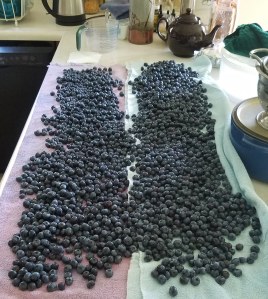
Drying 10 Pounds of Michigan Blueberries for Freezing

There is a strong argument nothing is wrong with our food system.

There is a strong argument everything is wrong with our food system.

To talk about a “food system” at all presumes a lot that may or may not be true.

It’s no secret large corporations increasingly control food production, distribution and marketing. Scalability is a key issue with providing nourishment for billions of people. The hand of large land owners, chemical companies, seed genetics companies, processors, banks, equipment manufacturers and consumer outlets runs throughout each household’s food ecology. Households have a food ecology even if they don’t speak of it using such fancy words. What appears at a meal is influenced at every point in the distribution chain by large corporations.

It’s also no secret farmers, especially small-scale farmers don’t earn a lot of money for their long hours each season. Neither do equipment manufacturing workers, seasonal farm help, truck drivers, grocery store workers, or restaurant workers. Whether one is a contractor for a large international meat-producing corporation or produces heirloom hogs for a meat locker, at the end of the day a diverse and ever changing personal economic structure is needed to ensure viability this year and in the near-term future. People struggle to make a living by farming alone.

At the same time, grocery stores are packed with food and if there remain some food deserts without one, enough food is produced in the United States to feed everyone. I met an executive from a large container manufacturing company when I worked in the Chicago Loop. He said the issue wasn’t having enough food, it was preserving and distributing what we already produce. That remains true, his statement representing another large corporation wanting a piece of the food supply action.

The deck is stacked against young farmers who want to produce food outside the mainstream. I’m thinking of friends that operate Community Supported Agriculture projects or grow specialty crops. Producing meat and vegetables for the local market has been a staple in society at least since medieval times. When there are a lack of well-paying jobs, or capital, if people have access to a piece of land for a season, attractive fruit and vegetables can be produced and sold at a margin that looks better because labor cost is removed from the calculus.

It goes without saying a farmer will work 60 or more hours a week, sometimes turning $100,000 per year in revenue derived from diverse sources (produce, livestock, grazing and retail sales) and living on a fraction of that. Land ownership? Only a small percentage of young farmers can afford to own land.

Consumers can afford a hodge-podgey food system with diverse sourcing, abundant supply, wide variety, and absence of much concern for how food arrived at our table. If corporations own equity in land, equipment and patented seed genetics, it’s hard to see that on our 9-inch dinner plate.

What matters more in this discussion is not whether a food system is good or bad, but whether that is even a thing. If each household develops its own food ecology, including best practices regarding water use, soil conservation, seed genetics and other resource use, that’s not good enough. If a food system exists, what it requires is scalability and that’s where corporations can and likely should play a role. Not evil corporations designed for extraction of resources and cash, but people joined together with common purpose regarding nourishing a growing population.

Asserting there is or isn’t a problem with our food system is itself a problem. It is much more fluid and undefined than that. Like vegetable farmers we need to accept each season for what it teaches us, hoping we can sustain ourselves for another season.

Additional Reading

Last Call for a Food Systems Revolution by Pallab Helder.

To Revive Rural America, We Must Fix Our Broken Food System by Austin Frerick.

World Hunger is on the Rise by Timothy A. Wise.

Twitter thread by Dr. Sarah Taber.

~ Written for Blog for Iowa