Extreme One-Day Precipitation Events in the Contiguous 48 States. Bars = years; line = 9-year trend. Image Credit: U.S. EPA
The headline from this morning’s Des Moines Register was that residents of 5,000 Cedar Rapids homes were asked to evacuate in advance of the flood crest predicted to arrive Tuesday morning. The height of the crest has been revised downward to 23 feet, however, damage is expected to be severe.
Cedar Rapids fire officials plan to ask for the names of next of kin of residents who refuse to leave the flood zone.
City officials say government has been preparing for a major flood since the record-breaking 2008 event.
There is bravura in the execution of the local preparations indicating the city knows how to mobilize to prevent anticipated damage — better than it did in 2008. It is always good to see people coming together in times of natural disaster to help each other.
At the same time, almost everyone in government, in news media and in other accounts of the disaster fail to consider the root causes of the heavy precipitation events driving record flooding. The world continues to annually dump more than 38 billion tons of carbon dioxide into the atmosphere like it was an open sewer. That’s 2.4 million pounds per second.
News media and politicians may be enamored of the story of human resistance to the forces of nature, but failure to address the root cause of increased levels of carbon dioxide and other greenhouse gases in the atmosphere through proper governance should be unacceptable.
Government plays a significant role in mitigating the effects of climate change. Perhaps it’s time we changed the current crop of politicians who fill elected office seats from those who are cheer leaders for reaction to natural disasters to those who will take action to prevent them.
Without action, the chart above from the U.S. Environmental Protection Agency will continue to map a direction that puts people and assets in jeopardy.
We should know better and do something about global warming and climate change as a society.
Godspeed Cedar Rapids. May your elected officials who don’t already do so perceive tomorrow’s flooding as a wake-up call to action.
There was a lot to make one cranky as summer ended yesterday, including the weather.
Extremely heavy rains are flooding parts of Iowa and the impact will soon be felt downstream.
The Cedar River is expected to crest at 24.1 feet next week in Cedar Rapids, Iowa, the highest level after the record 31.12 foot crest on June 13, 2008.
“We have four days to get ready, and now is the time to start,” Mayor Ron Corbett said Thursday.
We’ve had a lot more time than that to get ready.
During Al Gore’s Climate Reality Leadership Corps Training, conducted in Cedar Rapids in May 2015, Mayor Corbett made a presentation about the 2008 Cedar River flooding, how it impacted Cedar Rapids, and what actions were taken and being considered to mitigate damage from potential future floods. The next week will determine whether the plans and discussions were enough to prevent serious damage.
Senator Joni Ernst has been pushing the U.S. Army Corps of Engineers to expedite completion of the Cedar Rapids Flood Control Project, recently in the Water Resources Development Act.
“This legislation includes my work to direct the Army Corps of Engineers to expedite the completion of the Cedar Rapids flood control project,” Ernst wrote in a Sept. 15 press release. “The provision emphasizes to the Army Corps of Engineers that Congress wants this project to remain a priority. I will continue working to ensure the Army Corps of Engineers understands the great need for this long-standing project to be completed in a timely and efficient manner.”
These efforts seem well intentioned, but too little, too late.
The connection between this flood and global warming is clear. When the atmosphere is warmer, its capacity to store water vapor increases. When it does rain, it can do so in heavy precipitation events in which a large amount of rain falls in a brief amount of time. The frequency and intensity of heavy precipitation events has increased since World War II and that appears to be what happened in northeastern Iowa over the last few days.
Here’s an excerpt from a WHO-TV news article about flash flooding in Butler County. It tells the story:
BUTLER COUNTY, Iowa — Storms in northern and northeastern Iowa overnight caused some damage as they spawned tornadoes and dropped heavy rain – up to 10 inches – in some areas.
“We expect the crest this evening what we’re being told around 7 p.m. probably water levels similar to 2008 or more so,” said Jason Johnson, Butler County Sheriff.
Flooding from the Shell Rock River has cancelled classes in the North Butler School District for Thursday and many students gathered at the high school to help fill sandbags. Highway 14 on the way to Charles City is impassable because of water over the road.
Butler County Sheriff Johnson says there isn’t a widespread evacuation in Greene but some residents are moving to higher ground.
In Floyd County, 7.55” of rain was reported and Charles City saw 6.35”. The Little Cedar River is at moderate flood stage at Nashua and near Ionia. The rainfall total reported for Ionia is 6.24″.
Work will remedy the crankiness of summer’s end. One didn’t expect it to be sand bagging levies, homes and businesses to prevent damage from what is projected to be the second worst flood in Cedar Rapids history. It will get us through the weekend.
The newest flood begs the question of what’s next to mitigate the damage from future flooding? Government involvement in a solution is necessary but it must be implemented faster than it has been. We also have to connect the dots between our personal actions, global warming and climate change more than we have.
For now, we’ll just have to deal with the existential reality of the flood, something I recall doing since the 1960s. It’s a way of sustaining our lives in a turbulent world, but we can do better.
For the first time in a long time I missed work on Wednesday.
After a futile attempt to shave, shower and drive into the home, farm and auto supply store, I called off and slept until 2 p.m. — a total of 19 hours in bed.
I’m back to normal and scheduled four days vacation at the end of the month. If approved, I will use the time to catch up around the house and rest.
I don’t want to admit it, but 100 days of work may have been too much to attempt.
In an effort to understand low wage work life and the exigencies of lives where there is not enough income, I dealt with it as many do by adding more jobs. A predictable conclusion has been it doesn’t resolve the issue.
A key driver in the financial shortfall is buying health insurance, an expense that takes 34 percent of my wages from a full-time job. As the two of us approach Medicare age we’ll see some relief. We’ll also be approaching full retirement and presumably slowing our outside work. I look to my maternal grandmother’s example: she did alterations into her eighties. I expect to be doing something to earn money as long as I’m physically able. My current work on area farms is setting the stage for that.
Trying not to complain, these are observations about a life. In the spirit of Cotton Mather I’ve self-inoculated to see what happens. While believing in unlimited potential of a human, the brief illness is evidence of a physical limit. Knowing one’s limits will make us stronger and hopefully more effective.
We are well into the apple harvest at the u-pick orchard where I spend my weekends. It is an abundant crop and I enjoy interacting with hundreds of apple pickers each day. It is something like a fair, about which Garrison Keillor wrote in the Washington Post this week.
“The Fair is an escape from digitology and other obsessions, phobias and intolerances,” Keillor wrote, “also a vacation from the presidential election which has obsessed many people I know, including myself.”
The lone evidence of politics I spotted at the orchard last weekend was a single too-young-to-vote teen wearing a Trump T-shirt. Discussion of politics was completely absent within my hearing. I don’t know the demographics of apple pickers except from my own observations over the last four seasons. What I’d say is apple culture is an equalizer, something almost everyone with transportation can take part in and one in which I am happy to participate.
For me, it’s about forgetting a life that’s challenging and sometimes too hard for a shift at a time. It’s also about hope that society will find common ground.
Hiroshima, Japan after U.S. Nuclear Attack. Photo Credit: The Telegraph
The Washington, D.C. rumor mill is saying President Barack Obama may “do something” about nuclear weapons before the end of his term.
Among ideas being discussed are early retirement of some of the non-deployed weapons in the arsenal; declaration of a no first use policy; or taking weapons off hair-trigger alert.
The arms control community is pushing for no first use policy, but whatever — any Obama action to reduce the threat of a nuclear weapons exchange near the end of his presidency would be welcome, and largely symbolic.
Saturday, Aug. 6, marks seventy-one years since the United States dropped the first of two nuclear weapons on Japan.
When the Enola Gay dropped “Little Boy” over an unsuspecting Hiroshima, it killed between 60,000 and 80,000 people immediately with a total death toll estimated at 135,000. The bombing of Nagasaki occurred three days later. Men, women and children were killed indiscriminately.
President Harry Truman made the decision to use the bomb. In the end, he had no questions or regrets. Truman believed in the larger picture of World War II, a conflict in which tens of millions of people lost their lives, dropping the bomb would save lives. More than seven decades later we continue to debate whether bombing Hiroshima was necessary or played any significant role in ending the war.
After signing the New START Treaty with Russia, which entered into force in February 2011, the U.S. Congress embarked on a nuclear weapons modernization process expected to spend as much as $1 trillion over the next 30 years. That’s a lot of money for a weapons system we hope never to use.
What’s an Iowan to do? My friend and colleague Peter Wilk speaks for many of us.
Calling for “No First Use” of Nuclear Weapons
Submitted to the Brunswick (Maine) Times Record
This August 6th and 9th we are once again reminded of the atomic bombings of Hiroshima and Nagasaki, which killed an estimated 200,000 women, men and children. This past May, President Obama was the first President to visit the site and to commemorate the bombing victims.
While in Hiroshima, President Obama declared, “Among those nations like my own that hold nuclear stockpiles, we must have the courage to escape the logic of fear and pursue a world without them.” Thousands of members and supporters of Physicians for Social Responsibility completely agree.
Although most of us would rather not think about it, the U.S. and Russia continue to have thousands of nuclear warheads deployed on hundreds of missiles, bombers and submarines. We and the Russians keep over 1,000 of them on so-called “launch on warning” status. These warheads can be launched within minutes and reach their targets around the world within thirty minutes, putting millions of innocent civilians at risk in each of our countries.
The recent military uprising in Turkey reminds us just how unstable our current situation is, with 50 of our nuclear weapons stored in a U.S. airbase there. This airbase was surrounded and cut-off during the most unstable period of that coup attempt.
Perhaps most frightening is that the U.S. maintains a policy of threatening to be the first to use nuclear weapons in a future conflict. Combining this policy with our “launch on warning” stance sets the stage for a potential nuclear war initiated out of fear, anger, miscalculation or accident.
These horrific weapons threaten our own national security rather than enhance it. They are unusable in any meaningful sense of the word, given the global disruption to the world’s climate, food supply and economy that would result. At the same time, they have no value in countering terrorists or cyber-attacks.
Fortunately there are also some positive developments upon which to build. 127 countries have taken the Humanitarian Pledge calling for elimination of nuclear weapons. As a result, the United Nations established an Open-Ended Working Group that has begun meeting to discuss the most promising next steps toward a treaty to ban nuclear weapons around the world.
Meanwhile, the potential humanitarian impact of any use of nuclear weapons is so overwhelming that we in the U.S. must pull ourselves back from the brink by taking an easy step of our own. Since these weapons are in reality unusable, the U.S. should minimize their role in our military planning. President Obama can and should declare that the U.S. is adopting a “no first use” policy – pledging to never again be the first nation to launch nuclear weapons against another.
The U.S led the world into the nuclear age. Now it’s time to lead the world beyond it – to move to safer national security strategies that do not put all that we care about at risk, under the false premise that threatening to use nuclear weapons against others can protect us.
President Obama – your legacy and our lives are at stake. Please complete your presidency by taking a meaningful step to reduce nuclear risks by initiating a “no first use” policy.
On this 71st anniversary of the destruction of Hiroshima, let us all pledge “never again” and commit ourselves to do what we can to help make progress toward a world free of nuclear weapons.
Peter Wilk, MD
Physicians for Social Responsibility — Maine
It’s time to prevent what we cannot cure, and abolish nuclear weapons.
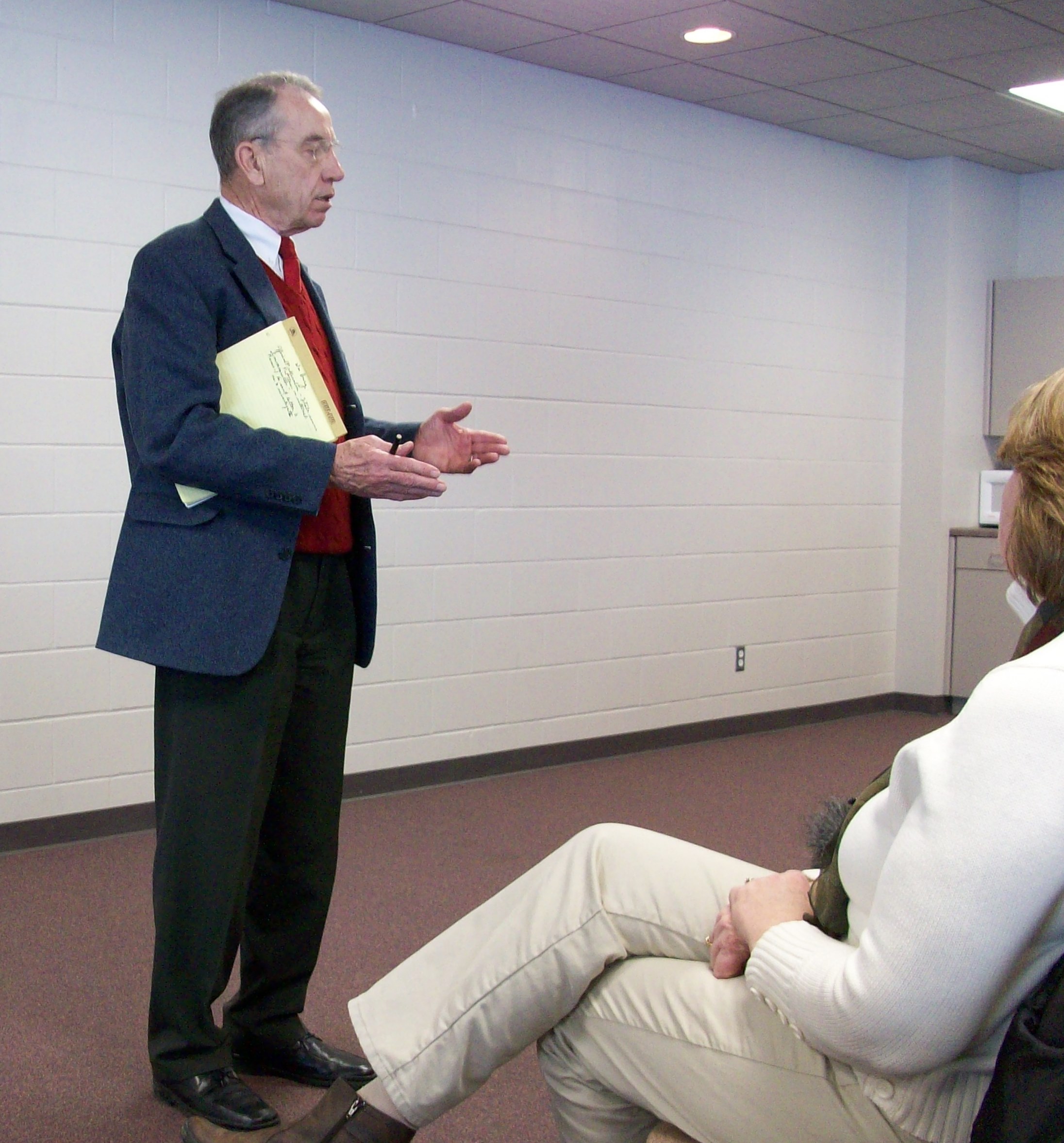
The conventions dispersed and the road home was ahead as Blog for Iowa writers engaged with Senator Chuck Grassley last Friday.
Both Trish Nelson, in a chance meeting in Mount Pleasant, and Dave Bradley, at a town hall event in Columbus Junction, each encountered Grassley in eastern Iowa.
Both stories are worth hearing and indicate where our senior senator is regarding his life in the Republican party.
“News is sketchy while on RAGBRAI,” Nelson wrote in an email.
She was driving support for a team of veteran RAGBRAI riders and responding to Dave Bradley’s report from the Columbus Junction event.
“Speaking of RAGBRAI and Chuck, guess who I ran into checking out of our Super 8 this morning in Mt. Pleasant?” she wrote. “I even had a few minutes of face time with him.”
“I was like a deer in headlights at first but I managed to stay polite and we had a light, friendly conversation,” she continued. “I asked him what he thought about Hillary’s speech — he said he thought it was good and he fell asleep during it. He said she would just be more Obama.”
“I asked him his thoughts on Donald Trump and he said, ‘he needs to act more presidential,’ as if he was lamenting that he wouldn’t get elected because of that one small thing. I told him Trump can’t act presidential because he is so impulsive and that people are genuinely frightened that he could actually become president.”
Grassley asserted something positive about Trump, which Nelson countered.
“Chuck kind of backtracked and said, Trump ‘only’ has a 25% chance of actually being elected. He said the Republicans have too much ground to make up in the electoral college for him to win. It was weird, as as if he was trying to reassure me by acknowledging that Trump is probably going to lose anyway.”
I can’t believe I didn’t ask him about his obstruction of Obama’s SCOTUS appointment and the judiciary, and for awhile I was kicking myself, but at least I got to address concerns about Trump.”
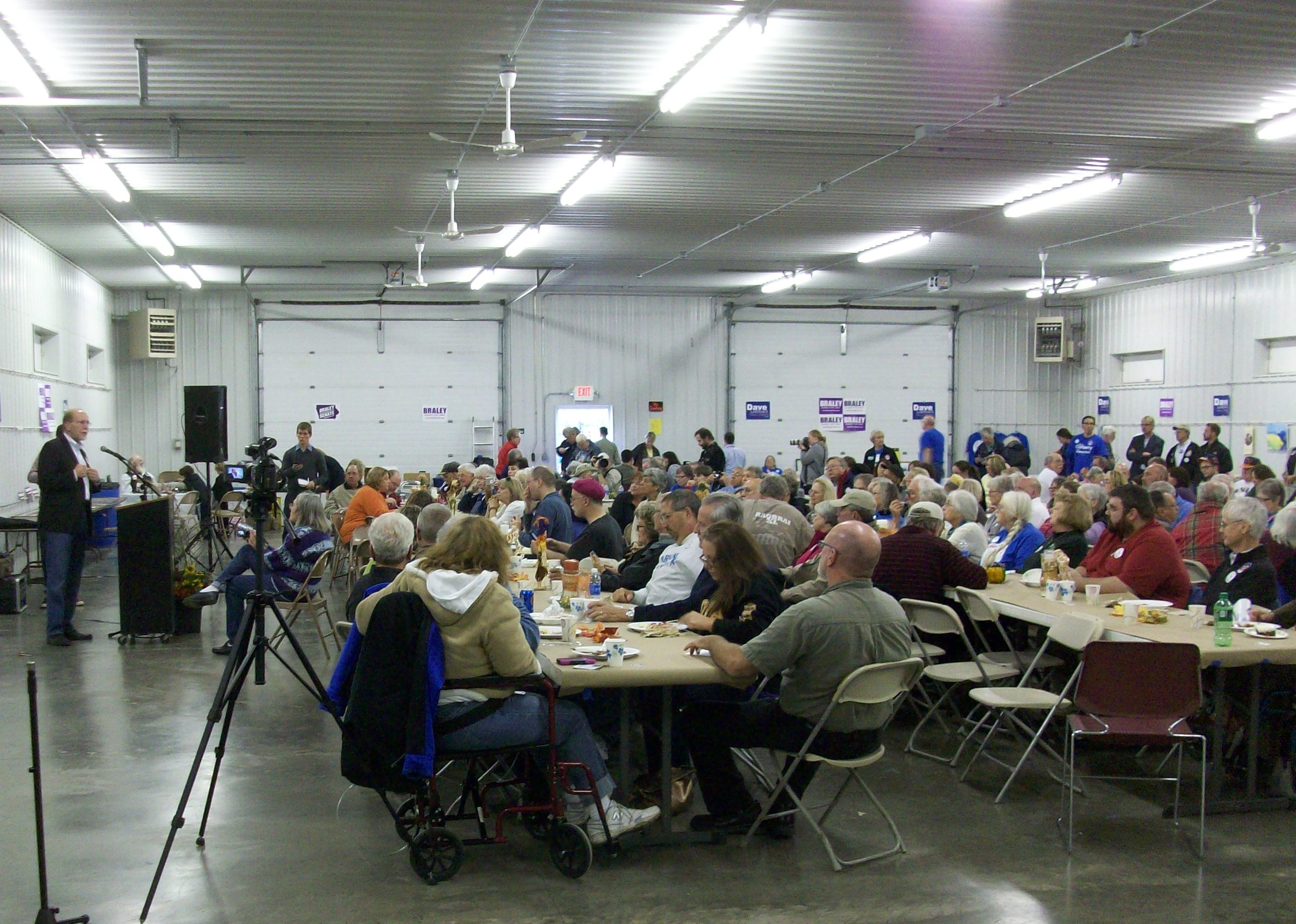
Later in the day at a Columbus Junction town hall, Don Paulson of the Muscatine County Democrats asked Grassley the question about Merrick Garland.
“Grassley said 30 years ago some senators set a policy of no appointments in a president’s last year,” Dave Bradley reported. “What horseshit.”
Bradley assumed this was a variation on Grassley’s Biden talking point and nothing new.
During her campaign for state representative, Sara Sedlacek lost Louisa County, where Columbus Junction is located, by a significant margin.
“It was probably a 90% Republican crowd,” Bradley wrote. “All white except one. State Representative Tom Sands was there to give Grassley a big smack on the cheeks. Another guy praised Grassley for ‘standing up to Obama — you’re the only one that does.'”
This describes every Republican event I have attended — a venue for Republicans to vent. Dave ticked off these notes:
Several said leave the VA (or at least Iowa City) alone.
One woman had a prepared speech about puppy mills.
Another guy praised Republicans for defunding Obamacare and said they should pass the same bill every day.
Couple of other all praise to Grassley statements.
One college student did have some challenging questions on gun sales but of course Grassley had very well prepped responses rolled out in his folksy manner.
An anti-Grassley guy from Iowa City asked him about term limits — Grassley said he favored them, but you can also always vote me out.
Couple of questions on Social Security — Grassley claimed it has 17 more years (2033) but no one is willing to talk about it with everything on the table.
One guy claimed Obamacare took $900 million from Medicare — Grassley agreed and said it just disappeared from Medicare.
Damn it was painful not to just stand up and call him a f*cking liar.
“Unlike Muscatine much earlier this year (Grassley) is much better prepared and has his talking points down really well,” Bradley said. “Trying to get him to stumble will take an exceptional effort if someone is trying to. He even took pains to refute his not visiting all 99 counties — with a big sign on a stand proclaiming that he visits all 99 counties every year.”
Grassley doesn’t always hold public meetings on his 99-county tour according to a July 20 Des Moines Register editorial.
“Since 2011, he has held only three public, town hall meetings in Iowa’s 10 most populated counties, and there were no meetings of that type in eight of those 10 counties,” they said.
If you want to discuss an issue with Senator Chuck Grassley maybe you’ll randomly bump into him, or maybe you can speak for a couple of minutes at his public meetings. What is problematic about this type of accessibility is the unbridled forum — for Republicans particularly — to say just about anything.
In my experience at similar events, Grassley moderated the wackiest of the wacky. By enabling people to express themselves as he does Chuck Grassley encourages extremism and political spin. He helped create the party of Donald Trump even if he doesn’t think much of the mogul’s chances in November.
It is important to contact our elected officials, especially our federal representatives. However, when Senator Chuck Grassley talks about “representative government,” take it with a grain of salt. What you see isn’t always what you get.
BIG GROVE TOWNSHIP, Iowa — A couple of years ago the Solon American Legion moved their annual Memorial Day commemoration from Oakland Cemetery to the new service memorial at American Legion Field.
As remaining World War II veterans depart on their long journey after this life, the new field is level, lessening the possibility of a fall for increasingly fragile nonagenarians.
The annual event seems better attended since moving to town.
The township trustees consider the condition of the cemetery before Memorial Day and the legion adorns its roadway with full-sized American flags with the names of local veterans on each flag post. We want the cemetery to present well regardless of where the event is held. After inspections, we decided it looked good for the holiday, although the trash barrels needed emptying.
Memorial Day began as Decoration Day in 1868 — a remembrance established by the Grand Army of the Republic to recognize union soldier deaths while defending against the rebellion. Confederate women had begun decorating graves during the earliest years of the long war that took 620,000 lives. It was traditional to visit the family cemetery and enjoy a picnic lunch and family reunion near remains of the departed. It took an act of Congress (the National Holiday Act of 1971) to sort out differences and competing claims of the remembrance. In many places traditions have vanished as family cemeteries gave way to cremation and burial in larger, public and commercial places of rest.
Just as grilling at home or at a park supplanted picnics near the deceased, and Memorial Day gets confused with Veterans Day, not many here think about what divided the North and South in the 1860s. Neither is there common cause in the deaths perpetrated by our modern national militarism. Our constant state of warfare has become a part of background noise many people try to ignore.
My ancestors and shirt tail relatives in Virginia fought on both sides of the Civil War and those roots provided me a form of ethnic identity — an indigenous culture shared by a localized clan of kinfolk. I’m not sure such culture is even possible today.
As for this Memorial Day, I’ll be working a shift at the home, farm and auto supply store and unable to attend the commemoration.
Memorial Day will start the summer vacation season, like it does for most Americans, and be a chance to relax after getting the garden planted. The bloody wars our country has fought and continues fighting will seem distant for a while… almost an abstraction. I’m not alone in that. Even drone pilots can go home after a shift to spend time with their families.
Memorial Day is part of a procession of life events that helps things seem stable and predictable. We want that as politicians and corporate news media slam us with bad news and frightening potentialities every time we tune in on a device. The idea that the dead don’t move unless someone made a mistake, and that grave decorations aren’t intended to be permanent provides comfort.
On the way to my shift I’ll stop briefly at the cemetery and pay my respects to neighbors killed in action, most of whom I didn’t know. Such deaths seem tragic and complex — clouded in a present that assigns new values to them. I’ll stand in silence on the hill among old oak trees considering the meaning of honor and valor and why it’s still important. I hope that’s decoration enough.
The premeditated killing of an Iowa Children’s Museum employee by a mall security guard in Coralville on Friday will have ripples in the community beyond the current news cycle. It was murder, the very definition of the word.
“In cases like this, where the shooter confesses to premeditated murder, there is a case to be made for capital punishment,” I said.
“Oh?”
“I understand you came up as a Quaker, but still,” I replied.
“I can think for myself.”
So too can we all.
Of the people I spoke to about the shooting, only one had been at the mall when shots were fired and was visibly shaken. When there is a murder in an innocuous place—to which most locals have been at one time or another—something changes. Murder becomes personal.
The movie theater gave rain checks to ticket buyers as the mall closed after the shooting—a sign of hope life could return to normal.
There will be a memorial for the victim later this morning at the mall, said the county attorney at a Saturday press conference.
On Tuesday more than 400 people joined a webinar titled, “Change Starts with You: Becoming a Climate Reality Leader,” hosted by the Climate Reality Project in advance of the May 5-7 training in Cedar Rapids.
The Climate Reality Leadership Corps already has more than 7,000 members from 125 countries since its beginning in 2006. It seeks to add another 3,000 in this year’s North American trainings in Cedar Rapids, Iowa, Miami, Florida, and Toronto, Ontario.
Attendees are expected to travel to Iowa from around the globe to be a part of the Climate Reality Project.
“Solving the climate crisis is within our grasp,” said Al Gore, founder and chairman, The Climate Reality Project. “We need people like you to stand up and act.”
Blog for Iowa received the following letter about the Iowa training:
I’m following up today from The Climate Reality Project. We are an organization started by former vice president Al Gore and focused on creating a global movement to influence action on the climate crisis. We have an upcoming training opportunity that I believe you and members of your organization will be interested in.
On May 5-7 in Cedar Rapids, Iowa, we and Mr. Gore will be hosting a training for new Climate Reality Leaders to help grow the movement. As you well know, United States leadership is critical as we travel the Road to Paris in preparation for December’s COP21. There has never been a better time to engage people in the U.S. and around the world on solutions to one of the world’s most important issues.
The training in Iowa will highlight the U.S.’s important and unique role in the COP21 negotiations, climate impacts on agriculture in Iowa, and Iowa’s ability to be a leader in renewable energy sources such as wind.
Applicants are accepted on a rolling basis with the applications due no later than April 13.
Please contact me with any questions or more information. I hope you and your colleagues will want to join the network of over 7,000 Climate Reality Leaders from 125 countries taking action on the climate crisis.
Thank you for your time!
Best,
Joseph Moran | Program Assistant-Climate Reality Leadership Corps
Email: joseph.moran@climatereality.com
JOHNSON COUNTY— It is possible to fall into a trap of believing that the world and society are about us— our small circle of friends and family and how we live. That would be perilous.
Not only is it impossible to live outside the broader context of global society, believing so isolates us from serving any greater good, and ultimately from taking care of our personal needs. A day’s events can become “all about me,” and the most pressing issues of our time—man-made contributions to climate change, nuclear proliferation, economic justice, food security and public health— can wrongfully be set aside. Not only does this affect society, it filters down to each of us in one form or another.
This weekend, I participated in different ways in a number of gatherings of people in diverse settings. Based on my personal interactions with hundreds of people, the definition of “us” needs broadening before substantial social progress is possible.
Make no mistake, there is a culture of “me.” I see it in everything I do outside our home. At the convenience store people line up to serve their addictions, whether it be tobacco, alcohol, sugar, gasoline or salted snacks. At the warehouse three generation families disperse in the aisles like an infantry squad on patrol exploring a foreign land. At the orchard, large groups of young friends bring along their usage of “perfect” or “awesome” as they head out to pick apples. At the political barbeque, activists gather to hear speeches and espouse judgments of each. At the same time, in the vast emptiness that is Iowa’s agricultural land, soybeans and corn stand ready for harvest and nary a person can be found as they were at home or in town, distracted from the leaching of nitrogen from last night’s rain. The culture of me creates isolation but not loneliness, even as people gather informally together in these settings.
To express my opinion, other than to select what is in this article, would be one more futile voice in the wind, and who has time for futility?
What I saw and participated in this weekend was a reminder of how little humanity has changed since Hieronymous Bosch made the painting below in the late 15th century. In a way we each seek our own giant strawberry to hold and consume. Despite ease of communication, we live compartmentalized and focused on personal delights, eschewing a broader perspective except as it serves our needs.
What to do about this weekend’s observations is uncertain. Figuring it out is important to sustaining a life at risk in so many ways as the days pass, and as people disengage from society.
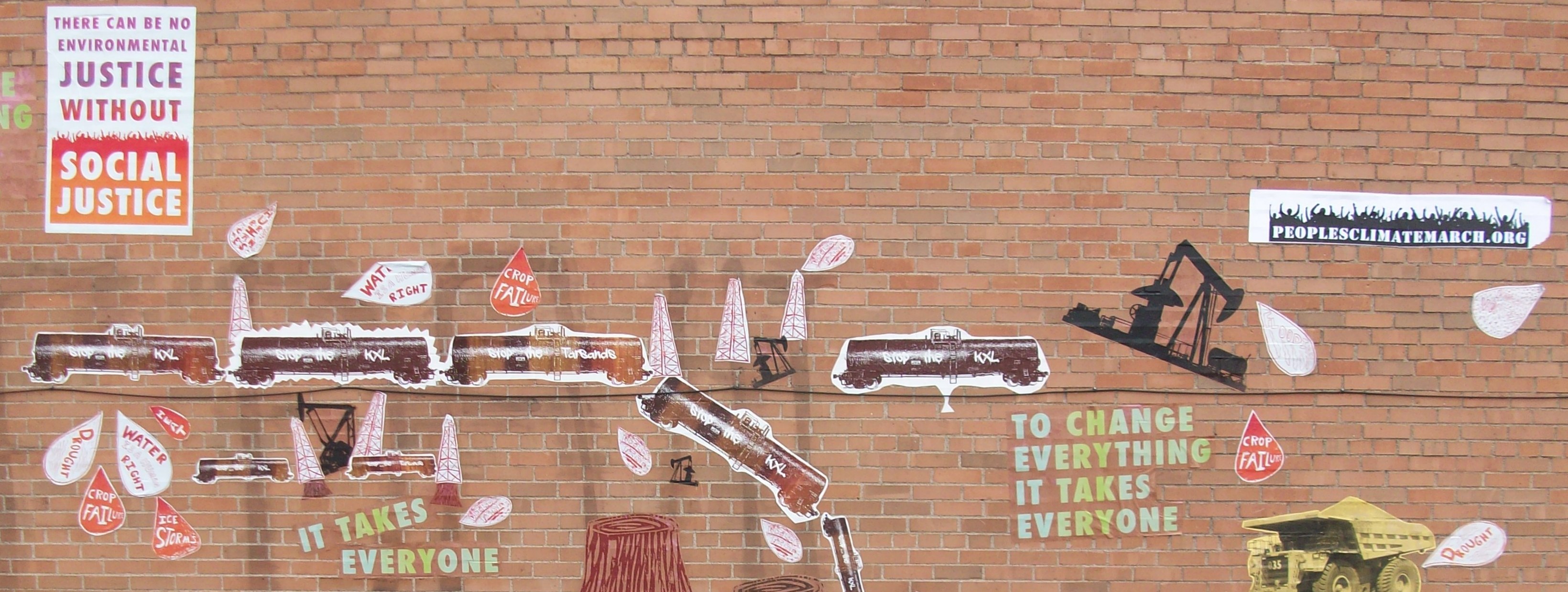
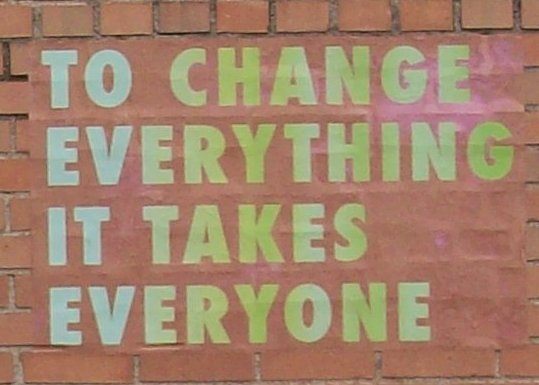
East Wall of George’s Buffet – People’s Climate March Advertisements
LAKE MACBRIDE— A steady rain fell and continued through the night, providing respite for the weary and sound sleep. Having thought I would retreat from society on a day mostly off work, it proved to be impossible, beginning with the trip into town to vote.
Two measures were on the ballot yesterday. Voters approved a $25.5 million bond issue to build a new middle school, a performing arts center to replace the one at the current middle school, and a special education classroom in a 698-294 vote. Voters also approved renewal of the Physical Plant and Equipment Levy of $1.34 per $1,000 in assessed value when the current levy expires on June 30, 2017.
The City of Solon was platted in 1840 and named for the Athenian statesman and poet. Ironically, the school district mascot is the Spartans, and the rivalry between Athenians and the Spartans has played out in the community ever since we moved here. Relevant to yesterday’s vote, debate has been about improvement of the auditorium facilities for use between the performing arts departments, and sports enthusiasts. Sports boosters defeated performing arts in the first battles and now we have a ginormous sporting complex in the city. Engaged residents of the district have decided it is time to invest in the performing arts. A ground breaking is expected in 2015.
In addition to passing through the city, I visited the county seat to pay property taxes. I also spent some time in the auditor’s office to see where my tax dollars go. My sense was that county government workers aren’t used to a lot of questions, but I received the answers I wanted.
Poster on the Unitarian Universalist Society Building
Advertisements for the People’s Climate March on Sept. 21 in New York City have appeared in a couple of locations in downtown Iowa City. I have been engaged to speak for five minutes about the humanitarian campaign against nuclear weapons at a supporting rally in the Iowa City pedestrian mall. That is, assuming I can get off early enough from work at the warehouse.
September and the start of school is always prime time for social movement initiatives, and a lot is at stake with regard to mitigating the causes of global warming. As the saying goes, “to change everything, it takes everyone,” and we are a very long way from engaging everyone in addressing the climate crisis.
The other piece of September news is that every freaking politician I know is doing some kind of event. Between the frequent text messages, email invitations, snail mail and telephone calls, it is impossible to miss the fact that an election is coming, and a lot is at stake. My ability to contribute in kind and financially is limited this cycle, but it is good to know politicians are working. That in itself is a form of news.









 Journey Home

You must be logged in to post a comment.