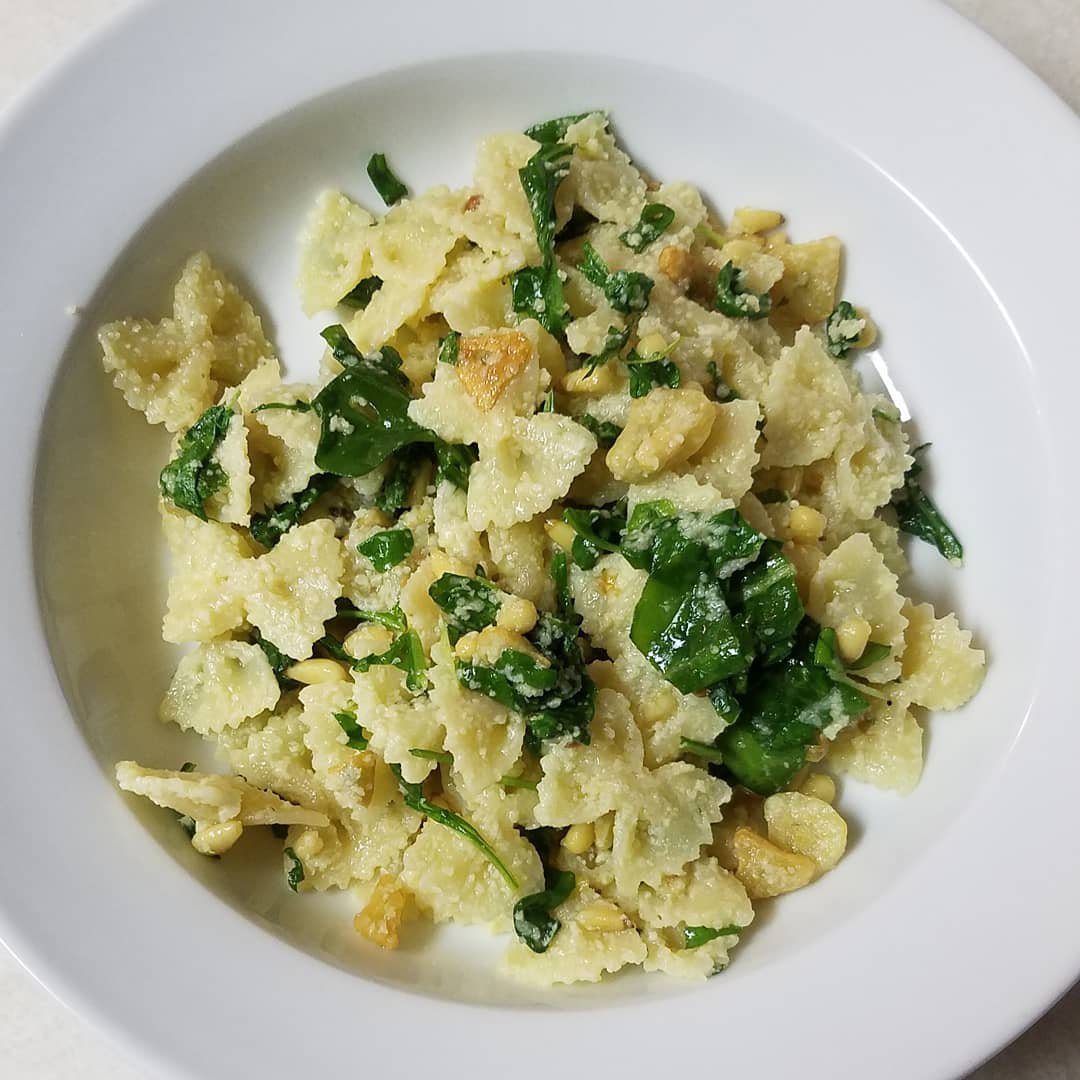
The arugula is top quality this year and I’m in a use it up mode. I spent more time preparing for this dish of bow tie pasta with garlic and arugula than usual. I researched recipes and thought a lot about it during the past two days. I used Parmesan cheese from a green can because of the coronavirus pandemic. It came out well but would be better with higher quality cheese. Here goes:
Ingredients:
Big bunch of arugula, half a pound, washed and roughly chopped
2 cups dried bow tie pasta
12-14 cloves of garlic
Quarter cup pine nuts
2 tablespoons extra virgin olive oil
2-3 tablespoons salted butter
1 cup grated hard cheese (Parmesan, Pecorino Romano)
Salt and pepper to taste
Process
Set a pan of water on the stove to boil for the pasta.
Peel and trim the garlic. Then slice finely (1/8 inch).
Once the water reaches a rolling boil, add the pasta and cook according to directions.
Once the pasta is down, bring the olive oil just to the smoke point. Add the garlic, stirring constantly. As the garlic begins to brown, add the pine nuts and cook for a couple of minutes.
Add the knob of butter and stir. Before the foam begins to subside, transfer everything to a mixing bowl. Drain the pasta and dump it in the bowl. Combine until they are incorporated.
Salt and pepper to taste.
Add the arugula and cheese and mix gently until the arugula wilts.
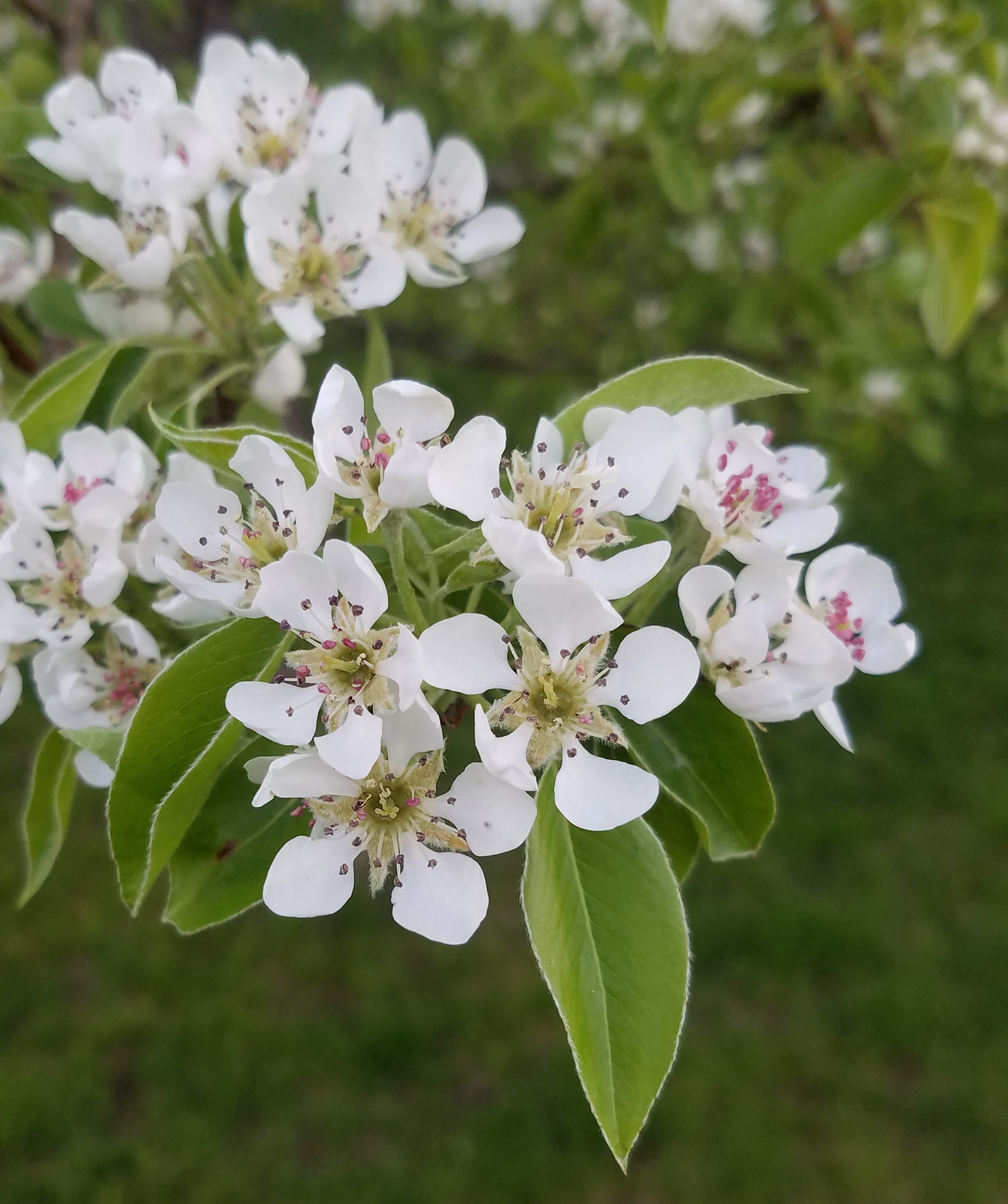
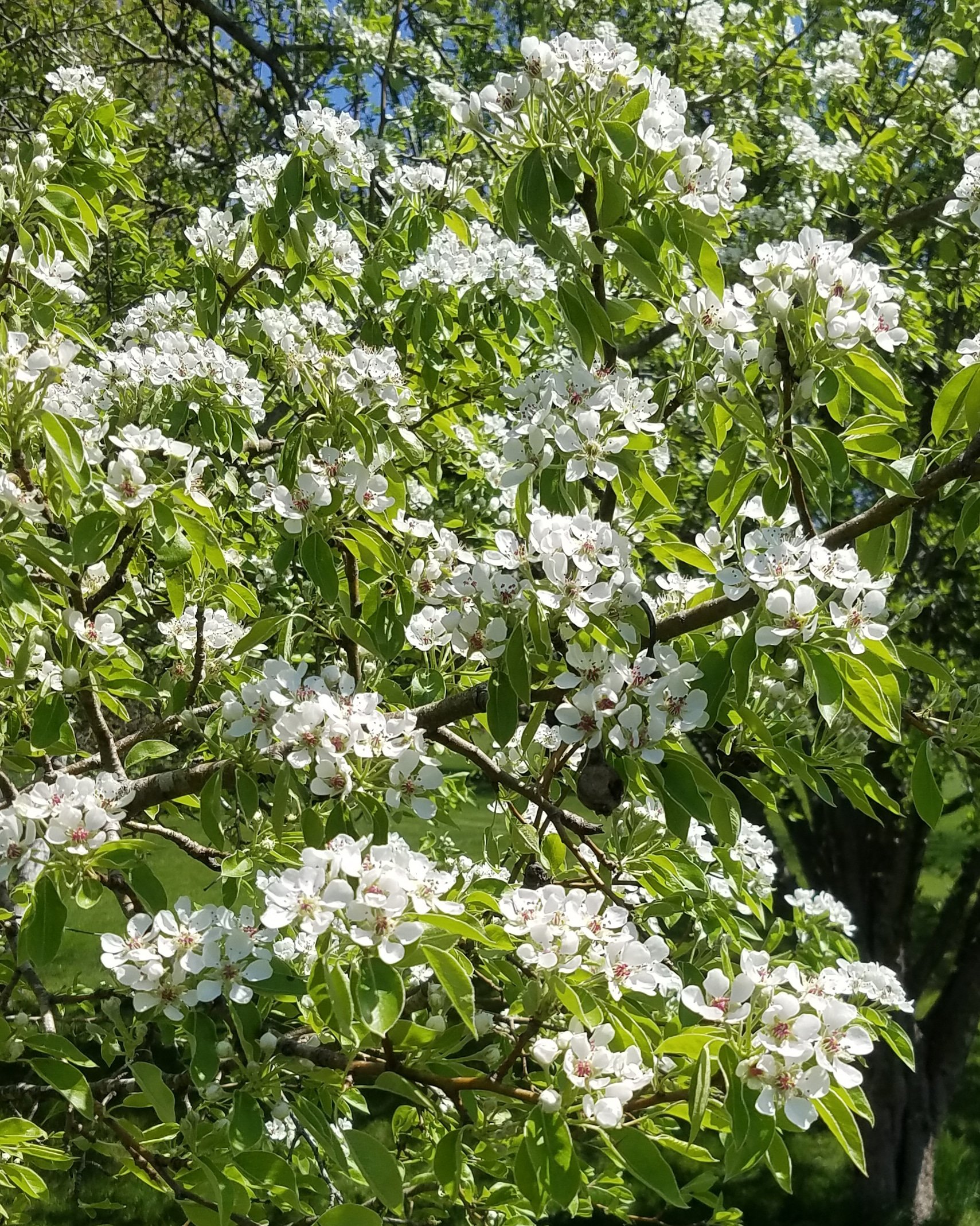
Pollinators came in abundance and did their work. Now it’s snowing flower petals.
The collapse of insect populations is a well-documented phenomenon. 40 percent of insect species are threatened with extinction, due mostly to habitat loss by conversion to intensive agriculture. Agricultural chemical pollutants, invasive species and climate change are additional causes, according to Biological Conservation.
In our yard insect populations find a home, begin doing their work, and cause trouble in the garden almost as soon as freezing temperatures abate. They are relentless. Humans should be so relentless.
Insect damaged Pak Choy.
Because of insects our yard has a bird population. They nest in the fruit trees and lilac bushes. They perch everywhere there is something upon which to stand. It’s easy to find them chasing insects through the air. It’s for the birds and insects I use no weed killers or lawn fertilizers and let the grass go to seed.
We are an island in a sea of agriculture. When wheat is harvested Japanese beetles head to property like ours where they feed on certain types of vegetation. Corn and soybean harvests result in visits of additional species of displaced insects. It is important to consider the world outside our property lines as insects know few boundaries and what farmers do a section of two over impacts us.
The first white butterfly flew around the cruciferous vegetables yesterday. They lay eggs on foliage which hatch and produce green worms that eat said foliage. It didn’t take long after planting for the butterfly to show up.
I observed a number of bee species during the pear tree pollination. Dandelions are an excellent source of early pollen for bees so I let them go. A large bumble bee lumbered through the air, laden with pollen, and flew through an opening in the chicken wire mesh around a garden plot.
The pear tree is being pollinated as I type this post. If pears form this year there will be another struggle with Japanese beetles over the fruit. Last year we lost the whole crop to the pests.
I went out to the garden before sunrise to see if I could catch the culprit eating my Pak Choy. In order to defend against bugs they need to be identified. I shone the light on my mobile phone but couldn’t find it today.
I turned to the arugula which reaching maturity. I returned to the garage, got a colander, a pair of scissors, and a knee pad, and pulled back the fencing to harvest a big bunch. I removed an insect, cleaned it and put it away in the ice box.
When I returned from a shift at the farm I made a lunch using this process:
Add two tablespoons of extra virgin olive oil to a large bowl. Add a teaspoon of lemon juice, tablespoon of home made apple cider vinegar and finely minced spring garlic. Salt and pepper to taste. Whisk until incorporated. Fill a serving bowl with arugula and dump it into the larger bowl. Toss gently until the leaves are coated. Return the salas to the serving bowl. Sprinkle feta cheese on top and serve.
Since retiring on Tuesday there has been one good day to work outside.
Tuesday and Wednesday were cool and dark with scattered showers. I read two books, reworked the family budget, and spent most of my time indoors.
Thursday was a glorious spring day when I measured and cleared the remaining three garden plots and planned the sequence of events and layouts. Today looks equally nice and an opportunity to start direct seeding and planting from the greenhouse.
This year may be the best yet start to the garden. I’m hopeful even though a lot of weeding and combating pests lies ahead.
There will be spring garlic from the volunteer patch and arugula planted March 2 is ready to harvest. I’m reviewing cook books for ideas, seeking a spring pasta dish as a chance to combine fresh arugula and last season’s garlic. Repetition is anathema to having a kitchen garden so a key ingredient will be spontaneity.
Mario Batali has a recipe using fresh mushrooms cooked in sweet vermouth with ten cloves of garlic. It sounds good. I have the garlic, but no vermouth and only canned mushrooms from the wholesale club. A recipe I remember from television is Jaime Oliver and Gennaro Contaldo making pasta using wild rocket they found growing in London. The spontaneity of their process is more what I’m after. Deborah Madison has a recipe called spaghetti with overgrown arugula and sheep’s milk ricotta. It’s closest to the ingredients on hand. Where our ice box is lacking and could improve is by having some pecorino or any kind of ricotta cheese. I make this once a year, so I’m in no hurry to get into the kitchen. Because of the coronavirus pandemic, I’ll use whatever ingredients are on hand.
Another spring-use-it-up recipe is a quick version of eggplant Parmesan. When the eggplant harvest comes in, I cut large ones into half-inch disks, roast and freeze them. Every so often I get fresh mozzarella pre-cut in disks from the wholesale club. Canned tomatoes are always in abundance and these three things together make a dish.
Make a simple tomato sauce using canned tomatoes (reserving the juice for soup), basil, dried onions and dried garlic. Whatever you like is fine, even a prepared pasta sauce. Place a few tablespoons of tomato sauce to coat the bottom of the baking dish. Seat frozen eggplant disks in the sauce and cover them with more sauce. Next, a disk of fresh mozzarella on each piece of eggplant. Sprinkle Parmesan cheese over the top and bake in a 400 degree oven on the low-middle shelf. It’s ready as soon as the mozzarella begins to brown. I usually make individual servings in small baking dishes.
A last spring tradition for today is vegetable soup using fresh greens and whatever is in the freezer that needs using up. I always begin with onions, carrots, celery and bay leaves. Key ingredients were a bunch of fresh greens roughly chopped, a quart of canned tomatoes, two quarts of vegetable broth, frozen sweet corn, frozen grated zucchini, and a quarter cup each of dried lentils and barley. There are few rules other than starting with mirepoix and whatever diners like and needs to be used up. It made about a gallon of soup.
Living with a kitchen garden is the center of so much. When arugula, garlic and spring onions start to come in we are ready to break the long winter absence of fresh vegetables.
Today is the first spring share at our community supported agriculture project.
The farmers developed a no-contact method to deliver shares during the coronavirus pandemic. Each member’s share will be prepacked in a cooler and left under the oak tree that dominates the farm entrance.
No more self serve from bins in the walk-in cooler until risk of infection passes. With portable coolers there is less to sanitize after pickup.
Sunday was a drop-dead gorgeous spring day in Iowa. Cumulus clouds floated in blue sky and the temperature was perfect. Neighbors were outside working in yards, kayaking on the lake, and walking the roads and trails. There are only so many days like this each year before insects arrive to eat our greenery. Each leaf on each tree looked perfect in the mid day sun.
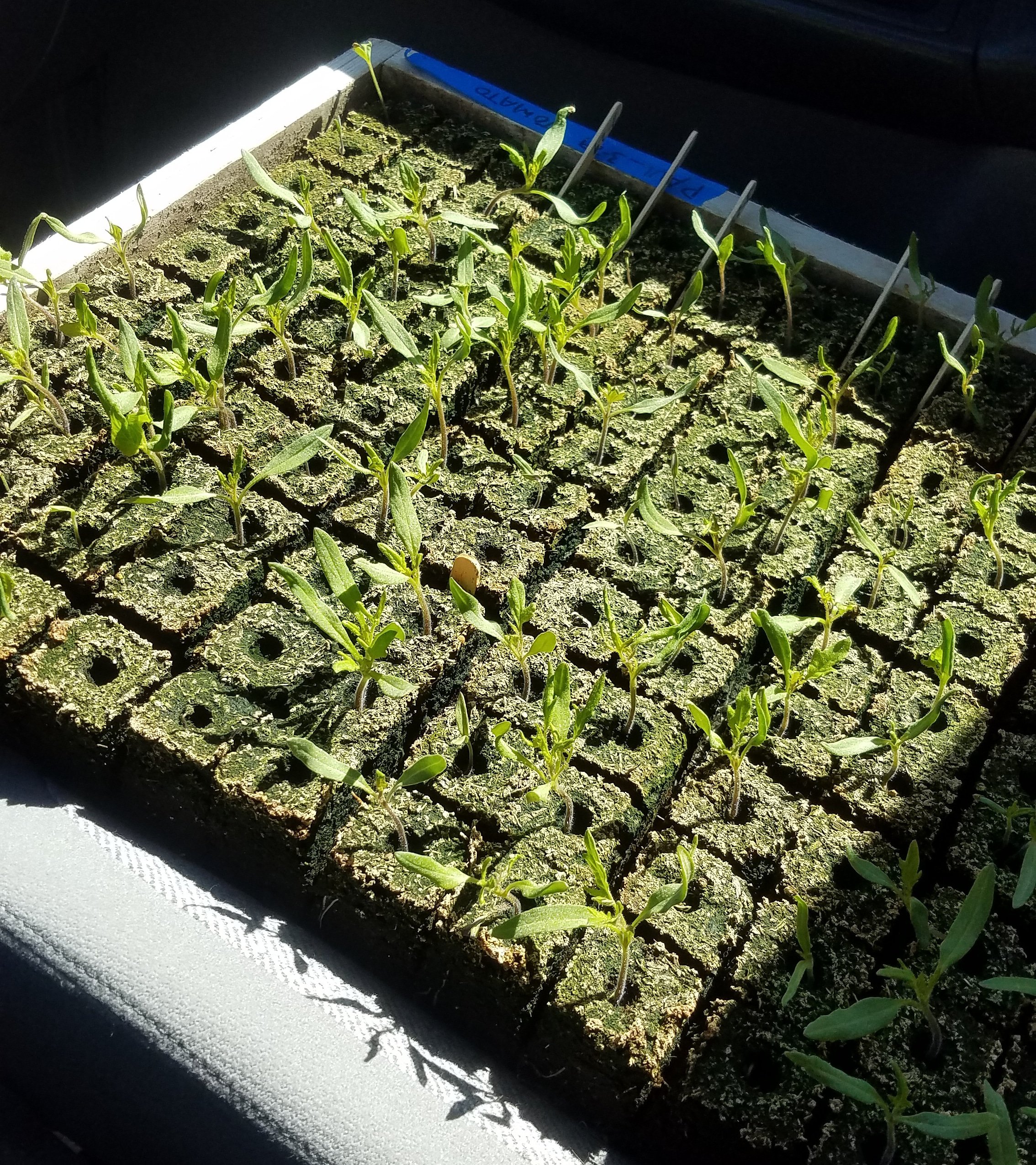
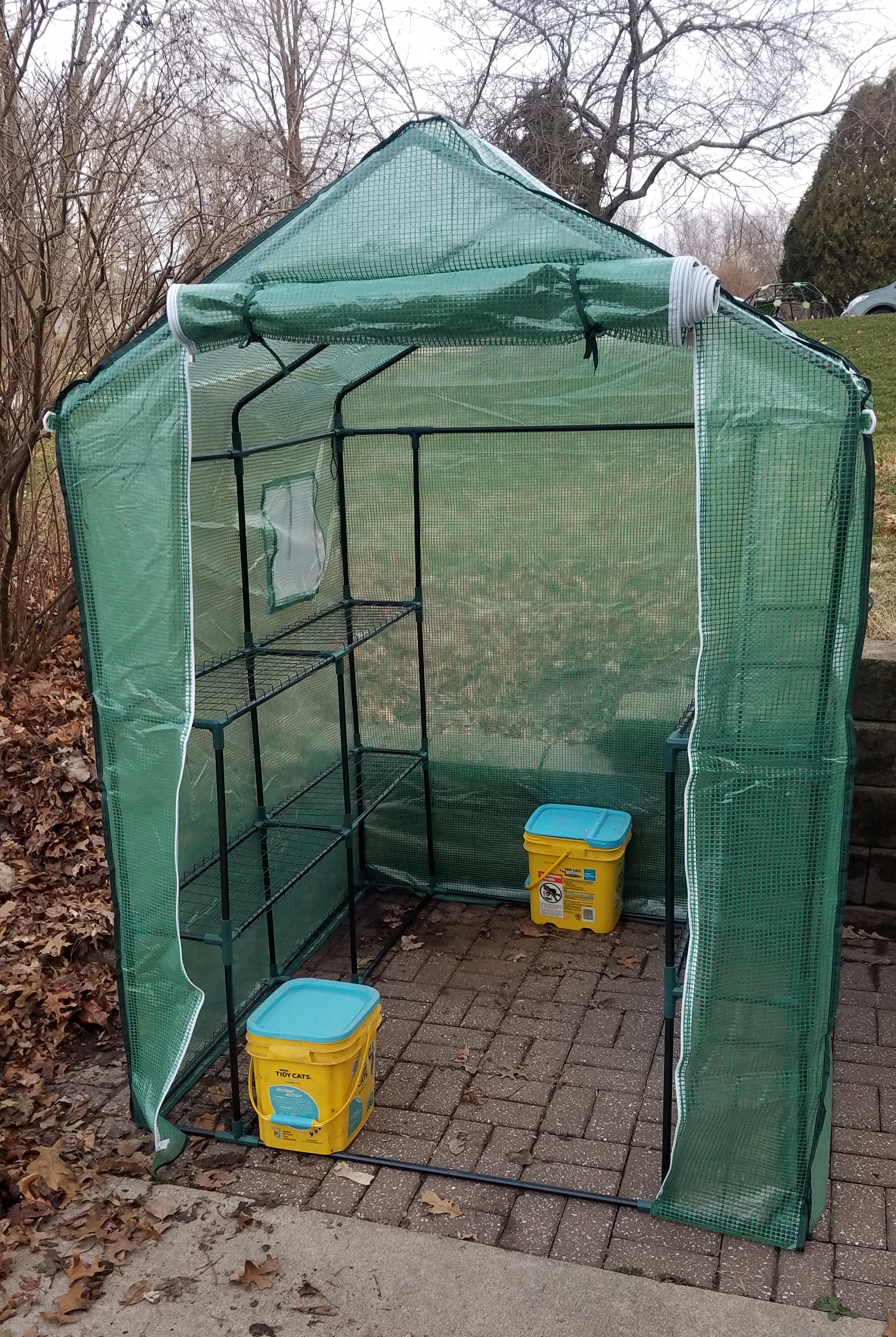
The first tray of tomato seedlings took a ride home in the passenger seat after my shift at the farm. The forecast is rain the next couple of days so I’m not sure when I will plant them. The portable greenhouse is getting full.
A group of friends from high school participated in a Zoom meeting last night. The host, who also played keyboards in our 1970s band, organized a weekly meeting using the service. I found value in the conversation.
One of the guys on the call is an unemployed nurse who found work last week helping a team from the Iowa Department of Public Health administer COVID-19 tests to slaughterhouse workers. Beginning Friday he spent three days in Waterloo with a team drawing blood and doing nasal swabs to about 3,500 people. Today they head to Columbus Junction for more. I’m glad he found work.
Whatever the reason for the governor’s hesitation, unchecked spread of the coronavirus happened in Iowa because of it. Chasing it in meatpacking plants and care facilities alone will be a major undertaking. She started this scale of testing too late to head off the worst aspects of the pandemic. We are in this until researchers develop a vaccine and distribute it world-wide. Word on the street is it will take three years to accomplish that.
Yesterday we completed our ballots for the Democratic primary. Like many, we are voting by mail because of the coronavirus. Primaries are the time to vote your beliefs. Once voters express their preference, we’ll support the nominees in the general election to retake our government. We can flip the Iowa House of Representatives this year, and if stars properly align, the U.S. Senate. It will be an unusual election because of the pandemic.
So much depends on so many things. Yet when spring is as glorious as it was yesterday the work ahead in politics fades from view. Our collective journey home continues.
One of the largest employers in Cedar Rapids, Collins Aerospace, announced salary cuts and furloughs in response to the coronavirus pandemic. They aren’t the first big company to do it.
Last night the Walt Disney Company, where our daughter works, announced furloughs beginning April 19 for union-represented cast members. There is a long list of corporations with furlough plans.
A month ago corporations were aware of the potential business risks of a pandemic. They froze things in place with some adjustments to see how the pandemic evolved. Next, they are taking steps to ensure longer-term financial survival and recovery. We’re a month into broad recognition of the pandemic which suggests business management believes, and we should as well, we are a long distance from exiting the restrictions imposed on our lives and returning to things like grocery shopping, buying gasoline, flying, visiting theme parks, and going to church without anxiety.
A team of Harvard researchers said models project social distancing may need to continue into 2022 to prevent medical systems from being overwhelmed by a resurgence of the novel coronavirus. The happy talk about “opening up the economy” rings hollow right now.
We go on living.
Yesterday I finished planting the main onion patch. That there is an onion patch is a change from previous years. By noon there were eight rows with seven varieties:
Red, yellow and white from the home, farm and auto supply store, varieties unknown but likely a July harvest.
Matador Shallots, Johnny’s Selected Seeds, 90 days from transplant.
Ailsa Craig Onion Plants, Johnny’s Selected Seeds, 95 days from transplant.
Patterson Onion Plants, Johnny’s Selected Seeds, 86 days from transplant.
Red Wing Onion Plants, Johnny’s Selected Seeds, 103 days from transplant.
All of the onion work is an experiment in being more successful in growing them. Red, white and yellow unknown varieties were from bulbs, the shallots from seeds, and three varieties of onions from Johnny’s are storage onions. Weeding and proper watering will be needed now and for the next three months until harvest.
It snowed last night. The temperature inside the portable greenhouse was 48 degrees this morning because of the space heater used overnight. The plants looked fine, although the cooler temperature will slow germination of recently planted seeds. Snowfall will delay planting in the garden as the soil was already too wet yesterday when I spaded a strip. We’ll see what the day brings, however, the snow should melt and if the lawn dries enough I could get some mowing done and use the clippings to mulch the garlic and onions. Lot of “ifs.”
On the tenth day of my unpaid leave of absence from the home, farm and auto supply store I’m waiting for the next shoe to drop so I can figure out how to manage our lives on the prairie.
I know gardening will be part of it yet there’s more to come.
A gentle rain fell after noon in Big Grove Township. Forecast to be a quarter of an inch, it continued into nightfall, slow and gentle. It was the kind of spring rain we need and have come to expect.
Neighbors worked in our yards in the morning: trimming trees, collecting brush, gardening and mowing. Children were supervised by parents and the sound of their laughter penetrated the neighborhood. With the coronavirus pandemic we checked in with each other, chatted some, maintained our distance, then returned focus to the work at hand.
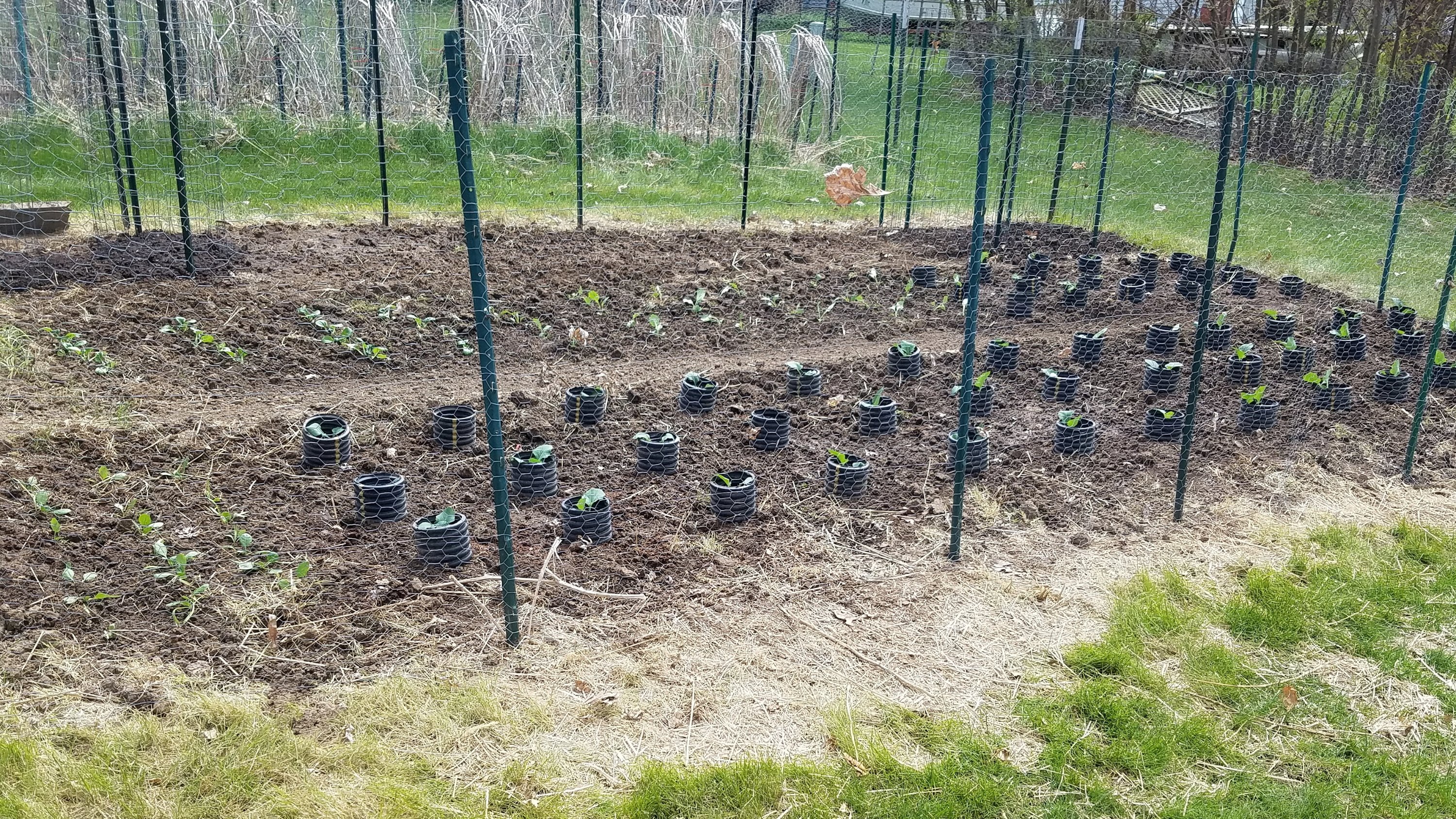
After planting I picked up and cleaned garden fencing from where I laid it to prepare the garden plots. Rolled bundles are piled near the Bur Oak trees until needed. For now, nothing is growing above ground that wildlife will eat.
I seeded the last of the early crops in the ground before the rain started:
The portable greenhouse is filling so I consolidated seedlings to make room for what I’ll bring back from the farm today. I gave a tray of broccoli and kale to a neighbor for their garden. Later I’ll post an offer of free seedlings for neighbors on our social media group. Kale is not as popular as I’d like and not everyone gardens.
Inside, I made luncheon of a cheese sandwich with a single slice of bread, spooned out some pickles, and turned to what would be the afternoon’s work.
I have two archival-style boxes of postcards containing hundreds collected from all over, maybe a couple thousand in all. Some were sent to me. Some purchased while traveling in the United States, Canada and Europe. Some bought at auctions for a dollar or two bid per bundle. When I visited second hand stores, if they had a postcard section I browsed for good ones. Post cards are an inexpensive collectible.
At some point I segregated those with more personal meaning from the boxes and put them in trunks with other memorabilia from those periods of my early life. Our parents used to take us to Weed Park in Muscatine, driving along Highway 61 from Davenport in our 1959 Ford. I have a photograph of Dad, my brother, my sister and me standing near the car with the Mississippi River in the background. I put the postcards of Weed Park in the trunk from the time before Father died.
I went through both boxes and looked at every card during a single, four-hour shift.
What strikes me about those hours is the nature of memory. Not only do I have memories evoked by artifacts, I have the sense of being in those places literally.
For example, today is the 75th anniversary of Franklin Delano Roosevelt’s death in Warm Springs, Georgia. In June 1976 four of us left Fort Benning, Georgia where we were taking infantry officer training and drove the 45 miles to visit. We saw the chair where FDR died and I bought a postcard from the gift shop.
I found the postcard in one of the boxes last night. It had the date and names of the other three soldiers who went with me written on the back. I saw myself in that room again, just like it was in the present. What is that experience? I had to look it up.
After consolidation, long-term memories are stored throughout the brain as groups of neurons that are primed to fire together in the same pattern that created the original experience, and each component of a memory is stored in the brain area that initiated it (e.g. groups of neurons in the visual cortex store a sight, neurons in the amygdala store the associated emotion, etc). Indeed, it seems that they may even be encoded redundantly, several times, in various parts of the cortex, so that, if one engram (or memory trace) is wiped out, there are duplicates, or alternative pathways, elsewhere, through which the memory may still be retrieved.
Therefore, contrary to the popular notion, memories are not stored in our brains like books on library shelves but must be actively reconstructed from elements scattered throughout various areas of the brain by the encoding process. Memory storage is, therefore, an ongoing process of reclassification resulting from continuous changes in our neural pathways, and parallel processing of information in our brains.
Shorter version: the postcard caused a group of neurons which physically comprised the memory to recreate it in real time.
This is particularly important when writing a memoir. Perhaps the hardest part of my work has been to resist the influence of today’s life on memories retained. Historians refer to this as presentism, or an “uncritical adherence to present-day attitudes, especially the tendency to interpret past events in terms of modern values and concepts.” It is important to learn how to live from memories and experiences we’ve had. In our search for meaning today, it’s important to refrain from assigning arbitrary values to our past. We have to let the memories exist and pay attention to what they are.
In the 50 years since Father died I frequently revisited the memory of the night men from the meat-packing plant arrived at our home to console Mother while we waited in our parents’ bedroom for news. I suppose the worst parts of those days after his death are blocked, or whatever psychological term represents that. I don’t want to put a name to that blocking process because while other memories physically exist in my brain, over the years I’ve adopted a view, or perspective about what that memory is. While that may provide comfort, when writing autobiography we have to work at retrieving that contemporaneous experience. It must be what it is. That distinction between the memory told and the actual memory is at the core of what I’m about in my writing.
When I woke last night to use the bathroom I thought about what I would write this morning. The shift of postcards prompted something… a lot of somethings. It’s not that complicated. In the rush of viewing memories prompted by a thousand or more artifacts, in a single sitting, we must get a grip on the quantity and manage it. In the end, though, do we need to do that?
Is it better to live in a hurricane of memories and hope for survival? It is better to confront the wind than hide from it. That is my only conclusion today, except for the notion I must post a photo of our Bluebells for complicated reasons.
Tuesday was the last time I started the automobiles.
I plan a drive in each of them later today to make sure the batteries don’t drain. With gasoline selling for $1.259 per gallon I’ll don a protective mask and gloves and fill the one I missed while out to buy groceries.
It’s a maintenance mode of living as we wait out the coronavirus pandemic.
Strong gusts of wind had me bring the greenhouse seedlings into the garage yesterday afternoon. If it did blow over, I didn’t want to lose the work done since February. It’s still standing this morning.
Overnight ambient temperature dropped below freezing, so when I return the plants to their shelves after sunrise I’m going to run a space heater out to warm them. The forecast is ambient temperatures around 50 degrees after noon. The sun should take over warming by then.
The pandemic is real and people who own and operate small businesses are getting antsy. Under normal circumstances a small business owner is eligible for unemployment payments only if they pay in for themselves or their employees. Most sole proprietorship operators don’t.
There is discussion in the national media about stimulus bill funding for small business owner payrolls to make sure they make it to the other side of the pandemic. People I know in this situation, who have applied for unemployment to Iowa Workforce Development, had their claims denied. There is a lack of information about how this provision of the stimulus will work, or whether it even exists. Bottom line is the federal government’s response to the coronavirus pandemic has been too little, too late.
With non-essential business shut down three weeks ago, small business operators are having trouble making ends meet without their regular cash flow. Some are considering returning to work to resolve the stress. It’s easy to say that’s not a good idea during a period of contagion, but our household is financially stable and as such, mine is a perspective of privilege.
As retired workers, our family relies on our Social Security pensions. Politicians floated the idea of increasing Social Security payments temporarily this week. That doesn’t seem necessary. The main thing about Social Security should be to ensure that the trust fund is solvent now and beyond 2034 when if nothing is done it will begin to run out of money. That’s a worry for another day in light of the pandemic.
After Tuesday’s trip to the wholesale club we are provisioned so we can make it through the end of the pandemic. According to current projections the peak is expected to be April 27 although it will take some time past that date for the CDC or Iowa Department of Public Health to give us an all-clear.
For now, I’m focused on planting the garden. If the pandemic continues into summer, we’ll need the produce.
A month after Governor Kim Reynolds activated the Iowa emergency operations center to cope with the coronavirus pandemic I took a 30-day unpaid leave of absence from the home, farm and auto supply store.
My close family gave a thumbs up.
After a trip to the grocery store the plan is to hole up here in Big Grove to ride out the pandemic. Early spring is a great time to spend more time at home. The garden will benefit greatly.
Yesterday I planted squash seeds in trays for my greenhouse:
Raven Hybrid Zucchini, Johnny’s Selected Seeds, 48 days.
Early Prolific Straightneck, Ferry-Morse, 50 days.
Early White Bush Scallop, Ferry-Morse, 50 days.
I posted in social media about my leave of absence and entered a discussion with a local friend about wanting to plant their garden, but not having seeds. I made a care package of early crop seeds and broccoli seedlings for them.
My dental appointment next week has been postponed due to the pandemic. In fact, more businesses are slowing down, delaying, and cancelling events. The Democratic Party decided to delay the county convention and is opting for on-line participation. I’m an alternate delegate this time and curious to see whether I get virtually “seated.” This week is expected to be a bad one in terms of COVID-19 positive test results and deaths in Iowa.
There are multiple models of the course of the pandemic. The one I favor points to April 26 as the possible peak in number of cases and deaths in Iowa. People social distancing at home watch the numbers closely. Regardless, we all must wait to see what happens as the pandemic runs its course.
I spent time cutting back overgrown lilac bushes in the backyard. The goal is to remove the old growth and let new recreate the appearance. The results are positive but I have to sharpen the chain saw before tackling the remaining thick trunks. This is preparation to cut back the ones in the front yard. The wood will create a second brush pile to burn before tomatoes go in.
A few masks for sawdust control rest in the garage medicine cabinet. I’ll take one to the grocery store and wear it while shopping. Hopefully I’ll survive another day of living in the coronavirus pandemic.
On a mild, clear Sunday I planted cool weather crops.
Arugula and lettuce planted in the ground March 2 are coming along. I tasted a tiny arugula leaf to confirm what it was. Mmmm. It won’t be long before I can make a pasta dish using fresh arugula with bow tie pasta.
In spurts of action with deliberate steps — a process developed as I slow down in the garden — I planted beets and turnips to fill out a patch near the early arugula and lettuce, and filled four containers with two varieties of potatoes, one with radishes and another with three types of onions from the home, farm and auto supply store to be harvested as spring onions. I filled out the onion container with basil seeds. It felt like I made progress.
I mulched the leaves remaining in the front yard, cleared off the plot which grew kale and cherry tomatoes last year, and removed the wire containers from the plot near the in ground containers. There’s more work to do as long as the rain holds off. I planted in soil:
Potatoes
Red Norland, ten weeks.
Kennebec, ten weeks.
Onions
Three varieties of bulb onions, three to four weeks for spring onions.
Turnips
Purple Top White Globe, Ferry-Morse, 55 days.
Purple Top While Globe (certified organic), Johnny’s Selected Seeds, 50 days.
Basil
Sweet Italian Basil, Ferry-Morse, 70 days.
Radishes
Red Meat, Johnny’s Selected Seeds, 50 days.
French Breakfast, Johnny’s Selected Seeds, 21 days.
Icicle Short Top, Ferry-Morse, 28 days.
Champion, Ferry-Morse, 28 days.
I removed the automobiles from the garage as I have each spring while planting the garden. I noticed my inventory of powered equipment increased. With a gas-powered trimmer, an electric tiller, two lawn mowers, and an electric and a gas-powered chain saw, it feels like I’m ready. The electric tiller is a concession to age, yet I admit it does a great job of preparing the soil for planting.
Sunday was gardening, as good as it gets. A fit thing to occupy ourselves as we maintain a distance from people because of the coronavirus.





 Journey Home
You must be logged in to post a comment.