The text message came while I worked at the home, farm and auto supply store. I saw it on my afternoon break.
“If you want to start tomatoes there is a crate on the packing shed floor you could pick up on way home from work,” Farmer Kate texted. “I’m not home but if you need help finding them let me know.”
We barter my labor canning for her tomatoes. Ready or not, the next aspect of the local food season begins with its quick-paced rush to beat spoilage.
When I picked up the tomatoes there was also a crate of bell pepper seconds unclaimed by CSA members. A farm worker offered them and I put the crate in the back of my Subaru.
On the way hope I spotted the librarian leaving the library for her car and swung by to offer some peppers. My sister in law was at our house when I arrived home. I offered her some too. They are so sweet — unlike what’s available at the grocery store. A gift to be shared.
The garden is coming in with more apples than can be picked before they drop. Pears are almost ready, there are tomatoes, celery, hot peppers, basil and more waiting to be harvested and processed. There will be more cucumbers for pickling. Sweet corn will run another week or two at the roadside stand and we want to put some up. Every night after work and most mornings before, I’m in the garden harvesting or in the kitchen making dishes and preserving the harvest. Right now tomatoes, peppers, sweet corn and apples are in the house waiting to be processed. It’s a mad rush.
It’s also a good life. Staying busy with useful work blocks out negativity from other sectors of society. It’s cultured and produces the tangible benefits of relationships, knowledge and good food for our table and those with whom we share.
For the rest of August and September, it’s work, kitchen, garden for me.
When people think of local food, most have seasonal sweet corn and tomatoes in mind. That hasn’t changed much in years.
The quest for good-tasting food that does no harm has also been around for a long time. Organic food production came up in the early 20th Century as an alternative to the rise in mechanized, industrial farming.
An organic food production system developed, although there is less clarity about it today than there was a few years ago. Organic certification has contributed to confusion.
The Organic Foods Production Act of 1990 and the National Organic Program were game changers that created a new certification process and, importantly, a greater market for organic food. Sales of organic food more than doubled during the period 2006-2015, according to the Organic Trade Association, reaching $43.3 billion in 2015. In its quest to bring standards and a market, the well intentioned government program suffered abuse in the form of government lobbyists from moneyed interests who diluted the meaning of “USDA Organic” many of us found inspiring in the 1990s. Under Sonny Perdue, the 31st U.S. Secretary of Agriculture, further erosion of the law’s original intent and the organic standard is expected.
“It seems that uncertainty and dysfunction have overtaken the National Organic Standards Board and the regulations associated with the National Organic Program,” Senator Pat Roberts (R-Kansas), chairman of the Senate Committee on Agriculture, Nutrition and Forestry, said recently according to the Washington Post. “These problems create an unreliable regulatory environment and prevent farmers that choose organic from utilizing advancements in technology and operating their business in an efficient and effective manner. Simply put, this hurts our producers and economies in rural America.”
Roberts statement is code for getting government regulations out of the way of large scale producers in the organic market. As the 2018 farm bill is crafted by the Congress, any meaningful regulation pertaining to organic standards is expected to be gutted by Trump Republicans.
What you see is not always what you get as organic food producers scale up to meet demand and work the system. Here are two recent examples:
Herbruck’s Poultry Ranch in Saranac, Michigan produces one in 10 organic eggs in the U.S. according to the Chicago Tribune. The linked article describes production processes indistinguishable from those of almost any Iowa confinement egg producer. Those eggs don’t seem organic despite assertions by the ranch. What does “organic” mean in this context. At a minimum, not what we expected.
In May, Peter Whoriskey of the Washington Post reported fraud in imported corn and soybeans. A large shipment of soybeans began as “regular” soybeans in Ukraine and changed to “USDA Organic” by the time it reached a California port, garnering an additional $4 million for the shipment because it was “organic.” Some doctored documents is all it took for a huge, fraudulent payday.
My perspective of organic food is from a backyard garden. Gardening is about changing one’s relationship with food as much as providing food for the table — process more than produce. Using organic practices comes naturally as gardeners are mindful of crop inputs that will land on the dinner plate. A common mistake is neglecting the social context of gardening. In most cases gardening includes family, fellow consumers, merchants, farmers and gardeners. A gardener has only slight intersection with government.
Once government got involved in organic food production a market became viable. That was a good thing for farmers who sought to make a living growing organic food. Organic food systems then merged toward commodification as they scaled to meet demand and that’s the sticky wicket.
An ability to increase organic food production without compromising organic standards has been difficult all along. When news stories raise doubt about the meaning of “organic food,” it’s one more burden for farmers to bear in a business where the challenges of producing organic food at a profit are substantial.
I work on farms that use organic practices and plan to resist compromise on organic standards in the next farm bill. If you care about what’s on your dinner plate, should too.
Yesterday I made the last 62 trays of soil blocks at Sundog Farm (Local Harvest CSA) and Wild Woods Farm.
Totaling 946 trays or roughly 110,000 individual seedling soil blocks, I made more than in any previous season. Adding Wild Woods Farm this year is the reason for an increase in this specialized work.
Not only did I produce practical farm products, I learned to be a better vegetable grower by observing farm practices and talking to people about grower issues. Sunday was the last day of the season. God willing and the creek don’t rise I’ll do it again next year.
Next is some summer respite before beginning work at Wilson’s Orchard in August. The garden harvest has begun so there will be plenty of work to keep me busy on weekends.
What could break the back of the local food system? Lack of affordable individual health insurance policies.
Finding and funding health insurance is a key pivot point for local food farmers when considering remaining in business. If they can’t afford health insurance, they may reconsider operations, take a job off the farm to get coverage, or even give up farming altogether. It’s that important.
Politicizing health care raised the level of uncertainty in a profession where uncertainty — about crops, weather, pests and customers — is de rigueur. Failure of our government to adequately address health care for everyone may be one too many burdens for small farm operators to bear.
The Patient Protection and Affordable Care Act has done a lot of good. Created in a political environment hostile to change, Democrats held hundreds of hours of public hearings and adopted more than 160 amendments proposed by Republicans, according to Minnesota Senator Al Franken. They held meetings with stake holders from every aspect of the country’s health care system to gain perspectives and buy in. Despite the law’s flaws, millions more people gained health insurance coverage, including farmers. The farmers I know have either been covered by the ACA or considered it as an option.
The contrast between Democratic creation of the law and the Republican efforts to repeal and replace it couldn’t be more stark. Crafted in secrecy, Senate Republicans eschewed public discussion that was the hallmark of the Democratic process while writing their new law. From whom are they taking counsel? We suspect but simply don’t know.
What we do know is small farm operators require health care and if they can’t afford an individual health insurance policy it may break their will. The uncertainty created in Washington, D.C. about health care has not been good for them. It hasn’t been good for any of us who believe sustaining a strong local food system is important.
After work at the home, farm and auto supply store I drove to the farm and picked up the first spring share. In it were spinach, baby kale, Bok Choy, Choi Sum, broccoli raab, rhubarb, oregano and garlic chives.
Already my mind is swirling with cooking ideas.
I’ll prepare a breakfast omelet using greens seasoned with oregano and garlic chives. Most of the oregano will be dried and flaked for cooking. Garlic chives will be processed with cream cheese for a sandwich spread. In the mix is rhubarb jam, spinach casserole, and sautéed greens. There will be lots of cooking with this week’s abundance.
It’s the next stop on along the annual circle of local food.
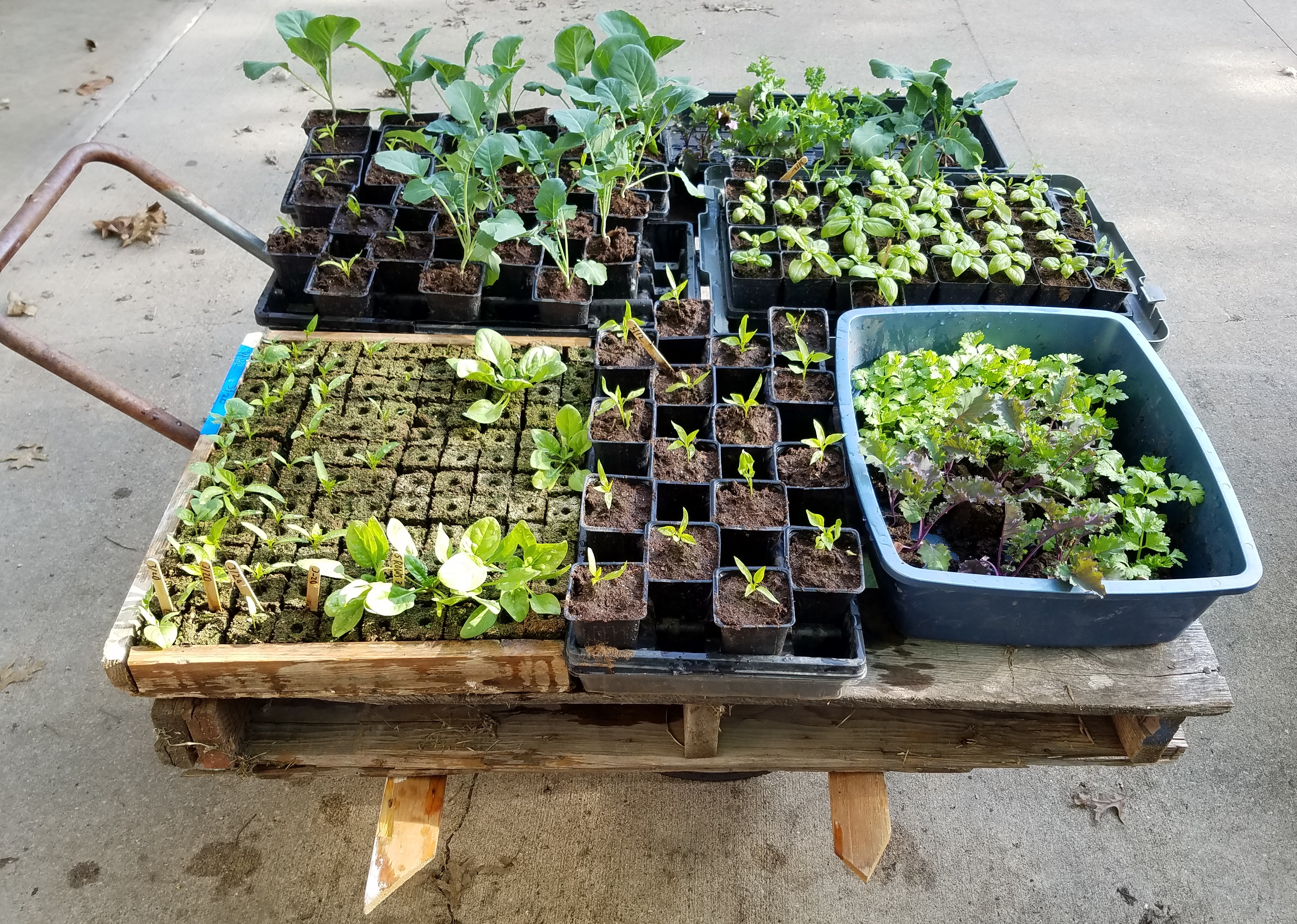
While at the farm I sorted through a stack of pallets used to deliver straw and hay and found two to bring home. I made a wheeled cart for summer crop seedlings finishing before the big May planting. The other will be used to organize the garage until Memorial Day. I’ve requested May 6 – 14 off work at the store to get planting done.
For the moment, life is about the weather — seeing how it unfolds and checking my weather app for forecast updates. It is also about forgetting the fray of politics for a while to become a practitioner of something useful — not only in Iowa but globally.
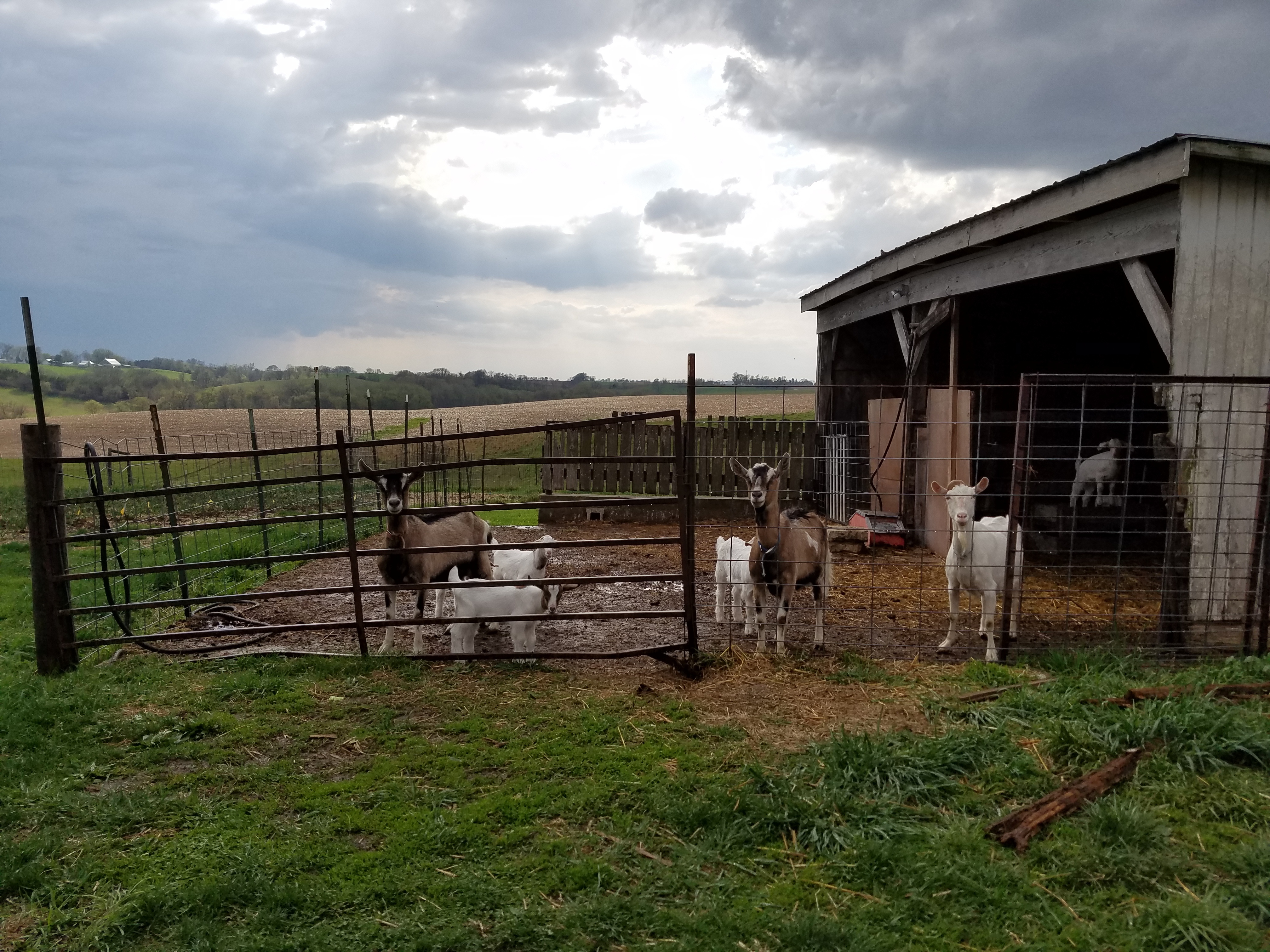
The sound of bleating lambs pierced the air during yesterday’s shift at the farm. It was a sad sound because we know their destiny.
Above is a photo of goats instead.
I made 60 trays of soil blocks for the germination shed. It’s time to transplant pepper plants from plastic trays where they germinated to individual soil blocks for finishing before planting. There are a lot of them.
Saturday, April 15 in the Germination Shed
I was to do 78 trays, but a thunderstorm blew over, dropping a brief torrent of rain and hail — enough hail to sting our skin. All of us —four people, two dogs and a cat — made our way into the germination shed to wait out the storm. It didn’t take long. The storm was an emphatic punctuation ending the day’s work.
Between Passover and Easter none of our lambs was sacrificed despite the popularity of leg of lamb as a holiday main course. On a farm we accept the reasons for raising lambs and goats, and the reality of thunderstorms.
I barter my work. Soil blocking yields participation in selected shares, notably the spring share which begins April 24, and fall shares from both farms. It is a way to leverage the high tunnel for early lettuce and greens, and to secure potatoes, sweet potatoes, cabbage, carrots, squash and other storage vegetables so I don’t have to grown them myself. We also exchange work canning tomatoes and freezing bell peppers with each receiving a share of the resulting jars or zip top bags.
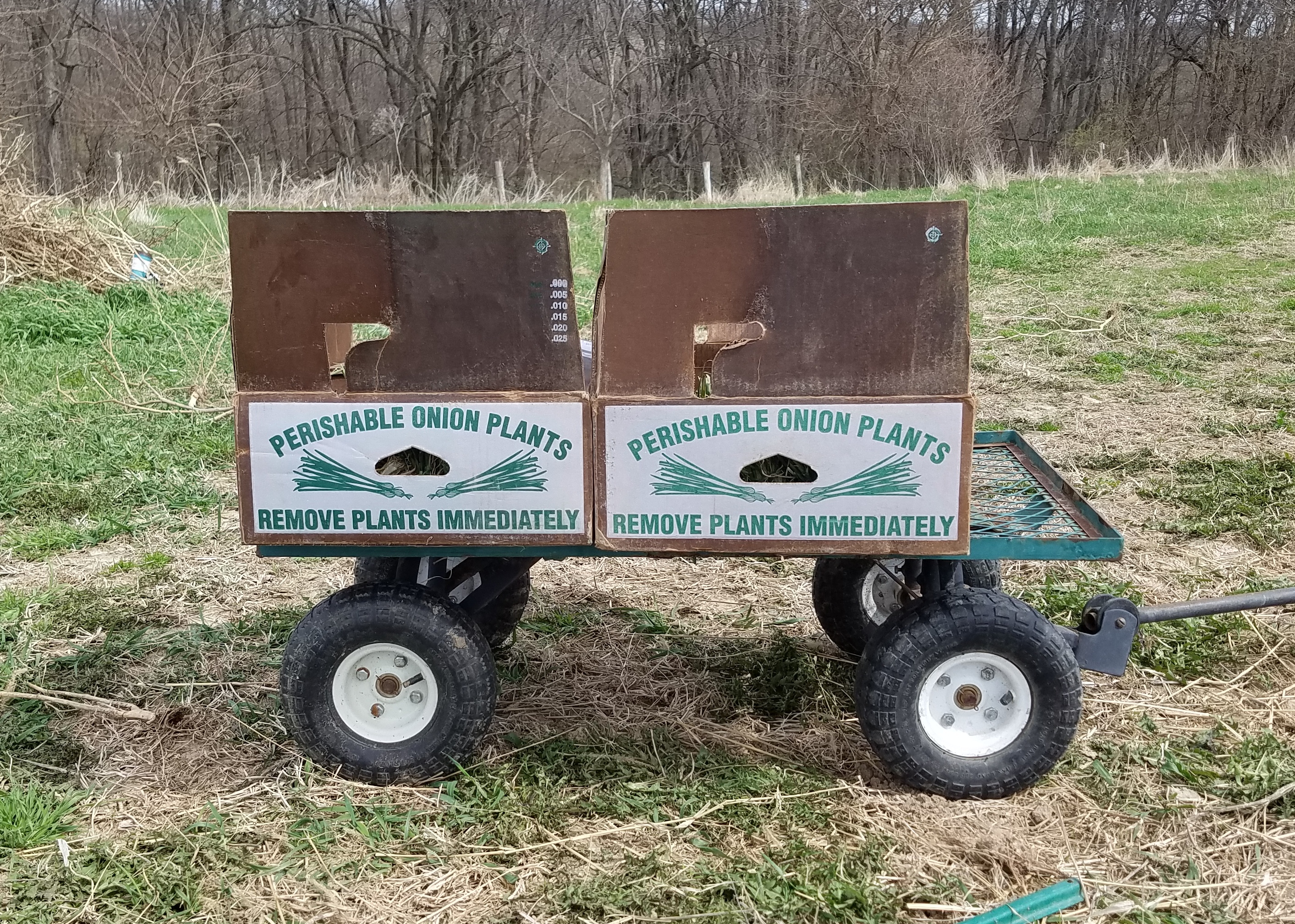
I started seven trays of my garden seedlings in the germination shed, also part of the deal. I got bags of last year’s soil mix and onion sets that were part of the farm order. There are other sundry items: pallets saved from the burn pile, leftover partial trays of seedlings, and vegetables when there is over-abundance or if they are too imperfect for members. While no money changes hands, there is mutual benefit from barter deals. My car was loaded as I departed the farm.
The sound of lambs permeates spring days bringing with it both hope and mortality. It’s a hopeful and sad sound. One that leads me to prefer goats.
The weather on Saturday was perfect for getting into the field. Wind had dried the ground making it tillable.
In the cycle of community supported agriculture projects, now is the time to plant onions — a key crop to share with members.
Most farmers I know were planting them — tens of thousands of onions.
I soil-blocked for the next planting in the germination houses — 4,608 at one farm and 4,320 at the other. I brought home two trays of kale, broccoli and hot peppers. The pepper plants will be transferred to larger soil blocks. The kale and broccoli will go into the ground this week after conditioning outside a few days.
Brought Two Trays Home for Conditioning
Saturday morning a group of about 20 people “pulled plastic” over a high tunnel damaged in a storm earlier in the year. We gathered at sunrise before the wind came up. I stayed until the bulk of the work was done. All the adults were either farmers or farm workers. Here’s what the new plastic looked like after the job was finished.
Repaired High Tunnel
I worked in the garden after returning home. There’s a lot to do. The carrots and lettuce are up. I planted potatoes in containers, peas in cages, and beets and radishes near the peas.
I measured the remaining space in that plot and determined 36 kale plants would fit. That’s the same number I planted last year, although I hope for a better yield this year. The kale plot will be 6 Vates, 6 Starbor, 12 Scarlet and 12 Darkibor. I grew way more than I’ll need and leftovers will be given away to friends and neighbors.
I decided to just keep working until I drop this year. Life is short and gardening and farming is a good way to use it. I was tired by Sunday night.
Progressives, farmers and environmentalists heard there is movement in the Iowa legislature to fund water quality and ears perked up — a natural impulse to interpret new events as supporting something we already believe or are working on, also known as confirmation bias.
56 percent of Iowans support increasing the state sales tax three-eighths of a cent to pay for water quality projects and outdoor recreation, according to a Selzer and Company poll reported by the Des Moines Register on Feb 12.
On March 14, Rep. Bobby Kaufmann (R-Wilton) introduced such a bill: the WISE (Water, Infrastructure and Soil for our Economy) bill House File 597.
After a three year implementation the tax would generate $180 million to fund Iowa’s Natural Resources and Outdoor Recreation Trust Fund, which was created by a 2010 amendment to Iowa’s constitution. It sounds pretty good. However, we shouldn’t let our confirmation bias help Republican efforts to tax the poor, cut the general fund, and support the failed Nutrient Reduction Strategy.
Rep. Chip Baltimore (R-Boone) had previously introduced a water quality bill (HSB 135) addressing structural issues related to the use of water quality funds. Baltimore favored spending funds on watershed programs such as the governor’s Nutrient Reduction Strategy. Kaufmann’s bill mandates 60 percent of funding be directed to “a research-based water quality initiative (that) includes but not limited to a practice described in the Iowa nutrient reduction strategy.”
When Governor Branstad created the Nutrient Reduction Strategy, in response to a federal requirement to address water quality, it was the least he could do. It was a way of tinkering around the edges of a water quality program, leveraging wide-spread concern about the need to act without changing the underlying structure of the system that creates excessive nitrate and phosphate loads in our water.
Branstad’s approach sucked up media attention and political will while doing little to address the root cause of the water quality problem.
“I welcome any legislative effort regardless of party that looks to protect the environment,” a progressive voter posted on Facebook. “While I agree that it is not fair that we have to take on the burden of trying to clean up after the farmers, I also know that they are a stubborn lot that hold great political power in Iowa. Therefore we need to be pragmatic and take whatever we can get while the Republicans are in charge.”
A lot of people would agree with this sentiment.
It’s clear solutions proposed in the Nutrient Reduction Strategy could work. They won’t work until either the strategy is compulsory, or there is funding to support broad participation.
“Republicans sometimes get accused of not being pro-environment, of not being pro-water quality,” Kaufmann said. “Well, this is our way of taking that bull by the horns and putting forth a good, tax-neutral water quality bill that puts guarantees in it that we can make sure dollars go to water quality.”
Despite Kaufmann’s work on the bill there are issues with the WISE approach to water quality.
Sales tax is regressive, which means it would be applied uniformly to all situations, regardless of the payer. Some might argue that everyone uses water so why shouldn’t everyone pay through sales tax? It is a straw man argument. A sales tax takes a larger percentage of income from low-income earners than from people causing this problem.
What’s worse than the regressive nature of sales tax is the Republican position any new tax must be revenue neutral. That means cutting the general fund budget. Where will the legislature find an additional $180 million in budget cuts after a year with three successive revenue shortfalls?
“Kaufmann admits there (are) still some questions about how the bill would affect other state programs,” Rob Swoboda reported in Wallaces Farmer. “But, he says, the only way the Republican-led legislature will pass a water-quality funding plan would be if the plan is revenue-neutral.”
Proposed budget cuts should be defined before advocating for the WISE bill.
There is no need to hold the agricultural community harmless in the pursuit of clean water. In 2013, when developing the Iowa Fertilizer Plant (a.k.a. Orascom) in Wever, Governor Branstad said, “the plant would create 2,500 temporary construction jobs and 165 permanent jobs and save farmers $740 million annually by cutting the price of fertilizer.” Whether or not there was a windfall in fertilizer savings farmers can afford to put skin in the water quality game.
“Where public money is needed (to fund water quality initiatives), consider an obvious source: the sale of farm fertilizer,” former state senator David Osterberg wrote in a May 25, 2016 column in the Des Moines Register. “If an urban person buys fertilizer for the lawn, there is a sales tax on the purchase. Farmers are exempt from the normal sales tax on fertilizer and a lot of other things. There is no reason for this exemption. Put the sales tax on fertilizer, earmark it to water-quality strategies and you have, conservatively, about $130 million a year to work with.”
While a majority of voters agree something must be done to improve water quality, political capital to act shouldn’t be diverted to supporting failed Republican policies just because they sound good or appear to support what we all believe.
After a Saint Patrick’s Day meetup with friends in Iowa City I drove home, parked my car in the garage and haven’t moved it since.
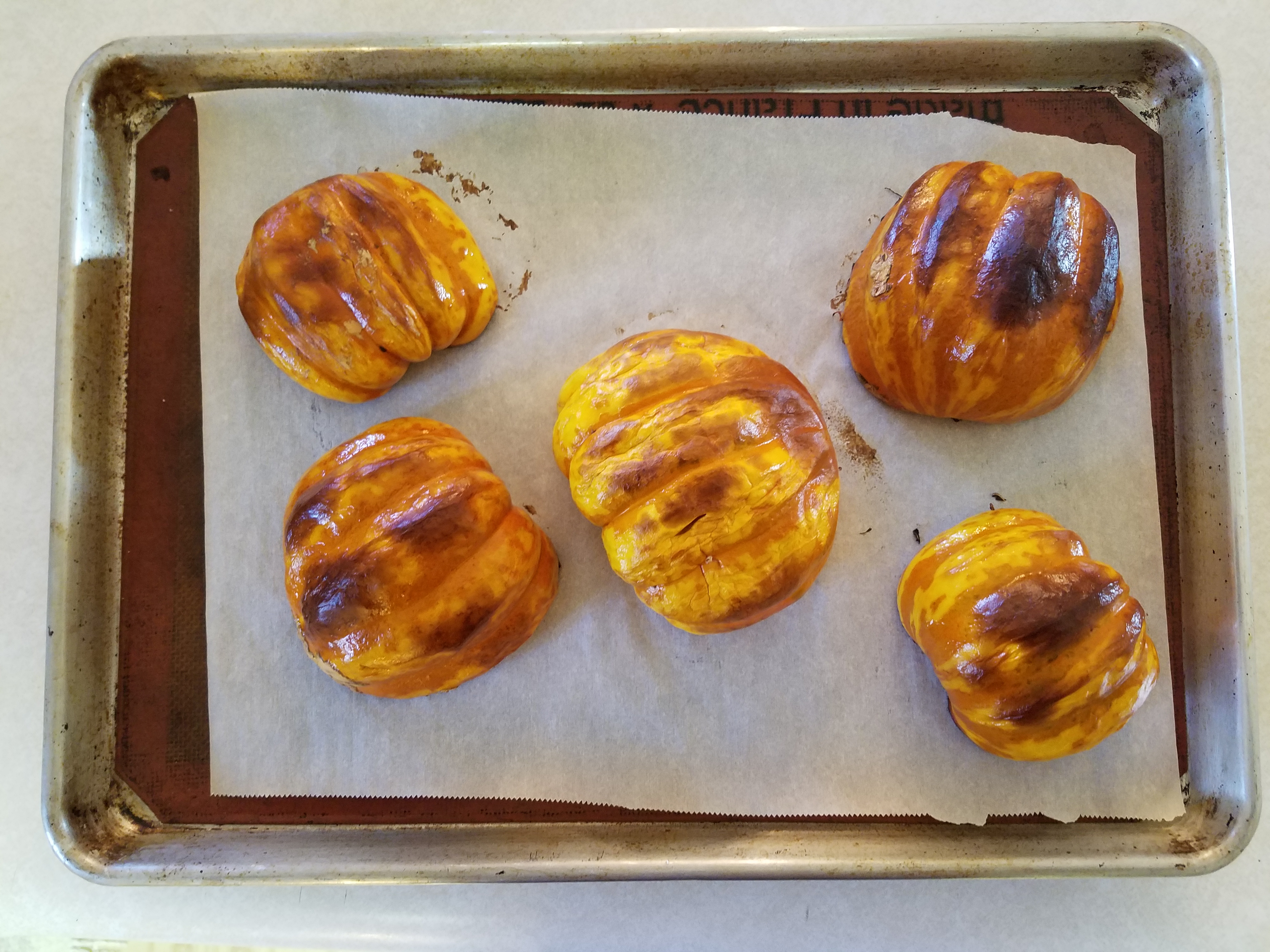
It was too cold for outside work on Saturday so I stayed in, did laundry, cleaned the bird feeder, wrote, read, and cooked dinner of bean soup, Carnival squash and applesauce cake.
The ambient temperature is expected to rise to almost 60 degrees, so I’m planning to work outside after a shift of soil blocking at a community supported agriculture farm.
I read Elizabeth Kolbert’s The Sixth Extinction: An Unnatural History in its entirety this weekend. Her combination of background information with personal stories of field trips is eminently readable. I can’t remember a day so absorbed in a book since leaving transportation. The main takeaway is how uncertain scientists are about changes in earth history over the long term and the consequences of our lifestyle.
Japanese Beetles
The broader meaning of words like “Anthropocene” is not settled, nor agreed. What I know after this immersion, and after reading Sapiens: A Brief History of Humankind by Yuval Noah Haran, I am ready to move forward with something other than narratives of how homo sapiens swarmed over the planet like Japanese beetles.
I buy more bird feed since working at the home, farm and auto supply store. Counting whole kernel corn, I have five different varieties in the garage. Each type attracts a different bird and we enjoy watching them through the French door off the dining area. Some days I feel like picking up a 20-pound bag on sale, and do. I went overboard with 50-pound bags of whole corn and millet, although sparrows seem to really like the millet. There is no science to my purchases.
Bartering is making this year’s garden planning a lot different. Part of the barter system is trading labor for a spring and fall share. Each side of the deal can be defined monetarily. I get a credit of $13 per hour for labor which is applied to retail price of the shares. I use greenhouse space and materials to germinate seeds and care for seedlings until planting in my garden. I will also acquire onion sets and seed garlic through the farms. Where there is a clear financial value, the barter system is simple and easy. This part of the exchange translates into things we can use in our garden or kitchen.
The exchange for specific produce is more complicated.
Canned Tomatoes
Tomatoes are a large part of summer. Last year I planted them in three different garden plots. This year I’ll decrease my plantings to what we’ll use fresh and rely on the farms for canning tomatoes. In 2013 the farmer provided crates of tomatoes which I canned. We split the canned goods 50-50 that year. That was a bit disadvantageous to me considering the amount of work. We haven’t finalized the split, but both farms I work on produce many more tomatoes than needed for their members. One farmer wants lots of canned tomatoes. Something can be worked out.
Bell peppers were a garden failure last year and for many previous years. I’m eliminating them completely. The farms produce bell peppers with a high frequency of imperfect fruit. I plan to trade labor for these seconds and get all of my bell peppers from them. In addition to fresh eating, I seed and freeze them to use throughout the year. We did a 50-50 split on these in 2013, however, this year I’m considering a straight trade of labor hours against a to be determined cost per crate.
There are a number of items we don’t use much in our kitchen but are abundant on the farms. I don’t plan to grow any kohlrabi or cabbage. Should be no problem getting what we need without occupying space in our garden. I’ll barter for some additional broccoli for freezing.
Likewise, I don’t plan to grow lettuce outside my small plot of Belgian lettuce. In between the spring and fall shares that’s coming from bartering.
Summer squash is abundant and available from the farms as are many kinds of greens: collards, chard and “braising greens.” I will grow my own kale and spinach, and everything else will be bartered from the farms.
Eggplant? If Johnny’s Selected Seeds proofs and sends Black Beauty seeds I’ll plant them along with Fairy Tale eggplant. The former can be sliced thick, baked and frozen. The latter are good for the kitchen while in season. There is always an abundance of eggplant at the farms.
Yesterday was the last winter Saturday of staying indoors. Going into the planting season it will also be my day off from the home, farm and auto supply store and the farms. Yesterday was a good day, made better by a feeling of accomplishment. As humans we sometimes need that.
My first work day at Local Harvest CSA, was spent organizing for the season and soil blocking for the first seedlings.
I made two trays for myself as part of the barter deal with the farmer.
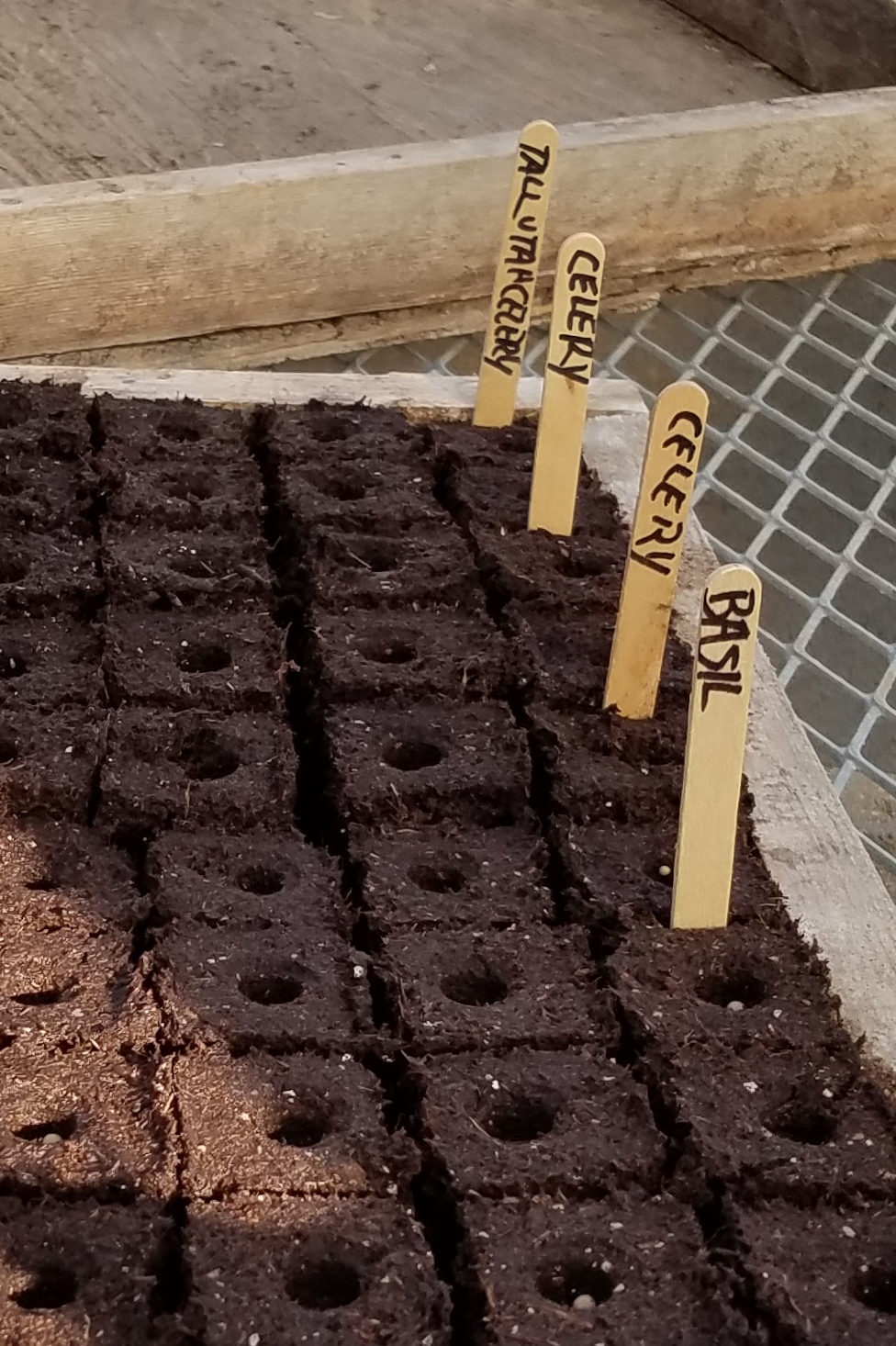
In one I seeded basil, Conquistador celery and Tall Utah celery. In the other was four kinds of kale: Dwarf Vates Blue Curled Scotch, Scarlet, Darkibor and Starbor. The growing season is here.
Basil and Celery
We never know the outcome of gardening. Tall Utah celery seeds are very small. It was difficult to get only one or two into each dibbled cell — I didn’t. I bought them on special from the Seed Savers Exchange in Decorah, Iowa where they don’t pellet seeds. Like with so much about gardening it is another experiment to see what grows well and tastes delicious. The pelleted Conquistador celery seeds from Johnny’s Selected Seeds in Winslow, Maine were easier to plant. A controlled germination house environment should encourage the best from these seeds. We’ll see how it goes.
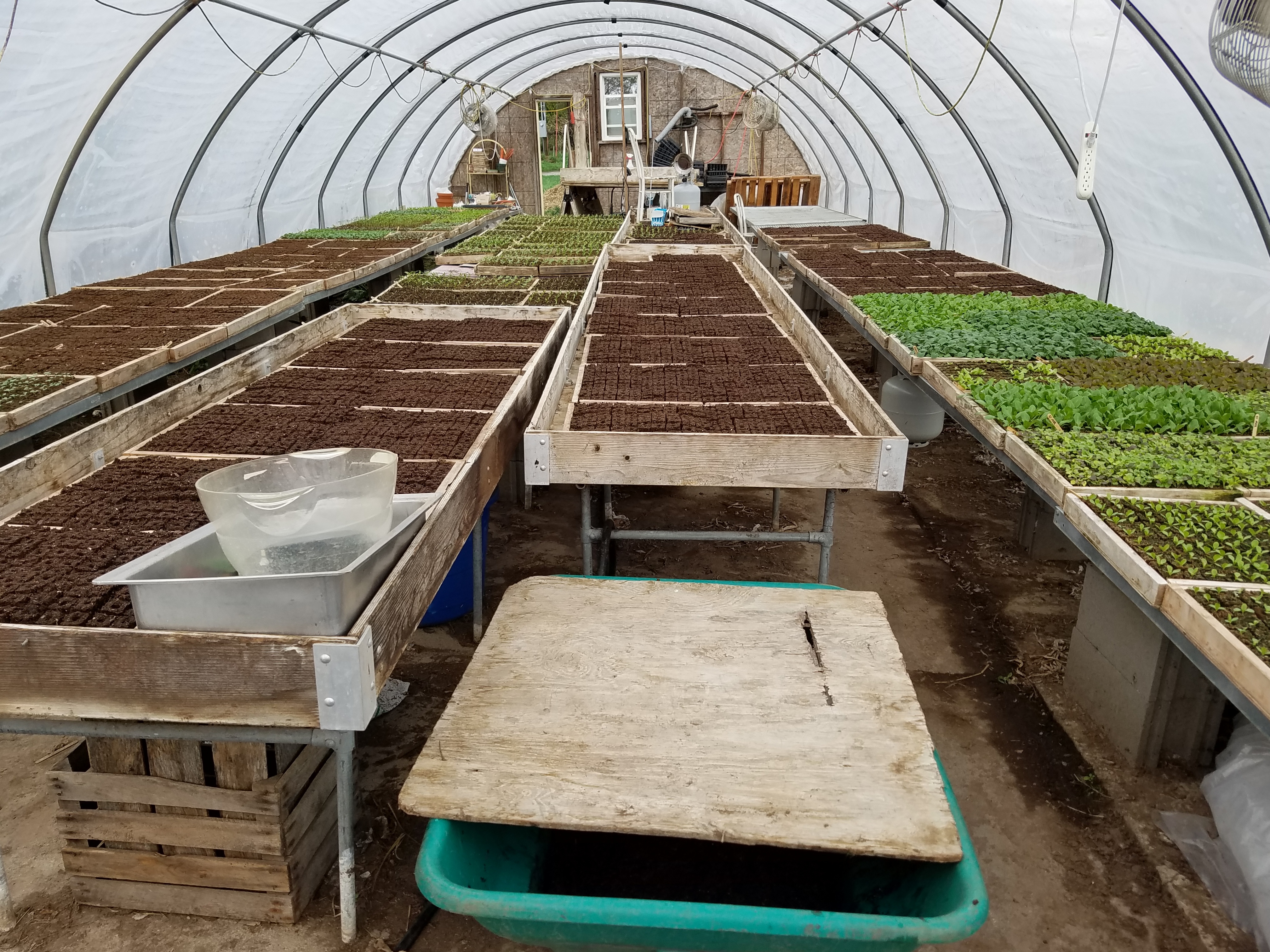
3,120 Soil Blocks
Soil blocking is endemic to Community Supported Agriculture projects. Like much of our work, it is done by hand. Getting the moisture content of the soil mix right is a constant challenge. It is dry as it comes out of the bag into a tub. Watering is done in stages, testing the moisture content after each round of turning with a transfer shovel. Moisture management continues as the soil blocks are made. The pressure of the soil block tool squeezes moisture from the mixture as the blocks are made. It makes the soil mix wetter. It took 3.83 hours to get organized and produce the first batch of trays. As the season progresses, I’ll get faster.
The farmer went to town to get some supplies for the germination shed leaving me alone with two dogs and partly cloudy skies. I took a moment to breathe the fresh air and look at the sky. Hope springs from days like this. New hope for a successful season.







 Journey Home
You must be logged in to post a comment.