Categories
Kitchen Garden

Time to Plant Garlic

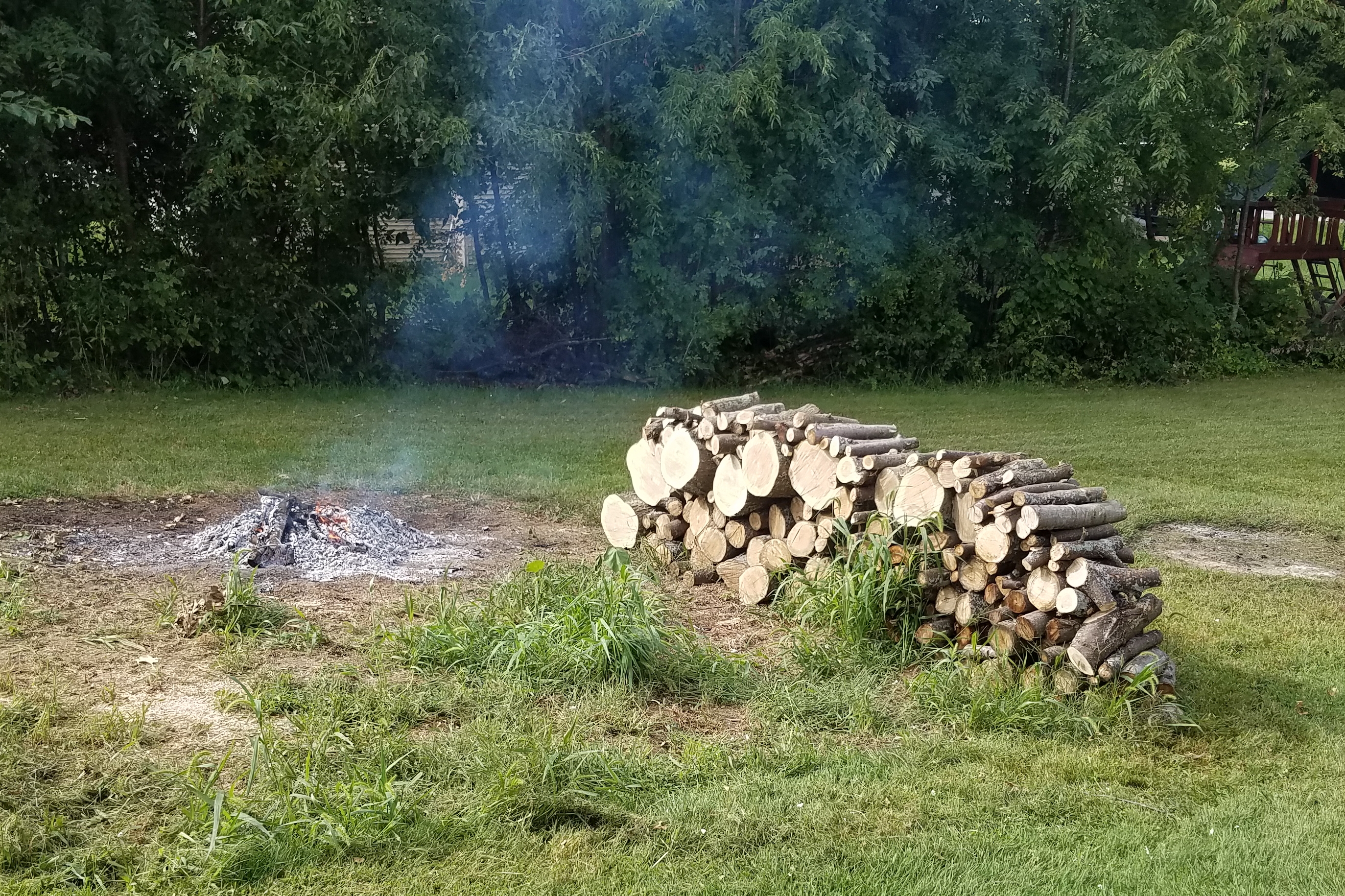
Burn pile, Sept. 19, 2020.

The sound of Spanish-speaking roofers found me tending a burn pile of limbs pruned from apple trees. It seems like the neighbors just built their house: it’s too soon for a replacement roof. The quality of craftsmanship isn’t what it used to be, I suppose. Maybe it was damaged during the Aug. 10 derecho. Roofers made a one-day job of the expansive surface overlooking the neighborhood and the lake beyond.

Embers remained by the time I went to bed. I raked them over large pieces of wood so they would have a chance for overnight consumption. It isn’t the last burn pile of the year although a necessary step toward disassembling the tomato patch. That’s where garlic seeds will go.

It is time to plant garlic.

This year’s crop was excellent. Healthy plants produced large cloves that are storing well. I’d like to repeat that. Part of me wants to be done with the garden yet until the first hard frost it will keep producing on the margins without much effort. This year’s kale may grow into November.

I picked the tomato patch for garlic because most of it has been covered with landscaping fabric and mulch all season. It will be easy to dig up and rototill. The lawn needs mowing and I’m saving that to use the clippings to mulch the garlic. If needed I will purchase straw bales to finish. Planting garlic is a two-day process here. Preparing the plot one day followed by planting and mulching the next. Once it’s done it doesn’t seem like much work for the reward next July.

Yesterday I delivered my completed ballot to the county auditor. With early voting comes a rush to election day. I scheduled a number of volunteer activities to help get out the vote, beginning with a rally in the metropolis with our congressional candidate tomorrow afternoon. The outcome of the election in Iowa is uncertain. Much work remains even if our federal candidates are holding their own in polling in this red turning purple state. It’s not over and we can’t relax now just because we cast our ballot.

I don’t know the future of our country yet I hope for the best. We’re doing the best we can to right the ship of state and set course for a better horizon. As society is increasingly and globally connected, new horizons resemble the previous one. Our work remains the same.

For now our climate in Iowa can still produce a decent crop of garlic and that’s where my attention is the next few days. In the background is the dull grind of the election. We’ll know the results soon.
Categories
Writing

Neighborhoods

Turn around near Seven Sisters Road.

In his book What Unites Us, former CBS news person Dan Rather refers several times to the “neighborhood where I grew up” in Texas.

This narrative meme should be abandoned by anyone who is serious about autobiography because the plural form of neighborhood is more accurate. In addition, growing up is not a linear process. We don’t “grow up” in a single way or in a single place and magically become a “grown-up.” The communities that surrounded our lives in the 20th Century were not homogeneous. They were diverse and less rooted in place. To root autobiography in place seems arbitrary. The narrative force of this meme casts aside our diversity of experience. We shouldn’t do that if we seek to be true to ourselves.

Our mind doesn’t stop growing as Rather points out. I had formative early experiences and it seems normal to emphasize them. I’ve written about getting injured when a swing set collapsed on me at age three and a half. That experience combined with my arrival at the hospital, taking ether through a funnel, and a lengthy stay had an effect on me that persists. There was a lot else going on at the time. I like to tell this story yet is it most representative of what makes me who I am? Probably not.

Writing autobiography means setting aside favored tales like my injury and hospital stay. It would be hard to write a memoir and leave it out. However, there were more significant influences by 1955. By then our family had moved to Madison Street where we lived only a short time until I finished kindergarten. Next we moved to a rental near Wonder Bakery for most of my first grade year. Then, in 1959, we moved to Marquette Street where I lived through high school. The house on Marquette represents a significant amount of time yet to characterize it as the “neighborhood where I grew up” is not accurate. I was well into personhood by 1959.

Part of autobiography is a timeline. It doesn’t have to be the main attraction. I’ve struggled with the single, time-based narrative and seek a way to articulate something different about how I “grew up.” Rather’s book raised awareness that one should really use the plural form of the word neighborhood. Or use something different like communities, or cohorts, or cultural nests, or something. Growing up meant experiencing many different kinds of social settings.

When Mother attempted a memoir she rendered it to a single narrative. It really didn’t work and she abandoned the project after a few pages. While there is always a timeline to autobiography, I don’t feel that’s the hook on which to hang a life story. Passing time moves a narrative along but complexity is sanded off in the woodshed.

I like Rather’s book well enough. It cost $2.10 on Kindle (cheap). It’s an easy read that touches on many areas of modern life that seemed important in the last century and are diminished in this. To the extent it inspired this post it was worth the purchase price.

Categories
Living in Society

Feeling A Cage

Peppers gleaned from the garden.

While riding my bicycle around the trail system I press against the edge of a boundary. It is mental, not physical.

I feel trapped in a cage, ready to break out.

June 18 was the first bicycle trip. I don’t remember where I went. The scale told me this morning I dropped two pounds since then. The purpose of increasing daily exercise wasn’t weight loss though. It was a way to deal with my diabetes diagnosis.

Since seeing my health practitioner in June I developed five types of exercise to get my heart going, produce a sweat, and support whatever magical physiological workings reduce blood sugar. I missed only three days of 25 minutes or more of exercise that included bicycling, jogging, using a ski machine, walking, and sustained gardening and yard work that produced a sweat. Combined with watching my carbs, eating fewer big meals, taking Vitamin B-12, an 81 milligram aspirin, and a cholesterol drug, my numbers came down to a more normal range. If I went to a physician today I wouldn’t be diagnosed with diabetes.

I’m ready for what’s next.

Part of me wants to ride and ride the bicycle. Mostly I run one of four five-mile routes and once or twice a week ride 10-14 miles. I have no interest in riding across Iowa with the tens of thousands who do so most years but I’m pressing the limit. I want more.

Desire is balanced by caution because of my age and the age of my 40-year old bicycle. Bicycles are always needing repair, adjustment, and maintenance so I’ve learned new skills and identified a bicycle repair shop. Even though I don’t work outside home there is a lot to do and I can’t afford a two or three-hour daily trip just because I’m restless. My lower body is strengthening and my jeans fit better. For the time being that may have to be enough.

During the days before the Nov. 3 U.S. general election the limits of my range are more profound, the cage more tactile. A lot depends on the election outcome. If Trump and Republicans do well, there is one course. If Biden and Democrats win there is another. I expect the results to be mixed in Iowa. There is a broad Republican base where Democrats win majorities only when everything aligns. Recent polling showed Biden leading Trump by 14 points in national popular vote polling. Hillary Clinton led Trump by 14 points in the same polling exactly four years ago. Political work remains this cycle.

With cooler weather approaching I’m not sure how much more outdoors exercise I can accomplish before winter. I have a good start on the ski machine and expect that to be my daily regimen until it warms again. Between the plan and reality comes a shadow.

For now, I’ll continue what I’ve been doing. At the same time this bird wants its freedom and to break loose from restrictions of a cage where we’ve been living too long. Not today, but soon.

Categories
Kitchen Garden

Guajillo Chili Sauce

Guajillo Chili Sauce

Evolution of a kitchen garden includes figuring out what to do with the harvest.

After a couple of years growing Guajillo chilies, the results of waiting for the fruit to turn red, then drying them in a way that resembles what’s commercially available from Mexico hasn’t worked out.

Instead, I’ve gone green.

After the first garden gleaning I washed and cut all of the Guajillo chilies into four or five segments. Next, into the Dutch oven with about three quarters of a cup of tap water. I brought the mixture to a boil then turned the heat down to simmer for about 15 minutes.

The lot went into the food processor in three batches. I added seven cloves of fresh garlic, a teaspoon of salt, and roughly half a cup of home made cider vinegar. After a rough chop to break down the chilies, I returned the mixture to the Dutch oven, brought it to a boil and then turned the heat down to simmer for 20 minutes or so. That is it.

The intent is to refrigerate the product in bottles and jars to use right away. My favorite uses for the sauce is in tacos and quesadillas, and as a universal condiment. The one liter bottle in the photo won’t last long.

If the harvest were bigger, the sauce could be processed in a water bath in pint jars for longer storage. I’m getting more comfortable with reducing the amount of canned goods in the pantry, though, and I like the fresher taste.

There was a time I would can, dry, freeze and preserve every bit of food the garden produced. The result was to throw the preserved items into the compost a few years later because we didn’t use them. Now I’m working on a process to give excess produce away either to the food rescue non-profit or to neighbors and friends who don’t garden. Part of a kitchen garden is living in the moment of what’s currently available.

I can’t imagine going to the store, buying the ingredients for this sauce and making it. The engaging part is the interaction between the kitchen and how the garden produces. The goal of a kitchen garden is to get away from consumerism and make things from what we have.

There are similar chili sauces available on the market. The one I made will serve and it’s a great way to use Guajillo chilies.

Categories
Living in Society

Cutting Deadwood

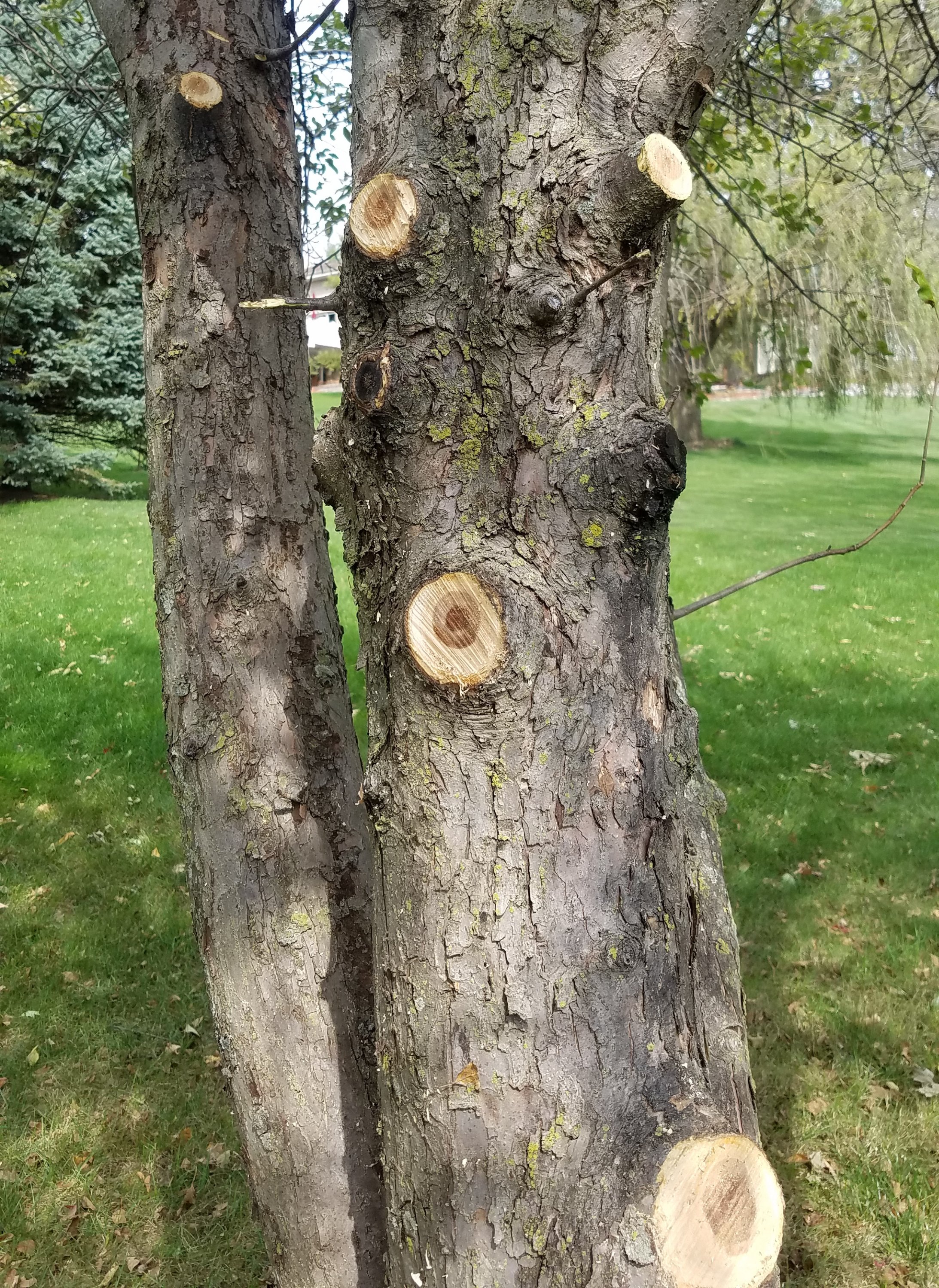
Removing deadwood

It is not ideal to chainsaw dead branches from living trees in autumn yet that’s what I did during my morning work shift. The wounds provide an entry point for insects which may eventually kill the tree. Some of these apple trees are eventual goners, so there was little to lose.

A bee landed on one wound while I was working, making my point.

I couldn’t get to sleep Thursday night which is unusual. I was stressed about 2020 and everything that has happened. A lot of that is going around. When I finally got to sleep around midnight I slept until 4:30 a.m., later than usual.

News the president and first lady contracted COVID-19 waited for me to wake. My reaction was he brought this on himself and should have been more careful. Regular people knew that all along. The following hours were filled with other takes and by the end of the day the president was hospitalized at Walter Reed. Last report was he didn’t need supplemental oxygen.

Friday I did morning work then rode my bicycle. When I got home I spent time outdoors. Leaves on deciduous trees have ignited into color. It was glorious to be outdoors. I feel better after using the chain saw. The pruning is partly finished and a new pile of brush awaits processing. The woodpile will get taller once it is.

The natural part of each day has been calming. We could spend more time in nature and be the better for it. So much depends upon this election, though. It keeps us up at night and retards our ability to function as we once did. We must work through the challenges and maintain our own health and welfare at a basic level. It means wearing a mask while talking to neighbors in the driveway, putting mail in quarantine a couple of days before opening, and reducing the number of in-person contacts with people we don’t know.

Out of isolation something better will come, a path to a better future, I hope. Days rush by toward the election and we can’t wait for the catharsis we hope it will bring. The uncertainty is unsettling and it’s important to acknowledge that.

Saturday begins another day with a full schedule. Mostly I’ll be working on the election as the first gleaning of the garden was yesterday and the brush pile can wait.

We placed our bets that hard work will change the direction of this misguided country. We all must do our part. Most of us are doing the best we can.

Categories
Kitchen Garden

At the Orchard

Wilson’s Orchard and Farm, Sept. 30, 2020

I began work at the orchard in August 2013. It feels weird not returning this season. I was asked. Due to the coronavirus pandemic and Iowa’s lack of governmental leadership in containing it, combined with my personal risk factors, I declined the customer-facing position as mapper. Maybe next year.

A May frost during bloom took out some of the crop. Then the derecho knocked down trees and shook fruit loose. For the first time in my memory there was no u-pick operation last weekend to allow remaining apples to ripen. It won’t be the best crop. The apples I bought yesterday were grown by the chief apple officer’s brother in Michigan.

There is a crop. I hope to buy a bushel of Gold Rush at the end of the season. When I last inspected those rows they were abundant. What happens is customers start picking them before they are ripe. I’ll wait to see what’s left at the end of October when they ripen. Fingers crossed.

Our back yard apple trees are reaching the end of their lives so I planted two new ones last spring. The Earliblaze trees are slowly dying. The Red Delicious tree had a branch knocked down and the scar from where it was can’t be fixed. Since my trees alternate years of bloom we’ll see what they do next year but it’s clear they need to be replaced.

On Instagram I follow a few Europeans who post about food. Yesterday Maria Bessières posted about apples:

“Got a bit carried away this morning at the market and came home with 4 kg of apples. Now, there is a difference between an apple you get from the grocery store and the apple that grows in your garden. In Estonia apples are one of those things that you never run out of during autumn. Everyone has a grandma with an apple garden or a summer house with apple trees and once the season starts, there is no end in sight. So you make apple jams, compotes, juice, anything and everything you can imagine that uses apples. And when there are still too many of them lying around, you put bags or buckets of them outside of your garden for whoever happens to walk by to help themselves. Apples for days and days to come.”

In the United States that world of apples doesn’t exist with consistency. Supermarkets sell many apples yet we rarely buy them there. When our own trees don’t produce we visit one of the several area orchards and eat them fresh and in season. Instead of dealing with apple abundance during off years we buy them as commodities for out of hand eating or specific recipes. When we do have a crop I put them up as apple sauce, apple butter, dried apples, apple cider vinegar, apple juice, frozen apple slices, and more. During off years we work the pantry down until there is another crop. There is a predictable pattern of our personal apple kingdom. It’s reflective of a type of American individualism.

It’s already October and the orchard is into Ida Red and the Jonathan family of apples. Because of coronavirus restrictions the experience isn’t quite the same. I see them advertising for help in social media yet I’m not tempted to return until the risk of contracting COVID-19 from customers is in the rear view mirror.

The orchard is a pretty place, a fit place for walking and breathing fresh air. A change of scenery from the isolating confines of home during the pandemic. The cloudy sky doesn’t look different, then it does as we spend a couple of autumn hours at the orchard.

Categories
Living in Society

Holding Pattern

Turn around at Lake Macbride State Park, Saturday, Sept. 26.

While waiting for Joe Biden’s first presidential debate my mind was not on politics. I was wondering what to do after the election.

I returned in memory to a trip I made to Philadelphia in September 2001 after the attacks on the World Trade Center and the Pentagon, the day an airplane laden with terrorists and bystanders crashed in Somerset County, Pennsylvania. Passengers on my flight were few, with most seats open. The country was still in shock although I had business to attend. While driving to the Cedar Rapids airport I heard the president was also planning a trip to Philadelphia that morning, his first trip after the terrorist attacks.

Because of the president’s visit our aircraft entered a holding pattern as we approached Philadelphia. It lasted a long time, 45 minutes or so. When we were cleared for landing and did I entered a changed world, eerily quiet. I rented a car and drove to our operation on Grays Avenue. There were law enforcement officers on every corner. I encountered the Bush motorcade heading back to the airport on the opposite side of I-95. It was a turning point in my support for the president after the attacks.

The question I find myself asking today is similar to what I asked myself that grey day in Philadelphia. What will be next? An honest answer today is I don’t know. A lot depends upon the outcome of the Nov. 3 election.

Yesterday the other shoe fell as the Walt Disney Company announced layoffs for 28,000 workers in Florida and California. After cast members were on furlough for six months this is an unwelcome announcement. Airlines will soon follow suit with layoff announcements. Cruise ships haven’t figured out how to operate post-pandemic. People aren’t going to the movies as they did. Government has done a poor job of containing the coronavirus and people do not want to join the more than one million people world wide who died from COVID-19. Everyone is cautious and it is unclear if or when we will do things again that once seemed so normal. If the travel and entertainment industry can’t figure it out, there’s little hope for us until well into 2021 or maybe 2022.

In the meanwhile we are in survival mode, conserving resources and making do. Every extra cent from our pensions is used to pay down debt and keep our credit lines open. The August 10 derecho resulted in $1,200 in direct expenses for us. We got off easy compared to many. The unresolved stress of the elections works against our best intentions. It will be worse if Republicans win.

In all of this we must find hope enough to find our way out of the darkness while remembering the darkest hour is just before the dawn. It is hard to find hope when we’ve been up all night.

Categories
Living in Society

Morning After: Iowa U.S. Senate Debate

Fall morning in Iowa

Republicans accused Democrat Theresa Greenfield of lying during last night’s debate on Iowa Press. Democrats accused Republican Joni Ernst of lying. The debate was a brawl, a cacophony of talking points. It was tedious.

Art Cullen, editor of the Storm Lake Times, described the event best, “the senate haggle debate.”

2020 is a change election. After six years in Washington Joni Ernst has not delivered for Iowa and Iowans seem ready for change. In the Washington Post, Cullen framed it like this:

Not long ago, 60 percent of Iowans approved of Ernst’s performance. Now, the same percentage disapproves. They tell the Iowa Poll that Ernst has not done enough for Iowa — a criticism that felled past senators such as Dick Clark, John Culver and Roger Jepsen before her.

History doesn’t always repeat itself yet this is Iowa and it could.

It was difficult to engage in the first ten minutes of the debate. Moderator questions meant little and perhaps the best use of the plexiglass separating people at the table due to the coronavirus pandemic would have been to build a cage like those in WWE events and turn the two candidates loose in it. It would not have been “senatorial” as David Yepsen tried to interject, yet that was the dynamic of the hour.

The Roe question asked by O. Kay Henderson was the expected dud. Not sure why she asked as the positions of the candidates are well known. Both indicated Roe is settled law, something even Supreme Court associate justice nominee Amy Coney Barrett has said. What matters more in the Supreme Court is how Roe v. Wade is viewed as precedent, or if it is even considered when deciding cases that involve late-term abortions and other women’s health issues. From a U.S. Senate candidate perspective what matters is whether one is pro-life or pro-choice. We know the answer because we are beat over the head with it constantly by media that believe conservative religious groups are very important in Iowa politics after Bob Vander Plaats got some judges tossed out.

Another Henderson question was about infrastructure. We delved into my favorite tropes about the gas tax. Regardless of how people use vehicles, or whether they don’t, everyone benefits from well-maintained roads, bridges, airports, seaports and railroads. The gas tax served it’s purpose regarding transportation. However, the formula is increasingly outdated as fuel economy increases, a growing number of travelers use electric cars, and our logistical supply chain has become more complex. Revision of how infrastructure that benefits all citizens is financed requires a bipartisan majority and better reasoning than tinkering with the outdated fuel tax system. Republicans held the majority and couldn’t effectively address infrastructure. It’s time for a change. I couldn’t really listen to this part of the debate.

Last night Theresa Greenfield put the scrappiness in “scrappy farm girl,” one of her taglines. Joni Ernst tried to dominate using talking points that mirrored her campaign manager’s pre-debate release. As expected, both stayed close to campaign talking points and didn’t get caught off guard. However their debate mannerisms made it difficult to follow and overall diminished the effectiveness for less informed viewers.

A majority of Iowans have determined for whom they will vote. There is one more chance to persuade the electorate before county auditors begin mailing ballots on Monday. If the Oct. 3 debate is like last night, few will be convinced of anything. Confirmation bias will rule.

Increased voter turnout caused by the Secretary of State mailing all state voters an absentee ballot request, combined with the fact that Ernst is perceived as not having delivered needed results for Iowans, will steer this race toward Greenfield. Recent polls show the same.

Like many Iowans I’m tired of the debates even though last night was the first of three. It’s time to vote.

Categories
Living in Society

Joni Ernst: Lying Liar of the Liardom

Signing the Police Pledge – Photo Credit – @joniernst Twitter Account

Tonight at 7 p.m. Democrat Theresa Greenfield debates her Republican opponent, the incumbent, junior U.S. Senator from Iowa.

Greenfield is expected to be well-prepared for the face off on Iowa Press. She should lay out her plans to make health care more affordable, and to protect Social Security. The link to a live stream is here.

Why didn’t I mention her name? Joni Ernst, the lying liar of the Liardom, may be pathological and I don’t want to get into other possible personality disorders. I want to be as focused as Greenfield is expected to be tonight.

What set me off is Ernst lies about Theresa Greenfield’s position on police reform and systemic racial injustice. Those are both issues requiring our thoughtful attention. By rendering the discussion into hyperbole and outright falsehoods, Ernst preempts any serious discussion or debate.

Epitomizing the distraction, on Sept. 3, Ernst signed the so-called “Police Pledge” from the radical conservative group Heritage Action. Here’s what it says:

A lawful society—free from mob rule and violent insurrection—is not possible without Law Enforcement.

Police Officers have chosen a noble profession. They dedicate their lives to upholding the law and protecting the sacred rights of their fellow citizens. As a profession, they deserve support and respect.

I stand with America’s Police and pledge to oppose any bill, resolution, or movement to “Defund the Police.”

The statement seems reasonable until we realize it is an attempt to rally around our police officers as a political calculation. I mean, who doesn’t like law officers we get to know in our communities? Ernst’s hyperbole and blatant lies about Greenfield obfuscate the issue. Instead of having a reasonable discussion about police reform or systemic racial injustice Ernst distracts us.

What lies has Ernst told? Here is one.

“But I see that my opponent and presidential candidate Joe Biden, you know that path is defund the police,” Ernst said in an Aug. 11 interview with KCAU. “It is encouraging others to rise up against the government.”

At no time has Greenfield, or Joe Biden for that matter, supported defunding the police. Greenfield has been explicitly clear. She does not support defunding the police. Instead, she believes we need real reform with more transparency and body cameras, more civilian oversight and Department of Justice reviews, and better racial bias and de-escalation training and standards, along with other long-term investments to address racial disparities in policing, housing, health care and education, according to her campaign. Greenfield said something similar on multiple occasions.

Here’s another lie:

“My opponent will support a position of dismantling our police, not just correcting injustice as it is out there, but actually getting rid of the police, which is not the direction that Iowans want to see,” Ernst said at the Aug. 26 Spencer Daily Reporter forum.

Nope. Theresa Greenfield doesn’t want to get rid of the police.

Here’s a third lie:

On Sept. 3, Joni for Iowa sent a press release titled, “Iowa Democrat Theresa Greenfield Denounces Police as Racist.” Three days later, at the Crawford County GOP Tractor Parade, Senator Ernst claimed that Theresa Greenfield said police are “systemically racist – which means that every single sheriff’s deputy, sheriff, every police officer, every trooper up there, she’s calling them racist.”

Theresa Greenfield has never once said that all police are racist. Ernst’s lies falsely manipulate Theresa’s comment on WHO-TV’s “The Insiders” where she said that “we do need to address systemic racism, not only in our policing, but in our housing policies and systems, in education, in health care, in financing, lending, and so much more.”

Like normal people we expect to hear candidates debate issues that matter. Instead of promoting that type of discussion Ernst seeks to distract from her own shortcomings.

Let’s face it, I’ll rarely agree with Senator Ernst. However, I believe that instead of rallying around the police we should address the actual mob rule and violent insurrection going on as conservative Republicans dismantle our government, assault the idea of equal protection under the law, and loot the commons. Here the junior senator seems a willing co-conspirator.

Highly recommend watching the debate. Let’s see if the lying liar from the Liardom can speak any truth.

Categories
Living in Society

Sunday Turn Around

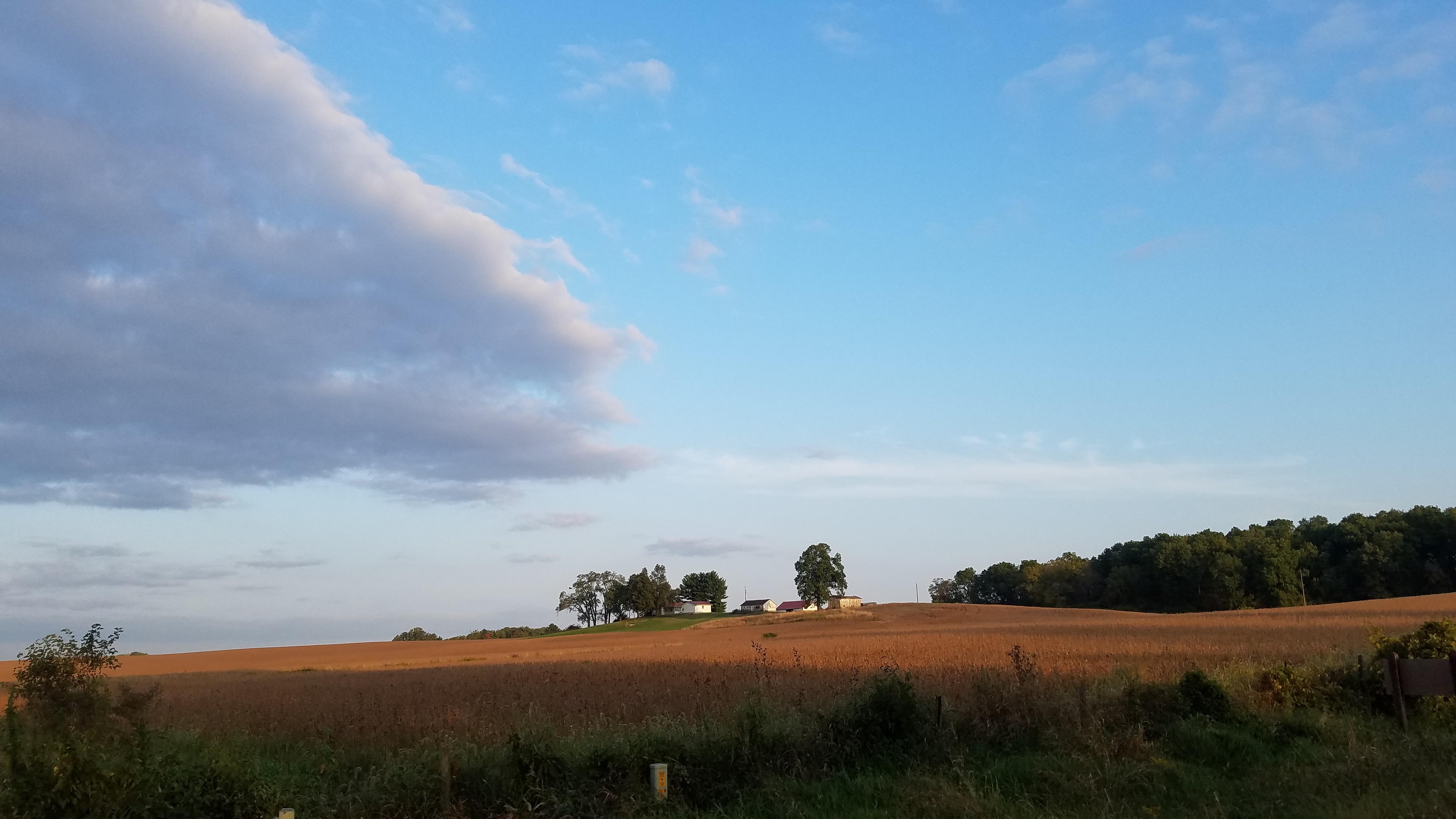
Soybeans coming out of the field in Johnson County.

As the odometer hit five miles I stopped and turned toward home. A light rain began.

Pedaling at 15 miles per hour I rode ahead of the rain cloud. Real rain would come later in the day, in the afternoon, on my political yard sign pickup event.

A week from today the county auditor will send out vote by mail ballots. Increasingly my energy is devoted to the election outcome. It will be a long, hard ride to Nov. 3. I’ve been in training for the coming month and am ready.

Everything else takes a back seat as I help bring this home.