Categories
Kitchen Garden

Vegan Cream Sauce

Raw Cashews

We have been experimenting with vegan dishes during the coronavirus pandemic. A basic recipe is “Vegan Cheese Sauce.” It’s a horrible name since it mentions the dreaded dairy product even though there are none in the dish. It’s a work in progress.

Our household began to move away from animal products when it was established in 1982. We became ovo-lacto vegetarians at home. That means we ate dairy products, including those made from cow and goat milk, along with chicken eggs. We have an interest in reducing reliance on those as well.

I am not doctrinaire about diet and maintain a semi-omnivore status. I hardly choose to eat meat, though. The pandemic has us avoiding restaurant dining completely and that was the source of what little meat I ate. For the past year the amount of dietary meat has been zero. I like my omnivore status and remain flexible when socializing outside home when food is involved. Usually, but not always, buffets and snack trays have plenty of vegetarian options. I don’t understand the American idea of eating constantly though, even if it is socially acceptable to serve food at a two-hour reception.

I know how to prepare a chicken and have done so. It was part of my survival training in French Commando School. Other cooking with meat is not complicated. In the unlikely event inadequate plant-based nutrition is available, I can return to survival mode. For the time being, the squirrels, rabbits, deer and raccoons traveling through our yard needn’t worry.

Why do vegan chefs compare their dishes to what omnivores eat? For example, this recipe for vegan cream sauce is intended for a version of vegan “macaroni and cheese.” There is a proselytizing aspect to such nomenclature and the resulting dishes. The vegan chef is recruiting us to join the culture. This dish tastes nothing like macaroni and cheese made with sharp cheddar and that should be okay without the cultural context. There is a whole business of imitation or fake meats and cheeses. As we navigate these waters I’m not sure why chefs don’t just go for dishes that taste good on their own merit.

Raw cashews don’t immediately come to mind as the base for a sauce. They are abundantly available, and easy to work with in the kitchen. The prepared sauce serves in pasta dishes, and more experimentation is needed. Ideas to be considered are using it on a pizza crust instead of tomato sauce and dairy cheese, on tacos, and in dips. The cuisine developed in our household has little emphasis on sauces, so the most likely use is with macaroni noodles. It is a once every four to six weeks dish.

I made vegan cream sauce three times and settled on a recipe. I enjoy spicy food and others does not, so most spicy seasoning is added after serving rather than cooking it into the sauce. If we had them, the dish could be topped with diced raw vegetables like Serrano or Jalapeno peppers, onions, shallots or scallions. Here is what I came up with.

Vegan Cream Sauce

Soak three quarters of a cup of raw cashews overnight in water. The amount easily fits in a quart-sized canning jar. Rinse in the morning, refresh the water, and soak until ready to use.

To a blender bowl, add one cup plant milk, one quarter cup nutritional yeast, one clove garlic, one teaspoon onion powder, one teaspoon Dijon mustard, and salt to taste. (Optional spices to consider include turmeric, paprika, black pepper, red chili flakes, to taste). Blend the mixture until smooth, then add the drained cashews. Blend until it is a smooth consistency. Thin the sauce as needed using additional plant milk. It’s ready to go.

Perhaps the most important aspect of this recipe is to remember it is not cheese sauce. While it may be used the same way, the sooner we embrace the culture, the better we’ll adapt to new dishes in our cuisine.
Categories
Living in Society

Why Politics is Less Fun

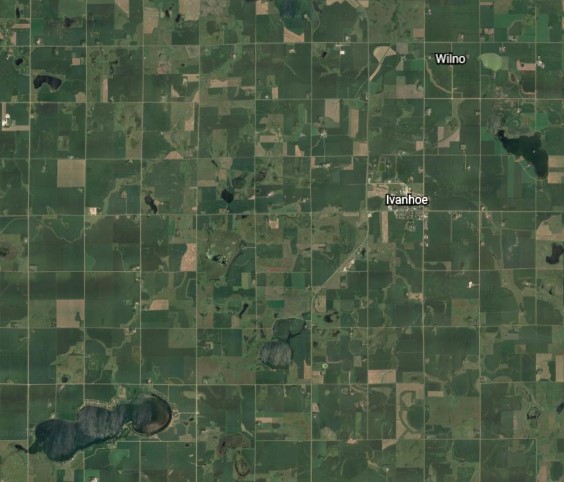
Google Earth clip of Lincoln County, Minnesota.

Depending upon which family tree one ascends, I am fifth generation American. The line descends from Prussia near Poznan during the late 19th Century partition of Poland. American politics was not as high on the list of priorities in 1883 when great great grandfather bought land.

An account of the funeral of the first Polish immigrant in Lincoln County, Minnesota says who we are as well as anything.

The first death that occurred after the Wilno Poles arrived “out of the wind,” as Róza Górecki had put it, was an occasion not only to mourn the deceased, but also to reflect on being buried in an alien land, far from the graves of friends and relatives. The funeral of Anna Felcyn (who died leaving several small children) in 1886 featured a procession with 30 wagons. Beginning at her home at 8 a.m. and proceeding past nearly every farm in the community, the procession lasted for six hours before reaching the church. Everyone stopped work for the entire day to attend the funeral Mass. A final procession to the cemetery — nothing more than a plot of land set in the vastness of the wind-swept prairie — ended in a graveside sermon by the pastor that was so emotional that all present — men, women and children — were moved to tears.

Poles in Minnesota by John Radzilowski

What stands out in this story is the sense of community. It takes a commitment to each other to make a six-hour funeral procession to the church. Over the years, these Minnesota Poles stuck together in numerous ways. After the turn of the century, the community advocated for Polish independence and for U.S. Government aid for their struggling homeland. They elevated George Washington and Abraham Lincoln into the pantheon of Polish heroes like Tadeusz Kościuszko and Kazimierz Pułaski in a process of assimilation that preserved their Polish ethnicity while entering the mainstream culture of Americans. Their politics came from this sense of community and causes that mattered to them based on their recent immigration and efforts to settle in Minnesota. I don’t know if they viewed it as “fun” yet absent these cultural ties, our politics has become less so.

Vestiges of community remained when I was growing up. Not so much a Polish community — although there was that — as much as a cross section of society created by my Virginia-born father and Illinois-born mother moving to and living in a community of mostly descendants of German and Irish immigrants.

Working out of the union hall where he was a member, Father organized the neighborhood to elect John F. Kennedy in 1960. When he finished organizing our neighborhood, he helped with another one nearby. The union hall provided the materials, although there were no computerized databases of voters like there are today. He worried about who lived here and how they might vote.

I was spoiled by the landslide victory of Lyndon Johnson in 1964 at age 12. Given recent Democratic presidents — FDR, Truman and Kennedy — I figured our party would dominate politics going forward. Living in Iowa, I knew the state was Republican yet Johnson’s decisive win created a false sense of security that political things would proceed in a commonsense, productive manner. Then came Nixon.

During the Nixon administration our politics lost grip of the rudder. He made some positive, logical steps in governance. He was perhaps the last president to do so in a way that benefited every American. At the same time, he appeared a drunken, vindictive, and lying politician. In the end, he was forced to resign. Since then, the party of our presidents rotated between Republican (Ford, Reagan, Bush I, Bush II, Trump) and Democratic (Carter, Clinton, Obama, Biden). The main common political direction has been supporting the military by spending too much money. For the rest, Republicans negated Democratic initiatives and vice versa as time went on.

After Nixon, the potential for a landslide election like in 1964 was diminished. Increasingly our electorate became divided into factions. It took a global pandemic to enable our politics to focus on resolving the contagion and the economic crisis it helped create. When Joe Biden won the election it was absent a feeling of jubilation. Responses were subdued, more a sigh of relief that we could grab the rudder and steer the ship more toward sanity and discipline, at least for the next four years.

There is no returning to the 19th Century sense of community. Remnants remain yet it is no more as it once was. In the fifth generation since immigration I see we must make our own way. In politics we seek other means to connect with fellow citizens, although the connections are not deep as they once seemed. Increasingly achieving political goals is not fun. Those of us with progressive ideals accept political solutions to our most pressing problems are beyond the ken. On the long journey home we accept its length.

From time to time images of the six-hour funeral procession come to mind. We don’t understand fully what we’ve lost.

Categories
Sustainability

New START Treaty Extended

B-61 Nuclear Bombs

We received news on Tuesday afternoon the New START Treaty was extended.

“A week ago, the United States and Russia ‘exchanged diplomatic papers’ in order to extend the New START treaty for 5 years,” wrote Physicians for Social Responsibility in a Feb. 2 email.  “Biden and Putin got this done in time — before New START was set to expire this Friday, Feb 5.”

Recent Republican administrations have not favored arms control treaties. In fact, the George W. Bush and Donald Trump administrations exited existing agreements. U.S. Admiral Charles Richard recently wrote in the U.S. Naval Institute journal Proceedings, the potential for nuclear war remains present.

“There is a real possibility that a regional crisis with Russia or China could escalate quickly to a conflict involving nuclear weapons, if they perceived a conventional loss would threaten the regime or state,” the four-star admiral wrote.

There’s nothing new in the Richard’s statement. While our relations with Russia and China require scrutiny, not only with regard to nuclear weapons, but with every facet of their complexity, a few things remain clear about the course the United States should be taking to prevent the detonation of nuclear weapons which may escalate into a full on war. In their new book, The Button: The New Nuclear Arms Race and Presidential Power From Truman to Trump, William J. Parry and Tom Z. Collina outline a framework that includes these items:

The president should not have sole authority to launch a nuclear weapons attack. The U.S. Constitution gives Congress sole authority to declare war. They should be engaged with any decision to launch nuclear weapons against another state or non-state actor. There is no need for the “nuclear football” that has been shadowing the president since the Kennedy administration.

We should never rush into nuclear war. Experience has shown us time is required to gather all the information needed to verify an attack is in progress. There is simply no need for the president to decide to retaliate based on sketchy or incomplete information in a matter of a few minutes. Launch on warning should be prohibited.

First use of nuclear weapons should be prohibited. Given U.S. conventional force superiority, there is little reason to use nuclear weapons.

Intercontinental Ballistic Missiles with nuclear warheads, positioned in silos to launch on warning are obsolete. If the U.S. were attacked with a large-scale nuclear missile launch, ICBMs in silos would be the among the first targets. They are part of the so-called nuclear triad which includes submarines and bombers ready to launch a nuclear attack or counter attack. If there were a nuclear attack on the U.S., submarines and bombers would comprise our primary retaliatory response. ICBMs are obsolete sitting ducks.

Strategic missile defense systems don’t work, despite billions of dollars spent developing them. Russia sees U.S. missile defense systems as a threat to their ability to retaliate in the event of a U.S. nuclear attack. U.S. missile defense systems, by their existence, block advancement of arms control negotiations between the world’s two owners of 90 percent of nuclear armaments.

The bigger picture is nuclear states should take seriously Article VI of the Non-Proliferation Treaty and work toward elimination of nuclear weapons. For those nuclear states which haven’t joined the treaty, they should. Countries should reduce and eliminate spending on weapons of mass destruction.

While I don’t agree with the Biden administration’s military spending priorities, I’m glad to receive the news they extended New START for five more years. Now build upon it.

Categories
Living in Society

Home Library

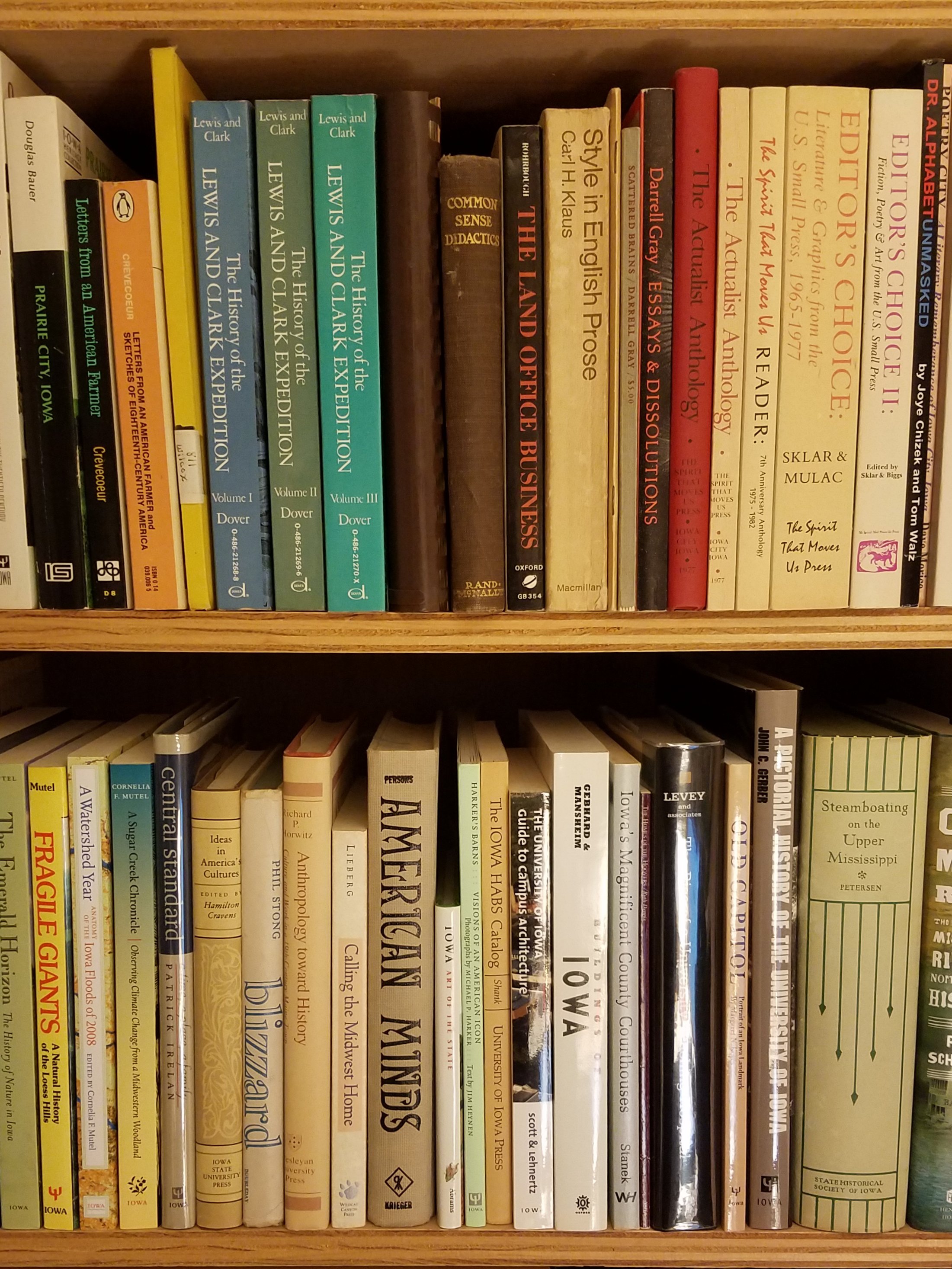
Bookshelves, Feb. 2, 2021.

Toward the end of my seventh decade I continue to buy books. I should stop, turn that around, and reduce my stacks each week. I am loathe to do it.

From my earliest days, going back to 1959 at least, I had a small library of books either given to me, or once I started working, ones I bought. The library has grown too big, and in truth, that happened years, maybe decades ago.

The easiest change would be to start reading books on an electronic reader instead of buying paper copies. Readers are convenient and the font size can be adjusted, making words easily legible. Quality of eyesight is increasingly an issue. A reader is better for reading in bed, and in a recliner or comfy chair. It would not be a big change to start reading fiction in that format. Adopting technology is a good thing and it would stop growth of the stacks.

A lot of volumes in my library were written by people I know, with whom I took classes, or did things. Others were special gifts. They have a souvenir value, a remembrance of time together.

For example, I made a driver recruiting trip to Southern Illinois University where, in addition to my recruitment event, I spent time with some teachers who felt isolated in the coal mining area. Students were more interested in getting a job in the trades — truck driving, coal mining, or manufacturing — than in learning. The teachers stuck together as a form of intellectual society. One of the group was Lucia Perillo who wrote a book of poetry, The Oldest Map with the Name America. I return to it often as a reminder of the challenge of intellectual pursuits in our time. I don’t recall if I met Perillo, but she was part of the group and it doesn’t matter to the memory.

The problem with books is they can be used as reference materials for my writing. It is a justification to keep almost any book. The idea I may return to it later for “research purposes” may sound good, but there is so much research and so little time. I need to thin the stacks. That, too takes time.

Our daughter expressed an interest in inheriting my books when I go. It would be a crime to leave her everything because some are more significant than others. If anything, the ideas of an inheritance will force a reckoning, a reduction in quantity, and an improvement in quality.

I started filling boxes that arrived containing mail ordered books with duplicates and others in which I lost interest. The idea is to give them to the public library for their used book sale. I have three boxes so far and it’s a start. I should fill more boxes.

Books are an addiction. In the scope of things, it is an inexpensive addiction. I spend no time on sports, movies and television, and go shopping only when we need something. Books can produce value in our lives. I’m reading more of them. Partly due to the coronavirus pandemic, but also because I realize the limited number I can consume before my inevitable ending. There is an increased urgency to read.

A friend said I should get rid of all the books. So did my late Mother. While I’m not ready to do so, a reasonable goal is to fit all of my books in the writing room. I have a long way to go to accomplish that, if it can be accepted as an operating premise. Today, I’m not sure it can.

Categories
Environment

Warm January

Open water on the driveway, Jan. 31, 2021.

This winter is shaping up to be a scary one. There has not been a substantial cold snap where the ambient temperature remains below zero for a week or more. We need that to suppress the insects living in the ground that feed on our plant life in the garden and yard when it gets warmer. Cold weather is also the best time to prune fruit trees.

It’s no surprise it’s getting warmer.

Atmospheric CO2 concentration hit 413.95 ppm at the Mauna Loa Observatory in Hawaii in December 2020. In my birth year of 1951 the global average was 311.80. There is a direct correlation between atmospheric CO2 and planetary warming. Our best hope is it’s not too late to mitigate rising CO2 levels.

According to NASA, 2020 tied 2016 as the warmest year on record in global average surface temperature. According to this chart, the rise in global surface temperature is in an accelerating upward trend since the baseline period of 1951-1980.

In the general election of 2020, Americans took a necessary step toward climate action by electing Joe Biden and Kamala Harris, the president and vice president willing to examine and understand the science of climate change and take action. Because Biden served as Barack Obama’s vice president, he knows what to do. It would have been better to elect a stronger majority in the legislative branch of the federal government, yet we didn’t. The majority we have will serve as we can’t wait two years to increase the majority of science believers in the midterms.

The United States rejoined the Paris Agreement within the United Nations Framework Convention on Climate Change. Like the election, it’s a beginning step. The Paris Agreement is flawed, yet it is difficult to see how the world makes progress toward reducing greenhouse gas emissions without the kind of cooperation it envisioned. Our country simply must be part of the discussion.

As a single citizen, or a small family, it is difficult to see how to help. We can and should reduce our personal carbon footprint, especially by doing things that don’t require a lot of capital: use less hot water, set the furnace thermostat lower, run the air conditioner at a higher temperature, use less gasoline and natural gas, eschew air travel and long automobile trips. The coronavirus pandemic kept many of us at home and that had a direct impact on greenhouse gas emissions. Eventually we will learn to live with the coronavirus and when we do, the need to control emissions will remain.

These are scary times. One view is there is nothing to be done about all this. The apocalypse is coming and the best we can do is mitigate its impact on us as individuals. It’s a vision of doomsday preppers, isolated and remote enclaves of the wealthy, and an attitude of preserving self as the catastrophe hits. I reject this view. We are stronger together and together we should remain in mitigating the impact of climate change.

It also seems important to focus on the big picture. Political leadership is required to make progress. For some of us, such leaders won’t be as bold as we want or feel is needed. We can’t relent on our politics.

Iowa has had its recent climate-related difficulties, floods in 1993 and 2008, tornadoes, straight line wind, a derecho, and drought. At the same time row crop yields were decreased due to climate change, as in the 2012 drought, a new, diverse agriculture remains possible because of our growing conditions. Gardeners like me contribute to resolving climate change by growing more of our own food. The process would be scalable if the importance of growing more local food were more generally accepted. We do what we can with local resources and conditions. We could do more.

Scary as it is, we can’t get depressed. It is human nature to be hopeful and hope is one of our most powerful attributes. It is important to be realistic about where we stand on mitigating the effects of greenhouse gases. For the next years, the picture isn’t going to be pretty. We can’t give up. We must persist in the effort to make our communal lives better. That’s what I plan to do.

Categories
Writing

A Blank Slate

Big Grove Township School #1, Jan. 29, 2011.

These days of contagion seem like a blank slate. By leaving the workforce after the coronavirus pandemic was declared, I found a form of freedom in each day’s beginning.

I hadn’t planned it, yet the pandemic forced my retirement. With our pensions and health care, mostly from Social Security and Medicare, we have adequate financial means to survive without paid work.

Each day begins with a chance to do what I want. I have a daily outline, though, so I know what tasks I told myself would be next.

Once the pandemic recedes, I may return to part time work for the socialization it provides. That is, if I can find people with whom I would enjoy working. Any additional income will find a place to be spent, yet income would not be the main objective.

For now the focus is on writing. I should get more disciplined and stick to my outlines. That seems too much like work. In January, my average daily output was 2,179 words. With editing, that number will be reduced in the final product. During the last draft before starting another section, editing takes more time. Partly it is figuring out what to say and how to draw on resources. Mostly it is reaching for a form of satisfaction in the written words.

There is a good month of winter remaining before I set up the greenhouse and plant cruciferous vegetable seedlings. There’s no time to dally on a blank page. I’m young enough to believe I can do what I want today and tomorrow. At the same time the work ahead is clear and will occupy my days.

For a moment I’ll bask in this moment, when the day seems like an endless expanse ready to be traveled. That alone can make life worth living.

Categories
Writing

Moonlight Shadows

Moon rise, Jan. 27, 2021

It was a full moon in a clear sky on Thursday. White snow showed the shadows of everything on its surface. We looked on in wonder as the moon rose.

When my maternal ancestors emigrated from Poland to Minnesota, Poland did not exist. It had been partitioned three times beginning in the late 18th Century and completely dissolved for more than a century before 1918. Serfdom had been abolished on May 3, 1791, yet the partition mostly nullified abolition. Serfdom’s vestiges persisted into the mid-Nineteenth Century. My ancestors came from the cohort of former Polish serfs. Our stock was peasant subsistence farmers for whom life in Europe, especially after the end of serfdom, made them want something better.

Maciej Nadolski emigrated from Poland through Philadelphia and took wage work as a coal miner in Allegheny, Pennsylvania. He was recruited from there to be part of a new colony near Wilno, Minnesota. Beginning in February 1882, 40 Polish settlers bought land from the railroad in Royal Township, Lincoln County, Minnesota. Great, great grandfather bought his parcel on Sept. 22, 1883.

Most of the Polish settlers in the new Wilno colony didn’t know each other before moving there. The organizing principle of the colony was for the Winona and St. Peter Railroad Company to deed land in Wilno for a Roman Catholic Church and cemetery to support a new, Polish-speaking community to whom they hoped to sell land. St. John Cantius Roman Catholic Church was built in 1883 and served to bring the community together. In this these Polish immigrants began a new, American life.

Lincoln County was one step out of the frontier in 1883. The first white child was born there in 1869. The first newspaper was published in 1879. In 1874 there was a grasshopper infestation that continued for a couple of years. The presence and perceived threat of Indians was real. If the Poles were coming to Royal Township to become subsistence farmers, the county had not previously seen a lot of success in it.

As I study this period and culture, a couple of things have been on my mind.

The historical accounts make scant mention of women. While writing about Nadolski land ownership and the Wilno colony for my book, I had an epiphany that Maciej was married to Franciszka Nadolski and her name appears on some of the deeds. It would be a mistake to leave women out of the story. After considering what artifacts survive from that time, the historical narrative makes more sense: there was a rich cultural life in addition to the hard work of subsisting on the Minnesota prairie.

Until this year, I did not understand that there was a Wilno colony and what it was. When I visited Wilno in 1991, the place did not seem like much. That’s partly because automobile culture had been dominant for a long time since settlement. Early settlers just made do with what they had. The rise of mass marketing and consolidation of business and wealth was yet to come.

The colony developed indigenous solutions to common problems of commerce and agricultural cooperation. While the railroad said they might run the line through Wilno when the original plots were sold, they ended up platting a new town of Ivanhoe (a.k.a. New Wilno) to the south because there would be more land sales to benefit the railroad. As an inland community it is remarkable the hamlet of Wilno survived at all.

The Polish immigrants’ connection to the Catholic Church was a main part of the settlement. If the railroad had not given land to the church, there would have been no colony. While there were established settlers in the county in 1882, they were not Polish. As the Poles arrived, their common language and culture created an insularity as they farmed, congregated, and socialized among themselves. Over time that changed, yet it was a cultural trait that persisted through my grandmother who was born there, and in some form was passed down to me.

In the shade of the spruce tree on Thursday I was thinking about how few cultural connections we have today. Anyway, we don’t have them the way the original Polish settlers of the Wilno colony did. We have many friends and some family. During the coronavirus pandemic we email, text, telephone, and video conference with them a lot. It’s not the same. Broader community connections especially like the church, although other cooperative ventures as well, have been broken by mass communication, consolidation of business, and concentration of wealth. While my ancestors may have escaped post-serfdom life as wage earners in partitioned Poland, in the United States today, with wages stagnant, unemployment high, and jobs that create a sense of community scarce, we may be returning to our serfdom roots.

It seems a long way for them to have come for life in society to end up this way.

Categories
Living in Society

Count the 22 Votes

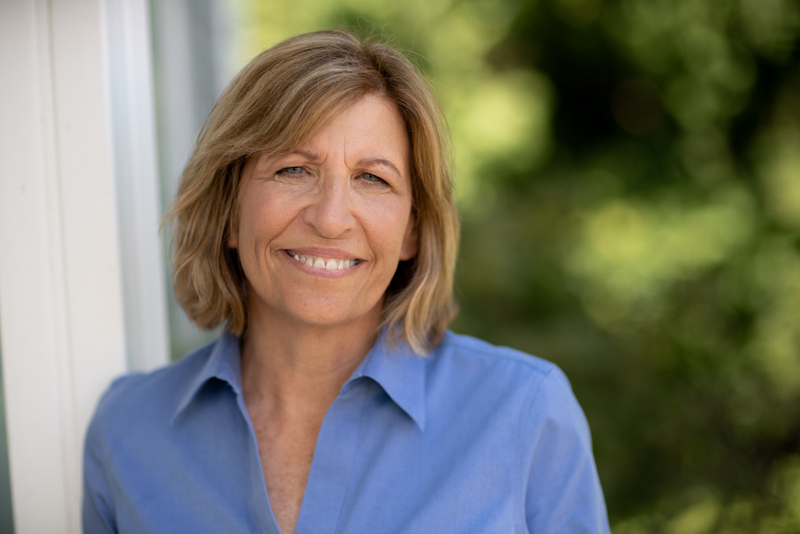
Rita Hart

The Federal Contested Election Act of 1969 is the statutory basis, designed by the Congress, to resolve election disputes like the one between Rita Hart and Mariannette Miller-Meeks in Iowa’s Second Congressional District. With a six-vote margin, it was as close as it could get.

The Hart campaign identified 22 legally cast votes that were not counted. Miller-Meeks has not contested them. They should be counted.

I read Miller-Meeks’ response to the appeal and it argued, in part, Hart did not exhaust all state-level venues for her contest. No she didn’t. That is not relevant. There is no legal requirement under Federal law to exhaust other remedies in this election dispute. If anything, the House Administration Committee is exactly where this dispute should be decided as the Congress designed the statute specifically for this type of case.

I would understand if Miller-Meeks contended the 22 ballots identified by Hart were in some manner suspect. She didn’t. Whatever the Congress decides on the rest of it, those 22 votes should be counted.

~ This letter first appeared in the Jan. 28, 2021 edition of The Daily Iowan

Categories
Writing

Seeing the Light

Onions starts under a grow light.

A few onion sprouts poke toward the grow light from channel trays resting on a heating pad. Planted Jan. 20, more of them should germinate soon and rise up. I check them multiple times each day. Successfully growing them is not a given.

We are a distance from working in the garden. Tuesday I cleared a deep snowfall from the driveway in case we have to get out. A neighbor plowed a two-foot berm left by the snowplow at the end of the driveway. We are well-provisioned and can stay home for a while, that is, unless something happens. I would enjoy visiting friends over coffee in town. But for the coronavirus pandemic I would.

Joe Biden has been president for a week. Already he ramped up COVID-19 vaccine distribution to bring an end to the pandemic. News reports say if his actions are effective, we could see the end of major risks of the virus by the end of summer. Partly, it’s why we elected Biden.

Tuesday was a good day for research on my book. I found a historian who used information and artifacts about my Minnesota ancestors to write about Polish immigration. While I printed copies of historical documents when I visited Lincoln County, his work pieces together a story I couldn’t see on my own. He tied together the locations where my Polish ancestors lived in Pennsylvania, Chicago, LaSalle County, Illinois, and Lincoln County, Minnesota with a specificity I hadn’t found previously. His work gave context to their lives in a way I couldn’t see when I visited the home place and surrounding farm community. His short article presented a believable picture of life at the end of the 19th Century that informs understanding of my family history.

For the last few years I’ve had trouble reading. When I visited an ophthalmologist at the University of Iowa clinics, years ago in the before the mobile device era, he identified a condition where my eyes don’t always focus together, resulting in a kind of double vision. Over the years I’ve gotten used to seeing double. Before he identified the condition I wasn’t aware of seeing double. I improved my reading ability by sitting at my writing table with eyeglasses on, instead of reading without glasses in bed or in a recliner. There was more at work than slight nearsightedness. Reading earlier in the day at my table has been more productive. While I wear bifocals and have specially made eyeglasses for desktop computer use and reading, my sight is pretty good. For that, I’m thankful as I read a lot, Now maybe I can read more.

It is another day in the time of contagion. I look forward to the gardening season, yet while there is snow cover, indoor work continues.

Categories
Writing

Army Volunteer

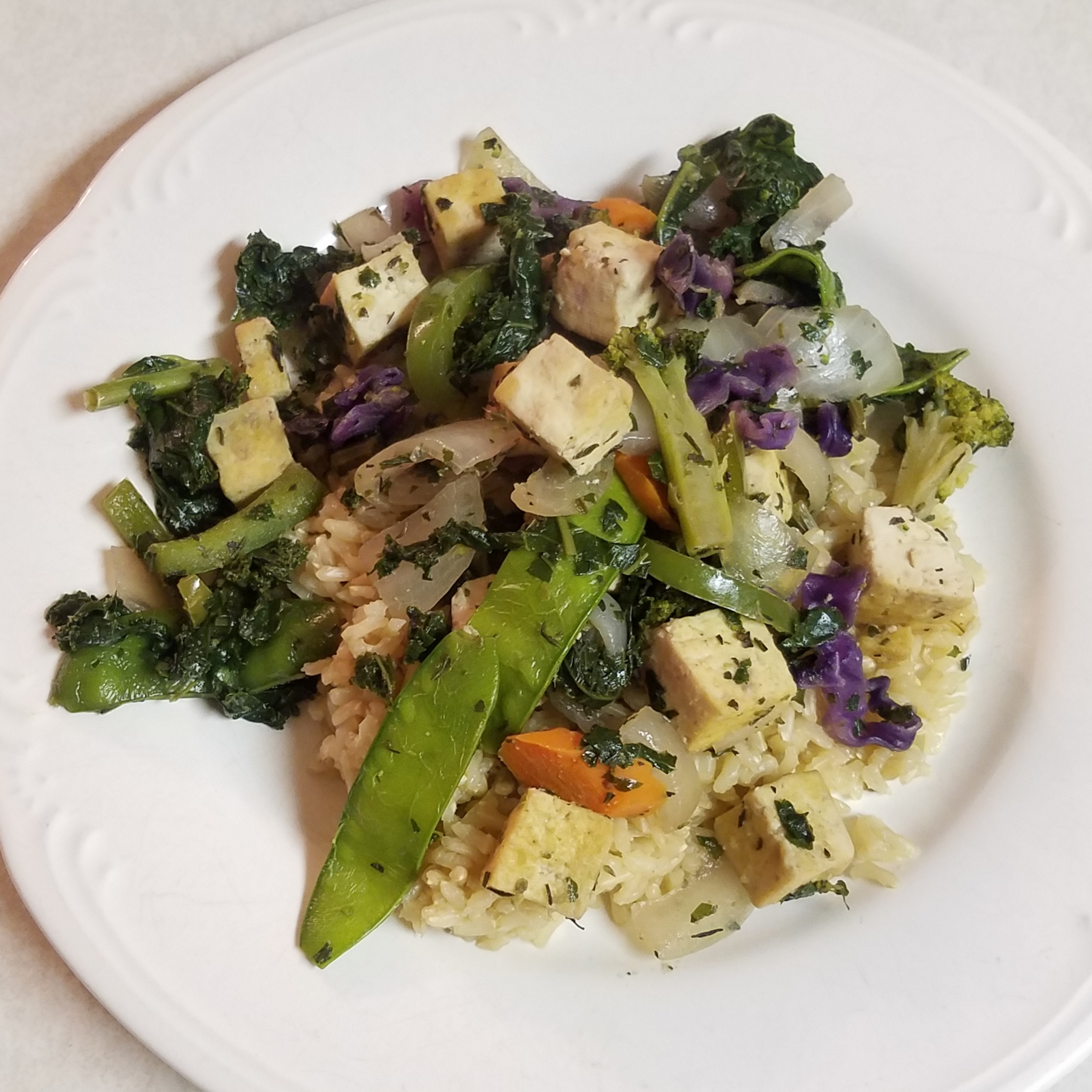
Stir fried dinner, Jan. 25, 2021.

My decision to enter the military created a personal challenge. I had protested the Vietnam War in high school and college, and favored non-violent approaches to resolving conflict. At the same time, Father had served in the Allied occupation of Japan after World War II. While he did not talk much about his military service, it was an important part of how his life evolved after graduating from Leon High School in Tallahassee, Florida.

Mother took me to register for the draft when I became eligible at age 18. I still have my Selective Service card. People in my birth year were eligible for the draft lottery on July 1, 1970 for calendar year 1971. I took a student deferment to attend the University of Iowa in fall 1970. Because of it, my number would be drawn in 1973 for the following year, after graduation. Rather than take a chance in the 1973 lottery, when the Selective Service drew 125, I canceled my deferment, and accepted eligibility, because my draft number was 128. One could be eligible for the draft lottery only once, so I was off the hook on conscription.

After graduating from university in May 1974, I stayed in Iowa City contemplating next steps. When Richard Nixon resigned the presidency on Aug. 8, 1974, a weight was lifted from me and almost everyone I knew. This freed me to take a long tour of Europe, a modern-day equivalent of the 17th and 18th Century Grand Tours. I returned to Davenport as winter set in. I worked a couple of jobs in 1975, yet living in my home town wasn’t for me. I remained restless about what would be next.

When the Vietnam War ended on April 30, 1975, I revisited joining the military. Without the danger of the Vietnam War, my father’s service came to mind again. I discovered a program to enlist for Officer Candidate School to become a commissioned officer. I took all the tests, went through various hearings, and despite frowns from the panel at my shoulder-length hair, was accepted. I enlisted in the program and left for Fort Jackson, S.C. in January 1976, the Bicentennial Year.

Why did I enlist? I felt the U.S. Army at the end of the Vietnam War was a despicable mess. The March 16, 1968 My Lai massacre of more than 500 people, including young girls and women who were raped and mutilated before being killed, was particularly on my mind. I believed the only way to address problems like My Lai was for people like me, who valued non-violent means of conflict resolution and common decency, to enter the military and do a better job of leading it. Father’s military service played a role in my decision, as did the opportunity of youth and being single. I have no regrets in following my father’s footsteps and joining the Army.

DAVENPORT, Ia. (Dec. 28, 1975) During the last three days I have heard two significant quotes and several metaphors well worth remembering here.

Christmas Day as I escorted my Grandmother down the front stairs (of the American Foursquare) and as the sun was sinking in the west, she said, “The day we have prepared for so long is gone.”

Also Joe, on the eve of his 24th birthday said, “The ink has dried on the last year, and already it begins to fade.”

Both of these touch home for me at this time of my life.

Journals, Dec. 28, 1975