Friday is my Monday as I embark on a substantial project to write several articles for the newspaper before the county seat makes a mass exodus for spring break. The paper expects to be shorthanded, so my editors want articles in the vault.
Today will be gathering information, with four scheduled interview events and a few followups. Tomorrow will be writing the first article and organizing to write the rest.
In part, it’s what being a writer means.
The rest of writing is varied and elusive. It is one thing to write for a newspaper, and quite another to compete for readers in the media jungle where their eyeballs reside. At some point writers decide whether to actively join the competition, or to focus on improving writing by cranking out work as quickly and as well as one can. It makes sense for me to choose the latter, and here’s why. Writing is a craft that requires practice. The only way to get better at it is to do it—often and regularly.
One of my projects is to create an anthology of past writing in book form to sell at public speaking engagements. When I review pieces written 40 years ago, a lot of them are pretty rough. My style has changed, and improved, even since I began blogging in 2007. Even more so since I began newspaper writing last year. The reaction to such editing of the past is to rewrite them all, or to let them stand warts and all. I have been unable to embrace either—the project is stalled.
Here’s the hard part: it’s easier to focus on paid work with an editor because there are specific demands to be met in a fixed time frame. When taking a drink from the fire hose of what’s possible, the rush of project ideas is hard to tame. Combine that with required attention to economic security and it is easy to see why many writers don’t get beyond the idea, outline or draft stage.
In a way, the short piece, around 1,000 words, is a great opportunity to improve stylistically without a big commitment. Writers miss an opportunity if they don’t create in short form because people are simply not reading that many books. According to the Pew Research Center, an average American reads five books per year, with 24 percent reading no books. Why spend the effort to produce book-length work if the chance of finding readers is remote?
Maybe it’s the full moon, maybe it’s threats to economic security, or maybe I’m just arriving, but as we cope with life’s busy-ness, it is important to consider where we’re bound and why. Becoming a better wordsmith to present short, meaningful pieces is never a bad path to take.
Snow fell as I drove home on Mehaffey Bridge Road through the lakes—a crystalline, sparkling snow. The wind blew as the sky darkened with imminent nightfall. I had turned the radio off.
I passed a frozen pond where a herd of deer and a flock of wild turkeys browsed—for what I couldn’t discern. A bald eagle flew overhead while entering the lane to our house. What other wildlife existed in the winter landscape went unnoticed, obscured by three historic species.
It is a time of change. This morning there is no Iowa City Press Citizen as the newspaper returned to a Monday through Saturday issue. They had been doing a brief cover, then inserting another Gannett Company paper, Des Moines Register, inside. Today the county seat is again without a daily newspaper.
That’s not to say there isn’t news. It’s just that people get news from a lot of other sources, including talking with neighbors and friends in person and over electronic media. Since I began writing for newspapers, I have read ours more. Despite the informative stories found inside each issue, news and news writing are not what they were, and the Monday issue is frequently quite thin. I predict newspapers will survive, but they compete for eyeballs in a way that has changed and continues to change. The economics of competition has led to less news coverage in newspapers and everywhere as we focus on the obvious.
I arrived home and turned the radio on to A Prairie Home Companion. That has changed too. One wonders how long it will continue once Garrison Keillor moves on.
Thinking about the mango-orange spread I bought last week, I put two tablespoons in a dish, added four tablespoons of home made salsa, mixed them together, and opened a bag of organic tortilla chips for a welcome home snack. Jacque was at work and not expected for a couple of hours.
The sweet taste of the mango came first, then the heat of capsaicin. It was crunchy, sweet, salty and spicy all at once. A perfect example of what living in these times means. We want it all at once.
We don’t often linger in falling snow to see what else is there. I’m certain it’s more than deer, turkeys and eagles.
The United Nations asserted that food production must double by 2050 to meet growing world-wide demand and to combat hunger which affects a billion people who are already here.
The 2009 report explained, “to achieve food security, investment in agricultural research, natural resources, financial services, local infrastructure, market links and safety nets are pivotal. Food prices, already high and volatile, could spike again as droughts, floods and other climate-related events affect harvests.”
In Iowa almost everyone has an opinion on how to feed the world, and there is no denying that the factors listed at the UN are important. There is also a role for increased productivity, measured in food produced per acre, in feeding the world.
To an investor—the kind that derives a living from Wall Street trading—opportunity presents itself. Synthetic biology writer Maxx Chatskoexplained on The Motley Fool:
To boost yields and combat pests, farmers will need to increasingly rely on technology ranging from high-yield seeds to agricultural biotechnology to even the Internet of Things.
While progress is being made, consumers in many wealthy nations are demanding that their food be grown using organic farming principles. Some consumers rationalize their purchasing decisions by claiming the health benefits of organic food (which have been thoroughly debunked), the avoidance of health risks associated with genetically modified foods (with which the scientific consensus disagrees), or the more environmentally friendly and sustainable approach to agriculture that organic farming enables.
This chart from Tom Vilsack’s USDA, cited by Chatsko, is a bit misleading:
For anyone who has been in a popular grocery store, box store or warehouse club, the proliferation of organic products is no secret and people are buying them. Growth of this market segment may represent an investment opportunity, or as Chatsko indicated, “the trend in organic food sales hints that opportunity does indeed exist, even if it’s fueled in large part by outsize marketing budgets, a fundamental information gap, or, worst of all, misinformation.” What’s most misleading about the chart is that it is only a market segment, not the global picture. That’s what the UN report was describing.
Local food production doesn’t come up in the UN report or on the Motley Fool analysis, and some of us believe it represents an answer to eliminating hunger. So where is it?
Partly, we are enamored of a few rock star farmers like Joel Salatin. It is hard not to like the stories Salatin tells in books like “Folks, This Ain’t Normal: A Farmer’s Advice for Happier Hens, Healthier People, and a Better World.” If Salatin and his ilk are great promoters of eating “real food,” such punditry doesn’t get to solutions to real problems. Thoughtful nuggets like this one distract us,
The world is awash in food and 50 percent of human food goes to waste because of anything from pernickety consumers, or because a Red Cross truck can’t get through a border. If you and I could figure out how to double food production, there would still be people going hungry for a whole lot of socio-economic issues.
We like Salatin, and some of us are glad he is able to make a living by speaking, farming and writing, but a few rock stars will not feed the world.
The story of Cuba tells a different, and I believe more sustainable story. Cuban agricultural systems were disrupted the end of Soviet support, oil imports particularly, in 1989. Reacting to change in the agricultural system became a national necessity as Cubans literally lost weight due to lack of calories. Cuba went local and semi-organic. Christopher D. Cook is among the most recent to recount Cuba’s story in “Cuba’s Harvest of Surprises.”
Cuba’s farmers shifted to organic fertilizers, traditional crops and animal breeds, diversified farming with crop rotations, and non-toxic pest controls emphasizing the use of beneficial plants and insects. This blend of measures is part of a sustainable-agriculture approach known as agroecology. It’s often described as a promising innovation — which is a little ironic given that it draws on age-old peasant farming practices.
There is a case to be made for peasant agriculture as a way to feed the hungry in a sustainable way. In doing so, there are substantial world-wide obstacles, not the least of which is access to land. In the United States people perceive a return to peasant-style lives as unappealing when they already cannot find time in the day. If Cuba represents a possible solution, it needs an advocate, and I don’t mean U.S. normalization with the island nation or a rock star promoter of it’s semi-organic food system.
There is a growing local food movement in the U.S. and it has had successes and challenges. A lot of folks are entering the local food movement only to find that it is tough to make a living. To clarify, by local food movement I refer to producing consumer goods to support a Community Supported Agriculture project, restaurant, farmers market or other geographically local food sales.
How people access land is a key constraint to entering the local food business. Local food production also relies on cheap labor—barter agreements, volunteers and lowly paid professional staff. Like with so-called traditional farming, success has been elusive and often requires government subsidies or working off the farm to pay basic, year-round living expenses.
Jaclyn Moyer, a Slate writer who operates a 10-acre farm in California, asked some key questions of the often rosy picture painted of small scale, local food producers. “Do you make a living? Can you afford rent, healthcare? Can you pay your labor a living wage?” She answered her own questions, “if the reporter had asked me these questions, I would have said no.”
Global hunger is a real problem, to which “feeding the world,” especially from Iowa, is no solution. Increasing food production is, has been and will remain a key challenge to agriculture as long as the value of a day’s work is eroded by marketplace demands. There is nothing new about that, and the introduction of farm subsidies during the New Deal is rooted in this basic problem with farm life.
There is a lot we can do to alleviate hunger. For urban dwellers, there is a substantial opportunity in food recovery, about which I wrote for the newspaper. Donations of food, money and time to a food bank all produce positive results toward hunger elimination. The use of urban space has potential for local food production. Whether one grows herbs on a window ledge or plants some kale and tomatoes on a few square feet in the backyard, everything helps increase the amount of available food for people who need it. These are small things that can make an impact.
Growing world population is not a new issue, but the limits of our ecosystem to sustain people are becoming increasingly evident. While a row crop farmer may be able to carve out a living by increasing yield or reducing input costs, it isn’t a solution to world hunger. As the UN pointed out, it is about more than productivity. It is about climate change, political issues, finance and land as much as it is about growing food. Until those issues come to be recognized and closer to resolution we can do as many small scale things as we like and people will continue to go hungry.
That’s not to say we shouldn’t do what we can. We should. At the same time, if we don’t accept what the UN has said is the problem, then someone with standing, and less of an axe to grind, should get to work on the issue. Don’t look for a rock star to do it. Hope is the solution lies within each one of us working together.
The warehouse club sells packs of six 8-ounce bars of cream cheese. I bought one.
A basic use-it-up strategy is to make a spread for crackers and bread for after work snacking or luncheon. It’s easy.
Soften a bar of cream cheese on the counter until it reaches room temperature. Unwrap it into the bowl of a food processor.
On the bits and pieces shelf in the pantry locate some roasted bell peppers. Add about one whole pepper’s worth to the bowl. Roast your own if you have them, but in winter, who does?
Add one peeled clove of garlic and process until the texture is smooth.
The basic spread could be seasoned as you like it, although I found garlic is enough. Spread on crackers, toast or bread, Top it with pickled bits from the ice box: cucumbers, olives, beets or radishes and no finer winter snack can be found. If we lived in Russia a shot of vodka would be a mandatory accompaniment.
Much though I enjoy thinking and writing about cooking and processing food, it’s not why I blog. That is, the food’s not the story, the process is.
My first blog in 2007 was an effort to provide a place for our daughter to keep up with the home front. Not sure how much she reads it now, but she has been and remains a primary audience regardless of where I have gone with this writing. Luckily, I have grown a larger, supplemental audience.
Learning and writing about food preparation exemplifies a main process for understanding complex topics. There are few recipes simpler than the one above, but its simplicity belies complexity that led me to it. It is easy to collect recipes, more difficult to decide which batch of 25 will go into a seasonal repertory, and harder still to align a cuisine to seasonal, local food. Writing this blog helps with all of that behind the scenes, when all the reader sees is the end of the process in the form of a recipe.
So it is with the other main topics: sustainability, politics, the environment, worklife, climate change and local food. A constant trying-out of ideas and phrasing. Most of what I see in daily life is complex and simply recording what may have happened through a viewpoint not that interesting.
This blog is a process that leads hopefully to better living. I am thankful for anyone who follows along.
Had to have known this was coming from my seed company:
Earlier this season you placed an order with us which included 365.11, Winterbor F1 PKT. Unfortunately, due to a supply problem we have canceled your order for the item listed.
The operator of the CSA where I worked last summer explained the kale seed problem in more detail:
For the past three years weather conditions around the world have impacted seed supplies. For the second year there is a shortage of kale seed. Turns out the big hybrid kale seed suppliers are in Europe and they were all affected by disease. Fortunately I had ordered and saved seed from my favorite varieties last year. So for those of you who were secretly happy there might be a shortage of kale it’s not going to happen.
Kale Seeds
The seed shortage is only half the problem. Demand for the leafy green vegetable has soared, with many people now including kale in smoothies, soups, casseroles, and salted snacks in the form of kale chips. Luckily I have two packets of kale seeds received as a gift last fall.
Kale was one of the most common green vegetables through the end of the Middle Ages. Because it grow and tastes better after the first frost, there has been plenty of it to go around.
Immediate plans are to look at garden stores to see if there are some packets of seeds available. However, I may have to make do.
Writing is about finding an audience. The prospects for any writer to develop a multitude of readers is slight and we take what we can get.
Suffice it that in time of social media some will follow, but whether and what they will read is an open question for which there are no native answers.
We put things out there, promote them as we can, and hope for the best.
There is a craft of writing, and the more I write in the 400-1,000 word form, the easier it comes. Countless blog posts, letters to the editor, speeches and emails have been a continuous written work in progress since my first published pieces in the 1970s. When I read my early work, it’s clear I’m getting better.
That said, I’ll be writing into 2015 with some of the same topics—gardening, local food, peace and justice, politics, and living in society—as I have.
There is a reality to deal with: sustaining a process to support writing. Steven King’s idea that writing is a form of self-hypnosis is a good starting place for this. As a writer, it is possible to set aside existential demands to focus on words for a few hours each day. The goal is to have about four hours of writing per day, hopefully according to a regular routine. When we come out of the trance, reality is there again, waiting like slobbery dogs of war to fill our attention.
Dealing with existential demands is incorporated into my writing, and the posts written with the tag “worklife” are examples of this. See the tag cloud in the right column.
At the same time, wonder, imagination and anticipation seem better topics for writing. Hope that whatever dirt from which we spring will be seeded, grow, flower and reproduce with the sweetest scent of pollination. We need a form of hypnosis to forget quotidian lives and experiences that seek to fill our attention the way water seeks its own level. Writing cannot only be escape, but must be engagement in the human condition without drowning.
This morning in late January is what we have lived for so long. Here’s hoping to build an audience and create something that matters in the page pixels in front of us. And continue to believe that’s possible.
When there are two of us, dinner is usually a snap. I cook some dishes like there is a whole crew, and it leaves an ice box full of leftovers—it’s easy to grab a jar of homemade chili and call it dinner.
The six-pack of eight ounce packages of cream cheese needed to be used. Yesterday I made a spread of one package, roasted red peppers, three cloves of garlic, and a tablespoon of mayonnaise. Once the cream cheese is to room temperature, everything comes together in the food processor. Three cloves of garlic bordered on being too much, but the spread will serve for a couple of days.
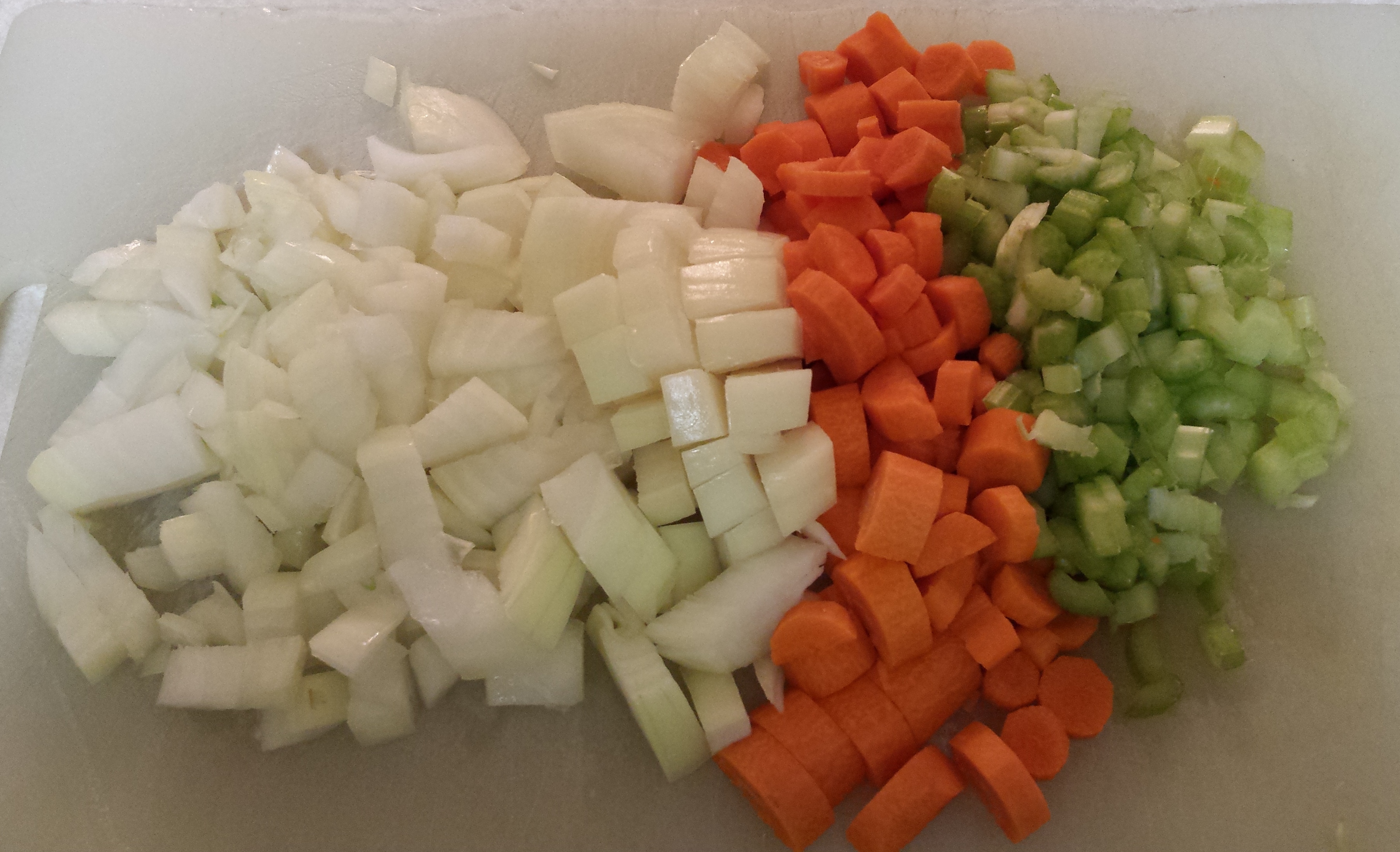
This morning a pot of mixed beans is cooking. On the cutting board are generous mounds of carrot, celery and onion. Once the beans are cooked, the whole lot will go into the pot with some bay leaves and enough homemade stock to cover. It will simmer a couple of hours until it becomes soup—just in time for lunch before I head over to the warehouse for a shift.
While there is prep work, and transformation with heat, is this really cooking? At a basic level it is. Acquired knowledge about spreads, soups and chili makes the work quick and easy. Even a long prep and cooking time, like there is with bean soup, is not hard. However, it is certainly not glamorous or particularly inventive. It is subsistence at the most basic level: turning raw material into food for sustenance.
As easy as this type of cooking is, there is a temptation to use prepackaged, precooked food as the main course in a cuisine. There are so many varieties of processed food, a person could go for months without having the same dish twice. At a price point of around $10 for a multi-serving package, processed food seems cheap, even if it isn’t. In the end, any home cooking is leveraged from the idea of controlling what we eat and the ingredients from which food is made more so than food cost. For the most part processed food is an infrequent convenience or comfort.
With the abundance of food in the U.S., it is hard to figure how people go hungry. They do. Even in our community of about 5,000 people we have a food bank that is well used. Perhaps we have gotten too far from producing meals in a kitchen from raw ingredients.
My mixed bean soup is easy to make, but there is a process to be learned and followed. It will make a dozen servings, and whatever the cost, that is cheap both in money and in work. We need to eat, so why not some bean soup? Why not indeed.
The WordPress.com stats helper monkeys prepared a 2014 annual report for this blog. The meaning of these statistics is unclear, except to say that I am thankful for people who read my writing in this space.
Best wishes for a happy new year.
Here’s an excerpt:
The concert hall at the Sydney Opera House holds 2,700 people. This blog was viewed about 8,300 times in 2014. If it were a concert at Sydney Opera House, it would take about 3 sold-out performances for that many people to see it.
LAKE MACBRIDE— Just before running my mobile phone through the washing machine, I searched the Internet for Hyemeyohsts Storm.
There were a few search results— what little information there was full of controversy. It was 2 a.m. and I hadn’t turned the lights on.
The year Seven Arrows was published, Chuck Storm was a lecturer in the Department of English at the University of Iowa, where he taught a course titled, “American Indian Signs and Symbols.” His wife Swan accompanied him everywhere he went, and would roll cigarettes for him as he told stories once a week for a couple of hours. That was before smoking was banned in classrooms.
I got an A in the course. Everyone did. Storm confronted the administration and made a case for the grade, and got his way. A lot of people who attended the classes weren’t registered. To call it a “class” was a stretch, as the curriculum was disjointed and sometimes incoherent, if one existed at all. What happened each week just happened, and I suppose that was part of the learning.
Storm welcomed us to visit their apartment, and one evening I did. Unannounced, and perhaps a little rude, I appeared at their door, and Swan welcomed me in. They were working with someone who had a issue with film. He was wrapped in celluloid from which he broke free. Afterward, Swan used a hand sweeper—the kind I use to pick up pine needles after the Christmas tree is removed—to clean the carpet, then we dispersed for the evening.
Seven Arrows was a work of fiction, and as such, it was easy to accept. While it claimed to be “the first book about the Ways of the Plains People to be written entirely by an Indian,” it was sometimes uncertain which stories were part of oral tradition, and which were fictionalized.
A number of modern writers have called Storm a fake Indian.
“Hyemeyohsts Storm, whose first name is hard to spell and to say, was another faker who made a minor fortune with his fake Indian book, Seven Arrows,” Dr. Dean Chavers wrote in the Native American Times. “It tried to be a genuine representation of the ceremonies of the Cheyenne people, but it came out as hippie mish-mash, just right for the 1970s.”
Why life would lead me here is uncertain. A whim from the beyond, as Meyer Baba might call it. What I know is I wasn’t ready to replace my mobile phone, or to consider negativity clouding the view of life as I knew it four decades ago. Perhaps it was just a night storm.
After discontinuing our subscription to the daily (except Sunday) newspaper years ago, I began freelancing for them. Feeling a need to subscribe again, I did.
The carrier came and left no paper on the inaugural subscription day. Perhaps communications between sales and circulation is not all it could be, although friction between these entities has been a bone of contention since I learned the structure back in the 1960s. For my part, I’ve always been an operations guy. Leave the delivery of services to me, and production and sales to someone else. Still, no paper despite my distraction recounting personal history.
Complaining is not my bag. At least that’s what I believe. While developing a tolerance for the human condition, sometimes I fall short. When we know a little bit more about something, like the structure of newspapers, one can get a bit whiny. That is not becoming of the 60-something.
Yesterday I distributed some 1,400 samples of a pastry confection to people in the warehouse. There were a lot of smiles as the imminent Thanksgiving holiday precipitated whole families arriving to shop together.
I enjoyed their conversations—carried on as if I wasn’t there. Men discussed how women could use a food item. Parents and grand parents marshaled children as they navigated the tall steel stacked with palletized product. Patrons with Irish whiskey in their carts lingered in the cheese aisle living large with dairy. It was a specialized soup of humanity and I was ladling it into my bowl attentively.
What I can say about my work in the warehouse is limited. Since I need the income to support my writing, one dasn’t disrupt things. Framing only general and positive remarks in public, there is a story to tell, but it must be told later, after I move on to what’s next to pay the bills. One always believes there will be a next thing.
But this morning, right now, I am writing. For now, that’s enough to accept the varied and imperfect life I have been living.






 Journey Home
You must be logged in to post a comment.