Categories
Environment

Hard Winter

Through the Window

This weird weather is unsettling. Wild variations in temperature made it a damaging winter… it’s not over.

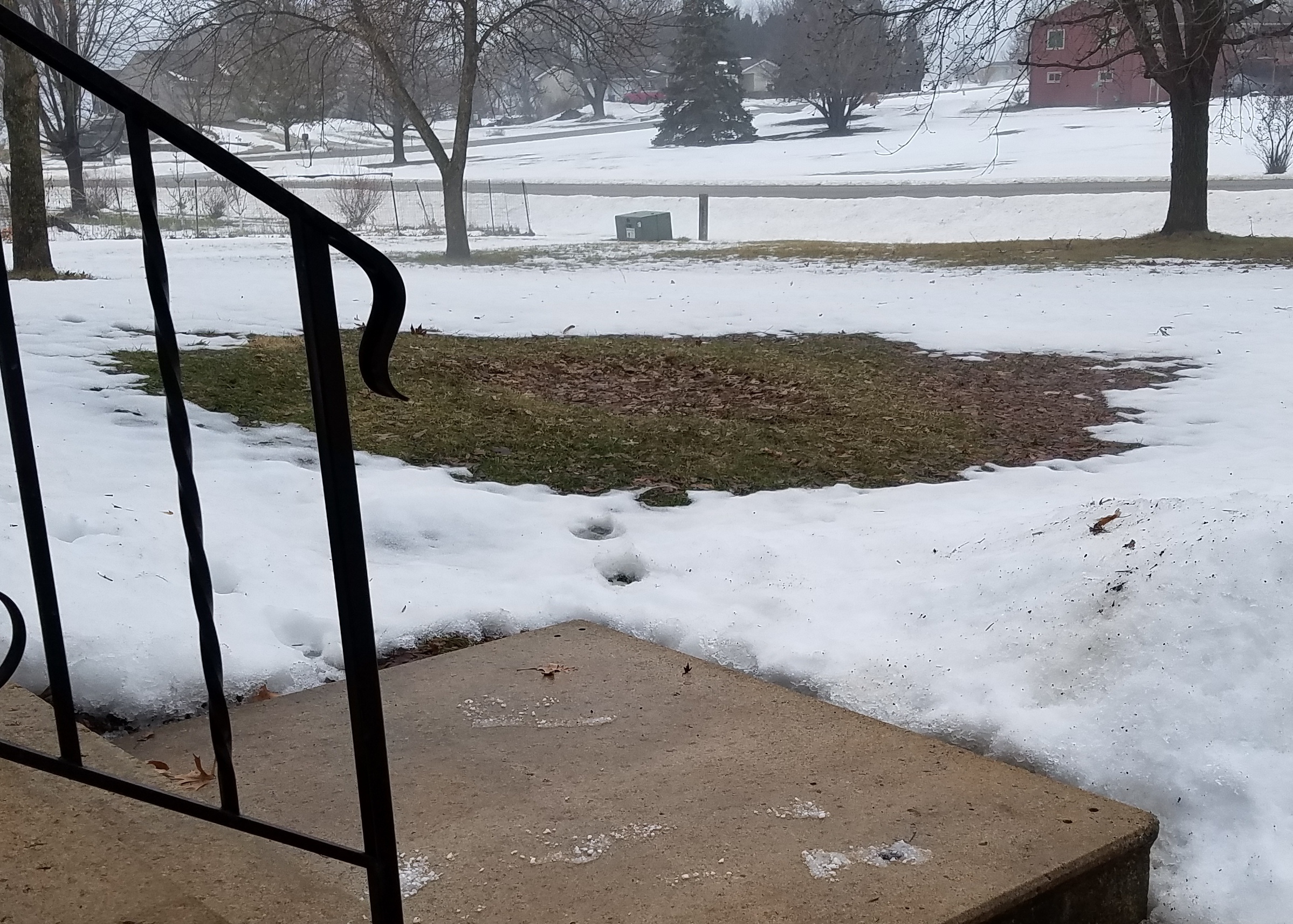
The driveway buckled a few feet from the garage door because of temperature swings. Water must be trapped underground with inadequate drainage before refreezing. The buckled pavement is directing rain under the door, flooding the car park.

Everything is off the floor as I advance plan for water emergencies. I found all the parts for the wet/dry vacuum and removed about 60 gallons from the floor. I let the water settle for a while, then will go at it again.

I’m supposed to soil block at the farm today. Temperatures are dropping and a coat of ice is expected on roads, on everything, as the wind howls 30 miles per hour until sunset. I’m to text the farmer before leaving for my shift to make sure roads are passable.

With the ground still frozen, snow melt and rain have nowhere to go. It is pooling near the main intersection a few dozen yards south of our home. The culvert under the road must be blocked with snow and ice. There will be river flooding later in the week as everything drains to the Mississippi basin.

I’m not freaking out… yet. I don’t know what to do but mitigate water damage and wait it out. Fixing the cause of this weird weather is not something to address in a day or two.

Media discussion of climate change seems more frequent. I reviewed Google Trends and there was a spike in searches about global warming the first week in February. Every day or so local newspapers carry a story about climate change. A lot of it has to do with the Green New Deal resolution proposed in the U.S. House of Representatives. Who doesn’t like what the resolution says? It seems toothless until a Democratic majority returns to the U.S. Senate. We are at least two years away from the possibility of that happening.

What will the Congress do to act on climate? More importantly, what will they do that the president will not veto? These are dark times if we rely solely on politicians.

Water may have settled in the car park, so it’s time to vacuum up a few more five-gallon buckets. Hopefully spring is on the horizon, even if it hasn’t arrived.
Categories
Environment Living in Society

Freezing Rain and a Green New Deal

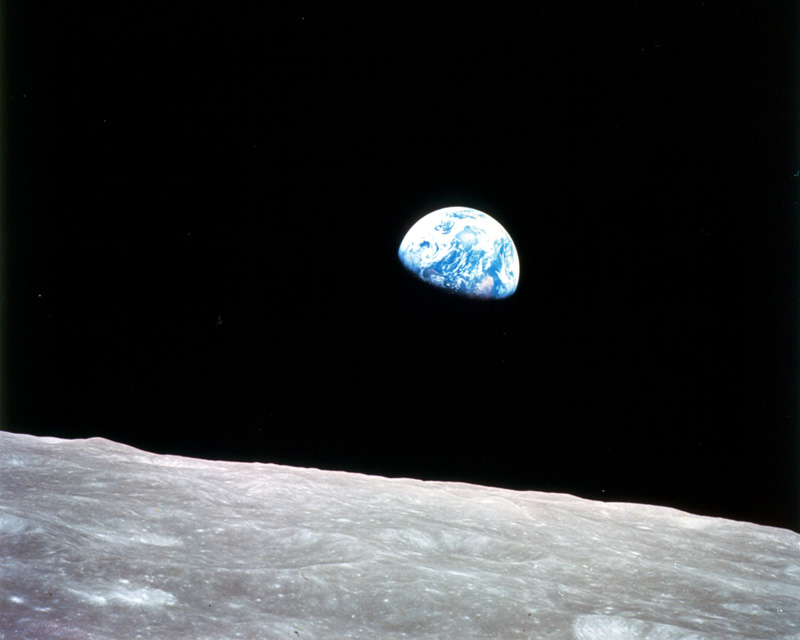
Earthrise by Bill Anders, Dec. 24, 1968

Ice turned to mush as rain fell Thursday morning. The surfaces of Lake Macbride and the Coralville Lake appeared to remain frozen as I drove on Mehaffey Bridge Road.

When I arrived at the home, farm and auto supply store it continued to rain. By the end of my shift a layer of ice had formed on my windshield and morning slush had frozen.

I started the engine and chipped at the ice. It took half an hour to gain enough visibility to drive. I decided to skip a monthly political meeting, emailed the secretary of my absence, and headed home.

Iowa is a red state now. Voters had an opportunity to return balance to state government in 2018. Instead they chose Republican control of the governor’s office and state legislature. Taking advantage of their mandate, Republicans plan to take more control of the appointment of judges by changing the composition of a commission that selects nominees for Iowa courts. We’re a red state now, and we don’t like it.

We’re not leaving the state. To even consider it would be an anomaly in lives we’ve come to accept. In the end, politics is something, but not everything. It is definitely not important enough to get stuck in the county seat as the world freezes.

I’m interested in what the Congress does to mitigate the impacts of climate change. Yesterday New York Congresswoman Alexandria Ocasio-Cortez introduced a resolution recognizing the federal government has a duty to create a Green New Deal. A draft of the resolution indicates the following goals for a Green New Deal during a ten-year national mobilization period:

  1. to achieve net-zero greenhouse gas emissions through a fair and just transition for all communities and workers;
  2. to create millions of good, high-wage jobs and ensure prosperity and economic security for all people of the United States;
  3. to invest in the infrastructure and industry of the United States to sustainably meet the challenges of the 21st century;
  4. to secure for all people of the United States for generations to come—
    (i) clean air and water;
    (ii) climate and community resiliency;
    (iii) healthy food;
    (iv) access to nature; and
    (v) a sustainable environment; and
  5. to promote justice and equity by stopping current, preventing future, and repairing historic oppression of indigenous communities, communities of color, migrant communities, deindustrialized communities, depopulated rural communities, the poor, low-income workers, women, the elderly, the unhoused, people with disabilities, and youth (referred to in this resolution as ‘‘frontline and vulnerable communities’’).

Who wouldn’t like these goals? Senator Edward Markey introduced the same resolution in the U.S. Senate.

It doesn’t take an advanced degree to understand a Green New Deal is dead on arrival in Mitch McConnell’s senate. While such goals need to be met to slow global warming, politics has ceased to be an endeavor of doing what needs to be done to ensure our mutual survival. Success of any legislation designed to advance a Green New Deal depends on recognizing the threat the climate crisis poses to society. Today, more people recognize there is a climate crisis. Our politicians, not so much.

Al Gore remained positive in his press release supporting the resolution:

The Green New Deal resolution marks the beginning of a crucial dialogue on climate legislation in the U.S. Mother Nature has awakened so many Americans to the urgent threat of the climate crisis, and this proposal responds to the growing concern and demand for action. The goals are ambitious and comprehensive – now the work begins to decide the best ways to achieve them, with specific policy solutions tied to timelines. It is critical that this process unfolds in close dialogue with the frontline communities that bear the disproportionate impacts today, as this resolution acknowledges. Policymakers and Presidential candidates would be wise to embrace a Green New Deal and commit to the hard work of seeing it through.

Failure to act on climate is the same as denial. I’ll support a Green New Deal while recognizing we can’t place all our hopes on a single, political solution. As we discovered during negotiations leading up to the Paris Agreement under the United Nations Framework Convention on Climate Change, political solutions are far from perfect. They may be inadequate. Yet they are something and have value if they can be achieved.

Categories
Environment

Out of the Polar Vortex

Snow Melted First over the Septic Tank

The ambient temperature is 45 degrees, a 73 degree swing since early Thursday morning. Warming is part of the polar vortex, just as the cold was. Temperatures are forecast to return closer to normal after tomorrow.

I had planned to prune trees today but am concerned about rapidly changing temperatures. If the sap starts flowing the purpose of waiting until winter to prune would be defeated. Maybe next week will be better once temperatures stabilize below freezing for a week or so.

Feb. 5 is the Iowa Environmental Council’s lobby day in Des Moines, followed by the Sierra Club’s lobby day the 6th. I noticed IEC scheduled 30 minutes for discussions with legislators. That’s about right because very little gets decided in one-on-one lobbying sessions, regardless of whether one’s legislators are supportive of climate action. What’s needed for change is a broad coalition and a dominant issue.

With the polar vortex we are living in a changed climate. Mitigating its effects is beyond the scope of the Iowa legislature. What can be done?

“In my view, the actions we take over the next 2-3 years are critical,” State Senator Rob Hogg wrote in an email. “The need for climate action has never been more urgent. Please take action personally and in public. Invite more people to get more informed, more involved, and do more.”

Hogg was trained by Al Gore as a Climate Reality Leader in 2008. He enumerated ideas with which to approach legislators for climate action, including “energy efficiency, renewable energy, electric vehicles, forests, prairies, soil conservation, and pre-disaster hazard mitigation to safeguard our people and our property.” Each of these items has its own constituency and many of the groups supporting them will be at Tuesday’s lobby day. What will get done?

There is a stability of operations among IEC members that works against substantial change. Some organizations, including some to which I belong, seem caught in a rut around a specific solution to the climate crisis. These formal, recurring events seem ineffective to me. I wrote about a 2015 trip I made to a similar lobby day in the Iowa City Press Citizen here. I’m not sure what, if anything was accomplished.

Some advocates believe climate denial among members of the legislature and elsewhere stands in the way of changing human behavior regarding climate change. I believe it is something different.

“I’m convinced that the greatest threat we face isn’t climate change denial,” climatologist and geophysicist Michael Mann wrote. “It is the weaponization of ignorance and apathy that is at its core…”

The weaponization of ignorance and apathy is something better to work on than any pet project. How does one do that when calcified lobbyists and citizen advocates petition the legislature for such issues? We need a more diverse group of stake holders than are in the IEC. Something bigger needs to happen to bring people together. I don’t know if the polar vortex is big enough even if it should be. What I know is if we wait to address climate change until it is too late the question will be moot.

This polar vortex is drawing to a close but it’s easy to predict there will be others. Many will have forgotten the polar vortex as they get absorbed in the big football game this afternoon. It is up to us to remind people of our common interest in sustaining our lives in a turbulent world. If we don’t, who will?

Categories
Environment

Dispatch from the Polar Vortex

Winter in Iowa

Editor’s Note: This email was sent to members of our home owners association at the beginning of the polar vortex of 2019. As I write this note, the outdoors ambient temperature is 26 degrees below zero and one person in the county seat has died from exposure.

Member,

As you likely know, ambient temperatures are forecast to get down to -25 degrees by 8 a.m. tomorrow morning and to -30 degrees overnight tomorrow. After that temperatures are expected to warm through Saturday and Sunday when it is forecast to be in the 40s.

That’s a seventy degree swing in a couple of days, which can be hard on things like water and sewer lines.

19th century British prime minister Benjamin Disraeli said, “Be prepared for the worst and hope for the best.”

We will do everything reasonable to get service back up as soon as possible if it is interrupted. Asking a contractor to work in wind chills like we haven’t seen since we moved here is not reasonable. I plan to contact our main contractor Wednesday and discuss the situation so we know our options in the event of a breakage.

What you can do to prepare for a potential outage is keep a temporary water supply if you don’t already.

In our household we keep a large Rubbermaid beverage container filled with water to use for washing hands and cooking in case we lose water.

We used to buy bottled water to have on hand but quit doing that over the years. It is an option.

If we know there will be an outage ahead of time, we fill up our two stock pots and keep them on the stove to be boiled and used to wash up in lieu of a shower, or as otherwise needed. We have also filled up coolers in the bathtub to use to flush the toilet.

Fingers crossed we will make it through the cold spell without a line breakage.

If something does happen, the procedures for reporting a water problem are below.

I hope this is helpful.

Paul Deaton
President

Categories
Environment

Dealing with Cold Temperatures

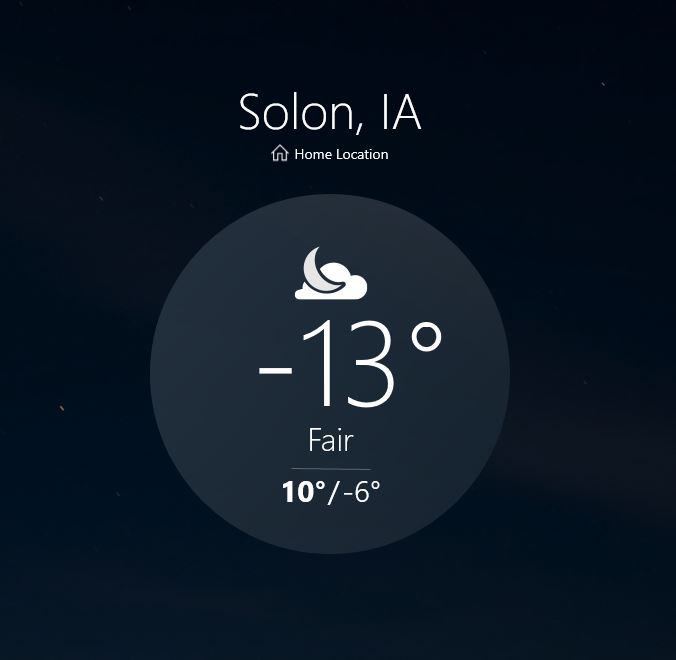
Outdoor ambient temperature Jan. 26, 2019, at 6 a.m.

Images depicting ambient temperature reports have been ubiquitous on social media the last few days.

According to the Weather Channel, temperatures plummet to 25 degrees below zero by Tuesday thanks to a polar vortex.

It’s what I’ve been waiting for to prune apple and pear trees as sap flow is halted by the temperature. Considering the forecast, the best day to prune will be Friday, Feb. 1.

Not everyone likes the cold but I don’t mind. I’ve never had frostbite or chilblains, even while living outdoors in subzero temperatures for a week at a time during military service in Germany. If one takes precautions, risks are minimal.

Once trees are pruned, I’ll be ready for it to warm up.

The cold spell began just as my shifts at the home, farm and auto supply store ended. We are bunkered in with plenty of food, a working furnace and water supply, and an internet connection. As president of our home owners’ association I worry that cold weather will cause a water line break, so fingers crossed. Later today I’ll drive my spouse to work in town so the car doesn’t sit in the snowy cold while she’s there.

Today’s cold weather is like what I recall from childhood. If there is no wind, it is tolerable and welcome. Like every year, winter will turn to spring and everything that means.

Categories
Environment Writing

Lunar Eclipse

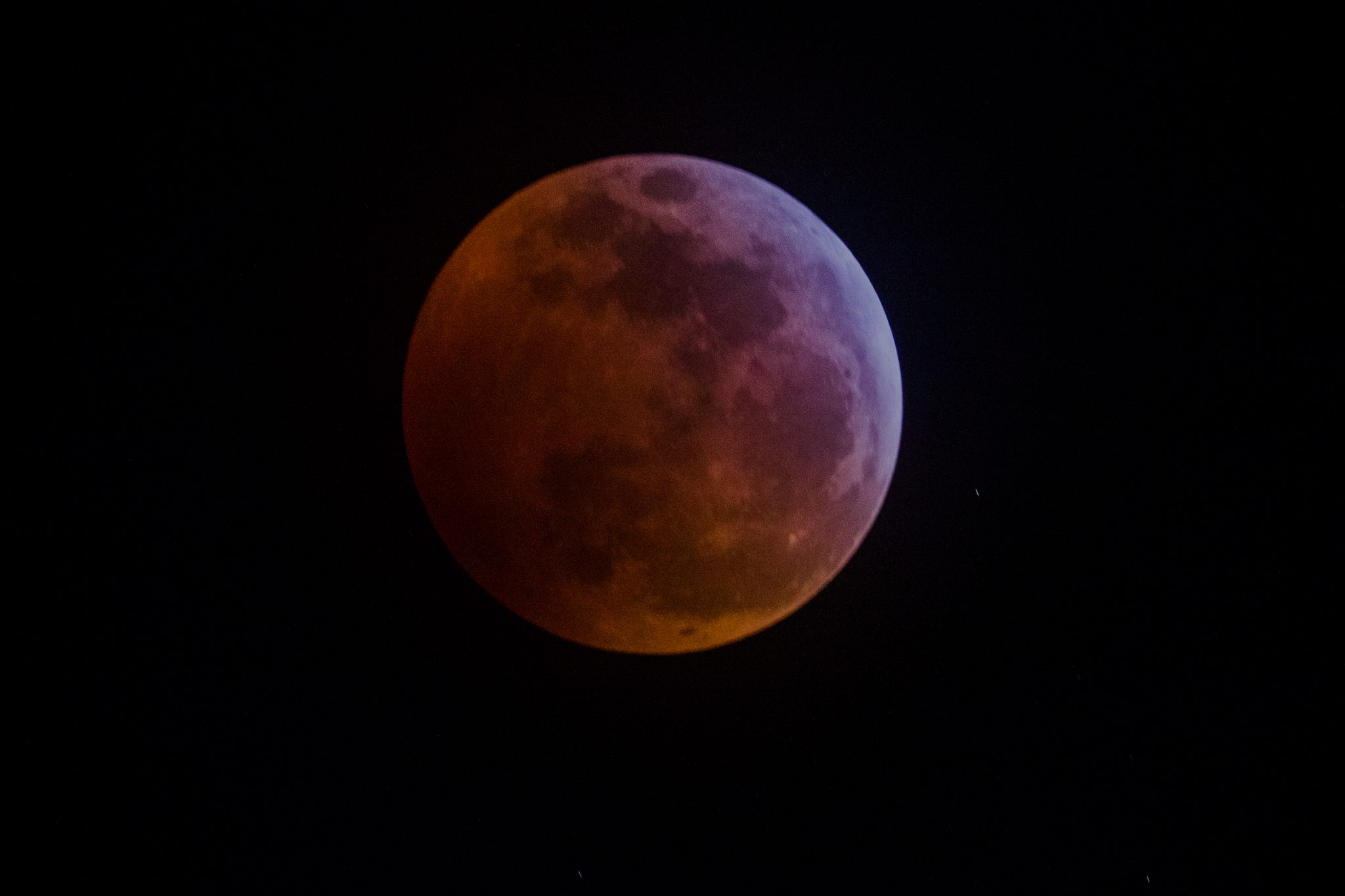
Lunar Eclipse on Jan. 20, 2019. Photo Credit – Van Allen Observatories, Iowa City, Iowa.

Refracted light creating a reddish-orange hue on the moon’s surface looked pretty cool last night.

It was an event to remember, one that transcended daily life. It drew many of us together with a shared experience.

In the eclipse it was easy to imagine and literally see the vast emptiness of the universe. It reminded us of how reliant we are on our only home with its thin layer of atmosphere. No human hand played a role in the astronomical phenomenon except to warn us, as astronomers have since ancient times, it was coming.

Lunar Eclipse Taken with Mobile Device

The event had a long name: super blood wolf lunar eclipse. I don’t need or want a name, just memory of the image enlarged on my retina with a pair of unsteady binoculars.

After sunset the sky was as clear as it gets. The full moon illuminated everything in bright, silvery light. A few years ago I would jog on the lake trail in such light. As the eclipse progressed, the landscape darkened. The moon moved above the house so I went out to the driveway to see it. It was below freezing and I returned inside several times to warm up.

Witnessing the lunar eclipse lacked profundity, it being a function of celestial mechanics. If I was inclined to howl, that’s on me and my humanity. The experience asks the question why can’t we get along when we have so much in common? No answer was forthcoming.

I thought of Juliet’s speech to Romeo:

Although I joy in thee,
I have no joy of this contract tonight.
It is too rash, too unadvised, too sudden,
Too like the lightning, which doth cease to be
Ere one can say “It lightens.”

I cling to the shared experience even if my view is blurred by an intervening atmosphere, inadequate lenses, and less than perfect eyesight. If the shared experience serves a human purpose, I’ll assimilate it, becoming the eclipse. Maybe it could transcend physics to help sustain our lives in a turbulent world.

Categories
Environment

A Winter Sort

Garden Seeds

A majority of the garden seeds wait in a corner on the lower level of our home.

I cleared a sorting table and next month will plant celery and kale at the first greenhouse shift. There is no immediate need to plan more.

The seven garden plots have stands of seed-spent foxtail and last year’s fencing. Clearing the plots will begin after a long period of subzero temperatures, assuming we have one. The first traditional planting is Belgian lettuce on March 2, although last year there was no early lettuce because of frozen ground during a spell of weird weather. The weird weather was related to global warming. A gardener, like a farmer, must adapt.

The 2018 vegetable growing season was challenging for farmers I know. However, to a person they responded to the challenges of late start, crop failures, uneven moisture, and other farm-related issues to produce an abundant harvest. They meet 2019 with renewed optimism and energy as the new cycle begins with the annual Practical Farmers of Iowa conference Thursday through Saturday in Ames.

Experience tells me not to worry about what might be during the upcoming gardening season. To deal with its actuality is sufficient. So much of what may happen this year is beyond our control. It’s best to deal with it as we go.

This approach is part of sustaining a life in a turbulent world.

Categories
Environment Living in Society Sustainability

Day to Day Politics

2018 Top Instagram Photos

Last June I broke publicly from our state representative Bobby Kaufmann and endorsed Democratic candidate Jodi Clemens for House District 73 in a letter to the editor of the Solon Economist.

With a circulation of less than 1,000 weekly copies, I’m not sure my endorsement was widely read.

I went on to post three additional pieces critical of Kaufmann before the midterm elections. I am confident he saw the ones in the local newspaper. He won the election without breaking a sweat.

Today’s question is whether I should drive to town to attend his town hall meeting. The 88th Iowa General Assembly convenes tomorrow.

Yesterday I emailed Kaufmann my priorities for the session, mentioning three things:

  • The legislature should support ways farmers can produce more revenue per acre.
  • I questioned the need for more tax relief and encouraged him to find a permanent solution to the back fill problem Republicans created in 2013 when they altered property taxes for farmers and corporations.
  • I reminded him of our local issue of keeping the restriction on larger horsepower boat motors on Lake Macbride during boating season.

Of everything on my political wish list, these three things seem possible yet also insufficient. The better way to impact the legislature would have been for Clemens to have won the election. We came up short. It’s time to accept the results and move on.

In a Sept. 24, 2016 opinion piece in the Cedar Rapids Gazette I articulated what is most important in society: follow the golden rule, nuclear abolition, and mitigate the impacts of climate change. Under President Trump, none of these is going well in our government. My work continues regardless of who my elected officials might be. Politics by its nature will almost always disappoint and party affiliation of our leaders does nothing to change the primacy of these focal points for action.

I’m left wondering why I would attend today’s town hall meeting when there is other, more important work to do.

The legislative agenda is being set by Republicans. If Democrats were in charge, it would be much different. I don’t accept the mental construct that the opposition party should resist the party in power as an end goal for the Iowa legislature. Likewise the idea we are “holding elected officials accountable” by constantly calling and emailing them is off the mark. I’ve been in Senator Chuck Grassley’s D.C. office when such calls came in and the impact was a tick mark in a pro or con column on a tally sheet to be read by staff. Grassley gets his legislative feedback directly from Iowans in his annual tour around the state, and from the Washington, D.C. community of which he has long been a part. So it is with with local representatives. That’s a case for showing up today, although not a strong one.

When I wake each day I don’t think about politics until I read the newspapers. As humans we are attracted to conflict and there’s plenty of it recounted in news media. Republicans have been a long time coming to power. Now that they have it, they are remaking the state in their eyes, changing long-standing policy. That’s the nature of political power. The longer conservative Republicans maintain control of government the harder it becomes for Democrats to undo policy changes. With two more years under Republican hegemony it seems unlikely there is any going back to what used to be.


Snow stopped falling overnight. The driveway needs clearing then there’s community organizing work for the coming year. Our infrastructure needs maintenance and if we don’t do it, no one will. Isn’t that always the case?

It reduces to a simple maxim that guides me through life: there is no other, just the one of which we are all a part. That perspective gets lost in today’s political culture. Working to improve our culture is as important as anything else we do. Such work starts at home where I expect I will spend the day.

Categories
Environment Kitchen Garden

Gathering on a Farm

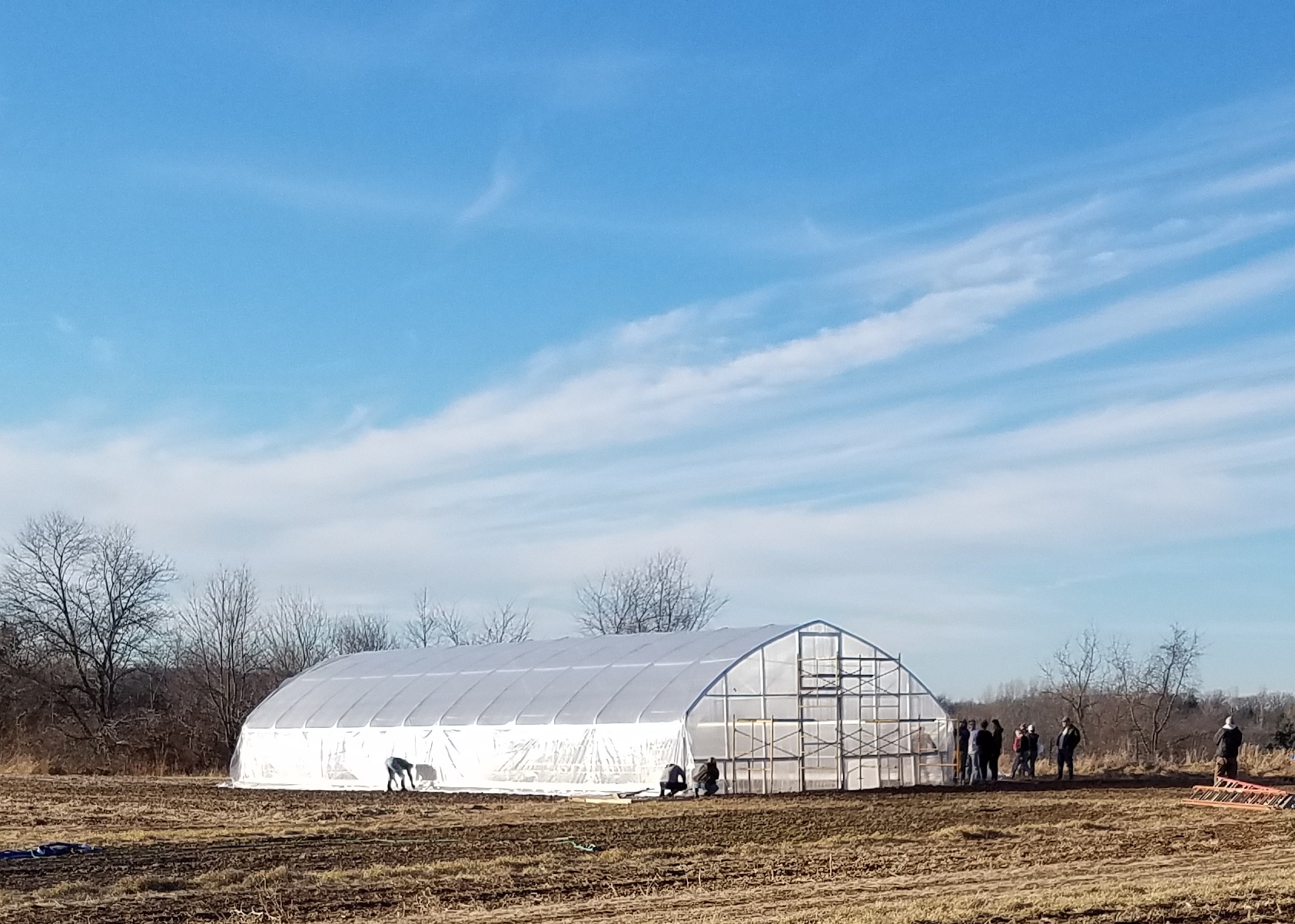
Farmer Kate’s High Tunnel

A lone bald eagle soared over Rapid Creek north of Wild Woods Farm. We were pulling plastic over the new high tunnel.

The eagle lofted in the wind as if it were summer. We would rather the wind died down until we finished. The project was well-organized and it took an hour and a half for 20 of us to get the plastic stretched over the aluminum frame.

Someone asked how many inches of frost were in the ground. That struck me as funny while standing in two inches of sloppy mud. We have yet to have a hard freeze this winter. Vegetable farmers have ordered seeds and as soon as they arrive plan to plant onions in trays. Spring planting will begin soon enough. With the ambient temperature at 50 degrees it doesn’t feel like we’ll have a winter even though an extended hard freeze would be good for farmers.

The fact of a warming atmosphere is all around us. Eagles attracted to open water in January is just part of it. Climate has changed, disrupting weather patterns we learned to expect coming up. Local vegetable farmers dealt with the weird weather last season and could use a break back to “normal” this year. A 50 degree January day may be a fluke — a welcome one for this project — but there have been too make flukes.

During wait time I finalized a spring soil-blocking schedule at the two farms. It was a productive day of catching up with friends in mid-winter… talking about spring.

Categories
Sustainability

Nuclear Disarmament in Trump World

B-61 Nuclear Bombs

Elimination of nuclear weapons remains a priority for many of us who followed disarmament progress through the years. Our work hasn’t ended. What should be our priorities in Trump World?

To a large extent, society answered that question in the Treaty on the Non-Proliferation of Nuclear Weapons (NPT), to which the United States is a party. Article VI has been and remains a sticking point in meeting treaty obligations. Here’s the text,

“Each of the Parties to the Treaty undertakes to pursue negotiations in good faith on effective measures relating to cessation of the nuclear arms race at an early date and to nuclear disarmament, and on a treaty on general and complete disarmament under strict and effective international control.”

Nuclear states have taken inadequate steps toward compliance with Article VI. U.S. backpedaling on disarmament treaties began when in 2002 President George W. Bush removed the United States from the Anti-Ballistic Missile Treaty (ABM) signed by President Richard Nixon in 1972. Under Donald Trump, the United States is expected to withdraw from the Intermediate-Range Nuclear Forces Treaty (INF), and negotiations for renewal of the New Strategic Arms Reduction Treaty (New START) have yet to commence. The Trump administration is heading the opposite direction of good faith negotiations to end the arms race. It is creating a political environment for a new arms race, a complete refurbishment of the U.S. nuclear triad, and development of new nuclear weapons.

Where should disarmament advocates focus their efforts? Here’s my list.

As the two largest nuclear states, the U.S. and Russia should de-escalate nuclear competition and establish a regular dialogue on strategic stability. At a minimum, we should make a mutual decision to extend the New START Treaty before it expires in 2021.

Russian President Vladimir Putin said publicly Russia would not make first use of nuclear weapons. The United States should adopt a no first use policy regardless of what Russia says or does.

During negotiations for U.S. Senate ratification of New START, Arizona Senator Jon Kyl negotiated a refurbishment of the nuclear weapons complex. Under President Trump, this budget has grown to over a trillion dollars. We should encourage the new U.S. House of Representatives leadership to cut back on the administration’s plan to upgrade the nuclear complex.

There has been talk of developing new types of more usable nuclear weapons. We should advocate to block administration plans to develop such weapons.

As President Trump withdraws from the Iran Nuclear Deal we should encourage and support our international partners to implement it without us.

Now is the time to implement realistic, action-for-action steps toward disarmament with North Korea. Any dialogue with North Korea should proceed with that goal as the basis for talks.

Finally, advocates should promote compliance with Article VI in the run up to the 2020 NPT Review Conference.

A nuclear weapons-free world remains possible. In Trump World making progress toward that goal will continue to be challenging. Like most citizens we have limited resources and a large number of issues wanting our attention. This list serves to focus on what’s most important politically, and look for opportunities to advance each item as they present themselves.

To learn more about nuclear disarmament efforts in the U.S., check out the Arms Control Association website by clicking here.