Does it make sense for our federal government to spend almost one and a half trillion dollars on a nuclear weapons system that should never be used?
No.
The Trump administration plan is to rebuild the entire American nuclear arsenal, including development of new, so-called “low-yield” nuclear weapons. During military training we prepared for deployment of such “tactical” weapons.
After spotting the signature flash or mushroom cloud of a nuclear detonation, while maneuvering among people’s farms, towns and businesses, we were to avert our eyes, find a low spot on the ground and cover ourselves as best we could with our poncho to prevent radioactive fallout from touching our skin and clothing. If we survived, we could go on fighting.
After the breakup of the Soviet Union, and elimination of tactical nuclear weapons, developing them again sounds crazy. We could build thousands of new community fire houses with that kind of money.
As Iowa ramps up for the first in the nation caucuses, we should ask presidential candidates, “Will you oppose current plans to spend upwards of one and a half trillion dollars on a plan to rebuild the entire American nuclear arsenal?”
Voters will likely welcome the responses.
~ Published in the Solon Economist on April 11, 2019.
Earlier this century India and China decided to build fleets of coal-fired power plants as their citizenry entered a world most Americans and Europeans already knew for its modernity and comparative affluence. The two populous states required more electricity.
Carbon emissions from the new plants have come home to roost. According to the International Energy Agency,
Global energy consumption in 2018 increased at nearly twice the average rate of growth since 2010, driven by a robust global economy and higher heating and cooling needs in some parts of the world. Demand for all fuels increased, led by natural gas, even as solar and wind posted double digit growth. Higher electricity demand was responsible for over half of the growth in energy needs. Energy efficiency saw lacklustre improvement. As a result of higher energy consumption, CO2 emissions rose 1.7 percent last year and hit a new record.
China, the United States, and India together accounted for nearly 70 percent of the rise in energy demand, according to the report. Failure to reduce carbon emissions is a result of the lack of political will to adopt renewables as aggressively as their lower cost warrants.
Having lived through the India-China build-out of coal plants, I understand why and importantly that they are planning renewables and to some extent, natural gas and nuclear power, for new electricity generation. The writing is on the wall for coal’s hegemony according to Energy Innovation:
America has officially entered the “coal cost crossover” – where existing coal is increasingly more expensive than cleaner alternatives. Today, local wind and solar could replace approximately 74 percent of the U.S. coal fleet at an immediate savings to customers. By 2025, this number grows to 86 percent of the coal fleet.
While their analysis does not adequately consider stranded costs, it is doubtful India or China will abandon coal-fired power plants built since the turn of the century as they are comparatively new. That is, unless the climate crisis is adequately recognized by governments.
Any doubt climate change is real? The New York Times reported on the flooding in Hamburg, Iowa:
“I’m looking at global warming — I don’t need to see the graphs,” said Hamburg, Iowa’s mayor, Cathy Crain, referring to the role of climate change in increasing the frequency of extreme weather events. After two record-setting floods in a single decade, Ms. Crain said, “I’m living it and everybody else here is living it.”
We shouldn’t be shocked by the International Energy Agency report as rising emissions were planned by China, India and the United States a long time ago. There is a long tail on carbon emissions and government is largely responsible to turn the corner. The report highlights we are going the wrong direction.
How many more tragic incidents like the one in Hamburg are necessary before government acts on climate? More people are ready to act on climate now but we haven’t reached our politicians… yet.
Rural Johnson County – 140th Street NE west of Ely Road on March 23, 2019.
During a tour of my usual spots to observe flooding it doesn’t look as bad as it has.
In 2008, the flood waters came to within 100 yards of our home before receding. We are nowhere near that now.
Yesterday afternoon Governor Kim Reynolds issued a press release saying the president had approved a major disaster declaration for 56 Iowa counties. Hazard mitigation funding became available for the entire state.
What’s going on?
“Are we just rolling snake eyes over and over or is there something happening here?” Erin Murphy of Lee Enterprises asked on Iowa Press this weekend.
“We have 147 years of temperature and precipitation records for the state,” Iowa State Climatologist Justin Glison responded. “The trend shows us warming and with the warmer atmosphere, a warmer surface temperature, we’re able to hold more water vapor in the atmosphere. That gives us a higher probability of having more precipitation events. What we are seeing over the past thirty years is that the intensity of precipitation events is increasing… Yes, we are moving into a new type of precipitation regime.”
No mention of the words “climate change” and that’s okay. Glison’s message is what I have been saying the last six years, and part of what Al Gore said the two times I heard him present his slide show. The current flooding is climate change happening in plain view. It is time to do something to mitigate not only the damage caused by climate change but the changing climate itself.
What should we do about climate change? Embrace the truth about what this scientist said. Then develop the political will to change human activities that contribute to global warming in a way that makes sense and creates a resilient culture.
The rest of my day seemed anticlimactic. While crossing the Cedar River bridge on Highway One I decided to visit the Ace Hardware Store in Mount Vernon to see if they had a replacement part for the faucet handle in the bathroom.
I entered the roundabout at the intersection of U.S. Highway 30 and Route One. It is a bit confusing but I was able to decipher the signs related to which lane was correct for my trip. I like the roundabout for intellectual reasons, although most locals hate it.
Before the roundabout was completed in October 2013, the intersection was one of the five most dangerous in the state, based on frequency of accidents. In the years since the new roundabout opened, the frequency of accidents remained higher than expected. The intersection is currently exhibiting a crash frequency of 16.8 crashes per year according to a 2018 study. The expectation was there would be from six to eight crashes per year. To make a 60 percent reduction in accident frequency, the study recommends better driver education and improved signage near the roundabout. In other words, Iowa drivers are not finding navigation of the roundabout intuitive and it shows.
I arrived in Mount Vernon and parked across the street from the small hardware store. The future of small city retail was on display as I walked through the entrance. As an employee of a home, farm and auto supply store my radar was up to take in the sales process.
Two cashiers greeted me as I entered and asked if they could help. They directed me to the plumbing aisles which were easy to find in the small space. I walked past a popcorn machine that offered fresh, hot popcorn to eat while shopping. Eating and retail seem inseparable in the 21st Century. I declined to sample a bag. I quickly found a selection of faucet handles.
Using my handheld device, I had taken a photo of the old handle with a ruler held up to it from two angles. I sought an exact match. Within a couple minutes, a sales associate walked up and asked if he could help me find something. I said yes as I wasn’t finding what I wanted. He confirmed the display represented what was on hand and led me to a dual-monitor computer where he researched alternatives. The idea was if we could find the part, the associate would order it on the spot. We looked through four examples, both the Ace and manufacturer brands and couldn’t match the size.
In my experience, expanding product offerings from a retail store’s physical inventory is essential to survival in small cities and towns. It harkens back to the early days of the Sears catalogue. While there were no mobile or home computers back in the day, modern retail at its best emulates the idea there is a broad array of available products that with time can be delivered just about anywhere. The difference between my experience at Ace Hardware and a large on line retailer like Amazon.com is the personal attention I received from everyone I encountered at the store. That service is what satisfies our human need for personal interaction, and is likely to make us a repeat customer. In doing so, local retailers can learn and work toward sustainability.
What do climate change, roundabouts and retail stores have in common? I’m not sure, but that was my day in society.
It felt good to be outdoors on Friday. The sky was clear and temperatures warmed enough to shed my coat. Green-up has begun.
We filed our income taxes with the Iowa Department of Revenue and the Internal Revenue Service. Earlier in the week I paid the second half of our annual county property taxes.
This morning I plan to walkabout our subdivision, inspect roads, and address concerns about water and sewer leaks. With the hard winter and significant ambient temperature swings, there is damage. Whatever needs fixing requires a plan and a budget. As a board member and trustee of our home owners association and sanitary sewer district I share responsibility for both.
We’ve done our part to support government services. Now spring can begin.
Outdoor work was sweeping up enough sand from the road in front of the house to refill sand buckets used last winter. I haven’t purchased sand in about five years. Because of the hard winter there was plenty available. A 50-pound bag of solar salt filled empty salt buckets.
I found the fan to blow air across the damp garage floor. It took about two hours for moisture to evaporate. Baby steps to start spring 2019.
Governor Kim Reynolds issued a disaster proclamation for Howard County Friday afternoon. The number of counties under disaster proclamations is now 53 (of 99), according to the press release. Current estimates of damage exceed $1.6 billion according to this morning’s Iowa City Press Citizen, although counties reported they have yet to fully assess damage within their jurisdictions. Governor Reynolds proclaimed nothing about what government would do to help mitigate the deleterious effects of climate change going forward.
My farmer friend from the home, farm and auto supply store reported the ground needs drying before getting into his fields. While the weather quickly became spring-like, the usual issues for row-crop farmers remain. My specialty crop friends also found the ground too wet to work. They are planting in their hoop houses which are traditional season-extenders.
Spring began Wednesday and is just getting started. We’re ready.
The amount of snow and ice melt in the Midwest is monumental.
Iowa Governor Kim Reynolds issued disaster proclamations for 41 counties because of flooding (Click on the map to see details).
News photographs show Offutt Air Force Base in Bellevue, Nebraska, home of the U.S. Strategic Command, is one third underwater with at least 30 buildings damaged.
Where did all the water come from?
Warmer atmosphere held more water vapor which was dumped on Iowa and surrounding states in the form of snow and rain during recent polar vortex events. Wild swings in temperature, sometimes as much as 70 degrees in less than 24 hours, combined with rain quickly melted the snow. Because of deep frost in the soil, there was nowhere for the water to go but downstream. Iowa is used to spring flooding, but not like this.
Climate change created conditions for this flooding, both by enabling a warmer atmosphere to hold more moisture, and through warming in the arctic, which destabilized the trade winds and made the polar vortex. It has been depressing to live through this winter. The damage we see on our small lot in rural Iowa is minuscule compared to the bigger picture.
Last week, Al Gore and the Climate Reality Project trained another 2,000 leaders in mitigating the effects of climate change. News media cover climate change now more than in recent years because viewers and readers experience its effects every day. Climate change is real, it is happening now and we hope it’s not too late to find the political will to do something about it.
The state is watching how our governor and other politicians react to this iteration of flooding.
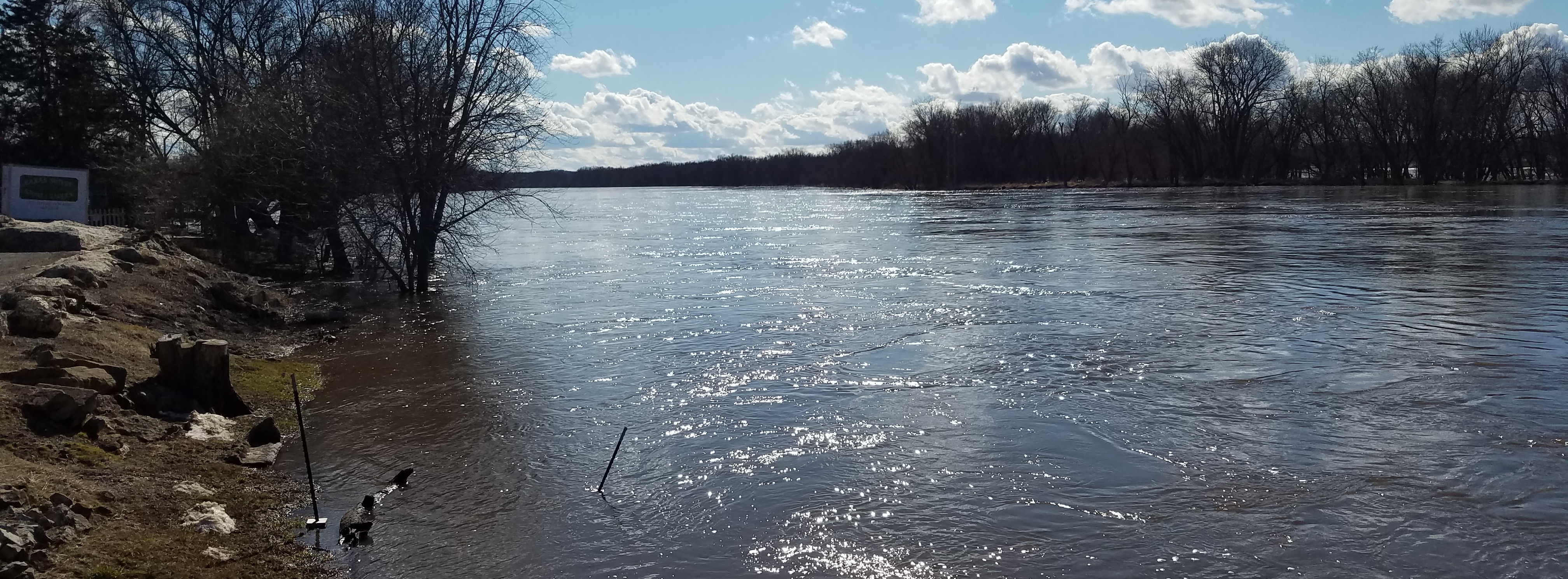
Cedar River at Iowa Highway One Sept. 27, 2016 at 11:36 a.m.
Mill Creek swelled its banks swamping nearby farm fields. It looks like the nearby city sewer system was spared inundation… for now.
Snow melt is everywhere in the county. Inches of packed snow yielded to ambient temperatures in the 50s and continuous rain. After a frigid, snowy winter the ice and snow pack is melting all at once. Snow was here Sunday and now is mostly gone.
Winter’s damage is being revealed. Our driveway buckled with the big swings in temperature. In one event, ambient temperatures swung more than 70 degrees in a day. Ice melted, then refroze under the cement, buckling the slabs leading to the road. Yesterday’s rain diverted inside the garage because of a buckle, requiring clean up to prevent further damage. Whether the buckled driveway will settle back down as it has before is unknown. It’s never been this bad.
The scale of the melt in a short period of time is what has Mill Creek flooding. Farmers removing buffer strips to grow a few more rows near the creek will take topsoil and farm chemicals downstream. It was foolish to sacrifice topsoil for a few more bushels of corn or beans. Farmers who did this likely didn’t see it that way even though flooding is not new to the area. Topsoil can’t be easily replaced but chemicals can.
Is this about climate change?
“A historic March blizzard is taking shape across Colorado, Wyoming, Montana, Nebraska, South Dakota, and North Dakota,” according to the National Weather Service. “Between one and two feet of snow is expected in some locations with wind gusts as high as 80 MPH.”
It is called a “bomb cyclone.” With hurricane strength, it has been forming over the Rocky Mountains and Great Plains, creating blizzard conditions and stranding hundreds of motorists.
“During the first 10 days of March, the Colorado Avalanche Information Center recorded more than 500 avalanches statewide (a record number),” wrote Jonathan Romeo in the Durango Herald. “For the season, a total of eight people have been killed in avalanches.”
Issues abound. Icebergs and open water were found on Norton Sound near Nome, Alaska where the Ititarod Sled-Dog Race finished this week. It’s raining in Greenland when it shouldn’t be. Global oceans are at the highest heat content on record. The planet is warming, there is no doubt.
It won’t take long for water to recede into the banks of Mill Creek. When everything melts at once, immediate damage is exacerbated, the duration shortened.
My colleagues with The Climate Reality Project are meeting this week in Atlanta to train another group of leaders. As newcomers join thousands of others, let’s work to mitigate the effects of climate change on humans. March has been a month where the evidence of climate change has come to the forefront. March has run only half its course.
Reading a book about tall grass prairie and savannas has me wondering why people bother preserving them.
Prairie used to cover more than 85 percent of Iowa land, according to the Neal Smith National Wildlife Refuge. Today less than one tenth of a percent of original tall grass prairie remains in the state.
In that context, the Iowa legislature considered a bill to prohibit setting aside new land for conservation with state money. After a popular outcry, the bill was suppressed last week before the first legislative funnel. There is substantial support among a diverse constituency for conserving prairie, savannas and woodlands. Such support drags political will along as best it can.
The Neal Smith National Wildlife Refuge is mostly replanted, which suggests human cultivation rather than a naturally occurring ecology. Which parcel is one of the many original prairie fragments at Neal Smith, and which a human tall grass garden? Presumably guides can point them out. There were no guides when tall grass prairie dominated Iowa landscape.
Either one participates in the culture of tall grass prairie or one doesn’t. It is a culture rather than nature. Throughout the state people and groups work to “restore the prairie” or “restore woodlands.” What does that even mean except as a style of gardening? Partly it means pulling garlic mustard plants and other invasive species during their early growth period. It means cutting down selected mature trees so saplings can survive to replace them. There is enough garlic mustard to make pesto for the whole state if such a delicacy were desired — all this cultivation is a lot of work. A lot of human work doesn’t seem natural.
The ecosystem that was our tall grass prairie relied upon burning the prairie to remove dead plant matter and stop the growth of trees that would shade plants growing close to the ground. Naturally occurring burns have been replaced with prescribed burns which are diligently considered and executed in a way that doesn’t catch whole neighborhood landscapes on fire. A local fire department has been summoned to put out a prescribed burn that got out of control more than a few times. Without burns a parcel of prairie or woodlands would cease to be what humans intended. I don’t know if a new and different ecosystem would be better or worse. If one is a believer in tall grass prairie, different is viewed negatively. Is that hubris?
We tend to forget the role vast herds of buffalo and other grazing animals played in the formation of tall grass prairie. Hooves kicking up dirt contributed to creation of the unique prairie biome. Animal grazing helped shorter plants gain access to sunlight and thrive. Animal droppings helped fertilize. Most of the land is fenced now with buffalo herds diminished and relegated to a form of domesticated hides, steaks, ground meat and sausages.
We are at the end of nature, Bill McKibben wrote in his 1989 book of the same name. There may be something to learn from remnants of tall grass prairie. There may be a human use for seeds from plants that survived and thrived on the prairie. If one is interested in the survival of tall grass prairie it is important to follow the work of people engaged in it. There is also a question.
How will we use our lives to mitigate the effects of global warming? Managing tall grass prairies is one check box on a long to-do list. My answer to “why bother” is that every bit of carbon sequestration has value and that’s what tall grass prairie accomplishes. My problem is under current land ownership policies and practices increasing the amount of tall grass prairie is not scalable quick enough.
I encourage people who seek to preserve parcels of prairie and woodlands to continue. If nothing else, it will improve our personal well-being and that is worth something in this turbulent world.
On June 14, 2018 PSR Board member Ira Helfand, MD met with South Korean Prime Minister Lee Nak-yeon in Seoul, urging South Korea to sign and ratify the Treaty on the Prohibition of Nuclear Weapons.
The main nuclear weapons threat on earth is increasing tension between the United States and Russia over Syria, Ukraine, Crimea and other issues. Not far behind is the ongoing dispute between India and Pakistan over Kashmir. Either conflict, if escalated to nuclear war, could end life as we know it.
So what the hell was the Hanoi Summit between Donald J. Trump and Kim Jong Un?
As a drill sergeant in the U.S. Army often described our duty performance when it did not meet his refined standards, it was a “goat screw.”
We don’t know what preparations the North Korean dictator made, in fact we know little about his country except what we might read in books like Barbara Demick’s Nothing to Envy: Ordinary Lives in North Korea. He presumably prepared for the summit, and had a 60-hour train trip from Pyongyang, North Korea to Đồng Đăng, Vietnam, in case last minute changes and consultations were required. Kim traveled by rail for security considerations according to Associated Press.
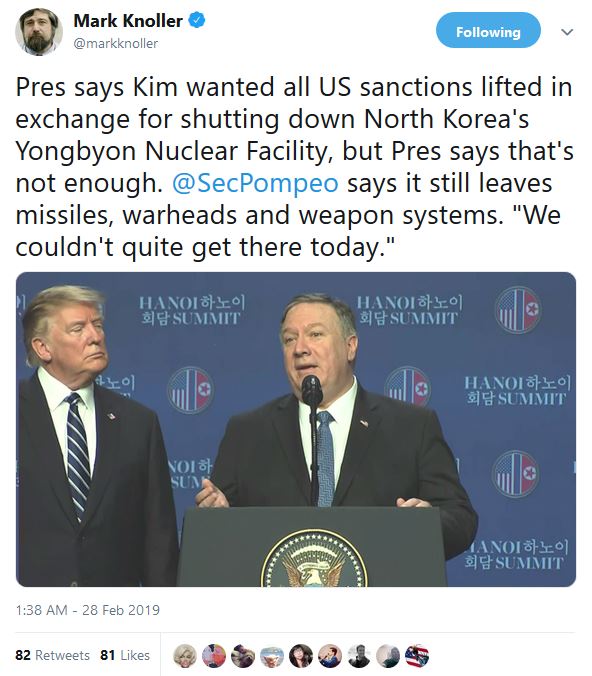
Air Force One’s 20-hour trip to Hanoi, with two refueling stops, was also very long. We don’t know what preparations the U.S. President made either, but it was clear from the news coverage it wasn’t much. Here’s CBS News reporter Mark Knoller:
Couldn’t this have been discovered and vetted long before the actual, expensive in person meet up? Isn’t that why we have diplomats? Why elevate this meeting to a “summit” if we didn’t know the basis for an agreement beforehand?
While Air Force One was enroute home, North Koreans disputed this characterization of the summit. Why cut the meeting short before agreeing what happened and would be said to the press? Seems like basic diplomacy is missing from this administration.
What a bunch of knuckleheads. I’m not referring to the North Korean dictator and his staff. Why would the U.S. elevate this guy to this level of prominence on the world stage? Importantly, it was a staged distraction from Secretary of State Michael Pompeo and National Security Advisor John Bolton’s dismantling of the U.S. – Russia arms control protocol. There is other stuff going on the the country to be distracted from as well. The tail is wagging the dog.
We don’t know but Kim must have been feeling good on the long trip home to Pyongyang after the president failed to find common ground for denuclearization of the Korean peninsula. We do know something about his green, bullet-proof train with yellow trim on the cars.
“Kim Jong Il, who was Kim Jong Un’s father, was known to have hated flying and traveled by train on several trips to China,” Eric Talmadge and Adam Schreck of AP wrote. “He is said to have fitted his train out to accommodate lavish parties and karaoke sessions.”
His father is also said to have kept four female singers on the train when he traveled, referring to them as “lady conductors.” Will lady conductors sing karaoke for Kim Jong Un on the trip home? Since the U.S. president won’t hold him to account, there may be something for a dictator to celebrate.
While eastbound on Highway 382, a large bird lifted from the ground within my headlights and dropped a recently killed rabbit. It hesitated, perhaps wanting to return to its prey, but not long enough for a collision.
I don’t know what species it was, but suspect it was an owl since it was two hours before sunrise. Owls live all around us in Big Grove and at night use the peak of our roof to observe the neighborhood and dine on small rodents.
As I continued around the lakes, then westbound on Mehaffey Bridge Road a deer crossed the road in front of me. I tapped the brakes. It was less dramatic than the bird of prey. I’m used to living with wildlife after so many years. I know what to do.
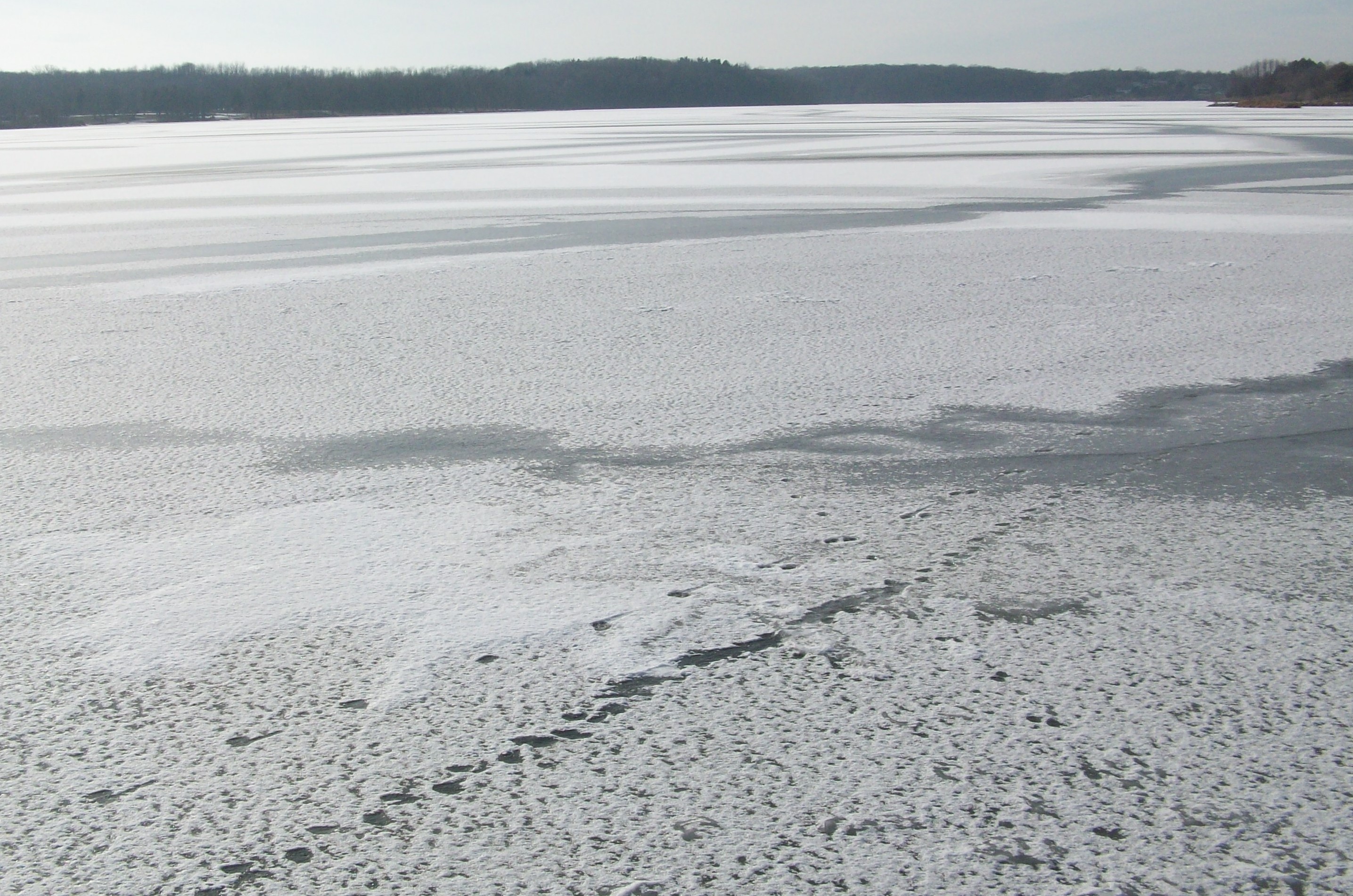
The lakes are covered with a smooth surface of ice, perfect for skating. With a couple more days of deep freeze, conditions should be excellent. The problem is no one I know ice skates any more and it is not a solitary activity. Time was we would clear a rink and sometimes start a bonfire. Importantly, it was fun. We’re getting older and other things occupy neighbors, busy looking at screens, I cynically suppose.
Wildlife appears to be flourishing. Maybe I’m just noticing. It is possible to step away from the screens and observe nature… a nature adapted to the built environment humans made since settling here in the 1830s. There was no risk of roadkill when there were no motorized vehicles or roads.
I don’t have much to say about the world outside our ecosystem today. Aren’t others saying enough? Suffice it that the 25-minute trip to work provides a window to the world around us.
The store manager from the home, farm and auto supply store phoned Sunday afternoon to ask me to work on Monday. The colleague who assumed my full time job last spring was visiting family in Nebraska and bad weather closed roads across the state, including Interstate 80. She couldn’t make it back in time for her shift.
In Iowa, helping out is part of our culture. I said yes I’d work and rearranged my plans so I could.
In addition, the farmer decided the weather was bad enough she didn’t want people venturing out to the farm. The roads were iced over and the wind howled at 30 miles per hour all day. Her sister, the shepherdess, posted social media photos of installing a new anemometer and weather station. Its LED panel displayed the digital message, “hold onto your hat!”
As I was settling in last night, the Washington Post put up an article about White House plans to form an “ad hoc group of select federal scientists to reassess the government’s analysis of climate science and counter conclusions that the continued burning of fossil fuels is harming the planet.”
In other words, the Fourth National Climate Assessment told the story of how dire our future could be without climate action. Rather than doing something, the administration is arguing with their own scientists that global warming is not caused by burning fossil fuels. These are times that will fry men’s souls.
Which part of yesterday’s howling wind was an amplification caused by global warming? The answer doesn’t matter because it’s the wrong question. We know the deleterious effect of burning fossil fuels. We also know thawing permafrost, agriculture, methane releases during oil production, building construction, manufacturing processes, air transport, deforestation, landfill decomposition and other human activities contribute to greenhouse gas emissions and global warming. We can’t get bogged down in details when the bigger picture is we have an obstructionist government led by Republicans and their conservative, dark-moneyed think tanks who would interpret the howling wind as something else. The better question is when will voters do something to fix this?
Yesterday’s wind was the kind that calls for hunkering down until it ends. Eventually we will have a calm, sunny day and the opportunity to work as normal. Or maybe it is something else, as Bob Dylan sang in the 1970s,
Idiot wind, blowing like a circle around my skull
From the Grand Coulee Dam to the Capitol
Idiot wind, blowing every time you move your teeth
You’re an idiot, babe
It’s a wonder that you still know how to breathe.







 Journey Home
You must be logged in to post a comment.