Categories
Environment Living in Society

Reynolds Proclaims Weather Disaster – 11 Times

Front Moving In

Governor Kim Reynolds proclaimed counties in Iowa to be a disaster because of severe weather. It is time to act on climate.

Tornadoes tore through Marshalltown, Pella and Bondurant last Thursday as I got off work at the home, farm and auto supply store. It doesn’t appear anyone was seriously injured or died, although damage to the communities was substantial. Photos and video posted on social media depicted a horrible scene.

Are these storms due to climate change? We know Governor Kim Reynolds issued 11 disaster proclamations since June 11 for severe weather, heavy rains, storms, tornadoes and flooding. Something is different about our weather. Even a casual observer understands our climate changed and contributed to these extreme weather events.

Additionally, the seasons have been out of wack this year. A late spring, early high ambient temperatures, and more frequent storms make our weather exceedingly weird. Iowans have noticed and are talking about it. It’s not a random occurrence.

Ben Santer, an atmospheric scientist at the Lawrence Livermore National Laboratory, led a study of four decades of climate data that concluded human activity is disrupting our seasonal balance. That is, the seasons don’t proceed through time the way they did. Eric Roston at Bloomberg wrote a more accessible article about the study here.

“Poring over four decades of satellite data, climate scientists have concluded for the first time that humans are pushing seasonal temperatures out of balance — shifting what one researcher called the very ‘march of the seasons themselves,’” Roston wrote. “Ever-mindful of calculable uncertainty and climate deniers, the authors give ‘odds of roughly 5 in 1 million’ of these changes occurring naturally, without human influence.”

While an individual study is one thing, the science of climate change is clear. I wrote about it in 2014:

People seeking scientific proof of anthropogenic global climate change are barking up the wrong tree. The goal of science is not to prove, but to explain aspects of the natural world. Following is a brief explanation of climate change.

Around 1850, physicist John Tyndall discovered that carbon dioxide traps heat in our atmosphere, producing the greenhouse effect, which enables all of creation as we know it to live on Earth.

Carbon dioxide increased as a percentage of our atmosphere since Tyndall’s time at the beginning of the Industrial Revolution. As a result, Earth’s average temperature increased by 1.5 degrees Fahrenheit.

The disturbance of the global carbon cycle and related increase in carbon dioxide concentrations in the atmosphere is identifiably anthropogenic because of the isotope signature of atmospheric carbon dioxide.

We can also observe the effects of global warming in worldwide glacier retreat, declining Arctic ice sheets, sea level rise, warming oceans, ocean acidification, and increased intensity of weather events.

It is no wonder the vast majority of climate scientists and all of the national academies of science in the world agree climate change is real, it is happening now, it’s caused by humans, and is cause for immediate action before it is too late.

To learn more about what you can do to help solve the climate crisis, go to The Climate Reality Project.

~ First posted on Blog for Iowa

Categories
Environment

Ed Fallon, Bold Iowa and the Dakota Access Pipeline

Ed Fallon in His Garden

Ed Fallon lives and works in Des Moines and has long been a friend of Blog for Iowa. Here’s an update on Ed’s current activities from an interview conducted last week via email.

We noticed you are affiliated with Bold Iowa. What is Bold Iowa and what attracted you to pitching your tent with them?

I continue to host the Fallon Forum and direct Bold Iowa. Bold Iowa grew out of the Bold Alliance, which was formed after the Keystone XL fight. Just a year after the alliance started, Jane Kleeb, founder of Bold Alliance, abandoned Alliance chapters in Iowa, Louisiana, Oklahoma and Virginia. We now operate as an independent organization.

What are you working on this summer and why?

We’re focused on supporting the landowners who have filed a lawsuit against the abuse of eminent domain to build the Dakota Access pipeline. Sierra Club is part of that suit. One of the ways we are supporting landowners is to raise awareness of the suit through The First Nation — Farmer Climate Unity March. We are also hosting a series of community forums, setting up editorial board meetings, sending out press releases, and encouraging people to write letters to the editor. If landowners and the Sierra Club prevail in the lawsuit, it could stop the oil from flowing through Iowa, North Dakota, South Dakota and Illinois.

Climate change has been in Iowa news this year more than recently. Have you noticed? If you’ve noticed, to what do you attribute the increased mentions in social and conventional media?

I’ve noticed, although the uptick has been small. Mostly, it seems some editorial boards and a few reporters are beginning to understand that climate change is not just another issue, that it’s a crisis that demands immediate attention.

What would you like our readers to do to support your causes during the remainder of 2018?

March with us Sept 1 – 8 from Des Moines to Fort Dodge, following the pipeline route through Story, Boone and Webster Counties. Contact media about the importance of the lawsuit and the urgency of climate action. Most important, vote in November for candidates who take climate change seriously.

Listen to the Fallon Forum live Mondays, 11:00-12:00 noon CT on La Reina KDLF 96.5 FM and 1260 AM (central Iowa). Add your voice to the conversation by calling (515) 528-8122.

~ First posted on Blog for Iowa
Categories
Environment Living in Society

The Great American Give Away

Coyote Natural Bridge, Grand Staircase-Escalante National Monument, Utah. Photo Credit – Wikimedia Commons

The Trump administration is giving away access to our public lands for discovery and exploitation of minerals and fossil fuel reserves. Conservatives and mining interests are setting a place at the table to get their share.

“Trump signed a pair of proclamations late last year reducing the size of the 1.35-million-acre Bears Ears National Monument by 85 percent and the 1.87-million-acre Grand Staircase-Escalante National Monument by roughly 50 percent,” according to Huffington Post. “It was the largest reduction of national monuments in history, with more than 2 million acres losing protections. Prohibitions on new hard-rock mining claims in those now-unprotected areas were lifted in early February.”

The administration’s assault on national monuments is upsetting on a number of levels. It is the culmination of an effort by conservatives to divest government control over national parks and monuments, something most of us thought was long settled.

It’s not settled at all.

A Canadian mining firm, Glacier Lake Resources, Inc., has staked a claim on land that was, until recently, part of Grand Staircase-Escalante National Monument in Utah. The Vancouver-based company said in a press release it plans to mine copper, cobalt, zinc, and other minerals from the Colt Mesa deposit about 35 miles southeast of Boulder, Utah.

On Feb. 2, four members of the Lamoreaux family, which owns a small mineral company called Alpine Gems LLC, staked an 80-acre claim near Butler Valley, southeast of Cannonville. On May 9, Alpine Gems staked three 20-acre claims in that same area.

Last week, Utah Senator Mike Lee introduced the Protecting Utah’s Rural Economy Act in the Congress. He explained in an opinion piece he wrote for the Deseret News. Here are two excerpts that provide the gist of it:

The looming danger for Utah’s rural communities comes from the Antiquities Act of 1906, which was originally intended to protect objects of historic and cultural interest, such as artifacts and religious sites.

Unfortunately, what was once a narrowly targeted tool for preventing looting on federal lands has become a weapon of faraway elites to use against hardworking rural Americans.

That is why I am introducing the Protect Utah’s Rural Economy, or PURE, Act. This bill would protect Utah from future abuses under the Antiquities Act by prohibiting the president from establishing or expanding a national monument in Utah unless the proposed monument has been authorized by an act of Congress and the state Legislature.

Rural Americans want what all Americans want: a dignified, decent-paying job, a family to love and support and a healthy community whose future is determined by local residents — not their self-styled betters thousands of miles away.

Lee’s argument is a genome away from political theorist and the seventh vice president of the United States John C. Calhoun’s arguments in support of slavery and state’s rights. Calhoun is remembered for defending slavery and for advancing the concept of minority rights in politics, which he did in the context of defending white Southern interests from perceived Northern threats, according to Wikipedia.

The Wilderness Society is challenging Trump’s proclamations in court and monitoring the progress of the companies seeking to extract minerals. It may not be enough.

Read more about The Wilderness Society’s efforts to protect our wild areas and fight back against the anti-conservationist movement at wilderness.org. If you are in a position to help financially, here is a link to donate to the Wilderness Society.

~ First posted on Blog for Iowa

Categories
Environment Work Life

Working in the Heat

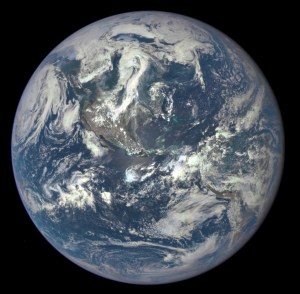
Image of Earth 7-6-15 from DSCOVR (Deep Space Climate Observatory)

Independence Day at the home, farm and auto supply store was a time to catch-up with organizing the warehouse, process expired pet food, reposition tall pallets of wood shavings, and generally clean up. The usual receiving activities slowed down as delivery drivers had the day off.

The store was pretty busy and comme d’habitude, management tried to feed us lunch: fried chicken with sides from a chain restaurant headquartered in Orange City.

I resisted. I also didn’t criticize because they were trying to be nice on the holiday we all had to work. We all should be nice when we can.

A couple of projects involved being outside in the blazing heat and humidity. I persisted and got the work done.

When working outside at home I get done early in the day to avoid mid day heat. I’ll work outside all day when the heat index is up to 90 degrees, but that’s the upper limit. With the heat and humidity we’ve been having that meant days indoors even though the sky was clear. It was weird.

According to this morning’s newspaper heat records are being set all over the world. In the Northern Hemisphere we’ve had the hottest weather ever recorded during the past week as a massive and intensive “heat dome” settled over the eastern United States.

In addition, the northeastern Atlantic Ocean is cooler than normal. Partly this means there may be less hurricane-strength storms this season. My worry is it’s being caused by melting of the Greenland ice sheet. If Greenland goes completely, the historical record shows the Atlantic meridional overturning circulation (AMOC) will slow down significantly or stop. That could mean disruption of the growing season in Europe and of their food supply. According to Scientific American, AMOC is the weakest it’s been in 1,600 years.

“The grand northward progression of water along North America that moves heat from the tropics toward the Arctic has been sluggish,” wrote Andrea Thompson. “If that languidness continues and deepens, it could usher in drastic changes in sea level and weather around the ocean basin.”

I think of the blue marble and how all of us on earth are connected.

“No single record, in isolation, can be attributed to global warming,” wrote Jason Samenow in the Washington Post. “But collectively, these heat records are consistent with the kind of extremes we expect to see increase in a warming world.”

There are so many signals and indicators of climate disruption in the global environment that such disclaimers may serve some editorial purpose but are immediately useless. The world is warming and there are consequences.

It’s about more than working outside on a humid and hot day at the home, farm and auto supply store.

Categories
Environment Home Life Writing

Under a Rainbow

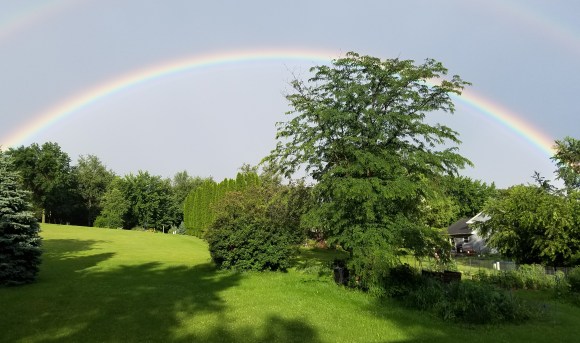
Rainbow Framing the Garden

Clouds broke while I watched it rain through the west-facing garage door. It was a slow, steady, gentle and soaking rain of the kind remembered from childhood.

Realizing there might be a rainbow I rushed upstairs and looked out an east-facing window. I saw a double rainbow framing the garden plots and our back yard.

The colors were as intense as I remember ever seeing. A sign the shit-storm of American politics would eventually end and our lives might heal.

Earlier I’d been on the roof cleaning gutters. A tree branch had blocked one of them, collecting leaves and impeding water flow. The view of the nearby lake was obscured by trees and vegetation that had grown up since we moved here. In the beginning there had been a clear view of the lake from the roof peak. We, people and plants, are older now.

Refraction of light through rain is simple and powerful physics. Outside quotidian affairs of which lives are mostly made, a rainbow brings hope. For a few fleeting moments we marvel at the colors and reflect upon the role rain and recovery can play in our lives. We notice.

Rain clears the air and washes away dust created by simple lives. On days like that, a better life seems possible. We weathered the storm and that may be enough.

A rainbow reminds us of that.

Categories
Environment Kitchen Garden

Gardening Before the Rain

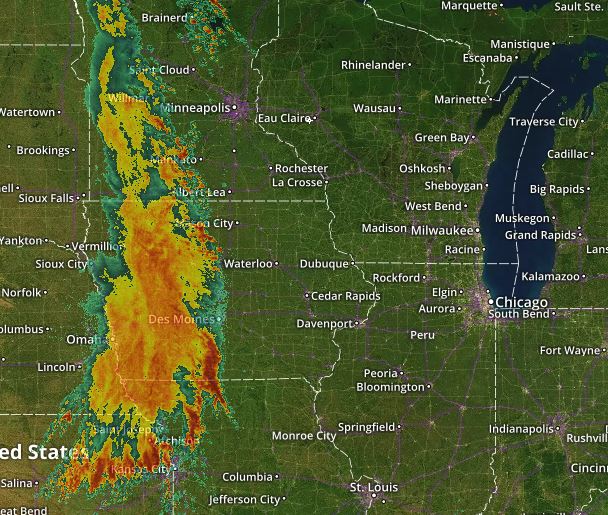
Weather Radar June 2, 4:46 a.m.

In the end it didn’t rain.

The forecast had been rain for a couple of days. The weather radar looked ominous Saturday at 4 a.m. It was heading our way.

At sunrise I went to the garden to beat the rain.

Our garden is big enough to engage a person for hours — weeding, harvesting, planting, mulching, fence mending and the like. It never ends. I think there, mostly about our relationship with the environment and toward a food ecology, the dreams of gardeners.

The work was to mulch tomatoes, weed carrots and beets, clean up kale leaves bitten by intense heat, replant seedlings where they failed and organize for the next planting session. The mulch collected this week is about half used. Before I plant, it must all be relocated to a final destination to clear space for peppers and beans. There is another day’s work waiting today.

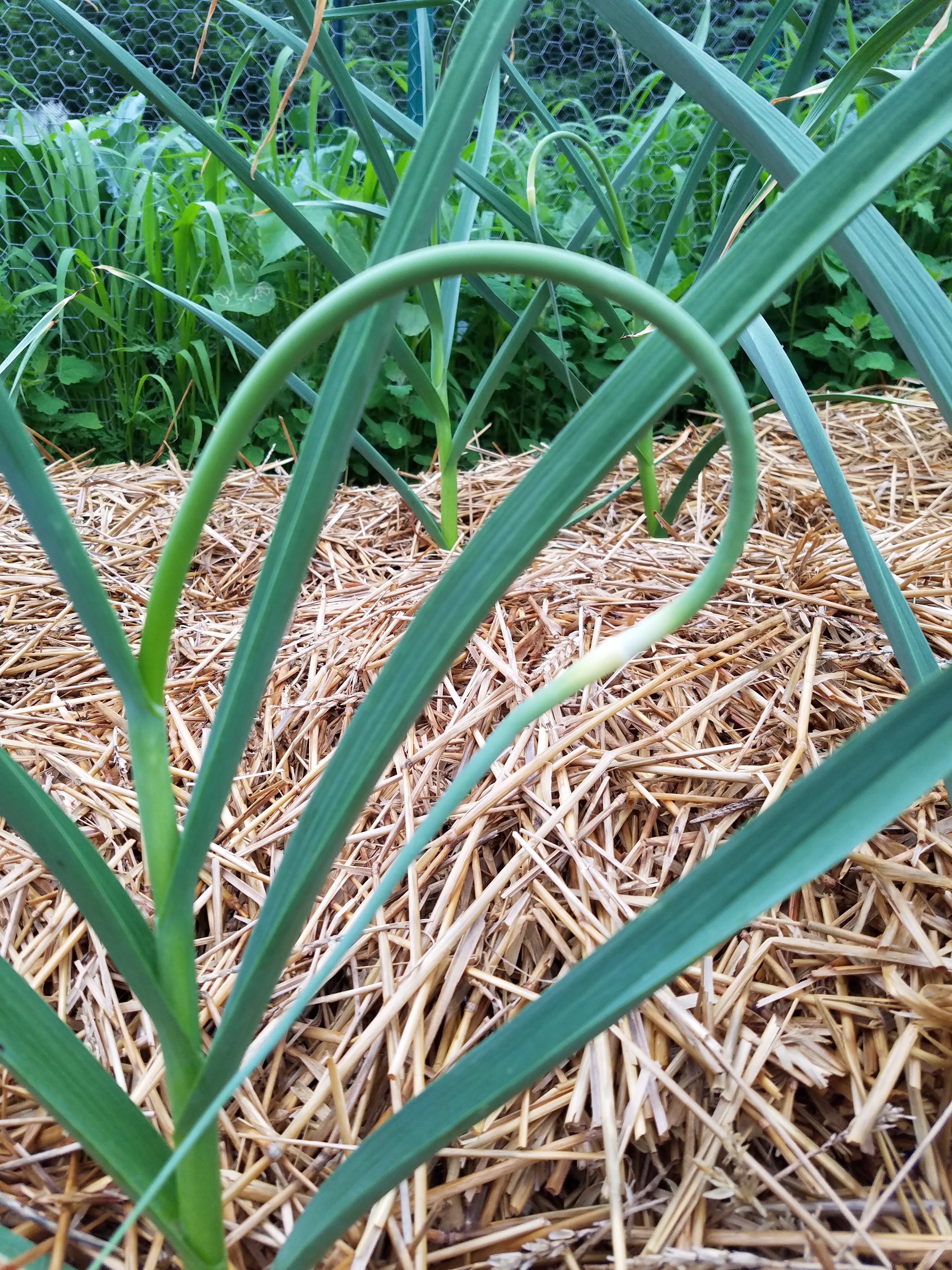
Garlic Scape

The garlic crop has been exciting. Scapes began to appear and as soon as they twist back around on themselves I’ll cut them off, to enable the bulbs to benefit from the plant’s energy, and to use them in the kitchen. The seeds were planted seven months ago so it’s great to see we’re getting closer to harvest.

The cloud formation I saw on radar broke up before it got to us. Where I expected rain, there were blue skies. I got out the hose and watered.

Like it or not, I must deal with my physical capabilities. I’ve been blessed with good health most of my life. When I had to give up running a couple years ago things began going downhill. What I mean is there was a perceptible decrease in flexibility and energy coupled with selected aches and pains in my shoulders, feet and hands. The foot pain is likely related to running although I’ve been spared the joint pain runners experience in their knees and hips. My shoulders? One of the transient doctors at the nearby clinic diagnosed arthritis, but I doubt it. I’ve learned to be careful not to injure myself with lifting. My back is sound. I get along.

Kale Harvest

The main thing is dealing with energy levels. Instead of staying in the same place to finish a job I’ll take a break and go walking… to the garage, to my desk, to the kitchen. Sometimes I sit in the recliner for a while. I get back up and return to the garden. It’s a hodge-podgey way of doing things, however, I believe variation in work routine staves off further bodily ailments. It’s likely good for my mind as well.

The spring share at the CSA finished on Monday. The ice box is filled with fresh greens and rhubarb. On deck is rhubarb something, a vegetable broth for canning, and spinach daily until the kale avalanche arrives. I did not barter for a summer share at either CSA in order to survive mostly from our garden. Each year I become a better grower. It enables us to sustain ourselves with fresh produce while the season continues.

What more could we want in a turbulent world?

Categories
Environment Kitchen Garden

Bringing Food Home

Farmers Market Food

A relationship with food in American society is complicated.

Some don’t have enough. Others are awash in calories. We each have a human need for nourishment and the ways we go about meeting it are as different as the families which engendered us.

A favorite childhood memory is when Mother went to work in the school cafeteria after the Catholic Church built a new grade school near our home. With other women like her, she took a list of ingredients based partly on government programs (including lots of cheese) and partly on a limited budget, and made meals that included such dishes as porcupine meatballs (hamburger and rice) and grilled cheese sandwiches with tomato soup. Father worked at the meat packing plant which had an employee butcher shop where he could buy beef, pork and meat products at a discount, and did. The idea of stretching hamburger by mixing it with cooked rice was a novelty in our household and eventually we implored Mother to make porcupine meatballs for us at home, just like the ones at school. She did.

This story of external culinary practices coming into our home is essential to understanding the rise of a diverse diet in American society. We see things out there, they look good, and we want them. Most people, including low-wage workers, have or find the means to get them.

Many books, careers and lives have been based on food in society. We are an individualized rather than generalized culture with regard to food acquisition, preparation and consumption. To a large extent, the rise of the modern mega grocery store has shaped our eating habits in ways no one would have expected. Much ink has been spilled about that and I’m less interested in regurgitating my slice of it.

What I do know is local food farmers work hard for the sparse income they garner. All farmers do. The local food movement of which they are a part is based on the hope more people will bring locally produced, raw ingredients produced in a sustainable manner into their kitchens, ice boxes and pantries. Enough people do for a small group of farmers to make a living.

In many ways the increased interest in local food is the same type of behavior that took place in our home in the 1960s. We experience surprise when our CSA share includes Broccoli Raab, Koji or Bok Choy. We learn how to eat and cook them and want more. It’s not that our home nourishment plan is boring. We want and enjoy the experience of creation as it relates to cooking and eating. We want that experience to be personal and shared with family. That is very American.

I concede promotion of local food is a form of consumerism no different from a tomato catsup purveyor who spends dollars on an advertising campaign to enhance sales. The same behavioral forces are at work. I’m okay with that.

Just so you know, I’m not bewitched by the allure of eating a kale salad, at least not yet. Suffice it to say the diversity and behavior regarding food in our household with its kitchen garden, farm sourcing and grocery shopping has some unique qualities that may not be of interest to the authors of the Michelin Guide, but make our lives a little better. That too is very American. That’s part of who I am, who we Americans all are.

Categories
Environment Writing

Earth Day Weekend 2018

Earthrise Dec. 24, 1968

Earth Day is and will always be about this photo taken by the Apollo 8 astronauts on the first manned mission to the moon.

“The vast loneliness is awe-inspiring and it makes you realize just what you have back there on Earth,” command module pilot Jim Lovell said from lunar orbit.

With a perspective six inches from our noses, we often forget who we are and how we fit into the vast reaches of the universe. We are a speck in a place larger than we can imagine.

When I participated in the first Earth Day as a senior in high school, the idea we should work together for peace, reduce pollution, and care for the environment seemed obvious. Even much reviled President Richard Nixon got it — society had to do something to address clean air, clean water and endangered species.

Earth Day is a chance to revisit this iconic photograph. When we consider a broader perspective, as the photograph encourages us to do, little has changed on Earth since it was taken. Our troubles seem petty compared to the overriding fact Earth is our only home. We are all in this together.

As much as societies seek to delineate metes and bounds, there are no borders on the globe. There is only one society of which we are all a part.

This Earth Day I’ll be working at home in my garden. A late spring created pent up demand for outdoors work. For the last four weeks, one excuse after another delayed needed work, yet now I’m ready to release the floodgates.

Not before I consider this photo one more time.

Categories
Environment Living in Society

Letter to the Johnson County Board of Supervisors

Woman Writing Letter

Dear Lisa, Mike, Kurt, Janelle and Rod,

It’s funny how when one gets all the information the picture looks different.

Since I complained about the purchase of Dick Schwab and Katherine Burford’s property using conservation bond money after partial information was leaked via our local newspaper, I wanted to get back to you now that the purchase has been made public.

The fact Burford/Schwab donated the developed portion of the property mitigates my concern about how bond money is being used. In fact, because of that, the plan, as explained in the Press Citizen, complies with what I said in my March 7 email. “I hope and expect you to vote no on the acquisition of this property using conservation bond money.” My concerns are rendered moot because of the donation.

On reflection, this decision was a good one for which the board should be commended. It is also consistent with conversations I have had with Schwab about how he planned to dispose of his property.

While I continue to be dissatisfied by the partial leakage of information, I have no beef with you.

Thanks for your service on the board of supervisors.

Regards, Paul

Categories
Environment Writing

Morning Coffee, Climate Change and the 2018 Midterms

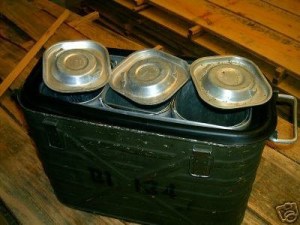
U.S. Army Mermite Can

I first drank coffee in the Army… on top of a hill… during the dead of winter… from a mermite can.

Steam rising from the lid proved irresistible when ambient temperatures were below zero and we had just slept on the ground. What else were we going to do but drink coffee? It was there.

We each have a personal history of drinking coffee. I asked one of the greenhouse seeding crews if they remembered their first cup. Some had specific memories, others did not. For me, it was the windy hill in Germany back in 1976.

Coffee was first discovered in Ethiopia in the 11th Century and spread throughout the temperate zones of the planet. It is currently being grown in more than 60 countries. Brazil, Vietnam, Columbia, Indonesia and Ethiopia are the largest coffee producers by annual export weight. Coffee has become ubiquitous as any foodstuff can be.

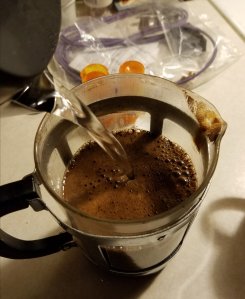
Making Coffee

The sources of our coffee are under pressure because of climate change. Yields are declining in part because a warmer atmosphere holds more water vapor, creating unseasonable and extreme weather events. Likewise, warmer temperatures expanded the range of the coffee berry borer. Coffee rust is a detrimental fungus increasing its range as the planet warms and winters no longer kill it off in mountainous regions where coffee grows. The impact of global warming caused climate change is not trivial.

We would like to drink a cup of Joe without worry. When we go to the warehouse club there is a long, abundant aisle of coffee produced all over the world. A cup of coffee continues to be affordable at restaurants. It hardly seems like a problem. It isn’t… at least not now.

The science of global warming is virtually undisputed. What seems less certain is how it will impact our personal lives going forward. The Earth’s ecosystem is complex and specific regions have had different issues. We’ve had our share of droughts in Iowa, but there has also been enough rainfall to produce crops. Some days it seems the only persistent idea about Iowa’s climate is that rain remains. When it comes to coffee, what happens six inches in front of our noses is not as important as the global environment in which humans live.

There’s the rub.

With the 2016 election of a Republican to the White House, all eyes are diverted from our most pressing problems. Challenges to the study of climate change is one of those pressing problems and not only because I may be deprived of my daily cup of coffee.

The administration walked away from policy decisions we’ve made to reduce greenhouse gas emissions. It is cutting funding for climate research. It is censoring and targeting government scientists. One could reasonably say the government under Republicans has abandoned science as a consideration in policy-making.

As Americans, we know what to do. We must repudiate the direction Republicans are taking our society by voting them out in the 2018 and 2020 elections. I’d rather linger over my morning coffee than get involved in politics again. However, personal political engagement is the price of a livable future.