Categories
Living in Society Social Commentary

Public Health Approach to Gun Violence

Polish Carpentry Crew in Chicago

On page A5 of Tuesday’s Cedar Rapids Gazette was the headline “75 shot in Chicago last weekend.”

From 3 p.m. Friday until 6 a.m. Monday 12 people were killed and 63 wounded, mostly on the south and west sides of the city.

It seems like a lot, even for a large city. Shootings in Cedar Rapids are frequent, but not like this. Is the headline a call to do something about gun violence?

Chicago law enforcement attributed the shootings to gangs who shoot into summer crowds at night, according to the news story. The shootings appear to be random, and ongoing. At least 1,700 people have been shot in Chicago this year. It is one tough city.

In the early 1990s I attended a session of arraignment court near the Washington Park neighborhood on the south side. It was an eye opener. Case after case came before the judge: shootings, domestic violence, assault, petty theft, sexual assault — plaintiffs were bandaged and bruised by incidents that provoked the court appearance. The public defender would lose track of his clients and which case was being heard. It was a chaotic meat grinder.

Experiences like these lead me somewhere besides lack of gun control as the core problem regarding social violence. The lightning rod has been the National Rifle Association.

Progressives found a certain amount of glee in the recent story in Rolling Stone titled “The NRA Says It’s in Deep Financial Trouble, May Be ‘Unable to Exist.’” The NRA is the poster child for what’s wrong about gun culture in the United States.

“The National Rifle Association uses its enormous lobbying power to stymie legislative debate and block most constructive gun legislation,” Ralph Scharnau recently wrote. “Thus even very moderate provisions fail to pass or even get out of committee.”

As a society Americans are not good at controlling violence. That includes our elected officials.

Chicago stands as an example the solution to gun violence is not only gun control. I’m not alone in believing that. The World Health Organization proposes violence be treated as a public health problem, outlining four basic approaches:

  1. Uncovering as much basic knowledge as possible about all the aspects of violence through systematically collecting data on the magnitude, scope, characteristics and consequences of violence at local, national and international levels.
  2. Investigating why violence occurs – that is, conducting research to determine the causes and correlates of violence; the factors that increase or decrease the risk for violence; and the factors that might be modifiable through interventions.
  3. Exploring ways to prevent violence, using the information from the above, by designing, implementing, monitoring and evaluating interventions.
  4. Implementing interventions that appear promising, widely disseminating information and determining the cost-effectiveness of programs.

Hasn’t this work been done? Yes it has. WHO produced a list of ten evidence-based strategies for preventing violence.

  1. Increase safe, stable, and nurturing relationships between children and their parents and caretakers;
  2. Reduce availability and misuse of alcohol;
  3. Reduce access to lethal means, such as guns, knives,and pesticides (often used to commit suicide, especially in low-and middle-income countries);
  4. Improve life skills and enhance opportunities for children and youth;
  5. Promote gender equality and empower women;
  6. Change cultural norms that support violence;
  7. Improve criminal justice systems;
  8. Improve social welfare systems;
  9. Reduce social distance between conflicting groups;
  10. Reduce economic inequality and concentrated poverty.

Will a public health approach to preventing gun violence work? I don’t know, but what we are doing now — hammering the NRA and elected officials — isn’t. It’s time to try something else.

~ First posted at Blog for Iowa

Categories
Home Life Living in Society Social Commentary

Shopping in Coralville

From a Shopping Trip in Coralville

I went on a shopping trip yesterday.

What of it, readers may ask. People go shopping all the time and some say our economy is predicated on consumers shopping.

That may be, however, in an hour and 12 minutes I spent 18 percent of our monthly budget on the stuff of living. It was a big deal.

The reason for the shopping trip was I took this week off from the home, farm and auto supply store to work on our garden. I usually dovetail shopping with trips to work. Garden time generated needs like a new 9-pattern spray nozzle to replace the one that began leaking, a dozen five-foot, light gauge fence posts for the garden, 100 feet of 4-foot chicken wire netting, and 50 feet of four-foot, 14 gauge, 2 x 4 welded wire fencing to make some additional tomato cages.

While there, I bought a new Stihl FS 56 R C-E loop handle trimmer. When the old, battery-powered Black and Decker trimmer broke I debated whether or not to acquire a gasoline or battery powered replacement. Two decision points. Even with two batteries the Black and Decker couldn’t trim the whole yard. Where the electricity to charge the trimmer batteries comes from is problematic.

We source electricity from the Linn County Rural Electric Cooperative and their generation partner CIPCO. More than two-thirds of electricity we use is generated by undesirable means: coal and nuclear. While the percentage of wind and solar CIPCO used increased in recent years, the Duane Arnold nuclear plant is a sore spot. The mix will change when the nuclear reactors go off line in the near future. I chose the most fuel-efficient of the Stihl line of household trimmers and expect to burn about two gallons of gasoline per season.

I stuck to my shopping lists even when I deleted the warehouse club list from my mobile device before arriving there. My mission was to find fruit. The selection of organically grown was very limited. Basically apples and bananas which both came at a premium price. I added a Dole pineapple on sale for $1.99 and a four-pound clam shell of grapes. The grapes weren’t the best — imported from Chile and treated — I won’t make that mistake again.

Finally I stopped at a large chain drug store on the way home. I go there three or four times a year to pick up personal hygiene items. The cost of razor blades has me thinking about letting my beard grow.

To acknowledge participation in consumer culture is essential. When I consider a history of my life, for good or ill, shopping has been part of it and an influence. When Father insisted on supporting César Chavez and the United Farm Workers’ grape boycott, we connected to the struggles of people who produce our food and learned a lesson about being a union family. That a gallon of milk cost $1.89 yesterday speaks volumes to the plight of family dairy farmers. That I get a discount for being employed at the home, farm and auto supply store is part of the reason I linger on into retirement.

This was my first big shopping trip of the year and may be the only one. It’s a small but important part of sustaining a life in a turbulent world.

Categories
Home Life Living in Society Milestones Social Commentary

Layered with Sadness

Sundog Farm

In our neighborhood a preteen found his father collapsed in the yard and ran for help. Despite best efforts by his partner of 30 years, emergency responders, and staff at the University of Iowa Hospitals and Clinics, he died Sunday. The funeral is Friday.

A layer of sadness blankets places I go.

It’s not just the death of a neighbor. Cold weather is delaying farmers from getting into the field. Tension permeates everything. We laugh but avoid the reality that something has to give — perhaps delaying the spring share until plants grow. Perhaps something else. We are ready for the weather to break.

Temperatures today are forecast in the low thirties… again. It’s April 18 for goodness sake! The garden should be a third planted by now. It has been difficult to spend time outside, bundled up to keep warm. It’s not the cold as much as it is a nagging hesitancy to venture out into the cold spring.

When we moved to Big Grove, before we put curtains in the living room, I sat on the couch after a long day and watched airplanes make their approach to the nearby Eastern Iowa Airport. Even though my wife and daughter were nearby I felt alone and on my own from time to time. I picked myself up from the couch and engaged in a diverse life. Every so often the quiet in the house is overwhelming, even today. I feel isolated from what matters most. The feeling passes.

I had a physical examination in town, and my arms ache. In my left shoulder I got a pneumonia vaccine and in my right a shingles vaccine. Both require boosters down the line. I had blood drawn for lab tests by a nurse I’ve known more than a dozen years. Achy doesn’t really describe it. I removed the three bandages and piled them up on the night stand this morning. The shingles vaccine is doing its job making me feel sore and unsettled.

Doctor did a depression screening. I passed, that is, I don’t believe I’m clinically depressed… just a bit saddened by the layers of crap we have to live through. It’s partly politics but it’s more than that. It’s as if everything with which we marked boundaries of our lives is being razed, surveyor pins pushed out of place by construction’s bulldozers. All we can do is put the pins back and start over. That’s what I hope to do.

Eventually the weather will break and my farmer friends will get the crop planted. Visitation for my late neighbor is tomorrow. I’m to pick up a sympathy card and a couple of restaurant gift cards to give the family a chance to get out of the house for a while. We all need a break.

The layer of sadness is palpable. At the same time as long as we pick ourselves up and go on living we’ll be alright. at least that is what we hope.

Categories
Living in Society Social Commentary

Getting Across the Line

Two Loaves of Bread

Can low income workers and retirees afford social media?

The conclusion I’m coming to is no.

Social media has served to engage me in writing brief posts, in collecting news, and from time to time, in chatting with friends and acquaintances. It helps pass time during breaks at the home, farm and auto supply store. Social media posts have been the subject of conversations at home. A few clicks and I can view what friends from the old neighborhood are doing. I can follow news reporters to tailor my feed and quickly match stories with my interests. As I approach retirement and feel the suck of a vortex into the pit of aging these uses seem less relevant.

I don’t think of myself as old although my frame reminds me I’m not as strong as I was ten years ago. Something’s got to give and I’m pretty sure it will be my time on social media.

What will I do instead?

I’ll keep writing, turning my blog into a primary way for people to follow me and keep up with I’m doing. I’ll get back to journaling and work on bigger projects I have discussed on this site.

I’ll do the unpaid work at home that helps people of limited means get by: baking bread, gardening, preserving food, making our meals more from scratch, home exercise, exploring home remedies, learning how to fix things around the house, and useful chores.

I’ll decrease my driving to keep a smaller carbon footprint — I don’t really enjoy driving as I did. Maybe get the car out once a week to pick up supplies, twice if I need unexpected parts while fixing something around the house. There will be occasional social outings.

I’ll read books and magazines in addition to internet articles, mostly to serve my writing.

I’ll downsize and organize in preparation for when the final curtain falls.

Today is Ash Wednesday and Valentine’s Day — an odd coincidence. Rose Monday is past, Mardi Gras finished. It’s time to contemplate our mortality in light of love, hoping spring works it’s magic again. A rekindling of hope to get us through this ashen world.

It doesn’t take the internet to get by.

Categories
Living in Society Social Commentary

Influenza, Viruses and Sickness in the Land

Vegetarian Soup Stock

On Monday I went to the Urgent Care clinic for a persistent cold.

After a thorough examination, and many questions about the trajectory of symptoms, doctor leaned against the counter in the small examination room and pronounced, “it’s viral.” It could persist for another two weeks, she said.

I’ve run the course of Benzonate she prescribed for the cough. It is getting better. She wrote a second prescription for Amoxicillin and said hold it to see how things progressed. Later this morning, I’ll get it filled. I’m on the mend, but not well.

At least 43 Iowans died from influenza and viruses this season. Because of the delay in autopsy results, the actual number is likely higher.

At the home, farm and auto supply store employees have symptoms similar to mine. The store manager distributed a couple dozen aerosol cans of Lysol so we would keep everything sprayed down and hopefully disinfected. I don’t know if I gave the virus to others, or they gave it to me, but the whole workforce is coping. We are a sick land this January.

Today is the first time I’ve been able to concentrate on anything, and there is a backlog of post ideas and work delayed. Yet, I’m still here, sustaining our lives in a turbulent world.

Categories
Living in Society Social Commentary

We’re Going Home — Bob Dvorsky

State Senator Robert Dvorsky Photo Credit – Iowa Legislature

State Senator Bob Dvorsky’s decision to retire at the end of his current term hits close to home for a lot of reasons.

He represented our family since we returned to Iowa in 1993. During the time since then he became a key player in Democratic politics and in the Iowa Legislature.

He did a lot for Iowans when Democrats held the majority in the Iowa Senate. He also worked to get things done regardless of which political party was in control.

With Bob Dvorsky in office, politics became personal in a way it hadn’t been before.

I began corresponding with him on issues shortly after he was elected to the Iowa Senate. My last letter from him, a response about the no wake issue on Lake Macbride, was dated April 25, 1996. A few years later I became politically active again and saw him everywhere, eliminating the need to write.

During the decades I’ve known him, I can’t recall a single time Bob didn’t seek me out for a brief conversation, whether at the capitol, at a political event, or at my workplace. He knew the owners of the company where I spent most of my transportation career, and after my retirement we encountered each other at the warehouse club where I worked part time. He was always positive and encouraging.

I understand he’s turning 70 next year and has had a good, 32-year run. He’s going home like so many in our generation. Bob’s retirement is a mile marker on my own journey home.

When people say all politics is local, I think of Bob Dvorsky. He’s been a friend and mentor who represented my interests in the legislature. I wish him well in the second half of the 87th Iowa General Assembly and ever after.

Categories
Environment Living in Society Social Commentary

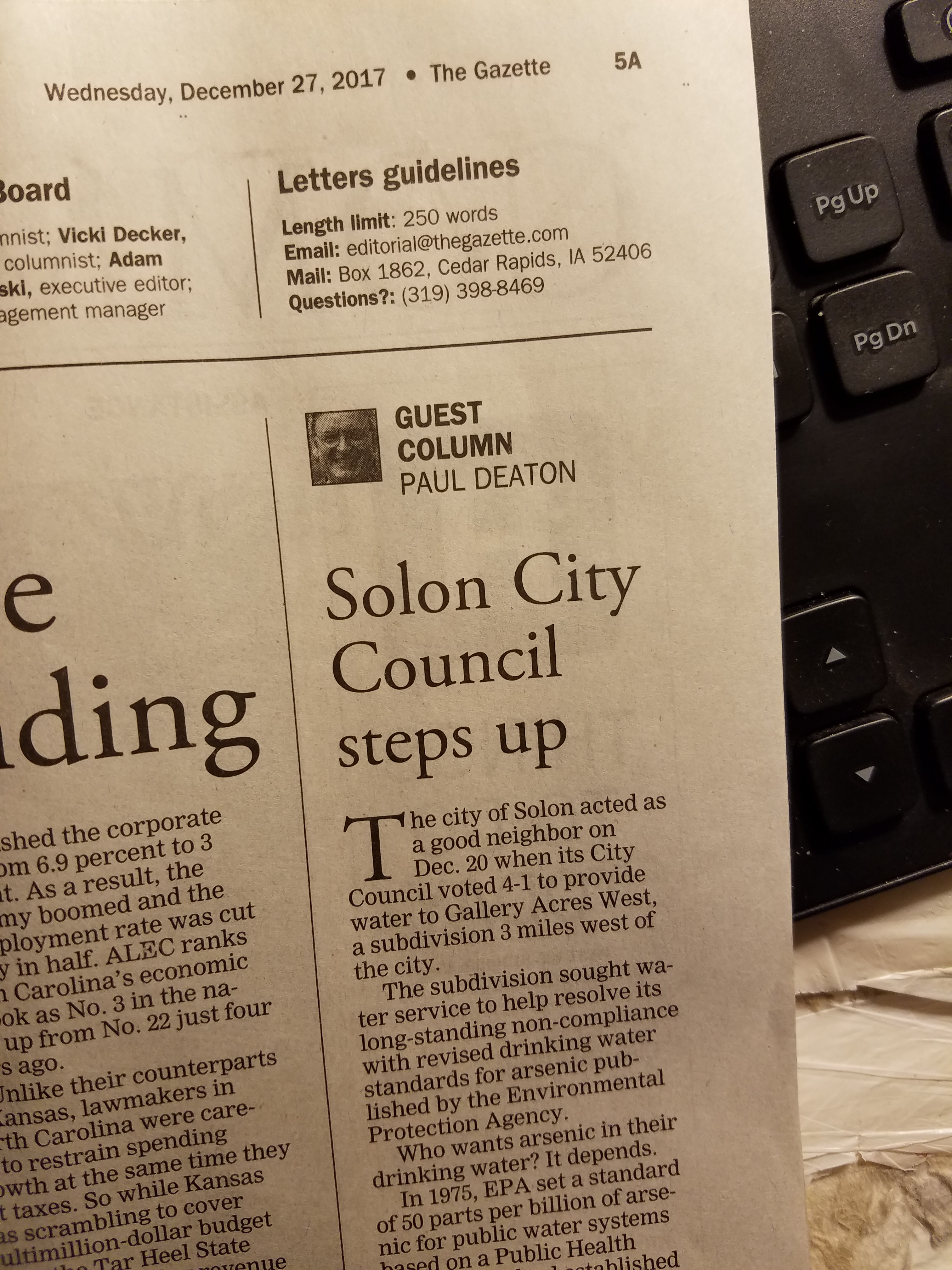
Solon City Council Steps Up

Column in the Cedar Rapids Gazette

The City of Solon acted as a good neighbor on Dec. 20 when its city council voted 4-1 to provide water to Gallery Acres West, a subdivision three miles west of the city.

The subdivision sought water service to help resolve its long-standing non-compliance with revised drinking water standards for arsenic published by the Environmental Protection Agency.

Who wants arsenic in their drinking water? It depends.

In 1975, EPA set a standard of 50 ppb of arsenic for public water systems based on a Public Health Service standard established in 1942. In 1999, the National Academy of Sciences concluded 50 ppb did not achieve EPA’s goal of protecting public health and should be lowered as soon as possible to allay long-term risks of low level exposure to arsenic.

EPA now has a goal of zero arsenic in public water systems however the goal is not technically feasible. The agency acknowledged there is a trade off between the cost of removing arsenic and its public health benefits.

“After careful consideration of the benefits and the costs,” an EPA fact sheet issued in 2001 said, “EPA has decided to set the drinking water standard for arsenic higher than the technically feasible level of 3 parts per billion (ppb) because EPA believes that the costs would not justify the benefits at this level.”

After multiple public hearings, EPA set the rule for arsenic at 10 ppb and public water systems were given five years after the arsenic rule was published to comply.

Some of us who manage public water systems took the new rule seriously and endeavored to comply. Others did not, and that leads us to Gallery Acres West. Their water system had its first violation of the new arsenic standard in 2002, failed to take action to reduce arsenic in their water system, and in 2015 was threatened with legal action by the Iowa Department of Natural Resources to force compliance.

During an Oct. 30 telephone call, I asked Mark Steiger, president of the Gallery Acres West home owners association, why they had not complied with the 2001 arsenic rule. He told me it was the cost of compliance. With only 14 homes in their association compliance would run thousands of dollars per household. I get it. As president of a home owners association that managed the same compliance issue for our public water system with 85 homes, it cost us $2,823.83 plus interest per household to upgrade our treatment facility to remove arsenic. In Gallery Acres West’s trade off between the cost of arsenic removal and public health, cost trumped health and residents continue to use drinking water with high arsenic content and will until they hook up to Solon.

The proliferation of development in unincorporated areas raises an issue of the quality of management in home owners associations. There are perceived freedoms in living in a small, insular community away from city life. There is also a cost. Things that could be taken for granted in a municipality require attention and potential action in rural Iowa.

It’s a good thing Gallery Acres West is close to a municipality willing to do their work for them.

~ First published on Dec. 27, 2017 in the Cedar Rapids Gazette

Categories
Home Life Living in Society Social Commentary Writing

2017 in Big Grove

Coffee Station

BIG GROVE TOWNSHIP — I found a quart jar of whole bean coffee in the pantry, ground a quarter cup, and made a pot with my French press — a bitter yet delicious treat while reflecting on the past year.

I will need a second pot.

2017 was a year of treading water in a sea of challenges.

National political culture mattered this year. The inauguration of Donald J. Trump as president set a sour tone as his conservative and sometimes unqualified picks filled out the judiciary. His cabinet ate away at the foundation of our Democracy the way termites invade the weakest point of a structure to consume and thereby weaken it. If Barack Obama’s 2008 election freed me from the constraints of a transportation career, the 45th president fouled the air of creativity with his every move — spoken and unspoken. It was a time when capital was valued more than labor, with no better expression of it than the tax bill signed into law on Friday. Repression of Democratic ideals could be found everywhere we live.

My response to the toxic environment was to engage. I re-joined the county party central committee, our home owners association, and the Macbride Sanitary Sewer District. I also wrote: seven letters to the Solon Economist, two columns published in the Cedar Rapids Gazette, 24 posts on Blog for Iowa, two on Bleeding Heartland and 159 posts here. I finished reading ten books this year, most of those in the first few months of the year. I followed the circus that has been Republican control of the federal and state government, and developed some new friends. Moral: when the nation goes sour, get involved locally.

My work at the home, farm and auto supply store has been a physical drain. I applied for and was approved to start Social Security benefits with the first check arriving in late January 2018. I’ll be transitioning out of low-wage work before Memorial Day.

Wild Woods Farm and Sundog Farm kept me busy spring weekends, and I worked the fall apple season at Wilson’s Orchard. There were bits and pieces of other income. By the end of the apple season, I was ready to rest from farm work. Our balance sheet was unchanged year over year.

My health has been okay. I got a crown and transitioned to a new dentist as Dr. Erusha retired. I avoided seeing a physician and am past due for a checkup. The physical work at the home, farm and auto supply store, and on the farms, has been tolerable. My plantar fasciitis remains present, but subdued going into 2018. I’m in reasonably good health for a soon to be 66 year old male.

On a positive note, Jacque and I marked the 35th anniversary of our wedding this month.

“That which does not kill us, makes us stronger,” German philosopher Friedrich Nietzsche said. I’m still here. We’re still here. We managed to sustain our lives in a turbulent year. That alone is hope for a better future.

Categories
Environment Living in Society Social Commentary

Shotgun Season

Deer in the state park – Photo Credit Heidi Smith

Today is the first day of shotgun deer season. Until Dec. 17 Iowa shows its culture in tradition-laden, bloody and violent detail.

The deer population needs culling. The damage they do in nature and on farms goes mostly unnoticed by city dwellers. The closer one lives to the land, the more empathy there is with the deer hunt. My solution to deer over-population — re-introducing wolves — is not going to fly where cattle, hog and chicken producers and ranchers live.

Roughly a third of Americans say they or someone in their household owns a gun, according to PEW Research Center. Estimates vary but there is about one gun for every man, woman and child in the United States. Given that reality, hunting serves a purpose to promote education, safe gun ownership, and proper handling of firearms. Gun ownership rates have been in decline since the 1970s.

I encountered a herd of deer on my way back from the home, farm and auto supply store last night. I’m pretty sure they sense what is coming. Many of my colleagues at the store are deer hunters. In some cases, husband and wife hunt together and mount their trophies side by side in the living room. Last year’s Iowa deer harvest was reported by hunters as 101,397, a typical year.

Iowa’s hunting culture seems sane and a bit reassuring against last week’s tumultuous news cycle. Opening the Twitter app on my smart phone was like viewing a portal directly to hell. Reading this week’s news stories was like drinking from a fire hose that left me ragged and didn’t suppress the hellfire. I felt thirsty for more after each Twitter session.

Given that, what to write about?

Despite what’s been in the news ad nauseum (Republican Tax Bill, Flynn flipping in the Mueller probe; emoluments investigation; U.S. boycott of the Nobel Peace Prize award ceremony; Interior Department selling vast seams of coal from national monuments for $0.41 per ton; EPA discarding Obama era rules requiring mining companies to fund cleanup from hard rock mining) the story that stuck with me is related to how we can change all the junk we see. Elections still matter and the 2018 election matters a lot.

Brent Hayworth, reporter for the Sioux City Journal, wrote about a Nov. 30 meeting  of 110 Democrats from South Dakota, Iowa and Nebraska held in Sioux City.

“Let’s do something and not just have lunch,” Linda Smoley, chairwoman of the Siouxland Progressive Women said. The group worked on strategy to turn out voters during the 2018 election.

Iowa Democratic Party Chair Troy Price attended the meeting.

“They said we would never win again, we could just go out to pasture,” Price said. “Democrats do what we always do — when we get knocked down, we get back up.”

This verbiage could have happened at any Democratic meeting after a tough election. Here’s what made the difference:

“In Iowa,” Hayworth wrote, “Price said a lesson from the 2016 election was the so-called coordinated campaign, where candidates tap the state party for help, ‘has not been working, it has been too top down.'”

This was a key learning experience for me during past campaigns. Price acknowledging it, and potentially doing something to change our political campaigns, validates the idea Iowa Democrats must and will find a new path forward to regain control of elected offices currently held by Republicans.

Good news during a hellish week. Better news than I expected.

Categories
Living in Society Social Commentary

Thrill is Gone

Thrill is Gone

(Editor’s Note: This is a recycled post from June 15, 2012. Midst life’s ambiguities I’m not sure I am free from the spell.)

My social media life began in November 2007 with creation of a Blogger web log. Since then, it expanded, notably with joining Facebook on March 20, 2008. But now, the bloom is off the rose, and I’m not sure what future, if any, social media holds for me.

This was coming for a while, but the Facebook initial public offering on May 17 was the high water mark. Wrapped up in a political campaign, it became clear how little social media matters in local politics, and how despite the recommendations of party elders to use Facebook, twitter and YouTube, our social discourse has not migrated from in person to the Internet. It couldn’t have been clearer during the run up to the June 5 election.

Social media serves us well by enabling us to gather information about people, places and things in a timely manner. If we like, we can share it with others. If there is a big story in the news, it rapidly appears on twitter and we can stay ahead of the news curve. There is little reason to turn on a television any longer, and mostly, we don’t in our household, except to watch a specific program, for background noise, or to view a DVD. Information exchange is the primary value of social media and that remains important.

At the same time, social media appears to fail when it comes to position advocacy and community organizing. What brought Condoleezza Rice to support the New START Treaty, as she did toward the end of 2010? Be assured, it was not social media. In stopping HF 561, the nuclear power finance bill the last two years, posting about it on Facebook didn’t appear to be a primary motivator for people to oppose the bill and contact their elected officials. Social media is more like preaching to the choir. It was countless community conversations that explained what the bill meant and why it was bad for Iowa that made the difference. One might invite someone to an event using social media, but the lion’s share of work was done in person and on the telephone. Any advocacy strategy that uses social media as its primary tactics seems bound to fail.

Like anything, the new social media is a tool, one that should be used like other tools in the satchel. Beyond that, and sharing photos with friends, being reminded of birthdays, and an outlet for creativity, it is hard to get excited about posting on Facebook. As B.B. King sang, “free now baby, I’m free from your spell.”

~ This is the third of a series of posts based upon writing in my journal.