Categories
Living in Society

Politics Doesn’t Take a Holiday

Newport Precinct Polling Place

JOHNSON COUNTY, Iowa — Talk about politics is everywhere as the June 7 Democratic primary approaches.

There is a lot to think about in the two races with a field: U.S. Senate and county supervisors.

Well maybe not that much.

The four U.S. Senate candidates participated in a foreign policy forum in Des Moines last night and this tweet summarizes why I support State Senator Rob Hogg:

Addressing anthropogenic global warming is high on my priority list.

I’ve written about the county supervisor race a couple of times and I’m still where I was with my three votes: Sullivan, Green-Douglass and either Pat Heiden or Kurt Friese.

Heiden comes with strong endorsements of people I know and respect in and out of politics. On the positive side, she is an experienced businesswoman turned political newcomer with credibility on the three issues she is highlighting during the primary campaign: good governance based on her experience as executive director at Oaknoll Retirement Community; attention to the needs of the elderly — the county’s fastest growing population segment, and addressing mental health care delivery in the wake of the state’s poorly executed consolidation of services.

On the challenged side, Heiden was registered as a Republican voter as recently as last year. Already the whisper campaign has begun: she is a Republican in Democratic garb and will undo the progressive agenda, they say.

I asked her about the recent switch in registration. While she didn’t have a good answer, she made clear she was new to politics and didn’t fully understand the importance of one’s registration in the so-called People’s Republic of Johnson County. It is not an issue for me, and the idea she would help undo progress is a stretch.

As for Friese, he appears to be working his campaign as one would expect a candidate to do. Information is readily available and he scheduled an event in each of the towns in the county. That he’s riding his bicycle to each town is a positive, unique twist. The importance of community outreach is high on my list. Thus far, only he, Sullivan and Heiden have made a noticeable effort to campaign outside the peculiar enclave that is Iowa City, Coralville and North Liberty.

On the positive side, Friese’s issues list includes social justice for people living in poverty, who are food insecure, and without affordable housing and access to mental health care. His list of endorsements is a mixed bag of people I know and respect, with some clinkers mixed in.

On the challenged side, Friese is a denizen of Iowa City with all the negative connotations that includes. His business is there and he participates actively as a notable person in society. Outside the county seat, people don’t know him and he has managed to get sideways with a couple of people I know and respect.

To an extent, he panders to the Newport Road gang and their method of slowing urban sprawl. His early tagline, “stop pouring concrete on good farm land,” is evidence of this. He has strong support on Newport Road. This is about the land use plan and how the supervisors administer it. At least Friese is engaged in this issue and expected to be a predictable vote on development in the northern part of the county.

As one of the liberal centers in the state, Johnson County has some responsibility to lead by example and support gender equity on boards and commissions, including the board of supervisors. The current status is two females and three males and I feel strongly we don’t want to walk that back to one to four. Gender equity is an important issue, although not the most important one. It’s worth considering when there are plenty of good potential supervisors in the race. With three of five seats up for election, the decisions made in the primary will presumably be ratified during the general election and set the agenda for the next four years.

It is important people take time to learn about the candidates before voting.
Categories
Environment Reviews

Book Review – A Sugar Creek Chronicle

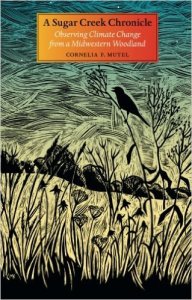
A Sugar Creek ChronicleIn A Sugar Creek Chronicle: Observing Climate Change from a Midwestern Woodland Connie Mutel produced an engaging narrative of her efforts to cope with change while living on a parcel of Oak – Hickory forest in Northern Johnson County, Iowa.

The narrative is about climate change as the title suggests. It is also rich with descriptions of the flora and fauna of the region and how her life as a Midwestern ecologist, wife, mother, and cancer survivor has changed and is changing because of our warming planet.

It was hard to put the book down once I started reading.

The narrative is a combination of autobiography, new journalism, scientific research and advocacy for the political will to take action to mitigate the causes of anthropogenic global warming and its impact on our climate before it’s too late.

What makes the book important is less the scientific discussions about climate change, and more how Mutel copes with a life she believed held stability and predictability as key components. In telling her story Mutel articulates a personal perspective of current scientific research about climate change in a way that should provide easy to grab handles on a complex topic.

The idea that carbon dioxide causes global warming is not new. Around 1850, physicist John Tyndall discovered that carbon dioxide traps heat in our atmosphere, producing the greenhouse effect, which enables all of creation as we know it to live on Earth. That story has been told time and again.

The benefit of reading Mutel’s observations is one finds a lot in common with her life, on many levels. Her inquiry into global warming and climate change provides us a window not only to her world, but to ours.

~ Posted on Amazon.com.

Categories
Living in Society

Mogul Rising

Mexican Wolf Photo Credit: Wikimedia Commons
Mexican Wolf – Photo Credit: Wikimedia Commons Colin Burnett

As bad as the Ronald Reagan presidency was for middle and low wage earners, a Donald J. Trump presidency could be worse.

Last week’s tit for tat about jobs for West Virginia coal miners is an example of how Reagan’s policies resulted in decimation of an industry, people forgot, and then Trump asserted he could bring those jobs back.

With a peculiar presentism Hillary Clinton became the villain because she spoke the truth about coal mining.

“We’re going to put a lot of coal companies and coal miners out of business,” she said.

Clinton walked her statement back while campaigning in West Virginia last week, however, its urgent reality stands: a majority of fossil fuels need to stay in the ground.

Not only is Trump the presumptive Republican nominee for president, there is a path to him becoming president. As progressive Thom Hartmann has said, his campaign should not be taken lightly.

His candidacy strips away everything we thought we knew about how the world works, about how people do things in society. Like a wind of rage blowing throughout the continent, it desiccates the landscape, and sets the stage for an extended and devastating wildfire season in which wage earners would take the brunt of change. The ongoing wildfire in Fort McMurray, Alberta is emblematic of this.

Trump would be Reagan on steroids and a lot of people wouldn’t mind.

It is time for folks to reduce the attention given to each outrageous statement made in social media or during interviews and speeches, and work to stop the rise of the mogul. It’s time to treat his candidacy less as a source of jokes and more as a threat to an already eroded way of life.

Categories
Living in Society Social Commentary

Seven Influences

Barn
Barn

We are blinded and forever changed by our experiences if we are lucky.

Insights and epiphanies are few in life’s span. They can shape who we are and the choices we make in profound ways.

Some become passions and border on enthusiasm. Enthusiasm as in close to spiritual ecstasy, or possession by a god or the devil.

It began when I was three years old.

In the basement of our home at 919 Madison Street in Davenport, I was playing on a swing set my parents set up. It collapsed and the next thing I knew I was laying in a pool of my own blood. Mother rushed me to Mercy Hospital where the physician made me breathe ether poured in a funnel before stitching me some 50 times to close the wound on my forehead. I stayed in the hospital for what seemed like a long time. My parents visited every day at least once.

It never occurred to me that hospitals existed, or that so many people outside our home were employed with systems that nurtured the sick and injured. It gave me comfort and curiosity, then, and now.

I began Kindergarten while we lived on Madison Street. Mother had me walking about three quarters of a mile to school for the half-day sessions.

One day I got lost.

The way was to walk North on Madison and then East on 10th Street until I reached the stairs on the steep hill that was Riverview Terrace Park. From there I not sure, but believe I walked North on Washington Street to Twelfth Street, then over to Marquette where I turned South until Jefferson Elementary School was on my left. It was a long trip for a Kindergartner.

One day I took a shortcut on the way home and got lost. My homecoming was delayed much so my mother came out to look for me. She set out on foot and eventually found me on the steps of the park. It was a scary thing for a young person. It taught me to persist in the face of the unknown.

When I entered the seventh grade, we occupied a new school the parish built a block from our home. It was a terrible separating from my childhood friends as I was selected to join other seventh and eighth graders in an advanced class. The nun told us we were college bound and needed to begin preparing. I didn’t like the separation from my neighborhood pals, and occasionally I would hang with them at the Cue and Cushion, a local pool hall. That wasn’t meant to last. It was a blessing and a curse that we were separated. Less fun, more studies and some isolation from the roots I had formed with neighborhood kids as a grader.

My father’s death in 1969 was sudden and jolting. I had begun to consider college, and during a conversation with Mother after Dad’s death offered to give up those plans to help her adjust. She encouraged me to go to college and that forever broke me from the home where I’d lived in childhood. Once I left home, I would never really return.

My college years, military service and graduate school were a long transition from homelife in Davenport to living in the broader world. I experienced the world’s diversity during those 11 years and became a global citizen. In the end, I decided to stay in Iowa where Jacque and I met while working for the University of Iowa. We married in 1982 and to say it was a life-changer is an understatement. I hope we will remain married until death do us part.

The arrival of our daughter in 1985 was another formative experience, one that changed everything in a positive way. Having been lucky enough to be a parent, I discovered the tremendous opportunities and challenges of providing a home life so they could become a responsible citizen. It gives me a great deal of pride to see how she has grown and changed over the years since she entered the world. If all the world’s a stage, her entrance was notable and her performance enduring.

The decision to leave the transportation business after more than 25 years shaped how my life has played out. With that decision came a new world of engagement in society. For the first time, I’ve been able to concentrate on living how I want, writing, distracted only by the existential demands of society. I don’t know what enduring writing will be produced, but without the commitment that began July 3, 2009, nothing of my current life would be possible.

In reasonably good health, in a safe environment, much is possible. Where shall I go? I hope to be on the road to some usefulness in society.

Categories
Living in Society Social Commentary Writing

Walt Whitman’s ‘New Book’

Walt Whitman House, Camden, N.J.

That scholars would publish newly found material written by Walt Whitman is not surprising.

In a time where old newspapers are being digitized and new methods of scholarship seine existing publications like factory ships trawl the Bering Sea, Whitman’s voluminous work shows up.

Manly Health and Training: With Offhand Hints Toward Their Conditions, serialized beginning in 1858, and written under Whitman pen name Mose Velsor, was published on line in its entirety in the Walt Whitman Quarterly Review edited by Ed Folsom. Read Jeff Charis-Carlson’s article about the new Whitman book in the Iowa City Press Citizen.

I’m not ready for more Whitman.

My relationship with Whitman is comprised mostly of the 1983 visit my wife, her brother, and I made to Whitman’s home in Camden, N.J. It is a simple place, much neglected over the years. By then it was restored to be a fitting remembrance of his last days. It is the only home Whitman owned.

Whitman's Last Home
Whitman’s Last Home

It was easy to imagine supplicants waiting downstairs for their turn to meet with Whitman in his parlor/bedroom up the narrow stairway. More than the host of American writers who preceded him, Walt Whitman was tangible, with footprints in society. He left them everywhere.

I hope to return to reading Whitman’s work, even this newest publication.

Yet there is so much to do and take in — and even in good health, life is short. Nonetheless, a new Whitman book is news, and in the digital age, it is available for free to anyone with access to the internet. A type of democratization Whitman may have appreciated.

Categories
Living in Society

Politics Takes A Holiday

Political Sign at a Business

The Bernie Sanders campaign is laying off hundreds of staff members, indicating either he is planning to throw in the towel after California, or that he won’t be placing people currently on his staff in local political organizations for the fall campaign. Maybe both.

The presidential nominating party may not be over, but most of the guests have left and the hosts have begun cleaning up the mess, getting ready for a return to normalcy, which in Iowa means organizing for the June 7 primary elections where there are contested races, and the fall campaign beginning after the Labor Day weekend.

Political campaigns will work through the summer, and there is a filing period in August, but each year, regular people engage in the election cycle later and closer to the election. For folks like me, politics takes a holiday after the primary elections until the fall campaign. We have lives to live.

I’ve written about the county supervisors race which has been reduced to a series of special interest forums in Iowa City and Coralville, along with fund raisers and whatever else each campaign sees fit to do.

I missed the first forum last night. Bottom line was I couldn’t afford the $5 in gasoline and an hour of driving on a work night. Stephen Gruber-Miller covered the forum for the Iowa City Press Citizen and here’s a link to his article. They say people in the county seat can access video of the event on their local cable television channel, but the service does not include Big Grove Township.

My trouble with picking three candidates for supervisor is besides the incumbents, I don’t share a view of the county with any of them. My relationship with the county seat is tenuous at best, although I likely benefit from the economic engine that is the University of Iowa. I’ll pick one of the two business people for my third vote and see what decision the urban centers make for me. No need to decide until late in the race, early June most likely.

The other primary election that matters is for U.S. Senate and I support State Senator Rob Hogg over three other candidates.

Politicization of our lives has become a detriment to living, so the compulsion I felt toward campaigns during the George W. Bush years is in remission. I work on issues, but like with the climate crisis, they represent human values and shame on those who politicize them or frame them in the false paradigm that is conservative vs. progressive. People like billionaire Tom Steyer is who I have in mind, but it applies equally to all of the billionaire class members.

Steyer Quote

My summer will be eking out a living on the margins of society, hopefully making enough money to live on, reducing debt, and finding joy in simple pleasures. We don’t need politics for that.

Categories
Work Life

Breaking Fast

Garden in March 2011

After a week, I’m coming up for air.

Our daughter visited for four days — just over 96 hours. Once she was safely returned home, I was incapacitated with a headache, fever and dizziness for a full 48 hours.

Of course I went to work sick. That’s what low income people do.

I broke fast with some cornbread and milk for breakfast yesterday.

I also had the last follow up for my injured hand.

“Let me see you hand,” Doc said as he entered the examination room, barely closing the door.

After a quick look he said it was good and released me. Hand shake, fist bump and done in less than 60 seconds.

I like the efficiency and my employer likely does too.

I’m ready for work around the house and garden… work delayed by the last week’s events. I feel the pressure of being way behind, but still hope to get early planting done by Derby Day.

The forecast is great weather for working outside after my shift at the home, farm and auto supply store.

Categories
Living in Society

Supervisor Race Update

Rural Polling Place
Rural Polling Place

JOHNSON, COUNTY, Iowa — Last time I visited the county board of supervisor race, I had picked the two incumbents for the June 7 primary, Rod Sullivan and Lisa Green-Douglass, leaving one pick open.

The Johnson County League of Women Voters is hosting a public forum with the candidates on Wednesday, April 27. I plan to attend and listen to what each has to say.

Pat Heiden 50-50-2020Pat Heiden is a blueprint candidate for 50-50 in 2020, a non-partisan group whose mission is to achieve political equity for Iowa women. Heiden said she was inspired politically when her parents hosted candidates like the late Harold Hughes at their home.

She seeks to give back to the community by running for office. This seems a tangible goal after more than 30 years working at Oaknoll Retirement Community.

Heiden is well connected and has a natural constituency. She has the support of former supervisor and state representative Sally Stutsman and retiring supervisor Pat Harney. She also has behind the scenes support from the significant political players who associate with 50-50 in 2020. Having three of five supervisors being female would not be a bad thing. Heiden has not been politically active.

The other leading contender for my third vote is Kurt Michael Friese, a local businessman and author. He chose not to run in the special election to fill the seat vacated by Terrence Neuzil. Lisa Green-Douglass won that election.

The strength of Friese’s campaign is his endorsement list. Some people I respect and know reasonably well, including Francis Thicke, Ron Clark and Jody Hovland, are publicly endorsing him.

At a recent event I overheard him tell another attendee he had the Laurie Tulchin endorsement. Tulchin is a member of the so-called Newport Road gang, a politically active, resource laden and well-connected group of people working to avoid development in the area around their homes. There is a conflict between the gang and the county land use plan which designated their area as open for development while preserving the farm land south of Iowa City. This endorsement will persuade some.

Friese’s name is widely recognized among city dwellers, but his universe of Iowa City is not strongly connected to mine. Despite the negatives, he is a contender for my third vote.

There are two in the also ran category, Jason T. Lewis and Mike Hull. Both are just getting their campaigns organized, so my prejudice is unfair.

Lewis works for the University of Iowa and we have enough influence on the board of supervisors from this dominating county economic engine. People I respect hold Lewis in high regard, but he’ll have to be persuasive at some level on April 27 to get my vote.

Hull is a medical helicopter pilot who got his flight training from Uncle Sam. He has been active in county veterans groups and had he inquired about or joined our chapter of Veterans for Peace, I might give him a second look. It seems doubtful a person who spends significant time with the American Legion will be my pick unless he is like Al Bohanan who served as a legion commander, is a member of Veterans for Peace and is very active in Democratic politics. Hull doesn’t appear to be like Bohanan.

My ballot in the primary looks pretty straight forward. Two incumbents plus one of two business people with a lean toward gender equity on the board. That could change by the election, and the League forum will be an important event to see how candidates handle themselves in public, and in reaction to each other.

Categories
Home Life Kitchen Garden

Recipe Search

Kennebec and Yukon Gold Seed Potatoes

I called off work at the farm because of the six stitches in my right hand. I had hoped to resume soil blocking today, but not yet.

On deck is transplanting basil into larger plastic pots, preparing containers for potato planting, and radishes, turnips and spinach planted in the ground as the temperature rises to 70 degrees and rain holds off until late afternoon.

With these tasks I can set my own pace and take breaks if pain in my right hand returns.

Mercy Hospital Auxiliary Cookbook 1977

Over the years I’ve collected several hundred cookbooks, including one from the hospital where I was born. Published in 1977, Cooking For… Mercy’s Sake is full of ingredients and ideas I won’t likely use — American cheese, lard, meat and seafood, and a host of prepared food and food mixes.

Still, I search through the recipes, seeking the name of a contributor I know and recipes that can be adapted to our fresh food, locally produced lifestyle. The cookbook committee wrote this poem as introduction:

Recipes are certainly handy
When making cookies, pies and candy.
On the pages of this cookbook you’ll find
Favorite recipes of every kind.
We thank all our friends who took their time
To write their recipes, line by line.
Good luck to you and may you have fun
Trying these recipes, one by one.

On first reading, there’s not much there. Because of my relationship with the hospital I’ll give it another read to see if I can find something adaptable.

My life is about much more than food. While I write a lot about consumables, I’m also preoccupied with the journey — hopefully a long one — through my later working years to full retirement and old age. I didn’t think this would be the case, but as I finished writing for newspapers and took a full-time job there is an undeniable feeling that a corner has been turned. I know part of what’s around the corner and much is also a mystery. I’ll need nourishment along the way, but the unfolding journey is what life has become about.

My take on this is pretty simple, and it goes back to Joan Didion, “We tell ourselves stories in order to live.” I’m trying to make a life in that sense.

Didion explained, “We live entirely… by the imposition of a narrative line upon disparate images, by the ‘ideas’ with which we have learned to freeze the shifting phantasmagoria — which is our actual experience.”

I respect the narratives of others, but can’t adopt them as mine. It is about disengaging from established narratives and experiencing what’s next.

Each day is an adventure in that regard, one to seek joyfully.

Categories
Home Life

Easter Rising

Sunrise Over Lake Macbride

Yesterday was a punk day.

We called the day between Good Friday and Easter Holy Saturday when I was a grader. It was not as important as Easter’s main event in the liturgical year.

On Easter Sunday we dressed in our best clothes to attend Mass with Grandmother. We’d return home for Easter dinner and talk around the table. I remember Grandmother helping wash dishes in the kitchen. It was the most significant holiday of the year, for her, and in our insular Catholic community.

No longer.

It was a punk Saturday because of the stitches in my right hand. Restricted from activity, I stayed indoors, managing to cook dinner, water seedlings, do laundry, make the bed, and read. I would have preferred to get my hands dirty in the soil but it wasn’t meant to be. It was a day of healing if not repentance. Of contemplation, not work.

I rose Easter morning for the first time in a long time without the pain of plantar fasciitis in my feet. Hopefully this condition persists.

Matthew 16:24-25 says, “If any man will come after me, let him deny himself, and take up his cross, and follow me. For whoever wishes to save his life will lose it; but whoever loses his life for My sake will find it.

If I’m not ready to walk those footsteps, today’s healing is a signpost. Healing is possible. Healing can come. Healing can set us free.

The large bandage on my thumb is a reminder healing is not done.

As darkness yields to dawn and sunlight, one can’t help but be comforted by the possibilities each day brings. Days of work lie ahead until that final night and its return to Earth which engendered us.

The journey ahead beckons, on this Easter rising.