This year a group of Ukrainians with temporary work visas joined us at the orchard.
They were hard-working and fun to be around.
Their contracted wage far exceeds the $185 per month they can earn in Ukraine from their trained profession as English teachers. The visa sets a specific hourly rate of pay and the host is required to provide round trip transportation to Iowa plus housing. They can stay for up to eight months at a time. The Ukrainians went home to their families after the season, although each of them plans to return in a couple of months to help prune apple trees.
Saturday I drove to the orchard to pick up apple cider and frozen cherries. While there, the octogenarian friend who referred me showed up. We talked with the owners long enough for my spouse to wonder where I was. We ran through the usual topics —the hickory nut harvest, Gold Rush apples, cooking projects, which books we were reading, activities of mutual friends — and told jokes, usually one at the expense of another. It was a great conversation among friends.
We live in the same political precinct and have common political interests. We discussed the surprising plan to move the U.S. Embassy from Tel Aviv to Jerusalem within a few years, and scuttlebutt about Democratic candidates considering a run to replace our state senator Bob Dvorsky when he retires at the end of 2018.
Multiple sources told me local internet personality Zach Wahls and former diplomat Janice Weiner are both kicking tires on a state senate run. I’ve not met either of them and it was news to my co-workers. While politically engaged, each of us has bigger fish to fry than politics.
The orchard sales barn will be open next weekend and that’s it for the year. I’ll need more cider… and conversation by then.
Everyone wants work that’s fairly paid. Once one accepts a work contract — agreeing to work for a wage — that usually ends discussion about compensation. We turn to our co-workers and the life we share in a place and time. If the job is any good we don’t talk about compensation, work hours, or much of anything but the idea of what we do and how to do it better. This has been the case most of my life in every job I’ve held.
At the home, farm and auto supply store we recognize it as lowly paid work, not just for hourly employees but for management. Yet we engage in work as a team and do our best to meet our goals. Employee turnover is high in retail and based on my experience compensation is not the driver. What matters more is it’s relatively easy to get retail work and if one keeps their nose clean and shows up, the employment and paycheck are predictable. A job easily secured is one easily left and that drives turnover. Our workplace is a stopping point for many people enroute to something else.
One of my colleagues was recruited from the sales floor to help check in freight during our busy season. We talk while working. Cognizant of his low wages, he said, “you get what you pay for,” indicating he would work harder if paid more. I’m not sure about that but didn’t tell him so. He is already a hard worker compared to others, and his income contributes to a household with his wife and two children. The job means something to him, but he’d leave it on short notice if a better one came along. We don’t talk much politics at work but he wears a stocking cap and coat with the word “Trump” screen-printed on them.
As my worklife winds down before taking “full retirement” next year, I value the people with whom I spend time. They are a diverse group and I hope to add something to our relationship before I go — remembering the past and living each moment to the fullest extent. These are stopping places, part of a long, personal journey that’s not over. As Robert Frost wrote in 1923, “I have miles to go before I sleep.”
I’m sitting in the back of my pickup truck, the tailgate is down. Gentle summer rain is falling. The tips of my toes are getting wet but I don’t mind. We need the rain.
In Des Moines political parties are holding their conventions. I followed the action on social media, but not closely.
Breeze from the rain is cooling my forehead. It feels quite good. It is much better than working on a computer, or thinking about politics.
This afternoon I tried pulling weeds in the garden. The ground was so dry they broke off at the surface. Now, after this long gentle rain, the roots should loosen and weeding be done more easily.
Wind is blowing from the west and my knees are getting spattered with rain. I still don’t mind.
Dozens of birds are out in yards around the neighborhood. They don’t mind rain either. All of nature seems to welcome the rain.
Lightning and boomers are starting to roll in. The rain continues to fall gently and steadily.
Some nights it is best to just listen to the rain, and so I will tonight.
The trouble for Iowa Democrats is a too long primary season fraught with internal competition. “Competition” is saying it politely.
On Dec. 2, U.S. Representative John Delaney (D-Maryland) began his fifth trip to the Hawkeye state as a 2020 Democratic presidential candidate. Delaney may be unrealistically early, but the presidential candidates are expected to help during the midterm elections next year, more than a year before the Iowa caucuses and two years before the general election.
There is an open race for governor after Terry Branstad resigned to become U.S. Ambassador to China. Republicans have two major candidates, and Democrats have seven. The primary election is June 5, 2018 and already Democrats are running television ads, sending mass mailings, and campaigning all around the state. Part of what’s good about early activity is it can activate people to pay attention to politics.
Whether early activity actually does activate people is an open question. The calls to knock doors and make phone calls for primary candidates in a supposed “ground game” six months out ring hollow in December. Democratic activists will use all the time given to pick and choose among people who are running and vote in the primary or caucus for their favorite presidential candidate. If, as in previous election cycles, the rest of the electorate lets political parties nominate candidates then choose among them a week or two before the election, the activation aspect of a long primary is rendered null. There is little to indicate 2018 or 2020 will be any different from the past.
What is my beef with current Democratic politics? Everything takes too freaking long.
In 2015 I had an email exchange with political operative and race horse owner Jerry Crawford. My issue was
The better question is what are Democrats doing to bring new people into the process? Prove me wrong, but they aren’t doing much except dusting off the same old sawhorses for the post-caucus campaign. Is anyone else tired of hearing the name Jerry Crawford?
Crawford unexpectedly responded, defending himself, “I got involved in politics as a teenager and one of the problems in Iowa is that at age 65 I am still younger than many activists.”
After a back and forth in which Crawford enumerated the ways he sought to bring new people into the Democratic Party, I wrote,
Democrats could use a better organizational strategy. The current one, which came into use beginning in 2004, alienates grassroots activists by being top-down, and not listening to what people in the community are saying. There is no evidence that changed with Hillary 2016. Democrats in a precinct, who seek to get active in politics, should be given more power to contact every voter living there, and not just ID people supporting our candidate, but invite them to join us in the struggle for social and political justice, which is bigger than any single candidate. We all have our dreams and that’s mine.
I don’t bear any political ill will toward Crawford. With Iowa Democratic Party Chair Troy Price’s recent comments, I feel somewhat vindicated:
“In Iowa,” Sioux City Journal reporter Brent Hayworth wrote, “Price said a lesson from the 2016 election was the so-called coordinated campaign, where candidates tap the state party for help, ‘has not been working, it has been too top down.’”
I wish the party under Andy McGuire had realized this before the 2016 election. If wishes were horses, Jerry Crawford’s jockeys would ride in a society where our current government favors capital over labor.
What is next?
I have grown to dislike the Iowa caucuses. The 2015-2016 fight between Hillary Clinton and Bernie Sanders went on far too long. There was never any serious doubt Clinton would be the Democratic nominee whether or not she won Iowa and Sanders supporters focused their energy on taking Clinton down rather than on winning the general election. This created a electorate where former Obama voters flipped to Donald Trump, not only in my Johnson County precinct, but in Democratic strongholds across the state. The long caucus battle, with a close result, and continuing acrimony contributed to the Republican victory in the general election. I understand giving up the early precinct caucus presidential preference activity would change Iowa politics. Borrowing a phrase from gubernatorial candidate Ross Wilburn, who didn’t mean it this way, “Let’s be Iowa” without the caucuses.
Thus far the seven Democratic gubernatorial candidate have played things mostly Iowa nice. While I’m not as active politically as I was in the 2004, 2006 and 2008 campaigns it seems clear the winner of the June primary for governor will be one of three candidates: Nate Boulton, Fred Hubbell or John Norris. Cathy Glasson and Andy McGuire are doing the work of a state-wide campaign but seem unlikely to prevail in the primary because of ties to old ways of campaigning: Glasson to the John Edwards caucus campaign in 2007, and McGuire to campaigns run during her tenure as Iowa Democratic Party chair. At this point, I don’t feel a pressing need to pick a gubernatorial candidate for the June primary but intend to see how things play out among them. That I feel a luxury of time is part of the problem with Iowa Democratic politics in 2017.
We don’t have time because what matters more in 2018 will be community organizing. That’s a much different approach to politics and Democrats abandoned it in favor of data analytics and targeted canvasses to win elections. What community organizing means is being active in our communities and getting things done with other people who live there.
What kinds of things? Water issues, sewer issues, economic development, budgeting, road use, public safety, planning and zoning, emergency services, school boards, cemetery maintenance, public health and other ultra local issues. The reason there is no time is the Iowa Democratic Party may develop policies to support values that impact these areas, however, local problems must be solved by local people who are willing to get involved beyond voicing an opinion. That means everyone regardless of voter registration. Once we work within our communities, we open a door of influence. While it may seem self-serving, it means influencing people to vote for our candidates. This is precisely what Republicans have been doing and it’s time Democrats got on the playing field.
My advice? Forget about the run up to the primary and work in your community to effect change with which people can agree. That may mean giving up the long road trips to attend political events and using the time to get to know our neighbors — all of them. It’ll take some wrangling to get this done, but I’m confident we can move onward in pursuit of a better politics and a better government. We have to.
Today is the first day of shotgun deer season. Until Dec. 17 Iowa shows its culture in tradition-laden, bloody and violent detail.
The deer population needs culling. The damage they do in nature and on farms goes mostly unnoticed by city dwellers. The closer one lives to the land, the more empathy there is with the deer hunt. My solution to deer over-population — re-introducing wolves — is not going to fly where cattle, hog and chicken producers and ranchers live.
Roughly a third of Americans say they or someone in their household owns a gun, according to PEW Research Center. Estimates vary but there is about one gun for every man, woman and child in the United States. Given that reality, hunting serves a purpose to promote education, safe gun ownership, and proper handling of firearms. Gun ownership rates have been in decline since the 1970s.
I encountered a herd of deer on my way back from the home, farm and auto supply store last night. I’m pretty sure they sense what is coming. Many of my colleagues at the store are deer hunters. In some cases, husband and wife hunt together and mount their trophies side by side in the living room. Last year’s Iowa deer harvest was reported by hunters as 101,397, a typical year.
Iowa’s hunting culture seems sane and a bit reassuring against last week’s tumultuous news cycle. Opening the Twitter app on my smart phone was like viewing a portal directly to hell. Reading this week’s news stories was like drinking from a fire hose that left me ragged and didn’t suppress the hellfire. I felt thirsty for more after each Twitter session.
Given that, what to write about?
Despite what’s been in the news ad nauseum (Republican Tax Bill, Flynn flipping in the Mueller probe; emoluments investigation; U.S. boycott of the Nobel Peace Prize award ceremony; Interior Department selling vast seams of coal from national monuments for $0.41 per ton; EPA discarding Obama era rules requiring mining companies to fund cleanup from hard rock mining) the story that stuck with me is related to how we can change all the junk we see. Elections still matter and the 2018 election matters a lot.
Brent Hayworth, reporter for the Sioux City Journal, wrote about a Nov. 30 meeting of 110 Democrats from South Dakota, Iowa and Nebraska held in Sioux City.
“Let’s do something and not just have lunch,” Linda Smoley, chairwoman of the Siouxland Progressive Women said. The group worked on strategy to turn out voters during the 2018 election.
Iowa Democratic Party Chair Troy Price attended the meeting.
“They said we would never win again, we could just go out to pasture,” Price said. “Democrats do what we always do — when we get knocked down, we get back up.”
This verbiage could have happened at any Democratic meeting after a tough election. Here’s what made the difference:
“In Iowa,” Hayworth wrote, “Price said a lesson from the 2016 election was the so-called coordinated campaign, where candidates tap the state party for help, ‘has not been working, it has been too top down.'”
This was a key learning experience for me during past campaigns. Price acknowledging it, and potentially doing something to change our political campaigns, validates the idea Iowa Democrats must and will find a new path forward to regain control of elected offices currently held by Republicans.
Good news during a hellish week. Better news than I expected.
(This note on the Tax Reform bill was sent this morning to U.S. Senators Chuck Grassley and Joni Ernst.)
I ask you to vote no on the final tax reform measure being considered by the U.S. Senate this week for these reasons:
As a low wage worker, I don’t see any benefit to me personally or to people like me whose annual income is less than $30,000.
By reducing revenue to the federal government the tax bill will force cuts in areas not covered by the bill. While cuts are needed in defense spending, my concern is Medicare, Medicaid and Social Security will have to be cut. As a low-wage worker I rely on those programs.
I spoke with my state legislator, a Republican, and he said Iowa is waiting to see what the Congress does to craft 2018 state tax legislation. As you should know, Iowa is failing to generate enough tax revenue to fund programs at reasonable levels. Cuts in revenue based on federal legislation are unneeded tampering in this time of fiscal stress.
Thanks for reading my email.
Regards, Paul
Response from Senator Chuck Grassley, Dec. 6, 2017
Dear Mr. Deaton:
Thank you for contacting me about tax reform. As your Senator, it is important for me to hear from you.
I appreciate hearing your thoughts on tax reform. There is broad consensus that our tax code is in dire need of reform. It was last reformed just over 30 years ago. Since that time it has grown out of control in length and complexity with taxpayers cumulatively spending over 6 billion hours annually complying with its dictates. Small businesses are estimated to be burdened with $15 to $16 billion annually in compliance costs. These are resources that would be better spent growing their businesses. Moreover, our outdated corporate tax system puts American companies at a competitive disadvantage as they try to compete in a 21st century global economy.
The Senate recently passed tax reform legislation that would make good on our commitment to provide significant tax relief to the middle income taxpayers, while making the tax code simpler, fairer and more pro-growth. Some of the middle-income tax relief in the bill includes nearly doubling the standard deduction, doubling the child tax credit from $1,000 to $2,000 per child, reducing the current law 15% bracket to 12% and the current law 25% bracket to 22%, meaning hardworking Americans will see more money left in their pocket to spend, save, and invest as they see fit.
According to an analysis by the Joint Committee on taxation, on average every income group will experience a tax cut with the largest percentage tax reductions in the middle income groups. As an example of the tax relief under the bill, a median income family of four would see a tax cut of nearly $2,200. Moreover, the reform bill would make the tax code more progressive with taxpayers earning more than $1 million shouldering a larger share of the tax burden than they do under current law.
Additionally, the Senate bill lowers the burden on middle class families by eliminating the tax penalty in the Individual Mandate. Iowans who have decided that Obamacare is too expensive for them are penalized by the federal government. More than 52,000 Iowans in 2015 were forced to pay the individual mandate tax. Over 80 percent of those who paid the tax made less than $50,000 a year. That’s a tax on working families, and this legislation does away with it.
The bill also enacts much needed tax relief for job creators providing a significant deduction on business income for small businesses, effectively lowering their top tax rate by nearly 9 percentage points. Moreover, the bill lowers the statutory corporate rate down from the highest in the develop world to 20% in 2019. This will allow U.S. corporations to create more jobs and pay higher wages. Economists generally agree that a significant portion of the corporate tax falls on workers in the form of reduced wages. Estimates of the burden of corporate tax on workers range from 25% to more than 70%. While the exact amount may be debated, one thing is clear; corporate rate reduction results in bigger paychecks.
I understand some are concerned that tax reform will add to the deficit. I agree it is important for tax reform to be done in a fiscally responsible way. Our tax reform proposal is designed to spur economic growth, which will result in more taxpayers and more revenue for the federal government. If tax reform spurs as little as .4 percent of additional growth on an annual basis that would equate to about $1 trillion in additional revenue. In truth, if we are ever to get a grip on our growing debt we can’t continue to settle for the anemic growth of less than 2% we have experienced since 2010.
I also understand that there is concern that the bill will trigger a budget rule under the Statutory Pay-As-You-Go Act of 2010, which some have claimed could lead to across-the-board cuts in certain government programs, such as Medicare. However, the Act has never been enforced since its enactment. Congress has acted to prevent a sequester on 16 occasions, and there is no reason to believe that Congress won’t act this time. Moreover, both Majority Leader McConnell and Speaker Ryan have pledged to work to ensure that these spending cuts are prevented.
Tax reform will provide middle class Americans with financial relief, make U.S. industry and workers more competitive, create jobs across the country, and get the economy growing again after years of stagnation. There’s still work to be done. The legislation now goes to conference and will have to be reconciled with legislation passed by the House of Representatives. This is a historic opportunity to help Americans from every walk of life. I look forward to working with my colleagues in both chambers to deliver on our promise for middle class tax relief.
Again, thank you for contacting me. Keep in touch.
Sincerely,
Chuck Grassley
Response from Senator Joni Ernst, Dec. 22, 2017
Dear Mr. Deaton,
Thank you for taking the time to contact me about federal programs, such as Medicare, that support folks during their retirement. Your feedback is critical to me, as I know many of our elderly neighbors rely on the valuable services of this program. I am committed to ensuring that Medicare remain accessible and viable for current and future recipients.
On December 22, President Trump signed into law H.R. 1, the Tax Cuts and Jobs Act, the first comprehensive tax reform in over 30 years. The law will provide significant tax relief for low- and middle-income families by doubling the standard deduction and child tax credit and lowering rates across the board. For a family of four earning the median income of $73,000, it will reduce taxes by $2,058. A single parent with one child who earns $41,000 would see a $1,300 tax cut.
It also makes significant changes to the taxation of businesses in order to make the United States more competitive with other developed countries and stimulate wage growth for middle-class workers. It would lower business tax rates for job creators of all sizes, impose a one-time tax on assets that businesses hold overseas, and establish anti-abuse taxes designed to prevent tax evasion.
As you shared with me, concerns have been raised in regards to the Medicare program and the pay-as-you-go rule, also known as PAYGO. PAYGO was first established by Congress in 1990 as a mechanism to help eliminate and reduce the deficit through immediate reductions to certain mandatory spending programs, such as Medicare. Social Security and Medicaid are not subjected to this rule. Since enacted, Congress has waived this rule from going into effect on numerous occasions.
Our seniors paid into the Medicare program with their hard-earned, taxpayer dollars with the assurance that Medicare would be an available option upon their retirement. We must preserve and protect Medicare for Iowans receiving benefits today, as well as for our children and grandchildren. We made a promise, and as your U.S. Senator, I am committed to keeping that promise.
On December 22, President Trump also signed into law H.R. 1370, which provides funding for government operations through January 19, 2018. Further, you will be pleased to know that H.R. 1370 also waives PAYGO, and no subsequent cuts to Medicare will go into effect. I supported this effort.
I appreciate you taking the time to share your input with me on this important matter. Feel free to contact me with any further information as I always enjoy hearing from Iowans.
(Editor’s Note: This is a recycled post from June 15, 2012. Midst life’s ambiguities I’m not sure I am free from the spell.)
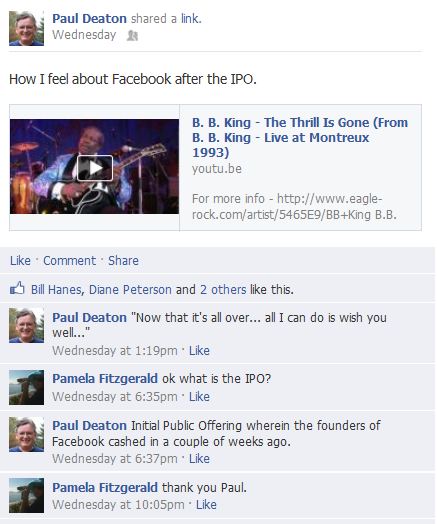
My social media life began in November 2007 with creation of a Blogger web log. Since then, it expanded, notably with joining Facebook on March 20, 2008. But now, the bloom is off the rose, and I’m not sure what future, if any, social media holds for me.
This was coming for a while, but the Facebook initial public offering on May 17 was the high water mark. Wrapped up in a political campaign, it became clear how little social media matters in local politics, and how despite the recommendations of party elders to use Facebook, twitter and YouTube, our social discourse has not migrated from in person to the Internet. It couldn’t have been clearer during the run up to the June 5 election.
Social media serves us well by enabling us to gather information about people, places and things in a timely manner. If we like, we can share it with others. If there is a big story in the news, it rapidly appears on twitter and we can stay ahead of the news curve. There is little reason to turn on a television any longer, and mostly, we don’t in our household, except to watch a specific program, for background noise, or to view a DVD. Information exchange is the primary value of social media and that remains important.
At the same time, social media appears to fail when it comes to position advocacy and community organizing. What brought Condoleezza Rice to support the New START Treaty, as she did toward the end of 2010? Be assured, it was not social media. In stopping HF 561, the nuclear power finance bill the last two years, posting about it on Facebook didn’t appear to be a primary motivator for people to oppose the bill and contact their elected officials. Social media is more like preaching to the choir. It was countless community conversations that explained what the bill meant and why it was bad for Iowa that made the difference. One might invite someone to an event using social media, but the lion’s share of work was done in person and on the telephone. Any advocacy strategy that uses social media as its primary tactics seems bound to fail.
Like anything, the new social media is a tool, one that should be used like other tools in the satchel. Beyond that, and sharing photos with friends, being reminded of birthdays, and an outlet for creativity, it is hard to get excited about posting on Facebook. As B.B. King sang, “free now baby, I’m free from your spell.”
~ This is the third of a series of posts based upon writing in my journal.
Hard frost and cooler temperatures make way for end of year holidays. Stress diminishes as plans for outdoor work become moot.
Diversity in the United States means holidays differ among social groups with each family developing a way of participating in a national culture.
Specific things have been on the agenda in our home. We discuss when to set up the Christmas holiday decorations, make and receive phone calls, cook a special meal, and pretty much stay within the boundary of our lot lines. It has been a quiet day for the last several years.
Some activities are particularly fun.
I mentioned the meal in yesterday’s post. What made it special was discussion about what to have combined with its simplicity. We made enough food for leftovers from recipes developed at home. The concession to consumer culture was an inexpensive bottle of Martinelli’s Sparkling Apple Cider. It was sweet and fizzy.
We don’t receive many seed catalogues in the mail yet I started online orders at Seed Savers Exchange and Johnny’s Selected Seeds. The activity informs visualization of next year’s garden. There is a lot of thinking and planning to be done prior to entering payment information and hitting the order button on the web sites. There are discounts from both companies for ordering online this early.
I read a couple chapters of Avenue of Mysteriesby John Irving. Books to read pile up on the filing cabinet near my writing desk. I finish most of the books I read each year between December and February. Reading is part of the holiday quiet time and sustains me through winter.
Napping is a lost art. Balance between falling asleep on the couch from exhaustion and intentionally resting is hard to achieve. After the day’s activities I slept straight through the night. I didn’t take a nap this Thanksgiving, but should have.
As a schooler we had at least a four-day Thanksgiving holiday. In the work force, I worked on Thanksgiving Day countless times, even the single time Mother made it out to Indiana for the holiday. That day I coordinated holiday meals for some of more than 600 drivers based at our trucking terminal and missed the main meal service at home.
Indiana was a tough place to live in the late 1980s and early 1990s. The Reagan era was noted for downsizing or eliminating large industrial job sites like U.S. Steel. I can’t recall the number of conversations about what used to be in the steel business. There were many. Even lake-effect snow from Lake Michigan couldn’t deaden the angst people felt. Electing Bill Clinton president didn’t change what the radio stations described as the “steel mill culture.” There wasn’t much for which to give thanks in that economic and political environment.
Memories fade with time and Thanksgiving presents opportunities to re-tell the stories of our lives together. Such storytelling has been wide-ranging and keeps the past alive. A past to inform our future, or so we hope even if the teller doesn’t get details right.
If we work a little, Thanksgiving can be a time to have fun. That may be enough to sustain us.
I’m not a fan of human physiology. Given a Cartesian outlook toward life, I’d rather not think about or acknowledge my physicality even exists.
Yet there it is, influencing my daily affairs in ways I don’t comprehend. The physicality of others impacts everything I do in public and in private. My physicality — driving a lift truck, operating a bar code scanner, lifting bags of feed, sitting in meetings with other humans — impacts others as well as myself. For at least a moment, I should consider and endeavor to understand physiology.
Maybe in another life.
“I think, therefore I am” has been my beacon since I was a grader. I call it Cartesian now but its roots are in serving as an altar boy a few blocks from home in the Catholic Church and in the convent located on the upper floor of our elementary school. I’d come home from daily Mass and read what today is called juvenile literature printed on cheap paper and mailed from places of which I’d never heard. I became fixated on my own awareness and with the fact that other people, places and things existed and had impact on me. I felt separate from their reality, connected only by ink on paper, conversation, and radio and television. I became aware that in fact it was a reality.
The origins of a Cartesian outlook have roots further back in my hospitalization for a head injury at age three.
“What I learned through the injury and recovery in the hospital was that there is an infrastructure of knowledge and caring to support us when things happen,” I wrote in 2009. “This experience assured me that although we are vulnerable, we are not alone.”
Four physicians ago, when we first moved to Big Grove, my doctor laid me back on the examination table and rested his left hand on my naked belly and held it for a moment.
“This is not normal,” he said, referring to excess weight layered between my guts and skin. I agreed, respecting his training and experience in physiology, something about which I cared little. One would have thought it easy to improve my Body Mass Index given the intellectual provenance awareness can bring.
But no.
It has been especially hard to exercise since developing plantar fasciitis. Given my love of jogging, I tend to avoid thinking about exercise now, hoping gardening and the physicality of work at the home, farm and auto supply store compensates. I don’t know if it does and am reluctant to do the type of analysis I did with other life schemes.
If mine is a life of the imagination, that’s where I’d prefer to live. Yet reality beckons: in the form of news stories of horrible things happening to people the world over; in the work required to put a balanced meal on the table; or in staying awake during the 25 minute commute to the home, farm and auto supply store. Who wouldn’t want to live in the imagination? There is an unparalleled comfort there.
Whatever I am, physically or intellectually, I go on looking.
I look through a window where spiders persistently weave and reweave a web to catch insects drawn to the warmth and light of our home;
I look through eyeglasses the prescription of which needs an upgrade;
I look through the car windshield alert for the sudden appearance of deer during the rut;
I look through the fog of morning to see what each day brings;
I look for things I recognize more than for discovery and that’s regrettable.
After college I vowed to read every book in our Carnegie library. At the time that may have been possible. I didn’t get past the religion section of the Dewey Decimal System-organized stacks. I don’t read as much today as I did then.
Now the veil of Maya wears thin.
Everything I believed upon retirement from my transportation career has been called into question. I was hopeful the long, difficult work of electing a Democratic president was finished and that common sense would dominate public discourse. It turned out to be too much imagining as we were struck in the tuchus by the physicality of modern politics.
As if awakening from a dream, it will soon be time again to get dressed and find my running shoes. Not because my plantar fasciitis is in abeyance, but because the built in arch support will comfort my aging feet as I re-engage in society. I didn’t imagine I’d have to do that again in this life. It turns out I was wrong and Frederick Douglass was right:
It is in strict accordance with all philosophical, as well as experimental knowledge, that those who unite with tyrants to oppress the weak and helpless, will sooner or later find the groundwork of their own liberties giving way. “The price of liberty is eternal vigilance.” It can only be maintained by a sacred regard for the rights of all men.
I imagine it’s time to get back to work in the physical world.
At 11:21 p.m. yesterday the U.S. Senate Finance Committee voted to pass a tax reform bill on a partisan vote, according to Senator Tim Kaine (D-Virginia). Note well, it was during the dark of night.
No Congressional Budget Office scoring, no hearings, no nothing. It was an indication that nothing we once thought mattered about legislating matters. Wealthy donors have an agenda and through the Republican Congress they are having their way with the American people.
My spouse and I were discussing the situation a few hours later and I concluded my part of the conversation by saying, “They are all a bunch of assholes.” I’ve calmed a little since then.
It is probably just as well the Congress rip the bandage off this live wound of a government, exposing its interest in perpetuating narrow views of governance and increasingly becoming a voice for the richest Americans. They go on because few citizens are engaged beyond headlines in the news.
While the federal government set me off this morning, Iowa Republicans are waiting to see if the Senate’s tax bill gets 50 votes plus the vice president and goes to reconciliation with the House version. If the president signs a tax bill into law, that will set the stage for the Iowa legislature, now controlled by Republicans, to take their own, reflective actions.
Here’s the exchange between Senators Sherrod Brown (D-Ohio) and Orrin Hatch (R-Utah) making news this morning. I watched it twice and can’t do it again.
Sherrod Brown really takes the fight to Orrin Hatch here. No Trumpian namecalling or low blows. Instead focusing on the GOP helping only the ultra-rich. Judging by how mad Hatch got, Brown hit a soft spot. pic.twitter.com/WxDFb8ipHB
In the meanwhile, I’ll go to work at the home, farm and auto supply store where I’ll take home another $54 after deductions for a day’s work and try to sustain our lives. It’s clear nothing matters in our politics. That is, nothing except our own engagement to repair the wound and protect the commons.
The desultory nature of lowly paid work is a grind.
That’s what I found yesterday upon returning to the home, farm and auto supply store after a four-day vacation. By afternoon I was ready for a nap but instead scratched at the stacks of piled up work and made a day of it. I won’t run out of work there any time soon.
I had thought to secure provisions at the warehouse club after work but was tired, achy and my feet hurt. I skipped shopping and drove straight home.
Vacation consisted mostly of sleeping, reading, napping, cooking, writing and resting. I’ve been working almost every weekday and weekend since February when I started soil blocking at the farm. It all caught up with me. By Tuesday night I felt more human if not fully rested.
I left our property exactly three times: to meet with a neighbor about our relationship with Iowa Department of Natural Resources, to fill Jacque’s car with gasoline, and to pick up our share at the farm. Most of what I hoped to do while vacationing remains undone. I did manage a few things using the internet: applying for Social Security retirement benefits, ordering a couple of books for winter reading, and ordering parts to repair a burner on our aging electric range. It’s something.
I’m not complaining. We have it better than most who make it on less than a livable wage in the post Reagan society.
What matters more was the ability to author a few posts during this down time. Nothing profound — public journaling really — and that escape into the imagination made all the difference.







 Journey Home
You must be logged in to post a comment.