Friday is my day to work with Farmer Kate near Iowa City.
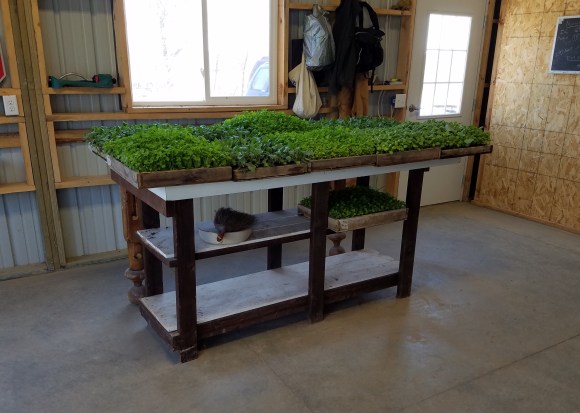
I made 30,288 soil blocks for plants at Wild Woods Farm this season. Add in additional work at Sundog Farm and my total production was 59,688 soil blocks since Feb. 25. That’s a lot of vegetable seedlings.
We’re planting lettuce, squash, cucumbers and zucchini which indicates we are more than halfway through spring production. Last year I finished at both farms on June 25 to get ready for the apple season beginning in August.
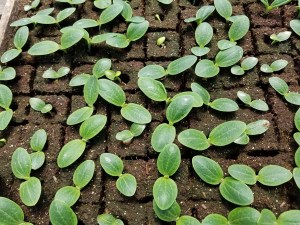
Cucumber Seedlings
Soil blocking is specialized. I use unique tools and soil to make the 72 and 120 block trays. This is my sixth year and I’ve incorporated soil blocked seedlings into our kitchen garden. Better propagation through this process makes a difference. Soil blocked seedlings are a part of growing better plants which produce great tasting vegetables. With retirement, healthy seedlings combined with additional weeding and better cultivation should result in higher yields. Importantly, it is all about freshness and flavor.
I receive fair compensation for my farm work. Over a few years we arranged a part barter – part cash settlement that works out for both parties. Each season has been a little different. This year I exchange labor for standard CSA shares in the spring and fall, then secure crates of tomatoes, potatoes, peppers and onions for preservation and storage. If my labor is more than that, I get a cash settlement. It is probably unnecessary to place a monetary value on these arrangements. Vegetable shares supplement our kitchen garden which produces much of what we need along with some specialty crops not grown on the farms. In turn, sourcing some crops from the farms reduces work in my garden. The arrangement is part of an ecology of food our household developed over time.
Over the course of spring, soil blocking at the farms has become part of our culture. I intend to continue as long as I can and the farmers are willing.
My next shift at the home, farm and auto supply store is May 16. That schedule provides a solid block of time at home to work in the yard and garden.
If it rains, I’ll work inside. There is no shortage of work, although I’m not concerned with that now.
The 87th Iowa General Assembly has been a pisser.
When Republicans won control of the Iowa Senate during the 2016 general election everything changed. It wasn’t small changes. They had a vision of Iowa and executed their legislative agenda in support of it. They took a broadsword to almost everything that matters. They reduced taxes beyond belief and hobbled the state’s ability to generate sufficient revenue to balance the budget. Then, because of the revenue shortfall, they drastically cut services. In Iowa that means cutting education, health and human services, public safety, and governmental compliance. Tomorrow the legislature is expected to pass more tax cuts and a budget that as of this writing isn’t finalized.
The state sought to get more involved in people’s lives under Republican governance, seeking to control how counties manage the minimum wage, how residents protest, how communities work with the federal government, and managing reproductive rights under established law.
Almost none of this legislation during the last two sessions was bipartisan.
The legislative changes impact everyone, including our family. We are not better off for it now and the prospects for the future are dim. The Republican vision for Iowa is not widely shared, especially among the 30 percent of Iowa voters who register as Democrats.
That doesn’t mean we have given up, we haven’t. Participation in the four Iowa Democratic district conventions was the highest anyone can remember during a midterm election cycle. A number of groups rose in resistance to Republican governance immediately after the election. The Iowa Democratic Party fielded the largest number of house candidates this year in most people’s memory.
However, the obstacles to convincing Iowans that Republican governance leaves much to be desired are daunting. 800,983 Iowa voters, or 51 percent of the electorate, chose Donald Trump as president. The votes are there to flip the state Democratic if we can find them. When everyone is running for cover by registering no preference or retreating into small family networks, that is no small task.
Proverbs 16:29 informs us here, “A violent man enticeth his neighbour, and leadeth him into the way that is not good.” Republicans may have been successful in accomplishing much of their agenda in the 87th Iowa General Assembly. We don’t plan to let them get away with it for long.
A relationship with food in American society is complicated.
Some don’t have enough. Others are awash in calories. We each have a human need for nourishment and the ways we go about meeting it are as different as the families which engendered us.
A favorite childhood memory is when Mother went to work in the school cafeteria after the Catholic Church built a new grade school near our home. With other women like her, she took a list of ingredients based partly on government programs (including lots of cheese) and partly on a limited budget, and made meals that included such dishes as porcupine meatballs (hamburger and rice) and grilled cheese sandwiches with tomato soup. Father worked at the meat packing plant which had an employee butcher shop where he could buy beef, pork and meat products at a discount, and did. The idea of stretching hamburger by mixing it with cooked rice was a novelty in our household and eventually we implored Mother to make porcupine meatballs for us at home, just like the ones at school. She did.
This story of external culinary practices coming into our home is essential to understanding the rise of a diverse diet in American society. We see things out there, they look good, and we want them. Most people, including low-wage workers, have or find the means to get them.
Many books, careers and lives have been based on food in society. We are an individualized rather than generalized culture with regard to food acquisition, preparation and consumption. To a large extent, the rise of the modern mega grocery store has shaped our eating habits in ways no one would have expected. Much ink has been spilled about that and I’m less interested in regurgitating my slice of it.
What I do know is local food farmers work hard for the sparse income they garner. All farmers do. The local food movement of which they are a part is based on the hope more people will bring locally produced, raw ingredients produced in a sustainable manner into their kitchens, ice boxes and pantries. Enough people do for a small group of farmers to make a living.
In many ways the increased interest in local food is the same type of behavior that took place in our home in the 1960s. We experience surprise when our CSA share includes Broccoli Raab, Koji or Bok Choy. We learn how to eat and cook them and want more. It’s not that our home nourishment plan is boring. We want and enjoy the experience of creation as it relates to cooking and eating. We want that experience to be personal and shared with family. That is very American.
I concede promotion of local food is a form of consumerism no different from a tomato catsup purveyor who spends dollars on an advertising campaign to enhance sales. The same behavioral forces are at work. I’m okay with that.
Just so you know, I’m not bewitched by the allure of eating a kale salad, at least not yet. Suffice it to say the diversity and behavior regarding food in our household with its kitchen garden, farm sourcing and grocery shopping has some unique qualities that may not be of interest to the authors of the Michelin Guide, but make our lives a little better. That too is very American. That’s part of who I am, who we Americans all are.
I planted onions and cilantro in the garden, transplanted some seedlings to larger pots, but that’s about it. The septic tank service arrived and pumped our solids tank while I trimmed the lilac sprouts from the space in front of our house.
Constant wind beating against me took its toll.
The first of five spring shares was ready yesterday afternoon from our CSA: Bok Choy, Koji and Broccoli Raab.
Both CSAs where I work are running behind due to weird spring weather. Carmen Black’s newsletter summed up where we are nicely:
First of all I want to thank all of you for your patience and understanding in starting a week later than planned! As I’m sure all of you can guess this weather has been very difficult to deal with on the farm. Two weeks ago it snowed, and today it’s eighty degrees! In addition to the swings in temperature its been the driest April on record, which means that everything we’ve finally been able to plant has needed to be watered immediately. Through all of this weather stress I’ve been very grateful to know that you all are so supportive of this farm, and will understand the challenges we’re facing in organically growing local veggies this spring.
First Seasonal Salad
Dinner was a salad to go along with pasta last night. Three kinds of greens and this year’s spring onions along with odds and ends of cold storage vegetables. It’s why we invest our time and resources in a food ecology.
The words “local food” mean less today than they did, and not what we thought they meant. I discuss local food with farmers and gardeners and I’ve heard the usage it is a form of green washing. Is “local food” a form of green washing? Maybe.
I know the produce harvested in our back yard is local food. With each passing season I see less significance. We want food we serve at home to be fresh, tasty and pleasurable. When we take a dish to a potluck, using garden produce gives a personal touch to a classic casserole. A kitchen garden like ours serves those things well.
“Local government can make policy that makes it easier to grow and consume #LocalFood,” Johnson County Supervisor Kurt Michael Friese posted on twitter.
If anyone is familiar with the local food system, Friese, a long-time restaurateur and food writer is. He is well positioned to make and implement policy that supports local food. But what exactly is that?
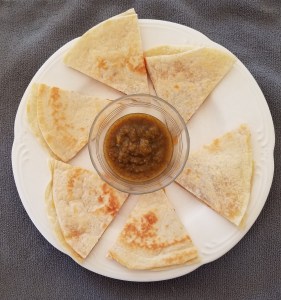
Breakfast Quesadilla with Homemade Salsa
Early on, local food referred to how and where food was sourced. There was talk about mitigating “food miles.” As I explained in a 2013 post, “Food distribution and related costs are a social construct that makes transportation seem inexpensive, or irrelevant to what we find in grocery store aisles.”
Where advocates of local food may have gone wrong is using the idea of food miles as a place holder for complex, flawed arguments. Costs are costs, and a producer has to recover his or her financial production costs when the consumer buys an item. Using any complex argument, including food miles, as a place holder seems a diversion. Such talk belongs more appropriately in a sales and marketing context as a form of puffery.
The better framing for “local food” is to know the face of the farmer. Two years ago I wrote at length about what it means to know your farmer and practices they use. Here is the salient point related to green washing:
Driven in part by mass media, consumers are concerned about a wide range of food issues that include contamination with harmful bacteria; dietary concern about consumption of carbohydrates, fat and sugar; the way in which plant genetics are modified to improve them; and more. Partly in response to media campaigns, annual sales of organic food exceed $30 billion in the U.S. (USDA). The increase in organic market share from national advertising campaigns is significant. If you get to know your local food farmer, what you may find is they benefit from this marketing, but their customers come and stay with them because of a personal relationship with the farmer.
Local food is not exactly green washing, which is defined as “disinformation disseminated by an organization so as to present an environmentally responsible public image.” However, there is a lot of conflicting and sometimes contradictory information related to food. Plant genetics alone set off a firestorm of media and organizational controversy and spawned a new food labeling process under the aegis of the Non-GMO Project. Simply said, it’s complicated.
If a definition of “local food” is elusive, how our county defined a local food system may be as good as it gets:
In Johnson County we see the need to localize our food system – and we are working to create a healthy, intact system that lessens resource inputs, promotes worker’s rights and preserves the natural environment.
Yesterday’s wind blew a single-use plastic bag into our Ash tree where it got stuck and is flailing in the wind. Part of me is tempted to leave it there as a symbol of all that is wrong with our society. Then again, if I want it fixed, I’d better do something about it. So it is with the local food system.
No food is more local than a kitchen garden. I’ve got to get moving on mine after a late spring.
Everyone was in a good mood at the farms when I soil blocked Friday and Sunday. My farmer friends caught up last week by finishing onion and potato planting. Trays of seedlings are moving to wagons and then into the ground, thus clearing the greenhouse for what will be June and July crops. I started zucchini and cucumbers Sunday in the greenhouse.
The first spring share is today and in honor of it I’m composting my over-wintered lettuce.
A neighbor and I had a conversation about spinach and how it grows. She is changing her garden around as last year the zucchini they love developed powdery mildew. Her tactic is to plant the whole garden in corn to give the soil a break and let the fungus dissipate. Here’s hoping that works.
As for me, Monday is mine to do what I want. This week that will include getting our septic tank pumped, writing off line, gardening and yard care. It’s time to put winter behind us.
Things are bad when the coop sends the suicide hotline number with the milk payment.
Milk prices are currently about $15 per hundred weight while cost of production at family farms is more than $22 per hundred weight. Like so many segments of agriculture, consolidation is driving down costs and small farmers are going out of business.
“The nation’s dairy farmers are again in dire straits, just like we were in the 1980s,” Jim Goodman, Wisconsin dairy farmer and board president of National Family Farm Coalition said in a press release. “Proposed safety nets are totally inadequate and without real long-term market reform, dairy farmers will continue to lose their farms. Consumers who care where their milk comes from and policymakers claiming to care about rural America must support these steps to ensure farmers a fair price. Without immediate government action, the days of the small dairy farm are numbered.”
A key component of government action would be to establish a floor for milk pricing at $20 per hundred weight which would provide immediate relief for farmers in debt and unable to pay bills.
“Dairy farmers today are facing no money, no hope, no way to plant spring crops or pay last year’s debts,” Pennsylvania dairy farmer Brenda Cochran, said in the press release. “Nothing will stop the financial hemorrhage we are facing except a better farm milk price.”
Dairy farmers are coming full circle, sort of.
In 1933, Congress passed the Agricultural Adjustment Act as part of President Franklin Roosevelt’s New Deal. Among other things, the AAA was designed to boost agricultural prices (including milk) by reducing excess production.
“Farm programs in America were originally created as a way to shrink the great mountain of grain, and for many years they helped to do just that,” Michael Pollan wrote. “The Roosevelt administration established the nation’s first program of farm support during the Depression, though not, as many people seem to think, to feed a hungry nation…. but to help farmers reeling from a farm depression caused by … collapsing prices due to overproduction.”
Fast forward to President Richard Nixon and his Secretary of Agriculture, Earl Butz, in the 1970s. Facing political pressure due to high food prices, Nixon ordered Butz to do whatever was necessary to drive down the price of food.
“Butz implored America’s farmers to plant their fields ‘fence row to fence row,’” Pollan said, “and set about dismantling 40 years of farm policy designed to prevent overproduction.”
Food prices have not been high enough to engage consumers ever since. That brings us to today’s dairy crisis.
“I have a hard time imagining how we can conserve farmers without some kind of production controls to curb the overproduction that causes the ag markets to crash,” dairy farmer Francis Thicke wrote on the Practical Farmers of Iowa list serve. “Are American farmers even open to considering production controls?”
The National Family Farm Coalition believes they must be and outlined aspects of a government program to ease oversupply:
Setting an immediate floor price of $20/cwt for milk used to manufacture dairy products;
Establishing a milk product purchasing initiative by utilizing U.S. Department of Agriculture’s authority under 7 USCS Section 612c, commonly referred to as Section 32 surplus removal;
Placing an immediate moratorium on Environmental Quality Incentives Program (EQIP) funding and direct and guaranteed loans for concentrated animal feeding operations (CAFOs);
Holding hearings on the milk pricing formula and the dairy crisis;
Implementing a supply management program as outlined in the proposed Federal Milk Marketing Improvement Act of 2011 to stabilize milk production.
It’s clear from watching the Republican controlled federal government that small dairy farmers are on their own. It’s hard for consumers to react when the price of cheese and other dairy products is down and milk sells for less than $2 per gallon. In this scenario, something’s got to give. Unless the federal government steps in with production controls it will be family dairy farmers.
Part of yesterday was spent outside — in the garden, working compost, cleaning buckets, collecting the bits of drainage tile used to support celery plants, tending the garlic, planting turnips and radishes.
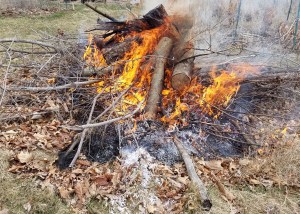
Using a bag of shredded office paper and a match, I started the burn pile created in the aftermath of an unusual wind storm last year. An arborist cut down the big branches and I sawed them into smaller logs and branches. The wood was dry and burned quickly even though it was covered with snow a couple days ago.
The first spring burn pile marks the beginning of gardening season.
I didn’t connect the garden hose as we are expecting freezing temperatures again this weekend. There is plenty of moisture in the ground to give the seeds a start.
A week ago I got a haircut. Partly it was too shaggy and in my eyes while working outside at the home, farm and auto supply store. Partly it was about casting aside the experience it represents for a new start.
My retirement March 16 has been something of a crash landing. Long anticipated, I know the major themes — writing, gardening, farm work, home maintenance and community organizing. I’ve had to add a need to deal with my aging frame and life systems. I made an appointment to see a medical doctor for a physical next week.
Even though I have more time, there never seems like enough to get what I want accomplished. With that in mind, I’ve come to believe what I said in February, that low income workers and retirees can’t afford social media. I posted this on Facebook this morning:
I’ve decided to end my relationship with the Facebook application on or about April 30. I joined in 2008 to follow our daughter and she deleted her account a couple of years ago. It’s not you fair reader, it’s me.
I listened to Mark Zuckerberg testify to Congress yesterday and his plans for dealing with public issues here. I have no interest in artificial intelligence reading my every post to determine if it is worthy according to Facebook criteria.
That said, I will miss the exchanges, likes and shares and appreciate your interest in what I’ve been doing. Facebook has been a creative outlet for me and I plan to channel those impulses elsewhere.
You are invited to continue to follow me elsewhere. I plan to keep my twitter account @PaulDeaton_IA and my WordPress account pauldeaton.com. If you are on WordPress click the button on my home page to add me to your reader, or click on the Follow Via Email button if you are not.
So that’s it. Hope to see you around… literally.
The burn pile was hot and I had to keep my distance while using a hoe to move partly burned branches to the top of it. By supper time it was a pile of white ashes with minerals returned to the ground and carbon released into the atmosphere. I plan to add another garden plot where the burn pile was.
We don’t know what tomorrow will bring. A burn pile reminds us all of the natural world is in transition. In a burn pile there’s no judgment, just the heat of released energy and beautiful, ever changing orange-yellow-blue flames.
In this moment that’s all we require to sustain ourselves.
At retirement plus 19 days I thought I’d be more productive.
Yesterday, after a shift at my desk and an hour-long visit with a neighbor and a team of surveyors, I took a nap… with long, deep sleep. Groggy when I woke, the better part of the day had escaped me.
It’s not like the main spring work of gardening was doable. Rain and ambient temperatures in the twenties and lower thirties gave me a chill most of the day. My farmer friends take advantage of every micro dry spell to plant a row of seeds or plow a field. A home gardener needs an ample period of dry ground and time to get in seed potatoes, early lettuce, radishes, turnips, peas and the like. Thus far the burn pile remains and the ground is unbroken, indicating there was a garden but little else. On the other hand, when the weather breaks, I’m ready.
Boxes of canning jars pile up as we draw down the pantry.
Last night Jacque and I went separate ways for dinner. She prepared a pasta dish with pasta made from lentil flour accompanied with a side salad. I prefer pasta made with semolina flour. These days a salad is organic greens from a specialty grocer, carrots, celery and home made dressing. When she finished in the kitchen I made a dish I had been thinking about for a week.
Mother made a simple gravy with bacon grease, flour and milk. My supper was a variation of that.
The gravy recipe is easy: three tablespoons fat, three tablespoons flour to make a roux then two cups milk simmered on low heat until thickened. We cook vegetarian at home so I substituted salted butter for the bacon grease. Mother added cooked hamburger to the gravy but I wanted more.
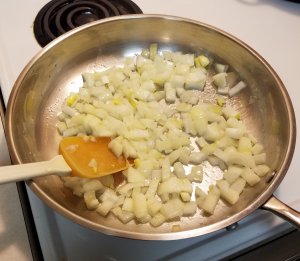
Dinner preparation began with diced storage onions, bell pepper from the freezer and a four ounce can of sliced mushrooms from the Netherlands sauteed in extra virgin olive oil, seasoned with salt and pepper. When the onions began to soften I added two finely diced cloves of garlic from Kate’s farm and incorporated them into the vegetables.
Next was two cups of Morningstar Farms recipe crumbles stirred in until thoroughly thawed and mixed. When the ingredients reached the proper stage I made a well in the center of the frying pan and added three tablespoons of salted butter to melt. I added an equal amount of flour to make a roux. When the roux had cooked for a couple minutes I added two cups skim milk and stirred the mixture until everything was incorporated. I brought it to a boil and turned down the heat to a simmer for about ten minutes until the liquid thickened.
I toasted a slice of sourdough bread, diced it, and spooned the mixture on top in a big bowl. That and a couple of raw carrots was dinner… with leftovers. Comfort food from memories of Mother.
In the annals of human history yesterday wasn’t much. Two people getting along in a place where we’ve lived for 25 years.
“I feel as if I’m fixin’ come out of hibernation and need to work with friends on something meaningful,” I emailed a friend. “What that is will eventually manifest itself… I hope we can recognize it when it does.”
For now I wait for the weather to break, rest and heal.
It is time to use up fresh onions, garlic and potatoes, then rotate the canned goods so oldest jars are consumed first.
Winter means soup, casseroles, pasta and hearty meals made from pantry and ice box ingredients.
As the ambient temperature warms, we are ready to move into the new year’s fresh food cycle. But not so fast!
There are egg sandwiches, chili mac and soups to be made before spring buds.
I donned my LaCrosse rubber boots and toured the yard and garden.
The ground is too hard to plant lettuce. Garlic is not up. The only bit of sprouting green was flowers I transplanted from Indiana. Tips of green were frosted on those that emerged. A thick layer of sand lies on the side of the road. Time to sweep it up and save it for next winter.
At 13 days until the transformation of worklife, I’m spending time organizing time and tasks.
To be successful means purging old habits and developing new. The work seems much harder than it should be. While working at the home, farm and auto supply store I’ve developed some questionable habits around internet usage, resting and eating. They produced the current result, so they were not all bad. One only gets so many chances to start over.
There are two problems with my transformation. First, I’m limited to 12 hours per day of primary activity. Not everything I want to do will fit. Second, I’m not used to working 12-hour days. To get things done, I need to ramp up. The situation is complicated by keeping two days of paid work in the mix. We’ll find a use for the money, but I’ll also need to figure out how to get more productivity out of a day to meet overall goals.
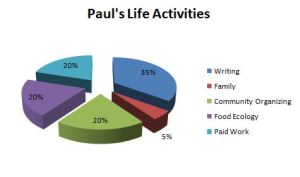
Paul’s Pie
Drawing the pie chart was fairly simple. Making that fit among rigid schedules of paid work, writing and farm work has proven to be challenging. Where I suspect this will end is with a hard schedule that includes writing, food ecology and paid work, leaving everything else flexible.
I’m committed to this now, so no turning back.
The week of the county party central committee turns into a session of drinking politics from a fire hose. As you can see in the pie chart, community organizing gets a 20 percent allocation of time and politics is a subset of that. I’ve limited myself to one social event per week and expect most of those to be related to politics for the next couple of months. I learned a couple of things:
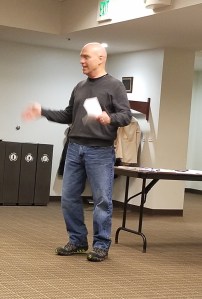
Rep. Dave Jacoby explaining plan to run 100 Democrats for 100 House seats.
Iowa House Democrats are planning to run 100 candidates for 100 seats in the midterm elections. We don’t usually run everywhere, so that makes this year different.
In the governor’s race, Democrats are working to win the primary. With seven announced candidates at the beginning of the filing period we’ll see if everyone files and if there is anyone else. It takes 35 percent of votes cast to win the primary. Cathy Glasson’s campaign is playing a side bet that the governor candidate will be chosen at the state convention with no one getting enough votes to win outright. The campaign claims to have won 30 percent of delegates at the caucus, which may or may not translate into 30 percent at the state convention after counties pick their delegates at the March 24 county conventions. 30 percent seems unlikely to win at the convention.
There are still too many geezers like me on the central committee. I’d gladly step aside and let someone else take my seat, but the truth is these women, millennials and newly registered voters who are supposedly playing a key role in the midterms don’t come to the meetings, don’t want the job. It’s a truism that flying at 30,000 feet, political strategists come up with all manner of demographic projections about the electorate. Our local elections of everyone up and down the ticket are made at a distance of six inches in front of our noses, rendering strategist musings moot.
Cold and frosty as the ground is today I can justify another day indoors to file our tax returns, work on community organizing and get caught up on everything else. However, it won’t be long before lettuce and potato planting. Next Sunday I start my first trays of seedlings in the greenhouse.
There’s everything spring brings and for which we yearn.
In a throwback to my work at a major logistics company I made a batch of vegetarian jambalaya for this week’s lunches.
The dish was born in Thomas County, Georgia as I was sequestered in a hotel for four months implementing a logistics project at a clay mining and processing plant. I had access to what was then called the TV Food Network and Emeril Lagasse. I made the techniques I learned my own.
Here’s a recreation of today’s recipe:
Ingredients:
2 tablespoons high smoke point oil
4 tablespoons butter
4 six-inch vegetarian sausage links sliced 1/4 inch on the bias
1/2 pound frozen sliced okra
2 cups diced onions
1 cup diced bell pepper
1 cup diced celery
4 cloves garlic minced
1 15 oz can red beans drained and washed
1 cup long grain brown rice
1 pint diced tomatoes
1 quart prepared vegetable broth
Salt, red pepper flakes, curry powder, prepared hot sauce to taste
In a Dutch oven, brown the sausage in cooking oil. Remove and set aside.
Melt the butter in the same pan and heat the red pepper flakes until aromatic.
Add the onions, celery and bell pepper. Saute until soft.
Add the garlic and stir together. Cook for five minutes over medium heat.
Season with salt, pepper, curry powder and hot sauce.
Add the pint of diced tomatoes and rice and stir together.
Add the quart of broth and bring to a boil.
Add the okra, beans and cooked sausage and mix everything together.
Cover and bring to a boil. Turn the heat to medium low so the liquid bubbles gently through.
When the rice absorbs the moisture, stir and serve with fresh, sliced green onions on top.
Makes six generous servings.
 My next shift at the home, farm and auto supply store is May 16. That schedule provides a solid block of time at home to work in the yard and garden.








 Journey Home
You must be logged in to post a comment.