RURAL CEDAR TOWNSHIP— A student from Nepal greeted me at the work bench where four trays of soil blocks awaited transplanted eggplant seedlings. She was like so many college students, alert, intelligent, and possessed of the confidence of youth. She asked me a lot of questions: where I lived and about local culture. So many, I didn’t get a chance to ask her about Nepal and her reasons for coming to the United States. She had just finished laying down mulch in one field and planting rows of eggplant in another with a group of farm workers. She was ready to call it a day and go on to what’s next. One of many chance encounters that have made the last 15 weeks of farm work an enriching experience.
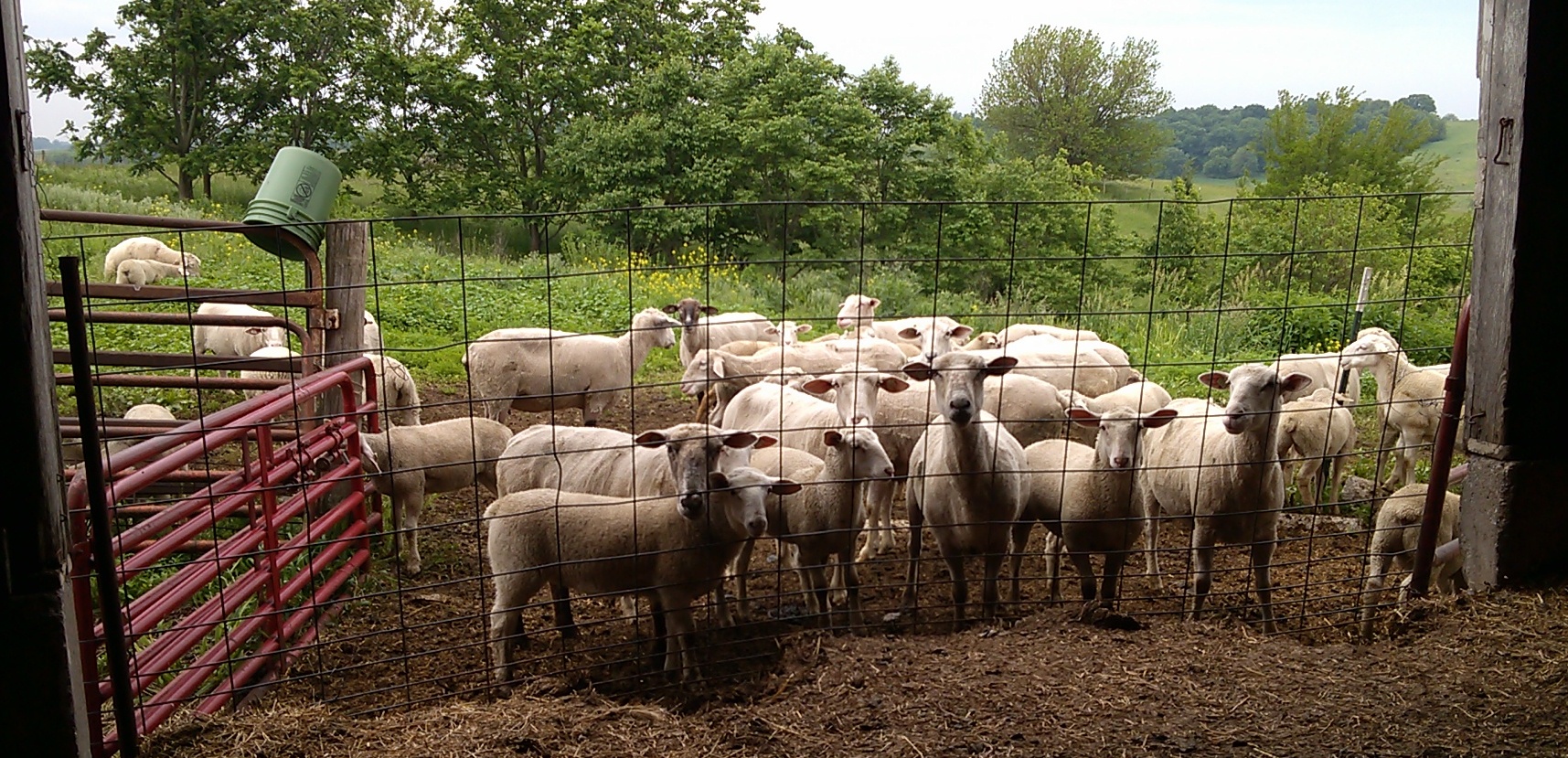
When my work moved from the germination house (formerly known as the greenhouse), to the barn, the sheep and lambs became occasional neighbors. The gentle bleating combined with bird songs made a soothing background while I made soil blocks, planted lettuce and transplanted seedlings. The two dogs hung out with me, napping most of the time. The intermittent encounters with other farm workers, combined with interludes of solitude in the barn—it is life as good as it gets.
Last week I brought jars of home made apple butter for the crew. My apple trees are expected to bear fruit this year, so the old stock needs circulation. To a person they liked it, making me happy to contribute to their farm experience.
There are apple trees on the farm, and if things work out, I’ll make apple butter from the fruit in exchange for some of the apples. My part time work on the farm has become a bartering process that gains complexity as time goes on.
There is something deep in meaning about this work. To see plants grow from seeds to seedlings to rows and then harvest is a connection with life itself. As the Nepalese student asked questions, I felt connected in a way that is hard to describe. Part of a sustainable and hopefully endless cycle of life on earth.
ELY— Two vendors braved threatening rain to set up tables at the Ely farmers market yesterday. I didn’t stop. Our refrigerator is full of leafy green vegetables from our garden and the CSA. This vegetable season will produce an abundance of variety and quantity. Already I have begun putting things up: freezing rhubarb and canning soup stock. We should support our local growers; however, there is a limit to how much one consumer can help. What’s needed is a movement supporting locally grown food. There wasn’t a lot of traffic at the market, indicating local movement in other directions.
It is still spring despite passing two unofficial starts of summer: Memorial Day weekend, and the release of children from school. What that means is the ravages of insects has not begun, and the leaves on the trees maintain their fresh wholeness. It won’t belong before the bugs begin to find the delicate food— there is a sliver of springtime to be enjoyed before summer starts.
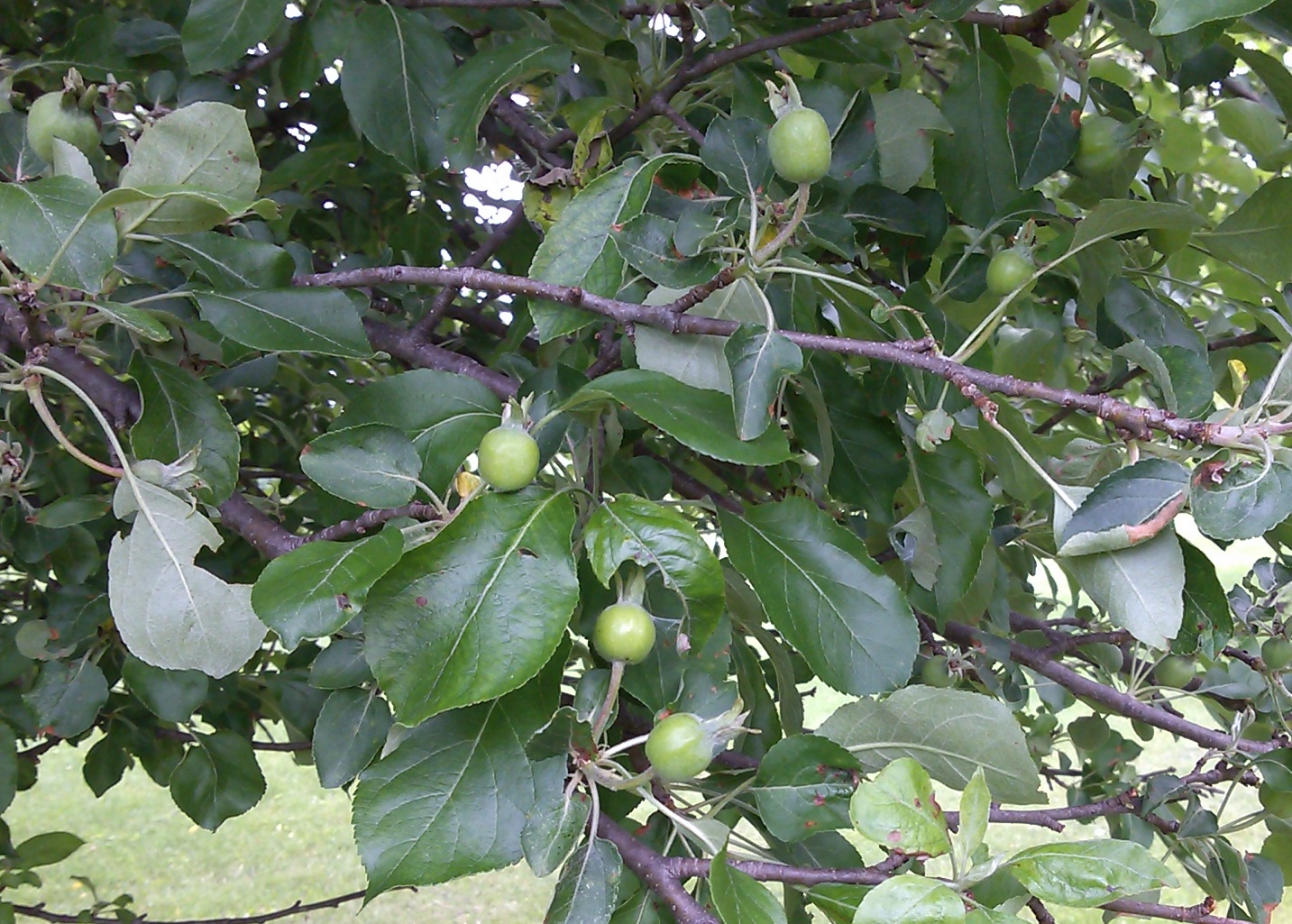
I would make a list of all the garden produce and its progress, but that seems too Edmund Spenser or Walt Whitman. English majors take note that every list or inventory is not a good one, and how many times can a person write about the progress of apples in the garden and make it interesting? There is a big difference between spending time in the garden and writing about it, although one should really be an extension of the other. Suffice it to compromise by posting a photo of developing apples.
The pressing needs of the garden are to prepare another plot for planting and to weed, weed, weed. The first four plots are growing well, and number five has three bur oak tree saplings, the remains of the garlic and bulbs of iris to be removed. It will be a relatively big project to return that space to production. It was also the first one dug and planted when we moved to Big Grove almost 20 years ago. Did I mention the garden needs weeding?
Pursuit of new nuclear power in Iowa was a bad idea when then governor Tom Vilsack began promoting it, and remains so. MidAmerican Energy’s announcement in the Des Moines Register today, that the utility “has scrapped plans for Iowa’s second nuclear plant and will refund $8.8 million ratepayers paid for a now-finished feasibility study,” was welcomed by people throughout the state. In the end, talk about nuclear power was a weird combination of the vaporous breath of politicians combined with a financially stable and well capitalized public utility owned by one of the richest men on the planet. The discussion Vilsack started is over for now.
In an email to members, Dianne Glenney, co-founder and communications contact for the grassroots organization S.A.F.E. (Saving America’s Farmland and Environment) wrote, “we have learned more about the dangers of nuclear energy than we ever wanted to know. But, we are much better informed now and an informed citizenry is primed to be a watchdog for future happenings, to report issues when they happen, and to take action.” While S.A.F.E. came into being only after the utility’s planned sites for a new nuclear power plant were recently announced in Muscatine and Fremont counties, Glenney’s words summed up the four-year process that stopped MidAmerican’s nuclear ambitions. Knowledge is power, and by 2013, the Iowa electorate had been educated about nuclear power.
As always, there is more to the story.
The idea that there was a nuclear renaissance in the United States was a product of the imagination of politicians, the nuclear industry, corporate media and the richest Americans. The nuclear disaster in Fukushima, Japan on March 11, 2011 brought the risks of nuclear power to the public’s attention. Shortly after the earthquake and tsunami that caused the failures, MidAmerican Energy’s Bill Fehrman asserted in an Iowa Senate Commerce Committee meeting that small modular reactors would solve some of the problems of Fukushima. The public wasn’t buying it, at least to the extent that they would support the legislation Fehrman said was necessary for the utility to get the financial backing of Wall Street to build a new nuclear power generating station. In today’s announcement, MidAmerican conceded that lack of an approved plan for a small modular reactor was problematic, citing as one of the reasons for pulling the plug, “there is no approved design for the modular nuclear plant it envisioned.”
A final decision by the Nuclear Regulatory Commission to deny a license to the Calvert Cliffs III nuclear reactor, slated for southern Maryland, is evidence that if there was a nuclear renaissance, it may be over from an NRC perspective.
Another part of the story is the abundance of natural gas resulting from increased exploration and discover using the hydraulic fracturing process. With the cost of natural gas going down, interest in more expensive nuclear power is waning. It is important that MidAmerican Energy noted the potential regulation of carbon as an impediment to building a natural gas power generating station, something that did not stop Alliant Energy from seeking approval for such a plant in Marshalltown.
The current solution to the radioactive nuclear waste produced by nuclear power generating stations is no solution at all. The plan is to store it on sites where it is generated until the federal government figures out what to do with it. Reasonable people can’t seriously consider adding new nuclear power capacity until this long standing deficiency is addressed.
Dianne Glenney of S.A.F.E. wrote last night, “no one should have to live under the strain of a potential nuclear power plant in their neighborhood, community, state and/or country. Someone is always downwind of every nuclear plant.” Now enough Iowans know this. Let’s hope we don’t forget.
LAKE MACBRIDE— 52 days of work for a nearby logistics company was an eye opener. In a world of constant electronic contact with smartphones and computers— via social media applications, on-line corporate media outlets and Internet discussion groups— our perceptions of society lean toward generalities and abstraction. Progressive commentary, about increasing the minimum wage and union organizing, seems disconnected when one works with others for low wages. As a worker, it is obvious there are inequalities in pay for work, and that the disparity between the richest Americans and the majority is widening. Yet people need an income, so they give up part of their freedom to toil in the fields of corporate masters, voluntarily.
In my short span as a warehouse worker, an endless river of people flowed through the building, each finding value, at least enough to attract them to the work, in the manual labor. Whether it was the prestige of having a job, working with friends, or socializing with new people, the monetary compensation was inadequate to have made it the main attraction. Some said they worked there to pay bills, but the compensation alone could not sustain the simplest of lives on the Iowa prairie.
The payday for low paying work is building a social network to help meet basic economic needs— one based in direct human contact, unfiltered by electronic media. A host of services was available because of the work relationship. A tattoo artist offered his ink, people of means offered loans, and gardeners offered to exchange vegetables and baked goods. There was ride-sharing, child care and a network of discovery of ways to escape low paying work for something better. Human society in places like this is like a living coral reef, where everyone’s needs can be met at a certain level.
Part of the learning was that such jobs are available, there is an ample supply of labor to fill them, physical stamina is required to perform the work, and a steady paycheck can play a role in a broader life. When we consider our choices in life— health care, a place to live, food to eat, taxes, loan interest and insurance— sustaining basic living can be problematic at $9.25 per hour without benefits. There is no simple resolution to this deficiency in pay for work.
Two progressive nostrums offer no help: organizing a union and increasing the minimum wage.
When I met Andy Stern, then president of Service Employees International Union, we talked about organizing logistics workers. Stern agreed labor unions lost the battle of maintaining union drivers and dock workers after the Motor Carrier Act of 1980 deregulated trucking. He suggested there was a new organizing possibility in the logistics workers who are the next layer of employees in a global supply chain. He felt it fit well with what his union was doing organizing janitorial and health services workers. Having worked a career for a company that made the transition from all union to non-union as deregulation rolled out, I was skeptical.
After my experience at the warehouse, Stern’s hope to organize logistics workers seems unrealistic. Not only is the corporation that was the ultimate customer for our work removed from employees, there were multiple layers of removal. A lengthy probationary period working for a temporary employment service distanced beginning workers from the company. Multiple temporary employment companies were used. Likewise, the logistics company to whom we were leased from the temp agency was a subcontractor for the company, working on successive three-year contracts. Colleagues often did not know for whom they would be working if they successfully made it through the temporary employment agency to the logistics company as employees. On a given day, people doing the same work received paychecks from at least three different entities. When combined with high employee turnover, union organizing would be nearly impossible in such an environment.
The progressive talk about raising the minimum wage is a case of barking up the wrong tree. At two dollars an hour above minimum wage, the warehouse work attracted former box store employees, fast food restaurant employees and other minimum wage earners. The earnings alone were not enough to live, even modestly.
When I heard former labor secretary Robert Reich speak in Iowa City, one topic was the widening inequality in society and concentration of wealth among the richest one percent of the population. He pointed out that the minimum wage was not the correct measure of how wage earners were doing. What matters more is that the median wage keeps up with the overall economy, something it has not done. He recently wrote, “the problem is we haven’t been living nearly as well as our growing economy should have allowed us to live,” and that if wages tracked the economy, the median wage would be over $90,000 per year today ($43.27 per hour for a 40 hour work week). Progressives may feel good about advocating for an increase in the minimum wage, however, an increase would not address the fundamental problem wage earners face on a daily basis. A substantial portion of their economic survival depends on social networking rather than their rate of pay from a single job.
The eye opener for me while working at the warehouse was that in a workplace where no one had ever heard of me, my work was accepted by management and by my colleagues without question. People find value in working a job at any rate of pay because the real value is in the social networking it enables. One doesn’t hear that in the social or corporate media, but maybe we should.
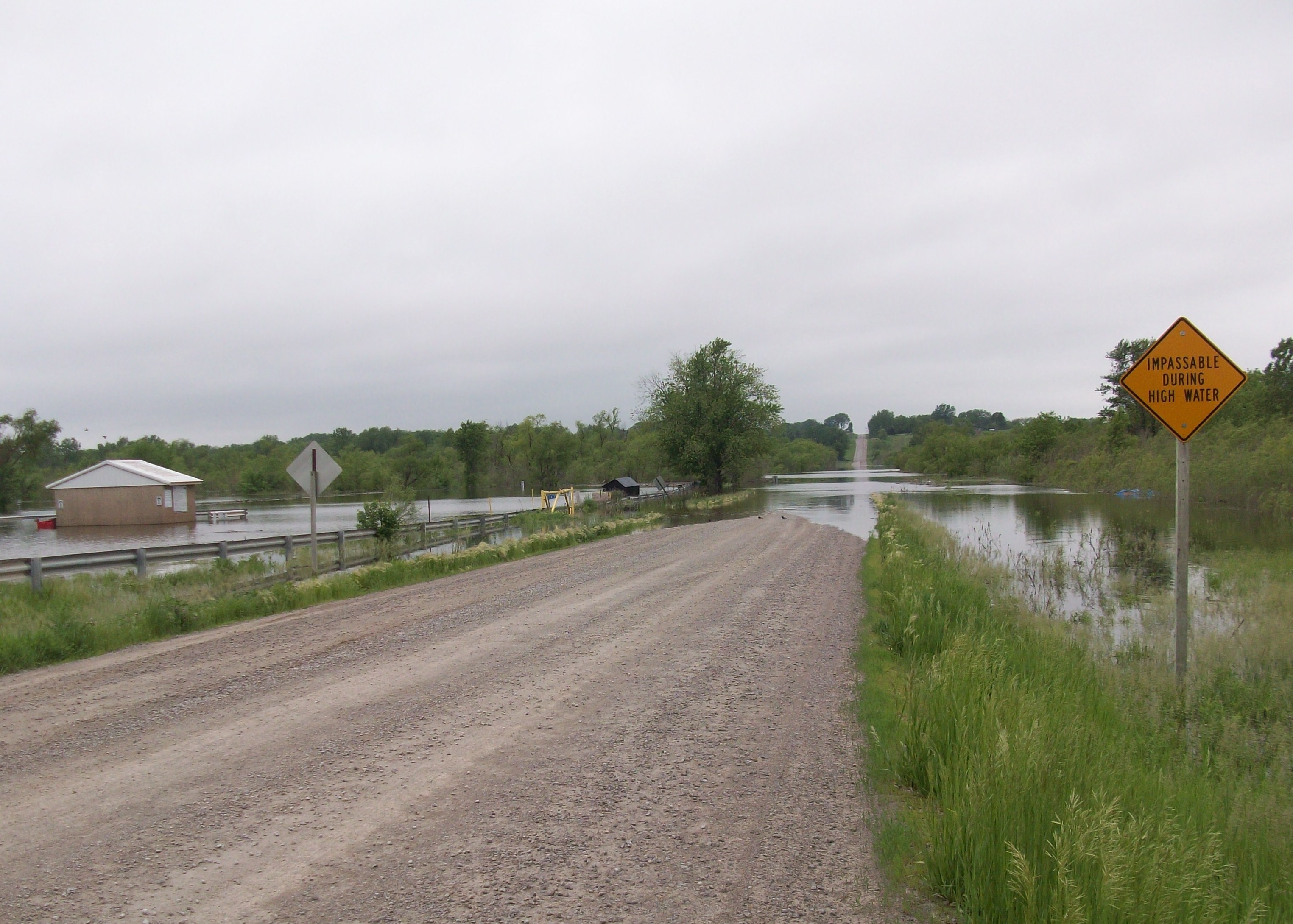
BIG GROVE TOWNSHIP— When we were children, our parents used to take us out for a Sunday afternoon drive. A typical trip might include visiting Weed Park in Muscatine, friends of my parents in Blue Grass, or to the Niabi Zoo near Coal Valley, Ill. Today’s Sunday afternoon drive was not as much fun. I drove to 140th Street NE near Ely Road to see the progress of the flooding.
That is, not as much fun unless one is a fisher. When I arrived at the edge of the water, about half a dozen motor boats were out. Click on the thumbnail above, and the boats can be seen as small specks toward where the road rises out of the water. Word is out that striped bass, catfish and carp are biting. The reason I know is a neighbor mentioned it while I was working in the ditch in the front yard after the drive.
140th Street, May 31
The water has risen about four feet since Friday. Compare the two photos to see how the building is being submerged. If you would like, take a look. For me, I would not like. It is wearying to deal with the consequences of climate that changed when we should be advocating to change how society interacts with so-called nature turned into an owned and built environment.
Like this flooding, changing climate is hitting us where we live. In the water we use, the air we breathe, and the weather we experience. This weekend politicians sought photo opportunities to post on social media: of them helping sandbag buildings to protect them; of them inspecting the damage. What they should be doing is actual networking with their colleagues in government to find common ground and take concrete action to solve the climate crisis.
Some may not notice the climate crisis because they are so busy cleaning up in its wake, or in this case, trying to catch the limit of striped bass. Maybe they are taking a much needed Sunday afternoon nap. Eventually the frequency of these hundred year floods, at a rate of three in 20 years, will be noticed. It is not too late to solve the climate crisis, but we don’t know for how long.
LAKE MACBRIDE— These are the best days. Partly cloudy, temperatures around 70, low humidity and plenty of outside work. We enjoy them when we can.
It’s not to say there is complete escape from the troubles of the world. Yet, for a few moments, beneath the cloudy heavens, it is possible to forget— a reason to anticipate such times with great fervor.
Today was what local food is. There were major farmers markets in Iowa City and Cedar Rapids. Between the CSA and my garden, we have most of what we need for the week, so I passed. After an hour at the newspaper, I did go to the grocery store to buy provisions: dairy, out of season vegetables and a few special items— popcorn, chocolate, snack crackers. The bill was much lower than usual as a result of growing so much of our own food, combined with working down the pantry.
When I arrived home, the rest of the morning was yard work, pruning the pin oak tree and repairing the erosion near the ditch with bagged soil and grass seed. The majority of the afternoon was harvesting, planting and processing vegetables: radishes, lettuce, turnip greens and oregano.
I picked the rest of the first row of radishes and put them in a bucket. Next, I harvested all of the first planting of lettuce. This cleared a space to till the soil and re-plant two rows of radishes and the rest of the first crop of lettuce seedlings. My garden mentor said one of the biggest mistakes home gardeners make is failing to plant in succession. There will be more plantings of lettuce and radishes.
Near the herb garden I cut a gallon bucket full of oregano from the volunteer plant. Finally, I picked most of the turnip leaves, leaving only those plants that looked like the root would fill out. The turnips grow too tall, too fast, and block out the nearby spinach. I have been thinking about the turnip greens since winter.
At the end of the harvest, I had a bushel of lettuce, five gallons of turnip greens, and regular one gallon buckets of oregano and radishes. A gardener has to keep the produce moving to make optimal use of it. I spent the rest of the day processing the harvest.
The radishes were easy. I trimmed them and placed them in a glass of water. They won’t last long. The oregano was also easy. Since two plants wintered (I only had one last year), the plan is to dry the leaves and make a jar of oregano flakes for cooking. I washed the leaves on the stem, placed them on clean towels on the front step, let the sun dry them and put them on the shelves of the dehydrator to finish drying. I don’t turn the dehydrator on. The temperature is too hot for herbs.
The bigger processing projects were picking through the lettuce to find the best leaves— cleaning, cleaning drying and bagging it; and making a large pot of turnip leaf soup stock for canning. Turnips make the best base for vegetarian soup stock, although leeks, if I have them, are good too.
As the day ended, I turned off the soup, left it on the stove and went to bed. Sunday will be back to the realities of finding suitable paying work, putting up the soup stock in jars, and weeding the garden.
ATHERTON WETLAND— The flooding continues here. It has not reached the level of either 1993 or 2008— yet.
As I write, the county has issued mandatory evacuation orders for people who live in low lying areas. What used to be a 100 year flood needs a new name, as this spring brought the third major flooding in 20 years. One has to believe that a cause of the frequent and extreme weather is our changing climate, wrought by greenhouse gas emissions resulting from human activity. The flooding is a reminder of the importance of working toward a solution to the climate crisis.
A proximate cause of the flooding is the rain. The Iowa Department of Natural Resources reported record rainfall,
swinging from drought concerns to flooding worries within weeks, Iowa has set two precipitation record highs in 2013: the statewide average precipitation for March, April and May collectively at 16.65 inches; and a year-to-date precipitation total of 18.92 inches. These are highs among 141 years of records.
What to do but adapt?
If the reader clicks on the photo, there is a building on the left side of the image. During June 2008, the flood waters reached the eaves of this building. In 1993, the building did not exist.
We live near Lake Macbride and in 2008, the trail next to the lake was covered in water. It would take a lot more water to fill the watershed enough to reach our home, so were never in danger of a wet basement.
We’ll see how the flood of 2013 plays out, but based on the reports on social media, it may fall somewhere between 1993 and 2008 levels. Iowans are getting used to frequent flooding, indicating advanced stages of adaptation to changing climate.
LAKE MACBRIDE— The house doors are open, creating a cross breeze that is very nice. This morning has been weeding the garden, and cleaning up the kitchen, neither of which jobs is close to finished. Time for an update on local food and the garden, beginning with the lawn.
With the abundant rains, the lawn had gotten lush and long. I spent three hours yesterday cutting and bagging the clippings on a third of the property, and now my tomatoes have their first layer of mulch to suppress weeds. Some say it is a bad idea to use grass clippings to mulch the garden because the seeds of weeds may be included. Others say the grass clippings should be left on the lawn for mulch. I am more concerned about suppressing the weeds in the garden. The rest of the spring grass clipping harvest is expected to take another four hours.
The tomatoes grown from seed and transplanted into the garden have taken. This year’s tomato plan means planting less in my plot, but because of my relationships with other growers, we should have more and diverse varieties. With the mulch being laid down, there is not much to do with tomatoes other than to watch them grow.
With our share from the CSA plus the greens from our garden, we are having salads daily, most times as a meal. The types of lettuce from each source are complementary, and there is plenty of produce to load each meal with veggie goodness. The key lesson I am learning this year is to keep planting lettuce and greens throughout the season. It will be a year of abundance.
We will have a bumper crop of oregano, and I am using the dehydrator to dry some of the herbage. A little goes a long way, so if I can store a small jar of dried oregano, it will last the winter.
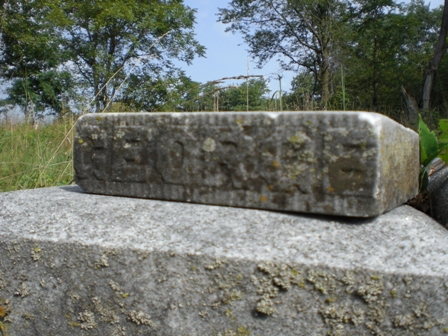
FACKLER’S GROVE— What should be done with an old cemetery? Fackler’s Grove is a pioneer cemetery that has not been used for interment for more than a hundred years. There are that many years of neglect. The remains of George Fackler, the first person to die in the township, are here, along with those of more than three dozen others. Some think we should do something with the cemetery.
The Ely Historical Society initiated a project to clean up Fackler’s Grove, and their first project day is Saturday, June 1. Check out the Ely History Blog post about the cemetery cleanup here. The group has been thoughtful about their approach, and have phased the work so a better understanding of the needs can be gained through their engagement.
The question for the Big Grove Township board of trustees is how many tax dollars should be spent to maintain a cemetery that many local residents don’t know exists? Today, the answer is unclear.
One line of thinking is to move the remains to a designated section of the Oakland Cemetery near the town of Solon. This has been investigated previously, and there are legal obstacles to consolidating the two cemeteries. Another way to look at it is the cemetery is sacred ground and should not be touched, except to remove brush, and to maintain trees, fencing and what artifacts remain there. The historical society project leads in that direction. A third way to look at it is to do nothing. Fackler’s Grove has been neglected for more than a hundred years, what harm is there in leaving it alone for a few more?
The thing is that when people are interested in donating time and money to maintenance of township property, the resources should be used to supplement the operating budget. I welcome the Ely Historical Society initiative. How the work will unfold over time is something in which I will engage, and report on from time to time.
WILTON—About 65 people gathered at the Wilton Community Center last night to view a screening of the documentary, “The Atomic States of America,” hosted by the group Saving America’s Farmland and Environment (S.A.F.E.). Attendees also heard an update from two of the group’s co-founders Dwight and Dianne Glenney. S.A.F.E. began with a group of farm families who rose in opposition to MidAmerican Energy’s plans for a nuclear powered generating station on 150th Street near Wilton.
No surprise that a group of farmers would fight a large corporation in the biblical terms of David v. Goliath when MidAmerican Energy bought options on 729 acres of prime Iowa farm land in the middle of an established rural community to build a power plant. According to Glenney, the electric utility has three possibilities for the land should they exercise the options: build a nuclear powered generating station, build a natural gas powered generating station, or do nothing. S.A.F.E. is organized so their Davids can remove MidAmerican’s Goliath from their lives and the land options expire without action.
I first met some of the group in October 2012 when Iowa Public Interest Research Group hosted a community organizing meeting to oppose siting a nuclear power plant near Wilton. My advice at the time was, “your most effective voice is with your state legislators when they convene the 85th General Assembly… Let your legislator know you’re opposed to it.” Since then, members of S.A.F.E. engaged their elected officials, securing resolutions opposing nuclear power from the Cedar and Muscatine county boards of supervisors. They also recruited state representatives Bobby Kaufmann and Tom Sands to support their efforts. Membership is approaching 400 people who have signed their petition and joined S.A.F.E.
According to Dwight Glenney, the group has been researching nuclear power during the time since the October meeting. What they learned moved the group from a not in my back yard approach to more general opposition of nuclear power in Iowa, in the United States and globally. Glenney indicated there are options besides nuclear power to supply electricity to meet growing demand in the state.
He reported that MidAmerican Energy has completed their three-year study of the feasibility of nuclear power in Iowa and is expected to deliver the report to the Iowa Utilities Board this week. Dianne Glenney reported on grassroots organizing activity of fundraising, letters to the editor, production of an information packet, attendance at legislative forums and other items.
S.A.F.E. makes a strong point that they are not affiliated with any so-called “green” groups, and that is a strength of the organization. By remaining strictly grassroots, with members of the community effected by MidAmerican Energy’s plans for rural Wilton being the primary stake holders in the group’s activity, they have an independent and unique voice that dovetails with other concerns of rural Iowa.
What’s next? S.A.F.E. supports building any new electricity generating facility on existing power plant locations so that new land is not taken out of farm production. According to Dwight Glenney, it makes sense from the standpoint that the logistical support of transmission lines, roads and infrastructure is already in place. They also plan to advocate with the Iowa legislature for a ban on nuclear power, similar to what 13 other state legislatures have enacted. Such a ban may be permanent, or until the unresolved problem of disposal of radioactive spent fuel is addressed by the federal government. S.A.F.E. is working with their legislators to introduce bills regarding these issues during next year’s second session of Iowa’s 85th General Assembly.
Dwight said that if the issue is resolved, and MidAmerican Energy decides not to build a power plant near Wilton, any funds remaining in their bank account will be divided three ways and donated to local Future Farmers of America groups. For the time being, they asked for financial support and for people to join their growing membership. If you would like to learn more about S.A.F.E., email Dianne Glenney at diglenney@live.com.




 Journey Home
You must be logged in to post a comment.