Categories
Kitchen Garden

Vinegar Time

Apples
Apples

With the apple harvest comes an opportunity to make apple cider vinegar.

Since 2012, when I began to wake up to local food, I’ve posted about vinegar twice: Bottling Apple Cider Vinegar in 2013, and Making Vinegar in 2014.

Without a home apple crop, this year’s batch is a little different.

The continuum of vinegar making goes back a long time: it’s the mother. Mine was procured from a neighbor and has been present since I began home fermentation of apples. His mother of vinegar had been in the family since the 19th century when Iowa was first settled. Traces of vinegar have been found in Egyptian urns dated the third millennium BCE.

The recipe for vinegar is simple. Keep a container of vinegar with the mother in the pantry and add apple juice from time to time. Cover with a cotton cloth for ventilation and let it ferment. After the bacteria have converted sugars to alcohol, then alcohol to vinegar, it’s ready to bottle and use. Currently there is a gallon ready to use and a gallon just started this year. At least one jar never goes empty to preserve the mother.

My production is small compared to the orchard where I work on weekends. We both use the same mother, although he uses brewer’s yeast to hasten production of alcohol. My method, using apples from my back yard and no yeast, works as well but takes more time. Making vinegar is about time more than anything.

This year I stopped at a shop that caters to people who ferment their own beer and wine to ask about brewer’s yeast. The proprietor said I was the first customer to arrive asking about making vinegar. Not a lot of people make their own.

After studying a few things on the internet he recommended a yeast made by a major company that would produce about 14 percent alcohol. He said too much alcohol may kill the vinegar bacteria. Both of us thought the low end of alcohol production would not. The $0.99 packet I bought will ferment a lot of apple cider.

Without a crop at home, I’m using cider from where I work. It is flash pasteurized, which will allow my bacteria to drive the process. I hope it is a better result. I bought half-gallon Mason jars  for the project and have two started about 3 weeks apart.

I trimmed the mother with a pair of kitchen scissors and put part in the jar. I added a scant half gallon of cider and let it warm to room temperature. I added a 16th teaspoon of yeast which began producing alcohol within a couple of days. The liquid tastes more like hard cider today with hints of vinegar. The process appears to be working.

I organized and bottled last year’s production and am ready for winter. I’ll keep making it and making pickles and dressings with it.

Making apple cider vinegar is one way we emulate an agrarian life in a modern kitchen. It’s also how we sustain our lives in a turbulent world.

Categories
Home Life Writing

A Place To Work

Garage Selfie
Garage Selfie

Only after a couple of days away from daily routine can a person begin to be themselves.

That’s where I am this morning.

I crave a place to work.

Desire is a blessing and a curse. When we want something, we set ourselves up for disappointment. We may get it, but can’t always get what we want.

It is a difficult path to nirvana. I do my best to void consciousness of self. It persists. There are selfies.

Like Eugene Henderson we feel restless and unfulfilled, harboring a spiritual void that manifests itself as an inner voice crying out I want, I want, I want.

Work is a cure for that.

Busy hands make happy children and happy children build a new world.

That’s where I am this morning.

Childlike and craving a place to work.

Categories
Environment

After the Latest Flood

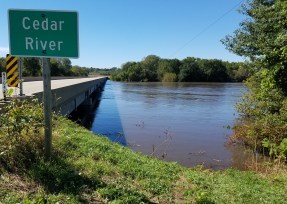
Cedar River at Iowa Highway One Sept. 27, 11:36 a.m.
Cedar River at Iowa Highway One on Sept. 27, 2016 at 11:36 a.m.

The Cedar River crested in Cedar Rapids at 21.91 feet at 11 a.m. yesterday.

As the river recedes over the next few days the temporary flood wall and earthen berms built over the weekend will be monitored for breaches.

They held during the crest, protecting people and property from damage. Here’s a link to a news story about the flood.

State Senator Rob Hogg announced a “Flood Relief, Recovery and Resilience Tour” of  Cedar Falls, Waverly, Clarksville, Shell Rock, Charles City, Vinton and Palo today and tomorrow. Hogg hopes to learn about the damage done, what kind of help people need, what worked and what didn’t work, and how we can do more together to reduce future flood damage, including better flood mitigation infrastructure and better watershed and floodplain management according to the event page on Facebook.

The City of Cedar Rapids knew what to do when flooding was predicted after heavy precipitation events upstream. Over the weekend officials executed a plan to build a temporary flood wall, evacuated low-lying areas and ramped up emergency services to prevent large-scale damage to homes, property and people living in Iowa’s second largest city. News media stories focused on the human drama of reaction to the impending flood. There has been little coverage of the causes of the heavy precipitation events that produced rain that caused the flooding in northeastern Iowa.

“Iowa is already experiencing the effects of climate change,” according to the Iowa Department of Natural Resources website. This includes “increased frequency of precipitation extremes that lead to flooding.”

Flooded Farm Near the Cedar River, Sept. 27, 2016

Because this is the second major flood in Cedar Rapids since 2008, solutions to protecting people and assets going forward have been discussed and are clear.

Senator Hogg outlined three essential strategies: get Congress to help fund permanent flood protection that has already received state and local funding; better upstream watershed and floodplain management to reduce peak flooding; and action on climate change to stop extreme precipitation events from getting worse.

U.S. Senators Chuck Grassley and Joni Ernst sent a letter to the Army Corps of Engineers “demanding answers on why they have neglected to complete flood mitigation projects in the Cedar Rapids region and have put the public’s safety at risk.”

They wrote:

With all due respect, it is no longer sufficient to say that your hands are tied and that nothing short of a congressional earmark can help communities like Cedar Rapids that have lower property values. You have some discretion to help and have simply made the decision to forego the assistance even though the community endured a 500-year flood event in 2008, worked with the Corps to develop a project to address that flood risk, and worked with Congress to get it authorized. Due to your refusal to budget for this project, Cedar Rapids is now facing another major flood event without the needed levee improvements.

Hidden in this tough language is a bitter irony. Congress won’t appropriate money for the project, yet the senators expect the Corps of Engineers to find it somewhere else in their budget. This is what austerity policies look like and they are not good for the people of Cedar Rapids and other flood impacted areas.

While Iowans impacted by flooding are concerned, in the upper atmosphere carbon dioxide levels maintained a level above 400 part per million according to monitors in Hawaii. Atmospheric carbon dioxide level is a key contributor to global warming which increases the intensity of precipitation events that have led to Iowa flooding.

“September is usually the month when carbon dioxide is at its lowest after a summer of plants growing and sucking it up in the northern hemisphere,” Brian Kahn wrote in an article on Climate Central. “As fall wears on, those plants lose their leaves, which in turn decompose, releasing the stored carbon dioxide back into the atmosphere. At Mauna Loa Observatory, the world’s marquee site for monitoring carbon dioxide, there are signs that the process has begun but levels have remained above 400 ppm.”

Why is 400 ppm important? The lower limit of the safe operating zone boundary for carbon dioxide on Earth is 350 ppm. We passed that level in 1986.

The United Nations Intergovernmental Panel on Climate Change’s fifth Assessment Report notes that, “continued emission of greenhouse gases will cause further warming and long-lasting changes in all components of the climate system, increasing the likelihood of severe, pervasive and irreversible impacts for people and ecosystems.”

That means more flooding in Iowa similar to this week’s event. While politicians like Senator Hogg are well-attuned to the urgency of this climate crisis, too many politicians and public officials are dismissive of climate change.

Governmental action to mitigate the effects of climate change is needed. If our current crop of politicians isn’t willing to take action, we should replace them with people who will.

Categories
Home Life

Vacation – Hour 12

Soup Ingredients
Soup Ingredients

A political meet up, dinner using orchard-fresh apples, watching the presidential political debate on my phone, and five hours of sleep highlighted the first 12 of 96 hours of vacation this week.

I need to get more rest, but not now. Not today.

Awake and writing, soon to be picking detritus from the yard, I expect to spend most of the day outside. According to my weather widget, sunrise is three hours away with zero percent chance of precipitation until after sundown.

The beginning of soup is on the stove — three jars of tomato-y liquid from the ice box and a bag of onions. I’ll add vegetables and seasonings from the garden, ice box and pantry through the day, progressing toward a peasant’s meal tonight.

In the United States we aren’t peasants and homegrown vegetables owe fealty to no one. Raising vegetables is a revolt against those who would enslave us.

I paid my taxes so the land is ours… at least for now. Property rights are an American common denominator stronger than any political party. Having dispossessed those who lived here before, we are free until someone dispossesses us.

A long list of tasks resides on my phone. I left the device on the night stand while I bask in this window of freedom before sunup. Feeling the breeze from the lake, and for a brief moment, being myself against the wind — resisting for a while, then giving way to its cool waves in the predawn darkness.

Categories
Environment

Evacuation of Cedar Rapids Under Way

Blah
Extreme One-Day Precipitation Events in the Contiguous 48 States. Bars = years; line = 9-year trend. Image Credit: U.S. EPA

The headline from this morning’s Des Moines Register was that residents of 5,000 Cedar Rapids homes were asked to evacuate in advance of the flood crest predicted to arrive Tuesday morning. The height of the crest has been revised downward to 23 feet, however, damage is expected to be severe.

Cedar Rapids fire officials plan to ask for the names of next of kin of residents who refuse to leave the flood zone.

City officials say government has been preparing for a major flood since the record-breaking 2008 event.

There is bravura in the execution of the local preparations indicating the city knows how to mobilize to prevent anticipated damage — better than it did in 2008. It is always good to see people coming together in times of natural disaster to help each other.

At the same time, almost everyone in government, in news media and in other accounts of the disaster fail to consider the root causes of the heavy precipitation events driving record flooding. The world continues to annually dump more than 38 billion tons of carbon dioxide into the atmosphere like it was an open sewer. That’s 2.4 million pounds per second.

News media and politicians may be enamored of the story of human resistance to the forces of nature, but failure to address the root cause of increased levels of carbon dioxide and other greenhouse gases in the atmosphere through proper governance should be unacceptable.

Government plays a significant role in mitigating the effects of climate change. Perhaps it’s time we changed the current crop of politicians who fill elected office seats from those who are cheer leaders for reaction to natural disasters to those who will take action to prevent them.

Without action, the chart above from the U.S. Environmental Protection Agency will continue to map a direction that puts people and assets in jeopardy.

We should know better and do something about global warming and climate change as a society.

Godspeed Cedar Rapids. May your elected officials who don’t already do so perceive tomorrow’s flooding as a wake-up call to action.

Categories
Work Life

Crashing into September

Openings to the Dual Septic Tanks

Things are falling apart so Tuesday I begin four days paid vacation from the home, farm and auto supply store. I plan to catch up around the house and run a few errands in and near the county seat — and try to regain a sense of being in control.

Not counting one paid sick day, I will have made it 64 of 100 in my plan to work 100 straight days.

It is time to deal with existential realities in the life of a sixty-something.

There is a lot of crap going on.

As I posted Friday, autumn began with a flood, one wholly predictable, but still catching many by surprise. Politicians talked about doing something after the 2008 flood to mitigate future flood damage. Not much talk turned into action. One doesn’t need to be Jeane Dixon to predict there will be more, similar flooding caused by heavy precipitation events during the next ten years.

The presidential election is sucking up space to the extent even I’m tuning it out. Tomorrow is the first televised debate between Hillary Clinton and Donald Trump. If it is streaming I’ll tune in for as long as I can take it (still haven’t solved the problem of owning an analog television set).

Trump is a ridiculous candidate supported by many of my neighbors and co-workers. The Republican Party of Iowa appears to be running a superior ground game when compared to the Iowa Democratic Party. However, this presidential election is changing the rules, tactics and values of ground games. If both parties have mastered similar Get Out The Vote practices, the next winner will breakout with something new. Trump is trying to do that. The outcome is uncertain even if Clinton continues to lead in the polls. Trump would make a disastrous president if elected.

Perhaps a few days of retreat will help me get centered and facilitate positive action going forward. At least that’s the hope. Right now it feels like crashing into September with a long skid into insanity if I don’t do something about it. I intend to take corrective action.

Categories
Environment Living in Society Social Commentary Sustainability

Protect Environment; Stop Nuclear Weapons

Paul Deaton
Paul Deaton

(Editor’s Note: When this guest column ran in the Cedar Rapids Gazette on Wednesday, Sept. 21, its abstract nature became real as heavy precipitation events pummeled Butler County and other parts of northeastern Iowa, disrupting lives there and downstream. Living in an environment where rain damages crops instead of nurturing them; where rivers jump their banks, close schools and displace people; and where Cedar Rapids must protect the city from record amounts of floodwater multiple times in eight years, something’s wrong. We must take action that includes electing a government that will address the causes of global warming and nuclear proliferation, not just deal with the actuality we have created).

Protect environment; stop nuclear weapons
By Paul Deaton

Guest column for the Cedar Rapids Gazette Sept. 21, 2016.
Reprinted with permission of the author

If we accept the premise articulated by Hillary Clinton’s presidential campaign, that we are stronger together, there is a lot in society requiring our collective attention.

There are no lone wolves in human society, although a number of people want to get away from the pack. Can we blame them? Being stronger together is a fundamental characteristic of Homo Sapiens. It’s what we do as a species.

What should we be working on?

It is hard to avoid the primacy of following the golden rule. We should be applying the golden rule, better than we have been, to everything we already do. This is basic.

Two other issues call for our attention, the threat of nuclear weapons, and mitigating the effects of climate change.

Today, on very short notice, nuclear powers can unleash a holocaust ending life as we know it. Nuclear war is not talked about much in the 21st Century; however the threat is as real today as it was when President Truman authorized the Hiroshima and Nagasaki nuclear bombings. The United States should take the lead in eliminating nuclear weapons. We need a transformational change in our nuclear policy that recognizes these weapons are the gravest threat to our security and must be banned and abolished.

We are wrecking our environment and should stop. Just 90 companies are to blame for most climate change, taking carbon out of the ground and putting it in the atmosphere, geographer Richard Heede said. If that’s the case, the move to eliminate fossil fuel use can’t come quick enough. These companies should be targeted for regulation by governments. Companies say they are not to blame for the demand from billions of consumers that drives fossil fuel use. Technologies exist to eliminate fossil fuels, and we should adopt them with haste. One purpose of government is to act as a voice for people who have no voice. Regulating business to protect our lives in the environment would serve that purpose.

After the 2016 election these issues will remain. The first can gain wide support easily. It is time the other two gain parity.

~ Paul Deaton retired from CRST Logistics in 2009.

Categories
Environment

Autumn Begins with a Flood

Flooded Wetland
Flooded Wetland

There was a lot to make one cranky as summer ended yesterday, including the weather.

Extremely heavy rains are flooding parts of Iowa and the impact will soon be felt downstream.

The Cedar River is expected to crest at 24.1 feet next week in Cedar Rapids, Iowa, the highest level after the record 31.12 foot crest on June 13, 2008.

“We have four days to get ready, and now is the time to start,” Mayor Ron Corbett said Thursday.

We’ve had a lot more time than that to get ready.

During Al Gore’s Climate Reality Leadership Corps Training, conducted in Cedar Rapids in May 2015, Mayor Corbett made a presentation about the 2008 Cedar River flooding, how it impacted Cedar Rapids, and what actions were taken and being considered to mitigate damage from potential future floods. The next week will determine whether the plans and discussions were enough to prevent serious damage.

Senator Joni Ernst has been pushing the U.S. Army Corps of Engineers to expedite completion of the Cedar Rapids Flood Control Project, recently in the Water Resources Development Act.

“This legislation includes my work to direct the Army Corps of Engineers to expedite the completion of the Cedar Rapids flood control project,” Ernst wrote in a Sept. 15 press release. “The provision emphasizes to the Army Corps of Engineers that Congress wants this project to remain a priority. I will continue working to ensure the Army Corps of Engineers understands the great need for this long-standing project to be completed in a timely and efficient manner.”

These efforts seem well intentioned, but too little, too late.

The connection between this flood and global warming is clear. When the atmosphere is warmer, its capacity to store water vapor increases. When it does rain, it can do so in heavy precipitation events in which a large amount of rain falls in a brief amount of time. The frequency and intensity of heavy precipitation events has increased since World War II and that appears to be what happened in northeastern Iowa over the last few days.

Here’s an excerpt from a WHO-TV news article about flash flooding in Butler County. It tells the story:

BUTLER COUNTY, Iowa — Storms in northern and northeastern Iowa overnight caused some damage as they spawned tornadoes and dropped heavy rain – up to 10 inches – in some areas.

“We expect the crest this evening what we’re being told around 7 p.m. probably water levels similar to 2008 or more so,” said Jason Johnson, Butler County Sheriff.

Flooding from the Shell Rock River has cancelled classes in the North Butler School District for Thursday and many students gathered at the high school to help fill sandbags. Highway 14 on the way to Charles City is impassable because of water over the road.

Butler County Sheriff  Johnson says there isn’t a widespread evacuation in Greene but some residents are moving to higher ground.

In Floyd County, 7.55” of rain was reported and Charles City saw 6.35”. The Little Cedar River is at moderate flood stage at Nashua and near Ionia. The rainfall total reported for Ionia is 6.24″.

Work will remedy the crankiness of summer’s end. One didn’t expect it to be sand bagging levies, homes and businesses to prevent damage from what is projected to be the second worst flood in Cedar Rapids history. It will get us through the weekend.

The newest flood begs the question of what’s next to mitigate the damage from future flooding? Government involvement in a solution is necessary but it must be implemented faster than it has been. We also have to connect the dots between our personal actions, global warming and climate change more than we have.

For now, we’ll just have to deal with the existential reality of the flood, something I recall doing since the 1960s. It’s a way of sustaining our lives in a turbulent world, but we can do better.

Categories
Living in Society

Letter to the Solon Economist

Big Grove Township Trustee Ballot

If you have been thinking of running for elected office, a slot is open on the ballot in Big Grove Township.

Mark Haight is the lone candidate seeking re-election as township trustee for two open seats. Mark has unique skills suitable for being a trustee, so I hope you’ll flip the ballot and vote for him.

I announced my decision not to seek re-election six months ago. To date no one has been recruited to fill my seat and that creates an opportunity.

Is it too late? Not at all.

On the first day of early voting in 2012 I noticed there was only one candidate for two seats. I decided in the voting booth to write myself in and campaign to become a township trustee.

I issued a press release, made a post on my blog, and made one speech at a political event on Cottage Reserve where State Senator Bob Dvorsky allowed me to speak to Big Grove residents. I sent a note to friends and neighbors and won the election with 71 votes.

The Big Grove Township Trustees are responsible to provide fire protection and first responder service for the township, manage the Oakland and Fackler’s Grove cemeteries, and to resolve lot line disputes. Our main activity is preparing and approving a budget each year.

If you’ve been thinking about running for public office, here’s your opportunity to campaign and win. The non-partisan board of township trustees is a great place to get started in politics.

Categories
Writing

First Folio: Important, but no Beowulf

First Folio Table of Contents

The Folger Shakespeare Library of Washington, D.C. sent copies of the First Folio of William Shakespeare’s plays on a 50-state exhibition in celebration of the 400th anniversary of the bard’s death in 1616.

The First Folio is the only reliable record we have of 18 of Shakespeare’s plays.

The exhibit is at the University of Iowa Libraries until Sept. 25.

I first heard of the First Folio in Father Harasyn’s freshman high school English class in 1966 when we read and memorized parts of The Merchant of Venice. I can still hear the voices of friends who went to work in quarries, at construction sites, and driving trucks reciting Portia’s quality of mercy speech from memory. It was the deepest dive into a single Shakespearean play I’ve had. May mercy fall like gentle raindrops from heaven on the graves of my departed childhood friends.

I’m not hopeful of getting to the county seat to view the exhibit. Let’s face it, First Folio is not that rare and is one of the most cited texts on earth. It’s commonplace. I viewed a copy at the Library of Congress where it was displayed near their copy of a Gutenberg Bible, a much rarer document.

First Folio is no Beowulf

Of roughly 500-750 copies believed to have been printed in 1623, about 234 are known to have survived. The printing process was “revise as we go,” which yielded many variants. When we think of a literary tradition that includes Homer, Sophocles, Euripides, Aeschylus, Aristophanes, the Gutenberg Bible and the Beowulf poet, 234 extant copies is a lot. The First Folio is no Beowulf in terms of rarity of manuscript copies.

My English major nags at me to see the exhibit. Yesterday I asked an orchard co-worker if she had seen the First Folio. The dialogue which took place between customers, much modified, went like this:

Me: Have you seen the First Folio?
She: No, not yet. My professor said it’s not that special. Why would he say that?
Me: Cancel his tenure, fire him, and get him to work digging ditches.
She: (Silence).
Me: Too extreme?
She: Yes. An apology would suffice.

I took an undergraduate Shakespeare course from the late Sven Magnus Armens at the University of Iowa. Born in 1921 to Swedish immigrants in Cambridge, Mass., Armens was a Tufts and Harvard graduate who served in the Coast Guard during World War II. His papers are located in the University Library Special Collections Department and of more interest to me than the traveling First Folio exhibit. I haven’t seen them either.

Known for walking his Great Danes around Iowa City, Armens was a chain smoker and smoked during our class. His hands were stained with tobacco and his classroom notes yellowed with age. By the time I took his course, he’d been at Iowa 20 years. We knew class was over when he crumpled his empty cigarette pack and threw it in the corner waste basket. A Shakespeare class seemed obligatory for an English major. Armens filled a slot and seemed delayed from life outside the classroom as he took us through several plays. His physical presence was as important as the texts we studied.

If we view the world through the window of Shakespeare’s plays, as Erving Goffman has suggested in The Presentation of Self in Everyday Life, the First Folio is important. Perhaps because of the way western society came up, Shakespeare has been ingrained in our lives like few other literary works. If some are dismissive of First Folio, one concedes there are other, Shakespeare-less, world literary traditions.

It is hard to escape the grip Shakespeare has on our lives 400  years after his death. Whether to view the First Folio exhibit, or not to view, has become surrogate for the struggle to transcend our roots and see the world in a different way. That is so Shakespearean and perhaps why I’m torn. The act of viewing would be a concession to Shakespeare preeminence, something for which I’m not ready.

The book will be opened to Hamlet’s speech, “To be, or not to be,” so maybe I should just get over it and go.