It has been two months since the Iowa State Hygienic Laboratory in Coralville reported the first positive test results for COVID-19, the disease caused by the coronavirus.
We look forward to returning to a semblance of our pre-pandemic lives. We also know our lives won’t be the same as the pandemic could continue until there is a cure a year or two from now.
I could have continued to work at the home, farm and auto supply store. Because of my age I chose a voluntary COVID-19 leave of absence, then retired after the first thirty days ended. Not everyone has these choices.
One hopes a better society emerges from the chaos the virus and its inseparable economic depression have wrought. Our president’s reaction to the pandemic cost us the strong economy he inherited and caused preventable mass death. It is delusional to believe informed people will accept his work and re-elect him for another four years. We have to work to make sure someone else, presumably Joe Biden, is elected to stop the destruction caused by the current response to the pandemic.
There is also more to life than politics.
In a series of posts I plan to write about the worklife I have known and how it may change after the pandemic. There is a clear delineation of my personal work timeline into several periods.
When I began outside work in grade school as a newspaper carrier there were expectations of knowing what types of jobs were available and then securing them. After college graduation the workplace had changed, offering few positions in which I found interest. This led to frustration and then entering the military.
After returning from overseas I went to graduate school. When finished I found even less desirable opportunity than five years previously. When I eventually found work in the transportation and logistics field it was a compromise between what I wanted to do and producing enough income to support our young family. It was never the best, but it accomplished a degree of financial security.
When I took early retirement in 2009 I wasn’t sure what the future would hold. I used part of our retirement savings and entered a series of low-paying jobs that helped pay bills but did little else to advance us financially. I’ve written often about this and hope to bring a new perspective to it. During and after the pandemic there will be another phase of worklife. In some ways it is a journey home to being the person I was when this all began.
The president and governor say it’s time to reopen the economy and our lives. From my perch in Big Grove Township the economy never fully closed and the first wave of the pandemic is not finished. To understand how we can restructure our lives in society we must understand from where we are coming. That’s the hope of the next series of posts.
Friday J.C. Penney filed Chapter 11 bankruptcy, another victim of the coronavirus pandemic.
To say I disliked the in-store experience is an understatement. To say how much I loved the on-line experience is impossible. They are a great alternative to Amazon where we can find affordable attire. Fingers crossed they come out of bankruptcy.
What will a retail experience look like on the other side of COVID-19? I don’t think anyone knows.
I’m reading another Obama administration memoir, this one by Ben Rhodes. I also read Samantha Power, David Plouffe, Jill Biden and Michelle Obama. On the bookshelf waiting is Susan Rice… I’m just passing time though, until the big guy’s book is finished and released.
It’s hard to believe the Obama administration existed at all in the age of Republican control. It’s like an Arthurian legend we lived through except now it is transformed into myth. So much so it’s easy to believe it never happened. It did happen and the memoirs serve to remind us of another possibility than the one dominated by a needy president.
I stopped and stood outside the garage breathing the fragrance of lilacs. They are close to full bloom and won’t last much longer. It is difficult to stop and experience flowers yet we must. A lot depends on the fragrance of lilacs.
I participated in a Zoom conference with friends yesterday afternoon. We are on the last mile of cable with our internet provider and the connection is sometimes inconsistent. After being dropped five times during the call I gave up. It was good to see everyone again, even if intermittently.
Life on the other side of COVID-19 will be different. For me, it precipitated full retirement and that change alone is big. There’s more though, and not just about one person’s experience of the pandemic. If anything, we are getting used to living with less. That should be good for us, and good for society. I’m confident J.C. Penney will try to adapt to the new reality. If they don’t, the world will be the less.
Rain fell on Big Grove Township last night and this morning.
Lilacs are in full bloom with branches weighed down by residual raindrops. It will be a day indoors to cook, to clean, to read and write.
The second batch of vegetable broth quarts has 20 minutes left in the water bath. Once sealed, cooled and dated they will join the others on the shelf. I heard one of them fracture when I submerged it in the hot water. Old Mason jars don’t last forever.
While digging in the cupboard to find 14 empty quart jars there was an old one with colored glass and a sharp edge on the lip. It had been chipped and was unlikely to hold a seal. I placed it in the recycling bin.
It’s another day in the coronavirus pandemic when we wait to see if the federal government begins to manage the crisis. Our governor gave the okay for beauticians, barbers, hair stylists and massage therapists to go back to work. I’ve seen a production of Sweeney Todd so I’ll continue with my aches and pains and let my freak flag grow back so I can let it fly once the rain ends and the pandemic has run its course.
The shoreline was exposed as I crossed Coralville Lake to secure provisions.
While it looks like we are in a drought, it is better to say we are ready for extra water coming from upstream snow melt and spring rains flowing into the Mississippi River basin.
Lake water level is decided by the U.S. Army Corps of Engineers, a function of their plan to mitigate flood damage. The experience was a reminder ours is a built environment.
I stopped at a chain drug store and at the wholesale club to stock up. I’ve been donning a mask and going shopping every other week during the pandemic. Most other people inside retail establishments wear masks. If I didn’t want dairy products or were vegan I’d go to town less often, maybe once a month.
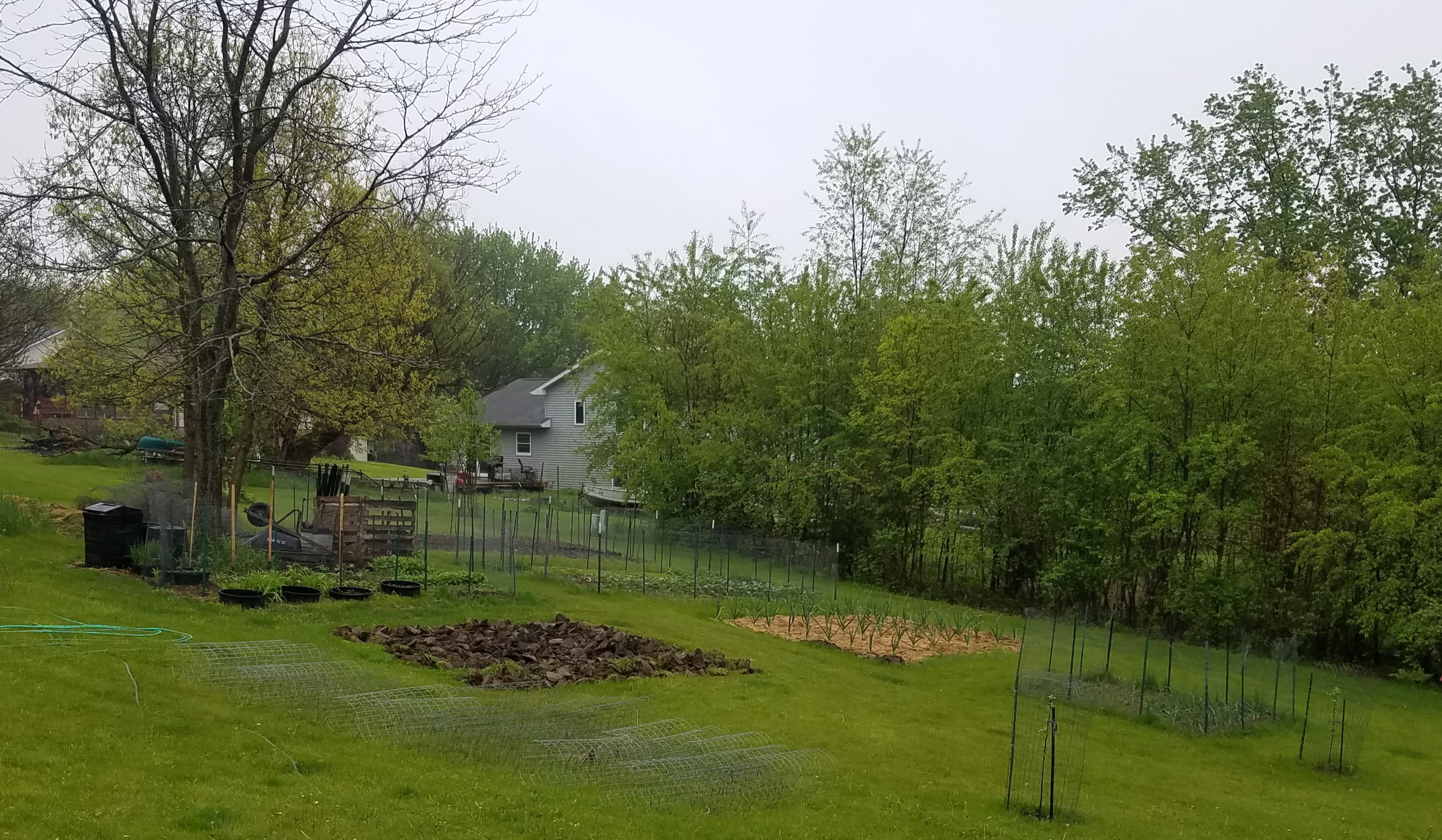
We harvest something daily from the garden. This morning it was spinach. With a spring share from the farm, I’m getting backed up on greens. It’s time to make vegetable broth for canning. I’ll carry six quarts over from last season and want 20 quarts on the shelf to make it through another year. Broth has become a pantry staple. I use it to cook rice, make a roux, and add flavor to soup.
In addition to making broth, today’s work will be preparing the main tomato bed for planting. That means to spade lanes in the plot, rototill the lanes, rake the surface smooth, lay garden cloth on the surface and put enough grass clippings on top to hold it down until the seedlings are in. I’m short of grass clippings for mulch but tomatoes are a high priority and will take the entire stockpile.
My creativity is at a low level and I’m not sure why. Partly it is the coronavirus pandemic, partly something else. Perhaps I’m simply enjoying this glorious spring weather — the part before insects begin foraging every living plant. Spring serves as fit distraction for what ails us. One can do a lot worse than spring.
The lilacs will soon be in full bloom. They don’t last long. What does?
Social distancing in the coronavirus pandemic has me well ahead in the garden, creating an in between time to consider life’s possibilities.
This week I plan to plant tomato and pepper seedlings and get everything I can into the ground. We are past the last frost, although with as chilly as it’s been, things aren’t growing well yet. There’s no hurry.
That said, there has been plenty of arugula, lettuce, spinach, spring garlic, pak choy, mustard greens and spring onions. What we don’t get in greens from our garden we get from the CSA spring share. I have big salads on the dinner menu three times this week and side dishes of stir fried greens every other day but Friday. When I was a younger gardener I didn’t understand the importance of greens to the enterprise. Now I do.
I’ve taken to hanging a U.S. flag over the garage door. The one I use flew over the U.S. Capitol. I paid $16 for it through our congressman. For a long while I flew the flag I took with us on field maneuvers in the Army. I flew that one from the radio antenna during non-tactical road marches. It got worn so I replaced it. Flags wear out. Everything does.
I’m down to my last face mask so Jacque has been getting input on what kind she should make for me. The one I have is a dust mask from the garage workshop. It fits snugly. It serves. The new one will have parts of an obsolete vacuum cleaner bag as the filter medium. While Americans have poor discipline in their behavior to prevent spread of COVID-19 (or lack of discipline, more likely), we’ll do our best not to catch it or transmit. The main thing is going out only when we need to. With the garden and plenty to do inside it shouldn’t be a problem. It’s better for us anyway.
Today’s challenge is figuring out what to do beyond getting through each day. I’d been dodging the idea of retirement and now that the pandemic flipped me to this new status I’m not sure what to do with the rest of my life. I’m not used to working without a clear plan. I need to make one and for that I need new priorities. It’s an in between time for now and those decisions will be delayed for another day.
For the time being, the allure of lilac scent beckons me outside.
When I was a grader, Mother would send me to the corner grocery store to secure provisions for the evening meal.
We had a corner grocery store. It was a block and a half away from home. There were no supermarkets within walking distance.
I don’t recall its name. A family owned it and the husband was the butcher. When it closed, run out of business by the multi-location Geifman Food Store that situated a block and a half away, they moved to the west end of town where the butcher was murdered in his store.
I was a paper boy for the Times-Democrat. The hyphenated name is from a 1964 merger into what eventually became part of Lee Enterprises and is now the Quad-City Times. I delivered the evening edition after school and the corner grocery was near the end of my route. At that time paper boys collected subscriptions directly from customers. When I finished weekly collections I’d stop at the store to buy a package of baseball cards or a candy bar. I remember a six-pack of 10 ounce bottles of Pepsi sold for 60 cents, the lesser known sodas bottled a few blocks away sold for 54 cents. Mother discouraged us from drinking soda.
The corner grocery store was an important part of our family life. Then it wasn’t.
Grandmother grew up on a farm and knew how to cook. She knew where food came from and how to prepare a live chicken. In our early years she lived near us, next door when I was a toddler, upstairs when I was in the first grade. After that she was a regular guest for Sunday dinners and special occasions like Easter when she checked in with her grandchildren and helped mom in the kitchen.
In the 1960s we began to eat more food prepared outside our home. Mom also began experimenting with different food preparations. We developed a taste for tacos and I recall the corner grocery didn’t carry some Mexican ingredients we liked, requiring me to walk to nearby Geifman’s. It was a sign of the end of the corner store.
In 1966 Joe Whitty moved to Davenport and ended up living with his young family in a rental the second house north from ours. It was across the street from a family that owned the dairy. He worked at the nearby hospital where I had been born, first as a baker, then as dietary director. He went on to establish a chain of pizza and ice cream stores. One of the ice cream stores ended up on the lot where the corner grocery store had been, although after I left Davenport.
On the other side of the church where I was baptized, about two blocks away from home and next to the Geifman Food Store, was a restaurant called Chicken Delight. They had a radio jingle, “Don’t cook tonight, call Chicken Delight.” The chain was founded in Illinois in 1952 and grew to have more than 1,000 locations. It was a take out and delivery only place and I don’t recall eating their chicken during the eleven years I lived at home there. Without the dining room we had little interest. If we had their product at home, I have no memory of it.
Chicken Delight was not known for its quality as each store followed their own cooking process, sometimes with their own equipment. That’s unlike the McDonald’s franchises which grew to prominence in the 1960s. McDonald’s prided itself on consistent quality in all their stores. They even had a “Hamburger University” near Chicago to train managers in how to operate with consistent results. Today there are not many Chicken Delight stores and most that remain are located in Canada. The women in our house knew how to make chicken and the family consensus was ours was better. Eventually one of the former neighbor’s pizza restaurants located in the Chicken Delight space.
That’s not to say we didn’t dine out in the 1960s, we did. We favored local, family run restaurants like Riefe’s Family Restaurant and Bell Eat Shop. Our parents knew both families. When McDonald’s built a restaurant on Brady Street we drove over there as a family once in a while. Their burgers and fries were different from Mother’s. They were cheap too. We ate in the car. We also drove to the A&W Root Beer stand where servers brought trays of food and drinks that hung on our car windows. The rise of automobile culture made home delivery pizza popular and inexpensive.
Grandmother would take us to Bishop’s Buffet on special occasions. We enjoyed being able to pick what we wanted from a generous selection of items like Mom and Grandmother made at home. In some ways it was a form of nostalgia. Grandmother insisted on paying the bill. These family events were important to her.
That’s the range of our 1960s dining experience outside home. A lot has changed since then. When Grandmother was born in the 19th Century people cooked most meals at home or took a dish to a potluck for weddings, funerals or other occasions where they ate what others had prepared. Prior to the current pandemic food prepared outside home comprised more than half of American diets according to the USDA. When the coronavirus recedes I expect there will be a rebound in restaurant eating.
It takes work to remember these things. Memories are not always accurate. What is important now may not have been important then. In the end, it is up to the author to research and present each story leaning on known facts. We must resist the temptation to tell a story only because the narrative flows or with ideological intent. It is hard to listen to one’s own voice and ignore what others may have experienced or have to say about something. We each own our memories even though there are shared experiences. We must be true to ourselves.
I’d like to be writing more pieces like this. I hope I will.
In an effort to move on to what’s next, here’s another post about the coronavirus pandemic.
Please bear with me. There is a “what’s next” although it will be different from what we would have expected a few months ago.
The threat of COVID-19 spreading into our household had me retire from the home, farm and auto supply store. It was inevitable I would do so soon. The pandemic flipped the switch. Now I’m done with outside-the-home work except for what I do in the local food system a few hours each week.
As I pointed out Thursday, we are in the pandemic for a couple of years or at least until a cure is in place. I believe there will be a cure in the form of a vaccine simply because there are so many bright minds and dollars being invested in this work. No one knows for certain how long it will take to develop and implement a cure, so if we’re smart, we will adopt a long-term perspective in order to keep our sanity.
For our household, with two retirees, resolution of the pandemic is to retire from society until there is a cure and life returns to some sense of “normal,” if that’s possible. While phone calls, social media, video conferences and the like will be an important means of communicating, it’s no substitute for every day activities to which we are accustomed. We yearn to return to those things and validate the Joni Mitchell lyrics from my college years, “Don’t it always seem to go that you don’t know what you’ve got ’til it’s gone.”
Returning to what was is not possible because the coronavirus is only the next in a series of pandemics expected as humans continue to exploit the natural environment and live in an increasingly connected society. To be resilient, our choices now have to prepare us for what I believe is that eventuality.
I don’t know what I would do if I were in my prime earning years like our daughter currently is. Our assumptions about what we are doing have to change. A simple truth is the life I wanted and thought I would have when I entered the post-college workforce was gone by the time I got there. What we’ve made for ourselves relies heavily on federal government programs of Medicare and Social Security. We are vulnerable to a major change in these programs, but so are a lot of people and I expect there will be sufficient political will to resist changes to the core programs of the pension and providing health care for the elderly.
For now, I’m working on projects: writing and gardening mostly. This in addition to checking in with key family and friends is a mainstay, one that will help me survive through the end of the coronavirus pandemic. If the future is uncertain, I am resolved to make it through. I appreciate readers sticking with me as I write to understand who I am and how we can adapt to the new world made for us in 2020.
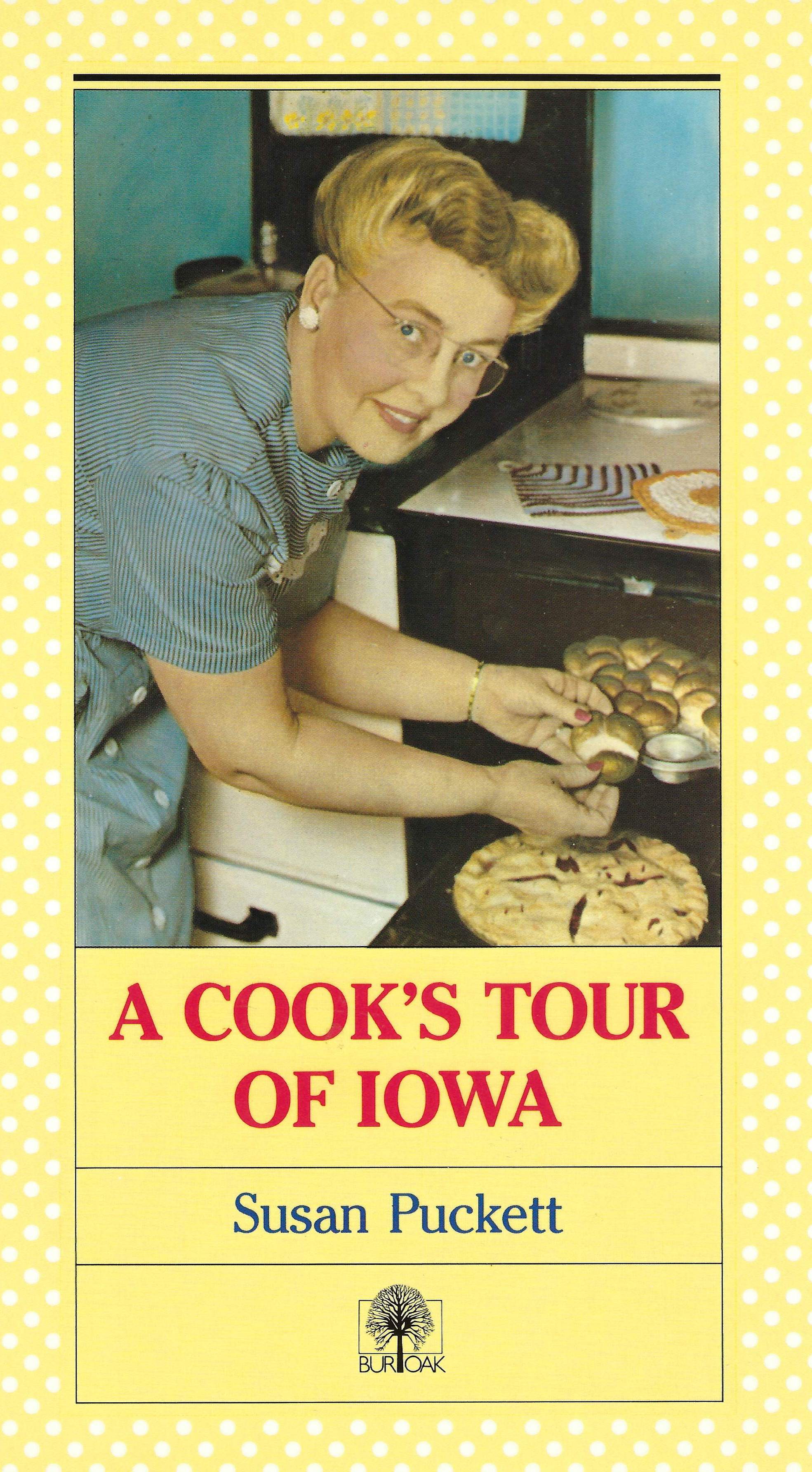
A Cook’s Tour of Iowa is a well-curated collection of culinary culture that represents a certain view of Iowa. It’s the picture Iowans can recognize. We also recognize many of the things mentioned as fading in cultural prominence.
As a resource for writing autobiography, the book conjures personal memories of Iowa things like the Grant Wood Art Festival, Maytag Blue Cheese, the African-American community in Buxton, Iowa, and many more. It is indispensable for that reason.
What is lacking is the diversity of what Iowa has become, even since 1988 when the first edition of A Cook’s Tour appeared. Our culture is also leaving behind things like VEISHA, Old Creamery Theater (no longer in Garrison, or Amana), and some of the festivals and events to which Puckett referred.
If we had an Iowa-themed dinner party, picnic or cookout, one might search the book’s contents for dishes to make for pure nostalgia. However, life in Iowa has become more than that.
I appreciate the work that went into A Cook’s Tour of Iowa. I may not open it often, but knowing it is there provides comfort as the food system changes along with the society that engendered it.
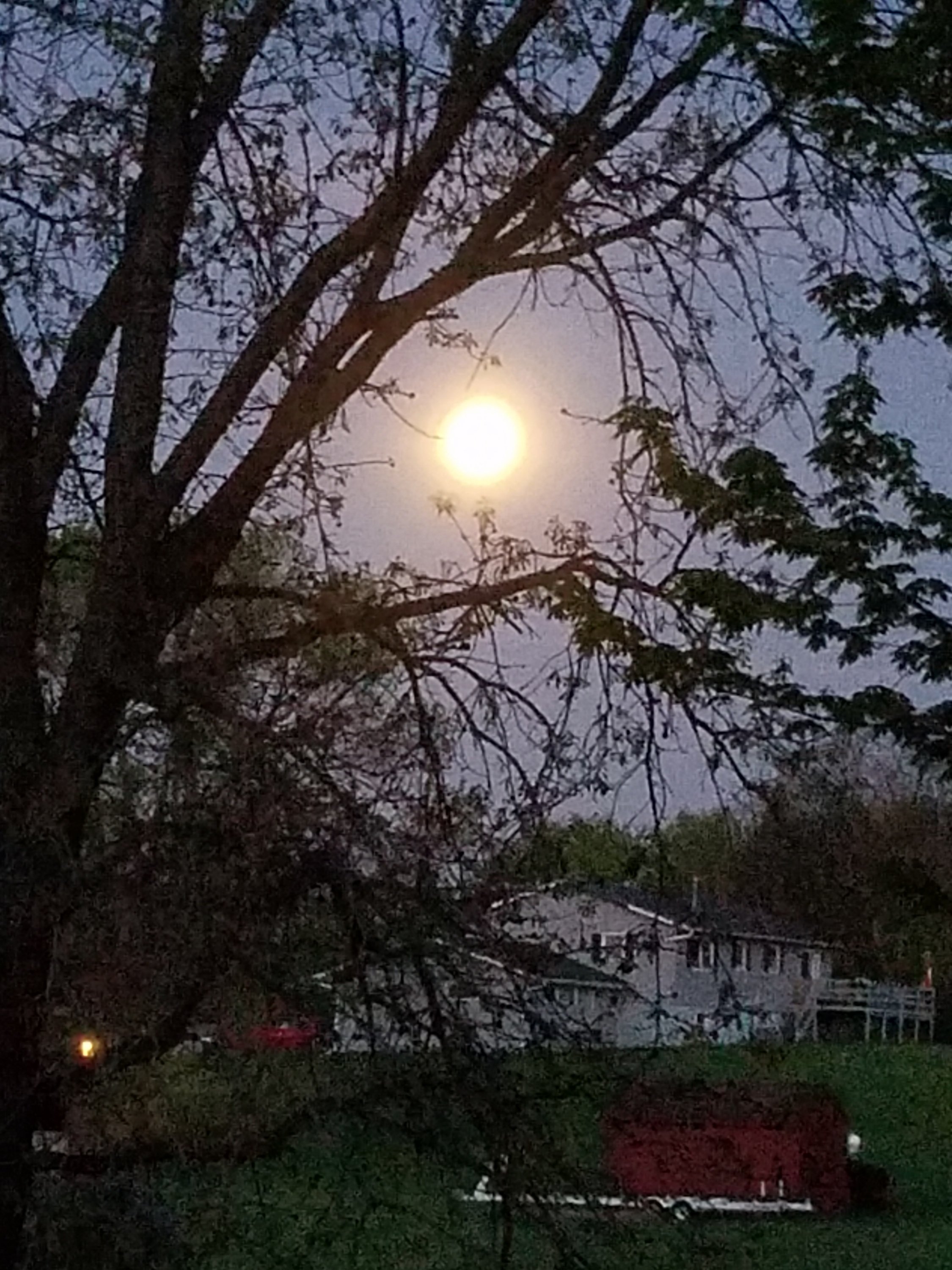
Supermoon viewed through the atmosphere, May 7, 2020.
I participated in a United Parcel Service webinar about challenges posed to supply chains by the coronavirus pandemic.
Rich Hutchinson of Boston Consulting Group presented an overview of our response to the pandemic that made plain, clear sense. He used three Fs — Flatten, Fight and Future — to frame his discussion.
We read and see a lot of information about the pandemic. In Iowa we fixate on daily reported number of cases and deaths. We need a break from that. The take away from Hutchinson’s analysis was as global corporations and mid to large size businesses use the pandemic to re-engineer their approach to supply chain and how they operate their businesses, regular people should be doing the same.
We understand what flattening the curve means, the first F. By reducing spread of COVID-19 we take the peak load off the bell curve of hospital bed usage and ventilator deployment so our health care system can handle the pandemic. In Iowa we began flattening the curve eight weeks ago with the governor’s March 9 proclamation of a disaster emergency due to COVID-19. Thus far the health care system has been able to handle the caseload. Hutchinson expected this phase of the pandemic to last several months with regional variations depending upon the extent of community spread of the disease.
Recent surveys show most people are not ready to end sheltering at home and restriction of business operations, although the president and the Iowa governor favor easing restrictions now. Governor Kim Reynolds issued new orders to ease restrictions yesterday. Whether we agree or disagree with elected officials’ approach, at some point people have to do more than shelter at home and shop on line or in limited trips to retail establishments that remain open. When the flatten the curve stage of the pandemic is over, COVID-19 will persist into the next phase. To cope with it, new approaches to what we previously took for granted about social interaction must be developed and adopted.
The second F, fight COVID-19, is not much discussed, but needs to be. Fighting the pandemic is expected to be book ended by an end to the first phase (i.e. the curve has been flattened) and development and implementation of either a cure or herd immunity. Policy implemented during the flatten the curve phase continues but will be relaxed. It could get ugly. Cases of COVID-19 continue to exist and spread during the fight phase, including additional significant outbreaks. The expectation is this phase will last another 12-24 months until there is a cure. This is the scariest part of the pandemic because as severe restrictions on business and social interaction are relaxed, identification of cases of COVID-19 and deaths are expected to continue in our daily reporting.
The most important phase is our future, the final F. I’m concerned about what the future will look like. My spouse retired last year and I retired last month because of risk of COVID-19 exposure. It seems likely my consumer behavior will change and be more limited than it was last year. With retirement this would happen without COVID-19. Society is not in a place where it makes sense for our political leaders to tell us “the economy is opening.” Nor would the advice President George W. Bush gave as we were coming out of the recession, “to go shopping,” make sense. I empathize with small business owners like cosmetologists, nail salon operators, and barbers who are itching to get back to work and generate operating income. At a minimum we need to deal with the pandemic for at least another couple of years and accommodate new behavior to protect us from the disease. How will businesses create needed changes in light of an extended pandemic? Our path forward is unclear at this writing.
If the question is whether workers will offer themselves as human sacrifice on the altar of late stage capitalism, Americans seem unlikely to do that. That’s not who we are. We expect more from our political leaders than they have given. The vacuum of leadership at the top — the president, the legislative branch of the federal government, and the Iowa governor — created a disconnect between corporations which can lobby government and people like me who lack such standing and may be forced to return to society beyond its digital aspects. My bottom line is no one is providing us with the type of information we need to make it to the new future us. That is as much a problem as the pandemic itself.
The first step in developing a future, post-pandemic life is recognizing our current location in the process. For a newly retired person it is easier to develop a future life than for those in their prime earning years. Our lives depended on so many beliefs and assumptions which have now been scrambled. If nothing else, Americans are a resilient people and we’ll figure it out together. Here’s hoping.
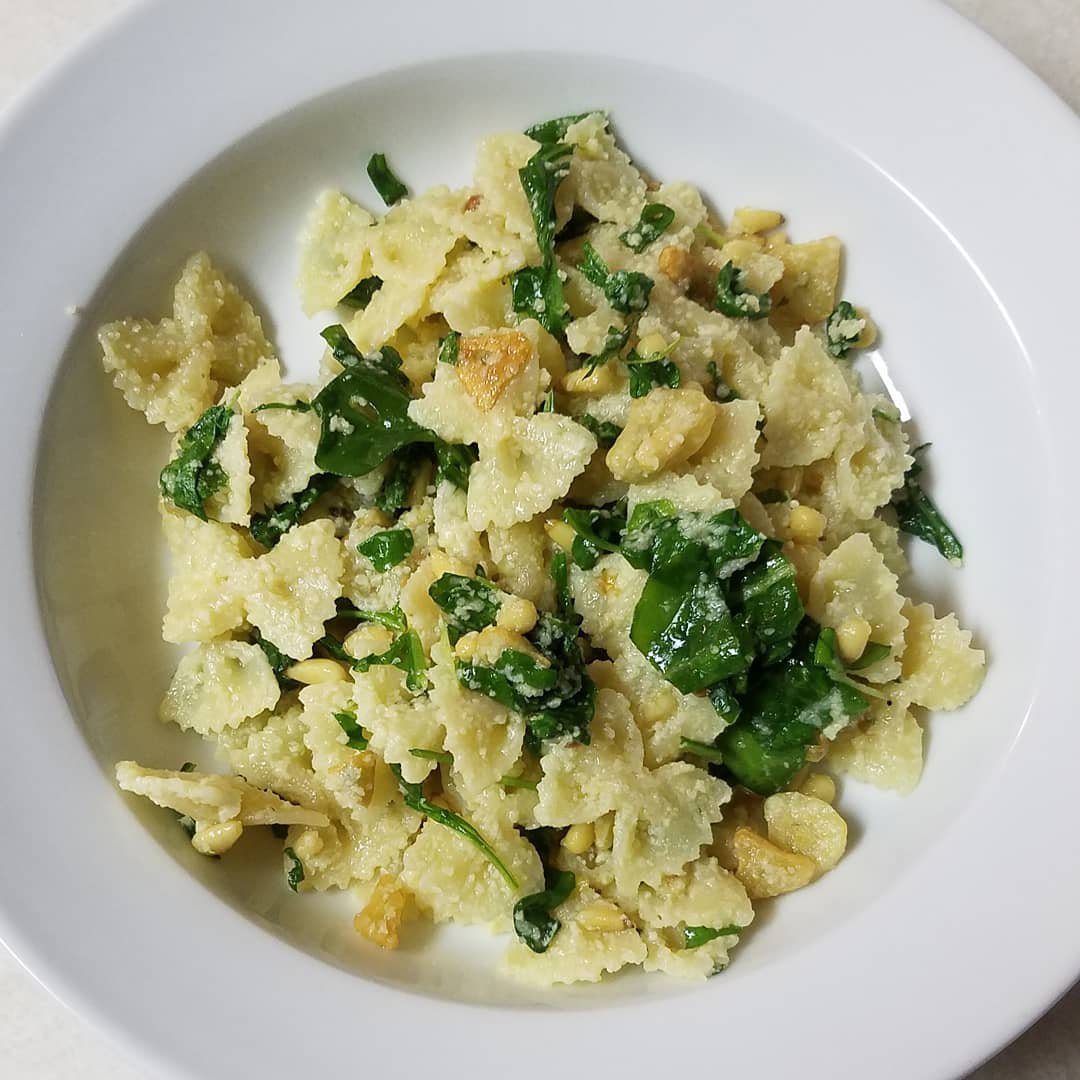
The arugula is top quality this year and I’m in a use it up mode. I spent more time preparing for this dish of bow tie pasta with garlic and arugula than usual. I researched recipes and thought a lot about it during the past two days. I used Parmesan cheese from a green can because of the coronavirus pandemic. It came out well but would be better with higher quality cheese. Here goes:
Ingredients:
Big bunch of arugula, half a pound, washed and roughly chopped
2 cups dried bow tie pasta
12-14 cloves of garlic
Quarter cup pine nuts
2 tablespoons extra virgin olive oil
2-3 tablespoons salted butter
1 cup grated hard cheese (Parmesan, Pecorino Romano)
Salt and pepper to taste
Process
Set a pan of water on the stove to boil for the pasta.
Peel and trim the garlic. Then slice finely (1/8 inch).
Once the water reaches a rolling boil, add the pasta and cook according to directions.
Once the pasta is down, bring the olive oil just to the smoke point. Add the garlic, stirring constantly. As the garlic begins to brown, add the pine nuts and cook for a couple of minutes.
Add the knob of butter and stir. Before the foam begins to subside, transfer everything to a mixing bowl. Drain the pasta and dump it in the bowl. Combine until they are incorporated.
Salt and pepper to taste.
Add the arugula and cheese and mix gently until the arugula wilts.




 Journey Home
You must be logged in to post a comment.