Categories
Kitchen Garden

Spring Garden Review – 2020 Planning

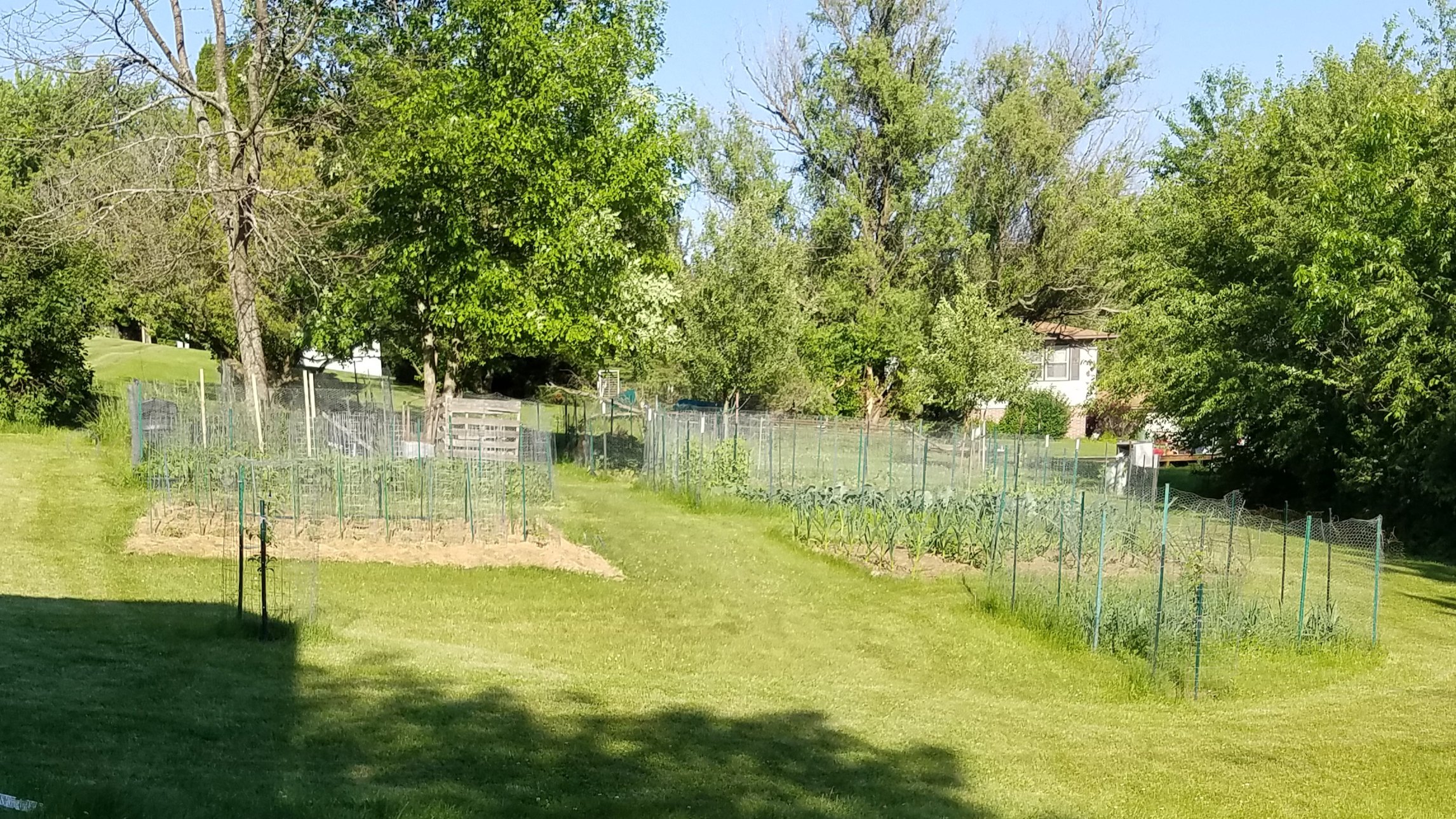
Garden on May 31, 2020.

We’re taking a break after spring planting.

At the farm the major crops for the CSA vegetable shares are in. We took time off from new seeding and begin fall crops next week. At home initial garden planting finished yesterday and a few sections have been replanted. Every available spot in our seven plots has been planted — the best space utilization since we moved here in 1993.

Time to consider some lessons learned. This post is about planning and I hope there will be others about technology, seed starting and other aspects of gardening in the near future.

With the exception of adding two apple trees near the west entry to the garden the layout remained the same as last year. Seven plots with three in specialty crops (tomatoes, onions and garlic) and four divided into rows with three-foot sections in each to separate varieties.

Since I began starting seedlings at the farm a few years ago I produce more than I need. This results in a tendency to use them, over-planting some leafy green vegetables which produced in abundance yielding restricted space availability for other crops. Family and friends can only eat so many leafy green vegetables.

I put in a lot of broccoli for freezing (33 plants), more kohlrabi than we will use, and varieties I don’t normally grow (mustard greens, two kinds of chard, okra, collards) because I got free seeds at the home, farm and auto supply store. I’m glad for the experience growing these varieties yet intend to harvest everything in one section of greens this week and replace it with more desirable tomatoes, many of which are mystery tomatoes from a wide variety of free packets from work. Even though the plan was to reduce the number of tomato plants because I canned a lot of them in 2019, I’m gravitating back to the number of plants I had because of the abundance of greens and tomato seedlings.

The main tomato patch is planned by variety (slicers and plums) although I got which is which mixed up when preparing the seedlings for transplant. There are also five plantings of cherries in another plot. Tomatoes make a great gift, so if they all produce, there will be no problem finding homes for them if the canning jars and freezer are full.

Each year I get a little smarter about deer deterrence. In addition to fencing everything with four foot chicken wire, I’ve used two tactics. I position plants deer like furthest away from the fence. This year I put the okra in the center of a plot so they can’t reach over the fence and eat the leaves. The high fence (five feet with an exposed section at the bottom) around the tomato patch also serves to keep them away from eating tender shoots and has improved production. I also use what I call gang planting. That is, I plant rows closer together so deer do not have a place to land if they jump the four foot fence. This year I spaced the rows more properly to enhance production. We’ll see how that goes. Since I began working on these issues, deer have been a minor inconvenience rather than a problem. I appreciate their help cleaning up fallen apples when there is fruit.

There are the questions of rabbits and small rodents. The main trouble with rabbits is when the new bunnies are born and they get into everything. Mature rabbits tend not to dig under the fences, partly because I don’t regularly mow the lawn or use any kind of spray or fertilizer. There is plenty for them to eat more readily available. The undisciplined litter of bunnies is unaware of these “rules.” Their reign of terror on the vegetable patch is short because predators reduce the population quickly. Thus far I live and let live with rabbits, although am skeptical that will be a long term condition of gardening. We keep a watchful eye on each other.

Planting potatoes in containers eliminated the problem of burrowing rodents eating into the tubers before I dug them. They continue to nibble at bulbous roots like beets, radishes and carrots in the rows. I’ve come to accept it as resolved through detente and just live with the damage. At such time there is not enough left for our family from their foraging my attitude could change. I rarely see the rodents although I am aware of their presence. They broke into the sealed compost container for kitchen waste.

The last planning issue is bigger, beginning with trees I situated in the garden that got away from me — the locust tree is dying, and the three oak trees planted the year our daughter graduated from high school (one for each of us) need to be thinned to one. The shade they provide has protected crops in the blistering sun of planetary warming and in times of drought. They became part of the overall garden design although that was adaptation rather then planning.

I have big ideas. One fall I’ll clear the plots early and take the locust down and cut two of the three oaks as they are planted too closely together and have grown too tall to transplant them. At the same time I may hire a landscaping firm to create a deer-proof enclosure and re-structure the plot layout to improve space utilization. That would enable me to get rid of a lot of the chicken wire. I’ll also build a shed to store garden tools so I don’t have to continuously wear a path (now visible from space) from the garden to the garage. These things have been delayed because of financial constraints. Soon we may be in a position to act on them.

Thirty seven years of gardening leads me to this formal reflection about what I’m doing. Next up will be technology which is making a big, positive impact in getting the plots planted and will hopefully improve yield.
Categories
Kitchen Garden Living in Society Social Commentary Writing

News, Retreat, Action

Home Garden May 30, 2020

When the news goes to hell, like it did on Friday, I retreat.

In an on line chat about poetry I wrote a follower, “Hope things are going better in Canada than they are here.”

“They are, very much so here in B.C.,” he responded. “I’m not a flag waver type but this present moment produces a real sense of refuge.”

On Friday moving to Canada was not out of the question.

To where did I retreat? I worked outdoors from 7 a.m. until 4 p.m. on Saturday. I harvested grass clippings for mulch, put in the seventh garden plot, and called initial garden planting done.

I picked kale and delivered it to one of the library workers. Our public library remains closed because of the coronavirus pandemic yet they continue to run limited operations behind locked doors. Next week they begin curb side materials pickup as they determine how best to reopen. The local newspaper featured a photograph of the librarian wearing a mask in from of the building. Our library is the most obvious local indicator of the progress of the pandemic and economic recovery.

Once again, a video shared in social media — the May 25 murder of George Floyd by a police officer in Minneapolis — sparked demonstrations and violence broke out in cities around the United States. Coverage dominated the news, eclipsing every other story, including the coronavirus pandemic which has now resulted in more than 100,000 U.S. deaths according to official statistics. It is a sign of the times I didn’t hear of Saturday’s demonstrations in the county seat, or in nearby Cedar Rapids until after working in the garden. There were no demonstrations where I live.

The thing about a retreat is it has a fixed beginning and end point, leaving us with the question what do we do next? It’s not complicated.

Above everything else, addressing the lack of leadership in our current government is a priority. That means voting the Republicans out of office in the 2020 and 2022 election cycles. It is difficult to see how any substantial change will be possible, in any area of society, until that is done. I’d much rather be writing about the climate crisis, income inequality, and social justice. For that to have meaning, we need leadership to set different priorities and move the country toward solutions. We can point out solutions to the climate crisis and income inequality, and that black lives matter all we want. To make a difference, our only hope is to change our government.

My last paycheck from a job was in April after retiring from the home, farm and auto supply store. Our expenses came down dramatically during the pandemic so there was money left from our pensions to pay down debt and donate to political campaigns. We’ll be doing more of that. Better than that will be to develop a positive message about who we are as Iowans and as Americans and to share that broadly. Living with a demagogue as president has been frustrating. We have to believe our best days are ahead of us and take action to work toward that end.

Categories
Kitchen Garden

Rhubarb Crisp

Rhubarb Crisp

Someone asked for the recipe when I posted this photo in social media. I was taken aback.

There was no recipe, I just made it out of the rhubarb and my experience. In a kitchen garden we don’t open a lot of cookbooks.

Ingredients arrive from multiple sources and we consider them, make dishes and meals, using what is available in the ice box, garden, pantry, and our imagination. Experience comes into play. It is a way to source food, cook and eat that isn’t emphasized as much as its value warrants.

Living with a kitchen garden is as good a way to produce meals as I know. It takes some experience but rather than ask, “what is the recipe?” an alternative is “How would this product be made palatable, nutritious and tasty?”

Here’s how I responded to the question:

I saved and diced all the rhubarb that was in my CSA share. It filled this dish. In a mixing bowl I put the rhubarb, one scant cup of granulated sugar, a tablespoon of ground cinnamon, sprinklings of ground cloves and ground allspice, a pinch of salt and two tablespoons of all purpose flour and mixed until incorporated. I returned the mixture to the clean baking dish and sprinkled about one to two tablespoons of water on top. (If I was making apple crisp I would use lemon juice here. Rhubarb is already plenty tart).

For the topping, just use any that you like. This one has a stick of chilled, cubed salted butter, a cup of rolled oats, two thirds cup packed brown sugar and a pinch of salt. I use a pastry cutter to blend everything together, leaving it in chunks. Sprinkle the topping evenly and baked 35 minutes in a 375 degree oven.

That’s a recipe of sorts. If a person eats ice cream, a scoop on the side of a warm, just out of the oven serving of rhubarb crisp would be divine. Or as close to that as we humans can get.

Categories
Living in Society Social Commentary Writing

A Death During the Pandemic

Sunrise May 27, 2020

No one wants to die early of COVID-19. This morning Johns Hopkins University reported there have been 1.7 million diagnoses of the disease in the United States and more than 100,000 people died because of it in less than four months.

May the souls of the departed rest in peace. May their families and friends find comfort as we go on with our lives.

I participate in TestIowa, the State of Iowa’s on line COVID-19 testing program. On Monday I was approved for testing and made an appointment at a drive-through test site 11 miles from home. Yesterday I arrived early for my appointment and there was no waiting. The site was well organized with lots of staff, including a half dozen uniformed Iowa National Guard soldiers directing traffic and maintaining security. The site could handle lot more tests than they were. The deep nasal swab used to take a culture was uncomfortable yet tolerable. The results should be posted to my on line portal by Saturday. This post is not about me.

I’m thinking about George Floyd who died after a Minneapolis policeman knelt on his neck while he was being arrested. In a time of ubiquitous cameras and recorders the incident was captured on video multiple times and posted on the internet. It rightly provoked outrage. Four police officers were fired after Floyd’s death yet that shouldn’t be the end of it. Why weren’t they arrested? We know the answer. There was no justice for George Floyd. He did not deserve to die.

While passing the milestone of 100,000 deaths from the coronavirus garnered attention yesterday we cannot forget the systemic racism that permeates our culture. Americans are not free unless all of us are free. The death of another black man in the hands of police is evidence we are bound to racism that shows itself only rarely. Its roots run much deeper.

How do we address that? I don’t know but unless we recognize racism for what it is in our lives there will be no addressing it. We have to do more than react when another black man dies. That death tally is not being closely followed yet it is as important and more enduring than the coronavirus.

May George Floyd rest in peace.

Categories
Home Life

Summer Will Not Be Repressed

Social Distancing Pick Up at the CSA

Shopping in person is my least favorite thing in the third month of the coronavirus pandemic.

I dislike losing control and exposing myself to maladies real and imagined. Since the pandemic is real, personal shopping activities are reduced to a minimum. That bodes ill for the economic recovery. Our household will be just fine with less shopping.

Some stores require customers wear a mask and others don’t. I have two clean, homemade masks in the car with me and wear them into retail establishments. Most retailers have taken action to protect their workers, but customers? “The customer is always right” has taken on new meaning.

In our neighborhood things are loosening up. We live next to a large lake. Foot traffic to the boat docks and trail was heavy over the long weekend as families made their way to get out of the house. A couple of residents are planning yard sales in early June. Rest assured there will be no social distancing in those driveways and garages. One neighbor plans to walk the streets to distribute popsicles in celebration of a child’s birthday. Don’t get me started on the ice cream truck that plays an annoying version of Scott Joplin’s The Entertainer while hawking wares. At least the parcel delivery drivers wear masks, if the USPS contractor does not.

The small town convenience store is a barometer of what’s going on in the community. I had to get gasoline to finish mowing so I stopped at one on the way to the CSA to pick up our weekly share. I paid at the pump. Tension rested over everything as I stood fueling. They were busy yet activity seemed subdued compared to previous holiday weekends. No one was wearing protective equipment. I used only my right hand to touch anything. When I got back in the car I cleaned up with a sanitizing wipe kept for that purpose.

I didn’t go inside to play the lottery, which I normally like to do. Last time retail clerks wore masks and gloves, although they hadn’t put up a plexiglass barrier like other convenience stores. That was several weeks ago and they may have changed. Money is dirty whether there is a pandemic or not.

We are out of milk. That’s the sign it’s time to make a shopping trip. Dread it though I do, I’ll venture out. I have a list so I can spend the least possible time inside the store. There won’t be any impulse purchases today and that’s bad for the economic recovery as well.

Being an American is a mixed bag. We have some of the smartest people on the planet working on big issues, but everyday folk could care less. Part of the problem is a lack of political leadership. Part of it is tied to a progressive deterioration of learning. Everything gets politicized and in practice facts have been cut loose from their mooring. We are on our own to study and make a determination of what to do with our lives. Some call that “freedom.” I call it re-inventing the wheel.

If the past weekend taught anything it is summer will not be repressed. People have priorities and one of them is re-enacting trusted and valued behaviors. In the age of the coronavirus people will have their summer. I believe most of us will survive. What do I know?

Categories
Living in Society Social Commentary Writing

Poetry for a Life

Service Flags

Best wishes on Memorial Day from this veteran who made it home. As Mary Chapin Carpenter says on her series of songs from home, “Stay well, be peaceful, be mighty.”

I’ve written what I will about Memorial Day. Some of those words can be read here, here and here. I’ve soured on the American celebration of the spring holiday yet one thing I’ve learned is the death of our soldiers in combat is no abstraction. May they rest in peace.

Iowa is one of 24 U.S. states with uncontrolled coronavirus spread. That alone is reason to stay home, read, write, cook, clean and weed the garden. At some point we’ll get caught up with those homebody tasks and venture out of this pandemic pattern, but not yet.

For vegetable gardeners Memorial Day marks the end of spring planting. At the farm we are taking next week off from starting new seeds. The following week we’ll start the fall crop. In between rain showers I hope to get the cucumbers in — the last of my vegetable plots — and weed, weed, weed.

During a rainstorm I reviewed the books on the Reading List tab of this blog. I’m not reading enough poetry as poems comprise only 7.1 percent of listed books.

7.1 percent! I can’t get over that. I want to do better so I asked twitter: “I want to read more poetry. Which author would you recommend?”

The recommendations were pretty good.

When I received a payroll bonus from my part time job in high school I went downtown and bought two books of poetry at the M.L. Parker Department Store: The Complete Poems of Robert Frost and Carl Sandburg’s Complete Poems. I didn’t really understand poetry and still have my failings, but it felt important to mark the beginning of my nascent home library with something other than young adult books.

Over the years I’ve developed other favorite poets. Of those well-known, my favorites are William Carlos Williams and Vachel Lindsay. I also favor Charles Bukowski, Wisława Szymborska, Lucia Perillo, Adrienne Rich, Gary Snyder. Lawrence Ferlinghetti and Seamus Heaney. Of the classics I enjoy Geoffrey Chaucer and William Shakespeare but could never get myself to read Edmund Spenser’s The Faerie Queen, although feeling like I should have.

In response to my Twitter query our daughter recommended atticus so I signed up for the newsletter and followed him on Twitter. I’ll be looking for an opportunity to read The Truth about Magic: Poems.

Recommended by a follower in the UNESCO City of Literature are Amy Woolard and Jeremy Paden. Their books Neck of the Woods (Woolard) and Broken Tulips (Paden) are available so I’ll start with them when I can get my hands on a copy.

Another I’d not read is Mary Oliver, recommended by an Iowa farmer. I studied Oliver in response to the tweet and will obtain a copy of American Primitive for which she won the Pulitzer Prize. It is curious Oliver worked at the Edna St. Vincent Millay home for Millay’s sister. Millay was another recommended poet whose Collected Poems was already on my shelf. I’m building a pile of poetry on the dresser in the bedroom.

Emily Dickinson and Ted Hughes were recommended by a follower and fellow gardener in Canada. I pulled down copies of Poetry Is and Crow by Hughes and The Complete Poems of Emily Dickinson, edited by Thomas H. Johnson. Punctuation editing is an issue with works by Dickinson as we know. Hopefully Johnson’s edition will serve.

A local friend who lives part of the year in Italy recommended W.S. Merwin’s Garden Time. I will locate a copy and start reading Writings to an Unfinished Accompaniment which was already on my shelves.

Richard Eberhart of Austin, Minn. was recommended by another Midwesterner. On my shelves, rescued from a Goodwill Store in 1994, was a copy of the New Directions Paperbook edition of Selected Poems 1930-1965, which I am reading now. The iconography of these poems is very familiar.

If Memorial Day is the unofficial beginning of summer, 2020 will be the summer of poetry in a pandemic.

Categories
Kitchen Garden

Warm Weather Vegetable Planting

Mustard greens – walnut pesto with a flat loaf of freshly baked bread.

On Friday I planted the rest of the tomatoes and the sweet, bell peppers. I’m running out of room for hot peppers so I harvested mustard greens and made pesto with ingredients from the pantry. I’ll use that space for a variety of hot peppers.

I have more seedlings than will fit in my seven garden plots so choices must be made. The last plot will be cucumbers with room for whatever else will fill the space, likely the single zucchini plant that germinated, and more hot peppers and tomatoes.

Succession planting is important to space management but the ice box is filled with leafy green vegetables and a family can only eat so many per day.

Rain is forecast in the next hour. As soon as the sun rises I want to harvest turnip greens to make the last of the vegetable broth for canning.

I’m trying to get better at growing bell peppers. Here’s a passage from the Jan. 18 barter proposal to my farmer friend Carmen:

We talked about mentoring on how to grow bell peppers. The idea we discussed was me spending some individual time with you discussing seed variety, irrigation systems, weeding, fertilizing, pest control and other issues, then helping you grow this year’s crop. While this means more labor on my part, I consider that part of the learning process for which I’d be bartering, not an added expense to you. As the crop comes in I would want a fair share for fresh eating and freezing as long as the harvest continues, some prime quality and seconds depending on what’s available. What is the value of that learning experience? I don’t know but I’m willing to settle the remaining accrued value for it, making us even.

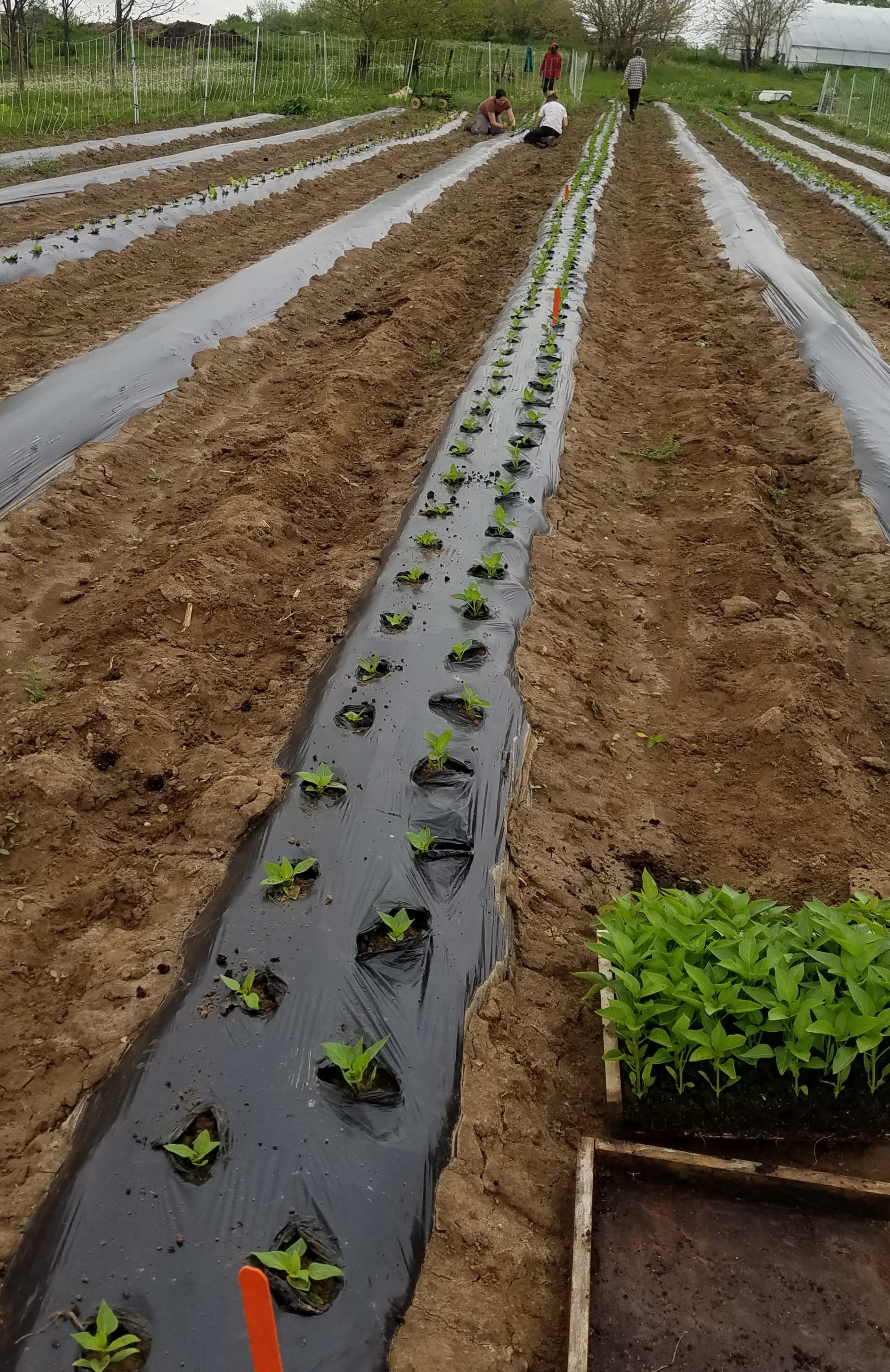
Thursday I spent a couple of hours at the farm planting peppers. Below are comparison photos of the farm’s peppers and the row I put in my garden yesterday.

Pepper row at Local Harvest CSA
Pepper row in my garden.

At the farm they have a mechanical device to lay plastic for the rows. It creates a berm of soil in the middle of each sheet into which seedlings are planted. There is drip tape irrigation under the plastic. In my garden I manually made the berm with a hoe and garden rake, then covered it with a 48-inch layer of landscaping fabric. I placed grass clippings on each side. I have no drip tape and therefore need to make sure peppers are adequately watered.

The seedlings I used were a combination of ones I started and the main crop peppers at the farm. I also put in six plants of Guajillo chili peppers and two each of Serrano and Jalapeno. Fingers crossed I produce some peppers out of this.

A lot of weeding remains to be done. Also remaining is the related grass clipping collection for mulch. For that to happen I need a solid block of weather without rain. Doesn’t look like that will happen today.

Categories
Kitchen Garden

First Kale

Red Russian Kale

I picked the first bunch of Red Russian kale and gave it to folks at the public library.

Despite the coronavirus, life goes on.

I spent a couple of hours at the farm learning how to grow bell peppers. Growing hot peppers has not been an issue. A generous supply of garden-grown sweet bell peppers has eluded me. By taking time to learn the process with more experienced hands I hope the harvest will be better this year. Fingers crossed.

Writers block hasn’t been a thing for me, but maybe it now is. Everything feels in between. In the third month of the pandemic I’m looking for new goals, new projects on which to work. I look at the calendar and realize the limited time left this year. Here’s hoping I find worthy projects pronto.

Categories
Work Life Writing

Writing About Work

Story Board

I began writing in grade school. The earliest remaining written document is a letter to my parents from YMCA Camp.

I reported having fun.

When reading those handwritten words, forgotten memories emerged. They reside in my brain like fossilized footprints from yesterday’s muddy garden. Such memories mean something. I can say with some certainty camp was fun.

When writing about worklife I seek several things. Partly I want to understand my own work history. It is more than a small chore to write a timeline of a life’s main events. Seeking that will aid telling my story.

More than a timeline I seek to understand why I worked and how it affected me. When I took my first job as a newspaper carrier the work was possible, something boys my age just did. I took a job in high school at a retail store called Turn-Style which was an entry into after school work life. It was possible and common among my classmates to have an after school job. Both of these early jobs funded activities that would have been less likely if I didn’t have income. The most significant activity Turn-Style funded was buying a used car and fuel to keep it going.

During the summer of 1971 I returned home from college. Like most of my male high school classmates I was able to find a summer job in industrial and manufacturing plants in the Quad-Cities. I landed at Oscar Mayer’s slaughterhouse working on the maintenance crew. It was dirty and hard work but in three months I made enough (at $4.04 per hour) to pay the sophomore year college expenses my scholarship didn’t cover. I learned how to clean a lard rendering tank among other valued skills.

After college the employment situation in Davenport seemed dire. Globalization was beginning to take hold, with some jobs moving to Mexico or overseas. It impacted the community with layoffs and those easy to find manufacturing jobs were less easy to secure three years later. I also did not want to get caught up in being a “shoppie,” working a career in manufacturing.

I didn’t have high expectations but after working a couple of low-wage jobs to make ends meet I enlisted in the U.S. Army and was gone for four years. Because of the G.I. Bill, I attended graduate school and got my M.A. in 13 months without other paid work. There were no good or exciting job options in 1981 after graduation so I applied and went to work at the University of Iowa.

After meeting my future spouse at the university, and getting married in 1982, I took a job in transportation and logistics with CRST Inc. in March 1984. I spent more than 25 years doing that type of work. I earned enough money so Jacque could work at home until she was ready to enter the paid workforce again.

Beginning in July 2009, I retired from CRST Logistics with a sheet cake and going-away gifts to enter a period of low wage work. In all I logged 24 different jobs and work activities since then — some paid and some volunteer. There was a lot of diverse experience in all that, about which I’ve written in this blog. What I’m left with today is being a blogger, writer, gardener and human.

While frequent blog posts are an important part of my writing, there is more. The coronavirus pandemic has been an opportunity to consider my writing and develop other projects including a memoir. I’m not finished working yet the number of paid jobs is close to zero as we enter the third month of the pandemic. It provides a perspective that might not have been otherwise possible.

As the sun rises on a forecast dry day I plan to work in the garden planting tomatoes, peppers and cucumbers. While I do, I will consider what’s next for me and the meaning of my years in the workplace. The pandemic isolation brings this into focus.

I hope what I write next is as meaningful as that letter to my parents written so many years ago. If it isn’t, at least we’ll have vegetables.

Categories
Work Life Writing

A 1960s Newspaper Boy

M.L. Parker Department Store

My first job in grade school was as a paper boy for the Des Moines Register.

I wanted a paper route. It was what boys my age did. After discussing it with Mother, she arranged the job by calling newspaper circulation desks. The Register route was available.

It was a long, morning route because the Register wasn’t as widely circulated as our home town newspaper, the Times-Democrat. I could ride my bicycle and get the papers delivered with plenty of time to get ready for school.

Before long, I changed to an afternoon Times-Democrat route located on Marquette Street between West Central Park and Locust Street. The Times-Democrat had morning and evening editions at the time. Less walking, more deliveries, and more money for me. I kept the route until high school when I was told it was time paper boys moved on to other things. Having a little money, maybe a couple of bucks a week, made a difference in my life and in the range of activities possible in grade school.

I made weekly collections from subscribers on Fridays. Some subscribers were the worst. They were never home on Friday and when I finally found them on other days they would deny they owed for multiple weeks. My collection pages had a coupon that indicated each week that was due so I knew where each account stood. I gave customers the coupon for a week after they paid. When they got four weeks behind and didn’t pay I called the newspaper to cut them off. My supervisor never wanted to do it because the newspaper had subscription targets. Statistically, the majority of my customers were nice and paid on time. However I do remember the deadbeats. In retrospect, my margins sucked but there was enough money to satisfy my nascent financial needs.

On Saturdays I paid my bill for the bundles of papers dropped on the corner of Marquette and Lombard Streets. I took a city bus from nearby Mercy Hospital to what was then a thriving downtown Davenport. I spent parts of every Saturday morning downtown, beginning at the newspaper office on East Third Street.

One of my favorite downtown places was the automat at the M.L. Parker Department Store where I occasionally bought a pre-made hamburger and warmed it under an infrared light bulb. We didn’t have such a heating device at home. I stopped at W.T. Grant, F.W. Woolworth and occasionally went to Petersen Harned Von Maur, inconveniently located across a busy Second Street. I also stopped at Louis Hanssen Hardware Store where they had a centralized cashier operation connected to the sales floor by a small trolley system.  There was a coin shop which was almost never open as early as I was downtown. The idea coins that passed through my hands on the paper route were worth more than face value was fascinating.

In 1964 a friend and I rode the bus downtown. After paying my bill we went to the local Democratic party office and stuffed envelopes for Lyndon Johnson’s presidential campaign. Our motivation was to trade labor for an LBJ for the USA button. After finishing with the Democrats we walked a couple of doors down to the Republican party office and did the same thing for a Goldwater button. The idea our families would vote Goldwater for president was ridiculous. Father had worked hard to organize for JFK and was doing the same for LBJ. It felt weird being in the Republican campaign office but I brought home a button which had “Au H2O” printed on it anyway.

My male schoolmates were also shoplifters at the downtown department stores. Having a steady income from my paper route, I never shoplifted. From time to time I met up with my mates at one of the movie theaters for a matinee. They compared the results of their thievery that morning. For a while they stole bottles of men’s cologne which they tried to sell me. What would I do with cologne? Retail managers wised up to what was going on and secured the products in display cases. That apparently ended such thievery.

My interest in meeting my friends was to see movies at a reduced price of 35 cents. Most of what we saw was related to World War II: The Longest Day, The Great Escape, The Bridge on the River Kwai, and others.  When the cost of a matinee went up to 50 cents, I felt we were being gouged.

One time we saw an ad for a movie in Rock Island about the Batman. Someone had compiled all 15 episodes of a Batman serial made in 1943 by Columbia Pictures. The Batman television show became a popular topic on the school playground, so we wanted to see the serials. We took the bus downtown and walked across the Centennial Bridge for the matinee. I told Mom what we were doing so she wouldn’t be surprised when I was gone for so long. I remember it was a very long walk across the Mississippi River although worth it because I now knew something others didn’t about the Batman.

In the mid-1960s working as a newspaper carrier expanded my horizons. I got to see how my customers lived and had a chance to explore a world outside the confines of our neighborhood. I found there was a broader world where everyone did not share the same values we did at home.

I felt the relationship with my manager was good, although my daily work was disconnected from him. I was always the last to know about sales promotions and newspaper policy that pertained to me. It led to an attitude that I would do my job as I saw best without worries about my supervisor or whether I was right or wrong in what I did. That proved to be a defining aspect of my character at the beginning of my work life. Being able to work on my own without regular, direct supervision became part of who I was and remained so for the duration of my work life.

My first work experience was positive and that made a difference as I progressed through life. Adapting to work in a positive manner was an important part of the working class home in which I came up. It prepared me for the challenges of a career yet to come.