Categories
Living in Society Social Commentary

Adapting to the Coronavirus

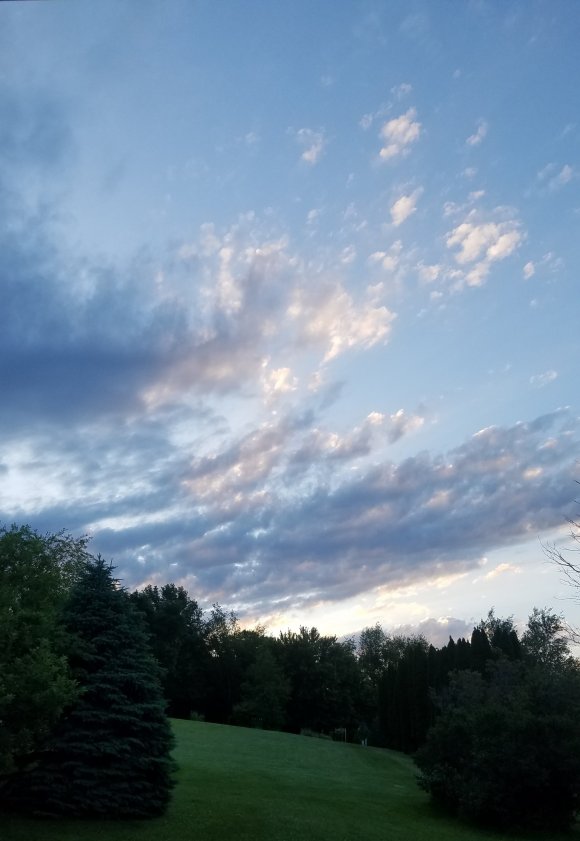
Sunrise June 13, 2020.

There have been 7.3 million confirmed cases of the coronavirus worldwide according to this morning’s Washington Post. The virus has killed more than 410,000 of which 112,978 deaths occurred in the U.S. since Feb. 29.

Mitigation of the coronavirus is not going well here. Poorer countries have done much better handling the crisis. Absent leadership, incompetence, and a deliberate decision to treat COVID-19 like influenza for weeks in February and March, combined with a just ‘let it go’ attitude have taken their toll according to one public health official.

On Thursday the Dow Jones Industrial Average plunged 1,861 points when witless traders found out there wouldn’t be a quick recovery from the pandemic. How did they get the notion the recovery would be quick? Praise the Lord I got out of the market when I did.

In any case, the administration has thrown in the towel on their so-called fight against the pandemic and is moving on to the campaign trail. They are having rally attendees sign a liability waiver in the event there is COVID-19 spread at them. Their work has been about re-election since the day after the inaugural address and little else. In the Republican political playbook what’s another 100,000 COVID-19 deaths? F*ck it! Four more years.

Where does that leave bloggers, writers, gardeners and humans like me? We have to adapt to the coronavirus pandemic. Part of the adaptation was forced upon us.

Retiring from retail work on April 28 was an easy calculation. At age 68, with some health conditions and a reasonable pension structure which included Social Security and Medicare, I decided to do without the additional income and potential exposure to the virus. I won’t be going back to the orchard to work in the retail barn this fall either.

For the first time ever my medical practitioner prescribed a medication which I now have to take daily to reduce cholesterol. I asked him what circumstances may result in ending the medication. He said maybe toward the end of life. While it’s not unusual for Americans to be on medication, and I’ve been lucky to avoid it this long, my health and welfare needs more consideration.

Finally, a lot of people remain unemployed and some jobs closed by the pandemic have not re-opened. Many won’t reopen at all or will emerge vastly changed. In any case, other people need the work more than I do. If I generate income it won’t be working as a wage worker for someone else.

What are the possibilities?

Our household spending plummeted since leaving work. The retained value of our balance sheet increased by 3.25 percent since the pandemic began in Iowa. Our personal debt decreased by 50 percent in the same period. We have a possibility of paying off our debt by the end of the year, opening up spending on large projects in 2021. There is a long list of backlogged projects.

I’m already reading more books, 23 since the pandemic began. I don’t know if it’s possible to “catch up on reading,” but many books wait in my queue and I might actually get to a lot of them. This is a positive alternative to spending more time on social media.

The schedule of work outside home is minimal and that enables a focus on home life. Part of that is taking care of health, and part is going through and getting rid of unneeded possessions in preparation for refurbishing our living space. More attention can be paid to the kitchen garden so our diet can improve, providing better nutrition. All this is welcome and showing marked improvement since the pandemic began in Iowa.

How I might re-enter society, being among people I know, doing things together, is missing from adaptation. With continued spread of COVID-19 I won’t join others at events unless I know their social distancing practices. That seems like a lot to ask friends and neighbors just to spend time with them. Zoom meetings aren’t really a replacement for someone who has been very social for as long like I have been. Likewise, with more people at home on the internet our connection isn’t adequate for an uninterrupted Zoom event. How all this gets resolved remains an open question.

Until there is a vaccine with widespread distribution, or some acknowledgement by public health officials the pandemic is over, I don’t see how adaptation can resemble the past. There will be gatherings but for now I ask myself why risk it? That’s going to continue for some time.

Being at retirement age has made adaptation easier. Maybe the best adaptation, the most socially responsible one, is to just fade away into my family, my bloggery, my writing, and my kitchen garden. There are worse fates than that. Eventually an opportunity to re-enter society will present itself but not yet.

Categories
Living in Society

Theresa Greenfield Wants A Real Conversation With Iowans

Theresa Greenfield

What conversation does Joni Ernst want to have with Iowans about the fall election for United States Senate?

If a recent advertisement by the National Republican Senatorial Committee is an indication, she doesn’t want any conversation with Iowans. She’s letting third party interest groups do her dirty work hoping to ride the coat tails of Donald Trump to a second term.

The ad depicts Theresa Greenfield’s work as the president of a home building company in an unfavorable light. When I interviewed Greenfield about this work on Feb. 22 here’s what she said:

“I went into home building and eventually became the president of a small home building company in Iowa. That was fun through the recession, until it wasn’t any more fun. We sold the assets at the end of 2011.”

I included it in the profile as part of Greenfield’s work history. Senator Ernst and the NRSC are grasping at straws to make something of this work experience.

The company was Twin Cities-based Ruttlund Homes which went into receivership in 2011. Greenfield was president of the Iowa division when a global recession reduced property values and banks stopped lending. Thousands of home builders went out of business. Did Greenfield get caught up in the massive recession? Yes. Has she been honest about it? Also yes.

Part of being a successful businessperson is having experiences such as this one. How one learns and reacts to business challenges is the mettle of which character is made. While losing her business and source of income was disappointing, Greenfield’s resiliency enabled her to be successful in a commercial real estate company where she eventually became president.

The conversation Theresa Greenfield wants to have with Iowans is about resiliency, optimism, and the jobs we need to get done after the disastrous years Ernst served in the U.S. Senate. She wants to represent every Iowan.

If Ernst chooses to go negative, that’s her liability. Voters will hopefully see through the noise and vote for Greenfield.

~ Written for Blog for Iowa

Categories
Living in Society Social Commentary Writing

Being Racist

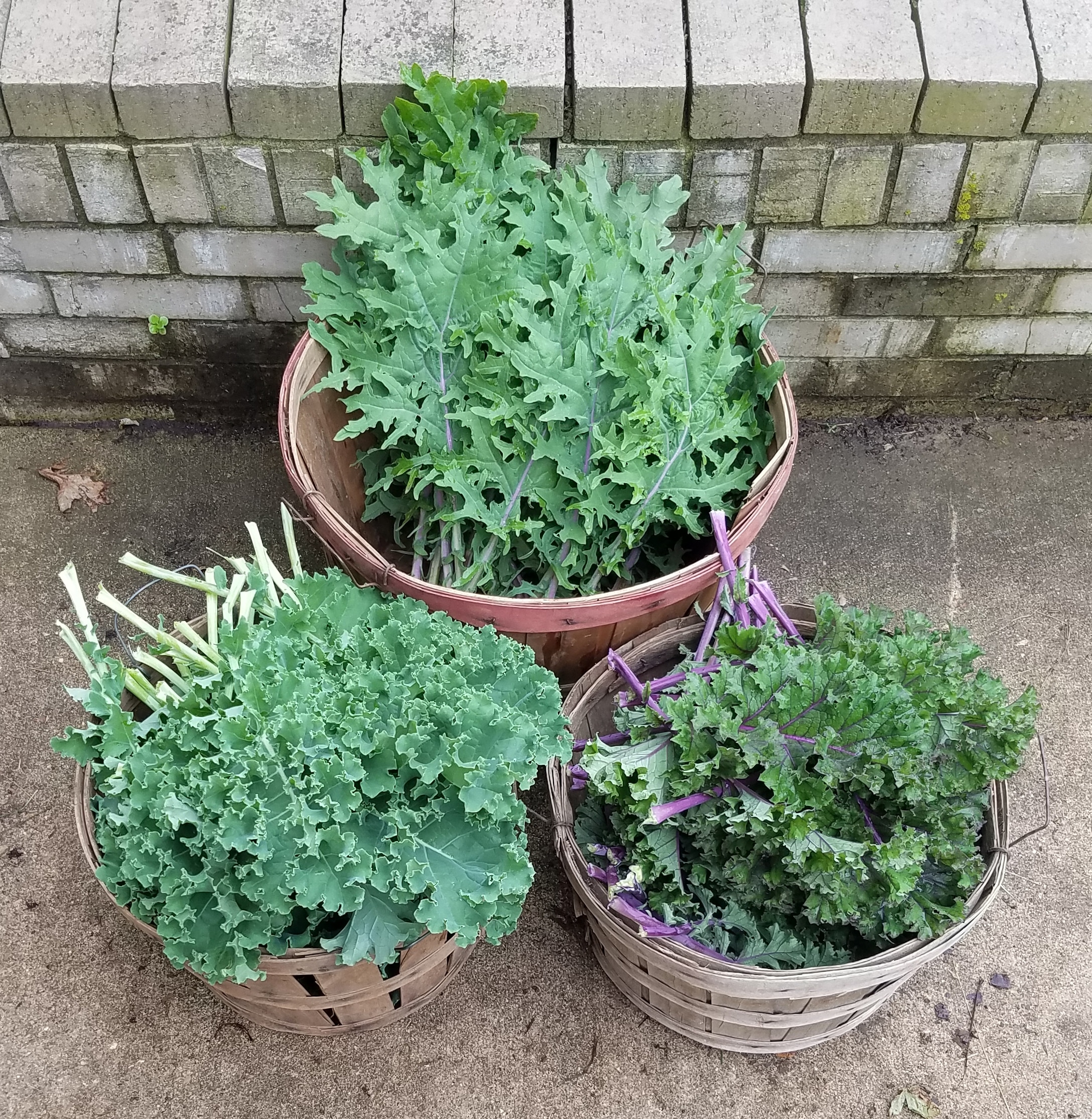
First big kale harvest, Spring 2020

We have to look at ourselves in the mirror and consider whether we are racist. It’s not easy to do in the best of circumstances.

Dictionaries consistently define a racist as someone who has a notion that one’s own ethnic stock or genetic makeup is superior.

Which is it, ethnicity or genetics that defines race?

The authority of dictionaries has diminished in society. There are few rules in the living language except we be understood. Haters gonna hate, as Taylor Swift noted, regardless what’s in the dictionary.

I was confronted with the idea there were different races as a child. It was and remains for me an idea. I knew I was different, but superior? I don’t think so. Diversity in the neighborhood in which I grew up meant defining whether one’s family was of German or Irish descent. Racism as we know it today, as in the Black Lives Matter Movement, wasn’t an obvious issue. We were shielded from racism and those blacks we encountered were in a context of their relationship with our father: plantation workers in Florida, co-workers at the meat packing plant, and fellow union members.

What are the genetic characteristics that define race? What cultural behaviors are specific to race? Should we care about race? These are the questions I’m asking while witnessing the resurgence of protests over race after the viral video of George Floyd’s murder.

Our family visited the Gettysburg battlefield when I was a grader. Which side of the Civil War was I on? I felt I had to be on a side. My maternal ancestors immigrated after the war and my paternal ones from Virginia fought on both sides. After a moving childhood visit to the battlefields I adopted the Confederacy as my own history and bought a Confederate flag in the museum gift shop.

We cannot disown our history even if we want or if our current values discredit the peculiar institution of 19th Century chattel slavery in the U.S. southern states. Thanks to the combined work of my fourth grade teacher and my mother I came to realize the racism inherent in embrace of the Confederacy, and that it was wrong. Before long, with their encouragement, I sought and found my own history.

I first encountered systemic racism while serving in the military. I paid little heed to the naming of military bases after notable racists Andrew Jackson and Henry Lewis Benning, where I trained in the U.S. Army. I was stationed at Robert E. Lee Barracks in Mainz, Germany. It was named after the World War II veteran with the same name as the commander of the Northern Army of Virginia. Racism in the military was about more than names.

Daily work was integrated, which is to say as an Army officer I paid little attention to race when giving orders or following them. All but one officer in the battalion was white and the lone black lieutenant and his family lived in a twelfth century castle off base. I visited them a couple times while we served together. In conversations, I came to understand he was held to a different standard because he was black.

When we lived in Indiana I managed an operation that recruited thousands of truck drivers. I became familiar with parts of Chicago and the suburbs because of this work. I hired the first black recruiter the company had and remember the surprised faces when we returned to the corporate office for a meeting. Race made no difference in this hire. I just wanted someone who could do the job.

We rejected an applicant from our new driver orientation and he threatened to call Bobby Rush because he felt we were discriminating against him because he was black. The claim bordered the ridiculous because more than half the group in orientation was black or Hispanic. I don’t recall why we rejected him but I said I’d like to have that conversation and provided my number. Several weeks later we received a letter from Rush’s office and I replied. That was the end of it.

That protesters in our county seat chose to shut down Interstate 80 in response to the murder of George Floyd was predictable, expected, and ineffective. It’s something, yet I’m not sure exactly what. In 1971 I was part of a group of protesters that shut down Interstate 80 near the Dubuque Street exit in response to the Vietnam War. We built a bonfire in the Eastbound lane feeling we had to do something to disrupt business as usual. What more usual thing is there than traveling on an interstate highway? Law enforcement attempts to keep the interstate open, although there was a report one of the Coralville exits was closed by them in anticipation of protests. Protesters have to do something to gain attention enough to create a fulcrum point for change. I support their actions and also believe there has to be a better way.

What does the Black Lives Matter Movement mean to me? In our rural subdivision the only time race comes to the surface is when it is scratched. If there is talk of a black family moving in neighbors assert property values will decline.What does one do with that? I point out to them the assertion is patently false and reject it. Most people here don’t scratch the surface of race to avoid such conversations.

If George Floyd’s murder was a turning point in how racism is viewed in the United States then some good will come of it once he is mourned dead and survivors heal. We must look ourselves in the mirror on racism. If we can’t then we probably are racist and don’t want to admit it. If so, Floyd becomes just another black man who died at the hands of police as white hegemony continues a while longer.

My religious education taught we are all equal in God’s eyes. That’s how it’s supposed to be in the United States. Yet slave owners sought to justify the peculiar institution using the same Bible I read today. In the end, we have to ask ourselves if we are racist, not because we seek an answer, but because in asking we open the possibility of a remedy to today’s long-standing problem. We seem so far from that now.

Categories
Kitchen Garden

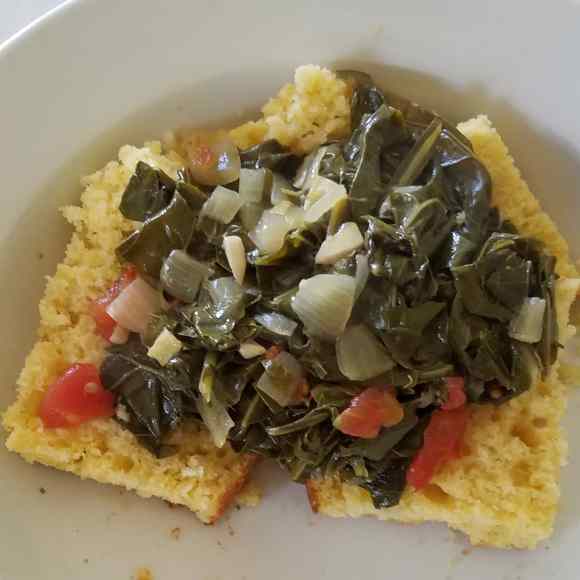
Collards on Cornbread

Collards on Cornbread

Collard greens are easy to grow and the plants produce for a long season. Once one decides to include them in a garden there had better be a plan to use them.

The first picking, before little hungry insects arrive, is the best. Sorting leaves near the composter is a way to cull the best of the best. Yesterday I harvested two pounds of leaves and decided to make collards on cornbread for dinner.

The vegetarian recipe was a collaboration with people I know combined with a few internet searches. Traditionally the dish is made with pork so the issue of how to replace lard and the meat was a primary issue. This dish came out tasty tender.

Collard Greens

One pound stemmed collard leaves
One cup diced onions
One head finely minced garlic (5-6 cloves)
Tablespoon each butter and extra virgin olive oil.
Salt and pepper to taste
One teaspoon hot pepper flakes or fresh chilies if available (optional)
Three cups vegetable broth
One pint canned tomatoes or fresh if available

Measure one pound of stemmed collard greens and cut into half inch ribbons. Set aside.

In a Dutch oven heat one tablespoon each of extra virgin olive oil and salted butter. Once foaming subsides, add one cup diced onions and a finely minced head of garlic (5-6 cloves). Season with salt and pepper to taste and sautee until softened. Add a teaspoon of red pepper flakes (optional).

Once the onions become translucent, add the collards and three cups of prepared vegetable broth. Also drain the liquid from a pint of diced tomatoes into the pot. Bring the mixture to a boil and cover. Stir the greens every so often. Once the volume of the greens is reduced, reduce the heat to a simmer.

Cook until the leaves are tender, about two hours. Add diced tomatoes and continue cooking until they have warmed.

Spoon onto cornbread, including a generous amount of the cooking liquid.

We found the recipe to be quite satisfying and a welcome way to use produce from the garden.

Categories
Living in Society Social Commentary Writing

Three Months In A Pandemic

Planks on the footbridge.

The absence of definitive guidance on what society should be doing during the coronavirus pandemic led us to a path of individual choices.

When Iowa Governor Kim Reynolds proclaimed the disaster emergency on March 9 few of us knew what to expect. Sadly, three months later that continues to be true.

Our social behavior is developing around risk avoidance, some of it informed, some less so.

Jacque made us facial masks on the sewing machine. I carry three of them in a plastic bag on the car seat to use when in public. Most frequently I wear them while shopping for groceries, and at the drug store, convenience store and at medical appointments. When I return home I wash my hands, change clothing, and if I’ll be inside the rest of the day, take a shower. I wash the masks after each wearing.

At the farm I don’t wear a mask because the crew has been self-isolated together since the pandemic began. The risk of me being exposed there is minimal. Since I’ve been tested, limit my activity, and maintain social distancing, I seem unlikely to bring it in. They developed a social distancing method of share delivery and are doing everything they can to avoid getting sick. An outbreak would be disastrous for them, their customers, and the business.

I don’t wear a mask to the state park trail and very few people I’ve encountered there do. Because it is outside and there is room enough to maintain social distancing the risk of contracting COVID-19 there seems minimal. I avoided going to the park for the first two months of the pandemic yet the need for exercise outweighed the risk of exposure to the coronavirus.

With more people home during the day the number of contacts with neighbors has increased. I don’t wear a mask while I’m with them because these encounters are pop-up activities of short duration. I have yet to see anyone in the neighborhood wearing a mask. The letter carrier and parcel delivery drivers are a source of potential contamination although a necessary service as our number of trips off the property has decreased. We sanitize packages and let them sit on the landing before opening.

Our main approach to risk management is reducing activity away from home and social distancing when we are out and about. It serves us well in that neither of us has been sick since the pandemic began. I don’t believe our experience and behavior is much different from any Iowan who takes the coronavirus seriously.

Clearly the pandemic will be of longer duration, so how should risk of COVID-19 spread be managed? There is little guidance from our government and public health guidance seems so universal it’s hard to figure how it impacts us in our actual lives. As a former career transportation and logistics professional I’m familiar with risk management. The pandemic is just one more layer added to risks already managed.

When I worked at the home, farm and auto supply store I got sick a couple of times a year. I caught something at work that caused runny nose, coughing, congestion or some combination of those ailments. The need for income outweighed potential health risks. When we entered the pandemic I reassessed and reversed my approach. I haven’t been sick since I walked out the door for the last time on April 2.

My point is we take risks in everything we do. During the coronavirus pandemic we must get better at doing so because the lives of our family and everyone with whom we come in contact depend upon it. The question never was “should we open up the economy?” The better question is what are the conditions upon which we can re-engage in society? How do we know it is safe enough to send our children to school, return to paid work outside the home, and participate in mass recreational events like concerts, sporting games, fairs and local festivals? If anything, we assumed those activities were safe before the pandemic, even though we knew, subconsciously at least, that safety has a broad spectrum of risk and no human activity is completely safe.

What are reasonable risks? Lacking appropriate guidance from experts each of us is making up our own rules, our own trade-offs between risk avoidance and participating in life. There is no going back to life before the pandemic. How do we restore enjoyable aspects of our lives with less risk of contracting COVID-19?

I don’t have definitive answers except that we are on our own. We are doing our best and for the time being, until we figure this out, that may be the best we can do.

Categories
Reviews

Book Review: Save Me the Plums

Save Me the Plums: My Gourmet Memoir by Ruth Reichl

I’d not heard of Ruth Reichl before a news reporter recommended this book. I had heard of Gourmet Magazine and have no memories of ever reading it.

I liked the book for these reasons:

It provides a window into the New York world of Condé Nast. As a Midwesterner New York seems exotic even though my brother in law lives there. It’s important to gain a broader understanding of the publishing world and to know something about it. Save Me the Plums provides that.

We all need some light summer reading to escape the sh*t storm our current politics, public health crisis, and climate crisis create in 2020. The food writing in Save Me the Plums is unlike anything I’ve read. While not sure of the attraction of something that tastes like sea foam, Reichl takes us into a world few of my cohort experience for themselves.

The book is well written and that makes a difference.

Recommend, especially if one is part of the broader American food movement. One wouldn’t want to be Ruth Reichl yet her story is interesting, different and valuable.

Categories
Kitchen Garden

Weeding the Onion Patch

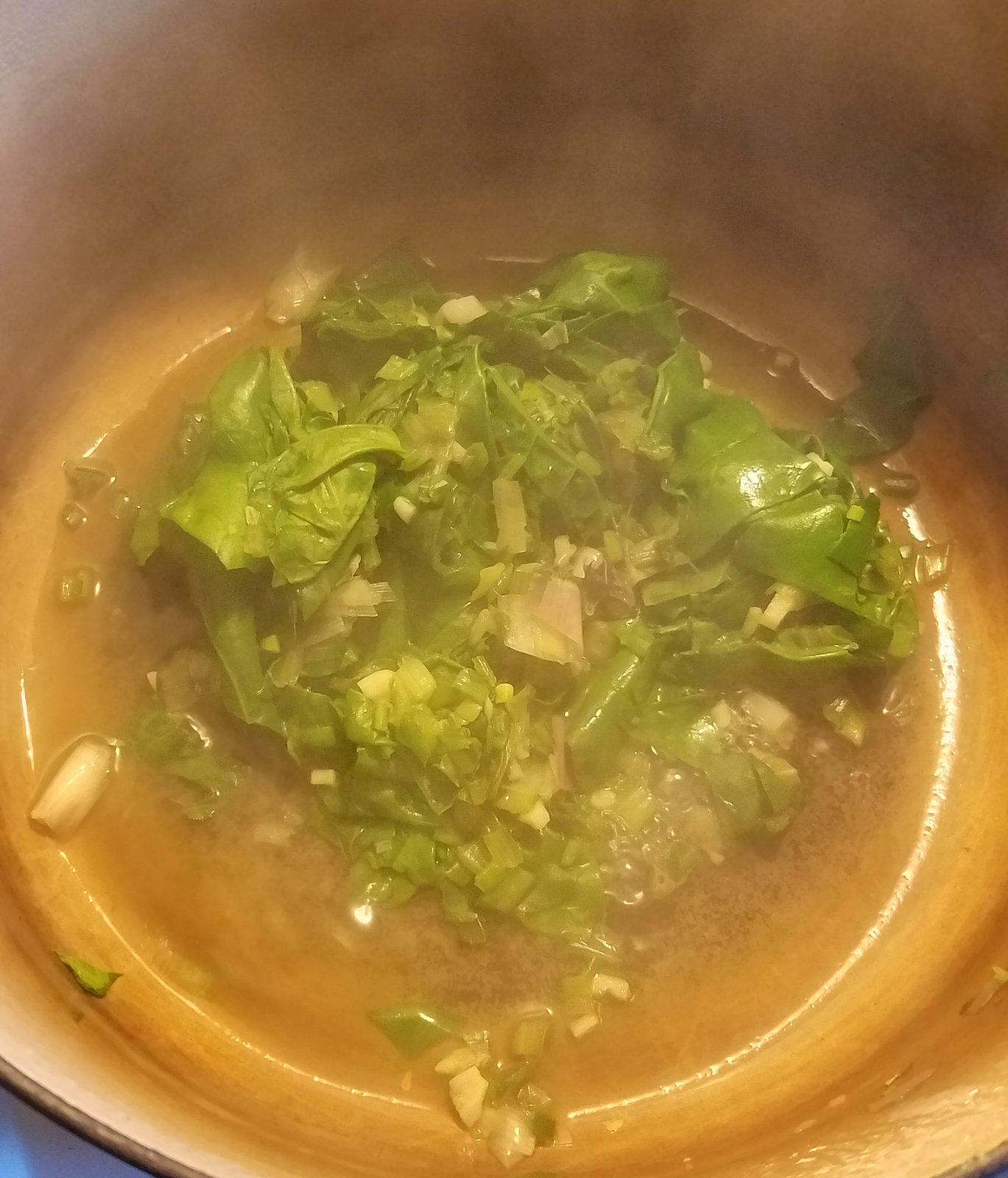
Kohlrabi greens with spring onions and garlic, steaming in vegetable broth.

I’m determined to grow shallots and onions this year. I took the solar powered radio to the onion patch, took down the fence, and weeded until it was done.

The onion starts purchased from the home, farm and auto supply store are growing but not yet forming bulbs. The shallots growing from seed look like they will be something, and soon three varieties of storage onions started from plants will need thinning so there is room for them to grow.

If the garden produces storage onions it would be for the first time. I’m following the guidance of my mentor so there’s hope of success in the form of a bin full of onions stored near the furnace over winter.

A few dozen onions from 2019 remain in the bin. I am so confident of onion success I’m planning to caramelize a big batch of them and transition to reliance on what I grow. More than anything, onions are a mainstay of our kitchen and growing them a key part of making our kitchen garden more relevant.

Among the weeds I found was lamb’s quarters, which grows in abundance without doing anything but planting other things. Lamb’s quarters grows everywhere in Iowa on its own. While culinarians forage these leaves to include in gourmet preparations, in a kitchen garden a cook needs only so many greens. I ate a few of the tender top leaves and composted the rest. They are a tasty green, less bitter than some I grow intentionally.

Around the country protests continue in the wake of videos of the May 25 murder of George Floyd in Minneapolis. The Cedar Rapids Gazette reported large turnout for demonstrations in nearby Cedar Rapids and Iowa City last night. No one knows how long demonstrations will continue or how long it will take government to act on them. The expectation is government will act.

In 1968 after the assassination of Dr. Martin Luther King Jr., and ensuing riots in American cities, it took six days for President Johnson to respond by signing the Civil Rights Act. I don’t see any such action coming out of the Trump administration whose reaction has been to build a fence around the White House and seek to retain power by winning the Nov. 3 election.

While we need to eat, the progress of my onion patch may be the least of our worries. What happened to George Floyd shouldn’t happen to anyone. There is systemic racism in the United States, and we must each do something to address it. What will be the enduring legacy of the Black Lives Matter movement? With our current federal government that remains an open question.

Categories
Living in Society Social Commentary Writing

Reading in 2020

French Breakfast Radishes

If daily life took its course without our engagement we would be reading more words and fewer books.

With the rise of social media a lot more words are being published and many readers get “glued to their phones” as they take in all the words and video they can within a circle of friends and followers.

Long form reading in books is an essential part of staying informed. It took a conscious effort to stop my entropic slide to reading no books each year to include long-form reading in daily life. Ironically this began by using the social media tool Goodreads. By setting a low annual goal of 16 books per year in 2018 I surpassed it and have increased my book reading every year since. In the first five months of 2020 I read 26 books.

Reading short pieces, newspaper and magazine articles, and social media posts is an important part of securing new information about our lives in society. At the same time erosion of book reading leaves us the less.

The current book on my night stand is Save the Plums: My Gourmet Memoir by Ruth Reichl who spent ten years as editor in chief of Gourmet magazine. An intellectual masterwork? No. I found Reichl’s reference to William Carlos Williams annoying, yet the pace is quick, the chapters short, and the language a straightforward narrative. It’s how a person with a specific experience wrote autobiography. The more experiences of writing styles we have, the better writers we can be. If you forced me to put this book in a category, it is summer reading and a part of a broader universe of reading material.

We seek in reading, in any format, an understanding of the person behind the writing. When I review my social media feeds, some people I know personally and have done things with. Others I know by their writing. There’s a reason it’s called “social media.” There are people behind the posts or at least that’s what we hope.

That is less true of book reading where the author may be present in every page yet strive to minimize their personality or presence in the words. Can a book stand separately from it’s creator as a work of art? I don’t see how it’s possible to separate the work from the author’s social context. In that regard, historians are the worst. There is an ideology of history writing and to attempt to hide or diminish it is a disservice to the reader (Oscar Handlin). There is a politics and poetry of writing history. There are books on those subjects. It is possible, and I’d argue necessary, to both adore historians (Robert Caro) and despise them (Doris Kearns Goodwin) that has nothing to do with the information presented on a book’s pages.

I look at reading the way I view being a food consumer: I seek to know the face of the farmer and in the case of reading, the face of the author. That’s true of any reading I do. I am more likely to trust, read and comment on something an acquaintance posts because we physically met and I’ve followed them in social media long enough to understand something about their social context. The same is true for writers in mass media. I want to know who they are and what their history is rather than read a single sensational story. As a reader and human, I’m in it for the broader picture.

The rise of artificial intelligence is producing computer generated writing. I think we need to inoculate ourselves against this fake writing by spending time learning about authors and reading their published work. As the noted philosopher Taylor Swift wrote, “the fakers gonna fake, fake, fake, fake, fake.” We need to be able to shake them off. That requires us to be informed readers.

If we are going to read more at least some part of our lives should be engaging the authors of those words. Obviously it’s less possible for dead writers. Yet we are living now and should be spending part of our time reading full-length books both as a supplement to short form reading and as escape from it. Entropic decline in long form reading is something we must address in our lives. That is, unless we accept the mutation of humans will eventually include genes for mobile phone adaption.

Categories
Kitchen Garden

Volley of Lightning Strikes

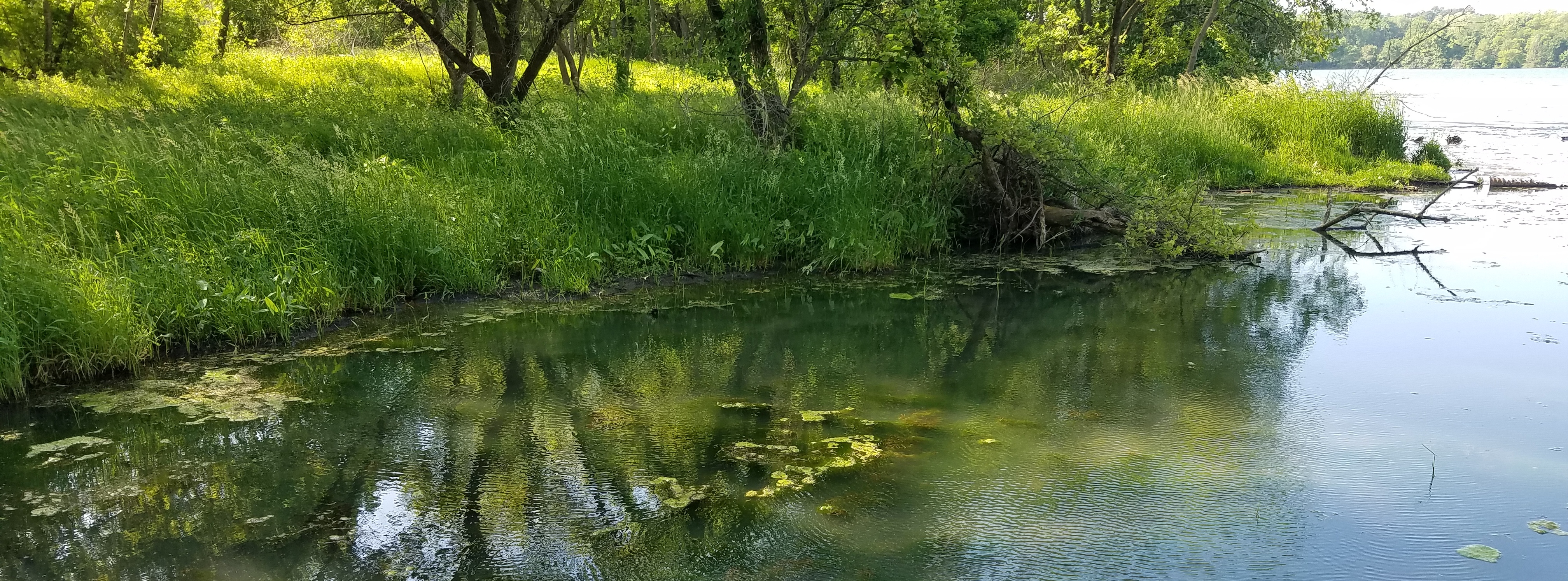
Lake Macbride State Park, June 2, 2020

The day began with a loud volley of lightning strikes west of the house. I don’t recall hearing so many at once. When hail pelleted the windows it felt like were in for the worst.

It didn’t last long and there was no damage to the garden or anything else I inspected after the clouds moved on.

Thus began another warm, wet day in Big Grove Township.

The morning work project was to organize the garage so both vehicles could be parked inside. Mission accomplished.

I found a cooking preparation for Fordhook chard that can be applied to other leafy green vegetables with great results:

Bring half a cup of vegetable broth to a boil in a Dutch oven. Clean the leaves from the stem of the chard. Finely slice the stems, three spring onions, three cloves of garlic, and add to the Dutch oven. Cook 2-3 minutes, stirring constantly. Add roughly chopped leaves and cover. Cook for 2-3 minutes in the steam then stir to get the other side cooked, a couple more minutes. When the chard decreases in volume mix the leaves and bits and pieces and serve. Makes two servings.

When the garden has many varieties of leafy green vegetables a basic kitchen preparation like this is important.

We are not out of the impact of video footage depicting the murder of George Floyd being released in social media. While there are no demonstrations here, the crowd of protesters in the county seat grew to about a thousand on Wednesday. The president’s amateurish way of handling the crisis will prolong more than end the violence. We can all feel the vacuum of leadership sucking.

The coronavirus rages. 106,198 people died of COVID-19 in the United States as of yesterday. No end to the pandemic is in sight, although there is hope for a vaccine. The plan after a successful vaccine is unclear. The president’s failed leadership is evident: he should set expectations and take bold action to assist with the response. He has done neither. Meanwhile, society is deteriorating into chaos with one state legislator saying yesterday to a group that opposes mandatory vaccination laws, “COVID-19 isn’t even killing anybody.”

On the state park trail near where I live most people don’t wear protective equipment. The Iowa Department of Natural Resources does not require it although they request people otherwise maintain social distancing. Joggers, hikers and bicyclists haven’t been wearing facial masks, although I spotted a family group wearing them while taking a hike.

My activities outside home are restricted to grocery shopping, drug store visits, gasoline purchases, medical visits, and a shift per week at the farm. The farm crew moved on site at the beginning of the pandemic and has been self-isolating since then. I work alone in the greenhouse when I’m there. Other than at the farm, I wear one of my homemade face masks whenever I’m with people anywhere else.

I have been participating in TestIowa, the statewide COVID-19 response application. The app suggested I was eligible to be tested so I went to a drive-up clinic at nearby Kirkwood Community College. The result was negative. After visiting clinics for a diabetes follow up I made a list of conditions I’m experiencing. There were a dozen. I’m at a loss to say when all that happened but I feel pretty good. Feeling good likely hinders the effort to address these conditions as well as I otherwise might.

As spring turns to summer I’m ready for change. It’s a time when the morning thunderstorm is both familiar and frightening — a time to persist in doing what’s right for our family and for the broader society.

Categories
Living in Society

Get Ready to Vote for Joe Biden

Vice President Joe Biden in a May 2010 rope line in Cedar Rapids, Iowa.

Now that the primary elections are behind us it is time to look ahead politically toward the general election.

Get ready to vote for Joe Biden as president.

Biden is the only thing standing between us and another four years of a president who seeks to dismantle everything we’ve come to know.

Think I’m exaggerating?

During the coronavirus pandemic the president has suggested cutting payroll taxes multiple times. If he did, it would be an assault on Social Security and Medicare.

Donald Trump repeatedly said if elected to a second term he would cut Social Security and Medicare to address his out of control budget. Twice (Jan. 23 & March 2) he walked those comments back tweeting he would protect Social Security and Medicare. Which is it? Do you trust him?

Even today as the Congress contemplates a new pandemic relief bill Republicans are talking about raiding the Social Security Trust Fund. Some view the trust fund as a piggy bank they’d like to break open and spend if they could.

I’m not concerned for myself but for our daughter and her cohort. Since I was a teenager I knew there would be something to retire on in Social Security and contributed through payroll taxes for 50 years. I’d like the programs to be solvent and available for them.

Is Biden perfect? No. Get over it. Get ready to vote for Joe Biden on Nov. 3.

~ Published in the June 4, 2020 edition of the Solon Economist