Categories
Living in Society Sustainability

Trinity 75 Years Later

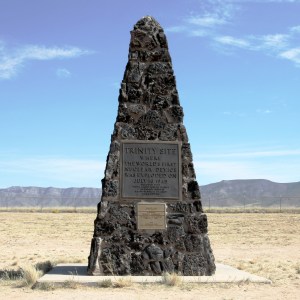
Trinity Marker near Bingham, N.M.

Trinity was the code name for the first nuclear bomb detonation 75 years ago today.

The test explosion was conducted by the U.S. Army at 5:29 a.m. on July 16, 1945, as part of the Manhattan Project. It took place in the Jornada del Muerto desert about 35 miles southeast of Socorro, New Mexico, on what is now part of White Sands Missile Range.

The day after Trinity, U.S. Secretary of War Henry Stimson flew to Potsdam, Germany where President Harry Truman was meeting with Winston Churchill, Clement Attlee and Joseph Stalin to determine the fate of Germany which had surrendered unconditionally on May 8.

Truman wrote about this meeting with Stimson in his memoir:

We were not ready to make use of this weapon against the Japanese, although we did not know as yet what effect the new weapon might have, physically or psychologically, when used against the enemy. For that reason the military advised that we go ahead with the existing military plans for the invasion of the Japanese home islands.

A committee had been established to evaluate use of the atomic bomb once testing was successful. Before Trinity, on June 1, the committee of government officials and scientists made their recommendation, which Truman recounts in his memoir:

It was their recommendation that the bomb be used against the enemy as soon as it could be done. They recommended further that it should be used without specific warning and against a target that would clearly show its devastating strength.

Ultimately Truman made the decision to drop the atomic bomb on Hiroshima and on Aug. 6 the U.S. Air Force delivered it. Truman threatened to drop a second atomic bomb. On Aug. 9 the Air Force bombed Nagasaki. The Japanese surrendered Aug. 10.

A friend and fellow Veteran for Peace, the late Samuel Becker, was in Guam in August 1945 preparing for the invasion of Japan. I recently asked him about the atomic bombing of Hiroshima and Nagasaki. He said the reaction in Guam was positive, they were in favor of it because it brought a quick end to what could have been a prolonged, bloody conclusion to World War II. In the years before he died, Sam didn’t believe it was a good idea. With time and reflection, the notion that the atomic bombings saved many lives turned out to be a myth. The Japanese were already in a position to surrender. At a Zoom call on Monday, author of the book The Decision to Use the Atomic Bomb Gar Alperovitz said that to a person contemporary military leaders went on the record to say there was no need to use the atomic bombs on Japan. The war had already been won.

On July 1, 1968, states began to sign the Treaty on the Non-proliferation of Nuclear Weapons (NPT) which entered into force on March 5, 1970. Every state on the planet has joined the treaty with the exception of India, Israel, Pakistan, and South Sudan. India, Israel and Pakistan have nuclear weapons. The treaty has three interrelated parts: non-proliferation, disarmament, and peaceful use of nuclear energy. Article VI states, “Each of the Parties to the Treaty undertakes to pursue negotiations in good faith on effective measures relating to cessation of the nuclear arms race at an early date and to nuclear disarmament, and on a treaty on general and complete disarmament under strict and effective international control.” 75 years after Trinity we missed the “early date” by a country mile.

Progress is measured in a meeting of the parties every five years. This year’s scheduled NPT review conference was postponed until next year because of the coronavirus pandemic. In the Trump administration nuclear arms control is not even up for discussion, except to eliminate constraints on “American freedom.” The U.S. plans to spend $1 trillion on the nuclear complex in the coming years. That will drive Russia to do likewise. FOX News personality Chris Wallace recently wrote a popular book regurgitating false myths about the history of the atomic bomb. Alperovitz debunked some of Wallace’s claims on Monday.

Also on Monday Sueichi Kido spoke about his experience as a five-year-old during the bombing of Nagasaki. People like him are called hibakusha or survivors of the atomic explosions at Hiroshima or Nagasaki in 1945. Over the years he and other hibakusha told their story many times. The hibakusha are aging and will soon all be gone. Along with them will go living memory of the effects of a nuclear weapon.

Truth matters and one truth is the atomic bombings of Hiroshima and Nagasaki were unnecessary. Atomic bombs were never needed for defense. Their existence, as demonstrated at Trinity, would fuel the Cold War and the idea of mutually assured destruction should they be used. This is crazy talk. Nuclear weapons must be eliminated and the only way to do that, to pierce the wall of our federal government, is citizen action demanding it. On the 75th anniversary of Trinity it’s past time we took action.

Categories
Living in Society

Simple and Easy Change or Voter Suppression?

Iowa Capitol

As chair of the Iowa House State Government Committee, Representative Bobby Kaufmann was quick to get out into the newspapers in his district to explain the last minute dealings regarding voting process as the second session of the 88th Iowa General Assembly adjourned Sine Die on June 14.

“The legislation that passed simply requires a Secretary of State to run changes to election law by the Legislature,” Kaufmann wrote in the June 25 Solon Economist.

He went on to explain new restrictions for county auditors in processing absentee ballot requests: they must contact the voter if something is missing on the form. This is instead of the current process of filling in missing information when it is available.

“That is all the bill does. It ensures that a person who wants an absentee ballot is the person who actually receives it,” Kaufmann wrote. “This is no different than if you forget your password for online banking, your credit card, or a loan at the bank.”

Sounds pretty simple and easy doesn’t it? Not so fast!

Representative Mary Mascher, ranking member of the State Government Committee, believes the new law creates barriers to voting and explained it in this July 9 letter to the editor of the Solon Economist:

Barriers to voting have been opposed by House and Senate Democrats for many years. Voter Suppression bills have been proposed and passed over the last four years by Legislative Republicans. Those laws disproportionately impact our elderly, people with disabilities, minorities and the poor. The legislation that was added to the omnibus budget bill in the last hours of the 2020 session created another barrier for the groups listed above.

This is why.

Voters requesting an absentee ballot are required to included their driver’s license number or their unique pin number on the (ABR) absentee ballot request form. The pin number was issued from the Secretary of State’s Office to all voters who did not have a driver’s license or a DOT Identification ID. Those pins were mailed out months ago. Many voters did not keep those pin numbers in a safe place or threw away the letter thinking it was junk mail. So many voters do not have easy access to those numbers.

If a voter fails to include their pin or driver’s license number they will not be automatically mailed their ballot. The auditor has access to the unique pin number but they are not allowed to fill that number in and mail out the ballot!

This is what the County Auditors will be required to do.

First the auditor must try to contact the voter by phone. Many voters no longer include their phone number on their voter registration because they do not want to receive the hundreds of phone calls that candidates and parties have access to if they provide that number. Some voters do not share their cell number for privacy reasons. Some voters do not have phones or have limited minutes on those phones so it may be impossible for the auditors to contact them by phone.

Second the auditor must try to contact the voter by e-mail. Again not all voters have e-mail or include those e-mail addresses on their voter registration form. For low income voters that option is not even realistic. They may not have a computer, internet access or a phone that allows them to receive an e-mail. Many have track phones or phones with limited minutes and cannot receive e-mails through those phones.

Third the auditor must mail the voter a letter through the US Postal System letting them know they have left vital information off of their ABR and they must contact the auditor’s office in order to receive an ballot for the upcoming election. If they contact the auditor’s office they will be able to verify their voter information and the auditor can then send them a ballot. If the voter thinks the letter is more junk mail they may end up throwing it away and will never know why they did not receive their ballot. If the voter receives the letter and fails to contact the auditor’s office they will not receive a ballot.

I have listed some of the flaws in the system above but here is one more challenge for auditors. They must phone, e-mail or mail the letter to the voter within 24 hours of receiving the ABR. Most auditors do not have enough staff to do this within this restrictive time frame. The larger counties may receive literally thousands of ABRs in a day. If hundreds of those ABRs have no pin or driver’s license number it will be physically impossible for the auditor’s staff to complete the requirements above in 24 hours.

If the vital information is missing and the voter requests the absentee ballot close to the day of the election. It may be impossible for the voter to provide the needed information and get the ballot prior to the election.

These burdensome requirements, with nearly identical wording, were in the original 2017 voter ID law, but the state Supreme Court overturned the requirements as an undue burden on voters.

Election fraud in our Iowa Elections is extremely rare. Our county auditors take their jobs seriously and do everything they can to make sure our elections are safe, secure and fair. Due to the COVID virus more voters will choose the option of voting by mail. We know this occurred during the recent 2020 Primary Election where records were broken across the state. Making it more difficult to request an ABR at this time is voter suppression at its worst. This is why Democrats opposed this provision and fought to defeat it on the floor of the House.

For most voters providing a pin or a driver’s license number on their ABR will not be a problem but for the elderly, people with disabilities, our minority populations and low income Iowans this could result in them being denied the right to vote and that is just plain wrong!

State Rep. Mary Mascher

Buyer beware when Republicans propose changes in voting laws.

~ The Solon Economist is available by subscription only. The entire Kaufmann column can be found in this clipping. Mary Mascher’s letter is used with her permission. This post was written for Blog for Iowa.

Categories
Environment

Toward Sustainable Pandemic Recovery

Image of Earth 7-6-15 from DSCOVR (Deep Space Climate Observatory)

The climate crisis continues in the coronavirus pandemic.

The pandemic with its economic downturn threatens years of progress addressing climate change and sustainability. It’s now or never for the environment.

Governments are expected to spend trillions of dollars in stimulus to get the economy going again. Addressing the climate crisis can’t wait. Climate solutions must be integrated with stimulus spending.

“We now have a unique opportunity to use (the economic crisis) to do things differently and build back better economies that are more sustainable, resilient and inclusive.” said Saadia Zahidi, World Economic Forum managing director.

WEF warned that “omitting sustainability criteria in recovery efforts or returning to an emissions-intensive global economy risks hampering the climate resilient low-carbon transition.”

Sustainability should be integrated into recovery efforts because the health crisis, economy, and environment are inextricably connected. There is only one chance to manage this recovery. Trillions can be spent only once. Given the scope of the climate crisis, its pressing urgency, society must choose to address the climate crisis now.

The International Energy Agency has ideas on how to do that. They developed a 174-page essay titled “Sustainable Recovery.” However, no single solution applies to global matters. We need multiple solutions implemented synchronously.

Global carbon dioxide emissions reduced by 17 percent in April as people sheltered at home, industry reduced production, and automobile use slowed. Since then, emission levels surged back. A conscious decision to integrate smart energy use into the recovery is needed. The issue has been politicized so thoroughly it seems doubtful any such action will be taken in the United States. One is being political whether they say something about climate change or not when discussing the economic recovery. We must persist in demanding a solution.

Fiona Harvey, environmental correspondent for the Guardian reported, “The world has only six months in which to change the course of the climate crisis and prevent a post-lockdown rebound in greenhouse gas emissions that would overwhelm efforts to stave off climate catastrophe.”

No one knows how long we have. It’s common sense that stimulus money could be used in a holistic way. Ideas are out there. What’s lacking is political will.

That few in our government talk about addressing the climate crisis as we “open up” the economy is part of the problem. Oil and gas interests have so infiltrated our government politicians don’t want to hear about solar or wind generated energy, even if they are the least expensive and least damaging regarding carbon dioxide emissions.

Think about it though. When has doing what makes sense gotten so politically out of fashion? Among other things, that needs to change.

Al Gore recently said, “Moving forward from COVID-19 means we have an obligation to rethink the relationships among business, markets, government and society. We must deliver a sustainable form of capitalism.”

That’s not going to happen without a change in our government.

People ask me how I plan to address the climate crisis. My answer?

It’s time to stand up for what is needed in our country right now: moral revival and transformative change. That means voting for Democrats in November.

Postscript: Since I wrote this post Joe Biden released his plan to ensure the future is “‘Made in All of America’ by all of America’s workers.” The word climate is mentioned once in a paragraph to “apply a carbon adjustment fee against countries that are failing to meet their climate and environmental obligations.” I support Biden for president and encourage readers to read his Made in America plan here. Like any plan it will be subject to modification if Biden is elected president. One modification I expect is to integrate addressing the climate crisis in the plan.

~Written for Blog for Iowa

Categories
Living in Society Social Commentary Writing

No Class Reunion

40th High School Class Reunion, Summer 2010.

This summer marks 50 years since about 260 of us graduated from Davenport Assumption High School. As a group, we were never close and that makes organizing a class reunion difficult. There won’t be one this year.

It was a Catholic high school and parish loyalties continued through the four years. To some degree, those parish-nurtured social groups continue. I still read about cliques of friends who get together from time to time. When we graduated, social media didn’t exist as it does today. Information about classmates’ current activities would be unavailable without Facebook, LinkedIn and Twitter.

I helped organize our fifth reunion, hiring a band to play music during the event. I also helped organize the 40th reunion, a two-day event, working on building a database of contact information that put me in touch with many former classmates. The fifth seemed too soon, the 40th was enjoyable and productive given my role. I heard from people whether they attended or not.

I stay in touch with a few friends from high school. If there were a chance to get together it would be great. With the coronavirus pandemic even a small gathering seems unlikely. We are of an age where conditions of life are catching up with us and at higher risk of contracting COVID-19. Maybe we’ll get together in some safer, future year should we be lucky enough to live so long.

For now I wish my living classmates well. For the increasing number who died, the Catholic faith holds hope of a life after this one. I remember them here. As for me, I continue to put one step in front of the last and go on living. Such living includes spending time every year considering those youthful days and learning what classmates are doing now. What else is a person to do?

Categories
Kitchen Garden

Weeds in the House

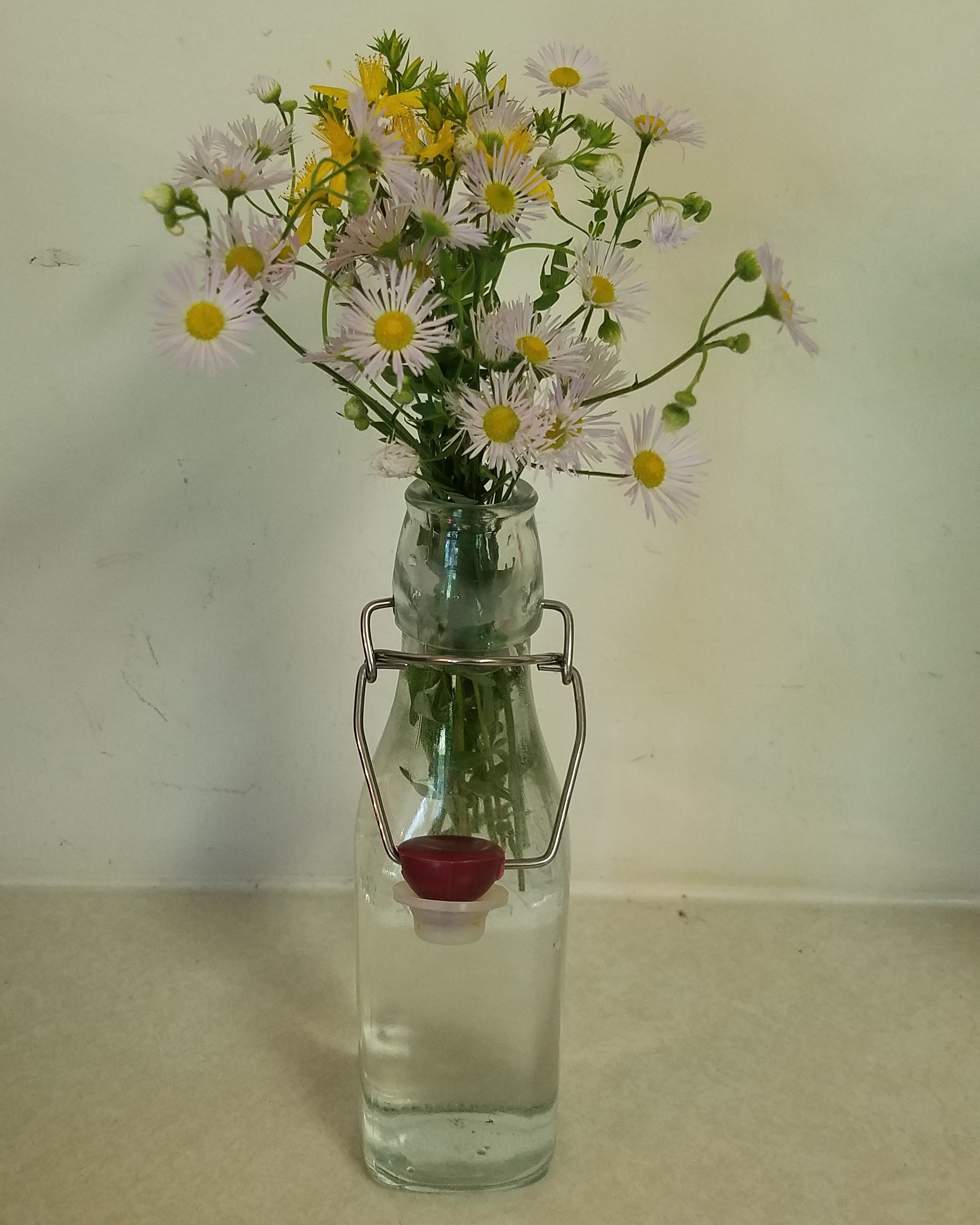
Wildflowers, July 11, 2020

I like my lawn. It is a great source of mulch for the garden, although it seems like there is never enough.

What is there transitions throughout the growing season. We are currently in clover and around the edges native plants come up like the ones in the photograph.

These are weeds, but they look nice on the counter.

When basil comes in I make pasta sauce of last year’s canned tomatoes, onions, garlic and basil. I’m trying to use up the old tomatoes to make room for new. Pasta sauce varies from preparation to preparation. Near as I remember, this is what I did yesterday.

Summer Pasta Sauce

Drain six pints of canned, diced tomatoes in a funnel. Once thoroughly drained, put them in a slow-cooker, reserving the liquid for another dish. Whizz them with a stick blender until somewhat smooth yet with a few chunks of tomato.

Ribbon all the basil you have (about a cup and a half of chiffonade). Put the basil in the slow cooker and incorporate with the tomatoes.

Dice two cups of onions and mince three or four large cloves of garlic.

Heat two tablespoons of extra virgin olive oil in a frying pan. Once shimmering add the onions and stir gently until they begin to turn translucent. Salt to taste. Next add the garlic and cook until the aroma of garlic rises from the pan. After a couple more minutes transfer the mixture into the slow cooker and incorporate.

Turn the cooker on high heat and let it go throughout the morning. Around lunch time stir and turn the heat down to medium. Once it’s dinner time, cook pasta noodles, put the drained noodles in a mixing bowl and ladle a couple of generous servings of pasta sauce on top and mix gently with tongs. It’s ready to serve topped with Parmesan cheese, pepper and maybe thinly sliced green onions.

We served the pasta with steamed green beans picked that morning and simple cucumber salad. We’re in the cucumber season so we eat them constantly. There’s no room for more pickles in the ice box or pantry.

New potatoes are in so I tried a new recipe for potato salad. I cut it back to make less for two people, so it could be doubled or tripled for a dish for potluck. In the time of the coronavirus, there won’t be any potlucks soon.

Summer Potato Salad

Boil a pound of peeled, cubed new potatoes. Don’t boil them to mush. Hard cook an egg and put both in the ice box overnight.

Dice the potatoes into a bowl. Grate the egg into the same bowl. Add salt and pepper to taste, a quarter cup prepared mayonnaise, a tablespoon Dijon mustard, and a generous tablespoon of chopped sweet pickles. Stir gently with a spatula until incorporated. Put the mixture in a refrigerator dish, level it out, and sprinkle paprika on top for decoration. Leave it refrigerated a couple of hours before serving if you can resist eating it at once.

Potato salad has many variations and this is most like what Mother made for us when we were graders.

Categories
Kitchen Garden

Garden Tour July 2020

Some photos from the garden taken Friday, July 10.

Categories
Living in Society

Iowa Summer Pandemic Politics

Iowa Summer

Independence Day is over! Time to get rolling on the fall campaign to elect Democrats! Not so fast…

The 2020 general election cycle has been like no other. Iowa didn’t stand a chance of influencing the national debate after the precinct caucuses yielded a field of five candidates who were awarded national delegates. Joe Biden, the presumptive nominee, placed fourth with six of 41 delegates, according to the Iowa Democratic Party website. A botched reporting process took Iowa out of the limelight as we didn’t certify caucus results until the race had moved on to New Hampshire and South Carolina.

Then the coronavirus hit the state. On March 9, Governor Kim Reynolds signed a disaster emergency proclamation regarding COVID-19. Political campaigns moved on line, conducting fundraising, voter contact, forums, and other events via telephone, text, email, and video conferencing. We got to know Zoom.

The impact of the coronavirus pandemic on political campaigning is far from over. There is expected to be little door-to-door canvassing, few in person events, and forget about the usual slate of county and state fairs, parades, pancake breakfasts, fish fries, and chili suppers. Politics in the pandemic seems much less significant than the public health emergency coupled inextricably with the economic downturn the pandemic is causing, to be honest. Whatever our federal and state governments are doing to mitigate the pandemic, it’s not working. The president’s recent guidance, parroted by the Iowa governor, is, “we need to live with it.”

On June 2 Theresa Greenfield became our nominee for U.S. Senate and all Democratic attention could turn to defeating incumbent Joni Ernst. In the age of Trump it seems possible to defeat the incumbent senator who had a solid win against Democrat Bruce Braley in 2014. The race will be tight and a lot of money will be spent by the candidates and political action committees.

In Iowa’s four congressional districts we have a slate of outstanding candidates in Abby Finkenauer (IA-01), Rita Hart (IA-02), Cindy Axne (IA-03) and J.D. Scholten (IA-04). They are working their campaigns and appear to have resources to do so. We can also expect each of them to be underdogs in the campaign cash department as Republicans have an unlimited supply of big dollar donors and political action committees just as in the U.S. Senate race.

The Iowa Senate seems out of reach for Democrats this cycle but we could make headway in the 18-32 minority, setting the stage for a majority in 2022. In the House of Representatives, flipping the majority to Democratic is within reach in 2020. If we could gain a House majority that would buffer the worst impulses of the Republican Senate and governor.

What’s an active Democrat to do? Get involved with electing Democrats.

While the way we support Democratic political campaigns may differ this cycle, the endgame is the same. Keeping track of voter contacts and make sure we reach out to everyone possible. In the pandemic that means participating where one can in virtual phone and text banks, and staying in touch with candidates through Facebook pages and virtual events. It also means adding politics to the list of things one discusses with friends and relatives. We each need our own list of people we seek to convince to vote Democratic whether it is provided by the party or not.

Politics has been weird this cycle. I’m okay with change yet the lack of person to person contact at events, door knocking, and fund raisers is unsettling. I have been walking in parades with Democrats and Democratic candidates for 20 years. Partly, I am involved in politics for this type of in person interaction. It’s hard to get fired up about a Zoom call the way it is to obtain a fresh list for door knocking.

The Iowa Democratic Party is being cautious about the risk of campaigning in the pandemic. An IDP employee explained it this way in an email.

The fear is that we might alienate Dems who are being extra cautious right now if we start showing up at their doors. The phones are the best option we have without in person contact being on the table, but hopefully it will become an option again soon.

Rank and file Democrats like me have little choice but to support what the state party and campaigns want to do. The thing is, we need to get everyone possible to vote for Democrats.

It’s clear no preference voters, along with some Republicans can be persuaded to vote for Joe Biden. They may not be willing to vote Democratic in federal and down-ticket races so we need to be nuanced in our approach to potential ticket splitters. We want those Biden votes for sure. If they are willing to pull the lever for Theresa Greenfield as well, that’s better. The secret sauce of Dave Loebsack’s long tenure is appealing to this type of ticket-splitting voter. A one size fits all campaign as we’ve run them previously hasn’t been as nuanced as 2020 demands.

My advice if you are reading this post is do three things: 1. Set a monthly budget to contribute to your favorite Democratic candidate. Almost anyone can afford a recurring small donation to the Iowa Democratic Party; 2. Make a personal list of people — friends, family, neighbors, and social groups — to contact about the election and then do it. Some may be resolute about their support for a candidate we do not prefer. Don’t beat them over the head with it but have that conversation; and 3. Get involved with formal party activities virtually or in person if they exist. The basic needs of the coronavirus pandemic — washing hands, social distancing, wearing a mask or shield in public, staying home if sick — are straight forward. If events support these precautions, they are worth considering for participation.

Summer is here, as is the pandemic. Democratic politics will adjust and move forward, hopefully toward victory in November.

~ Written for Blog for Iowa

Categories
Living in Society

Getting Over the Kennedys

Sunrise, July 9, 2020

When I think of politics I think of the Kennedys. That is, I did. I’m over it now. This was first posted on Dec. 15, 2012. It’s been significantly edited.

The end of year holidays are something I associate with the Kennedy family. Our family wasn’t of the Kennedy clan, yet didn’t seem that far removed. My framework was formed while being Kennedy-like.

Our family moved into a new home the summer after I finished first grade. It was an American Foursquare built in the late 19th Century in Northwest Davenport. By the time of the 1960 general election we were beginning to have a sense of neighborhood and local culture.

Father worked diligently to organize our neighborhood and elect John F. Kennedy as president. I still have copies of the mimeographed 8-1/2 by 14 inch sheets he used, with generic city blocks marked in purple ink, waiting to be completed with the names of voters. Father was from Virginia, the part where politics is a daily passion. His political engagement was infectious. His work for the Kennedy campaign expanded to include neighborhoods besides ours where he took the purple sheets and helped organize the effort.

When JFK won the election, it was a big deal for our family. The oral history is Dad and Mom were invited to the inauguration. We followed the Kennedy Administration, as much as grade schoolers could. In that context my association of the holidays with the Kennedys was formed.

We understood patriarch Joe Kennedy had earned enough money for his children to be free of financial worry to devote their time to public service. We also knew we would not have any such freedom. We were a mostly Catholic family on my mother’s side, so we looked on the Kennedy lifestyle, particularly their family life in Hyannis Port, Massachusetts as framed through press coverage, as something to emulate as best we could. Perhaps it was a dim reflection, but it was there.

Mostly, life centered around school, family, neighborhood friends and television. We weren’t poor, but we weren’t rich either. We lived close to the means of production. We played touch football in the back yard, like the Kennedys did.

Television was a strong influence. After finishing our homework and outdoor play, we watched news, variety, westerns, and comedy programs, almost daily. In the 1960s television was viewed as a vast wasteland by FCC Chairman Newton Minow, and maybe it was. Life was not always about participating in the nascent consumer society.

That is where the connection between the Kennedys and the holidays came in. At Christmas, from Advent through the Epiphany, we set aside much of mass culture and re-enacted family behavior that was our connection to society. To some extent we emulated what we heard about the Kennedys: siblings in a large family looking after each other, and participating in a life in retreat from the broad concerns of society, at least for a while. For us, there would be discussions, meals and home entertainment. Family members would come in and out of our home with our lives intersecting with others during visits at our home and at theirs. We would attend midnight Mass on Christmas eve.

It was a tribal time of friends and family, removed from external pressures, and a dim echo of what we believed society should be. I look back on those times with the nostalgia only separation in time can create.

What I know now, and only am beginning to realize, is that the bubble of that family life was popped when Father died in 1969. It would never be the same. Whatever cultural resonances of a faux Kennedy lifestyle remained after that, proved to be vaporous in the long run.

I caucused for Ted Kennedy in 1980, and remember his concession speech at the Democratic National Convention. I heard Robert F. Kennedy Jr. speak in Iowa City one recent evening. Throughout my life, I continued to touch them, or thought I did, even if I realized there had been no Camelot. I read the newspaper article about them selling the Palm Beach home in 1995 and the disputes over the final disposition of the compound at Hyannis Port after Ted Kennedy’s death in 2009. As time passes, the Kennedys seem less relevant.

What I realize now is life has always been mine to live. I have been over the Kennedys for a long time.

Categories
Kitchen Garden

New Potatoes

New Potatoes

The idea of new potatoes is to harvest them two weeks after the flowers are finished. This is what they look like with thin skins and creamy potato goodness inside.

I boiled a pound for dinner and served with butter, salt and pepper. Keeping it simple with condiment flexibility is a characteristic of our kitchen garden. Diners can take cooked vegetables and finish them how they will.

When I worked at the home, farm and auto supply store I bought seed potatoes as soon as they came in. Planting is within a radius of Good Friday, although not necessarily on the day. I planted early this year. A few years back rodents ate our potatoes in the ground so I moved them to a container. Container growing is working, likely helped by the two stray cats who hang out in our garden.

Our main sources of potatoes are from our garden and a bartered fall share of the community supported agriculture project. When there are potatoes we eat them and seldom buy outside spuds. We follow the season.

The soil in the containers needs recycling for next year. There are too many roots and not enough nutrients. This year the containers were more than half empty when I planted. As the vines grew I added more soil and compost until the container was full. The result was potatoes grew in layers and there were more of them in each container.

The photograph represents the yield from one container, about five pounds. There are four containers this year so they will last until the fall share begins in September. Together they should keep us in potatoes until Thanksgiving after which we’ll wait for more next year.

In addition to boiling potatoes, I’ll roast some with other root vegetables and onions when they are available. We make potato salad, escalloped potatoes, leek and potato soup, parsley potatoes, mashed potatoes, and add them to vegetable soup.

The harvest of new potatoes is another marker in the gardening season. Such markers help us keep our sanity in the chaotic world of the coronavirus.

Categories
Home Life Writing

4.875 Miles

Puch Cavalier 10-speed.

It’s been 12 days of riding my Puch Cavalier 10-speed bicycle.

I’ve had it since 1980, one of the last built in Austria. When we married, my wife had a women’s Puch 10-speed in the same color. When not being used they hang together in the garage.

Taking up bicycling again is a treatment for diabetes. My medical practitioner explained the health benefits of exercise in a way his predecessors at the clinic did not. Now I’m regularly riding 4.875 miles daily, weather permitting.

Why 4.875 miles? At first I just went out and rode. We live near the midpoint of a five-mile trail in the state park. I took turns riding from our home to either end and back. I figured it was a five-mile ride. Then I got an SY Bicycle Speedometer and Odometer. Once it was installed and adjusted I gained precision. Each day since then the odometer had the same reading, 4.875 miles.

Work was completed on another trail that leads from here to Waterloo in one direction, and to West Branch, Iowa City and Coralville in the other. A fellow gets tired of riding the same route every day so I’ve been exploring.

My current ride takes me from the garage down to the state park trail, then west until a road leading to the highway intersects. I pedal up that long, gentle incline to the highway and turn east. I ride along the highway until it intersects with the new trail at the roundabout. Then I follow the trail until it returns to the state park trail and turn west back to my entry point and home. The long initial incline gives me a workout, as does the long descent during which I see how fast I can go. My average speed is 10 miles per hour and the fastest just at 22. It takes about 27 minutes to make the route.

Hopefully the exercise will help my A1C, which measures what percent of my hemoglobin is glycosylated. The goal is to reduce it to less than 5.7 percent by the time I go back for a follow up in September.

A younger version of me wouldn’t be satisfied with 4.875 miles. I’ll get tired of the same route after a while, once it becomes too easy. The next goal will be to ride over to Ely on the new trail. For now my heart beats faster and I work up a sustained sweat. Doing that daily for an extended period of time is goal enough for now.