Someone broke the law to leak information about the county’s potential purchase of property with conservation bond money.
In a closed session of the full board of supervisors, with five staff members present, one or more of them broke the trust of being invited by leaking information about property the conservation board was considering for purchase. He or she broke the law.
The news made its way to the Solon Economist last week in the form of a letter written by two grey-haired Iowa City liberals. They made a case against a potential purchase most of us hadn’t heard about. Their biased opinions fill otherwise empty space about this topic. The letter raised questions about how they got their information.
“Someone flagrantly broke the law,” wrote Supervisor Rod Sullivan on his weekly blog. “She or he ought to face consequences. This was not an accidental slip. This was a purposeful, devious violation of the law.”
I’m all for a robust debate of how the county spends our tax dollars. If last week’s letter is true, I question whether buying the property is an appropriate way to spend conservation bond money.
However, I support the rule of law and the leaker should be sought out and receive due process for committing a crime.
Early and illegal notice about conservation fund spending did not benefit public discussion one bit.
~ Published in the Solon Economist on March 15, 2018
“Good navigators are always skeptical, not of the presences of things, but of what they see and understand. Good navigators are almost always lost.” ~Robert Finley
Green up has begun and everything seems ready to pop — even if it isn’t.
My usage of “green up” comes from the 1936 film The Trail of the Lonesome Pine,” in which June Tolliver said, “I ain’t marrying till green up,” delaying pending nuptials between her and cousin Dave Tolliver until after hog killing time. Waiting until green up is cause to delay not only weddings, but needed chores, engagement in society, and anything and everything until ambient temperatures warm and spring is in the air. It’s a lame excuse but we keep hoping it will work out after green up.
Demands on my time increased as tenure as a full-time employee at the home, farm and auto supply store draws to a close in seven days. If I’m lucky, and only partly as a result of planning, the most important things will fall into place. There’s also a lot not planned.
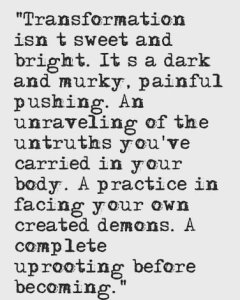
I hope to transform how to look at the world. Beginning March 18, my worklife will devote 56 hours each week to writing, food ecology and paid work. It’s a lot but I hope to increase that to 80 hours or more. Will determine if that’s possible in the process.
What I know is there’s much left to accomplish. That said, I don’t keep a bucket list. When young I meticulously kept a to-do list which helped my rise to a middle level of performance and productivity. The to-do list was always there, and rarely did I remove something without addressing it. I use no such device any more. I eschew lists. I abhor them. I can live my life without them and will.
What I hope is to continue to evaluate what and how I see in the world. It’s an imperfect process, one that requires attention and energy. Like green up it’s a path toward life’s potential. As June Tolliver found in the film, the unexpected can come into view. We must break the cycles of tradition and habit in order to see it.
BIG GROVE TOWNSHIP — It’s a little crazy for a 66 year old male to make plans.
It would be easy to “go on the draw” as people I know have done. This framing comes from relatives and friends in Appalachia, where my father’s family came up, who found a way to collect a monthly payment from the government in the post-FDR era. It seems universal in American society to expect the rewards of a life of work and trouble in order to take it easy. Going on the draw has a subtext of relinquishing part of the self-reliance that has come to characterize being American.
There is plenty in society to engage our mind, heart and soul, without adding a layer to it. Social groups abound. Paid and volunteer work create human relationships. There’s shopping, movies and restaurants. Central to many are public libraries — one of the few remaining places with no expectation patrons have money. As much as I’d like to self-identify as a “retiree” and take advantage of all this, the feeling “I want,” as Saul Bellow aptly described it in Henderson the Rain King, nags at me. We may not know what we seek, but are always looking.
Is it hubris? Ecclesiastes instructs.
Vanity of vanities, saith the Preacher, vanity of vanities; all is vanity.
What profit hath a man of all his labor which he taketh under the sun?
One generation passeth away, and another generation cometh: but the earth abideth for ever. (Ecclesiastes 1, 2-4, King James)
When we live our bodies break down from use. We are broken through trauma, physical and emotional. What we need more than treatment for symptoms is healing. Such healing falls to the care of a network of family and friends who look after us when we are broken. Health care is so often more about family and friends, home remedies and rest, than the health care and health insurance which takes an increasing proportion of our income.
Once we accept the underlying fragility of the human condition, many make plans and that’s positive. Our lives have meaning only if we find it in useful, social activity. Once we cease engagement in life and society, the truth that we might die tonight is rendered moot.
Asian Greens in Scrambled Eggs with Vermont Cheese and Pickled Bits and Pieces
After tangling with a schedule to reduce hours at the home, farm and auto supply store I concluded there were only three immutable weekly activities: writing (26 hours), paid work (16 hours), and farm work (12 hours).
Add an hour of prep time before work outside the home and these three activities fill 69 percent of available weekly hours. Everything else must fall in place behind these priorities. It is a rigid frame on which to hang everything else.
It’s already a 54-hour work week.
What’s missing is community organizing, the rest of food ecology, and home maintenance, all of which need to be squeezed into the remaining hours each week. Developing capacity to be more productive is part of this. It necessarily means doing better than using artificial stimulants or shoddy work in any activity area. It’s a plan.
It is time to use up fresh onions, garlic and potatoes, then rotate the canned goods so oldest jars are consumed first.
Winter means soup, casseroles, pasta and hearty meals made from pantry and ice box ingredients.
As the ambient temperature warms, we are ready to move into the new year’s fresh food cycle. But not so fast!
There are egg sandwiches, chili mac and soups to be made before spring buds.
I donned my LaCrosse rubber boots and toured the yard and garden.
The ground is too hard to plant lettuce. Garlic is not up. The only bit of sprouting green was flowers I transplanted from Indiana. Tips of green were frosted on those that emerged. A thick layer of sand lies on the side of the road. Time to sweep it up and save it for next winter.
At 13 days until the transformation of worklife, I’m spending time organizing time and tasks.
To be successful means purging old habits and developing new. The work seems much harder than it should be. While working at the home, farm and auto supply store I’ve developed some questionable habits around internet usage, resting and eating. They produced the current result, so they were not all bad. One only gets so many chances to start over.
There are two problems with my transformation. First, I’m limited to 12 hours per day of primary activity. Not everything I want to do will fit. Second, I’m not used to working 12-hour days. To get things done, I need to ramp up. The situation is complicated by keeping two days of paid work in the mix. We’ll find a use for the money, but I’ll also need to figure out how to get more productivity out of a day to meet overall goals.
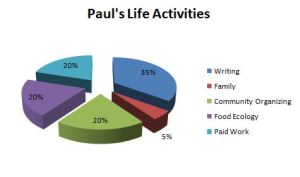
Paul’s Pie
Drawing the pie chart was fairly simple. Making that fit among rigid schedules of paid work, writing and farm work has proven to be challenging. Where I suspect this will end is with a hard schedule that includes writing, food ecology and paid work, leaving everything else flexible.
I’m committed to this now, so no turning back.
The week of the county party central committee turns into a session of drinking politics from a fire hose. As you can see in the pie chart, community organizing gets a 20 percent allocation of time and politics is a subset of that. I’ve limited myself to one social event per week and expect most of those to be related to politics for the next couple of months. I learned a couple of things:
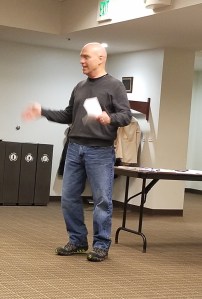
Rep. Dave Jacoby explaining plan to run 100 Democrats for 100 House seats.
Iowa House Democrats are planning to run 100 candidates for 100 seats in the midterm elections. We don’t usually run everywhere, so that makes this year different.
In the governor’s race, Democrats are working to win the primary. With seven announced candidates at the beginning of the filing period we’ll see if everyone files and if there is anyone else. It takes 35 percent of votes cast to win the primary. Cathy Glasson’s campaign is playing a side bet that the governor candidate will be chosen at the state convention with no one getting enough votes to win outright. The campaign claims to have won 30 percent of delegates at the caucus, which may or may not translate into 30 percent at the state convention after counties pick their delegates at the March 24 county conventions. 30 percent seems unlikely to win at the convention.
There are still too many geezers like me on the central committee. I’d gladly step aside and let someone else take my seat, but the truth is these women, millennials and newly registered voters who are supposedly playing a key role in the midterms don’t come to the meetings, don’t want the job. It’s a truism that flying at 30,000 feet, political strategists come up with all manner of demographic projections about the electorate. Our local elections of everyone up and down the ticket are made at a distance of six inches in front of our noses, rendering strategist musings moot.
Cold and frosty as the ground is today I can justify another day indoors to file our tax returns, work on community organizing and get caught up on everything else. However, it won’t be long before lettuce and potato planting. Next Sunday I start my first trays of seedlings in the greenhouse.
There’s everything spring brings and for which we yearn.
In a throwback to my work at a major logistics company I made a batch of vegetarian jambalaya for this week’s lunches.
The dish was born in Thomas County, Georgia as I was sequestered in a hotel for four months implementing a logistics project at a clay mining and processing plant. I had access to what was then called the TV Food Network and Emeril Lagasse. I made the techniques I learned my own.
Here’s a recreation of today’s recipe:
Ingredients:
2 tablespoons high smoke point oil
4 tablespoons butter
4 six-inch vegetarian sausage links sliced 1/4 inch on the bias
1/2 pound frozen sliced okra
2 cups diced onions
1 cup diced bell pepper
1 cup diced celery
4 cloves garlic minced
1 15 oz can red beans drained and washed
1 cup long grain brown rice
1 pint diced tomatoes
1 quart prepared vegetable broth
Salt, red pepper flakes, curry powder, prepared hot sauce to taste
In a Dutch oven, brown the sausage in cooking oil. Remove and set aside.
Melt the butter in the same pan and heat the red pepper flakes until aromatic.
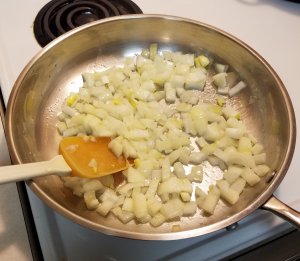
Add the onions, celery and bell pepper. Saute until soft.
Add the garlic and stir together. Cook for five minutes over medium heat.
Season with salt, pepper, curry powder and hot sauce.
Add the pint of diced tomatoes and rice and stir together.
Add the quart of broth and bring to a boil.
Add the okra, beans and cooked sausage and mix everything together.
Cover and bring to a boil. Turn the heat to medium low so the liquid bubbles gently through.
When the rice absorbs the moisture, stir and serve with fresh, sliced green onions on top.
Makes six generous servings.
We’re prepping for our annual inventory at the home, farm and auto supply store.
That means counting and labeling everything in the warehouse, and getting every possible item to the sales floor where hired staff can count it and customers can find it to buy it.
Inventory occupies a big space in the life of a retail outlet.
So it is with everything at home while getting ready for full retirement in 36 days.
We benefited from building a new home in 1993 by having to do very few major repairs. We changed the roof once, repaired the garage door, and that’s it. We’ve cycled through major appliances — refrigerator, dishwasher, washer and dryer — but have had very little work on the structure itself. A lot of little things require attention now.
In a flurry of emails this week I confirmed four part-time, seasonal jobs this year. One is writing for Blog for Iowa this summer, and the others are farm-related. Combine home repairs, these four jobs, my community organizing work, and political work during the midterm election cycle and there will be plenty to keep me busy in 2018.
Last night I ran into my former state representative Ro Foege at the warehouse club. I automatically shook his hand then apologized for spreading germs from my recent illness.
“I just came from the capitol,” he said. “I was exposed to a lot worse up there.”
I have a different view of political engagement this year. Mainly I want to be a helper of younger people who are engaging in politics. That means volunteering where I can, encouraging people, and contributing in ways people ask.
The metaphor of WYSIWYG, taken from the advent of computer graphical user interface, is an apt model for what I’m doing. The operative function of building an electorate presumes nothing and is rooted in a belief the 2018 general election electorate is not pre-made. It is being formed as we proceed through time and events toward election day. We have to pay attention to what is happening in real time and modify our activities to create a successful process.
It began with this week’s off-year caucus and engages voters with our many primary candidates for statewide and local offices. I see four remaining milestones for building the electorate: the June 5 primary, summer parade season, the fall campaign beginning on Labor Day, and the final week before the election. If we work early and smart, we should know where we stand as election day approaches. We should not freak out, just do the work.
Tonight after a shift at the home, farm and auto supply store I plan to meet Iowa gubernatorial candidate John Norris at a house party in Coralville. He may be the one for whom I’ll vote in the primary. More importantly, I want to see who is turning out for Norris and ask one or two questions if there is an opportunity. It’s not about my single vote, but about understanding the process. It’s not about me or him but who we are as Democrats in a state Donald Trump won by more than nine points. It’s about taking stock of our lives and effecting change in our government.
As some caucus-goers said Monday night, “we have to do something in November.”
For now we see through a glass, darkly; but then face to face: now I know in part; but then shall I know even as also I am known. ~ 1 Corinthians 13:12 (King James)
The story of Paul of Tarsus, his conversion and writings are essential to my world view. Paul stands equally with René Descartes in forming a view that isolation from what exists, then taking measured actions to engage, is what we humans can do to get along in society.
When I was a grader I discovered if you write people, they may write back. With that in mind, I wrote my State Representative at the beginning of the second half of the 87th Iowa General Assembly.
Bobby,
Good luck with the 2018 session.
As I have in the past, I’ll let you know my priorities as bills advance in the legislature.
Republicans have an opportunity to turn around the tax situation in the state. I believe the only chance for success is to review the entire income and expense process in a holistic manner and effect changes that balance the budget on both the revenue and expense sides. State law requires a balanced budget. Taking continuous budget cuts because the revenue side is out of whack is not sustainable.
The context of the new federal tax law is important, but the state should not presume tax cuts are needed. It means making administration more efficient, funding compliance efforts for existing laws, and reviewing every decision made regarding taxation since Governor Branstad was elected in 2010. Insufficient attention has been paid to whether his solutions worked or not, and Medicaid privatization stands out as something that clearly isn’t working for parties involved. Republicans have teed up a big opportunity this session. What kind of legislators will you be?
My hope is you will encourage members of your caucus to avoid partisan solutions and use your votes to make a difference for everyone in the district.
A group of farmer friends would like to attend an early listening post, so please keep me informed when and where they will be held. I favor the ones in Bennett, Lowden, Wilton and Durant since there is a better cross section of the district in attendance. We’d go anywhere in the district to hear you speak. :)
It’s sixty nine days until what I hope is my last day of work at the home, farm and auto supply store… and “full retirement.”
The paradigm upon which we based our life in Big Grove shifted. We settled here to be close to work, raise our daughter, and live happily ever after.
Our home is older (as are we), our daughter left Iowa after college, leaving us with the happily ever after. The latter has me stuck.
During bitter cold days, I spend most of my time in the living room, the kitchen, the bedroom, or at my writing table. This weekend I left the house once to get the mail. The tendency is to drift toward the last day of work, delaying everything until then. That’s not really an option with the community work I’ve undertaken and plans made. One foot in front of the other, onward I must go.
The ambient temperature warmed 46 degrees since yesterday morning. If I were a bear, I’d sense winter hibernation is almost over. Instead, this human is in between recovering from a week of physical labor and endeavoring to get busy with one of many projects. Today it’s not going as well as I’d like on either front.
I worked on a local version of dal, cooking the first recipe today. Using 1-1/4 cups lentils, three cups of vegetable broth, turmeric, cumin, hot red pepper, fresh garlic and vegetable oil, the first batch came out edible but not delicious. The idea is to replace the pre-cooked version I’ve been buying at the warehouse club with home made. The recipe creation process will take a while because each batch must be eaten: a person can only eat so much dal per week. After six or seven iterations, if I’m lucky, the finished dish might get to the delicious stage.
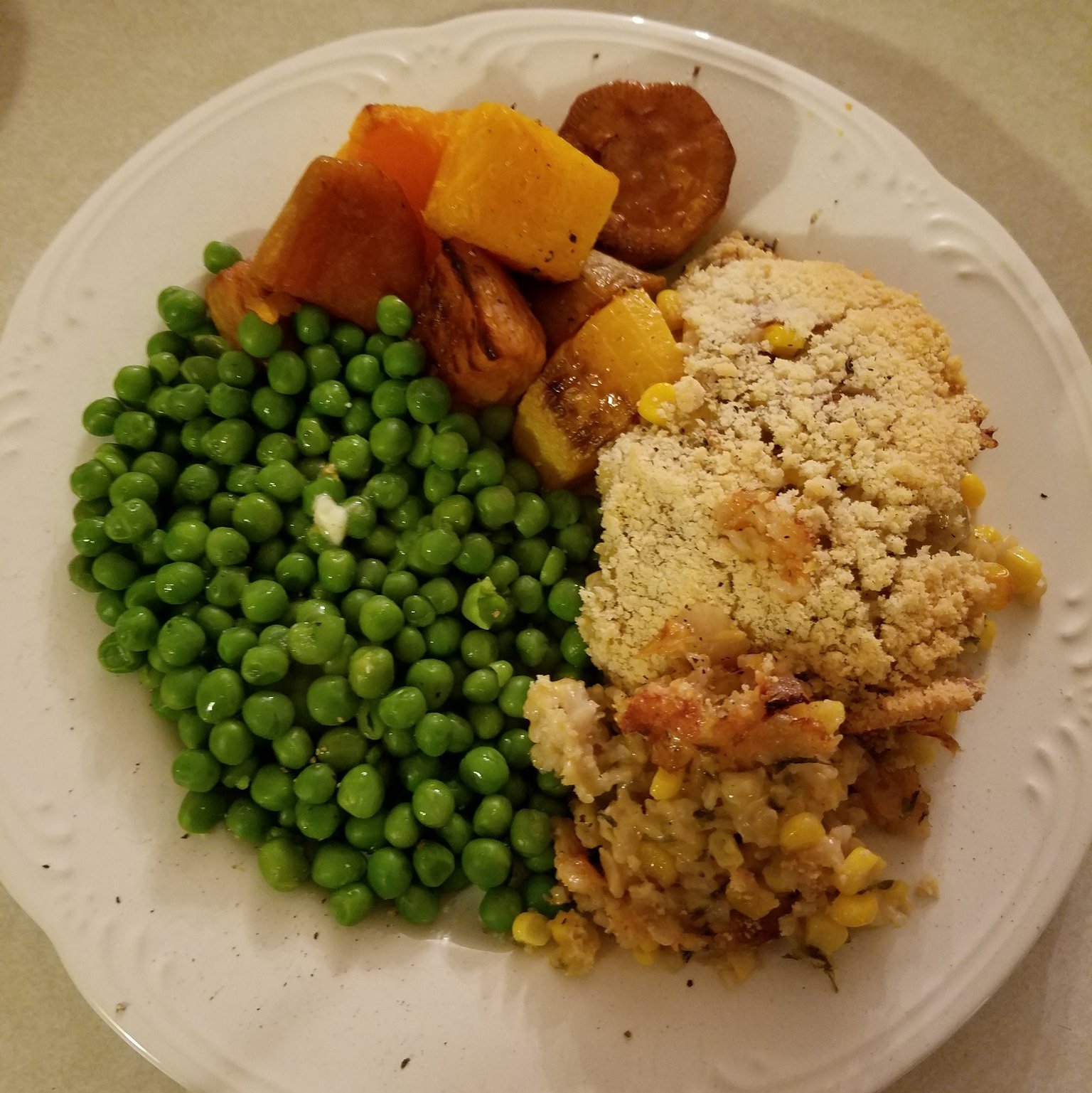
Last night I made dinner of corn-rice casserole, steamed peas and a mixture of roasted butternut squash and sweet potatoes. Saturdays have been my night to cook so Jacque has a meal ready when she gets off work. When Garrison Keillor was on A Prairie Home Companion, that provided background noise. Now the radio stays mostly off, or tuned to the classical music station. Another shift in the predictability of our lives.
All this is not to say I seek a rocking chair in which to sit until life departs this frame. Not at all. However, the combination of cold weather, bones, feet and back aching from physical work, and a restlessness about living happily ever after has me stymied.
Just as the cold snap is over, and there’s hope the recipe will eventually turn out well, I’ll get going. Sixty nine days out retirement seems unseen below the horizon. Much remains to be done and I feel myself waking and wondering what will be next.
I’d be good with happily ever after, but not ready to believe it’s possible.
In a hopeful year, the U.S. Congress is back to work, on Jan. 8 the state legislature convenes the second half of the 87th Iowa General Assembly, and grassroots politics begins another cycle with the Feb. 5 annual Iowa caucuses.
Politics affects us all.
In a time when there is no time for us to get anything done, here are five easy things to improve our politics.
If you are free Feb. 5, attend your political party caucus, which begin at 7 p.m. Republicans and Democrats agree when to hold precinct caucuses and these meetings represent a chance to see what having an R or D next to your voter registration means.
Subscribe to elected officials’ newsletters. All of our federal and state representatives have a newsletter. If you don’t know who represents you, in the Solon area it’s currently U.S. Senators Chuck Grassley and Joni Ernst, U.S. Representative Dave Loebsack, State Senator Bob Dvorsky and State Representative Bobby Kaufmann.
Take time to learn about the gubernatorial candidates and vote in the June primary. Both major political parties have a primary election for governor.
Worry less about process and more about values. So many voters get tied in a knot about what governing bodies should and shouldn’t do before enacting laws or ordinances. The better question is what do our representatives stand for? Their values are clear in votes they have made.
Be civil when talking about politics with friends and neighbors. If you can’t, then change the topic to the weather. Most important is taking time to listen, followed by thinking before opening your mouth. It’s possible to hear people out with whom we disagree without discussions escalating into an argument.
Use these five ideas and I believe you will agree a better politics is possible.
~ Published in the Jan. 11, 2018 edition of the Solon Economist







 Journey Home
You must be logged in to post a comment.