Yesterday I made 4,944 soil blocks which were planted in winter share. Leeks, broccoli and the like. It took four hours.
While driving north on Highway One I nodded off for a brief moment. After realizing it I sat upright, glanced in the mirror and concentrated on staying awake.
It’s not like I didn’t get a full night’s sleep Thursday… I did.
The combination of sun and repetitive work may have worn me out.
After arriving home I walked the garden, checked seedlings for moisture level, took a shower, and crashed into a two-hour nap. It’s become a Friday pattern.
Then I remember it was not soil blocking that wore me out but the news of Anthony Bourdain’s suicide in France.
Bourdain was a celebrity I liked. I read Kitchen Confidential a number of years ago and watched him on Food Network. In many ways, he is what I’d like to be as a writer, although with less inebriation. How little we know about celebrities. His suicide makes no sense. It may never make sense.
A memorable episode from Bourdain’s television work was when he returned to Borneo and got a chest tattoo on camera. He appeared to be drunk and uncomfortable. In a later CNN interview he recounted the process was much more painful than expected. We already knew that from the video. A reality came through in much of Bourdain’s work — one of his making. That’s why I liked him. The ability to depict a reality is essential to creative endeavor. Bourdain and his crew were masters at what they did. He’s gone too soon and will be missed.
I brought home a bag of groceries from the farm — lettuce, sugar snap peas, garlic scapes, kohlrabi, spring onions and kale. After napping I washed lettuce for salads and stored it in the ice box until supper time. I’m not sure what else got done. Maybe nothing, or something… whatever.
For the second day in a row ambient temperatures reached the high 90s with a “feels like” over 100 degrees. Farmers and gardeners were up at sunrise and curtailed outdoor activities by noon — a simple adaptation to unseasonable weather.
It was too damn hot.
While picking up the final spring share at the farm a fruit farmer friend arrived. We talked about the weather, then joined two farmers who were loading the truck for share deliveries in Cedar Rapids. They read my new T-shirt, which is red and says, “The United States of America Established 1776.”
“Very patriotic,” they opined.
The irony is the tee was made in China. They offered to screen print the farm logo on a new shirt at the next farm get-together. After the farmers left for the city we discussed politics until we gathered our shares and returned home.
I left seedlings outside in the morning, but well before noon, the pepper plants began to wilt. I brought them inside and they perked back up in the moist darkness. When I watered toward sundown the tomatoes, eggplant, cucumber and zucchini seedlings looked healthy — giving them plenty of water appears to be the key to survival. One kale plant looked worse for the heat and unlikely to be revived. Regrettably, I turned all the extra kale seedlings into salad the day before, so there will be a hole in that row.
Concerned about my ability to stand the heat, the afternoon and evening was spent indoors reading, cooking and working on my memoir. There is a lot of that kind of work to do and if the weather won’t cooperate with my gardening wants and needs, a person has to do something.
The good news is the forecast today is for highs in the high 80s. I’ll be out there as soon as the sun comes up.
A couple of weeks ago our association held a community cleanup.
We own a well, a wastewater treatment plant, two vacant lots, 25 acres of woods, roads, and sundry open spaces which require attention from time to time.
Teams policed up trash, landscaped near the well house, trimmed trees, inspected roads, and repaired a retaining wall around the community parking lot near access to the state park.
A group of us — men about my age — worked near an intersection where a tree blocked the view of oncoming traffic. We made quick work of the tree and piled the trimmed branches at the edge of the nearby parking lot. An adjacent retaining wall had fallen over and we couldn’t get the cement blocks to fit back into place. A retired contractor walked the short distance home and returned with a couple of paint scrapers to remove dirt built up along the joints of the blocks.
“It will only take an eighth of an inch,” he said.
We made short work of the wall and returned home for the rest of our day. As the African proverb says, “Many hands make light work.”
Our lives can be like these projects — they are our lives as we work them. We forget our origins and become crusted with habits accumulated in complex living to get by. To make a life work, we scrape off the residue of the past and make things fit in the present.
It rained yesterday and I went to town.
I recycled glass jars near the former grocery store on Dodge Street and drove into the county seat. En route I spotted a Charles Bukowski bumper sticker on a car not far from where John Irving lived and wrote during his early years.
There are always an abundance of construction detours in this UNESCO City of Literature. Parking in one of the ramps off Burlington, I walked past a construction site toward the jewelry store.
Wedding band in a pocket, I planned to resize it so it didn’t pinch and deform my ring finger more than it had. The jewelry store was gone… long gone from the look of it. I guess being a customer once every 36 years is not enough to sustain a local business. At first I didn’t know what to do.
I walked around the corner and found another jeweler. This one was established in 1854, 12 years after Iowa statehood. Staff was friendly and efficient. We determined one size larger would make the ring fit again. I’ll pick up the resized ring after farm work on Friday.
After waiting for an LTL carrier to back into the crowded construction site near the ramp I drove to Coralville.
This was my second shopping trip this month. The combination of adequate income, a worn out French press, and a wet, rainy day precipitated it. The fitting where the long rod of the plunger connected to the screen had become stripped with use. I researched on line and the Target store at the mall had what I wanted — something as close as possible to the French press I’d used for many years. It took me a while to locate it in the large box store.
I picked up a few items at other stores — necessities that fit our lives. I splurged on a bottle of Trader Joe’s organic ranch dressing. We usually make our own salad dressing but this is the season of spring salads and I craved something different. It cost $2.79. I visited the home, farm and auto supply store and bought three 16-quart bags of organic soil mix to transplant seedlings for further growth before planting. I appreciated the employee discount.
While rain kept me from gardening, the time was easy to fill with the habits of a creative life. We require a platform to create things the way my contractor friend kept tools to repair the retaining wall in his home workshop. Often that means fitting the bits and pieces of a seemingly random life into something stable and predictable — measured in fractions of an inch.
Plants and seeds are going into the ground — the main spring event in a kitchen garden.
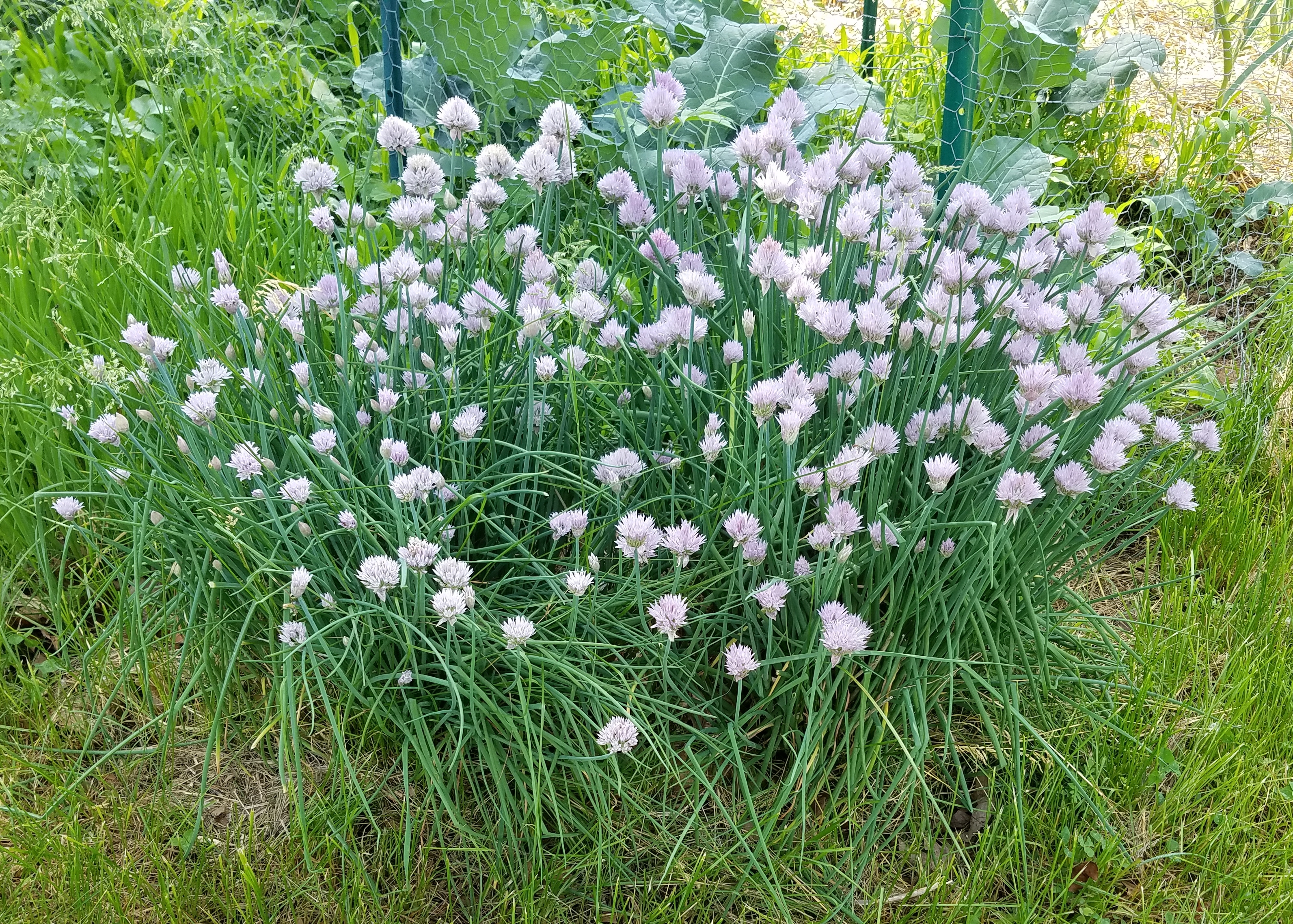
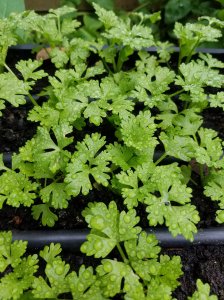
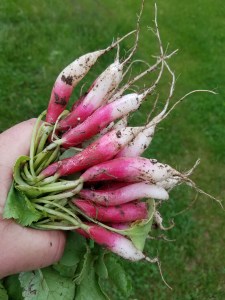
Harvest is ramping up with d’Avignon radishes, spinach, cilantro and chives heading to the kitchen.
I planned cilantro for my gardener’s lunch, and the spinach has been cleaned — some frozen and some in a big, recycled plastic clam shell chilling in the ice box. Chives will be for dinner and the radishes for snacks and salads.
This is why we have a kitchen garden.
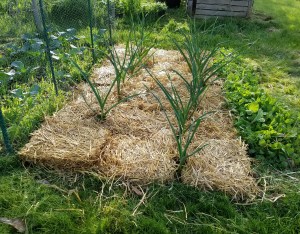
Yesterday I spent ten hours working in the garden. Big projects were making a space for zucchini and Marketmore cucumber seedlings, and mowing the lawn for the grass clipping mulch. I removed seedling rings from the kale, mulched garlic with a bale of wheat straw, and studied small sprouts to determine which were from planted seeds and which weeds. It’s not clear. Weeding and mulching are so commonplace it’s almost not worth recounting. It’s assumed.
Garlic Patch
Weather was perfect for being outdoors.
The harvest began before the garden is fully planted. Tomato and pepper seedlings mature in the greenhouse while celery plants are ready to go into the ground as soon as I can find time and a space. There are pickling cucumbers and green beans to go somewhere, winter squash to plant. The combination of planting, harvesting and cooking — kitchen gardening — will continue throughout the growing season.
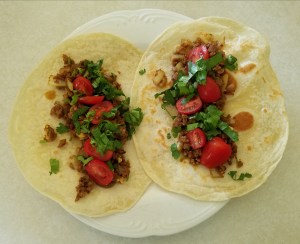
I stopped around noon and made lunch — fresh cilantro tacos.
Fresh Cilantro Tacos
Using pantry ingredients — storage onions, garlic, recipe crumbles, salt and home blended seasonings — I made a filling. I cooked tortillas in a large frying pan, and finely cut cilantro stems and ribboned the leaves. I topped the filling with halved grape tomatoes from California and fresh cilantro, which made the dish.
I bartered for a spring share at the farm so there are bags of greens in the ice box. We had a tub of firm tofu, so I decided on stir fry for dinner. Making stir fry is a way to use up vegetables.
I started two cups of raw brown rice in a quart of home made vegetable broth. I fried the tofu in olive oil, cut in half-inch by one and a half inch square slabs, then set them aside.
Included in the stir fry were baby kale (stems and leaves), carrots, onion, celery, garlic, pine nuts, halved grape tomatoes, red cabbage, a teaspoon of lemon juice and salt. Once the vegetables were soft, I spooned the mixture over a bed of rice and topped with spring onions and chives. It made four servings.
I texted Carmen to get the work forecast at the farm on Sunday. A light load of seedling trays is planned. After farm work, it’s back to the kitchen garden.
Two months into retirement I’ve learned how to avoid hungry dog syndrome and choose activities that conserve resources and contribute to improving our lives in Big Grove.
During personality tests taken while working in transportation and logistics I was identified with a “driven personality.” In retirement I’ve learned to hold my driving social style in abeyance and let others lead group activities. Part of retirement is moving to the side of the arena and letting others take the spotlight. I’m okay with that.
Stepping back has had positive consequences for our homelife. While I’m still in the mode of letting the turbulence settle in order to assess where we are, a few things stand out.
There are plenty of uses for the extra cash two days a week at the home, farm and auto supply store generates. My Social Security pension pays our basic bills. The extra cash can be applied to debt or go toward occasional shopping trips to improve home operations. Taking things slowly and considering each expenditure created a process to get our material lives in shape.
Through limiting the number of shifts of paid work, my plantar fasciitis is healing. The physical examination by a medical doctor informs what needs doing to maintain my health. Tracking health data helps me keep on my goals.
I remain interested in politics and stay informed about the campaigns in our districts. If needs are identified, I attempt to meet them and feel comfortable in a supporting role limited to within district borders.
There is time to work on things. I just go to one of my half dozen work spots and stay busy as long as I can. Then I rest and try it again while rebuilding my stamina. The process seems haphazard but helps me stay focused on tasks at hand. It’s a work in progress.
There has been more time to read and write. It’s been a slow reveal as to what my creative process will be going forward. I like what I see thus far.
I’m ready for retirement and in the early stage of figuring out what that means. Creative endeavor of youth is transformed into something more tangible and useful as we age. While I’ve been living a long time, I feel like I’m just getting started. That makes all the difference.
Fishing Trip with Maciej Nadolski (seated with beard)
The political, social and economic environment in Iowa deteriorated substantially over the last few years. What I mean is the 87th Iowa General Assembly was a pisser. What’s a person to do?
First thought was to chuck it all and move near our daughter in Florida. Father attended Leon High School in Tallahassee, and I worked for several months in nearby Ochlocknee, Georgia. I became enamored of the Spanish moss hanging from trees lining Highway 319 as I drove back and forth to the Tallahassee airport. “You and mom wouldn’t like it here,” our daughter wisely said.
If the sunshine state is out, what about Minnesota? It’s not far away and we have family roots there. They also have Democratic U.S. Senators — what’s not to like about that?
Our family doesn’t know much about why great, great grandfather left the Pennsylvania coal mines and moved to Lincoln County, Minnesota in the last decades of the 19th Century. Maciej Nadolski bought land from the railroad and settled a couple miles west of Wilno where he would go to town, drink adult beverages, and sleep in the wagon as the horse took him home. He did so even after his spouse joined him from Poland.
Wilno was the creation of the Chicago and Northwestern Railroad, the Polish National Alliance and the Catholic Church, according to Wikipedia. It seemed a lot like Iowa. I visited Saint John Cantius Church (established 1883) after Grandmother died and met briefly with the parish priest. He mailed our grandmother’s baptismal record. I drove the route the horse took to the home place where the then current owners let me look around. People in Ivanhoe, the county seat, weren’t wealthy and a bit scrappier than in Iowa. I was related to a number of people I met — shirt tail relatives were everywhere.
A few stories about farm life survived through family oral history. We know farming did not work out for the large Nadolski family. After 20 years in Lincoln County, they moved north near Argyle and tried it again. After ten years in Argyle, most of the family moved near LaSalle, Illinois.
Other parts of Minnesota might not be so bad. Grandmother worked as a maid in Minneapolis when she was young. We don’t like city life so much, but there are small rural cities like the one we live near today. Why not Minnesota?
I’ll tell you why. I was born in Iowa and this is my state. If the political, social and economic climate is not to my liking, I’d better damn well get busy and work to fix it. Thing is, my values are not that different from the values of most people I know. This creates an opportunity for change.
If my first reaction to the 87th Iowa General Assembly was “Nuts! I’m moving to Minnesota,” it is natural to revert to who we are in crisis. Now that we’re home, it’s time to get up from the wagon, sleep off the booze, and get busy building the environment in which we want to live. It can be done, it should be, and we’re up to the task.
The room was packed for the Johnson County Board of Supervisors public hearing on the County’s comprehensive plan. Current and would-be farmers were present and spoke about their profession. The hearing took two and a half hours.
Supervisors have been working on the plan for two years and would like to finish it and move on to what matters more, the Unified Development Ordinance, which codifies how the plan will be implemented. Last night’s public hearing brought the county closer to closure, even if the subject of land use will continue to be debated well beyond my years of walking the earth.
The main points were the 40-acre rule for definition of a farm is an obstacle to beginning farmers, and there is a wide difference of opinion regarding the role of animal feeding operations in producing the beef, pork and chicken non-vegetarians love to eat.
The Frequently Asked Questions page of the plan website addressed the first issue, “Will the new Comprehensive plan change the 40-acre rule?” Short answer is no. While officials expressed a desire to accommodate smaller farms during the process of developing the comprehensive plan, one expects the 40-acre rule to remain intact. A farmer can make a living on less than ten acres, especially if they can benefit from the State Code’s agricultural exemption from county zoning regulations. The path is unclear to enable farmers to acquire smaller parcels that would be zoned as ag exempt. There may not be a path, except by supervisors establishing special criteria and deciding each parcel individually on its merits. That’s no way to go. Not only is it labor intensive the politics of the board can and will change over time. People have spoken on the issue. Now it’s time to see what supervisors do.
If people want meat and meat products, livestock will be raised to meet demand. The words “concentrated animal feeding operation” have become a lightening rod of tumult about livestock production. Many do eat meat and few non-farmers want to live next to a livestock production facility. In any case, the State of Iowa maintains preemption over concentrated animal feeding operations. Under Republican control of government, preemption is here to stay. I doubt that would change under Democratic governance. People like their pulled pork, fried chicken, hamburgers and steaks, and it has to come from somewhere. Environmentally it would be better for humans to source protein from plants. If you believe they will over the near term, stand on your head.
The highlight of the hearing was a grader and son of a farmer who read an essay titled, My Barn. “I see my cows Jake and Nick coming up to me because they’re excited for me to rub their noses,” he said. “They feel as soft as a teddy bear.” The hearing engaged several livestock farmers. The ones who raised cattle and hogs took issue with persecution of their trade and the appellation “CAFO.” They said treatment of animals was humane on their farms.
There was insider baseball about the new map to accompany the comprehensive plan. My view is “whatever.” Let the supervisors decide based on best practices. There’s no going back to the way the land was before it was settled. It’s already been ruined by development and that happened in the 19th Century. The North Corridor Development Area has been designated as a buildable area in the plan in order to preserve county farmland. When one flies over it, it’s clear it has been settled from the outskirts of Iowa City and Coralville all the way to the county line. Everyone who has a strong opinion on the NCDA has an ox being gored. Speaker and naturalist Connie Mutel made the best case about how the new map was developed using “best practices.” Managing development in the county is like carrying water in a half empty leaking bucket.
Despite the serious nature of the presentations last night was fun. I got a chance to see friends and acquaintances in the context of working together to resolve issues of beginning farmers. That counts for something and in these turbulent times where would we be without that?
What of it, readers may ask. People go shopping all the time and some say our economy is predicated on consumers shopping.
That may be, however, in an hour and 12 minutes I spent 18 percent of our monthly budget on the stuff of living. It was a big deal.
The reason for the shopping trip was I took this week off from the home, farm and auto supply store to work on our garden. I usually dovetail shopping with trips to work. Garden time generated needs like a new 9-pattern spray nozzle to replace the one that began leaking, a dozen five-foot, light gauge fence posts for the garden, 100 feet of 4-foot chicken wire netting, and 50 feet of four-foot, 14 gauge, 2 x 4 welded wire fencing to make some additional tomato cages.
While there, I bought a new Stihl FS 56 R C-E loop handle trimmer. When the old, battery-powered Black and Decker trimmer broke I debated whether or not to acquire a gasoline or battery powered replacement. Two decision points. Even with two batteries the Black and Decker couldn’t trim the whole yard. Where the electricity to charge the trimmer batteries comes from is problematic.
We source electricity from the Linn County Rural Electric Cooperative and their generation partner CIPCO. More than two-thirds of electricity we use is generated by undesirable means: coal and nuclear. While the percentage of wind and solar CIPCO used increased in recent years, the Duane Arnold nuclear plant is a sore spot. The mix will change when the nuclear reactors go off line in the near future. I chose the most fuel-efficient of the Stihl line of household trimmers and expect to burn about two gallons of gasoline per season.
I stuck to my shopping lists even when I deleted the warehouse club list from my mobile device before arriving there. My mission was to find fruit. The selection of organically grown was very limited. Basically apples and bananas which both came at a premium price. I added a Dole pineapple on sale for $1.99 and a four-pound clam shell of grapes. The grapes weren’t the best — imported from Chile and treated — I won’t make that mistake again.
Finally I stopped at a large chain drug store on the way home. I go there three or four times a year to pick up personal hygiene items. The cost of razor blades has me thinking about letting my beard grow.
To acknowledge participation in consumer culture is essential. When I consider a history of my life, for good or ill, shopping has been part of it and an influence. When Father insisted on supporting César Chavez and the United Farm Workers’ grape boycott, we connected to the struggles of people who produce our food and learned a lesson about being a union family. That a gallon of milk cost $1.89 yesterday speaks volumes to the plight of family dairy farmers. That I get a discount for being employed at the home, farm and auto supply store is part of the reason I linger on into retirement.
This was my first big shopping trip of the year and may be the only one. It’s a small but important part of sustaining a life in a turbulent world.
When the Catholic Church built the new school, seventh and eighth graders were segregated from friends with whom we had been growing up. A group of us were mixed together in an advanced program for college bound students as a nun explained at the time.
I didn’t like it and continue to harbor resentment even though it was 1964 and the segregation proved to be the foundation of my interest in a creative life.
During the course of our succeeding years, neighborhood friends and I would never again maintain the “old school” relationship. Mostly I’m over it, I guess. I do have writing which relies upon the distance from peers I learned then. A bit of alienation is essential for writing or public speaking to be worth much.
These days each morning begins with creative work. Reading, writing and coffee mixed together beginning around 3 a.m. It has been a chance to understand a world that is increasingly complicated. If the morning is productive, I feel positive the rest of the day.
End of Personal Journal
I work on a few projects off-line but the majority of what I write is available to readers. Otherwise, what’s the point. For many years, from my first trip to Europe in 1974, until this year I maintained a journal. As one can see in the image, those days are finished.
There is also newspaper writing which includes many letters to the editor and the freelance work I did a couple years ago. Some pieces were edited more than others. These days what I send to the papers isn’t hardly edited. I value it all.
Writing on-line has it’s points. There is a chance to edit what was written both before publication and afterward. I don’t blurt out incoherent rants on-line as I did when a journal was a place to let off steam. Social media, especially Facebook and Twitter, serves as a creative outlet as well.
At its core writing originates in isolation from and connection to society. The two aspects are needed for it to be any good. When I review old pieces I am tempted to edit them, and my punctuation over the years has been inconsistent to be kind, but they capture moments I remember and wouldn’t change. There are also those where I don’t perceive myself in the finished piece. If that’s positive or negative I’m not sure, but the writing seems really good when I rediscover those.
We carry a limited amount of stuff where we go. The transition from old to new school is one that’s always in my kit bag. It taught me how social forces and institutions can tear us apart, and sometimes provide the foundation for something equally good or better.
A relationship with food in American society is complicated.
Some don’t have enough. Others are awash in calories. We each have a human need for nourishment and the ways we go about meeting it are as different as the families which engendered us.
A favorite childhood memory is when Mother went to work in the school cafeteria after the Catholic Church built a new grade school near our home. With other women like her, she took a list of ingredients based partly on government programs (including lots of cheese) and partly on a limited budget, and made meals that included such dishes as porcupine meatballs (hamburger and rice) and grilled cheese sandwiches with tomato soup. Father worked at the meat packing plant which had an employee butcher shop where he could buy beef, pork and meat products at a discount, and did. The idea of stretching hamburger by mixing it with cooked rice was a novelty in our household and eventually we implored Mother to make porcupine meatballs for us at home, just like the ones at school. She did.
This story of external culinary practices coming into our home is essential to understanding the rise of a diverse diet in American society. We see things out there, they look good, and we want them. Most people, including low-wage workers, have or find the means to get them.
Many books, careers and lives have been based on food in society. We are an individualized rather than generalized culture with regard to food acquisition, preparation and consumption. To a large extent, the rise of the modern mega grocery store has shaped our eating habits in ways no one would have expected. Much ink has been spilled about that and I’m less interested in regurgitating my slice of it.
What I do know is local food farmers work hard for the sparse income they garner. All farmers do. The local food movement of which they are a part is based on the hope more people will bring locally produced, raw ingredients produced in a sustainable manner into their kitchens, ice boxes and pantries. Enough people do for a small group of farmers to make a living.
In many ways the increased interest in local food is the same type of behavior that took place in our home in the 1960s. We experience surprise when our CSA share includes Broccoli Raab, Koji or Bok Choy. We learn how to eat and cook them and want more. It’s not that our home nourishment plan is boring. We want and enjoy the experience of creation as it relates to cooking and eating. We want that experience to be personal and shared with family. That is very American.
I concede promotion of local food is a form of consumerism no different from a tomato catsup purveyor who spends dollars on an advertising campaign to enhance sales. The same behavioral forces are at work. I’m okay with that.
Just so you know, I’m not bewitched by the allure of eating a kale salad, at least not yet. Suffice it to say the diversity and behavior regarding food in our household with its kitchen garden, farm sourcing and grocery shopping has some unique qualities that may not be of interest to the authors of the Michelin Guide, but make our lives a little better. That too is very American. That’s part of who I am, who we Americans all are.





 Journey Home
You must be logged in to post a comment.