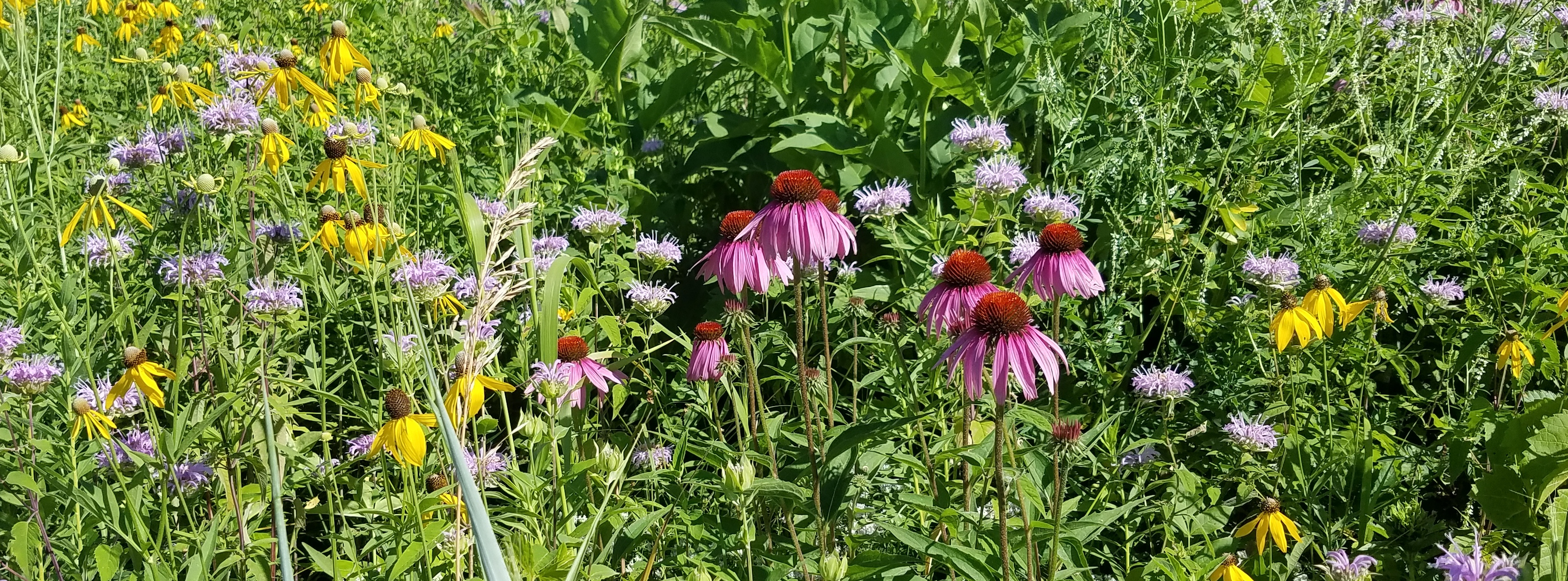
Prairie Restoration Area at Lake Macbride State Park
Each time I walk on the state park trail there are different wildflowers in bloom. Today’s offering was some of my favorites.
After returning from the day’s exercise, I mowed the front yard and couldn’t make out the line where the back yard started. Grass apparently wasn’t tall or thick enough to need cutting so I stopped and put the mower away until there would be enough to use as mulch.
I raked what few grass clippings there were for the garden, checked the moisture in the last few seedlings, and went inside to spend the rest of the day as temperatures climbed toward 90 degrees. We’re to have several days like this without rain.
We enjoy sunny days while we can. The restored prairie shows its pleasure in them with wildflowers in bloom.
On a fine summer day conditions were perfect to harvest hay and garlic.
My CSA friends recruited volunteers to bring in the garlic and across the county farmers were baling hay in large round and small rectangular bales.
On Independence Day farmers came to town to buy cultivators, salt blocks, pumps, feed, big pedestal fans, bedding (for horses), air compressor parts, nuts and bolts, and other stuff of life. At the home, farm and auto supply store we also sold a lot of propane, grills and kayaks, but that was not to farmers, as a farmer plans his/her kayaking and grilling ahead of time.
The rain has been good enough my garden doesn’t need much watering. Predatory insects are noticeably in abeyance, I suspect because of the polar vortex and extremely cold temperatures last winter. Tomatoes look as good as they have in years. It is already hard to use all the cucumbers. There will be green beans, okra, hot peppers, eggplant, squash, kale, carrots and more by the time August is finished.
We love summer.
Actually, we love life even in the extreme weather brought on by our own assault on nature. That we have perfect conditions for haying and garlic harvesting may well be an anomaly going forward. It was enjoyable this year and will be for however long it lasts.
I viewed the president’s speech on the environment on YouTube. It was not about climate change, human-made or other. In fact, the speeches by the president and about half a dozen others were devoid of any mention of the science of climate change, or solutions to solve the climate crisis.
I feel certain the bait shop owner from Florida has seen improvement in his local environment by the administration’s work on red algae. His speech was unprepared and somewhat random, but a slice of Americana available for public consumption and that, maybe, was the point. There was praise for the president from his staff, including the despised Andrew Wheeler, current head of the Environmental Protection Agency. If one adds up everything in the 56 -minute event, if we didn’t know the science of climate change, it would be believable. The climate crisis was absent from the environment Trump depicted and that is the problem with the Trump administration.
What bothered me the most, as it does any time I listen to the president, it’s the assertion that covers up a lie. Wheeler was bragging on how many super fund sites have been deleted from the list. Were they actually cleaned up or just declared clean and deleted?
I agree with Al Gore’s analysis:
Sometimes it’s hard to tell the origin of hot weather. Is it coming from Anthropogenic climate change, or from politicians in Washington, D.C.? Maybe a little of both.
Over the weekend Erin Murphy, a Lee Enterprises Des Moines based reporter, said it was quiet in Iowa’s congressional primary races.
“Perhaps in the coming weeks and months, some of these quieter primary races will become more crowded,” Murphy wrote in the Quad City Times. “For now, though, the fairly low level of interest from candidates has been surprising.”
Murphy recounted the five 2020 congressional delegation races, noted who was in each race, and which were conspicuous by the absence of a declared candidate from one party or the other (a Democrat in Iowa 4 and a Republican in Iowa 2*). It is a long time until the June 2020 primary election, so Murphy’s surprise seems premature, even if he acknowledged the 11 months in the article.
My sense, from talking to Democratic voters, is there is near universal belief “we have to do something.” By that, they mean overturn Republican control of the presidency, keep the U.S. House and retake the U.S. Senate, and win one or both chambers of the state legislature. People are dead serious about it and seem willing to devote resources to making it happen. They will be sure to show up to vote in the general election.
The disconnect, and maybe the premise for Murphy’s article, is between the “we have to do something” feeling and nominees produced by the party. Voters I talk to don’t care that much about who is nominated for Congress and U.S. Senate unless they are an incumbent. They just know what we have now isn’t working.
I know what that’s like. We had to do something toward the end of George W. Bush’s first term. My response was to pick a race, focus, donate money, and volunteer every chance I got. I felt long-time Congressman Jim Leach had to go. While the Democratic challenger Dave Franker wasn’t the best candidate, everyone who volunteered on his campaign worked hard toward his election. “It didn’t work out well,” I mentioned to Dave Loebsack via email when he established an exploratory committee for the Second District Congressional seat in March 2005.
I put 2004 behind me and re-started my effort to ouster the incumbent. Voters I spoke with on the telephone and in person had turned against the once popular Leach. It almost didn’t matter our candidate was Dave Loebsack, because the expressed need for change was so prevalent. We went into election night not knowing if we’d win but hopeful based on the large number of voters who’d had it with the incumbent. As we now know, Loebsack was successful in defeating him.
I haven’t started door knocking or calling voters in 2019. As I mentioned, “we have to do something,” and that’s similar to 2006 which was the beginning of a Democratic wave that culminated in a national trifecta in 2008.
Why is it so quiet in the congressional races in July? I’m not sure that’s an accurate statement. Maybe there are less candidates running, however, the noise, if there is any, is more among rank and file Democrats, particularly those who are normally less active, taking it all in and discussing politics with friends and family. They need space to consider candidates in lives that don’t normally revolve around partisan politics. Outside the presidential preference at the February caucus, most don’t really care who nominees are as long as there is a D behind their name and candidates act like it. People are making room for politics in busy lives, but it hasn’t the high priority that will drive a more exciting race of the kind Murphy was expecting.
Resolved not to let Trump and the Republican policies stand, people seem hunkered down trying to make a go of it in an economy that favors the wealthy and where corporations strive to squeeze regular people out of every last dime. Maintaining the type of resolve needed to change our government takes energy, just a different kind than what’s represented in an active, multi-candidate primary.
People say an open primary and debate between multiple candidates is good for the party. I don’t know about that. Rank and file view it differently and people seem to take stock before declaring candidacy, realizing the financial investment in one of these five races will be significant. Maybe what you see is what you get and others don’t want to run of office.
July 2019 may be the quiet before a political storm that’s brewing next year.
* On July 8, Erin Murphy reported that Bobby Schilling filed paperwork with the Federal Elections Commission to run for Congress in Iowa’s second district as a Republican.
Blaming the woes of society on our K-12 education system is a habit I need to break.
In the post below the target was a failure to teach children about their responsibilities when signing student loan papers. A high school graduate is an adult at age 18 in our culture, so when taking on debt that has the potential to cripple them for decades, they should be equipped to know what they are doing.
Parents also play a key role in educating youth, however my grievance with the way the Iowa legislature funds public schools is they are not spending enough money where it is most needed, and the results show in the form of an ill-educated electorate that makes what I believe are bad decisions.
It is unfair for me to pin this on public schools as State Senator Claire Celsi immediately pointed out:
In the July issue of The Atlantic, author Nick Hanauer addresses the tendency to blame public schools in an article titled, “Better Public Schools Won’t Fix America:”
Long ago, I was captivated by a seductively intuitive idea, one many of my wealthy friends still subscribe to: that both poverty and rising inequality are largely consequences of America’s failing education system. Fix that, I believed, and we could cure much of what ails America.
This belief system, which I have come to think of as “educationism,” is grounded in a familiar story about cause and effect: Once upon a time, America created a public-education system that was the envy of the modern world. No nation produced more or better-educated high-school and college graduates, and thus the great American middle class was built. But then, sometime around the 1970s, America lost its way. We allowed our schools to crumble, and our test scores and graduation rates to fall. School systems that once churned out well-paid factory workers failed to keep pace with the rising educational demands of the new knowledge economy. As America’s public-school systems foundered, so did the earning power of the American middle class. And as inequality increased, so did political polarization, cynicism, and anger, threatening to undermine American democracy itself.
Hanauer assigns blame to our economic system: income inequality and the fact workers are underpaid.
“Allow economic inequality to grow, and educational inequality will inevitably grow with it,” he wrote. “By distracting us from these truths, educationism is part of the problem.”
While sad that my participation on Twitter is sometimes a distraction, eventually I can get around to a more reasonable position thanks to the commentariat. One commentator accused me of adopting the policies of U.S. Senators Chuck Grassley and Joni Ernst. That’s not the case, but at least we didn’t have to invoke Godwin’s Law to resolve the issue. Despite any issues with an ill-educated electorate, hope for a better world remains.
The garden was muddy making it difficult to plant… so I waited.
For exercise I took a walk on the state park trail, 20 minutes out and 20 minutes back… with stops for photos.
Wildflower
Although the pace was slow, I could feel the benefit of the walk. It energized me to install the deer fence around the tomatoes and perform a few garden chores before an afternoon thunder storm.
I picked turnips and sugar snap peas from the garden. The first Japanese beetles have arrived. The six-foot stakes worked well to protect the tomato plot from deer who eat the top shoots if they can get to them. It makes a significant difference in yield. Almost everything looks good.
With season’s end of soil blocking tomorrow comes blank space to fill… or not. I’ll do something but let go of filling every moment with intentional action a while back.
One of the most profound things I studied in art history was horror vacui, or fear of the empty. We looked at photos of Greek vases where every space of the surface had images on it. The human tendency is to fill everything the way a person gets a tattoo or two and ends up with a full sleeve. Fear of the empty. It is more creative and more difficult to leave spaces blank. Letting go the obsession to engage every chance to express ourselves frees us to produce better work.
A gardener gets time to think about things like this… and watch the arrival of Japanese beetles, and vegetables planted with one’s own hands grow in sunlight, and devise unique solutions like my deer fence.
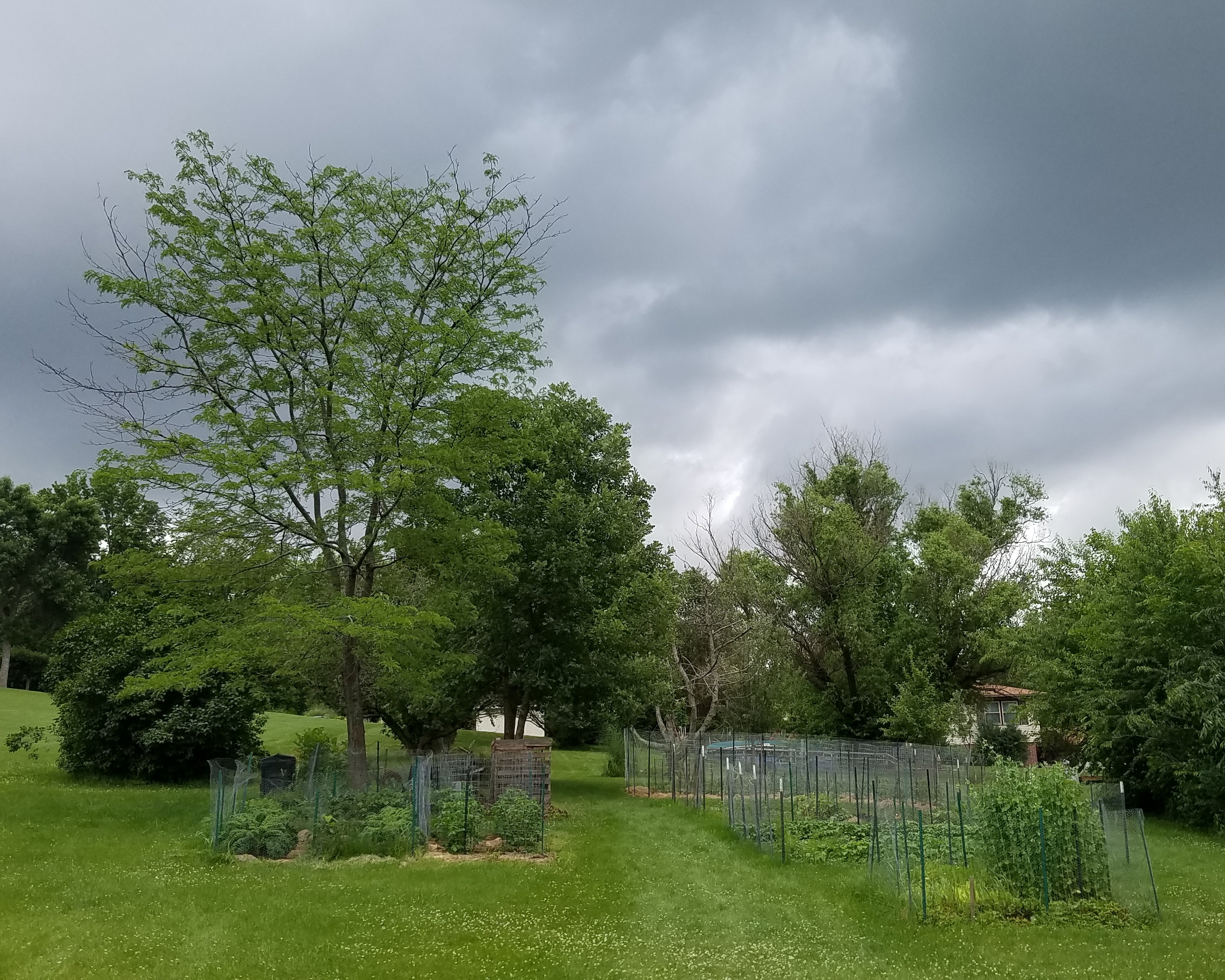
Some days we have to stand back and look at what we’ve built:
Ideas about how to cook are ubiquitous. Everyone — family, friends, neighbors, co-workers, chefs, dish washers, dieticians and scientists — has something to say about it. Almost everyone cooks. Talk about cooking can be devilishly engaging. Are there things we can do in our kitchen to mitigate the effects of the climate crisis?
It’s not clear how climate change impacts cooking once we get in the kitchen. We should minimize the use of water, electricity and natural gas while cooking. Many are and everyone should be doing so. Maybe that’s the point. Cooking is so common it’s hard to distinguish one process from another when it come to mitigating the effects of the climate crisis.
We recently lived through a rise in manufacture and consumption of pre-cooked and processed meals and ingredients, increased the amount of food grown closer to home, and changed consumer behavior due to national health scares originating in large farm fields in California, Arizona and Florida. Our collective actions to mitigate the effects of climate change, whether in the kitchen or elsewhere, matter in a time of hegemony of fossil fuels culture. For most, spending time cooking is when we nourish ourselves and practice culture that helps us deal with the complexities of a turbulent world. Cooking helps us focus on what we can control.
Inputs
Inputs set the stage for cooking. The focus is often on where ingredients originate and their environmental cost. That remains important yet I also refer to the framing of our lives in society, including land use, construction practices, kitchen configuration, water sourcing, energy sourcing, and education. All of these are inputs to cooking as they are to how we live our lives.
I’ve written about the importance of sourcing as much food as we can locally. My advice is get to know the face of the farmer where possible, and read the ingredient and nutrition labels on anything else.
If one has space, time and the ability, grow some of your own food. Not only can it taste better, time spent in a garden is enough exercise to avoid a trip to the gym or grocery store. Over our years in Big Grove I’ve developed a kitchen garden where what we eat and cook has become synchronous with seasonally available foods.
A cook includes ingredients grown or made a long distance from home where they offer something unique. Nutmeg and black pepper are examples of spices that serve a vital purpose but are not available locally. When the choice is learn to live without them or accept them for what they are, cooks will choose them as long as they are available. I don’t question that impulse.
Assembling and preparing ingredients on a counter t0 mix, saute, fry, steam, grill or bake them into a meal is fundamental. How much water, electricity and natural gas we use is part of background noise: important but seldom the focus of attention except when we configure our kitchen. Seeking energy efficient appliances and a faucet aerator are basic. Once a kitchen is configured few additional changes seem likely. Many of us don’t have the opportunity to configure a kitchen, especially when living in an apartment.
Simple practices like selection of cookware that retains heat, avoiding long preheating of the oven, keeping the oven door mostly closed while baking, and washing vegetables in a bowl instead of under running water have impacts.
A significant aspect of climate-friendly cooking is buying ingredients in a way that avoids food waste. Have a meal plan and buy only what’s needed for it. Plan to use up what’s in the ice box before it goes rotten when planning meals. These practices should be taught in the K-12 school system.
Our household eschews meat and meat products and has since we married in 1982. I’m an omnivore (just barely) and don’t understand the aversion to going meatless. Production of meat contributes to global warming and even if it is only one “meatless Monday” per week, reduction of meat consumption is basic enough that every household can do something.
Outputs
Cooking in our household is an irregular attempt to make something from ingredients that arrive unevenly over time. Cooking is about output, mostly what we serve for meals from our efforts. It is also about how we use what’s generated from the kitchen, including food waste, food storage and cooking by-products like carrot peels and pasta water.
I am a fan of Tamar Adler’s An Everlasting Meal: Cooking with Economy and Grace. Shortly after I read the book in 2011 I spent time generating the next meal from the previous one as she suggests. Adler presents an example of how cooking can be an efficient process that produces delicious meals. While her book is not about climate change, by being an efficient cook less resources are required and it can be better for the climate as well as our pocketbooks… and taste buds.
Our refuse company picks up weekly but we seldom put both containers at the end of the driveway. We could do better in reducing waste but in the kitchen every scrap leftover from inputs and meal production is put to use. We save leftovers for following meals. When there is excess produce we freeze or can it. Because we have a kitchen garden there is never enough compost so organic material goes into a stainless steel bucket, then out to a household waste composter near the garden. Using the results of kitchen production has become a part of a life that would seem weird if we didn’t do it.
Conclusion
The climate crisis is real, it is happening now, and the potential for global warming to harm us and our society is ever present. Cooking is ubiquitous, and determining ways to cook efficiently and with a smaller carbon footprint is as important as many things we do to mitigate the effects of climate change. It is not everything. It is something.
A brilliant, partly-cloudy sky hung over the landscape as I made my way east on Interstate 80.
Rain broke long enough to allow a trip to Davenport to visit Mom and a friend I met in grade school.
Mother insisted on making coffee and it was the best I’ve had in a while. It took her longer than it would have me, but I stood with her and helped as best I could. At age 89 she wanted to do it so who was I to object?
She’s joined the cohort of octogenarians who dread the thought of going into a nursing home when staying at home no longer works. This dread is almost universal among Americans and with good reason. Almost everyone I know who had experiences with a relative checking into a nursing home has a horror story or two about neglect and mistreatment.
I believe the problem with nursing homes is, like with other modern social phenomena, mostly because of the decline in K-12 education, the rise in private and home schooling, and the dominance of FOX News and right-wing radio among people who continue to be radio listeners or view television broadcasts and cable. People have been dumbed down and will swallow almost anything they hear repeated often enough.
Nursing homes don’t have to be as bad as they are, but education and social learning haven’t prepared us as well as they could for getting help with aging relatives. Most people can’t afford an in-home nurse when someone requires 24/7 attention. A nursing home has become the best opportunity to enable a loved one to live their final time on Earth with dignity. Indignities regularly imposed on residents become exceptionally objectionable because of this.
I met my friend for lunch at an Italian-style restaurant. Italian restaurants usually have fresh salad offerings and this one was no exception. They offered some “Chicago-style” dishes which apparently are gaining popularity in my home town. Like with Mother, my friend and I had an engaging visit.
I got sleepy and stopped at the rest area halfway home to walk around. A great thing about Iowa rest areas is they have clean rest rooms and drinking fountains with free, chilled, filtered water. Refreshed, I made it home okay, passing presidential candidate Tulsi Gabbard’s advertising billboard outside Iowa City. One may try to get away from it, but politics never takes a holiday.
At home, I mowed the lawn as best I could, breaking a sweat. The ambient temperature was moderate and the sky remained bright. As I mowed around the garden, the grove of fruit trees, and lilacs, I was reminded of how much yard work remains to be done to get the property in suitable shape. My solace can be found in the Meriam Bellina song,
One day at a time sweet Jesus
That’s all I’m asking from you
Just give me the strength
To do everyday what I have to do.
Yesterday’s gone sweet Jesus
And tomorrow may never be mine
Lord help me today, show me the way
One day at a time.
I need to make another pass to pick up the grass clippings for the garden.
The garden patch has standing water in divots dug last week. When I mowed near the ditch the sound of running water informed me it hadn’t dried out and might not this year. Gardeners on social media are getting their vegetables planted, and this is the latest start they can remember. The wet spring has been problematic, although all is not lost… yet.
Soon corn farmers will have to turn to beans if the ground doesn’t dry out enough for planting. With China no longer wanting corn and soybeans because of U.S. tariffs, the prospect of plummeting soybean prices is real, and farmers will take it on the chin… again.
All in all Saturday was a positive day in a turbulent world. Hopefully I’ll get some garden time in when I return from the farm this afternoon.
The myth of relaxing on a towel at a beach, sunglasses and sunscreen on, reading a book may not exist for most of us in Iowa. The beach nearest us has been closed in recent seasons because of the risk of exposure to microcystin and E. coli bacteria, both harmful to human health.
Nevertheless, reading is an important part of summer activities, and essential for people engaged in society. Our home owners association has a monthly meeting at the public library where staff politely boots us out in June and July because it falls on the same night as the summer reading program. Summer reading is one of the most important programs at a public library.
When I write “reading,” I mean books. A lot of our time is spent reading news articles which, while important, does not involve the kind of commitment as reading a book cover-to-cover. I started the Goodreads Reading Challenge last year and it helped me stay focused on reading. I’ve read 16 books this year and you can see which ones on my Reading List page.
Here, in no particular order, is a list of ten books on my bedside table for reading this summer:
Where the Light Enters: Building a Family, Discovering Myself by Jill Biden.
The Tallgrass Prairie: An Introduction by Cindy Crosby.
The Radium Girls: The Dark Story of America’s Shining Women by Kate Moore.
The Overstory by Richard Powers.
Pacific by Simon Winchester.
Milkman by Anna Burns.
The Wizard and the Prophet: Two Remarkable Scientists and Their Dueling Visions to Shape Tomorrow’s World by Charles C. Mann.
The Uninhabitable Earth: Life after Warming by David Wallace-Wells.
Janesville: An American Story by Amy Goldstein.
Energy: A Human Story by Richard Rhodes.
While beaches may be closed due to environmental pollution, I plan to find a shady spot on our property or a comfortable chair inside to crack open a book from time to time this summer. Please do leave a comment with what you are reading this summer below.
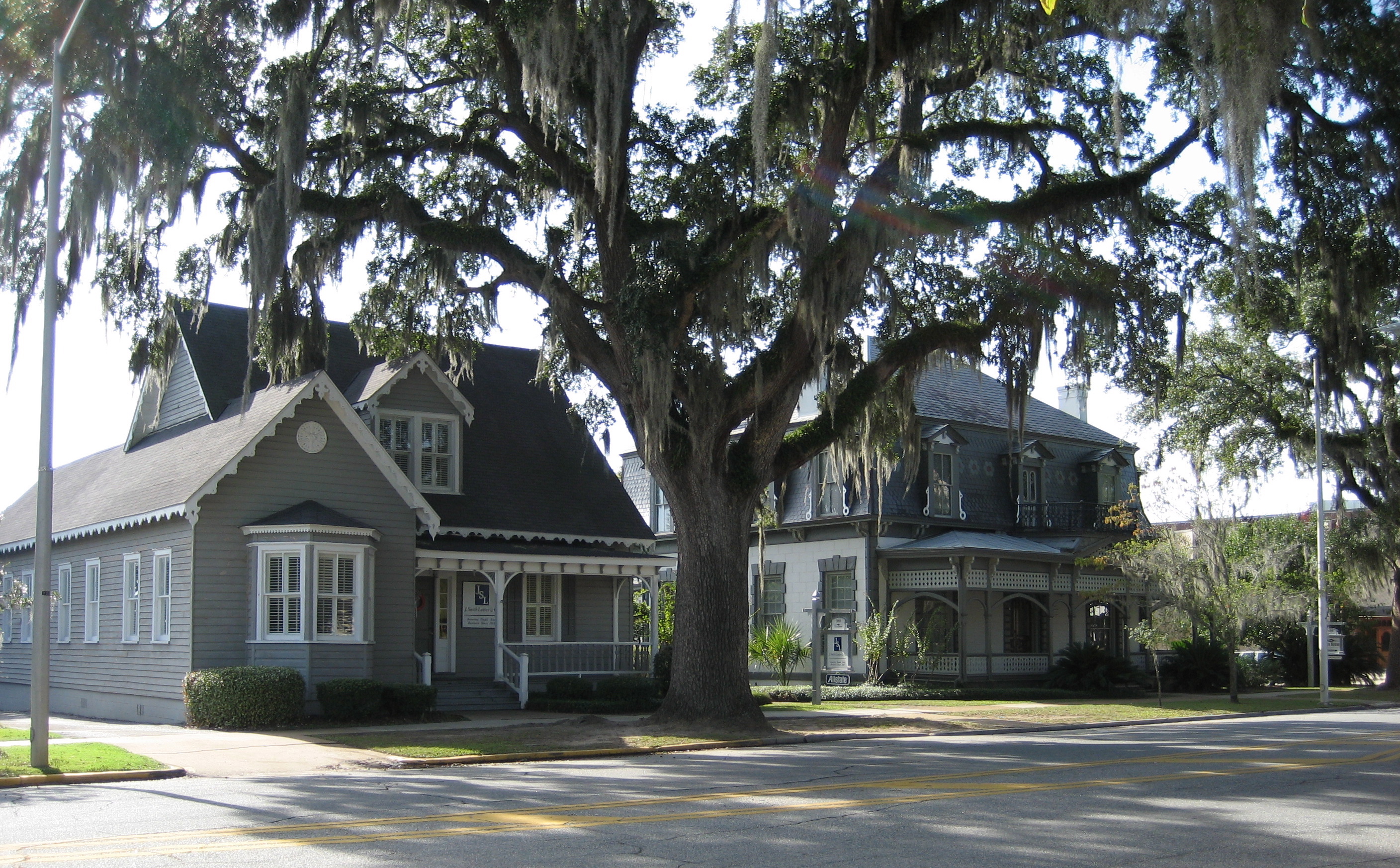
Spanish Moss on a Tree in Thomasville, Georgia Photo Credit – Wikimedia Commons
My memory of South Georgia is specific. I don’t know if it’s real.
As a child, our family drove from Iowa to visit Tallahassee, Florida, the place Father lived after re-uniting with his father after Grandfather’s release from prison. For the record, Grandfather’s conviction for draft evasion was a misunderstanding. He hadn’t meant to be a draft dodger during World War II, according to his late, youngest son Eugene. Dad graduated from Leon High School, then enlisted with his brother Don in the U.S. Army.
That trip was to visit relatives in Wise County, Virginia, according to a recent conversation with Mother. The Tallahassee stop was a side trip. I don’t recall whether the memory occurred southbound or northbound, maybe both.
The memory is of riding in the back seat of the family automobile as Father drove on two-lane Highway 319 where Spanish Moss hung from oak trees with branches extending over the road. Mother was in the passenger seat, I was in back with my brother and sister. Except for Dad, we had never seen Spanish moss before. We did not have that in Iowa. We visited the plantation where Father stayed, Leon High School, and maybe stayed over in a motel, I can’t remember. These events and the long trip at slow speed through the Spanish moss-hung oak trees rolled into one over time, It was almost 60 years ago.
In 1997 I had a three-month work assignment near Ochlocknee, Georgia. My project was located at the largest employer in the county, which was and is involved in mining and processing minerals for a variety of consumer applications. No local ever complained to me about the mines. The rest of the economy was agricultural: peanuts, cotton and pecans.
Because Tallahassee was the closest airport, I flew home from there every other week, driving the same road I had as a child, replete with oak trees hung with Spanish moss. I lived there long enough to recognize other flora and fauna. In particular, pine forests and pecan plantations. The road seemed the same as my childhood memory. I made this regular trip between Ochlocknee and Tallahassee for most of my stay.
The memory sparked an interest in Janisse Ray’s memoir, Ecology of a Cracker Childhood. I wrote the following brief review in the Spring edition of the Prairie Progressive:
Other than authors of country music, few write about the pine forests of South Georgia. Janisse Ray’s memoir, Ecology of a Cracker Childhood, is important for the sense of place it creates. She grew up in a junkyard with ever-present extreme poverty, mental illness, and fundamentalist Christianity. Her story is one of growing self-awareness and hope in a land where both were in short supply.
While Ray is ten years younger, we share cultural references. Perhaps the most significant is the sense of loss she describes for Long Leaf Pine forests and their ecology. I feel much the same living in a state where what was here — tallgrass prairie — has been replaced by fenced parcels where farmers grow crops and raise livestock. Her experience in Georgia informs my life in Big Grove.
Ray mentions Thomasville, Georgia a couple of times in the book. I stayed in Thomasville while working at the mine. There was little daylight between work and rest so my life then was very specific.
The biggest excitement during my stay was when an inspector found a boll weevil in a trap during the season. Boll weevil traps were part of an early warning system to prevent damage to the important cotton crop. One of the plant workers at the mine had a government contract to inspect boll weevil traps. When he found one it made news all round the county.
The first boll weevil appeared in Thomasville in 1915. The insect did its part to bring down the antebellum economy where cotton was a global mainstay. Boll weevils had supposedly been eradicated by chemicals by 1990, but weren’t.
Ochlocknee, Georgia was a poor place where cattle casually roamed Main Street and a Model T Ford sat up on blocks in someone’s yard. I went to the auction house one night, but had no way to transport anything home. I listened to the bidding and tried to keep my hands down. Lunch at the Depot Restaurant was a meat and two sides with iced tea. A diner could pay extra and get a third side. The restaurant has since closed. When I encountered locals outside the job site, the conversation was a mix of complaining, gossiping and harshness. The place and its people defined hard-scrabble.
I had few friends in south Georgia. After working a 13-hour day at the plant, I made dinner at a hotel and watched cable television including a fledgling channel called Food TV. The name later changed to Food Network. I attribute my interest in food and cooking to those nights alone in Thomasville. My involvement in the local food movement has its origins in the contrast between that uninviting place in South Georgia and my nightly food escape. We didn’t have Food TV in Iowa at the time. Like Spanish moss, it seemed exotic.
The main memory, of driving through Spanish moss hanging from branches over the highway, is essential. It is an unchanging remembrance of something seen as a child in a way that shaped me. It has no time or place and some days I don’t know if it’s real. It is the human condition to believe it is real, and eternal. So I do.
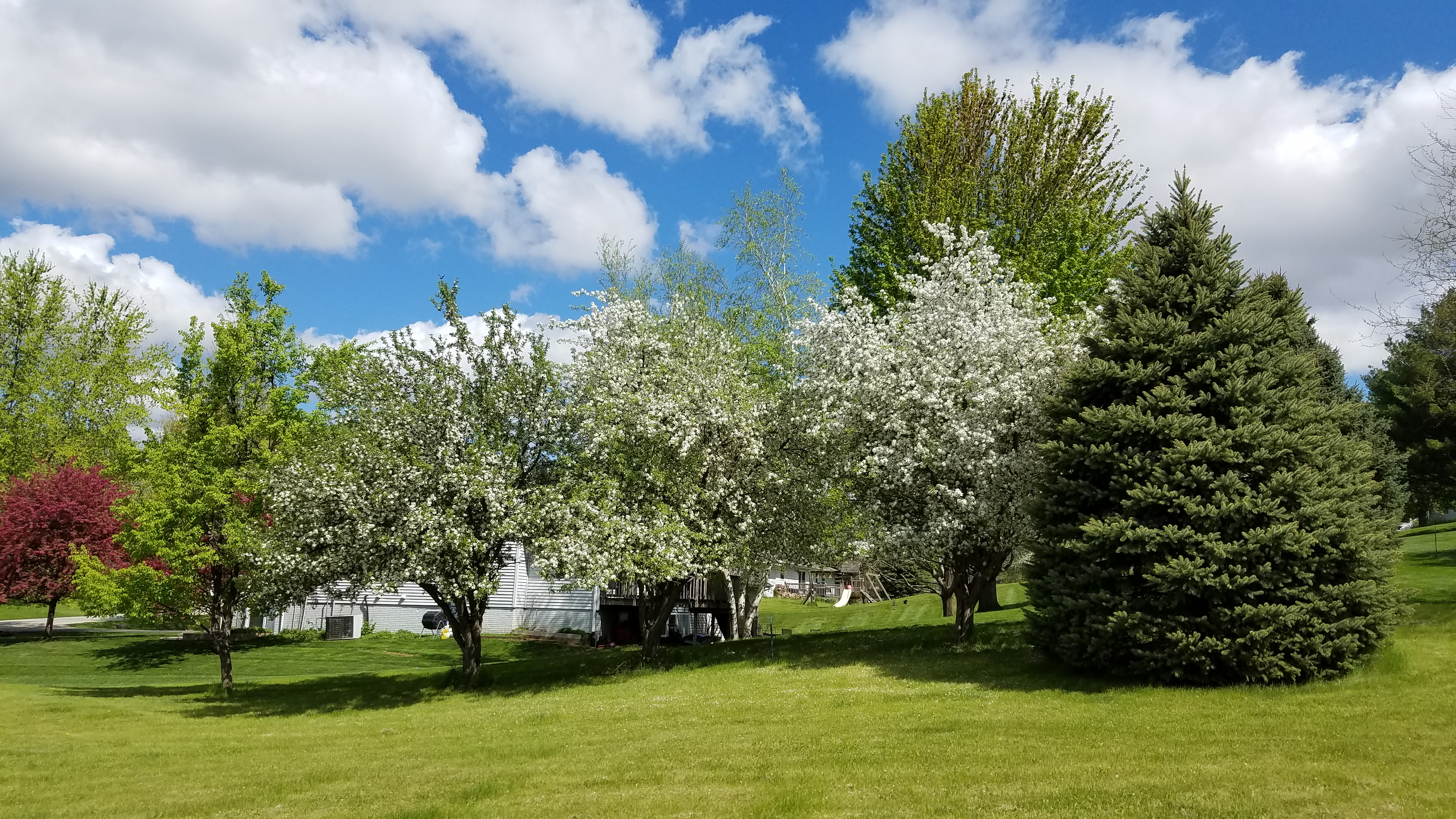
On a sunny Friday among peak apple blossoms I cleared the fourth plot for a multi-crop gardening area.
The first three plots have early vegetables and are not completely planted. With eight trays of seedlings ready, and more in the greenhouse, it’s time to get them, along with seeds I’ve been holding, in the ground.
I don’t clear garden plots in autumn. I’ve read it’s best to leave them and let small rodents eat the weed seeds left behind. Clearing a plot becomes a bit of a spring production.
I remove the fencing, cages, fence posts and any non-organic debris. Then I gather brush generated since the last burn pile and burn it with straw from the plot. Once the fire dies down I run the mower over it with the deck as low as it will go. Yesterday this produced a 15 by 12 foot plot ready for planning, soil preparation, planting and fencing.
The plan is for spring onions, celery, spinach, lettuce, radishes, leeks, green beans, red beans, chives, arugula, basil, parsley and cilantro. The plan is written, now subject to further consideration and modification as I turn the soil, spade-by-spade and attempt to beat forecast rain.
This work is the core of who I am. I’m thankful to be able to do it.






 Journey Home
You must be logged in to post a comment.