On a mild, clear Sunday I planted cool weather crops.
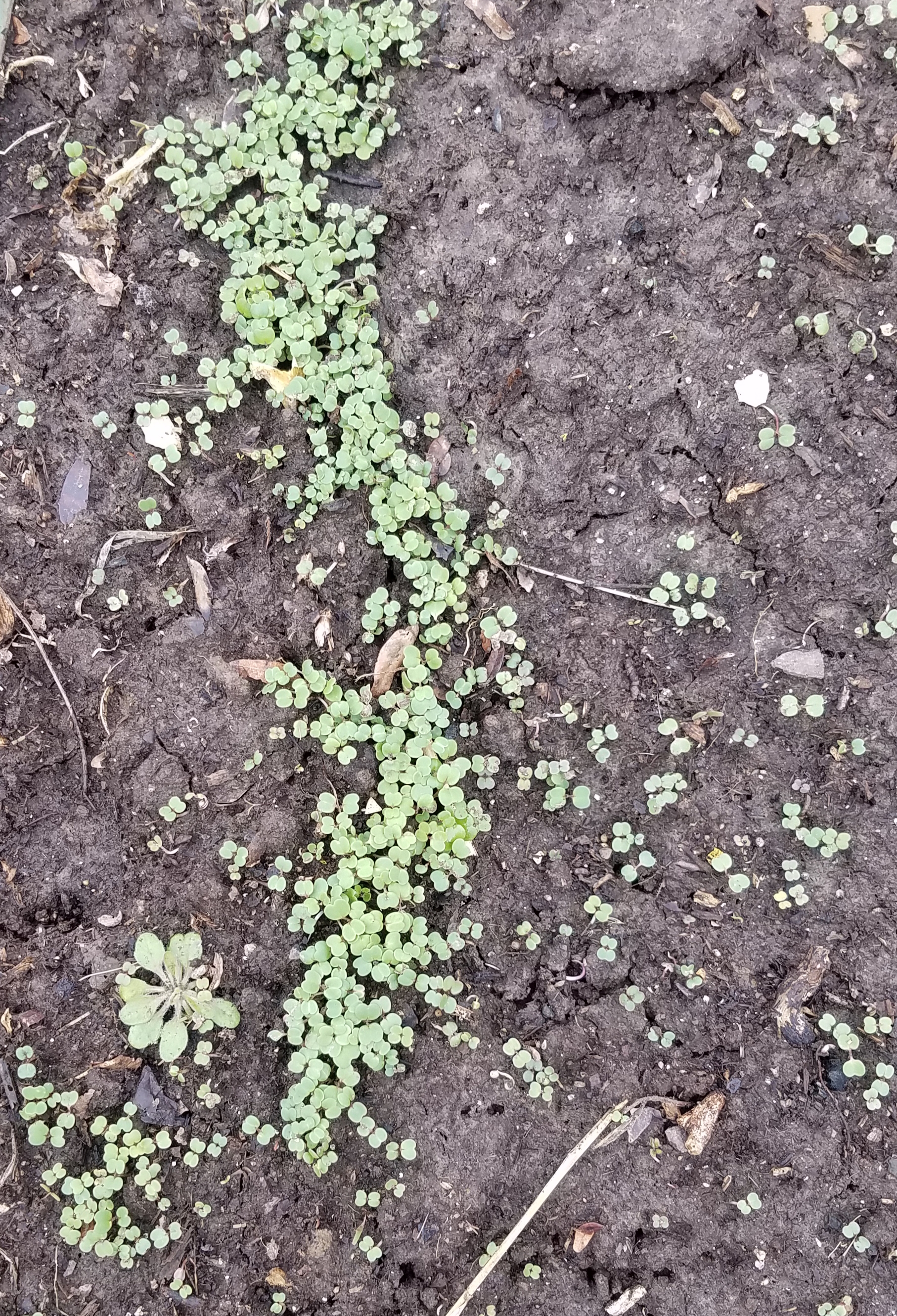
Arugula and lettuce planted in the ground March 2 are coming along. I tasted a tiny arugula leaf to confirm what it was. Mmmm. It won’t be long before I can make a pasta dish using fresh arugula with bow tie pasta.
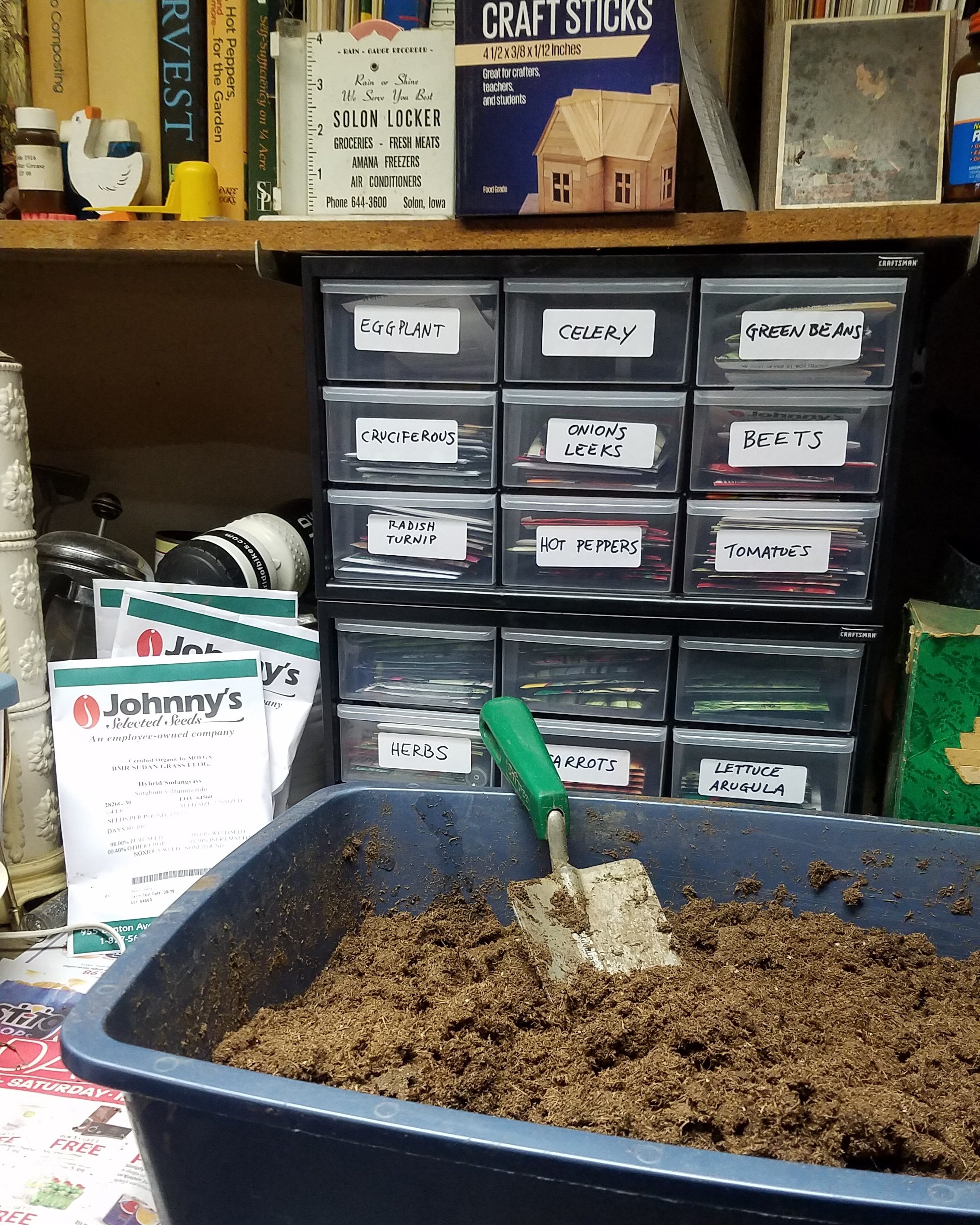
In spurts of action with deliberate steps — a process developed as I slow down in the garden — I planted beets and turnips to fill out a patch near the early arugula and lettuce, and filled four containers with two varieties of potatoes, one with radishes and another with three types of onions from the home, farm and auto supply store to be harvested as spring onions. I filled out the onion container with basil seeds. It felt like I made progress.
I mulched the leaves remaining in the front yard, cleared off the plot which grew kale and cherry tomatoes last year, and removed the wire containers from the plot near the in ground containers. There’s more work to do as long as the rain holds off. I planted in soil:
Potatoes
Red Norland, ten weeks.
Kennebec, ten weeks.
Onions
Three varieties of bulb onions, three to four weeks for spring onions.
Turnips
Purple Top White Globe, Ferry-Morse, 55 days.
Purple Top While Globe (certified organic), Johnny’s Selected Seeds, 50 days.
Basil
Sweet Italian Basil, Ferry-Morse, 70 days.
Radishes
Red Meat, Johnny’s Selected Seeds, 50 days.
French Breakfast, Johnny’s Selected Seeds, 21 days.
Icicle Short Top, Ferry-Morse, 28 days.
Champion, Ferry-Morse, 28 days.
I removed the automobiles from the garage as I have each spring while planting the garden. I noticed my inventory of powered equipment increased. With a gas-powered trimmer, an electric tiller, two lawn mowers, and an electric and a gas-powered chain saw, it feels like I’m ready. The electric tiller is a concession to age, yet I admit it does a great job of preparing the soil for planting.
Sunday was gardening, as good as it gets. A fit thing to occupy ourselves as we maintain a distance from people because of the coronavirus.
It took five and a half hours to plant two apple trees on Saturday.
I need to move the support stakes as I put them too close to the trunk. Hopefully they will be easy to remove as they have been in the ground less than 24 hours.
I planted bare root trees that arrived Friday from Cummins Nursery, Ithaca, New York:
Zestar! on G.210 root stock.
Crimson Crisp (Co-op 39) on G.202 root stock.
Here’s hoping for apples in a couple of years.
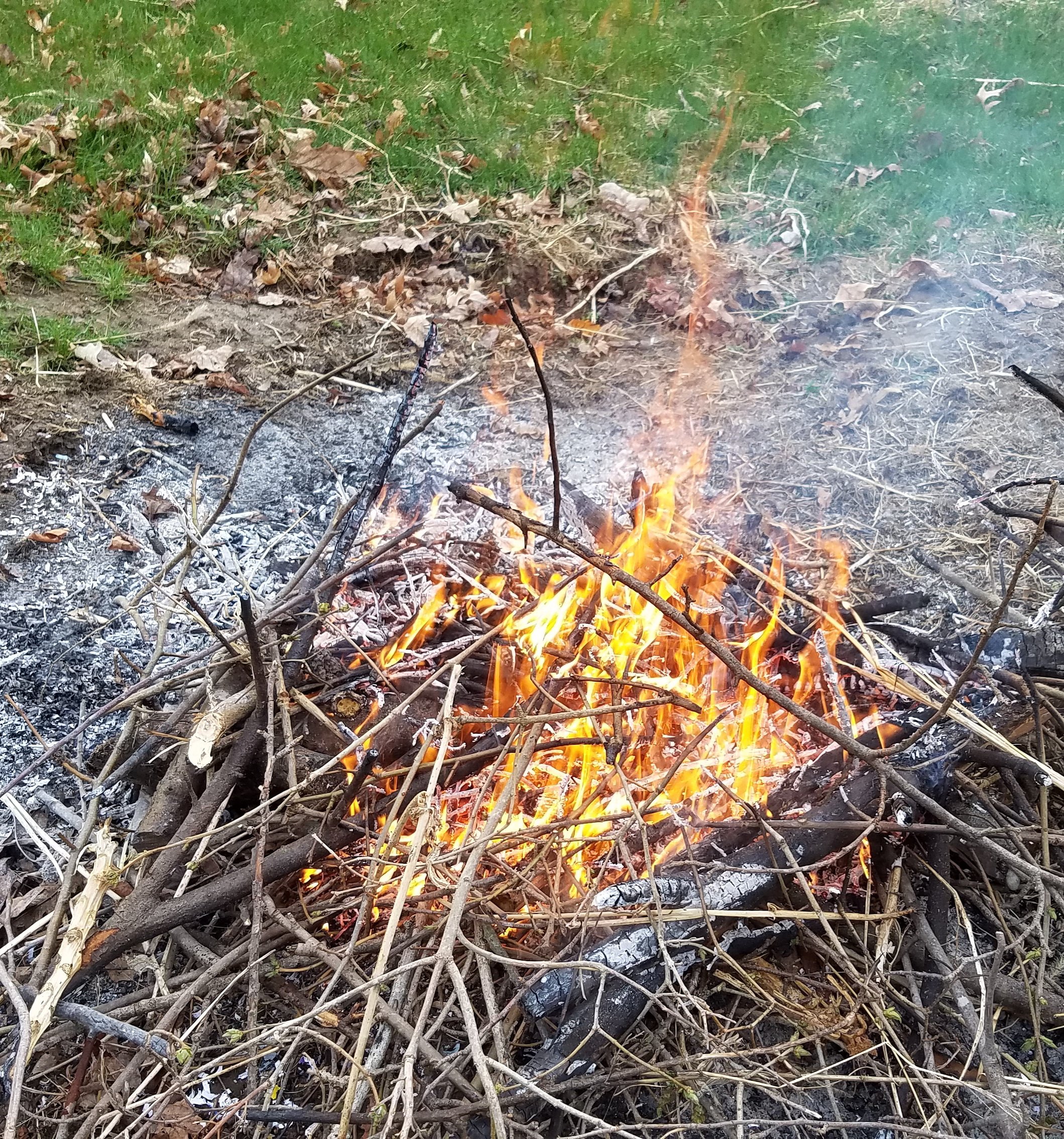
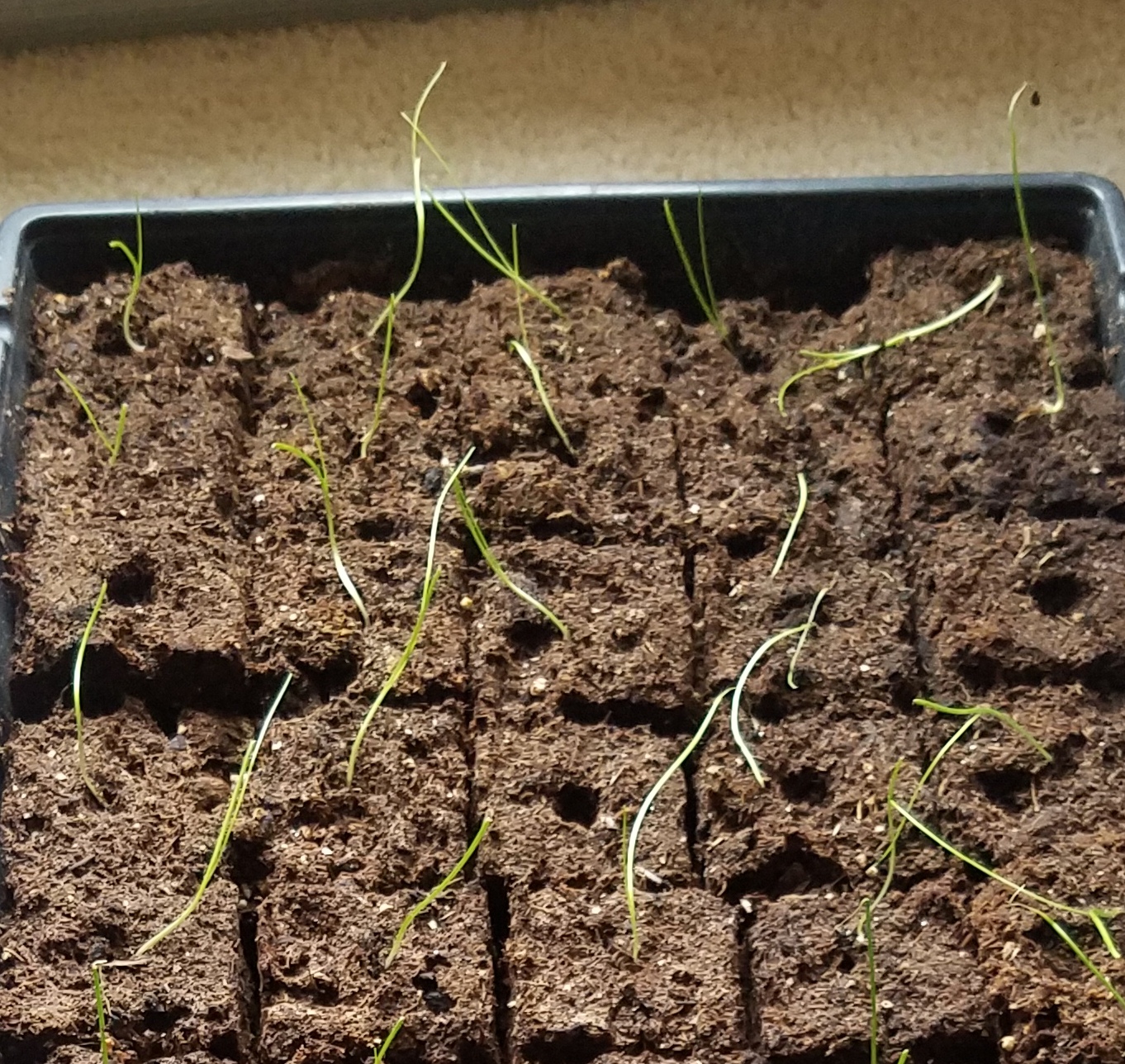
I burned the first brush pile on the to be planted kale plot. It was a clean burn. After sunrise I will spade and till the plot. I also want to plant potatoes in containers and sow peas, beets, carrots, radishes and turnips. If there is time, transplant the first batch of spinach seedlings. There is a lot on the gardening agenda as spring has arrived.
How should I use the time after waking until sunrise, not just today, but going forward? I’m not sure. Other than to continue doing what I am, it is difficult to envision changes from routine as much as they may be needed. I’m too unsettled to contemplate change.
People say it is normal to experience anxiety during the coronavirus pandemic. Knowing I’m normal is not reassuring and has made for restless nights.
The remedy will be to get lost in the work of putting in the garden. If I work longer shifts, maybe I’ll be tired enough at day’s end to sleep through the night. I’m a little sore from yesterday’s work as my spring conditioning regime in the garden begins. Engagement in a project has worked to relieve tension in the past.
It doesn’t help that I’m reading Anne Case and Angus Deaton’s new book exploring why capitalism is proving fatal for the working class with an uptick in mortality rates among white middle-aged Americans from what the authors call “deaths of despair.” There have been enough alcohol, opiod and suicide deaths in this group to reverse the 20th century trend of longer life expectancy. Other wealthy countries continue to see an increase in life expectancy in the new century. Americans do not. I’m looking forward to reading Case and Deaton’s analysis.
All this is not to say I find despair in daily life, I don’t. However, change is on the horizon. Unlike with the sunrise coming in an hour, it’s hard to know what to expect. I affirm today will be a gardener’s day with everything that means. That should be enough to move past the coronavirus engendered anxiety into something more meaningful.
After the first cases of COVID-19 were reported by the State Hygienic Lab on March 8 it took a while to understand the scope of the coronavirus.
The next day, Governor Kim Reynolds signed a proclamation of disaster emergency. Two days after that the World Health Organization declared the virus a pandemic.
The president set a 15-day federal stay at home order which has since been extended until the end of April. Tens of thousands of Americans could die from the virus. We’re all hoping the number is much less.
In Iowa six people died of COVID-19 as of this morning’s update on the Iowa coronavirus website. 183 people have confirmed cases of COVID-19 in our county and the six adjacent ones, or 43 percent of the Iowa total. While we don’t know precisely how the virus spread, it seems obvious reliance on a small number of employers (Collins Aerospace, University of Iowa, multiple food processors) resulted in local commutes that enabled it. During a press conference yesterday the governor noted, “the end is not in sight.”
Jacque hasn’t left the house since March 8, so I am the one with the most risk of contacting the virus. I studied how it is transmitted and have been careful to maintain social distancing and keep clean hands. When I’m out in public I avoid touching my face. Whenever I interacted with people I first ensured they made adequate precautions, then cleaned up when I arrived home.
At the home, farm and auto supply store the company cleans the store multiple times a day, although they don’t go to the extent the grocery store does in wiping down the conveyor belt at the cashier after each customer. According to an article in this morning’s Cedar Rapids Gazette, retail workers are most at risk because a. we are open for business, and b. a quarter of retail workers are age 55 and older and at more risk of contracting COVID-19.
Shopping trips? I don’t like shopping anyway so trips have been limited to the wholesale club, the grocery store, the gas station and to picking up soil mix to start and transplant seedlings at home. Because the cars are mostly parked we don’t use much gasoline. Each business I visited had a regimen to prevent spreading the coronavirus.
Outside I hear the laughter of children. I keep my distance. Occupied with writing, gardening and home life, the isolation from others is welcome even if the cause of it is not. I believe society will survive the pandemic. I also believe we will be changed by it. At least for a while, until we forget, and go on living as we have been for multiple millennia.
We each need something to cope with the coronavirus pandemic.
The linked video by Dr. David Price of Weill Cornell Medical Center in New York helped me and it might help you. Click here to view the 57 minute video.
It is a recording of a video conference call in which Dr. Price explains what is COVID-19 and how to protect ourselves while living as reasonable a life as may be possible as we keep our distance from each other. It relieved stress about living away from friends, family, neighbors and co-workers. It explained how we should interact with a small group of family members who live with us. It is presented in a way that is persuasive and practical. Unlike so much of the hyperbole, misstatements, and falsehoods I read and hear elsewhere, Dr. Price is believable when we need that as much as isolation from the virus.
I yearn to get out of the house and trips to the garden and yard are not satisfying enough. Armed with knowledge, I plan to go to work at the home, farm and auto supply store in a couple of hours. I’m not afraid any more. I’m not being foolish. I’ll be keeping my distance from co-workers and customers and washing my hands a lot, trying not to touch my face. Absent a general call to stay in place, either at the federal or state level, we must go on living as best we can.
Social distancing would be more tolerable if the ambient temperature would warm up by about ten degrees. Getting my hands in the soil and doing much needed yard work would take my mind off the coronavirus and self-imposed isolation.
As a writer, I’m used to working in isolation. It gives me strength and an ability to distance myself from social media and unwanted contact with others. I find a chance to think clearly about my life with others and how it will be lived. There cannot be enough of this time.
As the number of cases of COVID-19 rises in the United States we don’t know how the infection will escalate. In New York, the number of cases is doubling about every three days. In Iowa, we have limited testing availability for the coronavirus, so what numbers we have don’t tell the whole story. The first person died of COVID-19 in Iowa yesterday. While tragic, I’m not sure what it means in the context of everything else going on.
My remedy was to view Dr. Price’s video, and use the information in it to go on living. We’re doing the best we can.
When I say post-consumer, I mean the one percent of richest people in the world have extracted what they can of what we have.
Something’s now got to give.
Yes, I’ll buy at the grocery store, gas station and drug stores, but a budget like ours can’t afford much extra. If shoes and clothing wear out, I’ll buy some on sale. Maybe some books, or a cup of coffee at a restaurant or shop will be bought, but little else that is unnecessary for daily living.
No longer do I just get into my car and drive in wanderlust.
We hope to avoid potentially big and unexpected expenses associated with an accident, automobile malfunction, health concern or home or family emergency. In a capitalistic society, all of those unexpected expenses are good for someone, as they generate revenue for them and unwanted expense for us. The bottom line is that we won’t be generating much for the consumer society overlords to rejoice about.
That said, to go on living in our current lifestyle, bills must be paid, and I’ll maintain paying work to support all of our creditors and suppliers. We seek to live without incurring additional debt, having to sell our home, or spend all of our life savings. We have our pensions yet if something big happened — an expense of thousands of dollars — how would we pay for it? Our pensions cover basic expenses and some debt retirement yet there is little extra at the end of each month.
I wrote the following in 2013 when confronted with the gap between my first retirement in 2009, before our pensions kicked in.
There are plenty of jobs in the area that pay below $10 per hour. The trouble is they don’t pay enough to meet our financial requirements, even if I were to work a few of them.
Year-to-date, wages accounted for 14.3 percent of income. Consulting income was another 5 percent. Adding these two amounts to consulting accounts receivable, the total is roughly 30 percent of required 2014 income. If I were to return to warehouse work at $9.25 per hour, that would generate 60 percent of required income. Low wage jobs can be a trap to get further in debt, especially if they do not provide benefits.
A portfolio that includes some lowly paid work is acceptable, but there has to be something else, a significant part of it, that pays more.
The best part of 2013 has been working in the local food system. The pay was low, but the relationships fostered by participating were meaningful. Working in the local food system offers the prospect of something more than dollars.
The job as proof reader was in my sweet spot, relevant to my writing. Same goes for my brief stint as editor of Blog for Iowa last summer. All were lowly paid work that I want to be doing.
What Didn’t Work
The warehouse work did not work because of the physical toll it extracted. Too, taking loans and withdrawing from savings, were steps in the wrong direction. Stopping the outflow of savings will be a high priority for 2014. We’ve tapped our current home equity loan ceiling, and what is left is credit cards.
How to Get There
At its simplest, based on a six-day work week, I need to generate between $94 and $125 each work day to pay our bills. To make progress, by paying down loans, we need more.
We survived the gap that year and until Social Security payments began in 2018. The coronavirus pandemic and social change it is bringing will cause an adjustment. I see these things happening.
While weather continues with adequate rainfall and favorable temperatures, growing more of our own food will be part of the solution. When we chose to live here we picked a lot with 0.62 acres: enough for a large garden. Likewise, my relationships with farmers helps secure food items we don’t or can’t grow.
Maintaining health through exercise, eating well, and regular medical, dental and eye examinations is foundational.
During the pandemic I find myself talking people through challenges. Not that I am an expert, but there is a vacuum of concern about others that pulls me in. Whether it is family or friends, it is important to stay connected now and once the pandemic has run its course.
Focus on one financial thing. Right now it is paying down debt with any extra money. Major appliance purchases (stove and dishwasher) will wait, as will replacing our current vehicles to secure reliable transportation for our last decades of driving an automobile.
If we do pay down debt, there are possibilities. We don’t want to get too far ahead of ourselves.
Most important in all this is having a life worth living and working toward that end. With that I’m prepared as can be to sustain our lives in a turbulent world.
The coronavirus pandemic is changing us. Changes are just beginning. We’re not ready, change is likely permanent, and there’s no going back.
Attempts at social distancing push us to stay home and make constructive use of time. I don’t like what I see in this new awareness.
I’m not talking about our home with a fair share of boomer-style clutter. We seem to be at a point where the richest one percent of the population has extracted as much as they can from the rest of us. We are entering a post-consumer society in which assumptions about the past are out the window.
We’ve been inoculated and gained immunity to everything unrelated to meeting basic needs: the president’s lies and obfuscation, the GOP U.S. Senate lining the pockets of big business, the climate crisis, nuclear annihilation, foreign affairs, you name it. It will take all we have to survive and make ends meet. Other concerns? They are not ours as we hunker down to defend against the coming social apocalypse.
I discussed our tax return with a professional who characterized us as a “low-income household.” I did not know. Translated: anything we paid in federal and state taxes through payroll will be refunded. The tax refunds will go to paying debt incurred during lean times, a quotidian use of the money to be sure. Nothing will be left for the one percent.
So it begins – our life in the post-consumer society. We’d best embrace it. If we can there is hope we can do better than merely survive. If we can’t, what drudgery will be this mortal coil?
Remarks delivered on a community panel
“Citizen Involvement in Local Government.”
Community Leadership Program
City Hall, Coralville, Iowa.
December 9, 2011
I believe a person makes a choice in life, to be part of society and influence what the future will be, or to be a citizen centered on making our way in a challenging world, protecting what we have, and nurturing the advantages of living in the United States. While not mutually exclusive, each can be a lifetime of hard work.
In 2004, after helping manage our rural public water and wastewater systems for almost ten years, I sought additional engagement in society and applied to the county supervisors for appointment to the board of health. Without reservation, and in every respect, my service on the board was good for me personally and I hope it contributed to society.
So what did we do? Besides the regular board meetings, there were other commitments. I tried to consider our life in society from a public health perspective, and work toward doing things that made sense while complying with a host of rules and regulations.
The board of health has oversight of the public health department and the meetings could easily be filled with tasks required by government such as approving the department budget, writing policy and other administrative work. We did do a lot of that while I was on the board.
But there were other things not written in the black and white of legal code. We made a decision about an indigent suspected of having tuberculosis, trying to respect his rights as a citizen, while protecting the public from a contagious disease. When the health department closed a restaurant near where I live, I listened when the owner called me at home and explained the financial strain our action created and the injustice he felt. During an in service day, I found myself responding to an outbreak of norovirus and spent the better part of a day speaking to parents about what their children had for lunch the previous day. All of this work was engaging.
It is hard to list any disadvantages about being on the board of health. When we sign up, there is an understanding that there will be both good and bad things along the way. In a way, it was all good.
I found three things particularly rewarding while I served on the board of health. First, there was the self-fulfilling feeling that I was giving something tangible back to our community. Second, the board provided a vehicle to study and present information about issues that impacted people’s lives. For example, I spoke about arsenic contamination in county water and about the Silurian aquifer. What was best was getting to know people in the community in a way I couldn’t have predicted. A sense of engagement in society was a significant benefit, one that keeps giving and for which I will always be grateful.
Because of the coronavirus, people are stocking up on food and sundries in case they are quarantined. Local retail business is up compared to last year. The wholesale club has been rationing specific items.
The retail outlet where I work twice a week has a large table in the employee break room where we pass the time talking, looking at our mobile devices or yesterday’s newspaper, and eating snacks and lunches. The consensus among this group of employed yet low-wage workers was we could survive a month or more of quarantine without stocking up. It’s how we do.
When my uncle died, Mother found a large number of one-pound boxes of dried pasta in his pantry. A person is in the store, it’s cheap, so why not pick up a package? Years of accumulation like that reflects a certain type of affluence. For those of us with a stable home life the amounts build up. A person has to work at it to use up the pantry and freezer. It’s a form of food security.
If we were quarantined and had no access to new food, the first thing to go would be dairy products. Fresh milk and eggs would be most missed, although cheese and butter would not make it a month. This discussion is hypothetical since there is an ability to receive home-delivery of most grocery items in our community. My next door neighbor owns the grocery store in town so I’m not worried about running out of food if quarantined.
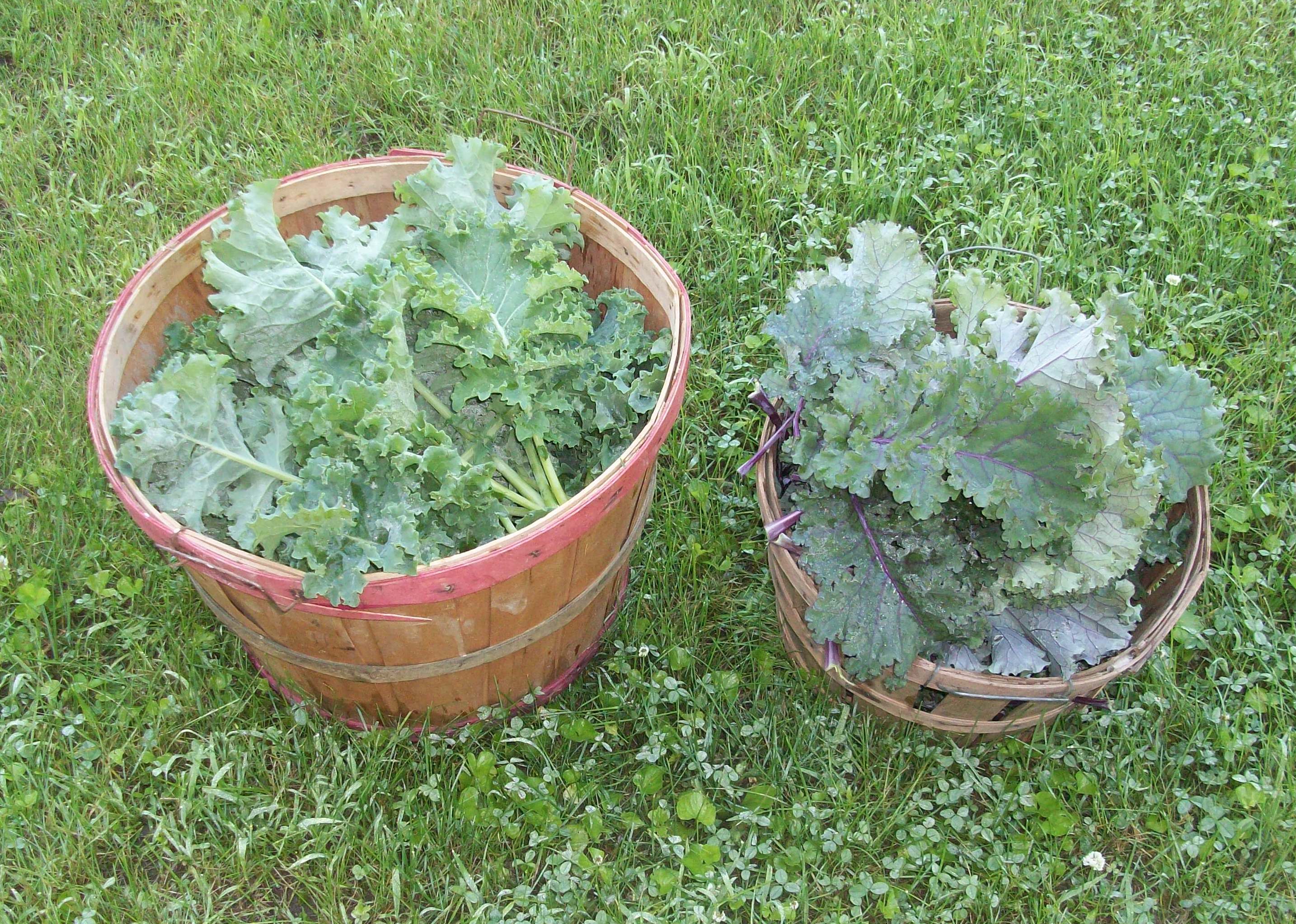
We have plenty of fresh onions, canned tomatoes, dried basil and olive oil to make it through a month of pasta dishes. There is plenty of applesauce and pickles. We have enough apple butter to last more than a year. Kale? there is plenty in the freezer along with other frozen vegetables from the garden.
We’d test how far ten pounds of flour goes. We’d see if the yeast in the ice box is still active. If the yeast isn’t active, there would be biscuits and corn bread made with baking powder as leavening. There would be a big batch of soup made from celery, carrots, onions and potatoes. We have five cases of prepared beans, a large bag of garbanzo beans, and plenty of rice. The freezer has frozen raspberries, aronia berries and blueberries. We’d find out what we have.
As indicated above, this is theoretical as the community would support us on quarantine. As we settle into a weekend spent mostly at home we have no worries about food security. Sustaining our lives on the Iowa prairie is what we do.
The 2012 general election marked the end of a personal era.
Working on campaigns drained our financial reserves and we would need income to meet our obligations going forward.
The following winter was a time of reflection and adjustment.
2013 began a work period where writing occupied more of my time. That, combined with low wage work, became a way to get along. We never made enough money as I worked those jobs. They bridged the time between leaving my career and beginning Medicare at age 65 and Social Security at age 66. What made our survival possible was a foundation created by my 25 years in transportation combined with Jacque’s income from the public library. It was tough going during the transition but we made it.
Our move to Big Grove Township was predicated on a few things: we needed a place to live, my job in Cedar Rapids, being centrally located near other job opportunities, schools for our daughter, two working automobiles, and being a distance from the office. Over time, and by 2013, those things changed, raising new questions:
Do we want to move to town?
What kind of work will be next for us?
Is there a way we can work without a commute?
Is this home right for us as we age?
Will we be able to afford living here?
We decided the best approach was to stabilize our lives here and we did. Working at home was difficult but straight forward. I wrote about it in a Dec. 29, 2012 journal entry:
Part of work is forcing myself to come into my work area and sit. The kind of discipline that Norman Mailer wrote about. Not being distracted, or leaving the work area. Just working to the detriment of all other activities.
It is not always easy to do this, but do it I must, and for more than an hour at a time.
I felt an urge to go to town. It is similar to the urge I felt when living in Mainz. That often led me to shopping or walking into the downtown area. I resisted it today, even though it was complicated by the new $50 bill my mother sent — itching to be spent. It was a major accomplishment to resist the urge to go “elsewhere.”
The low wage work I pursued was readily available in the area. My criteria was to work for a company with a professional payroll department where I could count on wages being paid accurately and in a timely manner. I didn’t give much thought to the physical requirements of the jobs, although they mostly required standing on concrete or other hard-surfaced floors. I worked as a temporary laborer, as a product demonstrator, and in 2015 wound up at the home, farm and auto supply store which offered full time work, health insurance and a reasonable work load. I also worked as a proof reader and freelance correspondent for local newspapers.
Most significant among these jobs was a chance to work with people much different from those during my transportation career. If I didn’t bring home much money, I met many new people.
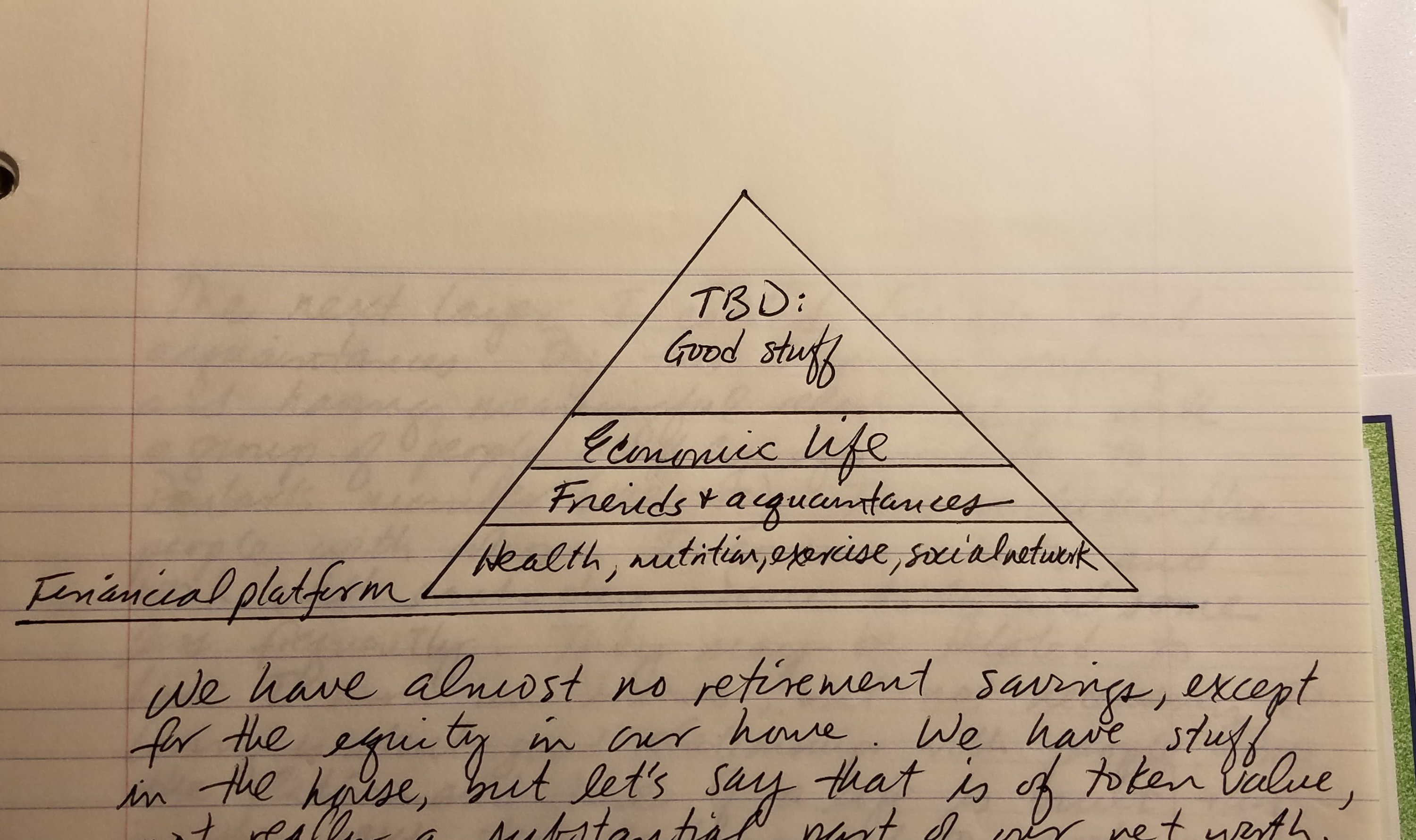
Weathering the last seven years was the kind of accomplishment few people point out as a highlight of life. We did what was needed to survive. Now that it’s over there are other things to do, including the “good stuff” in the diagram from my journal. We now have a chance to figure out what that means.
My ancestors first landed in North America in what today are the states of Virginia and Minnesota. I don’t know of any other connections but those two states.
My Virginia origins have obscure beginnings in the 17th Century. My Minnesota origins are tied to specific immigration from Poland in the 19th Century after the Civil War. I know a lot about these lines, but not as much as I may think.
Genealogy has been faddish for me. For a while a rush of interest. Then research halts and things sit for months or years. I enjoy discovering new artifacts, like the recent discovery of my parents’ wedding announcement in the newspaper. Such joy is insufficient to turn me into a consistent miner of artifacts and information. It’s been a hodge-podge endeavor from the get-go.
I hope to sustain an effort with the current memoir project. That means getting organized, developing a writing plan and sticking with it.
It is hard to determine a timeline, but necessary. Equally difficult will be choosing which parts to write about and in which order. I need to be in a place where the outline is finished and broken down into 1,000-word bites for drafting. I don’t know how long it will take to draft, edit and proof 170,000 words. Longer than expected, for sure.
The general rule is to write 1,000 words per day. By write, I mean draft because editing will take multiple amounts of the time drafting will. I expect as many as a dozen revisions, probably more. Likewise proof reading is important and time consuming. One has to get outside the narrative to a place where the literal words on the page mean nothing except for their correct spelling, grammar and elimination of redundancy and extra words. These things take time.
A couple of hours can produce 1,000 draft words with this type of work. That assumes a proper outline and work plan that puts the research into a semblance of order. It’s possible to do that.
So five steps: organize documents and artifacts, prepare an outline, create a first draft, edit and revise the draft, and proof read.
This spring is shaping up to be busy with the part time job at the home, farm and auto supply store, gardening, farm work, political work, community work, and the Food Policy Council. Somehow the memoir project needs to find a space. (I always forget to mention family. Why is that?)
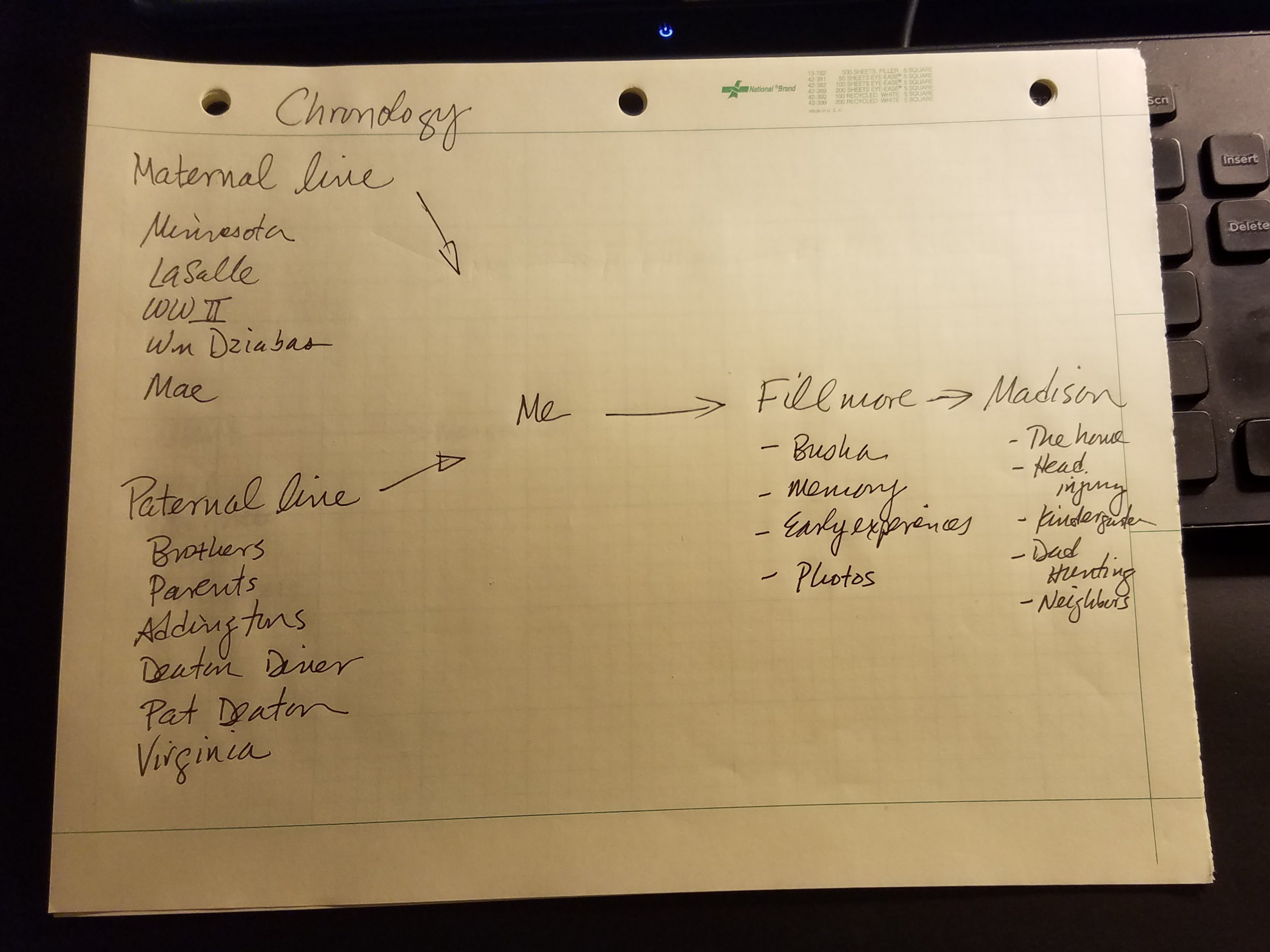
I plan to continue writing this blog most days, but need to add a period of daily time to organize for writing the memoir. The photo above is a first attempt to get something on paper. There will be revisions as work continues to sustain this project.


 Journey Home
You must be logged in to post a comment.