I’m from the government and I’m here to help. Now that I on-boarded with the county auditor to be a poll worker, I can truthfully say that. Ronald Reagan made a joke about those nine words, yet voting is no laughing matter.
On-boarding consisted of driving to the county administration building, locating the appropriate area, entering data on their system, and providing my I-9 documents for photocopying. I completed a time sheet with ten minutes and 20 miles. Easy-peasy.
About eight of us used IBM Think Pads for data entry. IBM sold that business line in 2005 and the company that bought it soon discontinued the product. I’m glad to see our county government using technology to get every last penny from the investment. I had forgotten how to use the track pad, so needed help.
As is usually the case, I ran into people I know from politics. I maintain a friendly relationship with everyone I helped elect at the administration building.
I made two other stops while in the county seat.
On the way in, I stopped at the used book store to see if they had certain titles by John McPhee whose Draft No. 4 I just finished. They had a McPhee reader with parts of the essays I sought for five bucks. A while ago, I had asked them if they had a copy of Howard Zinn’s A People’s History of the United States. I gave my copy to our child and wanted a replacement. When they said they didn’t have it, I procured it elsewhere. On Friday, they had been unexpectedly holding a copy for me. I declined it in person, yet on the way home, reconsidered it. Surely I could find a home for it. I emailed I would buy it if they still had it.
The other stop was at the grocer. It is conveniently located on Highway One which leads to our home near the lake. It has long been a stop when I have something to do in the county seat. I like the wholesale club better, yet they don’t have the granularity of item selection a home cook needs to run a kitchen. This produce section is particularly loaded with organic fruit and vegetables, all in a single location with non-organic. Too, when I fill my cart, the total is usually less than $100. At the wholesale club it can be double or triple that with less items overall.
I won’t be lording my new government employee status over too many people. The small bit of income will easily find a home in our budget. In fact, even though the general election is not until November, the money is already spent.
After I finished the work table, I sorted stuff in the workshop. In other words, I filled the table with stuff thrown hodge-podge in every nook and cranny. This will be a long process, yet I am heartened by having another surface to use for this work. It is beginning with tools.
The table project was easy, with the radial arm saw and power drill being the main power tools. There were a few hand tools, but all of them are frequently used, and easy to find. That’s not the case with things tucked away in the workshop today.
I brought home a lot of tools when my father-in-law died. That was almost 30 years ago. I never really incorporated them into my workshop. As a result of this neglect, I don’t have visibility of every tool I own. When I’m starting a project I’m running blind. I hope to remedy that.
This tool visibility project began with my red Craftsman toolbox. It has three drawers and a compartment in the top. I took everything out of the drawers and rearranged it.
All the fixed wrenches went into their own tool box. I don’t use them as often as crescent wrenches and I’ll know where to find them when I need one. Crescent wrenches and pliers filled a drawer. One drawer has gripping tools. Most sizes of screwdrivers are on a pegboard, so the ones in the toolbox are either specialty drivers or extra. Screwdrivers get their own drawer, which isn’t enough space to accommodate them all. The solution to that will wait until I see what else I have. When I replaced some tools with others, the idea was to keep thosek most frequently used in the red toolbox.
There are also what I’ll call specialty toolboxes. One is full of drill bits of many kinds. I keep a separate drill bit holder on the bench so I can quickly find common sizes. There is a toolbox with woodworking tools. There are all kinds of them, although I am hardly a woodworker. One toolbox has a set of metric and imperial sockets. In the cabinet, there is another whole set of Craftsman sockets. This is just the beginning.
The main goal of this project is to gain visibility of what I have. I am tempted to acquire one of those tall movable toolboxes with many drawers. I hope that is a passing infatuation. For now, just knowing what I have should be enough to get started on new projects. The new table led to this, and who knows where the forking paths ahead will lead? Being aware of what tools I have is a good start.
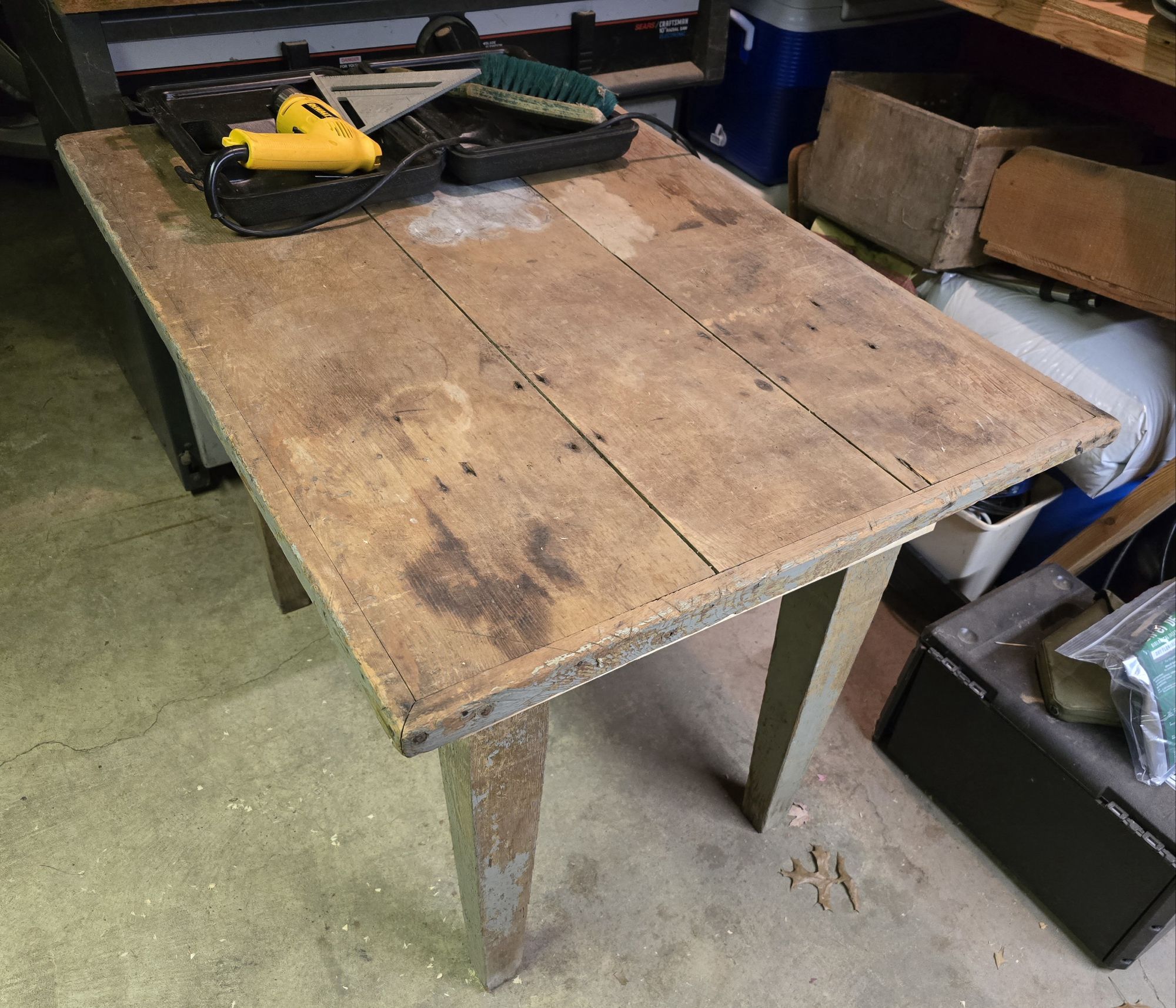
There was a time when I attended estate and farm auctions and bought things on the cheap for later projects. The years since then can be measured in decades. At a point in my life when I have to either do something with stuff, or otherwise dispose of it, I got out the top and legs of a table I bought for a buck at auction. It was time to make something. Since I rearranged the garage, I have space for a work table that is shorter than the custom-height workbench I made when we lived in Indiana.
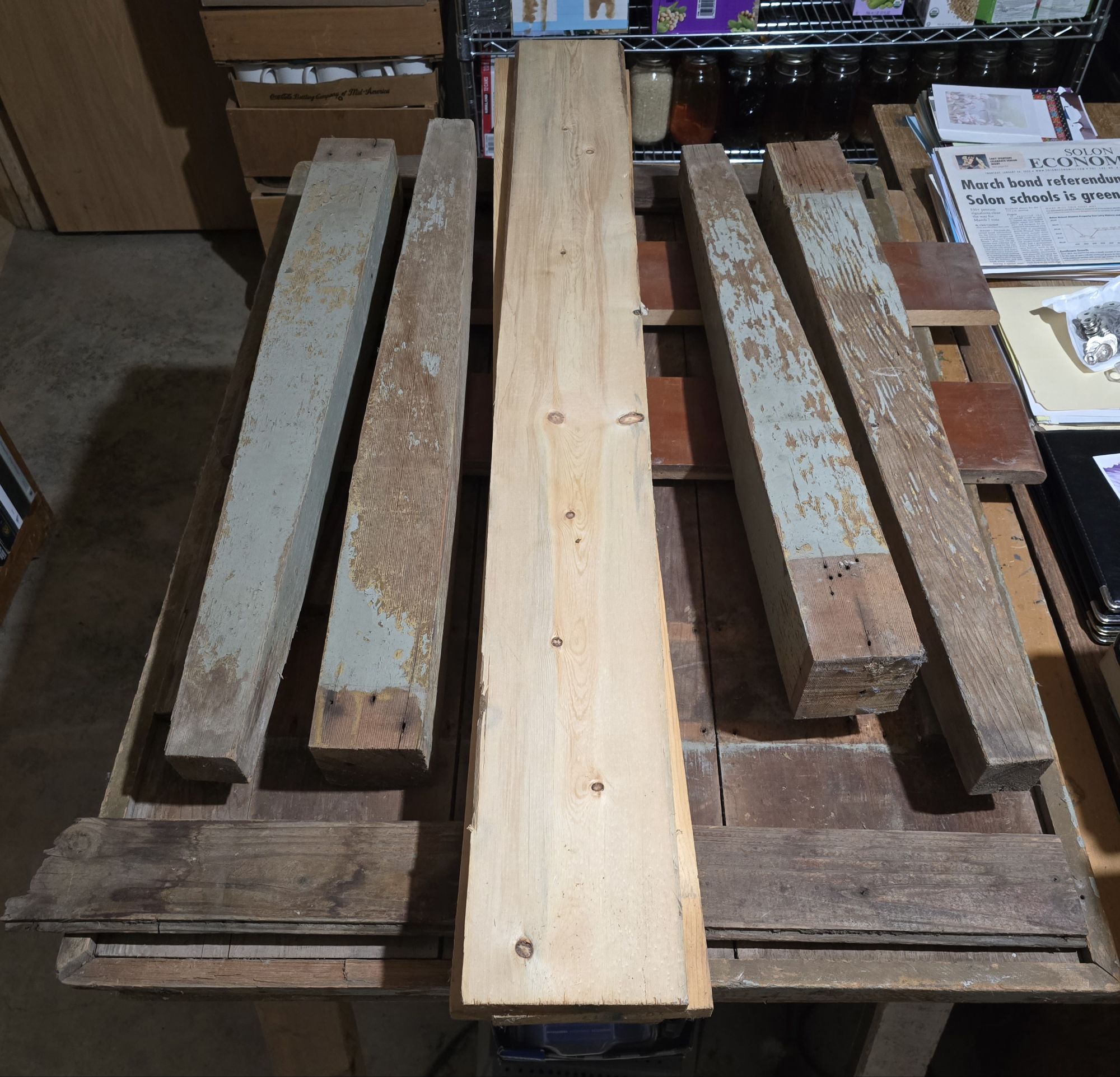
I went through the woodpile and found planks to make an apron and five of rescued lumber to reinforce the top. I laid the materials out on this workbench made of sawhorses and thought about what I would do for a couple of weeks.
After looking at local hardware stores and large online retailers, I finally found a packet of figure 8 steel desk top fastener clips with screws. They are not commonly available. To make a recess in the apron for the fastener, I got a 20 millimeter forstner drill bit. $20.12 all in.
After 12 cuts on the radial arm saw, I was ready to assemble. I spent about three hours on the project before my attention began to wander. I am better at recognizing when that happens, so I knocked off for the day. If everything goes together as planned, it will take an hour or two to finish assembly.
After a few hours of furniture building I had to take a break.
I don’t plan to refinish the wood. Inside the garage it will be protected from the elements. I expect it to get scuffed up with heavy use, so what’s the point of a coat of paint or finish? The wood it’s made of has been around for a long time, based on the assembly techniques my predecessor used to build it.
Fingers crossed the final assembly passes muster and I can begin using the new table immediately. One never knows about these things until the work is done and the piece is in operation.
Here is the finished product in the garage.
Table made from a top, four legs and salvaged lumber.
It’s bigger than I thought, but I will adapt. No adjustments were needed.
Stump cut to make a resting place for the gardener.
With four weeks left until Labor Day, summer is about finished. A lot of work remains. The only compensation I receive for any of it is the satisfaction of a job well done.
Is my work the same as working for an employer? I think so, yet there is an attitude shift when we work for ourselves. I find more personal risk and am particularly careful I don’t get injured or make a bad financial decision. There is no malarkey in my work life. It is based on empirical tasks, cash flows, and bank loans, all of which are necessary to piece together a life. Most things break down into short projects upon which I can work until completion. There is no overtime pay, or any of the benefits allowed many workers. My spouse and I pool our pensions and hope they cover the bills.
I came up in a work environment where I earned more money than needed for minimal survival. It enabled buying a house, saving for our child’s education, and then later, when our savings proved to be not enough, it allowed us to pay the student loan to take that out of the child’s bucket. I also earned enough money to be able to quit my job multiple times without immediate prospects. The biggest adjustment to living on pensions is there is no longer any “extra” money.
From the time I left the job where my spouse and I met, until we moved back to Iowa and our child left to attend college, she worked at home. The work she did was valued and important to raising our child. There was the avoidance of child care expenses, and a clear division of labor, yet it was more than that. It was a way of life that had little to do with money except treating it as the fungible commodity it was. Ours wasn’t a perfect life, yet we got by.
I resist framing what I do every day as a job. The old farm word for it is “chores.” It’s more than that. With our more sedentary lifestyle, we need exercise, a healthy diet, and some amount of socialization. I suppose that makes us more than a cog in the machine of life. I hope we are more than that.
Author at Kraft Foods Oscar Mayer plant on Second Street in Davenport, Iowa Nov. 25, 2011
Following is a chapter of my privately published memoir, An Iowa Life.
A Union Job
With classes and examinations finished, I headed back to Mother’s home for the summer. Several high school classmates applied for summer jobs at industrial workplaces in the Quad-Cities. The post-World War II economy was still humming at John Deere, International Harvester, J.I. Case, and other manufacturers. I took a job at Oscar Mayer and Company where my maternal grandmother and father had worked at different times.
It had been two years since Father died at the plant while loading an elevator. He had been the chief union steward and knew almost everyone. It was a safe, comfortable place to work where the folks who knew Father looked out for me. During one of my first shifts, a millwright who was good friends with Father, asked me if I wanted to see where he died. I passed on the opportunity and took no rain check. It was too soon.
I experienced being a union hire, Iowa-style. Once Oscar Mayer’s human resources representative finished orientation for our group of new hires, he reminded us that the company was an at-will employer in an at-will employment state. At-will means an employee can be discharged for any reason or for no reason. He then left the room so a union representative could recruit us to join. There was never a question that I would join the union, and I did. I worked for Oscar Mayer that summer and two years later in 1973. When I left, I secured a union retirement card. At $4.04 per hour, with overtime, I earned enough during the summer of 1971 to pay my bills during sophomore year at university.
Three college students worked as “maintenance helpers” that summer. It meant we performed a variety of work, usually helping one of the millwrights or welders on projects too big for one person. I spent time in almost every plant department and at the warehouse on Schmidt Road in the West End of Davenport. I learned to drive a forklift, but mainly, I was there to perform physical work. It was hard work.
I was skeptical about productivity. As summer help, a group of us did routine maintenance jobs, like picking up trash on the roof, and cleaning up large piles of metal that had accumulated over the year. But mostly, I helped millwrights and welders repair things in the plant. The work was important, but we were never very busy.
When the production line went down, it was all hands-on deck to repair whatever went wrong and avoid idleness among line workers. The cost of down time was estimated in the tens of thousands of dollars per hour, which seemed like a lot in the early 1970s. I remember trying to break loose a vat of resin with a jackhammer. The resin was used to remove hair that hadn’t burned off the animal at a previous station. Once it cooled and congealed, the line went nowhere until it was removed. I had plenty of supervisors as I ran the tool in the black brick the resin had become. We got the line back into production.
There were days when we were assigned a job at the warehouse. The old timers interpreted a trip to the warehouse as a full day’s work regardless of what had to be done. The times I went with millwrights to the warehouse, whatever needed fixing took a couple of hours. We always spent the full day doing the work. Instead of eating lunch in the company cafeteria, my co-workers looked forward to items off the roach coach which plied the neighborhood with sandwiches, snacks, and beverages. The plant foremen had full understanding about our use of time, and were part of the problem, if there was a problem. When a company recruiter offered me a job to become a plant foreman before college graduation, I turned it down. After my work experience, I did not want a job where lack of productivity was the norm.
My co-workers at the meat packing plant no longer work there, and I lost communication with them as soon as I returned to college that fall. Maybe I learned something from them. There is more to life than staying constantly busy.
Staying busy has never been my priority. I seek truth and meaning in life and feel no need to occupy every moment with items from a to-do list. In fact, there are several ways constant industry creates problems. We become task masters of an arbitrary list and block out the potential of life around us while we concentrate on what we thought was important in the morning.
While we may be skeptical of what a day will bring, and how busy we are, we should enjoy the anticipation of different work and what the roach coach may bring. If we do that, I suspect we will recognize opportunities that we otherwise wouldn’t have known exist. Productivity and industry are important in business, but in our lives, we must take time to wonder. That is a form of industry too often neglected.
It was easy to get a job at the plant. I belonged to a union, the Amalgamated Meat Packers and Butcher Workmen of North America, Local 431. Wages were good, plant conditions were dangerous, and the work was physically hard. I never felt in danger in the plant, despite Father’s death. In my work as a millwright’s assistant the first summer and on the cleanup crew the second, I got to see most of what went on throughout the plant and warehouses. It was not pretty.
Meatpacking was much different in 1971 from what it is today. The plant took in live hogs from farmers and processed about 500 of them each day. There was very little waste. There was a “hog hotel,” which was a place where hogs were kept in smaller pens and fed so they would be calm for slaughter, usually the next day. One of the dirtiest jobs I had was at the end of the production line where a rendering tank processed the final remains from the cutting floor into lard. What was left was shipped to a processor to make fertilizer. My job was to work with a millwright to remove and replace giant paddles inside the tank. It was among the dirtiest jobs in the plant. I learned about using hearing protection and lockout/tagout. The union had negotiated a payment for extra cleanup to perform that work. My millwright made sure I knew to request the pay on my timecard.
People who worked on the production line did not look happy. The work was repetitive and physically demanding, requiring a person to be on their feet for an eight-hour shift. A lot of the work was mindless. Stamping a USDA inspection marking on carcasses, picking through hog innards to find a certain organ, or making the same cut hundreds of times a day. The pay and benefits were perceived to be good by most workers, so they put up with the mindless quality of the job to bring home a paycheck. After the first summer, it was clear a career in meatpacking was not in my future.
Lafayette Flats, Buffalo, New York. Photo Credit – Wikimedia Commons.
Millennials seem unlikely to purchase homes in the same numbers as my cohort did. So many are sharing an apartment or house and paying rent. It becomes difficult for them to build equity the way I did when we paid down a mortgage. There are other consequences of living with others in a shared apartment or house.
The worm has turned on millennial home purchases according to some. When student loan payments were paused during the coronavirus pandemic, newly available funds were directed into home-buying. According to CNN, “The Department of Education said Wednesday it has approved the cancellation of nearly $5 billion more in federal student loan debt, bringing the total amount of student debt relief provided under the Biden administration to $132 billion for more than 3.6 million borrowers.” This should be a catalyst for more home-buying in the millennial cohort. Maybe they will catch up.
The other part of this financial equation is the lack of good-paying jobs. In part, this is driven by consolidation and outsourcing of functions in the business world. Pay packages have changed so more of compensation goes into hourly wages or contractor fees. Thanks Ronald Reagan and the Republicans for this crappy economic environment for younger people.
The change in types of jobs available also has to do with automation. The automation revolution began some time ago, yet it is taking off with force in 2023. Anything that can be done by a computer or robot will be. Human workers? Not needed as much any more.
Stuck living together with unrelated others is an issue, in particular, during the continuing coronavirus pandemic. According to the University of Minnesota, older adults made up 90 percent of U.S. COVID deaths in 2023. While the younger people the virus targets may be less likely to die of COVID, they continue to get sick and it’s debilitating. A goal for mixed households is to prevent the coronavirus from entering the residence. If it does get in, isolating individuals so they don’t contract it in close proximity to each other is a priority. For some that means shutting the door to a private room if they have one and not leaving one’s room except to use the plumbing.
I had a conversation this week about what food could be eaten in isolation from COVID without going to the kitchen or refrigerator often. It came down to only items that could be eaten as is, or made with boiling water. It didn’t take long to develop something both nutritious and filling. I had some ideas to contribute to the conversation.
When I was younger, I rode buses a lot. From time to time I encountered Hispanic men heading North for agricultural work from Mexico and points south. They solved the food issue for a long journey by making a meal of two cans of food: one beans with sauce and the other some kind of vegetable. They carried the full trip’s supply with them in their bags. It was shelf stable, filling, and reasonably nutritious. They could eat them while standing in a bus station and did.
When my group of Army officers left Germany in 1979-80, one of my buddies was assigned to the U.S. Army’s Fort Natick Labs. He participated in development of meals, ready to eat (MREs). Modern versions of these are available to the public, yet are too expensive for a person who has to share an apartment in order to live in a large city. They make nutritional eating, and people keep them in their bug-out bags to use in case of an emergency. The reality is there exists a generation that can’t afford to live, even in the most ideal economic circumstances, let alone in difficult situations during a time of contagion.
Eventually all the housing stock will become available as older generations die off. Perhaps prices will decline enough for millennials to buy. When I was born, I came home to a three generation home where an aunt and uncle lived along with Grandmother, Mother and Father. It was how they coped with limited income from mostly menial or low-skilled jobs. If I believe being related to housemates makes a difference, it’s because I have experience it has. Multi-generational households are a tradition that goes back deeply into my Appalachian roots. My forebears were dirt poor in many cases.
Being unrelated to others in a shared house is something different, though. I don’t have good advice for those who must do so. What may be the first step is realizing shared households have become a permanent fixture in the American landscape, a significant change from what has been. With such acceptance may come peace of mind if not riches. Peace of mind is well needed in a modern society that evolved around wealth migrating to the richest among us. It’s become a place where we must fend for ourselves.
Trail walking on the state park trail on Oct. 30, 2023.
Content creator is an upcoming profession that employs many according to a Washington Post article titled, “Millions work as content creators. In official records, they barely exist.” Authors Drew Harwell and Taylor Lorenz assert, “Millions have ditched traditional career paths to work as online creators and content-makers, using their computers and phones to amass followers and build businesses whose influence now rivals the biggest names in entertainment, news and politics.” Goldman Sachs forecasts this sector of the economy could generate half a trillion dollars annually by 2027. It is a thing!
Not so fast! I don’t see many financially stable folk living on revenues generated from content they create for a website, streaming service, substack, or podcast. Roughly 12 percent of participants in a recent survey of content creators indicated annual earnings of more that $50,000, according to Harwell and Lorenz. 46 percent said they made less than $1,000. It may be true some are earning a living as content creators, and some earn a lot, but rivaling the biggest names in entertainment, news and politics? Please.
Cutting the cord from a single employer job and venturing on our own is possible. I did it more than once in 55 years in the workforce. To me, breaking loose is mostly about developing a sustainable lifestyle without working a “big job.” It is individualistic and empowering. It relies on others much differently from working for a large company. It will drain your personal bank accounts more quickly than you can log into Twitch. It is something of a dream.
When I retired from a transportation and logistics career I started a small consulting firm with me as the only employee. The idea was to take contracts to do work in the peace and justice movement that would help pay bills and become a platform for bigger, better things. To supplement my income, I took any kind of transactional work, including newspaper freelancing, farm work, jobs through a temporary service, and others. While I had the organization, I found it nearly impossible to have enough jobs in the pipeline to stay busy and generate needed income. In the end, I retired on my Social Security pension with Medicare as my health coverage and do my content creation on that financial platform.
A piece of advice I gave someone pursuing a content creator career was to get 10 years in with a company or companies that paid/withheld Social Security taxes. With a potential worklife of 50+ years, spending ten of them in a company that participates in Social Security seems very doable without infringing on creativity. I also said they should wait until full retirement age before filing to collect benefits so as to maximize the monthly pension payment. The response was predictable: “Is Social Security even going to be around?” Who knows if Social Security will change from it’s current process? There is not enough money to pay full benefits after 2033 without Congress changing something. Medicare begins to run out of money in 2031. So many people rely on these programs, it’s hard not to image the Congress doing something to secure them for the future.
At our core we seek a way of living that meets our needs. While we don’t seek to join a cult, we do have an impulse to gravitate toward support groups that are not necessarily just family. Utopian movements of the 19th Century were communal in nature. (The Library of Congress lists some). I think of Brook Farm, the Shaker Community, Rappites (a.k.a. The Harmony Society), and the Amana Colonies when I think of utopian communities. They followed the impulse to break away from broader American culture and join together to better meet common needs. Longer term they were all unsustainable, yet people seek this form of community today in different ways.
My experiences with the millennial generation revealed a different kind of pursuit of being part of a community. Large group activities were commonplace when millennials were in their 20s. They persisted through the years. While members found what today seems like traditional jobs with a commute, workplace, payroll, and benefits, they bonded together in a way that had a separate trajectory from a single person-single job career. It was antithetical to the rugged individualism of myth and legend, especially after 1981. With good employment being harder to find, it is no wonder people cut loose and become individualistic entrepreneurs in the context of a larger group. Being a content creator can be attractive in a society that has comparatively few outlets for creative impulses. Like my small consulting firm, content creator is an umbrella organization to do many different things.
Being a content creator is viable for some. The challenge is to develop enough income streams so as to have a financial base to pay quotidian bills like rent, groceries, transportation and utilities. The temptation is to take a big job to accomplish this. At the same time, if done well, a big job demands a full share of one’s daily energy. I wrote about this in my unpublished autobiography.
We had a discussion with a friend of hers about how she had to give up her artwork after taking a job at John Deere. She was tired after work, raising a child, and found little time or desire to make art. I knew if I took a full time job, I might find myself in the same situation.
An Iowa Life, unpublished manuscript by Paul Deaton
I found myself in this situation several times, notably when in 1984 I began my career in transportation and logistics. Being creative and managing creative content that generates income are both difficult when working as an exempt employee in a management position. One makes a choice to live this way. I’m not sure being an effective content creator is possible in this type of work environment.
I think of the 46 percent of content creators who in the survey earned less than $1,000 per year. It is impossible for an American to live on this amount of money without significant support from others and other institutions. Some books have been written explaining how to do this. Yet what seems evident is turning the dream of freedom from economic needs to pursuit of content creation in a transactional society is possible only with more boilerplate opportunities to earn income than there are. Finding and developing such a community is the necessary first step many content creators stumble into. Recognizing it up front would save time and provide a better path to success.
What I’m describing is utopian, although not the way the 19th Century utopian movements were. Maybe a better descriptor is “communal.” Whatever one calls it, it is a dream until proven viable and sustainable in a transactional society. If it were easy, we’d all be content creators.
In 2022 I wrote how I felt about Labor Day: “Even though I retired during the pandemic, and its been many years since I carried a union card, I believe I’ll take the day off, work at home, and thank a union.” At 11.3 percent of the workforce, there are not that many American workers represented by a union. The number is down by 0.3 percent over last year, according to the Bureau of Labor Statistics.
The Iowa City Federation of Labor is hosting a Labor Day picnic at City Park this afternoon. When I was more involved with politics, I attended the annual event. What I found was it was difficult to relate to young union families with children. It is their event. Rather than feel alienated as a “friend of labor” once a year, I no longer attend. I’m okay with that. The union members in attendance likely won’t miss me.
It is hard to avoid talking about class on Labor Day. George Carlin famously said there are three classes in the United States, the rich who have all the money and don’t pay taxes, the middle class who do all the work and pay all the taxes, and the poor who exist to keep the middle class in line as a warning of what they might become. Carlin was funnier when he said this. The division between the rich and everyone else is no laughing matter.
My member of Congress sent her weekly update Sunday afternoon and it serves as an example of how Republicans attempt to co-opt the middle-class. There was no mention of the Labor Day Federal Holiday in it.
Miller-Meeks believes H.R. 1, The Lower Energy Costs Act is the answer to what’s troubling the middle class. The bill passed the House with four Democratic votes and is stalled in the Senate. I described the bill previously here. The bill represents a rejection of the Biden administration energy policy and establishes a view of the middle class that may sound good yet is off base. Here is the second paragraph from the email.
The consequences of high energy costs are far-reaching, particularly for working-class families who find themselves grappling with the rising cost of living. As gas prices linger almost $2 higher than they were when President Biden took office, many families are left to make difficult choices between essentials like groceries and rent. The relationship between energy policy and the price of goods is undeniable as American companies rely heavily on having affordable energy for both manufacturing and transportation. In fact, a major component of food costs is energy, which affects average Americans every day with much higher food prices. With gas prices nearly doubling in recent years, American companies of all sizes are left with no choice but to raise the prices of the goods they produce to survive financially. With an abundance of energy resources on American soil, hardworking Americans should never be forced to make tough financial decisions on their most basic needs.
Miller-Meeks Weekly Script, Sept. 3, 2023.
Was there ever a time when people did not grapple with the rising cost of living? No. Since I can remember, our family never had enough money to do everything we wanted. Each bill we got was prioritized in the order of payment. There were good times when we felt we could splurge on a vacation, but mostly, we held our nose to the grindstone to pay for our child’s education, pay off the mortgage, and keep functioning in society. Grappling to meet household financial needs is neither Republican nor Democratic. What is significant is the usage brings “working-class families” under the Republican tent. This is not a minor point.
While middle-class families may be familiar with gas prices when they fuel up, things get complicated when discussing why the local prices increased.
We can see the price at the convenience mart or gas station is higher than in recent memory. Two dollars higher than when Biden took office? No. She rounded up to simplify for the masses. According to the U.S. Energy Information Agency, the U.S. All Grades All Formulations Retail Gasoline Price per gallon was $2.420 in January 2021 when Biden was inaugurated. It was $3.954 per gallon last month. Gas prices doubled in recent years? No. Half of $3.954 is $1.98. Gas prices have not been consistently below that number since April 2004, although they did hit it for a single month after Trump took office. The congresswoman is selling us subtle woof tickets here.
By sanding the specifics off her message, Miller-Meeks seeks to gain buy-in to a conservative view of how we live. “Grappling the rising cost of living,” “gas prices,” “difficult choices between essentials like groceries and rent,” and “hardworking Americans,” are all political tropes. As gossip columnist Louella Parsons might have said, they are nothing burgers. The evenly-worded message lures the unsuspecting in, and I believe gains the congresswoman votes.
To make lives of middle-class working Americans better, Republicans should support universal healthcare, lifting the cap on Social Security taxes, raising the minimum wage, taxing the rich, smart regulation of business, and our K-12 public school system. I don’t hear any of that from the Republican who represents me in the Congress. If she did want to support the middle class, she might turn her attention to some of these instead of to energy policy which masks the large corporate entities who are pulling the strings on what gets done in Washington.
Best wishes for a happy Labor Day to all my card-carrying union buddies. You earned this holiday.
I work a lot on winter days. Some readers may want to put air quotes around that word. What I mean is cleaning the house, washing dishes, preparing meals, doing laundry, and snow removal. I began to plant seeds in trays to grow seedlings for the garden. In winter, any type of physical activity is welcome and most of it must be done to maintain a household. As a septuagenarian in reasonably good health, I need breaks from time-to-time to sustain activity throughout the whole day. When I do rest, it is in the form of a nap or to sit quietly for a few minutes in my living room chair.
While resting, I listen to the wind.
Since we moved here there have been three major wind events. The first two were what we called “straight line” winds that damaged the house and some of the trees. The last major event was the 2020 derecho. Before these events, I paid little attention to the wind. Now it is more engaging than television, radio, or looking at the screen on my handheld mobile device. It creates a form of solitary alertness well cognizant of the consequences of strong wind.
Listening to the wind doesn’t seem like much. At a certain age it evokes memories that transform the present into something else: a sense of fear, experience, or knowledge about the hazards of living in a turbulent world. Listening to the wind is more than about resting.
When I’m at my writing table I can’t hear the wind or anything else that goes on outdoors. Well, I can hear the predawn fusillade of shotguns during hunting season. It is a quiet environment by design. If I have the space heater on, I can only hear the fan. It is the type of environment suited to concentrating on memory and the imagination. It is the setting for reading and writing.
I’ve been reading Grandmother’s letters from when I was in the military. When she wrote them, she was not much older than I am today. She had at least four heart attacks while I was gone, and fell on the street twice. She was often tired, she wrote, especially during her recovery from hospitalization or the falls. She would stop working and lay on the bed or sit in her living room. Sometimes all she got done was to prepare meals and make her bed. It’s was not unlike how I am today.
The sound of the wind takes me back to the past. While wind may be a present danger, I worry less about it because of my experiences. I know for what to listen in the wind. I become thankful for my health and presence of mind. The wind inspires me to get back to work and improve how I live.
Some days we just need to shut off the noise, take a rest, and listen to the wind.
Peak migration. The noise of hundreds of waterfowl could be heard throughout the neighborhood. The big flock can be seen in the distance.
The lake is crowded with waterfowl stopping to rest during migration. We often take it for granted this exists, even if the noise of their gaggles can be heard inside our house. I saw them swimming during yesterday’s walk along the state park trail.
Today is Thanksgiving Day, a national holiday created by President Abraham Lincoln on Oct. 3, 1863 during the Civil War. He proclaimed,
I do therefore invite my fellow citizens in every part of the United States, …to set apart and observe the last Thursday of November next, as a day of Thanksgiving… And I recommend to them that while offering up the ascriptions justly due to Him …, they do also, with humble penitence for our national perverseness and disobedience, commend to his tender care all those who have become widows, orphans, mourners or sufferers in the lamentable civil strife in which we are unavoidably engaged, and fervently implore the interposition of the Almighty Hand to heal the wounds of the nation and to restore it as soon as may be consistent with Divine purposes to the full enjoyment of peace, harmony, tranquility and Union.
National Park Service website. Written by Secretary of State William Seward. Proclaimed by President Abraham Lincoln.
We Americans seem to be condemned to live in the shadow of the Civil War in perpetuity.
Today I am thankful for readership gained for my public writing. It is difficult to determine precise numbers because my main publication places here, on Blog for Iowa, and in a number of Iowa newspapers for whom I write letters to the editor and opinion pieces, each have quirks of reporting that obscure how many people saw my work. I do know 2022 was a good year for viewership.
Blog for Iowa
My most read post was a letter of support for Iowa gubernatorial candidate Deidre DeJear. It was the fourth most viewed post on the site this year. It was my effort to call attention to the race when most news outlets minimized her candidacy. A shorter version was published in the Des Moines Register.
Also popular was a post with Democrat Elle Wyant’s press release announcing her candidacy to represent House District 91 in the Iowa legislature. Her campaign benefited from the mention because there was so little information available from formal news outlets early in the campaign.
I published a series of posts about Carbon Capture and Sequestration in Iowa in 2021 and a couple of those posts did well again this year. It is a popular topic for our readers. New posts, cross-posting Sheri Deal-Tyne’s Physicians for Social Responsibility article on the subject, and my recent update were well-received.
I lost count of how many times my letters and opinion pieces were published in Iowa newspapers this year. The Quad City Times has daily circulation averaging 54,000 so when I published there, the reach was the greatest. The next most significant places were in the Cedar Rapids Gazette (my local daily newspaper) and Des Moines Register which each have average daily circulation of about 33,000. The other newspapers are important to my work, yet less in reach.
Publishing a letter in the newspaper is a tribal affair. From time to time people reached out via email to complain to or compliment me. When we write in public, we take what we get. Most telling is when I am with people in real life. I get comments, mostly positive, about them seeing my letters. I usually thank them and suggest they could also write a letter. I make it a practice of posting a version of my letters on this blog as a way to be sure I save a copy.
The most important letter I wrote may be to the Des Moines Register, titled, “The Second Amendment is not Good Enough for Republicans.” It was about the public measure to enshrine strict scrutiny into the Iowa Constitution and have an impact on law-making about gun control. I opposed it, yet it passed.
Journey Home
Journey Home is my home base where I post daily when I have a topic. My most popular posts this year, in descending order by number of views, were,
Last Walk in Solon, about my participation in the Solon Beef Days parade.
Dissolving Society, about neoliberalism tendencies in Iowa’s Republican administration.
With Thanksgiving comes awareness that winter is approaching. This winter will be the second where the majority of my writing goes off line and into my autobiography. I am thankful to have had a life worth living and to be passing my stories along to our child. I’m almost ready to go.
Reflection about what we are doing comes naturally at Thanksgiving. It is something I’ve done since before leaving home in 1970. I don’t know what the new year will bring except for hope. We should hold hope close and go on living.







 Journey Home
You must be logged in to post a comment.