Categories
Creative Life

Photos In May’s Last Week

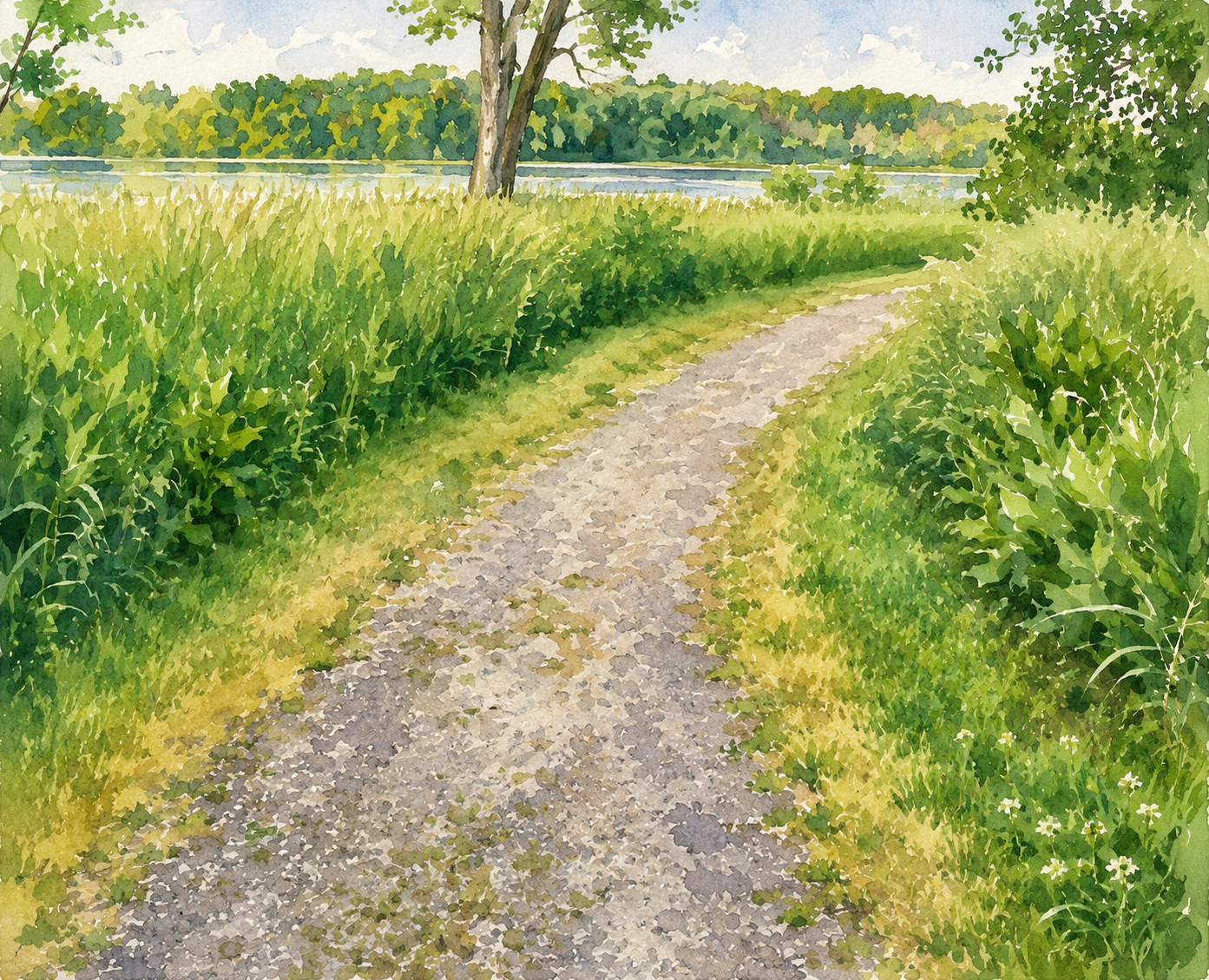
Sunlight on the trail.

There is so much life at the end of May! Here are some photos taken in the garden and during yesterday’s trail walk. Living near the state park has been quite the perquisite!

Pre-dawn light.
Categories
Creative Life

Spring Photos 2026

Blue-thirty.

Another month of spring remains. This year I took spring photographs, enough to make this special post with recent favorites. Being a photographer is a constant process. If we are lucky, some of the results are good.

Trail walking after sunrise.
Categories
Creative Life

It’s Still Spring

Pre-dawn light on the state park trail.

Signs of spring are everywhere: First sets of goslings on the lake with their parents, songbirds throughout the forested area, and earlier morning sunrises. During my at-home retreat, I have been keeping irregular hours and changing most everything about my daily schedule. On Tuesday I slept until first light, immediately dressed, and headed out for my morning walk without any of the normal daily regimen. It felt weird, but I did it. Behind all the schedules and regimen, I’m still me.

I came across what appeared to be a molted feather of a Barred Owl on the trail. Because I hear owls high in the tree canopy in the predawn light, there is ample additional evidence they are around. The feather confirms the species of owl. While researching the feather, I discovered the Migratory Bird Treaty Act of 1918, which governs such findings. The common outdoor saying, “take only pictures, leave only footprints,” applies here.

Barred Owl feather on the state park trail. The rules, according to the Migratory Bird Treaty Act of 1918, are to not touch them, tempting as it may be to pick it up and take it home. I took this photo and left it where I found it.

If you’ve been in the spice aisle of a grocery store, the high prices are quite noticeable. A jar of organic dried basil costs $7.75 per ounce at a local chain grocery store. If one buys bulk via mail order, the cost of a pound of the same product is $0.86 per ounce. I bought bulk of basil, marjoram, and parsley and shared the savings by giving some of it away to family.

Dried herbs bought in bulk and then broken down for a gift.

The big spring project is planting the garden. For now, I can stand all the work and hope to continue at least another ten years. Indeed the fresh produce—where I control the inputs—is of high value in our household. The year-to-date expense is running 73.4 percent of 2025. Lower costs have to do with purchases made last year, and reusing fencing, plastic ground cover, and the covered row. I’m not finished spending money but the trend is hopeful. Every pound of home-grown produce displaces money I would have to spend at the grocer or farmers’ market. It is a good way to live.

There was a chance of rain, but not much of a chance. We need rain, but the deep soil moisture is probably sufficient. The recent sunny and windy days have been drying the garden’s surface soil. That’s another spring worry—getting sufficient rain to produce a garden crop. Officials at the National Weather Service say we are near normal. That is good enough for today.

Categories
Creative Life

A Day Begins

Sunrise.

I wake in the middle of the night with the sun well positioned below the horizon. What light exists comes from stars, the moon, airglow, or the indirect light of nearby never-sleeping cities. I am awake, but don’t want to be.

Sometimes I get up and walk to the kitchen for a drink of water, then stand at the French door, looking at the sky. By now Earth is turning toward light as the sky begins to lose its blackness. Below the horizon, shapes blend into a singular darkness. Above, stars and planets are still visible. Light has begun to penetrate, thinning the darkness.

Our child called it “blue thirty:” the point where sunlight begins to dominate the sky. The sky is briefly a dark shade of blue. They noticed this while camping and taught me to look for it. The silhouettes of grounded objects emerge from darkness, becoming recognizable forms.

Now I want to turn on lights and wake. The horizon has become readable, and the urge to create something is present at nautical twilight. I make coffee and go to my writing place.

After donning hiking shoes, I walk toward the state park trail at first light. From obscuring darkness, the day takes shape in colors—greens, browns, and blues. It begins in semi-darkness with loud migrating birds—geese in late winter and songbirds in spring. Bird sounds surround me as I pick up the pace to increase my heart rate. I can see the trail changing from dark to light at my feet.

The sky puts on a show as dawn breaks. In pinks, reds, and golds, refracting sunlight makes the sky dance as an artist paints a canvas. Dawn arrives in colorful glory.

By the time I round the turn toward home, the sun rises. Direct light illuminates the trail, with long shadows of trees, bushes and other vegetation. The day has become clear—with things to do.

As I finish the turn, I feel my pulse and walk toward the rising sun.

Categories
Creative Life

A Life of Photos Part XV

On the state park trail.

The garden has me outdoors more often, and because of it, I’m taking more photographs with my mobile device. Here are some from April and early May.

Spring is about the outdoors.

I’m spending more time at my workbench.

Workbench.
Pre-dawn light.
Categories
Creative Life

Time Management While Aging

Footbridge over a field runoff creek into Lake Macbride.

I spent time Sunday working on how to use my time. The two parts were structuring days into time blocks and working to better define tasks listed for accomplishment. This post details some of what I did.

The natural breaks in my days at home are by time.

  • From waking at or before 4 a.m., I have a combination of routine morning things (calisthenics, breakfast, exercise, reading, writing), and unstructured creative time.
  • There are three pomodoros of 50 minutes each, beginning at 8 a.m. Each ends with a ten-minute break. I schedule activities for these pomodoros the day prior.
  • A break at 11 a.m. to have lunch, run errands, and perform household chores. Check social media, email, blog performance. This breaks up the day.
  • At 1 p.m., two pomodoros of 50 minutes each with a ten minute break in between.
  • Once the pomodoros are finished, I head to the kitchen to do dishes and begin preparing dinner.
  • 5 p.m. is a social hour with my spouse plus dinner, usually together.
  • Evening check in on social media, email, household tasks, and chores. Followed by sleep.

These time periods follow a natural rhythm developed since the coronavirus pandemic. While I need to watch the clock sometimes, there is a flow from one activity to the next that sometimes runs over. Almost always, I follow the seam toward completion if I can.

I need to learn to be more outcome oriented than task oriented. For example, clear one garden plot of debris from last season and till represents an outcome. It provides more structure than simply writing on the planner to spend time in the garden. Deliverables matter.

A main question is how will I structure more complex projects that span multiple days, weeks, and months? The good thing about the pomodoros structure is they force breaking complex tasks into do-able work units. This will be another learning process.

I was already using this structure unawares. We all need to maintain productivity and keep our daily routines fresh. When it seems like work, the system requires corrective action.

Categories
Creative Life

A Life of Photos Part XIV

Digital camera with extra batteries, circa 2014.

Most of my cameras have been inexpensive. A half-dozen shoe boxes full of photographs sit in storage around the house. Until I began a photo-archiving project, they were seldom opened.

There is a Minolta SRT-101 single lens reflex camera tucked away in the suitcase I inherited from Grandmother along with other old photographic technology. When I used it at university, I developed a few prints myself, yet relied on commercial film processors, typically a drug store, because it was easy and inexpensive. I went digital in 2005 with my first mobile telephone — a flip phone — with a built-in camera. Now, most snapshots are taken with my smartphone, for which I bought a camera upgrade. Cheap snapshots would make do when professional photographers were for newspapers, politicians, artists and special occasions.

I’ve seen photographic technology come and go. What I thought were very cool cameras in the 1960s are now relics that belong in a museum or more likely the recycling bin. For the most part, we no longer use film. Instead, my smartphone takes digital photos and uploads them to the cloud without me doing anything after making initial settings. The days of new shoe boxes are over as I easily import images to my computer, and store, use, and backup files constantly.

When taking my first photographs in the 1960s, everything was printed. The rise of home computing during the mid-1990s changed how we take and store photos. The question soon arose about the long-term survival of digital photographs. Would the software used to create and store them remain available? Would formats such as bitmaps or *.pict files become obsolete? And what would happen to the images stored in them? Will family memories become inaccessible, unlike the way some daguerreotypes persist from the 19th Century? It’s one more thing to think about in 21st Century life.

I don’t print many photographs today, and when I do, I use a local outlet of national retailers like Walgreens. Now that I understand their process, I will be using them more to print some images that are important to telling my story. Most digital images will live online.

Old habits related to photo processing die hard, and in this case, resolve an open question about emerging technology over time. A printed photograph is something we can touch and feel—a small certainty in a world where so much of life exists only on screens.

Categories
Creative Life

Embers of a Forgotten Fire

Remains of a brush fire.

Some days we feel spent. Our wood burned while leaving embers to warm us only for a while.

There is so much going on with writing this week it has taken most of my energy. Partly, the resolution is knowing when to set it aside and let the stories breathe within us.

On the plus side, celeriac is up. It’s tray partner celery is not. There will be arugula in a few weeks. The ground is frozen, yet the garden springs indoors.

A couple of photos for today.

2010 garden space.
Categories
Creative Life

Some Friday Photos

Some 2010 images from my photo archive project.

Snow on Big Grove pine trees.
2010 garden space.
Up against a brick wall.
Categories
Creative Life

A Life of Photos Part XIII

2009 photo at a political event in Iowa.

In 2009, I had a digital camera before smart phones and the several thousand images I took show I was learning. Getting a subject in focus with proper lighting was hit or miss. I hadn’t thought much about framing. There were a disproportionate number of misses.

However, some of the shots stood out.

I made some trips that year and took touristy photos like these:

This spot in Tama, Iowa, along the old Lincoln Highway, has been photographed by many others.

Most of the photos were of things and places near where we live.

My garden dominated the folders.

Holiday sugar cookies.