Categories
Creative Life

A Day Begins

Sunrise.

I wake in the middle of the night with the sun well positioned below the horizon. What light exists comes from stars, the moon, airglow, or the indirect light of nearby never-sleeping cities. I am awake, but don’t want to be.

Sometimes I get up and walk to the kitchen for a drink of water, then stand at the French door, looking at the sky. By now Earth is turning toward light as the sky begins to lose its blackness. Below the horizon, shapes blend into a singular darkness. Above, stars and planets are still visible. Light has begun to penetrate, thinning the darkness.

Our child called it “blue thirty:” the point where sunlight begins to dominate the sky. The sky is briefly a dark shade of blue. They noticed this while camping and taught me to look for it. The silhouettes of grounded objects emerge from darkness, becoming recognizable forms.

Now I want to turn on lights and wake. The horizon has become readable, and the urge to create something is present at nautical twilight. I make coffee and go to my writing place.

After donning hiking shoes, I walk toward the state park trail at first light. From obscuring darkness, the day takes shape in colors—greens, browns, and blues. It begins in semi-darkness with loud migrating birds—geese in late winter and songbirds in spring. Bird sounds surround me as I pick up the pace to increase my heart rate. I can see the trail changing from dark to light at my feet.

The sky puts on a show as dawn breaks. In pinks, reds, and golds, refracting sunlight makes the sky dance as an artist paints a canvas. Dawn arrives in colorful glory.

By the time I round the turn toward home, the sun rises. Direct light illuminates the trail, with long shadows of trees, bushes and other vegetation. The day has become clear—with things to do.

As I finish the turn, I feel my pulse and walk toward the rising sun.

Categories
Creative Life

A Life of Photos Part XV

On the state park trail.

The garden has me outdoors more often, and because of it, I’m taking more photographs with my mobile device. Here are some from April and early May.

Spring is about the outdoors.

I’m spending more time at my workbench.

Workbench.
Pre-dawn light.
Categories
Creative Life

Time Management While Aging

Footbridge over a field runoff creek into Lake Macbride.

I spent time Sunday working on how to use my time. The two parts were structuring days into time blocks and working to better define tasks listed for accomplishment. This post details some of what I did.

The natural breaks in my days at home are by time.

  • From waking at or before 4 a.m., I have a combination of routine morning things (calisthenics, breakfast, exercise, reading, writing), and unstructured creative time.
  • There are three pomodoros of 50 minutes each, beginning at 8 a.m. Each ends with a ten-minute break. I schedule activities for these pomodoros the day prior.
  • A break at 11 a.m. to have lunch, run errands, and perform household chores. Check social media, email, blog performance. This breaks up the day.
  • At 1 p.m., two pomodoros of 50 minutes each with a ten minute break in between.
  • Once the pomodoros are finished, I head to the kitchen to do dishes and begin preparing dinner.
  • 5 p.m. is a social hour with my spouse plus dinner, usually together.
  • Evening check in on social media, email, household tasks, and chores. Followed by sleep.

These time periods follow a natural rhythm developed since the coronavirus pandemic. While I need to watch the clock sometimes, there is a flow from one activity to the next that sometimes runs over. Almost always, I follow the seam toward completion if I can.

I need to learn to be more outcome oriented than task oriented. For example, clear one garden plot of debris from last season and till represents an outcome. It provides more structure than simply writing on the planner to spend time in the garden. Deliverables matter.

A main question is how will I structure more complex projects that span multiple days, weeks, and months? The good thing about the pomodoros structure is they force breaking complex tasks into do-able work units. This will be another learning process.

I was already using this structure unawares. We all need to maintain productivity and keep our daily routines fresh. When it seems like work, the system requires corrective action.

Categories
Creative Life

Drugstore Paperbacks

Mass-market paperback books.

When I had a newspaper route, I stopped at the corner drugstore and occasionally bought mass-market paperback books. They are characterized by their small size (roughly 4.25 x 6.87 inches), lower price point, and widespread distribution in places like airports, grocery stores, and drugstores. I have so many of them that I built a special shelf to store them near the ceiling.

They were never archival quality, and a typical one from the 1960s has yellowing pages due to the cheaper paper from which it was made. The pages grow increasingly brittle with age. They are what they are: a record of what I was reading. They are subject to the same curation as any of my books.

One of the first I bought was The True Story of the Beatles by Billy Shepherd, illustrated by Bob Gibson. It was promoted as “The original book about the Beatles,” with photographs published in the U.S. “for the first time.” After seeing them on February 9, 1964, on The Ed Sullivan Show, I bought this book that summer and, in the fall, went with my mother to the King Korn stamp redemption center and got a new Kay guitar to play. Our family members were Beatles fans.

Another early purchase was The Great Escape by Paul Brickhill. Several World War II veterans lived in our neighborhood and spoke about their experiences. My cohort of grade schoolers descended on downtown Davenport to meet up for matinees at the several movie theaters operating there. World War II films, including this one, were de rigueur. The 50-cent Crest Book reported, “Now a spellbinding motion picture starring Steve McQueen, James Garner, Richard Attenborough. A United Artists release.” The printing of my copy was October 1965. I can’t say how many times I saw this film—yet many. That’s how grade schoolers rolled in the 1960s.

I went through a period when I collected mass-market paperbacks written and popular in the 1960s. Among them are On the Road by Jack Kerouac, One Flew Over the Cuckoo’s Nest by Ken Kesey, Beautiful Losers by Leonard Cohen, Bound for Glory by Woody Guthrie, Reminiscences of the Cuban Revolutionary War by Che Guevara, Prison Journals of a Priest Revolutionary by Philip Berrigan, Soledad Brother: The Prison Letters of George Jackson, How to Talk Dirty and Influence People by Lenny Bruce, Daybreak by Joan Baez, and Long Time Coming and a Long Time Gone by Richard Fariña. Just typing these titles is a trip down memory lane.

In part, that is the problem. I moved past the 1960s in my intellectual development, and these books are unlikely to be reread. I envision more culling of less useful mass-market paperbacks as I move through this project. The special shelf space sets the limit on how many I retain.

Categories
Creative Life

A Life of Photos Part XIV

Digital camera with extra batteries, circa 2014.

Most of my cameras have been inexpensive. A half-dozen shoe boxes full of photographs sit in storage around the house. Until I began a photo-archiving project, they were seldom opened.

There is a Minolta SRT-101 single lens reflex camera tucked away in the suitcase I inherited from Grandmother along with other old photographic technology. When I used it at university, I developed a few prints myself, yet relied on commercial film processors, typically a drug store, because it was easy and inexpensive. I went digital in 2005 with my first mobile telephone — a flip phone — with a built-in camera. Now, most snapshots are taken with my smartphone, for which I bought a camera upgrade. Cheap snapshots would make do when professional photographers were for newspapers, politicians, artists and special occasions.

I’ve seen photographic technology come and go. What I thought were very cool cameras in the 1960s are now relics that belong in a museum or more likely the recycling bin. For the most part, we no longer use film. Instead, my smartphone takes digital photos and uploads them to the cloud without me doing anything after making initial settings. The days of new shoe boxes are over as I easily import images to my computer, and store, use, and backup files constantly.

When taking my first photographs in the 1960s, everything was printed. The rise of home computing during the mid-1990s changed how we take and store photos. The question soon arose about the long-term survival of digital photographs. Would the software used to create and store them remain available? Would formats such as bitmaps or *.pict files become obsolete? And what would happen to the images stored in them? Will family memories become inaccessible, unlike the way some daguerreotypes persist from the 19th Century? It’s one more thing to think about in 21st Century life.

I don’t print many photographs today, and when I do, I use a local outlet of national retailers like Walgreens. Now that I understand their process, I will be using them more to print some images that are important to telling my story. Most digital images will live online.

Old habits related to photo processing die hard, and in this case, resolve an open question about emerging technology over time. A printed photograph is something we can touch and feel—a small certainty in a world where so much of life exists only on screens.

Categories
Creative Life

Embers of a Forgotten Fire

Remains of a brush fire.

Some days we feel spent. Our wood burned while leaving embers to warm us only for a while.

There is so much going on with writing this week it has taken most of my energy. Partly, the resolution is knowing when to set it aside and let the stories breathe within us.

On the plus side, celeriac is up. It’s tray partner celery is not. There will be arugula in a few weeks. The ground is frozen, yet the garden springs indoors.

A couple of photos for today.

2010 garden space.
Categories
Creative Life

Some Friday Photos

Some 2010 images from my photo archive project.

Snow on Big Grove pine trees.
2010 garden space.
Up against a brick wall.
Categories
Creative Life

A Life of Photos Part XIII

2009 photo at a political event in Iowa.

In 2009, I had a digital camera before smart phones and the several thousand images I took show I was learning. Getting a subject in focus with proper lighting was hit or miss. I hadn’t thought much about framing. There were a disproportionate number of misses.

However, some of the shots stood out.

I made some trips that year and took touristy photos like these:

This spot in Tama, Iowa, along the old Lincoln Highway, has been photographed by many others.

Most of the photos were of things and places near where we live.

My garden dominated the folders.

Holiday sugar cookies.
Categories
Creative Life

My January With AI

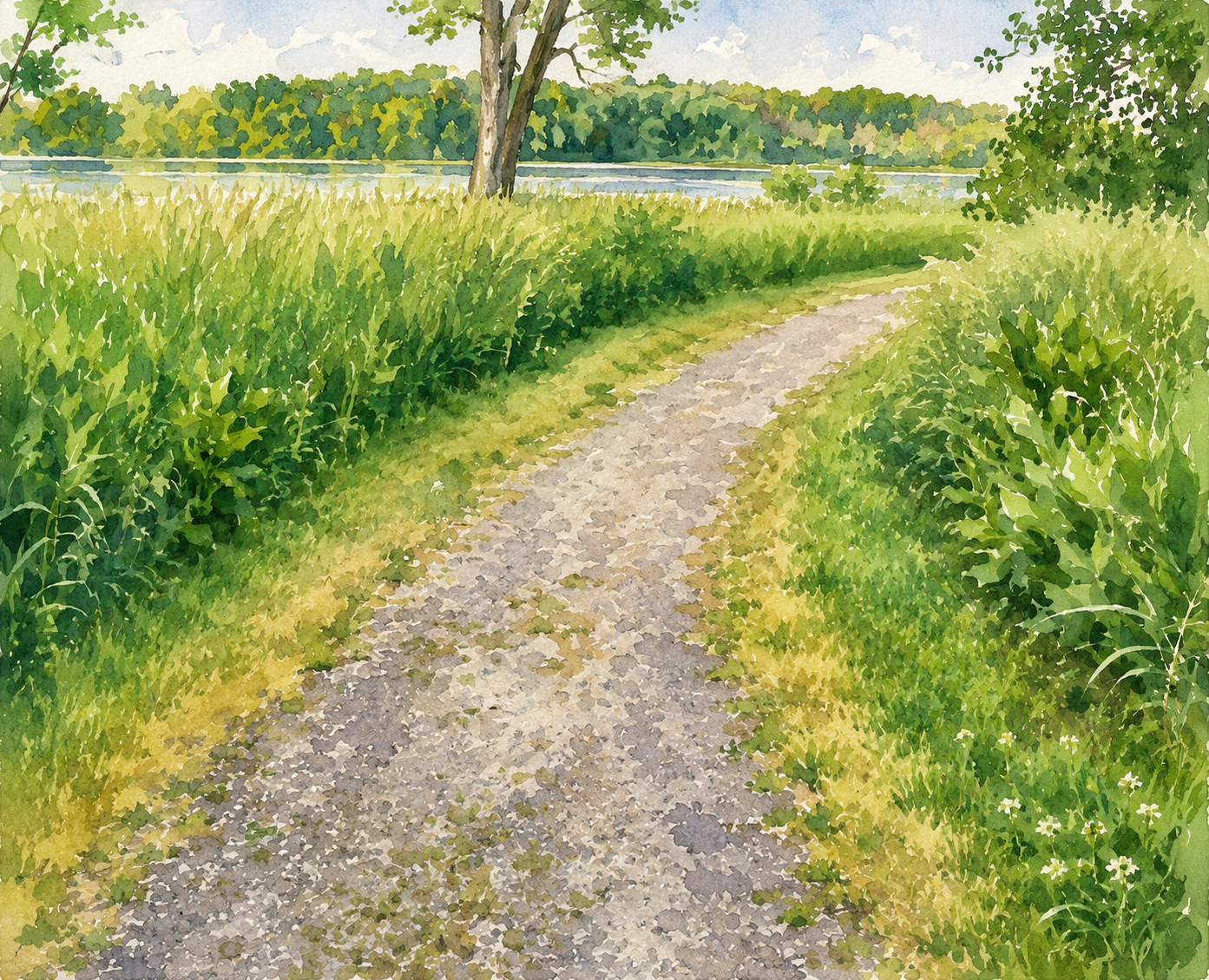
On the state park trail Jan. 24, 2026.

Artificial Intelligence is everywhere I am on the internet and January has been a month of learning to use it. This post includes my experiences with some of the artificial intelligence tools, including Rufus on Amazon, AI Overview in Google Search, and ChatGPT. The brief comment I would make about any of these tools is we must change how we interact to be effective. This isn’t your parents’ Google search any more. Without doubt, AI made my life better. We must ask better questions.

WordPress uses artificial intelligence on its help screen. The paradigm is simple. Define your role and frame what you want. For example, “I am a site admin and don’t have a lot of programming experience but I’d like to set up a new site and transfer my domain to it.” WordPress AI frames its response in terms of the request, often using the same language. This is ultra simple and important to every AI platform. That is a key learning point.

My main learning this month has been to ask any artificial intelligence tool better questions. Google and other search engines have trained us how to use them for decades. The old ways of entering a few related nouns or a simple phrase do not serve us as well going forward. Because AI has been trained on an enormous portion of human-written text, part of our queries must include minimal framing of questions. For example, I wanted to use a photograph as the basis for ChatGPT to render it in the style of Claude Monet impressionism with oil paints. It did a reasonable job of doing so. This kind of role-defining for our AI interface seems subtle at first, but more so it seems fundamental to the new approach needed to maximize our value.

Amazon sells stuff and uses an AI platform named Rufus. Even here query framing matters. The same type of role playing is important, yet roles are likely similar for everyone — we mainly visit Amazon to buy stuff. I asked Rufus, “Based on last year’s purchases, what are my buying patterns?” It listed Brand Loyalty, Shopping Style, and Household Profile. It identified me as someone who uses the account to shop for myself, incorrectly identifying me as a single-person household, which surprised me, since my spouse and I have linked accounts. Rufus also identified me as “price conscious but quality-focused” because I bought some Made In cookware. It also noted I am an active cook, based on buying Mexican oregano, canning jars and rings, and the aforementioned cookware. I likely used Rufus the least of the AI platforms mentioned.

With the broad database inherent in large language models like ChatGPT and Google’s AI Overview, our queries must include a way of paring potential answers down. To make our intent clear, state our goals for the tool, and most importantly set constraints. One of my favorite constraints is to write “I have 30 minutes to work on this so give me the top 3 findings,” or something similar. If I know something about what I am querying, I mention that as well. AI can provide its reasoning, and there’s no harm in asking for it.

I am still learning, yet with the long discussions I have with ChatGPT, the tool remembers what was previously said within a single chat. This is something I tend to forget when my follow up query is a week or two after the initial one. One evident thing is I need a better skill set when it comes to querying AI tools. Eventually, better AI queries will become part of a standard tool box for using artificial intelligence.

Categories
Creative Life

Is It Real?

The truth or reality behind these two images is unknowable. I believe in a Cartesian view of humanity in which the phrase “I think, therefore, I am” indicates the isolate self, reaching to others that potentially exist, through the veil of Maya. The minute I captured the photograph on my mobile device, it left the plane of reality. The artificial intelligence rendering of it in a Monet-style impressionism is merely a variation of the original. The underlying reality of that sunrise is no longer knowable. Even I have only memories that have decayed for eight hours as I type this.

These images reflect an actuality I remember, yet not reality. Shakespeare famously had Hamlet say, “to hold as ‘twere the mirror up to nature: to show virtue her feature, scorn her own image, and the very age and body of the time his form and pressure.” Perhaps Shakespeare assumed the mirror was a neutral conduit for reality. For purposes of an Elizabethan play making that assumption may have been necessary and fodder for audiences who knew otherwise to react.

Images such as these have a use in social media and blog posts. Those who followed my blog the last few months often saw sunrise photographs at the header. I post them on BlueSky, as well. They represent a shorthand of my experience on that date at a specific time. They are largely throw-away images even if some of them are quite fetching. The point I am making with this photograph and its rendering is a new day is dawning in which we can be better humans with new chances. That, too, is an interpretation, something worth hoping for.

I’m a bit infatuated with the image rendering capabilities of artificial intelligence. Of the five photographs I tried, only two were keepers, and then only for long enough to post them on one of the platforms I use. While that moment in which I captured the rising sun is no longer knowable, it was as real as anything can be. My Cartesian model notwithstanding.