Categories
Environment

COP24 and What’s Next

Image of Earth 7-6-15 from DSCOVR (Deep Space Climate Observatory)

Like others, I was skeptical the broad coalition to act on climate formed during and after the 21st Conference of the Parties to the United Nations Framework Convention on Climate Change in Paris would last. This week at COP24 in Poland, three top oil producing states, the United States, Russia and Saudi Arabia, along with number nine, Kuwait, blocked acceptance of the Intergovernmental Panel on Climate Change report the conference commissioned.

The four oil producers objected to “welcoming” the report and preferred the vague language of “noting” the report. Because the conference proceeds only after reaching consensus, and they couldn’t, the report was not adopted.

“Opposition to climate action is one of the issues motivating Trump’s cozy relationship with the corrupt leaders in Russia and Saudi Arabia,” State Senator Rob Hogg tweeted Dec. 9. “This is not who we are as Americans, and we need to put a stop to it.”

“Under Trump, instead of leading the world to act on climate change, the United States joined with Russia and Saudi Arabia to stop the recognition of a scientific report about the increasingly urgent need for climate action,” he tweeted.

Absent U.S. leadership on climate I expect further dissent within the coalition that reached consensus Dec. 12, 2015 with the Paris Agreement. Our politics, led by moneyed interests, hinders efforts to do what makes sense regarding climate change. We can’t even agree on the facts about climate change. Accepting the IPCC report, or “welcoming” it to use the vernacular of the conference, should be a non-issue.

Although President Trump announced his intent to withdraw from the Paris Agreement, the U.S. continues to be party to it. We live in a time when the truth has become unhinged from reality and it’s hard to see what path our country will take regarding our need to act on climate going forward.

What we see in Iowa is changing weather patterns enhanced and made worse by climate change. The 2012 drought was unimaginably oppressive and reduced corn and soybean yields. After local storms on Sept. 19, 2013 knocked trees down and damaged our home I wrote, “Everywhere in the farming community, people are concerned about extreme weather. Weather is always a concern for farmers, but this is different.” New research shows change in the atmosphere is reducing the nutritional content of foods we take for granted. None of this was expected. All of it hits home.

Whether people use the words climate change is less the issue. What matters more is our lives are changing, with tangible costs, and people are worried about it. Not only for the monetary damages of a storm, or for reduced crop yields, but for what it means for the future.

The aspiration of the Paris Agreement was noble, but likely unfeasible without leadership from the United States. Regretfully President Obama did not get buy-in from Republicans in government before he signed the Paris Agreement. Once he was gone, politics took over and his efforts to mitigate the effects of climate change are rapidly being rendered null.

There’s no easy solution to climate change. Was there ever? The truth before us is we must act on climate before it’s too late. Whether society is capable of doing so remains an open question. COP24 provided another setback to action.

Categories
Home Life

Thanksgiving Leftovers

Tacos

I put Thanksgiving leftovers in a plastic dish for my lunch at the home, farm and auto supply store.

Low levels of activity characterized the last week. Once I finished morning sessions at my writing desk, I didn’t leave the house much. I don’t like the thought of going to work today, yet two shifts each week provides structure and socialization. It would be easy to get disconnected from society where we live. It’s time to get going again with a trip across the lakes.

I made a slaw of green cabbage and daikon radish and put a serving in a plastic container to supplement the beans, kale and rice lunch in the other. I’m ready for my shift.

Yesterday the Cedar Rapids Gazette reported Devotay, the restaurant started by Kurt and Kim Friese, was shuttering Jan. 1, 2019. Frieses sold the restaurant last January and under new owners the tapas bar is not attracting enough customers. They plan to re-name the Linn Street restaurant, create a new menu and re-open. Tapas was a thing when I worked in the Chicago loop, and I’ve eaten paella in Spain, but today’s potential customers apparently don’t get it. Such is restaurant life in a county seat that hosts a large university with a transient population.

As I read the news, the letter carrier delivered a copy of Friese’s book A Cook’s Journey: Slow Food in the Heartland. When I ordered it, the web site said it was the last copy in stock, although it was published across the lake in North Liberty. They can probably make more as long as there is demand. I knew of Friese the food author, but never read him, ate in his restaurant, or ran into him around the county. I met him when he became more active in politics. He was a good writer and a great conversationalist. I still can’t believe he is gone.

To make sense of our food ecology, some knowledge of what Friese did is essential. Until his last days he was recruiting people to join the slow food movement. I doubt anyone can replace what he did because of his long tenure and specific knowledge. Devotay likely relied on this as well and was bound to change after they sold.

“Food is important,” chef Matt Steigerwald said when he opened Lincoln Cafe in Mount Vernon. While I didn’t know Kurt Friese’s food hardly at all, he left a legacy which is likely entwined in the Thanksgiving leftovers I packed for lunch. I intend to unpack his food legacy in my quest to understand the complex food ecology where we live.

But for now, I have to get ready for my shift.

Categories
Milestones Work Life

Bernardo Bertolucci and General Motors

Bernardo Bertolucci (77) died yesterday in Rome, Italy where he had been suffering from cancer. The bigger news was General Motors’ decision to reduce workforce and eliminate six car models, including the Chevrolet Volt rechargeable gas-electric hybrid.

What do they have in common besides their coincidence?

They both hit me where I live.

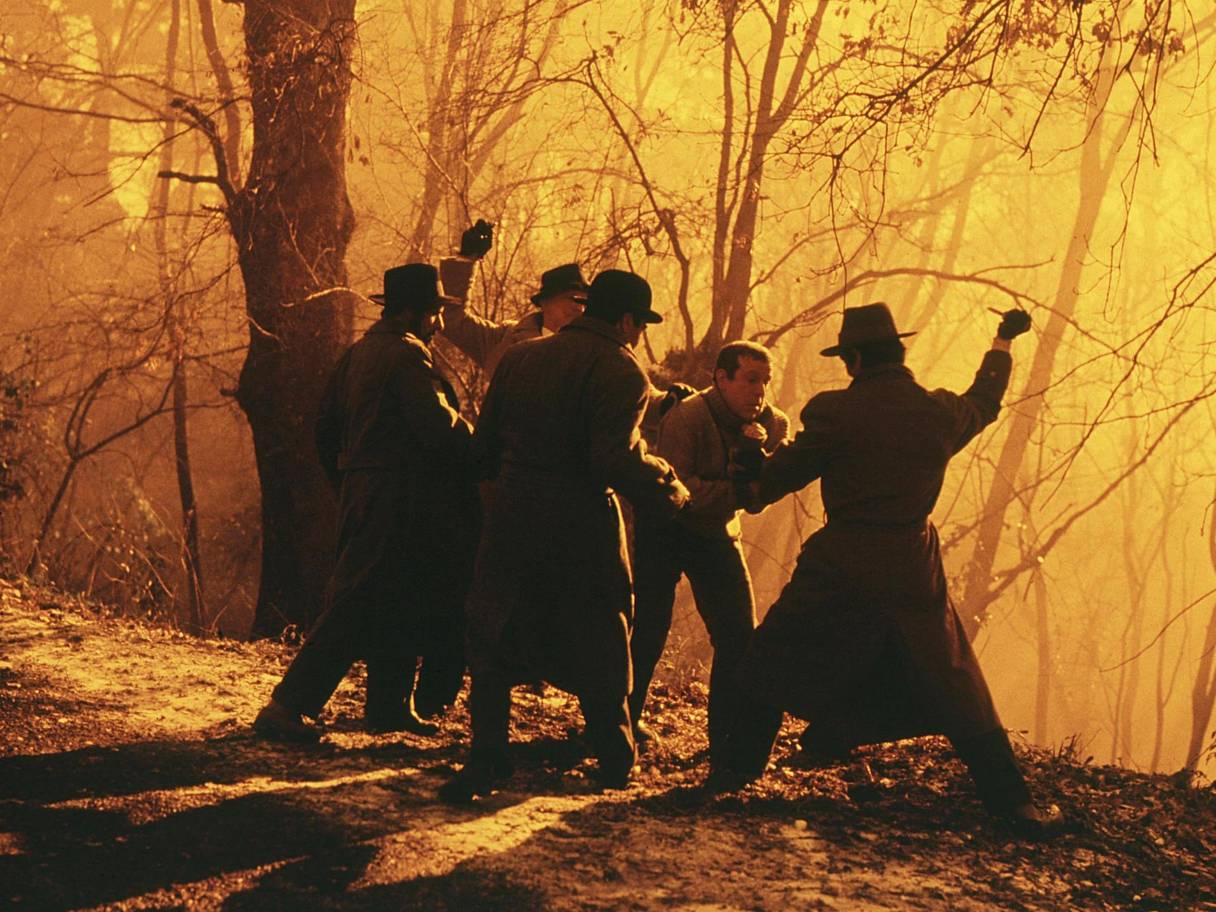
When I returned from military service I spent time viewing movies I missed coming up, including The Conformist. I became enamored of the film, its director Bertolucci, and its cinematographer Vittorio Storaro. On my cross-country trip from New Jersey, where my pickup truck had been shipped from Germany, enroute home to Iowa, I visited friends Diana and Dennis in Springfield, Illinois. Diana fed us cornbread and beans and Dennis and I went to see Francis Ford Coppola’s Apocalypse Now, with cinematography by Storaro. That night began an infatuation with cinema that continued through my return home and lingered into the early years of our marriage. Of the films I have seen, The Conformist ranks in my top ten.

The Conformist

Partly The Conformist resonated with my short trips to Italy in the 1970s. More, though, it was Marcello Clerici, the vacillating, spineless protagonist who would kill his professor in a woods at the direction of the Communist Party. Who would want to be that? Not me. Not anyone. The impression the film made on my artistic consciousness persists. I will be forever thankful to Bertolucci for his contribution to this formative experience.

The General Motors announcement was a gut punch to anyone who lived and worked in the Rust Belt.

“The reductions could amount to as much as eight percent of GM’s global workforce of 180,000 employees,” Tom Krisher wrote for Associated Press.

What makes this pill tough to swallow is the damage that has already been done throughout the industrialized part of the country. I’ve written extensively about my experiences recruiting truck drivers in Illinois, Wisconsin, Indiana, Michigan, Ohio, New York and Pennsylvania during the period 1987 – 1993. I met thousands of people laid off from industry jobs. What makes the GM announcement different is what I experienced then was related to globalization. What’s happening now has to do with board room decisions emboldened by the recent Republican tax breaks.

The Conformist

There is talk unions will negotiate a better deal for workers as GM moves forward with their plans. How has that worked before? It hasn’t. The only union-related board member had been from the UAW health care trust, a position vacant since December 2017. The fund lost the board seat in October after selling a big chunk of GM stock.

Why would a person that drives a 21-year old passenger car care what GM does? When you’ve seen the faces of long-term employees who lost everything after a plant closing or down-sizing, you know what this announcement from GM means to workers. Only a cold, venal, rudderless being like Marcello Clerici could look on and not feel anything.

Categories
Environment

Protect Our Planet, Protect Ourselves – 24 Hours of Reality

It’s a fact: Fossil fuels are driving a climate crisis and threatening our health. On Dec. 3 – 4, Climate Reality and former Vice President Al Gore will be joined by an all-star line-up of artists, thought leaders, and scientists for 24 Hours of Reality: Protect Our Planet, Protect Ourselves. Tune in and learn how we can make a healthy future a reality: https://www.24HoursofReality.org.

Categories
Environment

Act On Climate

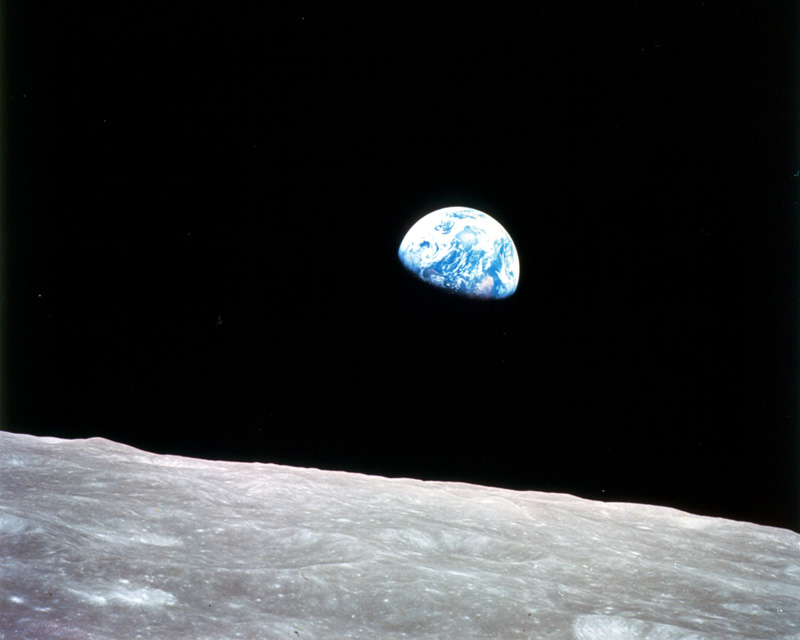
Earthrise by Bill Anders, Dec. 24, 1968

Every few years, interest in climate change spikes, according to internet search frequency reported by Google Trends. When the Intergovernmental Panel on Climate Change released their special report on the impacts of global warming of 1.5º C above pre-industrial levels on Oct. 8, searches spiked again. Searches are already trending downward.

Newspapers in our area ran stories about climate change, about one a day in recent weeks. Is there a new window of opportunity to act on climate? I doubt it. There is no window because the walls of the house we used to live in have been blown out.

It is time to act on climate.

Every environmental activist has a to-do list. Mine has four parts.

Reduce, reuse and recycle personally. I don’t seek to create a livable environment for me only as the late George Carlin derisively asserted about environmentalists. It is better to buy only food the household can use rather than let it go to waste. We live a life of making do with old clothing, old cars, and recycling single use bread and celery bags for our garden crops. It remains important to have a discussion with Waste Management about why they won’t recycle plastic. If enough people do it, maybe they will find a better way than baling and shipping it overseas or discarding it in landfills. This is a starting point for almost everyone.

Band together with like-minded people. We walk a tightrope in life in which the risks are many. On one side, we avoid the insularity of confirmation bias in which like minded people often find themselves. On the other, we are stronger together. A recent Stanford University study of 30 years of data about street protests found “citizen activism, which has been shown to impact state and firm policy decisions, also impacts electoral outcomes.” A single voice can be amplified if it joins a chorus of hundreds or thousands.

Advocate with elected officials to mitigate the effects of climate change. There is an art to political advocacy. Where groups have been successful, we found common ground with people of divergent backgrounds to unify around a single action. This is partly how we stopped two new coal-fired power plants from being built in Iowa. It is also how we changed the minds of legislators regarding new nuclear power plants in the state. Two tactics serve little purpose: contacting a legislator every time we disagree with any action they take, and group think of people who advocate for a carbon tax as their primary method to combat climate change. We must understand the diversity of solutions to the climate crisis, keep our powder dry for when it matters most, then act in unison.

Help educate people on the threat of unaddressed climate change. It goes without saying there is uneven understanding about the impacts of climate change in society. My popular post, Climate Change in 200 Words explains the basic science, about which there is little disagreement from even the most strident climate deniers. Where society gets hit hardest is in the impacts of warmer atmosphere and oceans. The news is full of examples. Few people have missed the fires in California, hurricanes in Florida, Texas and New Jersey, or the severe 2012 drought in Iowa. All of these events were made worse by global warming. Much of the intensification of our weather events is predictable and likely avoidable with societal action. Education is a valid and essential part of creating collective action to mitigate the effects of climate change.

Perhaps the important lesson about climate change derived from Google Trends is there are clear news hooks which can make climate action more likely. The problem hasn’t gone away and we can’t rely upon news events to precipitate our actions.

Whether we will act on climate before it is too late is unknown. What we do know is the human condition includes hope for survival and a better world. It is unrealistic to believe global societies will unite around a single course of action. Part of the brilliance of the 2015 Paris Agreement was it enabled every nation to participate in their own way toward a common goal of reducing greenhouse gas emissions. Whatever deficiencies existed in the agreement, it was a positive sign of what humanity is capable.

The IPCC special report is another scientific explanation we must act on climate before it is too late. This is my to-do list. What is yours?

Categories
Home Life Kitchen Garden

Into the Light

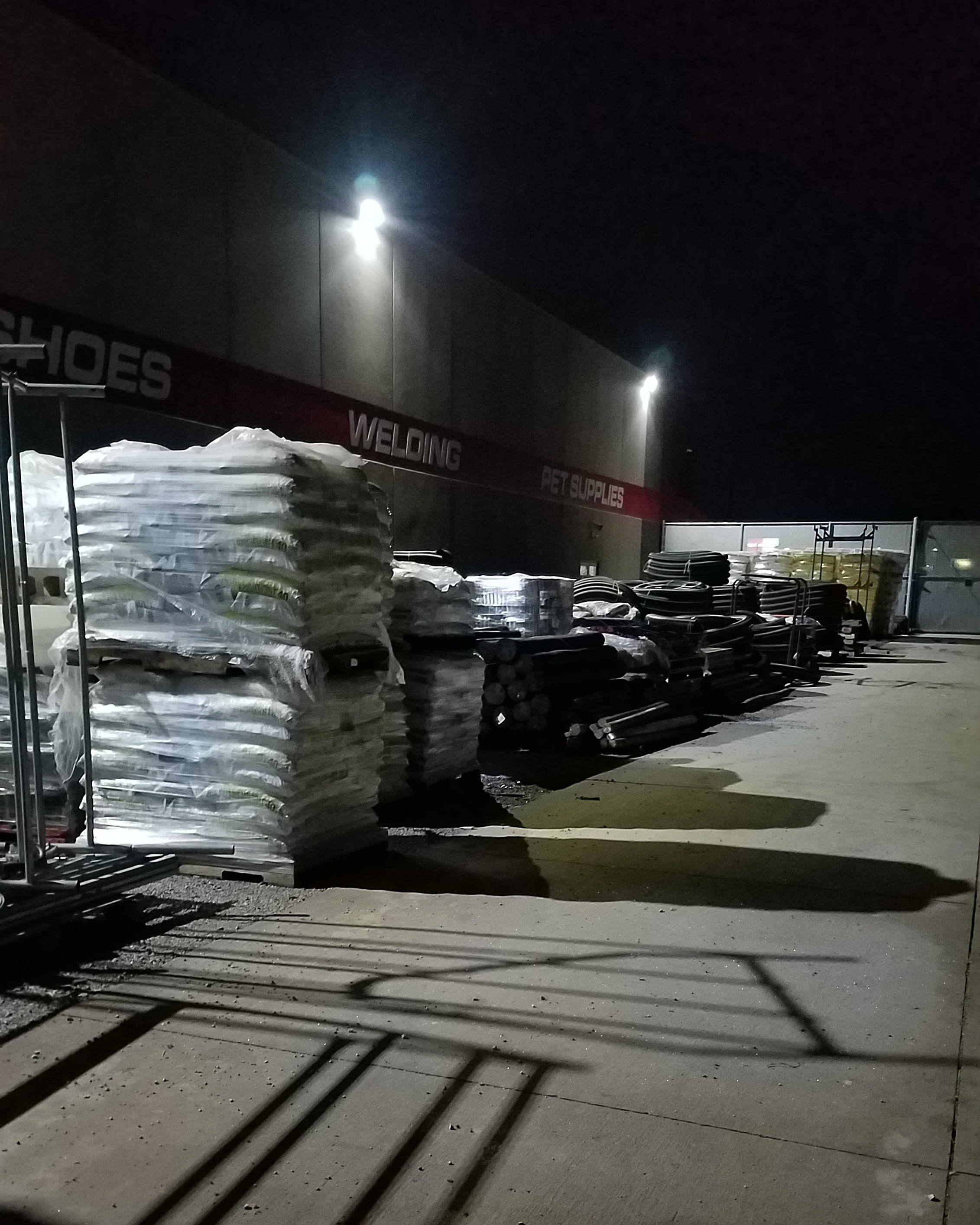
Black Friday, 4:30 a.m., at the home, farm and auto supply store

I spent much of Black Friday loading customer vehicles with large, bulky items that were on sale. It was often a three-person job.

Management had us come in an hour before the store opened at 6 a.m. to put the final preparatory touches on what is one of our biggest sales days of the year.

A crowd of shoppers waited when we opened. Given the types of merchandise we carry and aggressive pursuit of Black Friday market share, it was no surprise.

Throughout my shift shoppers arrived in vehicles containing bags of merchandise from other stores. We helped fill them up and all was good in retail world.

I was tired when I arrived home at 2:30 p.m., more because my early morning schedule was disrupted than the work I did at the home, farm and auto supply store.

First thing I did was make a batch of red chile sauce using dried New Mexico chilies.

We continue to have kale in the garden so the day before I planned a last-minute dish for our Thanksgiving dinner. Before I forget, here’s what I did:

Saute a diced medium onion in a frying pan. Add a couple of cloves of diced garlic. Once the onions and garlic are tender, add a pint of diced tomatoes and a tablespoon of Mexican oregano. When the sauce comes together, add a large amount of sliced kale leaves with the stems removed. I used three big leaves but more is okay because it will cook down. The stems can be sliced finely and added for more texture. Add a drained and rinsed can of prepared black beans. Season with salt to taste. Reduce heat to a simmer until the liquid has evaporated and serve hot as a side dish.

I had dinner of Thanksgiving leftovers and went to bed early. There will be a lot to do as we come into the light of this weekend.

Categories
Home Life

A Vegetarian Menu

What does a Thanksgiving menu look like in an ovo-lacto vegetarian household?

Deviled eggs, crudites and pickles

Roasted pumpkin seeds

Pickles and crudités

Deviled eggs

Vegetable Dishes

Wild rice pilaf

Baked sweet potato

Steamed green peas

Kale and black beans in tomato sauce

Desserts

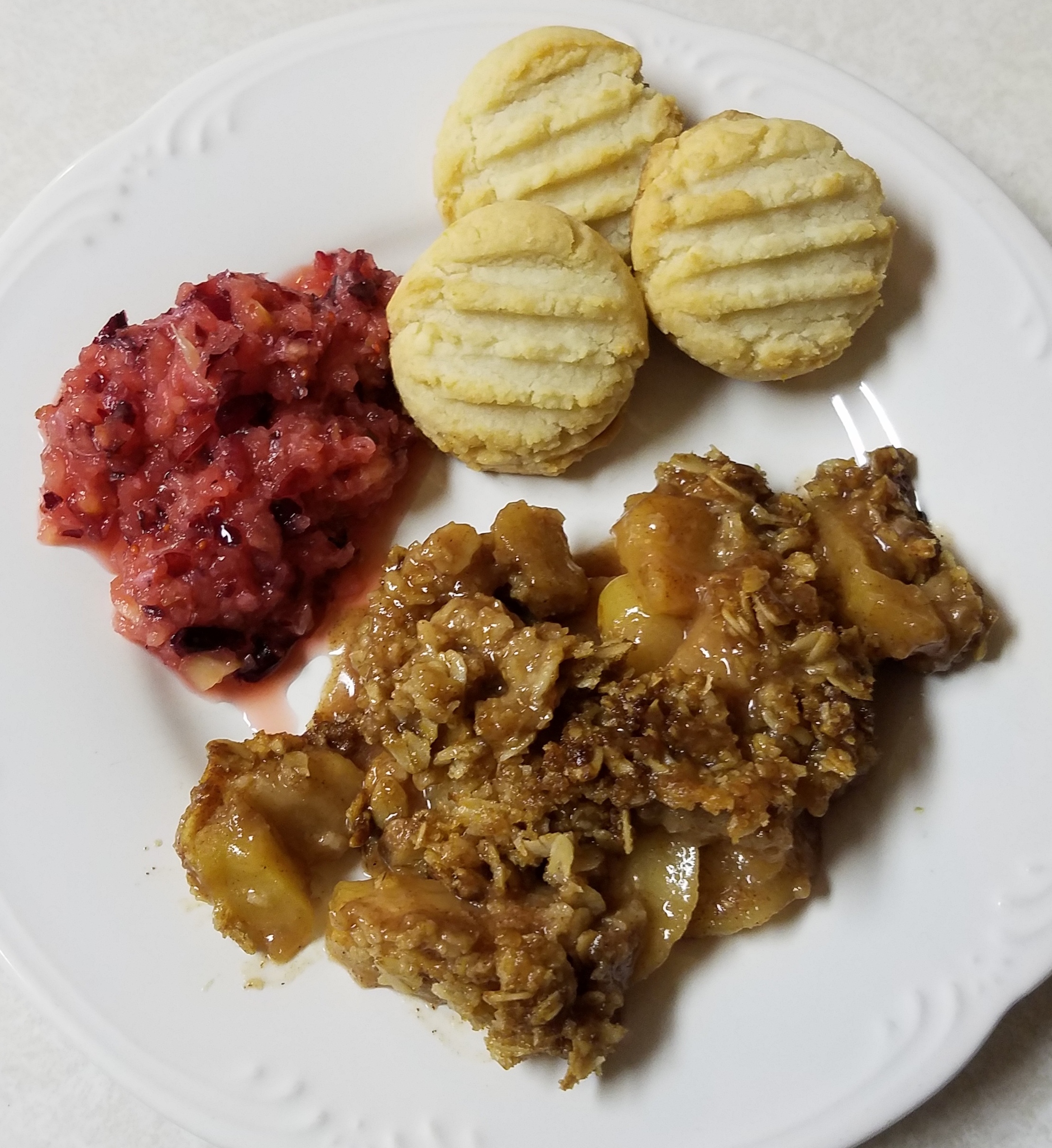
Cranberry relish

Apple crisp

Almond flour shortbread cookies

Sparkling apple cider

Categories
Home Life Kitchen Garden

Into the 2018 Holidays

Wild Turkeys in the Johnson County Lake District

This year’s holiday season is just beginning. I’ve been reluctant to turn the page on a year of transition and hesitate still.

We’re writing a Thanksgiving Day menu together and thus far know there will be our special recipes for wild rice and cranberry relish, along with sweet potatoes, green peas and an extensive relish tray split between crudités for her and pickles for me. There are roasted pumpkin seeds.

Yesterday I went to the orchard to buy Gold Rush apples for the cranberry dish. It was the last chance to catch up with my orchard co-workers until mid-December. I bought frozen Montmorency cherries from Michigan. The retail merchandise on display is dwindling down, soon to be placed in storage until next year. Should I get another frozen pie or two to last through winter? I don’t know but we have peach, cherry and apple already and once we get past the holidays anything that’s left will likely rest in the freezer. We are not dessert people and potluck season is drawing to a close.

Seventeen degree weather ended the kale run. I cut the number of plants in half this season and we still had more than could be used in a single household. We have fresh kale in the ice box and will use it in some to be determined dish on Thanksgiving. The point of all the food is the leftovers, and not having to cook for a few days.

My orchard supervisor asked me what I was doing with my weekends now that the season is finished. I didn’t have a good answer. I’ve been napping more, reading too, and preserving the abundance that still lives in our ice box. At some point I must turn the page. She asked how many we were having for Thanksgiving dinner. Like always, it’s just the two of us.

Until soil blocking begins at the farm in late February my weeks are two days at the home, farm and auto supply store and five days to do what I will. Three months to make progress on home projects among which writing is most important to me. To begin planning would be turning the page on life, something I’m not ready to do.

By Wednesday I should feel more in the holiday spirits as I have dinner planned with a friend. I’m not one to linger in uncertainty, at least I didn’t used to be. I’ll take these days into the 2018 holidays one at a time. Focused on the present, rooted in the past, and hoping for a better life afterward. Sustaining a life in a turbulent world.

Categories
Kitchen Garden

Functional Tortillas

Second Batch of Tortillas

I made corn tortillas for the first time last week. They tasted okay, but weren’t the best. They served.

A tortilla press is forgiving but my dough texture and portioning needs practice. The second batch was better than the first, so there’s hope of better fresh tortillas.

Tortilla-making was not part of our family culture coming up. Mother began making tacos at home when she worked in the grade school cafeteria. She used store-bought tortillas and everyone liked them, including some of my friends who frequently asked, “when is taco night?” Those were the days when neighborhood grocery stores began selling more prepared food and eventually instituted a “Mexican section” in one of the aisles. Occasionally I make taco filling similar to what Mother made. When I do, it’s comfort food, plain and simple.

I’ve been buying raw flour tortillas from the warehouse club and make breakfast tacos once or twice a week. Home made tortillas provide better control of what goes into them.

Tortillas serve as a better delivery system than a slice of bread, or pouring stir fry on rice. Fillings can more interesting than tortillas. In the works is a kale, black bean and Guajillo chili sauce filling. My recent project of buying a press and warmer, Guajillo and New Mexican chilies, Mexican oregano and Mexican cheese is to develop new meal options. If it goes well, I’ll cultivate different chilies in the garden next year, although I’ve already ordered the seeds so there’s little doubt about that.

Tortillas are like the mathematical function that establishes relationship between inputs and outputs. At the beginning is the raw material from the garden. In the end, it can lead to a better life.

Categories
Environment Living in Society Sustainability

Politics in Desperate Times

Atherton Wetland. Ely, Iowa.

“January 20th, 2017 will be remembered as the day the people became the rulers of this nation again.”~ President Donald Trump inaugural address

It would be one thing if we had entered a new era of Jacksonian Democracy where the common man raised into prominence. Plain folk like me would apply common sense to problems with a focus on results.

When elites and moneyed interests control almost everything in our government, the way the aristocracy did in Andrew Jackson’s time, to invoke Jackson now as something positive is a cruel joke. Like Jackson, Trump exaggerated the size of the crowd at his inauguration and motivated mob scenes.

Under Republican hegemony I have less say than ever in government.

That said, there is a lot we can do. The perils of our times are obvious and beg solutions, beginning with electing people who more closely represent our values. During the next 14 days I’ll continue to contribute my part to electing such people. If anything, one effect of the Trump administration and Republican hegemony in Iowa has been to recognize and bolster my Democratic roots.

14 days will come and go quickly. What then? As I suggested in my recent letter to the editor, climate change and proliferation of nuclear weapons pose existential threats to society as we know it. We must embrace change and adapt as we can. We must also work to mitigate these threats for ourselves and future generations. There is a life’s work in that, especially as my personal bandwidth decreases with advancing age. The challenge is to make every effort meaningful, thoughtful and aimed at impactful targets.

I hope to elect more Democrats to the Iowa legislature and the U.S. Congress and in doing so gain a voice where what we’ve been saying has been muted in recent years. Even if we fail in this effort we must re-assert our voices. I’m optimistic things can get done.

Climate change is already negatively impacting agriculture, the mainstay of our state. If we seek to grow nutritious food in the corn belt there needs be a focus on soil health and water management. Today the focus is on yield and market prices and that tail is wagging the dog. Something has to give over the near term. Farmers’ attitudes toward cover crops, buffers, and soil and water management must be encouraged by government to change. Sending our topsoil to Louisiana and the Gulf of Mexico at a rate exceeding the land’s ability to regenerate it is unsustainable and farmers know it. It is made worse by precipitation patterns that combine heavy rainfalls, long periods of drought, and warmer, more humid nights. The impact of climate change on agriculture is significant and can no longer be denied.

A primary role of our federal government is national defense. With or without nuclear weapons, the United States remains the most powerful nation on Earth. It is a simple question begging an answer: why impose the risks of nuclear weapons on society if they are no longer needed for national defense?

The nuclear non-proliferation movement has ebbed and flowed during my lifetime. Whenever there is a broadly organized plan of action to do something about the Trump administration’s change to nuclear proliferation policy, I’m ready to join. Right now, there’s too few of us in Iowa and no fulcrum for action. I continue to follow groups like the Arms Control Association, Council for a Livable World, Friends Committee on National Legislation and Physicians for Social Responsibility in Washington, D.C. to stay informed.

While I am hopeful of positive advances mitigating these two threats, my optimism is tempered with realism gained through a few successes and many failed attempts to move the needle on them since the 1970s. Today is no time to give up.