The amount of snow and ice melt in the Midwest is monumental.
Iowa Governor Kim Reynolds issued disaster proclamations for 41 counties because of flooding (Click on the map to see details).
News photographs show Offutt Air Force Base in Bellevue, Nebraska, home of the U.S. Strategic Command, is one third underwater with at least 30 buildings damaged.
Where did all the water come from?
Warmer atmosphere held more water vapor which was dumped on Iowa and surrounding states in the form of snow and rain during recent polar vortex events. Wild swings in temperature, sometimes as much as 70 degrees in less than 24 hours, combined with rain quickly melted the snow. Because of deep frost in the soil, there was nowhere for the water to go but downstream. Iowa is used to spring flooding, but not like this.
Climate change created conditions for this flooding, both by enabling a warmer atmosphere to hold more moisture, and through warming in the arctic, which destabilized the trade winds and made the polar vortex. It has been depressing to live through this winter. The damage we see on our small lot in rural Iowa is minuscule compared to the bigger picture.
Last week, Al Gore and the Climate Reality Project trained another 2,000 leaders in mitigating the effects of climate change. News media cover climate change now more than in recent years because viewers and readers experience its effects every day. Climate change is real, it is happening now and we hope it’s not too late to find the political will to do something about it.
The state is watching how our governor and other politicians react to this iteration of flooding.
There is nothing magical about 40 acres in the 21st Century. Today’s American farmers can make a living on much less, largely because of crop diversification, technology, and emerging markets for locally grown food.
For a beginning specialty-crop farmer, 40 acres might be too much to handle.
“40 acres and a mule” entered the vernacular as a way of dealing with the question of what to do with newly freed slaves during and after the Civil War. Give them 40 acres and a mule to get started as free men, or so the line of thinking went.
In 1865, William Tecumseh Sherman provided for confiscation of 400,000 acres of land in South Carolina, Georgia and Florida, to redistribute in 40-acres parcels to formerly enslaved farmers. The arrangement did not persist, although even today, presidential candidates posit the United States should pay reparations for slavery.
While specialty crop farmers work hard, long days to make ends meet and sometimes take a job in town to provide enough household cash, they increasingly seek to own their future. To a person, that means buying land. In Iowa good farmland is expensive.
For farmers, the desire to create a farm on less than 40 acres has to do with start up capital. To make a go of it as a specialty farmer on 40 acres, that means $350,000 or more for land, another $100,000 or more for an on-farm dwelling, and more for at least one barn, a couple tractors, and other equipment for cultivation, mowing, tilling, fencing and general operations. Finding a banker to finance such an operation is difficult without collateral other than the land. There is also the hurdle of what to do with all that land. While a small farm can grow into 40 acres with success and over time, a beginning farmer has much to learn and the scale can be intimidating.
Shouldn’t there be opportunities to start a farm on less than 40 acres? The county board of supervisors said no. Couldn’t you move to another county? The market is in urban centers.
In Iowa farms have an agricultural zoning exemption. Beginning farmers seek the ag exemption in order to make ends meet on narrow gross margins. To be defined as a farm in our county, and get the exemption, 40 acres is required. Some of my farmer friends have been asking for accommodation of smaller farms for many years and none has been forthcoming from the county board. The future belongs to the young and they will not be stopped.
That brings us to House Study Bill 239, an act relating to the county zoning exemption for property used for agricultural purposes. Farms are defined as follows:
The bill provides that property is used for agricultural purposes if at least 51 percent of the annual gross revenue derived from the property comes from the growing, harvesting, or selling of crops and livestock raised and produced on the property or brought to the property and not more than 49 percent of the annual gross revenue derived from the property comes from the sale of agricultural experiences and other farm-related activities.
The number of acres defining a farm becomes irrelevant should the measure pass the legislature and be signed by the governor.
This bill amounts to an end run around the county board of supervisors. While it didn’t clear the state government committee this session, it remains eligible for consideration and debate next year in the second session of the 88th Iowa General Assembly.
A representative from our county made it to the bill’s subcommittee hearing on March 5. In what was described as a long, arrogant speech, the official characterized rural residents who had been working with the county board of supervisors as “loud complainers.” Not a good look for anyone, especially a county official.
Today was a great day of spring-like weather. We can feel it in the air as farmers prepare equipment, tend livestock, and prepare for another crop. Whether on 40 acres or 4,000 there are many common threads running through farming. Whether they will be defined according to the same standard is an open question. It’s time to see if the legislature can resolve the issue for beginning farmers, since the county won’t.
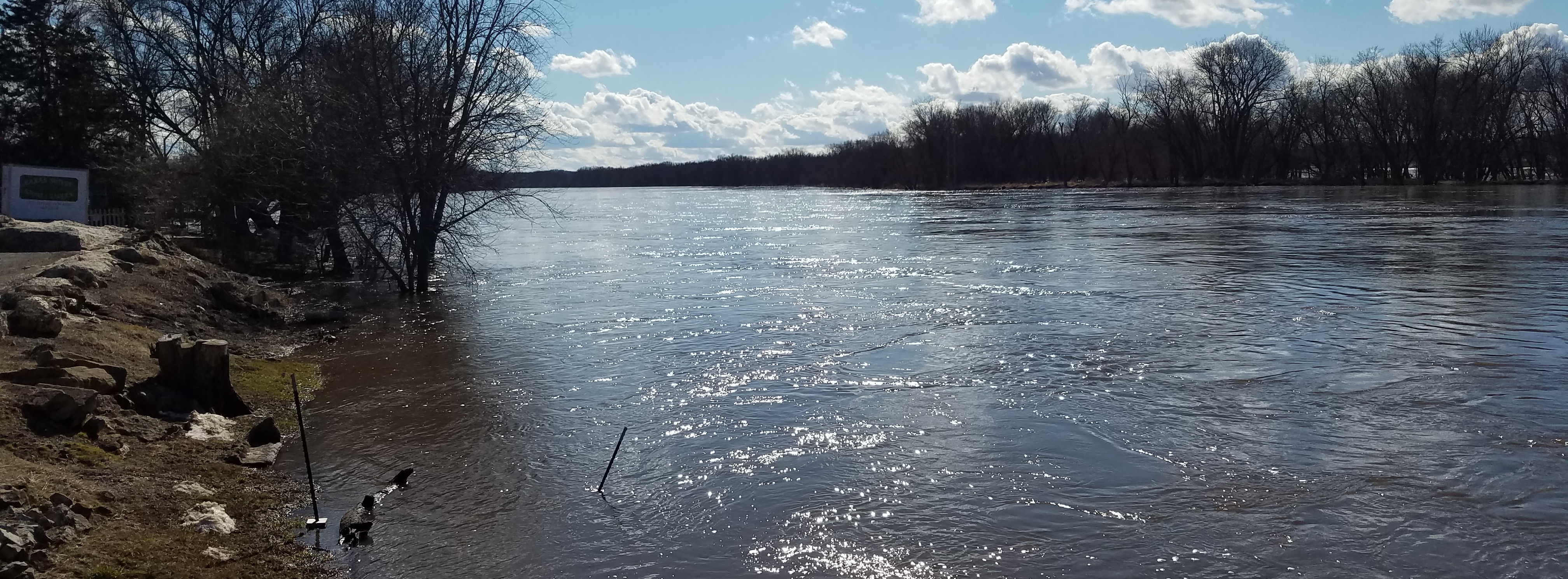
Cedar River at Iowa Highway One Sept. 27, 2016 at 11:36 a.m.
Mill Creek swelled its banks swamping nearby farm fields. It looks like the nearby city sewer system was spared inundation… for now.
Snow melt is everywhere in the county. Inches of packed snow yielded to ambient temperatures in the 50s and continuous rain. After a frigid, snowy winter the ice and snow pack is melting all at once. Snow was here Sunday and now is mostly gone.
Winter’s damage is being revealed. Our driveway buckled with the big swings in temperature. In one event, ambient temperatures swung more than 70 degrees in a day. Ice melted, then refroze under the cement, buckling the slabs leading to the road. Yesterday’s rain diverted inside the garage because of a buckle, requiring clean up to prevent further damage. Whether the buckled driveway will settle back down as it has before is unknown. It’s never been this bad.
The scale of the melt in a short period of time is what has Mill Creek flooding. Farmers removing buffer strips to grow a few more rows near the creek will take topsoil and farm chemicals downstream. It was foolish to sacrifice topsoil for a few more bushels of corn or beans. Farmers who did this likely didn’t see it that way even though flooding is not new to the area. Topsoil can’t be easily replaced but chemicals can.
Is this about climate change?
“A historic March blizzard is taking shape across Colorado, Wyoming, Montana, Nebraska, South Dakota, and North Dakota,” according to the National Weather Service. “Between one and two feet of snow is expected in some locations with wind gusts as high as 80 MPH.”
It is called a “bomb cyclone.” With hurricane strength, it has been forming over the Rocky Mountains and Great Plains, creating blizzard conditions and stranding hundreds of motorists.
“During the first 10 days of March, the Colorado Avalanche Information Center recorded more than 500 avalanches statewide (a record number),” wrote Jonathan Romeo in the Durango Herald. “For the season, a total of eight people have been killed in avalanches.”
Issues abound. Icebergs and open water were found on Norton Sound near Nome, Alaska where the Ititarod Sled-Dog Race finished this week. It’s raining in Greenland when it shouldn’t be. Global oceans are at the highest heat content on record. The planet is warming, there is no doubt.
It won’t take long for water to recede into the banks of Mill Creek. When everything melts at once, immediate damage is exacerbated, the duration shortened.
My colleagues with The Climate Reality Project are meeting this week in Atlanta to train another group of leaders. As newcomers join thousands of others, let’s work to mitigate the effects of climate change on humans. March has been a month where the evidence of climate change has come to the forefront. March has run only half its course.
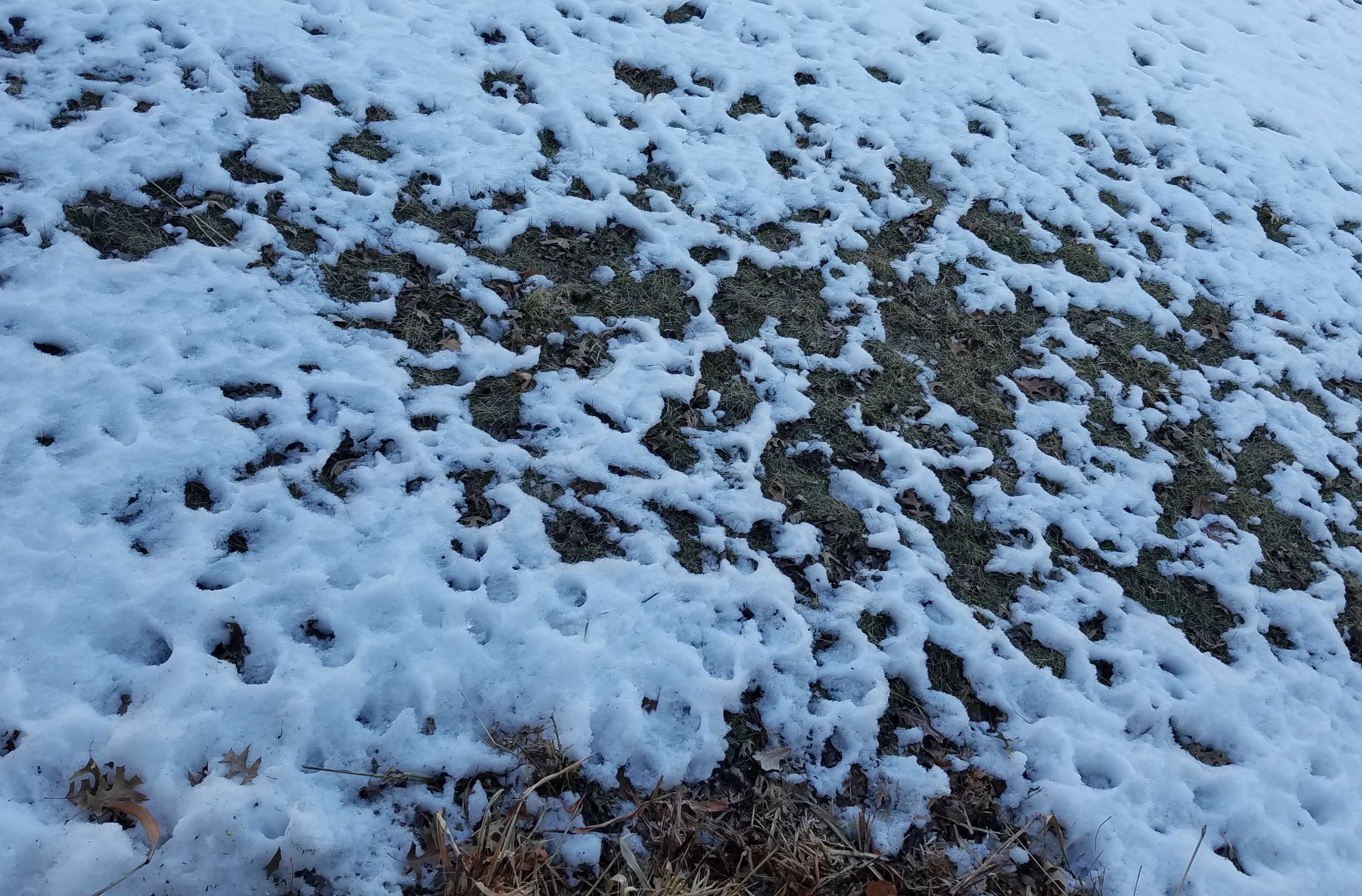
Depressions in the snow pack made a Swiss cheese-looking melt outside the French door where we feed wildlife.
Deer are nocturnal grazers, eating what birds, squirrels and mice don’t, leaving their hoof prints behind in the snow.
We hope this melt is the end of winter. Despite problems with downstream flooding, we are glad to see it go.
It has been a solitary winter. So cold we didn’t feel much like leaving home. So snow-packed it was a struggle to get into the yard. The driveway buckled, providing new places for ice melt to pool. Reading, writing, cooking and hanging out were tasks to relish for the season. It is time to turn the page.
Reading a book about tall grass prairie and savannas has me wondering why people bother preserving them.
Prairie used to cover more than 85 percent of Iowa land, according to the Neal Smith National Wildlife Refuge. Today less than one tenth of a percent of original tall grass prairie remains in the state.
In that context, the Iowa legislature considered a bill to prohibit setting aside new land for conservation with state money. After a popular outcry, the bill was suppressed last week before the first legislative funnel. There is substantial support among a diverse constituency for conserving prairie, savannas and woodlands. Such support drags political will along as best it can.
The Neal Smith National Wildlife Refuge is mostly replanted, which suggests human cultivation rather than a naturally occurring ecology. Which parcel is one of the many original prairie fragments at Neal Smith, and which a human tall grass garden? Presumably guides can point them out. There were no guides when tall grass prairie dominated Iowa landscape.
Either one participates in the culture of tall grass prairie or one doesn’t. It is a culture rather than nature. Throughout the state people and groups work to “restore the prairie” or “restore woodlands.” What does that even mean except as a style of gardening? Partly it means pulling garlic mustard plants and other invasive species during their early growth period. It means cutting down selected mature trees so saplings can survive to replace them. There is enough garlic mustard to make pesto for the whole state if such a delicacy were desired — all this cultivation is a lot of work. A lot of human work doesn’t seem natural.
The ecosystem that was our tall grass prairie relied upon burning the prairie to remove dead plant matter and stop the growth of trees that would shade plants growing close to the ground. Naturally occurring burns have been replaced with prescribed burns which are diligently considered and executed in a way that doesn’t catch whole neighborhood landscapes on fire. A local fire department has been summoned to put out a prescribed burn that got out of control more than a few times. Without burns a parcel of prairie or woodlands would cease to be what humans intended. I don’t know if a new and different ecosystem would be better or worse. If one is a believer in tall grass prairie, different is viewed negatively. Is that hubris?
We tend to forget the role vast herds of buffalo and other grazing animals played in the formation of tall grass prairie. Hooves kicking up dirt contributed to creation of the unique prairie biome. Animal grazing helped shorter plants gain access to sunlight and thrive. Animal droppings helped fertilize. Most of the land is fenced now with buffalo herds diminished and relegated to a form of domesticated hides, steaks, ground meat and sausages.
We are at the end of nature, Bill McKibben wrote in his 1989 book of the same name. There may be something to learn from remnants of tall grass prairie. There may be a human use for seeds from plants that survived and thrived on the prairie. If one is interested in the survival of tall grass prairie it is important to follow the work of people engaged in it. There is also a question.
How will we use our lives to mitigate the effects of global warming? Managing tall grass prairies is one check box on a long to-do list. My answer to “why bother” is that every bit of carbon sequestration has value and that’s what tall grass prairie accomplishes. My problem is under current land ownership policies and practices increasing the amount of tall grass prairie is not scalable quick enough.
I encourage people who seek to preserve parcels of prairie and woodlands to continue. If nothing else, it will improve our personal well-being and that is worth something in this turbulent world.
It runs counter to the Western Christian tradition but employees at the home, farm and auto supply store held a potluck luncheon on Ash Wednesday.
While others were submitting to dust from a priest’s thumb, my co-workers were feasting on loose meat sandwiches, deviled eggs and Amish Wedding fare in the form of pickled green beans and jalapeno-stuffed mushrooms. Tater tots revolved under the heating element of a shared pizza-cooking appliance.
One person brought red checkered tablecloths for our industrial tables in the break room, providing a festive look to the event.
The only penitence among my colleagues was related to over-eating.
The last Chevy Cruze rolled off an assembly line at the Lordstown, Ohio GM plant yesterday. I looked at photos of workers standing around the vehicle and had to look away. Too many memories of heartbreak among factory workers I’ve known. I conducted thousands of interviews with laid off workers when we lived in Indiana. Enough to understand the look in their eyes. Another sad day in the evolution of American manufacturing in the rust belt.
After work I stopped to secure provisions at the warehouse club, comme d’habitude. A farmer called me while I was contemplating the value of pre-cut aluminum foil sheets to be used wrapping root vegetables before baking. The issue was whether I needed a restaurant-sized box of 500 sheets rather than an inexpensive roll of aluminum foil to be replaced from the grocery store as needed. The farmer and I talked about legislation before the first funnel of the Iowa legislature. After 10 minutes we hung up and I decided to wait on the foil squares. I’ve been thinking about this for over a year.
Our county political party is re-organizing tonight. The meeting starts a little earlier than normal and word is the current party chair will seek another term. He’s the mayor of a small city near our border with Linn County. If he wants another term, I’ll vote for him. In our liberal county we tend to find a new chair each cycle, whereas counties with less Democrats in them tend to keep their party chairs for much longer periods of time. The chair has done a good job including old timers like me. The main work of the county party this year is preparing for the 2020 Iowa caucus. I know the drill, and since no one stepped up in 2018, I’m planning to run it again next February.
On my way home from work I noticed a number of homes along the route displayed political yard signs for the same candidate for city council in North Liberty’s March 12 special election. Placement is on or near property where signs saying “Lock Her Up” and “Trump-Pence” continue to be displayed more than two years after the 2016 general election. A reminder that even in the state’s most liberal county the overall political color continues to be red.
The best news this week was after my initial soil-blocking efforts at the farms I feel better with no soreness to report. Now if the frozen ice-pack that is our yard would thaw, I’d be ready for spring. It won’t be long.
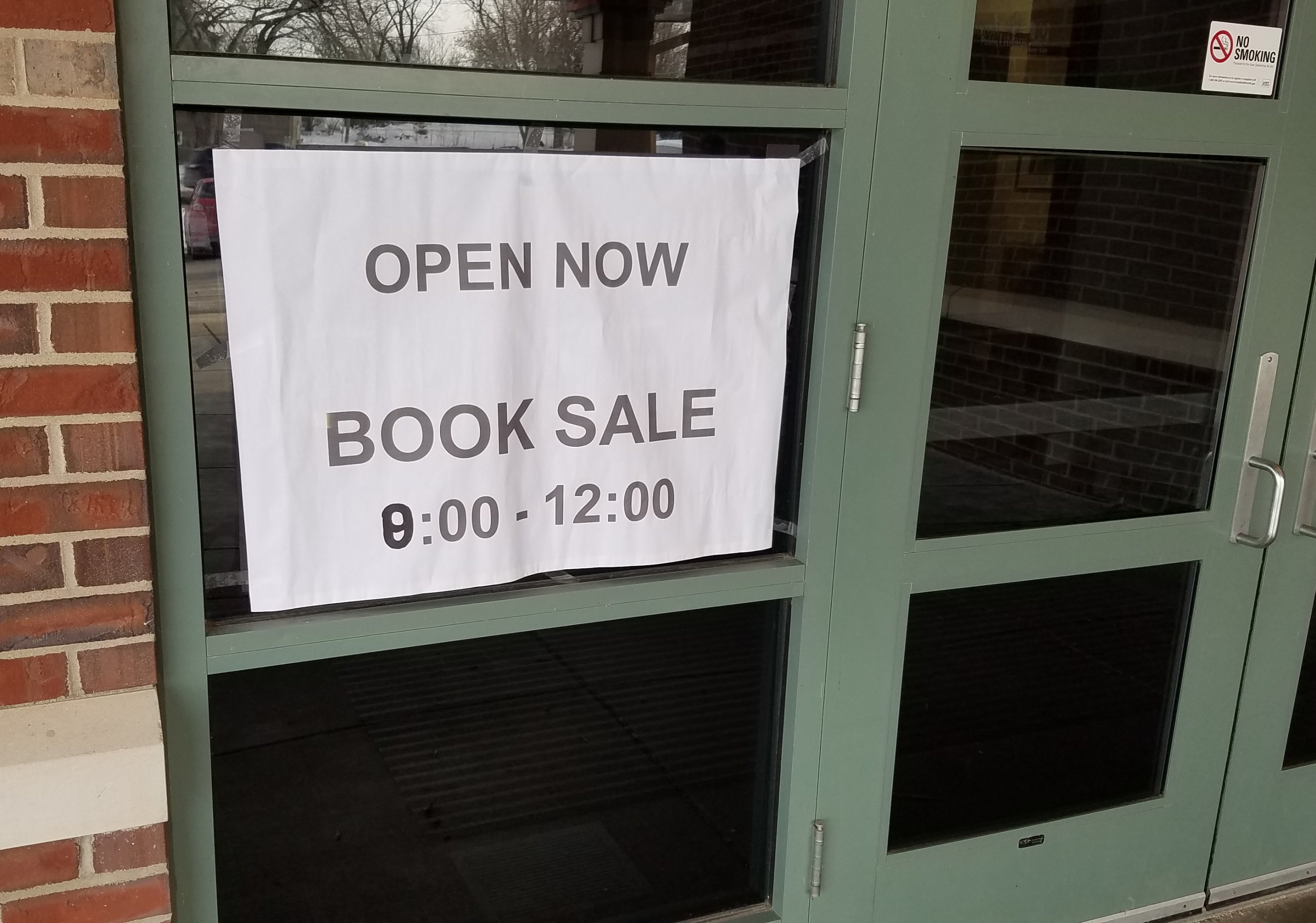
Sign for the Book Sale at the Solon Public library
Yesterday was the annual used book sale at our library.
In addition to clearing the stacks of unpopular or outdated books, the community donates books, media and labor to manage the sale.
Each item is reasonably priced and this year’s proceeds were about $800. That’s a lot of $0.50 and $1.00 books.
I spent ten bucks on ten past issues of the Wapsipinicon Almanac, three large format picture books about Yellowstone National Park, the Vietnam War, and the Marx Brothers, one fiction book, Water for Elephants by Sara Gruen, and a book of poetry, Songs of a Sourdough by Robert W. Service. I spent part of the afternoon reading Service’s poetry about the Yukon. First published in 1907, the copy I got is more than 100 years old. Thoughts of surviving bitter cold, wolves, pine trees, bonfires to stay warm, dog sleds, and the gibbous moon roamed my consciousness for the rest of the day.
It is doubtful I needed more books. The measure of a person’s library is less about reading or having read every book in it. A personal library is more a reminder of what we don’t know. I don’t feel guilty having more books than time to read them. I’m lucky to have a stable home life and the space to fit in a few more books after a used book sale in town. The house hasn’t exploded… yet.
I’ve been buying clothing this year. In 2018 I spent $281, and this year I already spent $150. T-shirts, jeans, socks and underwear, along with a few sweatshirts and woven shirts make up my wardrobe. For funerals and weddings I keep one pair of dress slacks, a good shirt, some neckties, two pair of shined shoes from when I worked in the Chicago Loop in 1991, and a blue blazer. Judging from what people wear to funerals and memorial services, I could get by with a decent pair of jeans, a woven shirt and a newer pair of sneakers.
There was a gift of four t-shirts and a sweatshirt from my spouse. The t-shirts are for the shepherdess to imprint next time she silk screens an image from the farm. I missed out last year because most of my shirts already had something printed on them.
The big 2018 expense was a pair of steel-toed boots to wear on my shifts at the home, farm and auto supply store. Last week, after my shift, I bought a new overcoat using my employee discount.
Me: I need a new coat.
Cashier: You really do.
Me: I know… big grease stains, broken snaps and zipper… it’s disreputable.
Cashier: Oh my!
Me: It will be my first Carhartt… this is Walls. Well I do have a pair of Carhartt bib overalls.
Cashier: Every man has those.
When I worked in the Loop I quickly wore out the pants in my suits. I picked styles where I could get multiple pairs of matching slacks. I don’t need fancy work clothes at the home, farm and auto supply store where the main issue is the quality of Wrangler jeans purchased on discount for less than $20. The denim must be of an inferior quality because holes show up in unexpected places after washing. Too, the radio and box cutter wear a hole just below my belt line on the left side. I asked the Wrangler sales representative about this at a recent trade show. He didn’t have any good answers except to buy more expensive jeans. I didn’t mention my low wages.
Food, shelter and clothing are traditional basic needs. Add potable water, clean air and sanitation and that’s still really basic. A good night’s sleep? Needed, but optional. Without these things, the need for survival dominates our daily lives. Education, healthcare, transportation and internet access are basic needs according to Wikipedia, but seriously, while important, those are extra when it comes to survival.
A lot of people would have us return to life as basic survival. For our family, years of hard work made us financially stable and built a foundation so we don’t often worry about survival. As long as there are used book sales and employee discounts at the home, farm and auto supply store we’ll be alright. Knowing a bunch of farmers and a good auto mechanic helps.
Wolves are mentioned in the history of Lincoln County, Minnesota where my grandmother was born. Wolves can be an issue, but mostly one read about in books about the Yukon… or Iowa and Minnesota at the time of settlement. As we live our modern lives it is important to remember there were once wolves, even if their meaning is lost for want of an education. Education is a salve for our worries. That’s part of why library used book sales remain important.
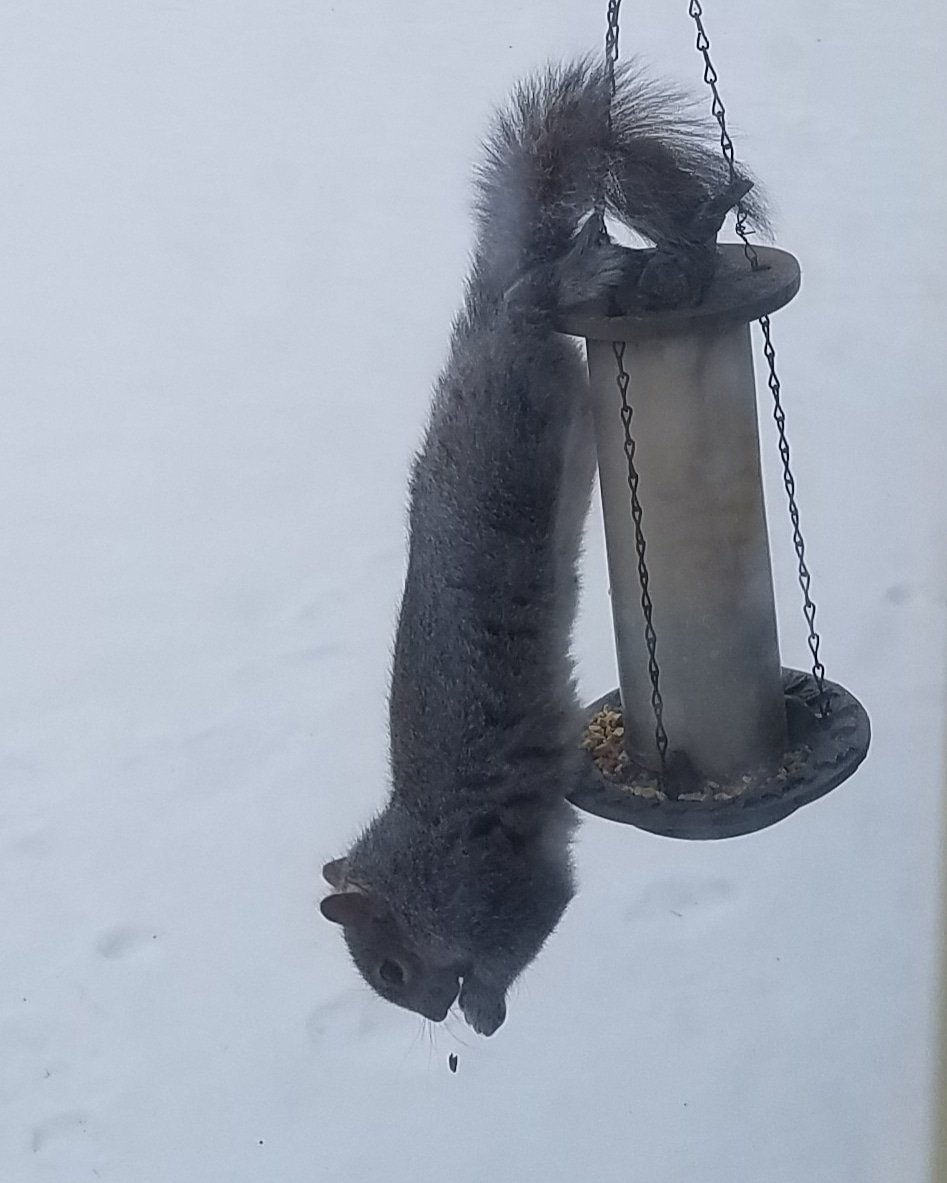
Squirrel Training for Acrobatic Work at Walt Disney World
I opened the door to the garage and turn signals on my car were flashing.
It was the first time in the garage yesterday and I feared having left something turned on, depleting the battery charge. I put the key in the ignition and it started.
At an undetermined point in the night turn signals and some dash lights started a slow blink. I couldn’t turn them off. I started the car and turned it off — still blinking. I started the car and drove it around the block — still blinking. Should I call my mechanic or troubleshoot and fix it myself?
I went to a computer and searched “1997 Subaru Outback lights blink when ignition off.” Some results came back and 83 people recommended a procedure to disconnect the battery, then reconnect it with the ignition turned on. It was simple and it worked. Make that 84 people recommend the procedure to reset the electrical system.
That I drive an old beater is not news. I bought it six years ago and with a good mechanic fixing things as they break, it gets me around. I feel a little like the Mercury astronauts running around Cape Canaveral before Florida car dealerships gave them Corvettes and such to drive, just another guy needing earthly transportation. As long as it is mechanically sound I don’t care what vehicle I drive. The astronaut dreams are extra.
Yesterday’s farm work shift cancelled because of a cold weather forecast the following week. CSA farmers who belong to Practical Farmers of Iowa gathered at a local restaurant to discuss their trade. I am a member but declined to go. I’m more interested in reducing the amount of farm work I do than in engaging more. Since I began earning a living wage last year the economic need for farm work went away. It’s mostly a social event any more despite the well-received work I do at the farms.
I woke early this morning, around midnight, and picked up my mobile device in the dark. There was a Washington Post alert from 11:24 p.m. saying Michael Cohen had prepared a written statement about his testimony today before the House Oversight Committee. In it, Cohen indicated Donald Trump personally signed the check to pay hush money to Stormy Daniels, and that Trump knew Roger Stone was negotiating with WikiLeaks to publish stolen emails from the Democratic National Committee during the run up to the 2016 general election. Trump and another of his attorneys, former New York City mayor Rudy Giuliani, have both accused Cohen of lying since then.
We’ll see what Cohen actually says while I work a shift at the home, farm and auto supply store. Like with Watergate, it would be hard to watch the proceedings live. If what Cohen said is true, the president has been lying to the American people. In today’s corrupt political climate I’m not sure what that means. If Trump were Nixon, we’d already have his resignation on our Resolute desk.
The store manager from the home, farm and auto supply store phoned Sunday afternoon to ask me to work on Monday. The colleague who assumed my full time job last spring was visiting family in Nebraska and bad weather closed roads across the state, including Interstate 80. She couldn’t make it back in time for her shift.
In Iowa, helping out is part of our culture. I said yes I’d work and rearranged my plans so I could.
In addition, the farmer decided the weather was bad enough she didn’t want people venturing out to the farm. The roads were iced over and the wind howled at 30 miles per hour all day. Her sister, the shepherdess, posted social media photos of installing a new anemometer and weather station. Its LED panel displayed the digital message, “hold onto your hat!”
As I was settling in last night, the Washington Post put up an article about White House plans to form an “ad hoc group of select federal scientists to reassess the government’s analysis of climate science and counter conclusions that the continued burning of fossil fuels is harming the planet.”
In other words, the Fourth National Climate Assessment told the story of how dire our future could be without climate action. Rather than doing something, the administration is arguing with their own scientists that global warming is not caused by burning fossil fuels. These are times that will fry men’s souls.
Which part of yesterday’s howling wind was an amplification caused by global warming? The answer doesn’t matter because it’s the wrong question. We know the deleterious effect of burning fossil fuels. We also know thawing permafrost, agriculture, methane releases during oil production, building construction, manufacturing processes, air transport, deforestation, landfill decomposition and other human activities contribute to greenhouse gas emissions and global warming. We can’t get bogged down in details when the bigger picture is we have an obstructionist government led by Republicans and their conservative, dark-moneyed think tanks who would interpret the howling wind as something else. The better question is when will voters do something to fix this?
Yesterday’s wind was the kind that calls for hunkering down until it ends. Eventually we will have a calm, sunny day and the opportunity to work as normal. Or maybe it is something else, as Bob Dylan sang in the 1970s,
Idiot wind, blowing like a circle around my skull
From the Grand Coulee Dam to the Capitol
Idiot wind, blowing every time you move your teeth
You’re an idiot, babe
It’s a wonder that you still know how to breathe.
This weird weather is unsettling. Wild variations in temperature made it a damaging winter… it’s not over.
The driveway buckled a few feet from the garage door because of temperature swings. Water must be trapped underground with inadequate drainage before refreezing. The buckled pavement is directing rain under the door, flooding the car park.
Everything is off the floor as I advance plan for water emergencies. I found all the parts for the wet/dry vacuum and removed about 60 gallons from the floor. I let the water settle for a while, then will go at it again.
I’m supposed to soil block at the farm today. Temperatures are dropping and a coat of ice is expected on roads, on everything, as the wind howls 30 miles per hour until sunset. I’m to text the farmer before leaving for my shift to make sure roads are passable.
With the ground still frozen, snow melt and rain have nowhere to go. It is pooling near the main intersection a few dozen yards south of our home. The culvert under the road must be blocked with snow and ice. There will be river flooding later in the week as everything drains to the Mississippi basin.
I’m not freaking out… yet. I don’t know what to do but mitigate water damage and wait it out. Fixing the cause of this weird weather is not something to address in a day or two.
Media discussion of climate change seems more frequent. I reviewed Google Trends and there was a spike in searches about global warming the first week in February. Every day or so local newspapers carry a story about climate change. A lot of it has to do with the Green New Deal resolution proposed in the U.S. House of Representatives. Who doesn’t like what the resolution says? It seems toothless until a Democratic majority returns to the U.S. Senate. We are at least two years away from the possibility of that happening.
What will the Congress do to act on climate? More importantly, what will they do that the president will not veto? These are dark times if we rely solely on politicians.
Water may have settled in the car park, so it’s time to vacuum up a few more five-gallon buckets. Hopefully spring is on the horizon, even if it hasn’t arrived.
 Iowa Governor Kim Reynolds issued disaster proclamations for 41 counties because of flooding (Click on the map to see details).



 Journey Home
You must be logged in to post a comment.