Only after a couple of days away from daily routine can a person begin to be themselves.
That’s where I am this morning.
I crave a place to work.
Desire is a blessing and a curse. When we want something, we set ourselves up for disappointment. We may get it, but can’t always get what we want.
It is a difficult path to nirvana. I do my best to void consciousness of self. It persists. There are selfies.
Like Eugene Henderson we feel restless and unfulfilled, harboring a spiritual void that manifests itself as an inner voice crying out I want, I want, I want.
Work is a cure for that.
Busy hands make happy children and happy children build a new world.
A new perspective revealed itself from paths traveled daily.
Something showed through the uncut grass and garden in the light of a rising sun.
I should quit thinking and mow the damn lawn.
It depends. What time will I finish at the orchard? How will I feel after interacting with locals for a shift? Will the press of decaying produce draw me into the kitchen again? How guilty will I feel about letting grass grow long?
So much depends. If conditions are right — temperatures moderate, weather dry, and a couple hours of remaining daylight — I may mount the John Deere and make a first pass. The lawn is so long it will take at least two.
So much depends upon weather, capacity for work, and a will to sustain our lives in a turbulent world.
I looked up and saw the vanishing point through the middle of my garden for the first time in 23 years this has been our home.
It has been there all along, the work of the farmer who subdivided his homestead, the surveyors who platted the lots, and the home builders who positioned structures according to convention and restrictive covenants recorded at the county administration building. I played my part unintentionally by positioning my garden in the southeast corner of our lot.
It was hard to miss.
Yet it was there. I walked into it and am still here.
The local food movement relies more on kitchens than grocery stores; more on gardens than commercial growers.
While use of locally sourced food by many restaurants has changed to include more of it, a local foods movement cannot be sustained by the hodge-podge of farmers, growers and entrepreneurs who sell locally produced food to restaurants, or for that matter, to grocery stores.
The problems include scalability and sustainability.
We are living in a time where demand for local food exceeds supply. Scaling up to meet demand requires a capital investment most small farmers can’t make. Sustainability relies on creating value along with the food in a way that cooks can afford it and farmers can make a reasonable return on their investment.
Someone recently asked if the area was becoming saturated with Community Supported Agriculture projects and if that’s why some are having trouble growing membership. An answer lies elsewhere. The market for local fresh food has grown so big corporations noticed.
Companies like Hy-Vee, have tapped into the fresh food market by increasing their number of suppliers and offering fresh and local food alongside wares from large commercial growers. They are sucking up market share like a vacuum cleaner as their business model is designed to do – putting pressure on small and mid-sized growers.
Corporate involvement in the local food market is a two edged sword. Growers can sell their best wares to companies like Hy-Vee and get a reasonable return. At the same time reliance on companies rather than CSA members can distract a farmer from his or her core business.
A solution? CSAs should stick to their knitting by getting payment up front and sharing the harvest with members… all of it. It may be tempting to sell some on the side to restaurants and grocery stores, but the further away from the model they get, instead of doing one thing well, everything they do can suffer. In addition, the market share they help corporations grow may be detracting from their core business.
There is nothing wrong with a farmer growing organic greens for restaurant salads and stir fries. In the end, each farmer must make ends meet, and operating a farm —even a small one — is an expensive operation with tight margins. My point is to focus on one thing and do it well.
It is one thing for a farmer to disassemble a barn and use the materials to create raised beds for a ten-person CSA. It is quite another to support a couple hundred families with the variety of produce the market demands. If you ask a hundred CSA members, as I have, why they belong, answers are all over the map. Some want assurance of a grower who uses organic methods to produce food. Some want variety unavailable at Aldi’s or Fareway. Others want to create a cooking experience with young children as part of their education. Most want to feel good about what they are doing with their lives.
One hopes we are beyond the discussion of “food miles” and on to the core value of the nascent local food economy: know the face of the farmer. It’s corollary is know how your food is grown. Try as they might with life-size cutouts of farmers in their stores, corporations have a hard time doing that. Their customers are too diverse, and they have to cater to everyone in the community. If a person combines these two ideas, knowing how our food is produced and creating demand for local, fresh food the local food movement has a chance.
A very few people strive to source every food ingredient locally. It is not with them the future of local food lies. The future of local food is within the potential of every Iowa kitchen.
To sustain the local foods movement requires consideration of what it means to belong to a CSA or buy from a farmers market. Can that fit into culinary habits in a way that is not an encumbrance to what most perceive as very busy lives?
Can kitchen cooks grow some of their own produce? Probably yes, even if it means only a large flower pot with some cherry tomatoes or an herb jar on a window ledge. Even these small things may be a step too far for some.
The trend in food includes extensive prep work done by machines and large companies. Heat and serve has become a by-line for many available grocery items. Along with taking the kitchen work out of meals, risks of contamination have been created and along with it the need for recalls from large processors whose products get contaminated by E. coli and listeria.
In a consumer society it will always be tough for small-scale producers to survive and thrive. That’s why I say the future of the local food movement rests in Iowa kitchens where cooks can use less processed foods and more fresh — secured by buying local and growing their own.
It’s work many can’t do because of choices made about careers and family. What may be the saving grace of the local food movement is the idea of taking control of our kitchens, in part by living and eating local as much as we can.
Mounds of grass clippings blocked the John Deere’s steering as I mowed part of the lawn.
The temperature was ideal, the sky clear, and I was alert enough to safely operate the equipment.
To engage the steering I backed off and tried again.
Grass clippings lie in wind rows where I mowed last night. Using a rake and wagon I’ll transfer them to the garden for mulch.
In high summer a gardener/low wage worker/family member finds more to do than there is time. I managed to send a box of kale, fairy-tale eggplant and tomatoes to the library for the workers earlier in the day. They were appreciative.
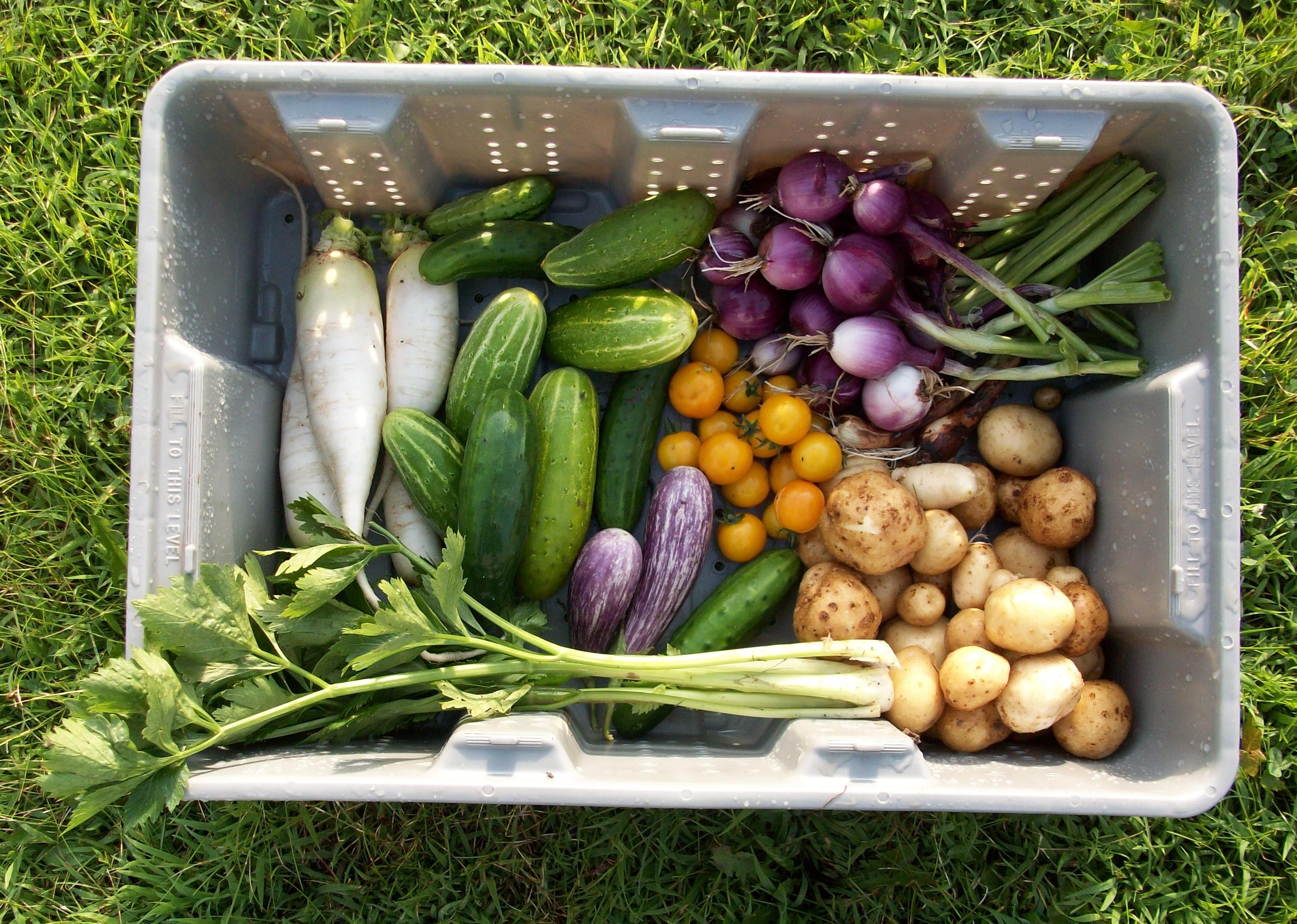
The garden hose was coiled near the house for mowing. While driving past the garden I noticed the cucumber leaves drooping. I stopped, got the hose back out, and watered. I missed a lot of cucumbers during the morning harvest so I picked them. They filled a crate and created another thing to do.
Dinner was sweet corn on the cob and tomatoes with cheese plate, bread, and blueberry yogurt for dessert. The corn and tomatoes were filling, so I didn’t get to dessert.
After dinner I put cucumbers — newly harvested and those already in the ice box — on the counter after washing them. I sorted and found a place to put them. I hadn’t planned another task, but it needed doing. I’d say I’m in a pickle, and that’s more solution than problem.
As a result of my cucumbering, processing peppers and tomatoes got pushed back.
I put on my rubber boots and went to the garden in the predawn sunlight. I left a trail where my boots scraped against the dew drops formed on the lawn.
Fresh deer droppings lay moist under the oak trees and two rabbits stopped and watched as I made my way through the clover. I picked cherry tomatoes, jalapeno peppers, daikon radish and everything in this photo.
In the kitchen I made salsa using fresh ingredients, some old relish — everything that made sense. It was tasty and spicy, quite delicious.
The future of any local food movement is in the hands and kitchens of people who do these kinds of things.
If you ask my mother’s generation, “what is local food,” they often mention sweet corn and tomatoes. Hard to argue with the taste and seasonality of those two vegetables, but there is more.
Cooking goes against the grain of a global society increasingly and intentionally seeking to remove creative, engaged prep work from the kitchen and replace it with heat and serve processed food. Here’s an example.
While on break at the home, farm and auto supply store food preparation became a conversation topic as it often does.
A colleague explained how he bought a bag of prepared frozen meatballs from COSTCO and warmed them in his favorite barbecue sauce. He then took a small loaf of white bread, halved and toasted it, and spooned the meatballs on the bottom half making a meatball sandwich. He said it was really good as we listened.
If taste and ease of preparation is all we seek, the industrial food supply chain can meet our needs. In that case, when it comes to local food, what’s here becomes local.
I’ve been spending time in the kitchen this week. At 5 a.m. I stop what I’m doing and make breakfast. Stirfry, roasted vegetables, and because they are in season, fresh steamed green beans with every meal. It feels a little weird, but I felt better all day because I ate mostly what I grew before 7 a.m.
The local food movement is just not going to happen based on a small number of farmers, chefs and advocates and there’s the ceiling. If it becomes a part of our daily lives, which include vegetables from the garden, eggs from chickens we know and preparing food to taste, then the local food movement has a chance.
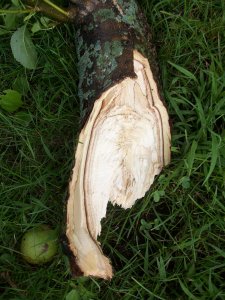
The last branches of the Golden Delicious apple tree blew over in a gust of wind during an intense thunderstorm.
I hoped there would be fruit again but not now, not ever from that tree.
I’ll chain-saw the stump for the fall burn pile, finishing the work time brought.
When I planted six trees on the day of my mother-in-law’s funeral I had no idea about apples. The second Red Delicious tree was the first to go, and the Lodi was felled by another storm. Three trees remain and I know a lot more about apples today.
The storm blew over the row of six-foot cherry tomato plants and some of the hot pepper and kale plants. The cucumber cages were also blown around. I straightened everything as best I could. There was some damage, but not ruinous. The wind exposed a generous crop of slicing tomatoes under the leaves. Here’s hoping everything makes it to maturity.
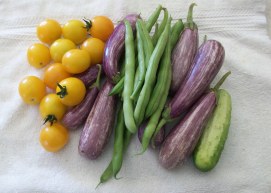
Cherry tomatoes, Fairy Tale eggplant, green beans and a pickling cucumber harvested July 16, 2016
Photographs of kale can only be interesting for so long.
The leafy green and purple leaves are producing in abundance — so much so I pick only what is needed, removing imperfect leaves from the plants to the compost heap.
Seven kale leaves stand in a jar of water on the counter to keep them fresh and ready to use.
If summer were only about kale, this one would be an unmitigated success.
Something else is going on.
This week I conversed with a group of twenty-somethings about the new application for smart phones, Pokémon Go. It was the most animated they had ever been. I asserted the application represented the beginning of the zombie apocalypse. They didn’t dispute it. One had already tried the game and moved on to something else. Apparently there are not that many Pokémon to find in rural Iowa.
The continuous stream of violence manifest its latest event Thursday with a terrorist attack in Nice, France. More than eighty people were killed and as many as 300 injured as a lone driver drove a large truck through a crowd gathered to view a Bastille Day fireworks display. The terrorist made it two kilometers before he was shot dead by law enforcement. French President Francois Hollande seeks to extend the existing state of emergency put in place after the November 2015 attacks in Paris.
In American political news, the Republican top of the ticket is set with Indiana Governor Mike Pence named presumptive presidential nominee Donald Trump’s running mate. The less said about this pair the better. Suffice it that I disagree with them on just about everything. The national political conventions are imminent, with the Republicans this week and Democrats the following. Something unexpected might happen at either convention.
In a strange turn of events, twice failed U.S. Senate candidate Tom Fiegen made a post on Facebook that blogger Laura Belin re-posted:
Belin makes sense if Fiegen, not so much. The episode represents further coarsening of Iowa politics. Fiegen likening an effort to persuade him on his presidential vote to sexual advances is plain weird. I know I wouldn’t want to get in the back seat with him on a dark gravel road. Whatever virtue he may have had vaporized after he quit being his own person and hitched his campaign wagon to Bernie Sanders. His current, post being a Democrat, rants serve as an example of how low politics has gotten. I know my mother said if you don’t have something nice to say about someone, don’t say anything, but Fiegen lives in our house district and may foment more ill will. I hope not.
Lastly, this week Deadhorse, Alaska set a record high for any Arctic Ocean location. Is it climate change? How could it not be.
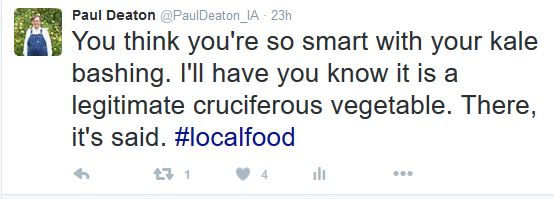
At least for now there is plenty to eat and fewer photographs of cruciferous vegetables.
More specifically, why don’t more Community Supported Agriculture projects produce it for members and local food farmers for restaurants and markets?
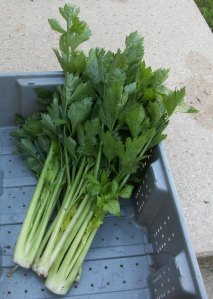
I’ve been asking this question of growers and the reaction has been surprise at my results and maybe an assertion they will try it. There is substantial demand for the aromatic vegetable in kitchens and restaurants yet the perception is celery doesn’t grow well in Iowa, so farmers mostly don’t.
Celery from my garden tastes better than regular or organic available at the grocery store. In addition, celery is in the Environmental Working Group’s Dirty Dozen fruits and vegetables for use of pesticides, ranking #5. Why buy California celery when we can produce our own at least part of the year? Having the best possible flavor is important to everything cooked with celery.
Celery takes about 120 days and requires adequate water, more than most vegetables. That means seeding trays planted in late February to produce the crop being harvested this weekend. I use Conquistador OG seeds from Johnny’s Selected Seeds in Winslow, Maine. (OG stands for organic). It took me a couple of years to get successfully from seedlings to the ground to a crop as I experimented with growing. This year’s crop has been the best ever.
I attribute success to using 4-inch drainage tile cut into 8-inch lengths to protect and support young seedlings. I mulch with grass clippings and weed regularly. Each morning I make sure a substantial dose of water is applied. Larger scale farmers shun this extra work, focusing more on crops that can be mechanized (like potatoes) or are popular among customers (like cabbage, tomatoes and peppers). The flavor of local celery, and growing it pesticide-free, make the extra work worth it.
Every head of celery will be used fresh this year. There were only a dozen from the garden in this experimental year and I shared some with library workers in town. Next year I plan to double production and if there is more than can be used fresh, preserve part of it.
In June at the Global Foods Market in Kirkwood, Missouri, I bought a jar of celery salad in a glass jar. The preparation uses celery, apple juice, walnut extract and vinegar and is an example of a shelf-stable item for winter consumption. For the time being, I expect to use everything fresh in soups, stir fry and Louisiana-style beans and rice.
If the local foods movement doesn’t wake up to celery, there is a market for sales to restaurants to pursue. If they don’t exploit it, I will.
As the garden produces more food than we can eat fresh, attention turns toward the kitchen where preservation, along with preparation of tasty fresh food meals, are the priorities.
Kitchen work started Saturday afternoon and continues.
I prepared a simple dinner while listening to A Prairie Home Companion on the radio. For appetizer there was basil pesto spread on a piece of toast, a slice of cheese, and raw carrots. The main course was brown rice cooked in homemade soup stock sprinkled with scallions, steamed green beans, a burger patty topped with home made barbecue sauce, and a Belgian beer. Dessert was fresh cherries mixed in a cup of Greek yogurt. Each plate exuded summer goodness.
A full row of basil produced enough leaves to make pesto. Here is the recipe:
Simple Basil Pesto
2 cups fresh basil leaves (packed)
1/2 cup grated Parmesan cheese
1/2 cup extra virgin olive oil
1/3 cup pine nuts
3 garlic cloves
Salt and pepper to taste
In the bowl of a food processor take the following steps:
Pour basil leaves in the bottom and add pine nuts.
Pulse for about 30-45 seconds.
Scrape down the sides of the bowl.
Add garlic and cheese.
Pulse for 30-45 seconds.
Scrape down the sides of the bowl.
Stream the olive oil into the bowl while it is running, scraping down the sides from time to time.
Stir in salt and pepper to taste.
Pesto must be used quickly or frozen to prevent oxidation. The plan is to make a pasta dish using pesto as the dressing.
Michigan Cherries
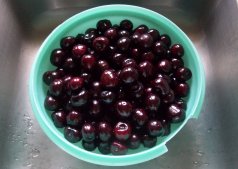
On a working class payday it feels like there is money so I did some shopping, buying some special items: two kinds of bird seed, a case of Stella Artois, a case of brewed root beer, and three pounds of fresh, Michigan sweet cherries. The beverages should last the rest of the summer.
Here’s how I told the story on social media,
After work at the home, farm and auto supply store I bought two kinds of bird seed: straight safflower seeds and a mix of sunflower kernels, peanuts, sunflower seed, safflower seed, hulled pumpkin seed, raisins and dried cranberries. We’ve already tried straight millet, and straight sunflower seeds, plus a traditional mix.
Next I went to the warehouse club up the hill where I bought a big bag of garlic (to make basil pesto on Saturday) and some root beer for the holiday weekend.
After that, to the orchard where I bought these cherries. I met Paul’s brother once at the orchard and these are his cherries, grown in Michigan. Know the face of your farmer is my best advice on eating good food. I also confirmed the start of my employment when the season begins July 30. With my other jobs that will be seven days a week of work until November, but it’s so much fun, it’s not really work. Hope my Facebook friends have a great weekend.
Use of greens turned from turnip tops to kale. I gave library workers a reprieve and have a large plastic bag full of kale in the refrigerator. While not sure what to do with it, it will be revealed when I return to the kitchen. Fresh soup certainly; a kale salad for lunch most likely. Kale freezes well, however, if everything goes well in the garden, plants will continue to produce until November — no need to fill up the freezer with kale today. It is encouragement to pick the best leaves now and compost the rest.
It is sad more people don’t appreciate kale.
Cut stems of oregano are on the drying rack. The herb returns each year and we don’t use much of it. The plan is to dry enough to fill a small jar for winter. Whatever basil is left after another jar of pesto will also go on the drying rack.
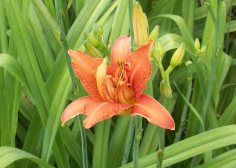
Day Lily
One of the deficiencies of our garden is not enough flowers. In fact, the only flowers are some volunteer day lilies and milkweed. After many years of fruit and vegetable growing, I may be proficient enough to plan a flower garden plot. That idea will go into the planning hopper for next year.
We are going home and three events this weekend reminded us of that.
Elie Wiesel died, silencing an important voice for human rights. I will never forget the Holocaust as one of the genocides that make us who we are. While visiting Dachau in 1974 I learned the reason Jews were exterminated with poison gas was bullets were too expensive, according to the Nazis. My visit highlighted the importance of treating every human being with kindness and dignity — a lesson that continues today.
Garrison Keillor performed for the last time as host of A Prairie Home Companion. During a previous “last show” in the 1980s I turned on the cassette recorder and went for a walk with our daughter. I wanted to be with her constantly before she left home for school. As we now know, Keillor’s departure in the ’80s was more hiatus. Preparing dinner with the radio tuned in has become a part of my life, reinforced during the years in Big Grove. I’ll get over the change. I listened to the whole program last night.
Paul Simon is ready to give up writing and performing music. “Showbiz doesn’t hold any interest for me,” Simon told Jim Dwyer of the New York Times. “None.” If he does give up music after his current world tour, it will have been a great run for the septuagenarian. I was a fan of Simon and Garfunkel in high school and have vinyl of their first album with “Hey School Girl.” On the album jacket it reads, “Contained in this album is a generous sampling of two stars of tomorrow who are the talk of the record world today.” Simon continues to be the talk of the recording world, so cross off the part about the future. Early Paul Simon inspired me to write. Modern day Paul Simon teaches us to keep learning and changing.
Celebrity departures from life in society are one thing, but it’s closer to home. My parents’ generation is dying and so many of my high school classmates have left us. There is a meme going around social media expressing this sentiment. Here is a sample with my response:
Michael Martinez explained why the elves left Middle Earth in the Lord of the Rings. While not exactly the same it articulates a relevant sentiment:
The elves were compelled to leave Middle Earth by a spiritual summons of the Valar, calling them to their ultimate destinies within time and space. In The Simarillion J.R.R. Tolkien explains how the Valar — the guardians of the world — felt that the long-lived elves would be better off living near the Valar in the blessed realm, far from the mortal lands where men were destined to build their civilizations and live out their lives.
It is time to let go and let others build their lives. The kale and basil won’t preserve themselves, so I’m off to the kitchen.
Supper was a leftover jar of bean soup, sage and cheddar biscuits, and apple crisp from last year’s crop.
It was delicious… an apple joke.
I set my alarm for 4 p.m. to begin two hours of cooking. I also wanted to hear Garrison Keillor’s radio show from Tanglewood. He’s retiring in July.
Keillor lucked into radio.
“Through a series of coincidences, I lucked onto this show, for which I had no aptitude to speak of, sort of like a kid in Port-au-Prince who’s never seen ice becoming captain of the Haitian Olympic hockey team,” Keillor wrote in an email sent Saturday afternoon. “I was never in theater, never sang in public, but I had grown up at the end of the radio era so I had some ideas about how it might sound. I was a plodder, but persistent.”
So did I luck into a pattern of preparing Saturday dinner with A Prairie Home Companion in the background. All of my other favorite Saturday shows on public radio are gone – likely as a result of budget cuts. Soon Keillor will be gone too. New times require new patterns and I’m okay with that.
Saturday’s harvest included a head of cauliflower, carrots, turnips, an onion, two bunches of celery, and lots of kale for the kitchen and to give to library employees. The herb garden is coming along. I didn’t pick basil but will need to soon.
Planting included an acorn squash seedling and some dill, both given to me by a library worker. The Swiss chard seedlings went into the ground, as did some more jalapeno peppers. I planted lettuce where the carrots grew. The overnight thunderstorm provided needed rain.
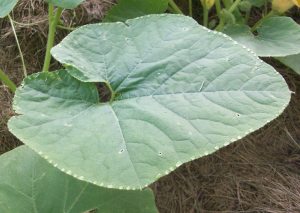
Turk’s Turban Squash Plant
The harvest was shortly after sunrise. I was out in time to see dew around the edges of the Turk’s Turban heirloom squash plant leaves. It’s as if the leaf was a large moisture collection device, and the drops waiting to get big enough to roll to the ground and provide moisture to the roots. Summer Saturday harvest is becoming one of my favorite times.
After lunch I organized and cleaned the garage, which is to say I put things away, swept the floor and laundered the rags. I decided to leave the bagging attachment on the John Deere for another pass at collecting garden mulch. It’s debatable whether more is needed. It can always be composted if not used.
It’s been a couple of tough weeks in the news, making it difficult to process what’s happened in society. The murders at Pulse Orlando kicked off a series of news cycles that have been enervating at best, at worst a beginning of the end of society as we know it.
There’s a lot to write about. The futile efforts of the U.S. Congress to call attention to gun violence and do something about it, the referendum in Great Britain about whether to leave the European Union, a slate of Supreme Court decision announcements, the peace agreement between the FARC rebels and the Colombian government, and more.
What caught my attention midst the swirl of current events was yesterday’s 140th anniversary of Custer’s last stand during the battle of Little Bighorn in southeastern Montana. During a visit to the battlefield it occurred to me Custer was a fool. The idea the Seventh U.S. Cavalry Regiment could prevail in that open terrain was ridiculous.
Little Big Horn was part of a genocide that began shortly after arrival of Europeans in the west. It found it’s last practical expression 14 years later in 1890 on the Pine Ridge Reservation at Wounded Knee. Leonard Peltier’s case notwithstanding, our war with native populations in the Americas is finished.
The removal of cultures is in many ways the history of the country. We removed native populations, trees and wildlife and called it “settling.” Surveyors laid out a pattern of land use that enabled us to settle the prairie and forget what once was here. Oak-hickory forests, tall grasses and bison as far as human eyes could see have been relegated to special heritage sites. It’s not all been good but it is what we live with.
As rain falls, reminding me to clean the gutters, it’s hard to miss the need to engage in society outside a surveyed lot in Big Grove. To sustain a single life requires engagement in everything around us and many things that no longer are here. At least that’s how I cope with American violence and sustain the will to do something more about it.






 Journey Home
You must be logged in to post a comment.