Categories
Writing

7 Things About 2016

Hats and Rags
Hats and Rags

It’s Christmas Eve in Big Grove, the ambient temperature is about freezing, and we’re ready to bunker in, finish decorating our Christmas tree and prepare a traditional supper of chili and cornbread.

My Christmas wish is for peace on earth.

Elusive as that may have been during 2016, we can’t give up hope. Not now. Not like this.

As winter solstice brought longer days — increasing light imperceptible in each day’s cycle — it is time again to fly with eagles, gain a broader perspective, and thank people who are always in these written words if rarely mentioned — my wife Jacque, our daughter, my parents and my maternal grandmother.

Reading

I continue to read more on my phone and computer than I do full-length books. Nonetheless I managed thirteen books in 2016, the most important of which were authored by people I know: Connie Mutel and Ari Berman.

Methland by Nick Reding had the biggest influence, by a distance.

Here’s the list of books, most recent first:

Diet for a Hot Planet: The Climate Crisis at the End of Your Fork and What You Can Do About It by Anna Lappé; My Life on the Road by Gloria Steinem; Sapiens: A Brief History of Humankind by Yuval Noah Haran; Methland: The Death and Life of an American Small Town by Nick Reding; Give Us the Ballot: The Modern Struggle for Voting Rights in America by Ari Berman; A Sugar Creek Chronicle: Observing Climate Change from a Midwestern Woodland by Cornelia F. Mutel; Atlantic: Great Sea Battles, Heroic Discoveries, Titanic Storms, and a Vast Ocean of a Million Stories by Simon Winchester;  And Then All Hell Broke Loose: Two Decades in the Middle East by Richard Engel; Slavery in the Upper Mississippi Valley, 1787-1865: A History of Human Bondage in Illinois, Iowa, Minnesota and Wisconsin by Christopher P. Lehman; The Diary of a Napoleonic Foot Soldier by Jakob Walter; Old Man River: The Mississippi River in North American History by Paul Schneider; MiniFARMING: Self-Sufficiency on 1/4 Acre by Brett L. Markham; and Fast Food Nation: The Dark Side of the All-American Meal by Eric Schlosser.

Writing

I wrote 175 posts on On Our Own during 2016. I also sought increased readership by posting letters and articles outside my blog. Previous years’ posts garnered the most views. The most popular new posts (in descending order) were: We Like Amy Nielsen, Iowa Democrats Convene, Supervisor Race Update, Flesh Wound, and Living in the United States. Among my favorites were Into the Vanishing Point, Rural Door Knocking, and Palm Oil is Bad for Iowa.

For the fourth year I edited Blog for Iowa while Trish Nelson took a break, writing at least one post each weekday during August. My book review of Give Us the Ballot ran in The Prairie Progressive, a guest column ran in the Cedar Rapids Gazette, and I wrote two letters to the editor of the Solon Economist since the general election. I cross posted Next for Iowa Democrats on Bleeding Heartland, my first post there.

More outside publication is planned for 2017.

Working

Income from five jobs helped financially sustain us in 2016. Work at the home, farm and auto supply store provided health insurance and a regular, predictably low paycheck. In descending order of income were jobs at Wilson’s Orchard, Local Harvest CSA, Blog for Iowa and Wild Woods Farm.

Each of these jobs was good for a reason. Blog for Iowa encouraged me to write every day. Farm work helped me connect with others in the local food movement. The home, farm and auto supply store provided a venue for conversations with low-wage workers. I’ll seek additional income in 2017 and maintain relationships with each of these organizations.

The common denominator among these jobs is interaction with people. As I enter my last year of work before “full retirement,” I seek that as much as income.

Gardening

2016 was another improved year in our home garden. Among many experiments were growing root vegetables in containers (a success with carrots and daikon radishes), growing squash in the unused storage plot, and using sections of 4-inch drainage tile to protect young seedlings. Failures included bell pepper plants which succumbed to weed competition, and loss of tomato yield due to a lack of attention. The best crops included broccoli, celery, eggplant, tomatoes, Bangkok peppers, turnips, basil, sage, oregano and kale.

Ancillary activities included distribution of kale and a few other vegetables to local library workers and friends, and weekly posts about the garden on Facebook.

We raised adequate produce to serve the needs of our kitchen. I also learned a lot through collaboration with friends and neighbors.

Apples

I followed the 2016 apple season at the orchard and continued to develop our home apple culture. Our apple trees did not produce a crop this year.

The last of the 2015 crop is peeled, sliced and frozen, or turned into applesauce and apple butter. We have enough frozen apples left for a Christmas Day dessert. This year’s orchard apples were mostly eaten fresh.

I made more apple cider vinegar. The process was simple: I added Jack’s heritage mother of vinegar to apple cider from the orchard in half-gallon ventilated jars and waited. This year I added an eighth-teaspoon of brewers yeast to each container at the beginning. The benefit was hastened alcohol production and a superior final product. I also learned that a cooler temperature slows alcohol production and this can produce a better result. Today there are two gallons of apple cider vinegar in the pantry and another gallon and a half in production.

Politics

The general election did not produce the result many people, including me, wanted.

At the same time, a lot of acquaintances seek to become active and “do something” during a Trump administration. There is plenty of work to resist the expected rollback of what we value in society. Specifically, work toward protecting the environment, reducing the number of nuclear weapons, and ensuring social justice.

My term as a township trustee ends Dec. 31, so regarding politics, I can be an unencumbered agent of change. The next step is to leverage the opportunity the general election brought with it.

Retirement

The time since my July 2009 retirement from CRST Logistics can be divided into clearly defined phases. First came a period of social activism characterized by work with community organizations. It lasted until the end of 2011. Next was the political year 2012. After that, life found me working low-wage jobs to support my writing. That’s where I am today. In 2016 came a realization that in order to spend more time writing, I have to get past the finish line to “full retirement” as defined by the Social Security Administration. For me that’s in December 2017. I took the first step by signing up for Medicare this month.

2016 was a time to learn, work on writing, and do things that matter. More than anything, I have been writing. Everything else provided a platform or material for it. If 2017 presents significant challenges, there should be plenty to write about.
Categories
Kitchen Garden

Fall Errands

Bangkok Peppers for Seeds

The last day of Thanksgiving weekend found me working in the yard.

Wearing old sneakers, overalls, a sweatshirt and a stocking cap, I tended the list gardeners carry around in memory.

Empty the water hose and bring it inside, fill the bird feeder, adjust the combination windows, take the compost out, inspect the garden.

There should be more kale and Swiss chard if temperatures stay warm.

It started to drizzle so I cut things short — there is always more to do. Rain is forecast in a couple of hours.

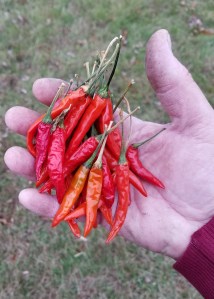
Before going inside I harvested some of the last Bangkok peppers. The frost killed the plants. Points of red on stalks with shriveled leaves. I’ll save the seeds for spring.

Saving seeds is where aging gardeners end up. It’s not a bad life. On the contrary, it is life, as good as it gets.

There is a lot to do between now and year’s end — a lot of errands to run.

Here’s hoping to sustain our lives. Midway through life’s seventh decade it seems less about me and more about what we’ll leave behind.

Categories
Kitchen Garden

Garden Plot Six 2016

First Tomatoes Ripening

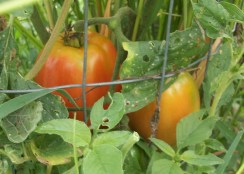
Garden plot six was five varieties of tomatoes — Italian, Amish Paste, Beefsteak, Rose and Kanner Hoell.

It was an abundant crop — about 200 pounds harvested — but most of the crop went bad on the vine due to an inability to spend time harvesting.

The culprit was a busy work schedule that included four jobs during the prime tomato month of August.

Heavy rain produced large sized fruit. When rain was imminent I hurried to harvest — preventing tomatoes from bursting. I didn’t always make it in time.

Lesson learned and applied this year was to give the plants space between them to breathe. So too it is with us. We need freedom from being cloistered to thrive.

Plans for this commodity plot are up in the air until I take a pencil to the 2017 garden plan. Wherever I plant tomatoes, I will give them even more room between plants. In 2016 this paid dividends that made up for my lack of care.

Categories
Kitchen Garden

Garden Plot Five 2016

Cherry Tomatoes from Garden Plot Five

The ambient temperature dropped to 20 degrees last night — a hard frost.

This morning, while raking the remainders of grass clippings in the yard, I found Swiss chard growing in garden plot five.

Chard will be a centerpiece for tonight’s dinner, most likely in a casserole with rice, onions, chopped chard, garlic, eggs, oregano and Parmesan cheese.

While poorly planned — a place for odds and ends of cherry tomatoes, eggplant, cauliflower, hot peppers and a failed section of bell peppers — it produced early with cherry tomatoes and late with aforementioned chard. I pledge to make a better plan next year.

The section of bell peppers took up more than a third of the space. The seedlings went in fine, with protection from ground threats in the form of six-inch sections of four-inch drainage tile, and mulch. Because of working four jobs in August, it got away from me, producing not a single fruit. I can’t recall a year when my bell peppers have done well. Weeding and watering are two important aspects of growing peppers and I didn’t do either one well. But what do I know? A farmer friend gave us adequate seconds from her farm so we are okay with bell peppers for winter.

Four cherry tomato plants is enough for our household. The four different kinds produced before the main tomato crop and were great in salads until the slicers matured and ripened. The cherries were positioned at the edge of the plot for easy picking from the center path.

The eggplant and cauliflower seedlings were gifts stuck in empty rows. Fairy Tale eggplant is great because of its size and length of time producing. Four plants produced more than we could use. I’ve added Fairy Tale eggplant seeds to my December order and will put them in the indoor planting schedule.

Now that frost has come it will be easier to clear the plot. The plan is to clear it and make a burn pile. It was very windy today, so I’ll save these tasks for another day in this unseasonably warm autumn.

Categories
Environment

Sustaining Saturday

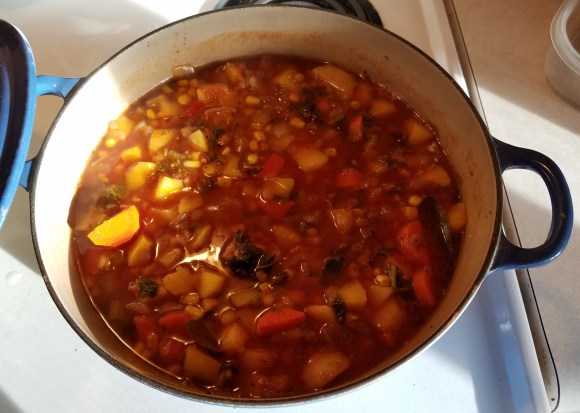
Harvest Soup
Harvest Soup

The weekend began with a trip to the COSTCO bakery where I bought 2.2 pounds of cookies after my shift at the home, farm and auto supply store.

I am celebrating my first Saturday without a work shift since July 26 with, that’s right, cookies!

Saturday morning I made harvest soup from bits and pieces in the ice box, pantry and counter. With a sandwich it made a hearty lunch with three leftover quarts of soup for later in the week.

Hot peppers and kale

Gleaning the garden yielded sage, oregano, chives, kale, hot peppers, cucumbers and tomatoes.

After cleaning the vegetables there are bags of herbs and kale in the ice box, Bangkok peppers in the dehydrator, and a big bowl of Serrano and Jalapeno peppers in the ice box. More Bangkok peppers are ripening on the counter. Cucumber salad is in the works for Sunday as is an appetizer for the work dinner later in the evening. It is weird to be harvesting cucumbers and tomatoes in November.

I don’t fully understand the El Niño/La Niña cycle but the weather has been warm. Saturday’s harvest weeks after the normal first hard frost stands as evidence. Climate change is not about the weather per se but warming temperatures in the equatorial Pacific Ocean impact Iowa.

Assorted kale leaves

Photos of fresh produce compliment each day and help us forget about the impacts of changing climate. There is something to be said for a warm Iowa winter. It would be welcomed by most people I know.

The hard frost is coming and with it the end of the gardening season.

In the meanwhile we harvest what we can and make a life for ourselves on the Iowa prairie.

Categories
Kitchen Garden

Garden Plot Three 2016

Field Tile Protecting Celery Plants

What is a kitchen garden? Garden plot three.

More than others, vegetables grown here made it to our kitchen and were used. Herbs, onions, celery, broccoli and green beans are always expected from a Midwestern garden. This year plot three delivered.

The story was of technique.

The plot is shaded by the locust tree each morning with full sun after noon. Almost everything planted here thrived. This year’s production included perennial chives and oregano, spring onions, basil, celery, broccoli and green beans.

I used drainage tile to protect young celery seedlings and it worked. Celery plants grew tall inside the 12-inch by 4-inch tile segments, producing enough for the kitchen with extra to give to library workers. There is nothing like home-grown celery.

The success of this year’s broccoli is attributable to protecting the seedlings as they grew. I put one old tomato cage around each seedling and wrapped chicken wire around the cage. As the plants grew, I removed the cages and put a 4-foot fence around the broccoli — tall enough to prevent top-nibbling by deer and close enough together to prevent them from jumping inside the fence. It all worked, producing the best broccoli crop I’ve had.

More than 100 onion sets produced spring onions well into summer. I tried seeding basil, but it didn’t take. Basil seedlings started indoors produced better results with plenty to make pesto.

What made this plot a kitchen garden was the production of aromatics — herbs, onions and celery particularly. In season I used them in everything.

Plans for next year: Split the chive and oregano plants; more basil; cherry tomatoes where the beans were; eggplant and hot peppers; and peas.

Categories
Environment Work Life

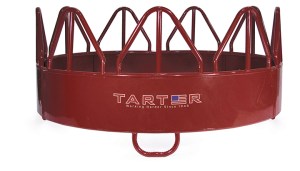
Hay Feeder Rings

Photo Credit - Tarter Farm and Ranch Equipment
Hay Feeder Ring Photo Credit – Tarter Farm and Ranch Equipment

Something is wrong when the garden produces tomatoes, cucumbers and peppers in Iowa the fourth week in October.

I’ll dice tomatoes for breakfast tacos later this week, Bangkok peppers are in the dehydrator, and cucumbers and jalapeno peppers in the icebox waiting to be used. There is chard and kale, oregano and chives. Those leafy green vegetables usually survive until November, but tomatoes and cucumbers?

Call it what you want but something is happening and we know exactly what it is.

I spent most of Friday working with hay feeder rings.

After re-resurfacing the outside lot where farm equipment is displayed at the home, farm and auto supply store, I assembled and re-merchandised the stock of feeder rings.

I don’t know if it was a day’s work, but spent a day doing it, working slowly and as safely as possible. I was tired after the shift with a hankering to leave everything and head west to work on a ranch — day dreams of a low-wage worker.

The garage was cluttered after a summer of intermittent work.

I checked off each item on the to-do list on my handheld device before heading to the orchard for a shift. I disassembled the grass catcher and stored it; re-mixed bird seed and filled the feeder; checked the air pressure on our auto tires; brought in salt and paper products from the car; stored 40 pounds of coarse salt in tubs for winter ice melting; cleared a work space on the bench; and swept the entire floor. It took about two hours. I wanted more, but time ran out.

Yesterday’s political events had me thinking of Gettysburg, Penn. My parents, brother and sister went there before Dad died. I remember reading President Lincoln’s Gettysburg Address on a placard near where he read it himself. With deep roots in rural Virginia, and ancestors fighting on both sides of the Civil War, it was a seminal experience for me. It began the process of turning me from being a descendant of southerners enamored of romantic notions about plantation life to being an American eschewing the peculiar institution and those who stood for it. To my mother’s probable dismay, I brought home a Confederate flag and hung it in my bedroom. Visiting Gettysburg helped me understand the reality of the Civil War and those who fought and lived through it. I was coming of age.

My parents pointed out the house and farm where Dwight and Mamie Eisenhower lived after his presidency. Eisenhower hosted world leaders there, including Nikita Khrushchev, Charles de Gaulle and Winston Churchill. He also raised Angus cattle. We thought favorably of Eisenhower even if he was a Republican. As Supreme Commander of the Allied Forces in Europe during World War II he was a well known part of our culture. Seeing his farm enabled us to touch reality in his celebrity.

My life is here in Big Grove. I’m not heading west to work on a ranch. I don’t display the Confederate battle flag or think about it much any more. I will re-read the Gettysburg Address as I did this morning and wonder how my ancestors got along with each other after fighting in the Civil War. Perhaps there are lessons for the United States in 2016. I’m certain there are.

Categories
Kitchen Garden

Garden Plot Two 2016

Frost Under the Locust Tree

Garden plot two was productive this year.

Nothing but prairie grasses was on this, or any of the garden plots when we moved here in 1993. Shortly after we dug plot two, I planted mail order trees about 12-inches tall to grow them for transplanting. Due to neglect, the locust trees grew and grew and became a 40-foot giants. One of them blew over in a 2013 extreme storm that passed through. I cut it up and sold it for firewood. The remaining locust tree provides shade for the three northern plots, and adds value to the backyard landscape.

Hosting the two compost piles, the locust tree, and a bed of day lilies, plot two is challenging because of the tree root structure. Pieces of roots as big a two inches in diameter had to be removed for planting. The tree suffered no apparent ill effects after cutting some of the roots.

Radishes and turnips were the first crop, followed by onions. All produced well. After the root vegetables finished, I installed four four-foot tall meshed wire containers to grow cucumbers — pickling and slicers. They produced well. High winds blew one tower over, pulling the roots from the ground and killing some plants. Lesson learned from this experiment is to spread the cages out more and better stake them. After 2016 there is no question cucumbers grow better in the air than on the ground.

Kennebec and Yukon Gold potatoes were planted in big plastic tubs as an experiment. I got the tubs from a friend who gets them with her animal feed. The technique served the purpose of keeping rodents from eating the mature vegetables before I did. Production was okay, although we don’t eat a lot of potatoes in our kitchen. It was enough. I’m not sure the soil composition in the containers was the best. It was mostly compost with some dirt spaded in. Harvest was easy once I turned the weighty tubs over and picked through the dirt for the potatoes. There was no fork or shovel damage to the crop because of the technique.

Burying four more containers about 12 inches in the ground, I planted four types of carrots. The purple ones were a disappointment, but the others produced enough to justify another year. I made a second planting of daikon radishes which produced enough for eating fresh and pickling.

Plans for next year: think and plan more about this plot; move the compost bins to different locations; dig up and move the day lilies to a more decorative place in the yard; plant Belgian lettuce and other early greens; re-mix the soil in the containers and move them along the southern border of the plot for potatoes and carrots; plant radishes and turnips again, adding beets; a second planting is in order after the greens and root vegetables: more thought needed on that. These ideas may change as I give the plot additional consideration.

Categories
Kitchen Garden

Garden Plot One 2016

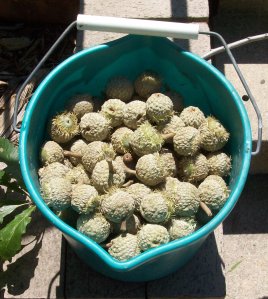
Bur Oak Acorns
Bur Oak Acorns

It’s time to write about this year’s garden — plot by plot.

Dedicated gardeners reflect on the past year and I am mostly serious about gardening.

As the garden has grown, so has my knowledge of how to care for the soil and grow crops. Evaluation of the year just past is part of learning.

Plot one was the first dug during spring 1994.

It is dominated by three Burr Oak trees planted from acorns collected the year our daughter graduated from high school. One tree for each of us. It is adjacent to a row of lilac bushes plants in 1994.  As drought conditions often plague Iowa, accompanied by scorching heat, it is better to plant some vegetables in a partly shady area. Shade creates a longer growing season for lettuce and reduces the amount of watering needed. The three oaks and lilacs are staying for now, although eventually may be thinned.

On the north side of the plot are some spring flower bulbs transplanted from the Indiana trucking terminal where I worked. They grew in the ditch near Highway 41 and were likely planted by a previous owner. They bloom faithfully each year and need to be dug and separated.

Next to the flowers is what used to be a row of iris. They are dying and what’s left needs to be dug and separated. Only an occasional flower now appears.

The rest of the plot was planted in garlic rescued from the town library. It eventually spread to cover the entire plot. A few years ago I placed tarps over the middle of the garlic patch to store stakes, cages and fencing. Each spring garlic pops up around the tarp perimeter. I harvest it for spring garlic, otherwise let it grow wild.

This year I pulled up one of the tarps and planted Turk’s Turban and Acorn squash. Both produced and some wait on the counter to be used.

This is the first year I tried an annual crop in plot one, and based on the results, I might try more. The near continuous shade makes crop selection the essential dynamic. While we enjoy the spring garlic, we should convert production to a regular, annual cycle of planting and harvesting garlic cloves. It is not too late this year, but with continuous daily work outside home until November, it is doubtful I’ll get a crop in.

Plans for next year: dig up the bulbs, separate and move to a more decorative spot in the yard; try an early spring crop like turnips, beets or radishes; till the entire plot after spring crop, evaluate, and likely plant beans to fix nitrogen in the soil; plant garlic in the fall.

Categories
Kitchen Garden

Season’s End

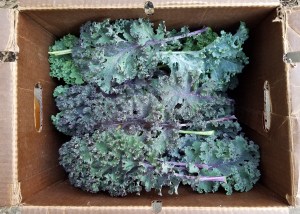
Kale
Kale

Yesterday’s harvest yielded kale, some cucumbers and hot peppers.

I sent another box of kale to the library for workers. It has been filled with kale countless times in recent years. It’s better quality than what’s available at grocery stores and they use it almost every day — good use for an abundant crop.

The aroma of Bangkok peppers in the dehydrator pervaded the kitchen air as I prepared a simple dinner of spaghetti with tomato sauce made of canned tomatoes, garlic, onion, basil, olive oil and oregano. I peeled and diced cucumbers to make a salad with Kalamata olives, feta cheese, olive oil and balsamic vinegar. There was fresh apple cider from the orchard.

I tasted the pickled red onions and decided to stop at two half-gallon jars. There are plenty to last until spring. Three crates of onions remain — more than enough for our small family.

The solace of kitchen work occupies hands and mind to help us forget what seems intolerable in society. At season’s end it is welcome relief.