Categories
Environment

Can Hipsters Stomach The Truth About Avocados From Mexico

Avocado from Mexico

Can consumers buy avocados from Mexico at the grocery store, or in prepared guacamole with impunity?

Probably not.

Last week’s article “In Mexico, high avocado prices fueling deforestation” by Associated Press author Mark Stevenson explained why.

Americans’ love for avocados and rising prices for the highly exportable fruit are fueling the deforestation of central Mexico’s pine forests as farmers rapidly expand their orchards to feed demand.

Avocado trees flourish at about the same altitude and climate as the pine and fir forests in the mountains of Michoacan, the state that produces most of Mexico’s avocados. That has led farmers to wage a cat-and-mouse campaign to avoid authorities, thinning out the forests, planting young avocado trees under the forest canopy, and then gradually cutting back the forest as the trees grow to give them more sunlight.

“Even where they aren’t visibly cutting down forest, there are avocados growing underneath (the pine boughs), and sooner or later they’ll cut down the pines completely,” said Mario Tapia Vargas, a researcher at Mexico’s National Institute for Forestry, Farming and Fisheries Research.

Why does it matter?

Deforestation plays a key role in the release of greenhouse gases. Carbon stored in trees and other vegetation is released into the atmosphere as forests are converted to avocado plantations.

With the advance of climate change, securing adequate water to produce the fruit has increasingly been an issue in avocado growing regions. A video posted by the World Bank explained the problem and how farmers are coping. It’s pretty simple. In recent years there has been less rainfall in Michoacan, desiccating the soil. Farmers divert rainwater runoff to retention ponds for use during dry months. Avocados require twice the water of pine forests they replace, depriving downstream users of an essential resource.

If that’s not enough, these particular forests are part of the Monarch butterfly wintering grounds. Deforestation impedes the butterfly’s evolved life cycle.

You may have seen one of the web ads featuring celebrity chef Pati Jinich promoting avocado use for the trade association Avocados from Mexico. Here is an example:

(Editor’s Note: Sorry, the video was deleted from the Avocados from Mexico Website)

When encountering these ads, I found Jinich endearing and her tips helpful. That is, if I were a user of avocados, something she and the trade association is trying to change with the promotion. My experience with guacamole has been a tablespoon served on the side of Mexican food with other condiments, so not much.

One doesn’t always know what to do about stories like Stevenson’s. How extensive is the deforestation problem in avocado growing regions? How will downstream users react to deprivation of water from the mountains? How are workers treated on avocado plantations? Can we live without Monarch butterflies, and will another plot of forest gone really make the difference for this pressured species?

I don’t know, but here’s a relevant question raised by Joanna Blythman in The Guardian, “Can hipsters stomach the unpalatable truth about avocado toast?”

“When we pick up a fashionable import like avocado,” Blythman wrote, “we need to be sure that it not only benefits our personal health and well being, but also that of the communities that grow it.”

The issues around deforestation are well known. To the extent avocados add to the problem users should be driven to do something.

That may be as simple as asking the server to hold the guacamole.

~ Written for Blog for Iowa

Categories
Environment

Chuck Isenhart Addresses Iowa Clean Water Strategy

Runoff Heading to Lake MacBride

On Wednesday, Aug. 3, State Rep. Chuck Isenhart issued a press release addressing the need for Iowa government to update the state’s clean water strategy.

Following a visit to Louisiana, where he consulted with stakeholders regarding Gulf of Mexico hypoxia, Isenhart wrote a letter to Iowa Secretary of Agriculture Bill Northey urging the Water Resources Coordinating Council to adopt a 20 percent reduction in nitrogen and phosphorus load. Read his July 17 letter here.

Isenhart is ranking member of the House Environmental Protection Committee and a leading voice for the environment and on energy issues in the Iowa legislature. Following is his press release in its entirety.

Time to update state clean water strategy

In light of Gov. Terry Branstad’s renewed call for more funding for water quality initiatives, State Rep. Chuck Isenhart (D-Dubuque) has asked the Iowa Department of Agriculture and Land Stewardship (IDALS) to update Iowa’s nutrient reduction strategy to establish performance goals to be achieved with any new money.

In a letter to the Water Resources Coordinating Council — chaired by Secretary of Agriculture Bill Northey — Isenhart has encouraged the body of state and federal officials to recommend that Iowa adopt the interim milestones endorsed by the Mississippi River/Gulf of Mexico Hypoxia Task Force

Northey is co-chair of that task force. Isenhart is ranking member on the House Environmental Protection Committee and liaison to the state Watershed Planning Advisory Council.

The Gulf task force’s 2015 report to Congress called for a 20 percent nitrogen and phosphorus load reduction at the watershed scale by the year 2025.

“After three years of demonstration projects, we know what works,” Isenhart said. “Time to move to the implementation stage and scale up our efforts with widespread adoption of effective pollution-reduction practices. But first we owe it to Iowa citizens to show them how we will be accountable and what their money will buy: How clean will the water be and when will it happen.”

Isenhart noted that, while the Gulf task force is looking for documented results by 2025, Governor Branstad’s funding plan doesn’t kick in until 2029. “That is a glaring oversight, hopefully not intentional,” he said.

During the last legislative session, Isenhart and State Rep. Marti Anderson (D-Des Moines) offered an “Iowa Clean Water Partnership Plan,” based on their participation in the Greater Des Moines Partnership’s Iowa’s Soil and Water Future Task Force.

If adopted, the plan would create a clean water trust fund comprised of both public and private monies contributed by farm producers through water quality checkoff programs. The legislators plan to improve and re-introduce the bill in 2017.

“In the meantime, we will continue to educate and learn from Iowans during the upcoming election campaign season,” Isenhart continued. “We want to know if we are on the right track. We also want to know if Iowa voters still want us to raise the sales tax by 3/8 cent to fund the Natural Resources and Outdoor Recreation Trust fund they put in the Constitution with a 2010 referendum.

“If Iowans still want it — and surveys indicate that they do — that would bring the greatest, most consistent funding that a long-term enterprise like this requires,” he said.

This week, Isenhart is attending the annual meeting of the National Conference of State Legislatures in Chicago. He serves on NCSL’s Natural Resources and Infrastructure Committee.

Isenhart has offered an amendment to the NCSL water policy directive that would prioritize nitrogen and phosphorus pollution as a water quality improvement objective in the Mississippi River basin and “wherever such pollution from pervasive point and non-point sources creates serious hypoxic conditions in waters of economic, ecological and/or recreational significance.”

The proposal also calls on the federal government to “foster and assist in the financing and support of working groups of state legislators within major watersheds where water pollution is a multi-state responsibility.”

Such working groups or compacts could be formed to “coordinate the development of strategies, policies, statutes, regulations and spending priorities for the attainment of clean water, including goals, timelines and accountability for performance,” Isenhart explained. “Right now, many state legislatures are AWOL when it comes to clean water. We need to get in the boat.”

~ Written for Blog for Iowa

Categories
Writing

In An Iowa Kitchen

A Gardener's Breakfast
A Gardener’s Breakfast

The local food movement relies more on kitchens than grocery stores; more on gardens than commercial growers.

While use of locally sourced food by many restaurants has changed to include more of it, a local foods movement cannot be sustained by the hodge-podge of farmers, growers and entrepreneurs who sell locally produced food to restaurants, or for that matter, to grocery stores.

The problems include scalability and sustainability.

We are living in a time where demand for local food exceeds supply. Scaling up to meet demand requires a capital investment most small farmers can’t make. Sustainability relies on creating value along with the food in a way that cooks can afford it and farmers can make a reasonable return on their investment.

Someone recently asked if the area was becoming saturated with Community Supported Agriculture projects and if that’s why some are having trouble growing membership. An answer lies elsewhere. The market for local fresh food has grown so big corporations noticed.

Companies like Hy-Vee, have tapped into the fresh food market by increasing their number of suppliers and offering fresh and local food alongside wares from large commercial growers. They are sucking up market share like a vacuum cleaner as their business model is designed to do – putting pressure on small and mid-sized growers.

Corporate involvement in the local food market is a two edged sword. Growers can sell their best wares to companies like Hy-Vee and get a reasonable return. At the same time reliance on companies rather than CSA members can distract a farmer from his or her core business.

A solution? CSAs should stick to their knitting by getting payment up front and sharing the harvest with members… all of it. It may be tempting to sell some on the side to restaurants and grocery stores, but the further away from the model they get, instead of doing one thing well, everything they do can suffer. In addition, the market share they help corporations grow may be detracting from their core business.

There is nothing wrong with a farmer growing organic greens for restaurant salads and stir fries. In the end, each farmer must make ends meet, and operating a farm —even a small one — is an expensive operation with tight margins. My point is to focus on one thing and do it well.

It is one thing for a farmer to disassemble a barn and use the materials to create raised beds for a ten-person CSA. It is quite another to support a couple hundred families with the variety of produce the market demands. If you ask a hundred CSA members, as I have, why they belong, answers are all over the map. Some want assurance of a grower who uses organic methods to produce food. Some want variety unavailable at Aldi’s or Fareway. Others want to create a cooking experience with young children as part of their education. Most want to feel good about what they are doing with their lives.

One hopes we are beyond the discussion of “food miles” and on to the core value of the nascent local food economy: know the face of the farmer. It’s corollary is know how your food is grown. Try as they might with life-size cutouts of farmers in their stores, corporations have a hard time doing that. Their customers are too diverse, and they have to cater to everyone in the community. If a person combines these two ideas, knowing how our food is produced and creating demand for local, fresh food the local food movement has a chance.

A very few people strive to source every food ingredient locally. It is not with them the future of local food lies. The future of local food is within the potential of every Iowa kitchen.

To sustain the local foods movement requires consideration of what it means to belong to a CSA or buy from a farmers market. Can that fit into culinary habits in a way that is not an encumbrance to what most perceive as very busy lives?

Can kitchen cooks grow some of their own produce? Probably yes, even if it means only a large flower pot with some cherry tomatoes or an herb jar on a window ledge. Even these small things may be a step too far for some.

The trend in food includes extensive prep work done by machines and large companies. Heat and serve has become a by-line for many available grocery items. Along with taking the kitchen work out of meals, risks of contamination have been created and along with it the need for recalls from large processors whose products get contaminated by E. coli and listeria.

In a consumer society it will always be tough for small-scale producers to survive and thrive. That’s why I say the future of the local food movement rests in Iowa kitchens where cooks can use less processed foods and more fresh — secured by buying local and growing their own.

It’s work many can’t do because of choices made about careers and family. What may be the saving grace of the local food movement is the idea of taking control of our kitchens, in part by living and eating local as much as we can.

Categories
Environment

What’s After Paris?

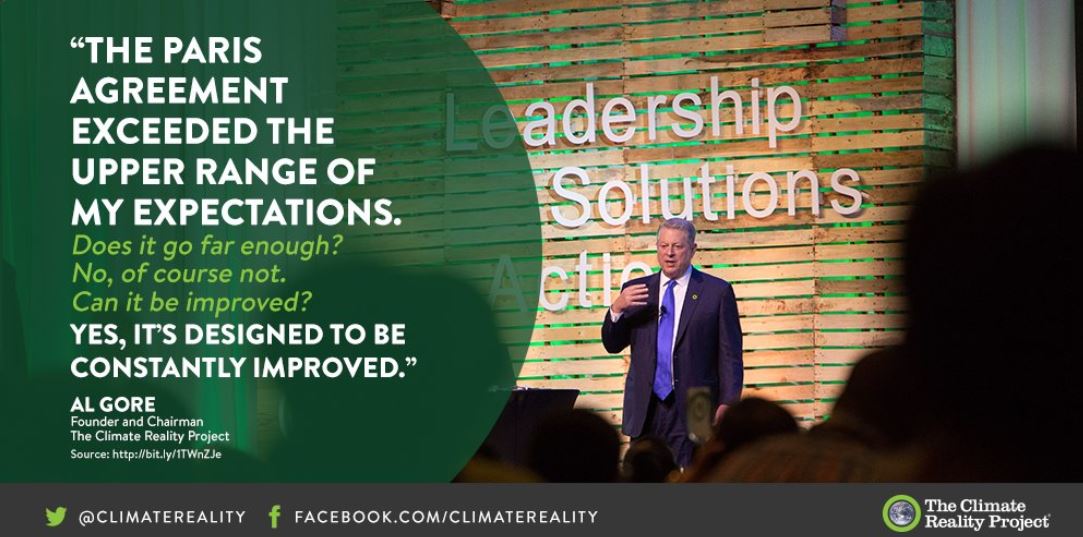
Gore ParisLast week, Al Gore reflected on the ten years since he founded The Climate Reality Project. Following is an excerpt from an email he sent to the Climate Reality Leaders he trained.

Ten years ago, I trained the first group of Climate Reality Leaders in my barn in Carthage, Tenn. I asked them to join me in spreading the word about the urgency of the climate crisis, and I was impressed by the commitment and passion they demonstrated. I’m even more impressed now as the work they’ve done in their own communities and beyond has helped to spark a global movement for action on climate change.

In the decade since that first group came together, I’ve trained more than 10,000 Climate Reality Leaders who are just as committed to making the world a better place for future generations. The Climate Reality Leadership Corps is active in more than 130 countries around the world and represents people from all backgrounds and walks of life. I’ve enjoyed working alongside teachers, scientists, community leaders, business owners, students, and so many others who all share a dedication to promoting solutions to the climate crisis.

Ten years of concerted action by the Climate Reality Leadership Corps came together last year when 195 countries committed to working together to reduce greenhouse gas emissions planet-wide as part of the Paris Agreement. Now, it’s time for us to continue our work together and push countries to strengthen and implement their commitments so we can make the promise of Paris a reality.

Even as we look to the future, I want to make sure we take a moment to appreciate the last 10 years and all of the amazing work that you’ve done to help share the truth about the science and solutions of climate change with your friends, family members, colleagues, and everyone else.

I want to thank each and every one of you for what you’ve done in your own communities to bring attention to the most important issue of our time.

It is easier to play a role in the global effort to mitigate the causes of global warming and climate change when thousands of others are doing the same thing, each in their own way. That’s been my personal benefit from The Climate Reality Project.

I joined in Chicago (August 2013) and have no regrets. I learned the story behind Gore’s film An Inconvenient Truth, and the science behind it. Gore presented a broad mix of information about what is happening in our environment because of global warming and how it impacts communities.

Since then, I’ve presented my story to individuals and groups in the area and seek opportunities to do more. I served as a mentor at the Cedar Rapids training last year and have written about the need to act on climate change in my blogs, and in letters to the editor of our local newspaper. When I worked as a freelance correspondent, climate change informed my world-view and was a context in which I framed stories whether they were about farming or forestry, the school board or city council, or about new business openings or individual achievements.

Talking about global warming and climate change has become part of my life.

If the Paris agreement was the culmination of ten years of work, as Gore said it was, the work is not finished.

With a sharp focus on identifying the impact on our climate of CO2 emissions from burning fossil fuels, Gore and many allies made the point about seeking alternatives. As solar and wind-generated electricity reach price parity with fossil fuels (and they are doing so faster than anyone imagined) the coal industry is in disarray and nuclear power is waning.

There is a cloud on the hopeful horizon of renewable energy. Buoyed by exploration and discovery of oil and shale gas reserves, companies like British Petroleum, once green washing us with their interest in renewables, divested their interests in solar and wind energy this decade to focus on oil and gas.

I predict declining prices of solar power will help it dominate the future of municipal and regional electricity generation. Already companies like Central Iowa Power Company (CIPCO) are changing their tune. Not so long ago they were promoting nuclear power at their annual shareholder’s meeting. Today, they are building solar arrays.

If there is a blind spot in Gore’s laser focus on burning fossil fuels it is the impact of greenhouse gas emissions from other sources. He acknowledges them, but they have not taken the spotlight. There’s work to be done regarding manufacturing, agriculture, mining and other aspects of our industrialized global economy.

Every time I talk to an Iowa farmer Gore’s work can be heard in the conversation. Not so much from me, but from farmers. They’ll tell you the hydrology cycle seems different even if they dislike Al Gore and don’t acknowledge it is related to global warming. They don’t have to and I don’t need ratification of my own beliefs.

Like so many others I am focused on the work of mitigating the causes of climate change. You may not know it, but it is baked into everything I do.

What have you done lately to create a better environment for all of us to enjoy?

~ Written for Blog for Iowa

Categories
Environment

Bakken Oil Pipeline Pledge

BakkenPledge_v2_600px(EDITOR’S NOTE: Ed Fallon has long been a friend of Blog for Iowa. Here is his latest on the Bakken Oil Pipeline).

Over the past two years landowners, farmers, tribes and environmentalists have done everything possible to stop the pipeline.

We have pursued legal and legislative channels at great cost of time and money.

We have held forums, rallies, protests, flotillas, press conferences and more.

We have written letters and opinion pieces for our newspapers, spoken with radio stations and TV reporters, and written countless letters to government agencies.

We have learned more about pipelines, climate change, watersheds and eminent domain than we ever imagined we’d need to know. With the knowledge we’ve acquired, we’ve educated others — and public opinion has moved our direction. The most recent Iowa Poll shows less than half of Iowans support the pipeline while three fourths oppose the use of eminent domain to build it.

We await court rulings on a lawsuit filed by ten Iowa landowners and another just filed by Tribal leaders in the Dakotas, and remain cautiously optimistic that the court will decide in our favor. But barring an injunction, those cases may take time.

Meanwhile our land, water, property rights and climate are being trampled.

From the perspective of climate change, it is unconscionable that our government enables this pipeline to go forward. President Obama claims to understand the seriousness of climate change, having said, “No challenge–no challenge–poses a greater threat to future generations than climate change.” Yet he hasn’t lifted a finger to stop this pipeline.

From the perspective of eminent domain, Republican Governor Terry Branstad campaigned against the abuse of eminent domain, yet now has no problem with its use for a powerful, wealthy pipeline company.

From the perspective of our environment, Democratic officials like State Senator Mike Gronstal and Congressman Dave Loebsack either openly support the pipeline or refuse to stand with their constituents against it, despite grave concerns about the potential impact on our land and water.
As with many great struggles before us, when those elected to represent and protect our interests fail to do so, it is incumbent upon the people to challenge an unresponsive government through nonviolent civil disobedience.

In this struggle against the Bakken pipeline, there are two key examples of the failure of law and government to respect and protect our rights.

First is the Army Corps of Engineers’ abdication of its responsibility to assure the safety of our waters. In issuing a permit to Dakota Access, the Corps failed to assess the full range of the pipeline’s probable impacts.

Second, the decision by the Iowa Utilities Board to issue eminent domain to a private company providing no service to Iowans is an assault on the sanctity of our right to own and enjoy property. If government can allow your land to be confiscated for an oil pipeline, where will the assault on liberty strike next?

Yes, it is time to defy an unjust law, time to defend liberty, time to fight the expansion of the fossil-fuel infrastructure and the accompanying destruction of our environment.

In the tradition of other great American struggles for freedom . . .
From the Boston Tea Party to the labor movement struggle to secure rights and freedoms we still enjoy and take for granted;

From the fight for women’s suffrage to the civil rights struggle of the 1960s;

From the Farm Crisis when farmers stood with their neighbors to block foreclosure auctions to the struggles happening now all across the country in opposition to fracking, pipelines and oil drilling;
. . . It is time to step forward and risk arrest.

Over a month ago, a Pledge of Resistance was circulated. The Pledge was initiated by Bold Iowa and supported by Iowa CCI, CREDO Action and 100 Grannies for a Livable Future. To date, over 1,000 people have signed the Pledge, which reads:

“{W}e are the conservatives, standing up for a safe and secure future for our families. It is those we protest, those who profit from poisoning our water, who violate our property rights, and who are radically altering the chemical composition of our atmosphere — and the prospects for survival of humanity — that are the radicals.”

If you are moved, please sign the Pledge and stand with us in a final attempt to stop this pipeline that our planet can’t sustain and most Iowans don’t want.

Ed Fallon
Des Moines

Categories
Environment Home Life Kitchen Garden

New Saturday Night

Audio Cassettes
Audio Cassettes

Music filled the Saturday afternoon gap left by Garrison Keillor’s retirement.

Not radio, but music recorded on audio cassette tapes.

It is amazing there is even a player in the house. (There are two that work). The sound quality of this outdated technology was surprisingly good.

While processing vegetables into meals and storage items, I listened to Shaka Zulu and Journey of Dreams by Ladysmith Black Mambazo, and Graceland and The Rhythm of the Saints by Paul Simon. I hit the pause button when I left the room so the tape wouldn’t run out without hearing it.

When Jacque returned home from work we had our first sweet corn meal of the season: steamed green beans and corn on the cob. As they ripen, tomatoes will replace green beans. There is nothing like seasonal Iowa sweet corn. I made a cucumber-tomato salad as accompaniment using a recipe found by googling on-hand ingredients.

The Saturday kitchen produced a gallon of vegetable soup, refried bean dip, daikon radish refrigerator pickles and sweet pickles made with turmeric. Outside was hot and humid although nowhere near as oppressive as the summer of 2012 when we had record drought.

On Friday Donnelle Eller posted an article about corn sweat at the Des Moines Register. Corn and soybean plants, which cover Iowa farmland, transpire moisture. During pollination and ear formation as much as 4,000 gallons of water per acre of corn is released into the atmosphere daily, making it feel humid. There were a number of articles about corn sweat in the media last week.

What makes this year different is not corn sweat. The first half of 2016 was Earth’s hottest year on record. This impacts the hydrology cycle, change in which is a primary manifestation of climate change. With global warming the atmosphere can hold more moisture until a precipitating event makes a rainstorm. It is more often a gully-washer.

The high winds and heavy, short-duration rain have become more frequent in recent years. This week a storm caused significant damage to the garden. In addition to losing the Golden Delicious apple tree, the cucumber towers blew over uprooting about half of the pickling cucumber plants. The Serrano pepper plants blew over, breaking the stalk of one near the ground. The high deer fence blew down and deer got into the kale and pepper patch by jumping the low fence. The cherry tomato plants blew over, however I was able to upright and re-stake them without damage.

Climate change is real, it is happening now. It is time to act to mitigate the effects of global warming.

Political Event with Tim Kaine at Bob and Sue Dvorsky's home in Coralville, Iowa on Aug. 17, 2010
Tim Kaine at Bob and Sue Dvorsky’s home in Coralville, Iowa on Aug. 17, 2010

Hillary Clinton announced Senator Tim Kaine would be her running mate this weekend. Friends were posting photos all weekend from the August 2010 event he attended in Coralville. If he wasn’t the center of attention then, as the photo suggests, he will be now.

I’m torn about viewing the Democratic National Convention this week. Hopefully key speeches will be available for viewing afterward and I can avoid social media enough to think clearly about what Hillary Clinton says.

As Sunday begins, I’m not sure listening to recorded music will adequately replace Garrison Keillor’s A Prairie Home Companion. It’s here. It’s what I can do to sustain our lives in a turbulent world.

Categories
Environment Reviews

Book Review – A Sugar Creek Chronicle

A Sugar Creek ChronicleIn A Sugar Creek Chronicle: Observing Climate Change from a Midwestern Woodland Connie Mutel produced an engaging narrative of her efforts to cope with change while living on a parcel of Oak – Hickory forest in Northern Johnson County, Iowa.

The narrative is about climate change as the title suggests. It is also rich with descriptions of the flora and fauna of the region and how her life as a Midwestern ecologist, wife, mother, and cancer survivor has changed and is changing because of our warming planet.

It was hard to put the book down once I started reading.

The narrative is a combination of autobiography, new journalism, scientific research and advocacy for the political will to take action to mitigate the causes of anthropogenic global warming and its impact on our climate before it’s too late.

What makes the book important is less the scientific discussions about climate change, and more how Mutel copes with a life she believed held stability and predictability as key components. In telling her story Mutel articulates a personal perspective of current scientific research about climate change in a way that should provide easy to grab handles on a complex topic.

The idea that carbon dioxide causes global warming is not new. Around 1850, physicist John Tyndall discovered that carbon dioxide traps heat in our atmosphere, producing the greenhouse effect, which enables all of creation as we know it to live on Earth. That story has been told time and again.

The benefit of reading Mutel’s observations is one finds a lot in common with her life, on many levels. Her inquiry into global warming and climate change provides us a window not only to her world, but to ours.

~ Posted on Amazon.com.

Categories
Living in Society

Politics Takes A Holiday

Political Sign at a Business

The Bernie Sanders campaign is laying off hundreds of staff members, indicating either he is planning to throw in the towel after California, or that he won’t be placing people currently on his staff in local political organizations for the fall campaign. Maybe both.

The presidential nominating party may not be over, but most of the guests have left and the hosts have begun cleaning up the mess, getting ready for a return to normalcy, which in Iowa means organizing for the June 7 primary elections where there are contested races, and the fall campaign beginning after the Labor Day weekend.

Political campaigns will work through the summer, and there is a filing period in August, but each year, regular people engage in the election cycle later and closer to the election. For folks like me, politics takes a holiday after the primary elections until the fall campaign. We have lives to live.

I’ve written about the county supervisors race which has been reduced to a series of special interest forums in Iowa City and Coralville, along with fund raisers and whatever else each campaign sees fit to do.

I missed the first forum last night. Bottom line was I couldn’t afford the $5 in gasoline and an hour of driving on a work night. Stephen Gruber-Miller covered the forum for the Iowa City Press Citizen and here’s a link to his article. They say people in the county seat can access video of the event on their local cable television channel, but the service does not include Big Grove Township.

My trouble with picking three candidates for supervisor is besides the incumbents, I don’t share a view of the county with any of them. My relationship with the county seat is tenuous at best, although I likely benefit from the economic engine that is the University of Iowa. I’ll pick one of the two business people for my third vote and see what decision the urban centers make for me. No need to decide until late in the race, early June most likely.

The other primary election that matters is for U.S. Senate and I support State Senator Rob Hogg over three other candidates.

Politicization of our lives has become a detriment to living, so the compulsion I felt toward campaigns during the George W. Bush years is in remission. I work on issues, but like with the climate crisis, they represent human values and shame on those who politicize them or frame them in the false paradigm that is conservative vs. progressive. People like billionaire Tom Steyer is who I have in mind, but it applies equally to all of the billionaire class members.

Steyer Quote

My summer will be eking out a living on the margins of society, hopefully making enough money to live on, reducing debt, and finding joy in simple pleasures. We don’t need politics for that.

Categories
Environment Kitchen Garden

Warp and Weft of a Garden

Spring Lettuce
Spring Lettuce

Farming is more than putting plow to furrow. It is a multitude of experiences, evaluations and decisions made over time.

The same is true for gardeners. Each garden, each plot, has its own micro environment and climate. Not only sun and rain, but wind, topography and history play a role.

This year a friend changed rented land for her community supported agriculture project and stories about her struggles are going around the local food community. The new soil hasn’t been worked for organic vegetables, and is recovering from row cropping. I believe — everyone is confident — she will persevere through the change. Yet it will be a setback in a business that operates on thin margins and more physical labor than mechanization. It’s when the going gets tough that farmers get going.

Over the last 23 years my Big Grove garden expanded from a single plot to six, and I’m looking at adding more. That doesn’t count the five fruit trees which have been a source of produce for a number of years. Yesterday the pear tree burst out in full bloom.

I mistakenly planted a locust tree in one of the garden plots. It has grow to maturity, providing shade for two plots at the same time the frequency and severity of drought has increased. Shade serves to protect cucumbers, herbs and greens from constant, intense sunlight in the absence of precipitation. It took me a while to realize what’s going on and leverage it. Now I couldn’t imaging growing without it.

There are a hundred small things like the benefits of a locust tree that converge in the plots of my garden. When I think of retirement — more often now than previously — I can’t imaging life far from a garden and the diverse intricacies of what sustains me and enables vegetables to grow.

My garden and I are the same warp and weft of life that sustains us all.

Categories
Environment

Earth Day 2016

Earthrise Dec. 24, 1968

My participation in the first Earth Day on April 22, 1970 evolved in a convergence of social vectors. Among them was this Apollo 8 photograph of Earth above a lunar landscape by astronaut William Anders.

After viewing the photograph I felt conflicts and maladies in society were insignificant compared with what we have in common within our tiny, shared ecosystem suspended in the dark vastness of space. The photograph and its wide publication were a call to action to work for a common good. I still feel that way. It makes sense.

By spring 1970 we had witnessed the Tet Offensive, the My Lai Massacre, and renewed bombing of North Vietnam. We watched the violence of the 1968 Democratic National Convention in Chicago. We saw bits of Woodstock and Altamont in the media. We also landed men on the moon and returned them safely to Earth. At this convergence I didn’t know what to do, so joined with some high school classmates who were organizing Earth Day events. Earth Day was a common denominator.

What has Earth Day become?

Last week the Johnson County Board of Supervisors proclaimed April 17 through 23 Earth Week and announced two related events: an energy fair, and a local foods panel.

The focus on energy, CO2 emissions particularly, is well placed. We continue to use the atmosphere as an open sewer, discharging millions of tons of the greenhouse gases into it daily. Any reduction in electricity usage benefits the environment, even if the changes needed to solve the problem are trickier to accomplish than changing light bulbs.

Our food system is an obvious pick for Earth Day. Nine percent of greenhouse gas emissions come from agriculture according to the U.S. Environmental Protection Agency. It is a commonplace people need food to live, and the merging of Earth Day with the local food movement is an expected assimilation within normal spring activities. There are few better ways of appreciating Earth than getting one’s hands dirty in the ground, and spring in the Northern hemisphere is a great time to do it. It’s tough to see how planting a few trees, flowers or vegetables will rescue the environment, but as with electricity usage, every bit helps.

There is an entire menu of Earth Day related activities in our county.

Quoting Albert Camus in a recent opinion piece in the Washington Post, Kareem Abdul-Jabbar described why the 2016 election is important,

“This is no longer a prayer but a demand to be made by all peoples to their governments — a demand to choose definitively between hell and reason.” That is what the stakes of this election are: We are choosing between hell and reason.

In 1970 I thought we were already living a form of hell and the Earthrise photograph gave us hope. I would not have believed that in 2016 the Age of Reason itself would be on the brink of dissolution.

The good news is solutions to the climate crisis are working, particularly in the development of alternatives to fossil fuels to generate electricity and industrial power. The challenge is everything on our blue-green sphere is connected in a single ecosystem. What I do in my back yard has implications for living creatures around the planet.

Individuals in the U.S. are willing to do their part and what’s lacking is no secret: the political will to do straightforward things like ratify the Paris Agreement. Negotiated by 195 states within the United Nations Framework Convention on Climate Change, the agreement addresses greenhouse gases emissions mitigation, adaptation and finance starting in the year 2020. Some 120 nations are expected to sign when the agreement opens for signature this Earth Day.

Will the United States be among them? It’s an open question. Many politicians have indicated the United States should not participate in the agreement at all. Their rational doesn’t make sense, and that’s what Abdul-Jabbar was getting at. Reason the way most understand it is not in vogue in parts of our government.

Politics aside, Earth Day is a chance to revisit this iconic photograph. When we consider the big picture, as the photograph encourages us to do, little has changed since it was taken. Our troubles seem petty compared to the overriding fact we live on our only home and it’s much smaller than we often see.