Is it wrong to collect seeds from a prairie restoration project for use in a home garden or another prairie restoration project?
I posed the question on social media. While the responses weren’t that many, they were a unanimous yes.
Not so fast!
“Stealing is stealing,” Cindy Crosby, author of The Tallgrass Prairie: An Introduction wrote.
A prairie manager I know was out for a stroll on his site when he came across a woman cutting buckets of blooms. Horrified, he said, “Lady, what are you doing?” She replied testily, “Well I tried to cut the flowers up by the visitors center for my party and they wouldn’t let me. So I came out here.”
Wildflowers will replenish themselves, right? Maybe and maybe not.
I asked our local state park ranger for his thoughts about harvesting seeds from prairie restoration areas. His response was speedy and made sense, “You are good to take seeds from the plants but just do not remove the plant itself and you will be ok.”
That’s good enough for me. I’ll be watching the patch of restored prairie for seed formation and try some of the varieties in our home garden.
Prairie used to cover more than 85 percent of Iowa land, according to the Neal Smith National Wildlife Refuge. Today less than one tenth of a percent of original tallgrass prairie remains in the state. A prairie restoration project, like the ones at Iowa state parks, is a work of human hands and culture.
People like Cindy Crosby have a personal investment in work they have done to restore prairie. Even if such restorations are anything but natural, and a constant struggle to keep invasive plants like garlic mustard at bay, they add cultural value in the form of habitat for plant and animal species and the narratives spun around them. We should tread lightly in their work, take what we need, and leave the rest.
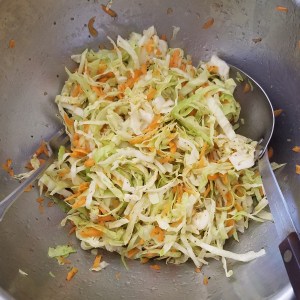
Mixing bowl with summer coleslaw made of local produce and my fermented apple cider vinegar.
Six weeks into summer 2019 we are over a hump, if not the halfway point.
I visited Paris in August 1974. It was hard to find a business open. Eschewing air conditioning we Americans find ubiquitous, Parisians fled the heat of August for the Mediterranean Coast and other breezy spots.
We could learn from that society.
My spouse visited her sister for the month of July. While she was gone I set the thermostat at 84 degrees compared to doing what we wanted in July 2018. The average monthly ambient temperature increased from 75 to 76 degrees Fahrenheit. Between running the air conditioner less and only one person active in the house, our electricity usage dropped by 37 percent in terms of kWh used. I appreciate the savings but I’d like her to return home more.
Summer in Big Grove Township has been reasonably nice with plenty of warm, sunny days, not enough rain, and an abundance from the garden. Friday the ditch had dried out enough I could mow the tall grass and get it looking more normal. The rabbit that lived there this year is likely frowning as rabbits do.
The yard grasses are in transition and need mowing, but not that much. I thought to do it yesterday and rolled up the garden hose near the house after watering in the morning. Not yet. Maybe today after my shift at the orchard. Maybe not as it is a low priority.
We planted our first garden in 1982 and grew or harvested something from our yard in the five places we lived since then. I’m getting better at it.
Cucumbers
We produced more cucumbers this year than we could eat and preserve. I determined a process using four varieties of seeds: two pickling, a Japanese-style cucumber and the utilitarian Marketmore. I made a gallon of fermented dill pickles as dill came in from my barter arrangement with Farmer Kate. The key to good pickles is the cucumber size. Once cucumbers get an inch in diameter they are too large for pickle making. Just don’t do it.
I made dishes of sliced cucumbers for potluck dinners, gave them away, and ate them as much as I could stand sliced raw, in mixed salads, and with lettuce greens when they were in season. There were plenty for sweet pickles but I overdid it last year and have more than a dozen leftover jars. I struck balance between the desire to use every bit of produce in the garden and how we eat them in season.
Tomatoes
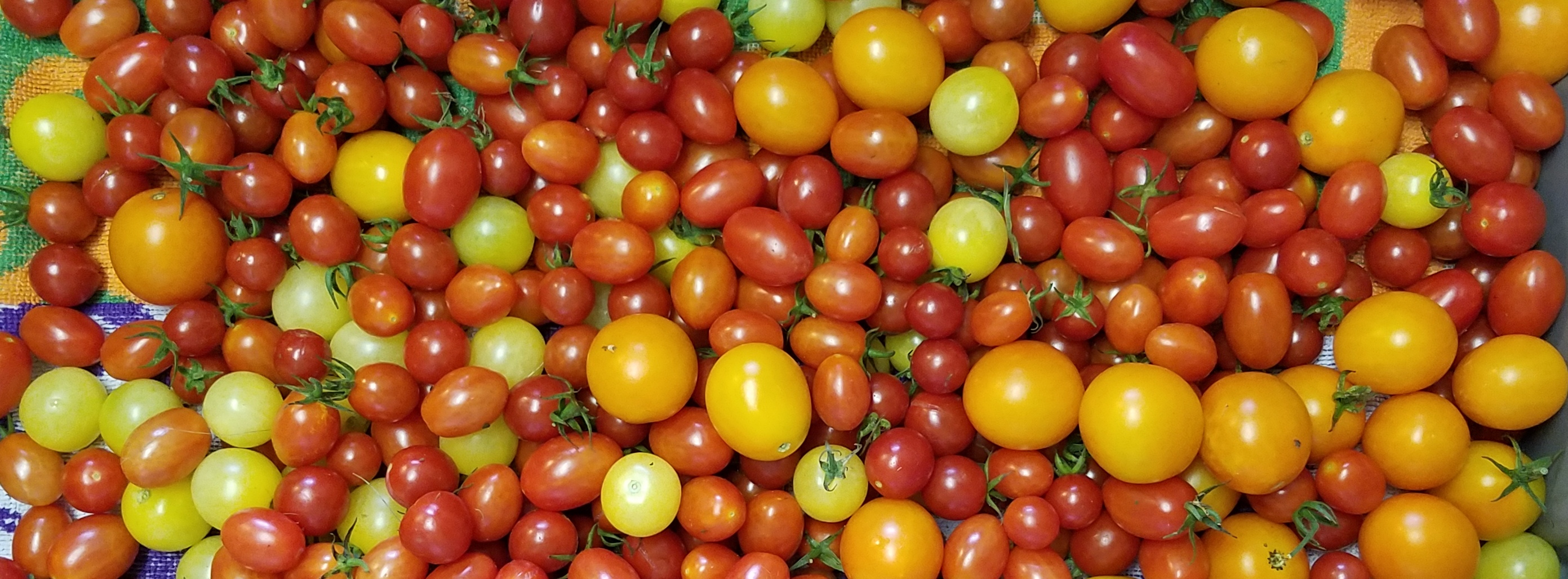
As I posted a couple days ago, we are waiting for tomatoes. The cherries are coming in Jasper, Taxi, Matt’s Wild, Grape, White Cherry and Clementine. The White Cherry, Jasper and Matt’s Wild are surprisingly sweet and delicious. The single Early Girl and Black Krim plants produced fruit. I’ve had a couple Speckled Roma which I found to have tough skin.
This year as last, I planted the rows too close together. I crawled under the seven-foot indeterminate vines and inspected. A lot of good sized fruit waits to ripen under the foliage.
The plants have less blight this year than last. I don’t know why but two things are different. We had extremely cold weather last winter. Perhaps the cold killed some of it off. I also applied diatomaceous earth to the ground after tilling to keep down the crawling bugs that love tomatoes. Perhaps it had an effect on the blight. So far, so good and if all continues to go well, we will have plenty of tomatoes for fresh eating, canning and gifts to friends.
Green Beans
By now we’ve usually had green beans but there are hardly any on the plants. The foliage looks great. There are flowers. No beans. Other area gardeners are experiencing the same thing with a reduction in yield. I picked exactly two beans from a 15-foot row.
Apples
After nearly perfect pollination and fruit setting the invasion of Japanese beetles has the apple trees looking like dirty brown lace. I wait for the fruit’s background color to get right and have been tasting them every other day. The first of two varieties is getting close. Fingers crossed.
A friend sprayed his apple tree with Sevin to kill a Japanese Beetle infestation. The pesticide works although it contains carbaryl, a known carcinogen banned in some European countries. “Aren’t you worried about eating the fruit?” I asked. “Nah!” he said. I continue to refrain from using insecticides, which offer a temporary abatement to the detriment of the environment and apple eaters.
It’s a race to ripeness with popilla japonica. If bugs eat too many tree leaves, inadequate sugar is produced for fruit to ripen. If fruit gets ripe on the tree and they can penetrate the skin, they will mass on it and eat it. There appears to be enough green leaf left to absorb sunlight adequately to ripen the apples. I plan to pick them the minute I find them ripe and ferment the juice to make apple cider vinegar. The second variety, Red Delicious, is for eating out of hand, and everything else apple-related.
The Joni Mitchell song comes to mind, “Give me spots on my apples but leave me the birds and the bees.” In our garden there are plenty of apples and an abundance of birds and bees with whom I enjoy co-existing.
This week I met someone who works with trees for a local municipality while working a shift at the home, farm and auto supply store.
We discussed several topics, including dealing with Japanese Beetles, tree species that thrive in Iowa, and the Emerald Ash Borer. He favored the River Birch tree.
The city had inventoried every ash tree on public property and had a plan to replace them when they inevitably become infected with the insect.
I asked with what species would the city replace ash trees? He mentioned Chestnut and Black Tupelo (a.k.a. Black Gum). We discussed the blight that eradicated the immense population of Chestnut trees in the Eastern United States and how genetics had improved the tree to resist the disease. He also mentioned the Black Gum tree is attractive, with a nice head, and grows comparatively quickly. The conversation drifted off into how people plan trees on their property and the challenges of establishing them on property with a limited number of spots. I returned to the rest of my work.
Growing trees is a long-term commitment. When we built our home only one tree, a mulberry, lived on our lot. We now have 15 with room for more. I’m not sure I want a chestnut, but a Black Gum sounds like a possibility.
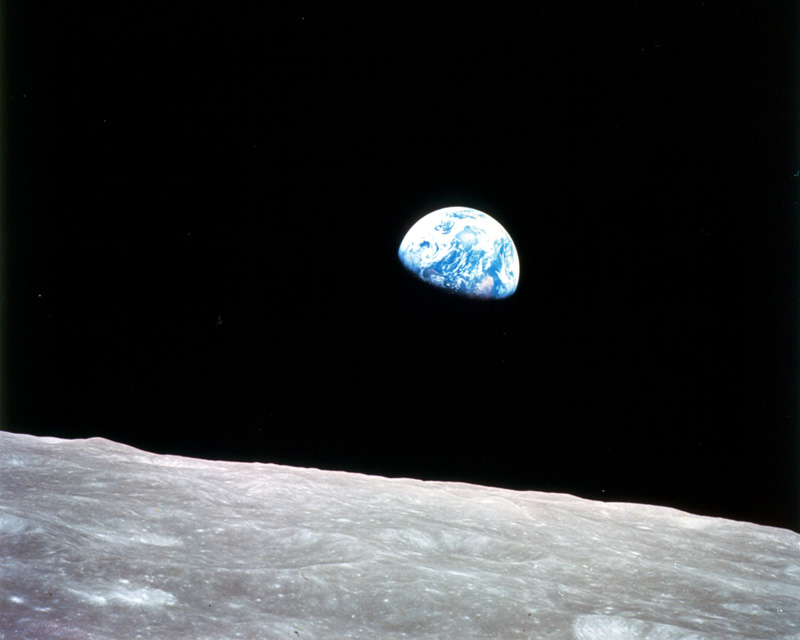
Image of Earth 7-6-15 from DSCOVR (Deep Space Climate Observatory)
Iowa Public Television devoted its weekly Iowa Press program to climate change.
Dr. Gene Takle, Professor Emeritus at Iowa State University and Dr. David Courard-Hauri, Professor and Director of the Environmental Science and Policy Program at Drake University faced reporters David Pitt with Associated Press and Katarina Sostaric of Iowa Public Radio.
No new ground was broken in the 27-minute program because the nature of climate change as we experience it in Iowa is reasonably clear: it’s about moisture, too much in the spring, or too little during the growing season. World-wide warming atmosphere and oceans contribute significantly to extreme weather in Iowa.
Some don’t believe what goes on in Iowa falls into a broader trend or context. Courard-Hauri made an important point about this.
And one thing I’d add is that we focus a lot on this question and if you look at surveys it’s about 20 percent of the people who actively argue that climate change is not caused by people. And the majority of people either, well the majority of people believe the climate is changing, you can see it now, it’s at that level. And then the large majority are aware and concerned and so when we spend a lot of our time focusing on that really small minority, it’s a larger minority of lay people that (sic) it is scientists obviously, but if we spend a lot of time talking about that then I think we miss the fact that most people are wondering what can we be doing, what should we be doing?
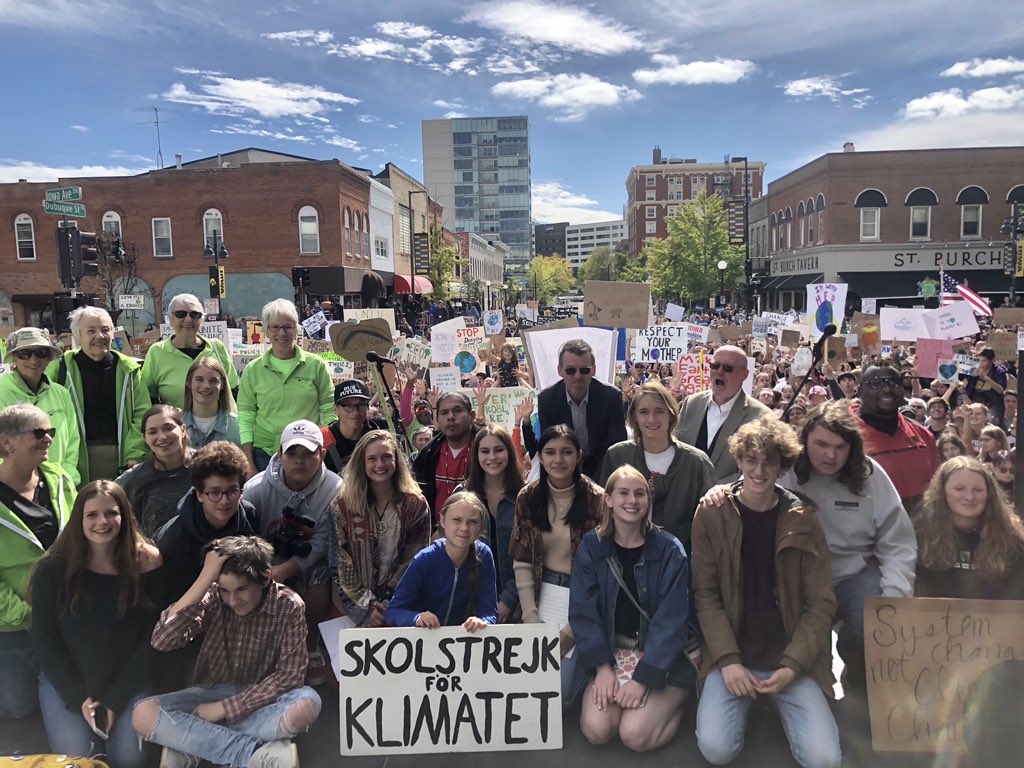
What can we be doing about the climate crisis?
A few years ago State Senator Joe Bolkcom made the best case I’ve heard on what to do: join with like-minded people around a cause.
In a society where the myth of rugged individualism persists, and the expansion of media in the form of radio, television, smart phones and computers brought with it a new form of social isolation, that is hard to do. Do it we must and it’s not just me saying it. At some point the climate crisis becomes so obvious and threatening almost everyone wants to answer Courard-Hauri’s question.
An article by Cathy Brown at Yes! magazine last week pointed out there is a climate action for every type of activist.
“Susan Clayton, a professor of psychology and environmental studies at the College of Wooster, says getting involved with a group can help lift your climate-related anxiety and depression in three ways,” Brown wrote. “Working with like-minded folks can validate your concerns, give you needed social support, and help you move from feeling helpless to empowered.”
Bolkcom’s point was similar to Clayton: groups are more effective than individuals.
The reason I’m involved with environmental groups is to work on inter-generational issues. I won’t likely be around when the worst of the climate crisis hits but people I know and love will be. As I ease into retirement it is important to allocate some time to work on the issue.
When Iowa Public Television is doing a program on the climate crisis, the concerns are mainstream. While we expect a lot from our government, politicians need nudging from voters and that is where joining with others in our communities is important. As Brown’s article suggests, there is a way to get involved for every personality.
Ed Fallon is a friend of Blog for Iowa and we support what he does with his radio program and his advocacy against oil and natural gas pipelines in Iowa.
He caught the attention of Democrats in Cedar Rapids last weekend with a performance art piece, staged by his group Bold Iowa, in which three individuals posed in a gallows with a noose around their neck, standing on blocks of melting ice under a sign that said, “As the arctic melts the climate noose tightens.”
While many on social media and in-person viewers of the piece took a dim view of this direct action, if you know Ed at all, not thinking things through is a feature, not a bug of his work. There is no denying deterioration of the Greenland ice sheet, the Arctic, and the Antarctic ice shelves is a planetary problem that could cause environmental disruptions not seen in living human memory. Bold Iowa’s performance piece was successful in that social media was abuzz discussing its meaning and appropriateness. It was unsuccessful in that major media outlets did not appear to be covering it with the notable exception of the Cedar Rapids Gazette which ran a story on Wednesday framing the piece a racially callous because of its use of a noose, invoking for some an association with lynching in American history.
“We underestimated the way it may trigger folks who either are concerned about the rise in racism in this country, in many respects because of Donald Trump,” Fallon said in an interview with the Gazette. “And also people who were affected by a family member who maybe committed suicide by hanging. … Our focus is to get people to understand just how urgent of a situation climate change is. We really are at a point where human extinction is a possibility.”
In a July 16 email, Fallon wrote he planned to write a blog post about the incident while promoting his Fallon Forum podcast, saying,
Pascha Morgan joins (the Fallon Forum) to discuss Bold Iowa’s provocative performance art, which involved a gallows (representing the threat of extinction) and large blocks of ice (representing accelerated ice melt in the polar regions).
Bold Iowa’s action demanded that Democratic presidential candidates make human survival their first act as president. The banner above the gallows declared, “As the Arctic melts, the climate noose tightens.”
The action received some enthusiastic support. Yet despite what organizers thought was clear messaging, it also experienced some strong pushback. In addition to this week’s live on-air discussion, I’ll publish a more in-depth blog later this week, responding to criticism of the action and apologizing to people offended by the imagery.
Thursday, July 18, Fallon made a post titled An Error of Judgement on the Bold Iowa website. In it he apologized to people offended by the imagery of the noose and accepted full responsibility for what he called an error in judgement. The post also ran as an op-ed in this morning’s Cedar Rapids Gazette.
Our support for Ed Fallon’s work continues. If one reads Fallon’s book Marcher Walker Pilgrim: A Memoir from the Great March for Climate Action there is a clear sense of the haphazard way Fallon goes about planning direct action. The fact is people continue to talk about the performance art piece five days after it happened. To the extent fingers are pointing at Ed’s quirky and in this case considered yet somewhat tone-deaf approach to direct action as the problem, the performance art failed.
Listen to the Fallon Forum live Mondays, 11:00 – noon CT on La Reina KDLF 96.5 FM and 1260 AM in central Iowa. The program is also available on podcast later in the day at FallonForum.com.
Algae Bloom in Lake Erie, Oct. 5, 2011. Photo Credit – NASA Earth Observatory
During his July 8 speech on the environment, the president mentioned his administration’s fight with “toxic algae” in Florida 50 miles from his Mar-a-Lago resort.
Bruce Hrobak, a bait and tackle shop owner in Port St. Lucie, Fla. gave a testimonial at the event about the great job he thought the federal government did to help his business which was “devastated by toxic algae from Lake Okeechobee.” His praise was about more than the government.
“You jumping into this environment brings my heart to warmth, knowing that what you’re doing is going — is the truth,” Hrobak said. “It’s going wonderfully. My business in 2018 was so horrible, we — I own two stores — we closed several days a week because of, you know, the algae and people being frightened, if they were afraid to touch the water and everything. I have a marine mechanic — I just wanted to say really quickly — has a bad infection in his arm from the marine algae and stuff.”
Mr. Hrobak gushed about the attention his problem had received and mentioned his wife was yelling at him less because business was better this year. People laughed and applauded. Rhetorically anyway, Trump halted advance of the red tide.
Iowans are familiar with the problems of algal blooms. The nutrient-rich soup that comprises our lakes and streams has been a hindrance to public recreation. We’ve restricted access to public beaches and educated kayakers, swimmers and boaters about the dangers of exposure to blue-green algae and the microcystins they produce. Iowa’s response to the problem amounts to shrugging our shoulders.
The Iowa Department of Natural Resources doesn’t plan to follow new federal recommendations for beach water quality that could lead to more public warnings about toxins in the water, according to a June 20 Cedar Rapids Gazette article by Erin Jordan.
Instead of adopting federal standards for algal contamination, an Iowa Department of Natural Resources spokesperson told the Gazette, “The group does not agree with the formula and science used to develop the eight micrograms per liter for cyanotoxins microcystins standard.”
Arguing with science is the new normal for government doing what it wants. The other new normal is the president asserting he has addressed a problem when in fact he is ignoring it.
Mother Jones reported July 12 on a toxic algae problem not being adequately addressed by the administration:
In June, the National Oceanic and Atmospheric Administration projected a Massachusetts-sized dead zone would alight upon the Gulf of Mexico, driven by a vast algae bloom fed by fertilizer runoff from the upper Midwest. As the bloom decays, it sucks oxygen out of the water. As a result, as NOAA puts it, “habitats that would normally be teeming with life become, essentially, biological deserts.”
And on Thursday, NOAA predicted that Lake Erie, which provides drinking water to 11 million people, will also experience a massive harmful algae bloom, starting in late July. The bloom is fed largely by phosphorus runoff in the Maumee River basin in Ohio, where the land is dominated by corn and soybean farms as well as massive indoor hog farms. Phosphorus is a key nutrient for plant growth, and farmers apply it to fields in the form of fertilizer (which comes mainly from phosphate mines in Florida) and hog manure.
People argue in social media that algae blooms are a naturally occurring phenomenon, that they are nothing to worry about. While that is partly true, they do occur naturally, they are fed to grow very large by agricultural runoff. For political reasons, government won’t connect the dots and take action on the much larger issue of nutrient runoff.
“Science is a fundamental part of the country that we are,” Neil deGrasse Tyson said. “But in this the 21st century, when it comes time to make decisions about science, it seems to me people have lost the ability to judge what is true and what is not… When you have people who don’t know much about science standing in denial of it and rising to power, that is a recipe for the complete dismantling of our informed democracy.”
The president is addressing red algae in his back yard. What has he done about blue-green algae for the rest of us? He denied us a solution and distracted us from the problem. This while his minions in the audience for the speech stood and applauded.
I stood outside in early morning darkness where there was a refreshing yet decidedly warm breeze.
The overnight low was 80 degrees Fahrenheit. I’m not sure if that’s warm enough to hinder apple production but scientists believe at some point failure to cool adequately at night does impact taste and texture.
They don’t fully understand the impact of climate change on apple production. For the home fruit grower it’s one more thing for concern.
The breeze dissipated with arriving sun. The forecast is clear and hot with ambient temperatures rising to the mid-nineties. We’re getting used to the heat, especially after the 2012 drought.
After sunup I went to an apple tree, picked one and ate it. The sugars are beginning to form but it is still a “green” apple.
Tonight begins the two-day festival in the small city near which we live. The ambient temperature is expected to peak around 6 p.m. when things are just getting going. Tomorrow is the parade through town when it’s pushing 90 degrees. I’m not sure it is a good idea to attend this year so am skipping the famous hay bale toss tonight and will re-evaluate the parade in the morning. A friend from across the lakes in Big Grove Township is running for sheriff so I want to be there to support him.
It’s blazing hot! We have an air conditioner and refrigerator with an ice maker that both work. There are also three bushels of vegetables that need processing. There will be plenty of inside work to keep me busy now that the heat is here.
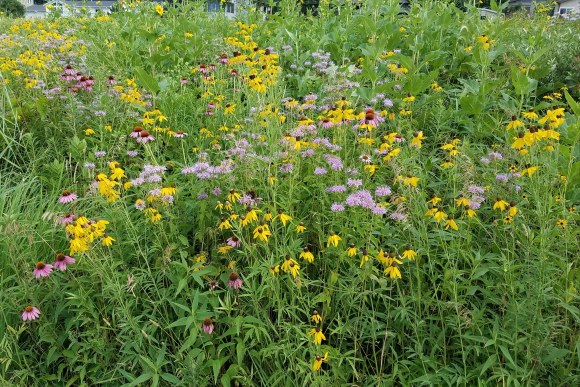
Prairie Restoration Area at Lake Macbride State Park
Each time I walk on the state park trail there are different wildflowers in bloom. Today’s offering was some of my favorites.
After returning from the day’s exercise, I mowed the front yard and couldn’t make out the line where the back yard started. Grass apparently wasn’t tall or thick enough to need cutting so I stopped and put the mower away until there would be enough to use as mulch.
I raked what few grass clippings there were for the garden, checked the moisture in the last few seedlings, and went inside to spend the rest of the day as temperatures climbed toward 90 degrees. We’re to have several days like this without rain.
We enjoy sunny days while we can. The restored prairie shows its pleasure in them with wildflowers in bloom.
On a fine summer day conditions were perfect to harvest hay and garlic.
My CSA friends recruited volunteers to bring in the garlic and across the county farmers were baling hay in large round and small rectangular bales.
On Independence Day farmers came to town to buy cultivators, salt blocks, pumps, feed, big pedestal fans, bedding (for horses), air compressor parts, nuts and bolts, and other stuff of life. At the home, farm and auto supply store we also sold a lot of propane, grills and kayaks, but that was not to farmers, as a farmer plans his/her kayaking and grilling ahead of time.
The rain has been good enough my garden doesn’t need much watering. Predatory insects are noticeably in abeyance, I suspect because of the polar vortex and extremely cold temperatures last winter. Tomatoes look as good as they have in years. It is already hard to use all the cucumbers. There will be green beans, okra, hot peppers, eggplant, squash, kale, carrots and more by the time August is finished.
We love summer.
Actually, we love life even in the extreme weather brought on by our own assault on nature. That we have perfect conditions for haying and garlic harvesting may well be an anomaly going forward. It was enjoyable this year and will be for however long it lasts.
I viewed the president’s speech on the environment on YouTube. It was not about climate change, human-made or other. In fact, the speeches by the president and about half a dozen others were devoid of any mention of the science of climate change, or solutions to solve the climate crisis.
I feel certain the bait shop owner from Florida has seen improvement in his local environment by the administration’s work on red algae. His speech was unprepared and somewhat random, but a slice of Americana available for public consumption and that, maybe, was the point. There was praise for the president from his staff, including the despised Andrew Wheeler, current head of the Environmental Protection Agency. If one adds up everything in the 56 -minute event, if we didn’t know the science of climate change, it would be believable. The climate crisis was absent from the environment Trump depicted and that is the problem with the Trump administration.
What bothered me the most, as it does any time I listen to the president, it’s the assertion that covers up a lie. Wheeler was bragging on how many super fund sites have been deleted from the list. Were they actually cleaned up or just declared clean and deleted?
I agree with Al Gore’s analysis:
Sometimes it’s hard to tell the origin of hot weather. Is it coming from Anthropogenic climate change, or from politicians in Washington, D.C.? Maybe a little of both.
The combination of advancing age and a world heated by human-made global warming has me looking for ways to cope.
When temperatures are forecast above 90 degrees Fahrenheit with high humidity I get my outside work done early then head into the house. I keep the thermostat at 83 degrees so as not to use too much electricity, but to take the edge off the hot, humid days. I manage to sustain my sanity.
I used to work outside in blistering weather until beginning to black out. It is a concession to age that I refrain from scheduling work to spite such conditions. Mother Nature always wins.
If the political failure to address global warming takes us all out, I can live with that. The extinction of humans would be fair if everyone goes together. Such fatalism serves no useful purpose if there is still a chance to slow greenhouse gas emissions and eliminate the use of fossil fuels that power our economy. What choice do we really have but to go on living? Part of that has to be political advocacy.
If we are individuals in the Anthropocene, we are doomed already. One has to wonder what Ayn Rand would have to say about the prospect of an end to humanity. One supposes as long as government doesn’t tax individuals and corporations she’d be okay with it. Although, she too signed up for Medicare and Social Security.
2019 has been a time of personal rebuilding. I made it across a career finish line and it took time for life to settle. I signed up for Medicare, then Social Security, and have begun to take better care of myself and effect repairs around the house. I spend a significant amount of time at home where reading, writing, gardening, yard work and cooking take a majority of my time. Something will be next.
I know what part of it is. The 2020 general election looms large in our efforts to engage the government in addressing the climate crisis. How to impact the election is complicated. In part I plan to band together with like-minded citizens and work for candidates, Democratic candidates for the most part. Everything from president down to township trustee requires positive change. There is more than politics.
It starts with taking care of ourselves but cannot end with the individual. That’s the outlook that brought us to today. What we know is government’s reduction of taxes and deregulation of business have played out in front of us. They fail to address the core issue: our survival in a turbulent world. What seems important is answering the question what role should government play in our lives? Finding a new answer is essential while living in the Anthropocene.
You must be logged in to post a comment.