Image of Earth 7-6-15 from DSCOVR (Deep Space Climate Observatory)
I noted the 50th anniversary of Earth Day with a letter to the editor.
“That’s it?” I asked myself this morning.
Next I reminded myself the essential environmental task between now and the general election is to remove as many Republicans as possible from office nationally, in Iowa, and locally.
When I attended Al Gore’s slideshow presentations and the Climate Reality Leadership Corps training I held certain assumptions about how government would work. What may have been isn’t or has been tossed out the window in the time of Donald Trump’s political leadership.
When I say we should “Act on Climate” it means getting involved in politics to elect people who will address the climate crisis. None of us can do much alone.
Our choices are few but to do the work of getting people to vote. Six months from the election Democrats can feel the wind at our backs. Nonetheless it will be a hard sail to shore and a foundation on which we can begin to face the challenges of the climate crisis more directly.
I helped organize my home town for the first Earth Day, April 22, 1970.
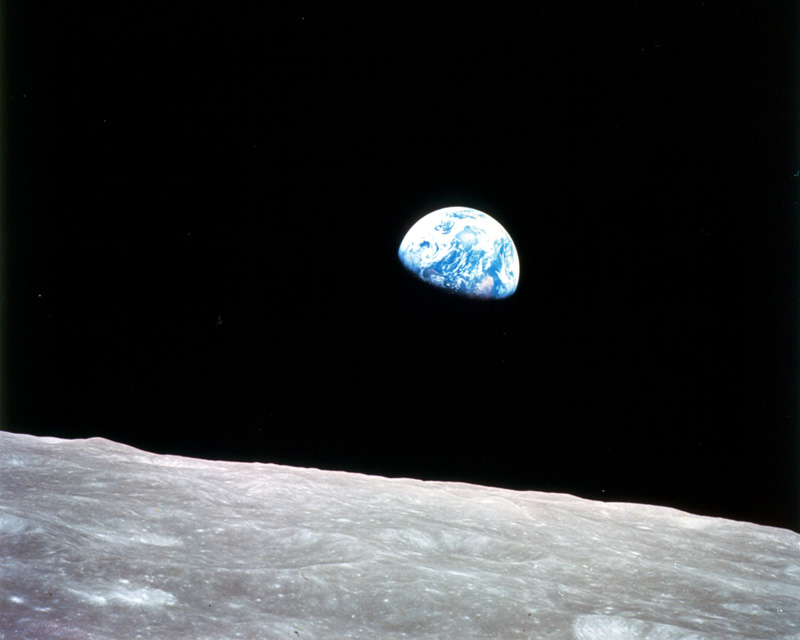
Apollo 8 astronaut William Anders’ Dec. 24, 1968 Earthrise photograph changed the way we look at our lives. We became aware of the fragility of human society spinning through the void of space.
As we complete the 50th year since then, society changed.
The Environmental Protection Agency was created in December 1970. The Republican president led an effort to protect our natural environment through legislation including The Clean Air Act (1970), The Clean Water Act (1972), The Endangered Species Act (1973), and more. These laws made positive things possible.
50 years later our government seems ready to throw all that in the ditch because it is too much of a burden for business. Powerful interests infiltrated our government. Corporations write environmental laws that protect their interests first, rather than the common good. A form of nationalism is rising which says, “Put America first.”
We live in a global society in which we are intimately connected, as Anders’ photo suggests. Large American companies manage a global supply chain and produce much of their revenue in other countries. We are connected as the current pandemic suggests: the coronavirus does not recognize national borders.
We must transcend nationalism and consider the best interests of everyone. We must lead in a way only the United States can. On the first Earth Day we thought that was possible.
I hope it still is.
~ Published in the Solon Economist on April 16, 2020.
State Senator Liz Mathis (L) and State Representative Molly Donahue at the Ely Public Library, Ely, Iowa. Feb. 29, 2020.
It should be no shocker that I attended a political event on Saturday. How could I miss it? It was six miles from our house.
State Senator Liz Mathis represents the 34th Senate District in the Iowa legislature. Alongside State Representative Molly Donahue, who represents House District 68, they hosted a legislative listening post at the Ely Public Library.
The closer one gets to Cedar Rapids, the more likely we are to encounter kolaches, a traditional semi-sweet roll originating in the Czech heritage of Iowa’s second largest city. Mathis pointed out the box of kolaches in the back of the meeting room soon after my arrival. About 16 people attended.
I was in graduate school in Iowa City when Mathis began her broadcast news career at KWWL at their then new Cedar Rapids bureau. She has been a broadcast anchor, television producer, college professor, and is currently an executive at the non-profit organization Four Oaks Family and Children Services. Donahue has been a teacher for 30 years with a current focus on secondary students in special education or those who have behavior disorders that can affect their learning. They were well qualified to discuss Iowa’s mental health system, school safety, the K-12 education budget, the school bus driver shortage, and related topics. I listened and tried to learn.
News on Friday was Pattison Sand Company of Clayton sought to extract 34 million gallons of water per year over a ten-year period from the Jordan Aquifer, according to Perry Beeman of Iowa Capitol Dispatch. The water would be shipped by rail to arid regions in the American west, potentially to New Mexico, Colorado, Wyoming, Nevada, Utah, Arizona or California. The Jordan Aquifer is also the source of municipal water for the city of Marion which lies within Mathis’ senate district.
Earlier this month Pattison proposed to extract 2 billion gallons per year from the Jordan Aquifer using wells they drilled to support their frack sand mining operation. This proposal was rejected by the Iowa Department of Natural Resources.
The problem with tapping the Jordan Aquifer is it is prehistoric water, in other words, it has been there a long time. The aquifer does not recharge at the same rate as the Silurian Aquifer which lies on top of it. Once the Jordan Aquifer is drained, the water will be gone and communities that currently rely upon it could be left without a reliable water source.
The climate crisis is evident in the American west. Demand for water exceeds the region’s capacity to produce it through rainfall, snow melt, and underground aquifers. Something’s got to give for people who settled there to survive. Mining and shipping water from Eastern Iowa is not a good idea because what may be abundant to meet our current needs will be diminished by the extraction proposed by Pattison and others. It is easy to see how a discussion over water rights could escalate into regional conflict over this basic human need.
If we look at history, humans have continued to exploit natural resources until they are gone, in many cases leading to the collapse of societies. Our brains are not wired to perceive the threat shipping billions of gallons of water from Iowa to the west could have. We have to pay attention, and the role of government is to look out for the common good.
It is hard to image an overall plan to resolve the climate crisis at its root causes. Further exploitation of natural resources doesn’t solve anything and could potentially make matters worse. At least we were discussing it and in doing so raising awareness on a sunny morning in Ely over kolaches.
The driver delivering pallets of yard and landscaping stone, peat moss, and dirt said his spring deliveries are running about two weeks behind last year.
We just finished our annual inventory at the home, farm and auto supply store and are ready for incoming freight of garden supplies, utility trailers, wheelbarrows, fertilizer, three-point farm equipment, and the like. I unloaded a pallet of 50-pound bags of seed potatoes. The greenhouse will be installed in the parking lot next week. Spring seemed late to our suppliers but it’s almost here.
It’s more like we didn’t have a winter.
In a retail warehouse we notice the seasonality of commerce. Shelves fill with mowers, trimmers, blowers, chain saws and tillers. We received two tall pallets of box fans. Large ceramic pots were shipped in crates from Mexico. We have a delightful collection of ceramic and metal rooster art. This entire post could be a repetition of inbound inventory processed during my two days per week part time job. I have something else in mind.
The intersection of commerce, private lives, spirituality and society is where we spend most of our lives. In time, if we are lucky and talented, we create a process of living that ensures our survival. In Eastern Iowa it is pretty straightforward how one secures food, shelter and clothing: seek training and then work as a skilled professional, an entrepreneur, or for someone else. There is no guarantee of success but most people in my circle make it, including those who are forced to live in their cars because they are poor, or who sleep on someone’s couch for a while due to physical abuse at home. We live a privileged life despite the real problems people have.
There is a sense our process of living, for lack of a better description, is built by us, for us, and there is separation from what others do. That’s okay. If we have more in common than we believe, the articulation of a life can be a conscious effort with variations in the use of materials from a mass society. We make something of our selves. Such a process may seem individualistic, bordering on taking care of “me only,” but it is intertwined with the fate of the society which provides context.
I may subscribe to the local newspaper, but so do a thousand other people, our subscriptions and advertising giving life to the enterprise. In a few brilliant moments I find my life has not been consciously nurtured, nor has it been self made. It has been a collaborative undertaking in a social network from which I emerged and in which I remain rooted… kind of like the newspaper.
I read an article about the high cost of prescription drugs. The Congress is working to lower the cost of such medicine, yet to date their work has been an utter failure. People are skipping medically necessary prescriptions because of the cost, Megan Leonhardt of CNBC reported. There is another side to this issue.
Over the years I’ve had several conversations with physicians, and now my nurse practitioner, about taking prescription medicine. Just like finding a good auto mechanic or a reliable technician to work on my yard tractor, it is part of a process for living. Every time a medical practitioner suggested a prescription — either to control cholesterol or prevent Type II diabetes — I pushed back.
I have been able to address each diagnosis through behavioral changes coupled with regular visits to the clinic. These physiological conditions may persist, and at some point I may have to accede to medication. Last year I took a small step and began taking a low-dose aspirin in addition to my daily vitamin B-12 tablet. We’ll see how things go during my follow up appointment later this year. My point is when we focus on the failure of our government to properly regulate the pharmaceutical industry we neglect focus on a process for living. Having a process for living is more important than what our government does or doesn’t do.
I feel life in society all around me. Maybe that is a Cartesian outlook, one rooted in my earliest memories of reading at home before breakfast, after being an altar boy for Catholic Mass at the convent. Despite whatever separation I feel in intellectual outlook our future is inseparable from its context. The fate of our society is complexly intertwined. To separate a single strand of it in the form of an individual life, from the broader organism, would be to our mutual detriment.
I don’t understand how we will manage the many challenges we face — environmental degradation, climate change, economic inequality, the threat of conflict, and diminished natural resources. I do know that without a process for living that recognizes the web of life that engendered us, that brought us to this moment, we may not be up to the challenge. Humanity’s well-being will predictably decline. I’m not ready to say it is inevitable. I don’t believe it is.
Yet so much depends on the observations of truck drivers who pay attention to the variability in our lives — and together try to make them better.
On certain days the weight of civilization is crushing.
Despite occasional good news, our steady decline into the abyss seems imminent.
Signs of it are everywhere.
Iowa is a manufactured place. The wilderness that once existed here is gone. It was the first thing to go after the Black Hawk War. A few stands of oak-hickory forest remain but not many. Instead we have endless miles of farm fields fenced neatly on the landscape. With the ancient forests so went our dreams.
It’s an ersatz life we created, lived in a wake of environmental destruction. We do the best we can. Row crop fields look dull, almost gray. It feels like we are in end times.
That’s not to say there is no hope of improving our lot. The political will to do so is in remission, gone like big groves of trees that used to live here. New trees could grow yet someone must plant them. It would take more time than is left in my life to restore what used to be. I wait. For what?
Snow lingers on the ground as I plan the gardening season. We have to eat and what we grow is better than what can be bought in retail outlets. The cycle of gardening and harvest inspires hope that our efforts will produce something. We keep at it.
All the while, the gray, predawn sky reminds us of a new day’s potential. Today comes down to what we will do to make the most of it, to get along with others, to be kind.
In 2018 NextEra Energy Resources announced plans to retire the Duane Arnold Energy Center (DAEC) — a 615-MW nuclear power plant located in Palo, Iowa — before the end of 2020.
NextEra’s main customer at DAEC, Alliant Energy, will buy out its contract in September for $110 million, sourcing electricity instead from NextEra’s wind generation fleet. The move is expected to save Alliant Energy customers $300 million over 21 years.
There are no plans to replace Duane Arnold with new nuclear generating capacity.
Two essential problems with nuclear power plants are they cost too much, and a lack answers to the question of what to do with spent nuclear fuel. These problems are political. In our current political climate that makes them unsolvable, practically speaking, even though potential solutions exist for both.
Certain environmental groups favor nuclear power to replace coal as an emissions reduction tactic. On its face this is belied by the urgency of the climate crisis.
“Nuclear, especially next-generation nuclear, has tremendous potential to be part of the solution to climate change,” climatologist James Hansen said on Dec. 3, 2015. “The dangers of fossil fuels are staring us in the face. So for us to say we won’t use all the tools (such as nuclear energy) to solve the problem is crazy.”
The challenge for nuclear energy is the timeline for market penetration in the industrial age. It will take too long.
Cesare Marchetti of the International Institute of Applied Systems Analysis did research which suggests the historical trend on implementation of new technologies such as wood, coal, oil and gas takes 40-50 years to go from one percent to 10 percent of market share. Nuclear energy occupies about 12 percent of current global market share. It will take almost a century for an energy source to occupy half the market. The world doesn’t have 50 years, and likely longer, to wait for nuclear energy sources to gain acceptance and growth the way coal, oil and gas have.
Even if political issues surrounding nuclear waste disposal could be resolved, the financial cost of building out a fleet of new nuclear power plants would likely follow the course of the Georgia Power Vogtle Plant expansion, which, when they broke ground, was the first nuclear power plant contemplated in 30 years. Despite proclamations of “making American nuclear cool again,” by then Energy Secretary Rick Perry, the Georgia Public Service Commission questions whether the plant will be economically viable if going on line is delayed much longer. New nuclear energy remains too expensive, especially when compared to renewables and natural gas.
Renewable energy (wind, solar, hydroelectric) is further along than nuclear in its evolution as an energy source. At 31 percent of global market share, we remain decades away from achieving 50 percent market penetration, according to Marchetti’s analysis. At the rate we are going, elimination of coal, oil and natural gas from the energy production mix for electricity won’t occur in my lifetime, and likely not the lives of the millennial cohort. By then all of this electricity talk may be rendered moot by the climate crisis.
There are no big-picture answers to the trouble of an over-heating planet in a 500-word blog post. What remains clear is our problems are driven more by politics than by technology and reason.
It is critical we root out influence and corruption in government. To do that it will take voters who care about our future and are willing to make the hard choices necessary to address the climate crisis.
In any case, from my vantage point, it seems unlikely nuclear power plants will be part of our energy future.
Republican U.S. presidents don’t like international climate agreements.
George W. Bush withdrew the United States from the Kyoto Protocol, a treaty we ratified, and yesterday Donald J. Trump notified the United Nations of our intent to withdraw from the global climate agreement signed in Paris when the mandatory one-year waiting period finishes the day after the 2020 general election.
The two Republicans said the agreements would hurt or restrict the U.S. economy.
If Democrats re-take the White House in 2020, there is a lesson to be learned from these agreements. A broader consensus is required for international agreements to be sustained over time. They can’t be subject to the vagaries of U.S. politics.
What then?
The answer is in engagement — in society, with friends and family, and with government. We can no longer survive alone in the context of these networks.
The sooner we realize it the more likely will we be to better implement solutions to the climate crisis. We can’t rely on government alone as its strengths wax and wane with political tides. We must use broader societal tides to our advantage, eroding recalcitrant shorelines when we can, and flowing back to the sea when we can’t.
From Act II, Scene 2 of Romeo and Juliet by William Shakespeare:
JULIET
O, swear not by the moon, th’ inconstant moon,
That monthly changes in her circle orb,
Lest that thy love prove likewise variable.
ROMEO
What shall I swear by?
JULIET
Do not swear at all.
Or, if thou wilt, swear by thy gracious self,
Which is the god of my idolatry,
And I’ll believe thee.
ROMEO
If my heart’s dear love—
JULIET
Well, do not swear. Although I joy in thee,
I have no joy of this contract tonight.
It is too rash, too unadvised, too sudden,
Too like the lightning, which doth cease to be
Ere one can say “It lightens.” Sweet, good night.
This bud of love, by summer’s ripening breath,
May prove a beauteous flower when next we meet.
Good night, good night! As sweet repose and rest
Come to thy heart as that within my breast.
So it is, and so it should be. Now back to figuring next steps as Republicans ditch the work leading to near consensus on how to mitigate the effects of climate change.
Greta Thunberg in Iowa City, Iowa Oct. 4, 2019. Photo Credit: Greta Thunberg Twitter feed.
Was yesterday’s gathering of a couple thousand people to support school strikers for climate action the equivalent of Evangelical Christian mega-churches?
Maybe.
Drawn to Iowa City by the arrival of 16 year-old Swedish environmental activist Greta Thunberg, people attended the event for a variety of reasons. Mostly they seemed interested in environmental action as well as in Thunberg and her celebrity. Such feelings fall at the intersection of an impulse to do something, political activism, and the real need to prevent human-caused climate change from getting worse.
By all accounts the event was positive, although I did not attend. I’ve been to mega-church revivals, one replete with Johnny Cash performing. It’s not who I am. Iowa City is the bastion of our state’s liberal elites, a group that includes many friends, but has proven ineffective in implementing the kinds of change needed to address our most significant shared environmental problems.
The presidential campaign of John Kerry, spouse of Teresa Heinz Kerry, scion of the Heinz ketchup family, gave rise to notions of liberal elites. Together the couple wrote a book titled This Moment on Earth: Today’s New Environmentalists and their Vision for the Future. While it was a New York Times bestseller, it did little to move the needle on climate action. It reinforced the idea that Kerry was of the East Coast liberal elite. Kerry’s campaign contributed to coalescence of a reactionary cult that eschewed all things liberal.
I don’t hear my liberal friends talking about this very much. In some ways, Kerry faded into the background in a male-dominated cultural environment that brought us Barack Obama, then Donald J. Trump.
R.F. Latta made a point on social media yesterday. “What liberals don’t understand about GOP reluctance to stand up to Trump is that conservatives fear the floodgates of culture change will burst open if they do and that will end of their way of life forever.” A similar sentiment is found in Lyz Lenz’ recent book God Land: A Story of Faith, Loss, and Renewal in Middle America in which she describes the male-dominated nature of white Evangelical churches. Rejection of Hillary Clinton as president was related to her female gender. Lenz wrote the 2016 election was an assertion of male power. Liberals must endeavor to understand the fears of conservative, evangelical Christians and others if we hope to avert the worst outcomes of the climate crisis.
Iowa City is home to Democrat Jean Lloyd-Jones, who along with Republican Maggie Tinsman, founded an organization called 50-50 in 2020, a “campaign school for women.” The organization has “a 10-year campaign with the goal of electing women to fill half the seats in the Iowa Legislature and half of Iowa’s Congressional delegation, and a woman Governor by 2020 – the 100th anniversary of women’s suffrage in this country.” The organization serves as an alternative to the churches of liberalism and conservatism. Jean and Maggie have kept the issue of moving women to a more prominent role in politics at the forefront of media attention. As Greta Thunberg’s visit to Iowa City fades into memory we need something similar for environmental issues.
We have some top drawer environmental activists in our area. I’m thinking of State Senators Rob Hogg and Joe Bolkcom, Mike Carberry, and members of the non-partisan 100 Grannies for a Livable Future. All of them would like nothing better than to bridge partisan divides to work on sustainable climate action. Without addressing conservative fears about liberalism, I don’t see how that can happen.
Yesterday’s climate strike was positive in many respects. The climate crisis will impact everyone so solutions must also include everyone. Otherwise, we could find ourselves kneeling at the altar of celebrity with nothing to show for it.
If August was a tough month, this summer has been one of the best in recent years.
Moderate local temperatures with reasonable relative humidity, rain enough to help the garden grow, and friends meeting the challenge of growing flowers and vegetables in a changing climate, all helped us feel comfortable.
July was notable for being the hottest month for the planet since record-keeping began, according to the U.S. government. Regional variation made Iowa tolerable, perhaps a harbinger of the impact of humans living on the planet continues its steady deterioration of our biome.
Despite favorable weather it was hard to get off the starting blocks in August on scores of projects needing attention.
It will soon be time to turn the page.
For the time being I’m eating cherry tomatoes and enjoying the last weeks of this glorious summer.
A main feature of the vacant lot we bought in 1993 was its proximity to Lake Macbride State Park.
When we need exercise, or just want to get away from the house, it’s a short walk to the trail that runs five miles from our nearby city to the main park entrance. In August the park is filled with wildflowers, insects and other flora and fauna of living in Iowa. There is as much to observe as there is to escape in quotidian life.
A trail walk can reset our lives each time we venture out.
Two weekends into my seventh season at an apple orchard I continue to enjoy the work and its customer engagement.
A family drove over from Chicago, one stopped on their way back to Rochester, Minn., and regulars return with the micro-seasons within a procession of a hundred apple varieties. Every chance we have to converse is a window into lives where with at least one common interest. It is the beginning of something positive.
A trail walk can get us centered and ready for such engagement.
You must be logged in to post a comment.