Categories
Writing

7 Things About 2016

Hats and Rags
Hats and Rags

It’s Christmas Eve in Big Grove, the ambient temperature is about freezing, and we’re ready to bunker in, finish decorating our Christmas tree and prepare a traditional supper of chili and cornbread.

My Christmas wish is for peace on earth.

Elusive as that may have been during 2016, we can’t give up hope. Not now. Not like this.

As winter solstice brought longer days — increasing light imperceptible in each day’s cycle — it is time again to fly with eagles, gain a broader perspective, and thank people who are always in these written words if rarely mentioned — my wife Jacque, our daughter, my parents and my maternal grandmother.

Reading

I continue to read more on my phone and computer than I do full-length books. Nonetheless I managed thirteen books in 2016, the most important of which were authored by people I know: Connie Mutel and Ari Berman.

Methland by Nick Reding had the biggest influence, by a distance.

Here’s the list of books, most recent first:

Diet for a Hot Planet: The Climate Crisis at the End of Your Fork and What You Can Do About It by Anna Lappé; My Life on the Road by Gloria Steinem; Sapiens: A Brief History of Humankind by Yuval Noah Haran; Methland: The Death and Life of an American Small Town by Nick Reding; Give Us the Ballot: The Modern Struggle for Voting Rights in America by Ari Berman; A Sugar Creek Chronicle: Observing Climate Change from a Midwestern Woodland by Cornelia F. Mutel; Atlantic: Great Sea Battles, Heroic Discoveries, Titanic Storms, and a Vast Ocean of a Million Stories by Simon Winchester;  And Then All Hell Broke Loose: Two Decades in the Middle East by Richard Engel; Slavery in the Upper Mississippi Valley, 1787-1865: A History of Human Bondage in Illinois, Iowa, Minnesota and Wisconsin by Christopher P. Lehman; The Diary of a Napoleonic Foot Soldier by Jakob Walter; Old Man River: The Mississippi River in North American History by Paul Schneider; MiniFARMING: Self-Sufficiency on 1/4 Acre by Brett L. Markham; and Fast Food Nation: The Dark Side of the All-American Meal by Eric Schlosser.

Writing

I wrote 175 posts on On Our Own during 2016. I also sought increased readership by posting letters and articles outside my blog. Previous years’ posts garnered the most views. The most popular new posts (in descending order) were: We Like Amy Nielsen, Iowa Democrats Convene, Supervisor Race Update, Flesh Wound, and Living in the United States. Among my favorites were Into the Vanishing Point, Rural Door Knocking, and Palm Oil is Bad for Iowa.

For the fourth year I edited Blog for Iowa while Trish Nelson took a break, writing at least one post each weekday during August. My book review of Give Us the Ballot ran in The Prairie Progressive, a guest column ran in the Cedar Rapids Gazette, and I wrote two letters to the editor of the Solon Economist since the general election. I cross posted Next for Iowa Democrats on Bleeding Heartland, my first post there.

More outside publication is planned for 2017.

Working

Income from five jobs helped financially sustain us in 2016. Work at the home, farm and auto supply store provided health insurance and a regular, predictably low paycheck. In descending order of income were jobs at Wilson’s Orchard, Local Harvest CSA, Blog for Iowa and Wild Woods Farm.

Each of these jobs was good for a reason. Blog for Iowa encouraged me to write every day. Farm work helped me connect with others in the local food movement. The home, farm and auto supply store provided a venue for conversations with low-wage workers. I’ll seek additional income in 2017 and maintain relationships with each of these organizations.

The common denominator among these jobs is interaction with people. As I enter my last year of work before “full retirement,” I seek that as much as income.

Gardening

2016 was another improved year in our home garden. Among many experiments were growing root vegetables in containers (a success with carrots and daikon radishes), growing squash in the unused storage plot, and using sections of 4-inch drainage tile to protect young seedlings. Failures included bell pepper plants which succumbed to weed competition, and loss of tomato yield due to a lack of attention. The best crops included broccoli, celery, eggplant, tomatoes, Bangkok peppers, turnips, basil, sage, oregano and kale.

Ancillary activities included distribution of kale and a few other vegetables to local library workers and friends, and weekly posts about the garden on Facebook.

We raised adequate produce to serve the needs of our kitchen. I also learned a lot through collaboration with friends and neighbors.

Apples

I followed the 2016 apple season at the orchard and continued to develop our home apple culture. Our apple trees did not produce a crop this year.

The last of the 2015 crop is peeled, sliced and frozen, or turned into applesauce and apple butter. We have enough frozen apples left for a Christmas Day dessert. This year’s orchard apples were mostly eaten fresh.

I made more apple cider vinegar. The process was simple: I added Jack’s heritage mother of vinegar to apple cider from the orchard in half-gallon ventilated jars and waited. This year I added an eighth-teaspoon of brewers yeast to each container at the beginning. The benefit was hastened alcohol production and a superior final product. I also learned that a cooler temperature slows alcohol production and this can produce a better result. Today there are two gallons of apple cider vinegar in the pantry and another gallon and a half in production.

Politics

The general election did not produce the result many people, including me, wanted.

At the same time, a lot of acquaintances seek to become active and “do something” during a Trump administration. There is plenty of work to resist the expected rollback of what we value in society. Specifically, work toward protecting the environment, reducing the number of nuclear weapons, and ensuring social justice.

My term as a township trustee ends Dec. 31, so regarding politics, I can be an unencumbered agent of change. The next step is to leverage the opportunity the general election brought with it.

Retirement

The time since my July 2009 retirement from CRST Logistics can be divided into clearly defined phases. First came a period of social activism characterized by work with community organizations. It lasted until the end of 2011. Next was the political year 2012. After that, life found me working low-wage jobs to support my writing. That’s where I am today. In 2016 came a realization that in order to spend more time writing, I have to get past the finish line to “full retirement” as defined by the Social Security Administration. For me that’s in December 2017. I took the first step by signing up for Medicare this month.

2016 was a time to learn, work on writing, and do things that matter. More than anything, I have been writing. Everything else provided a platform or material for it. If 2017 presents significant challenges, there should be plenty to write about.

Categories
Home Life Kitchen Garden

Cleaning House, Making Soup

Harvest Soup
Harvest Soup

Holiday tradition in our house includes cleaning and decorating beginning mid-December.

Dec. 18 is our wedding anniversary. This year we plan to celebrate 34 years of marriage with a meal at a local restaurant.

Our wedding anniversary is also when the Christmas tree goes up with decorating to be finished by Christmas Eve.

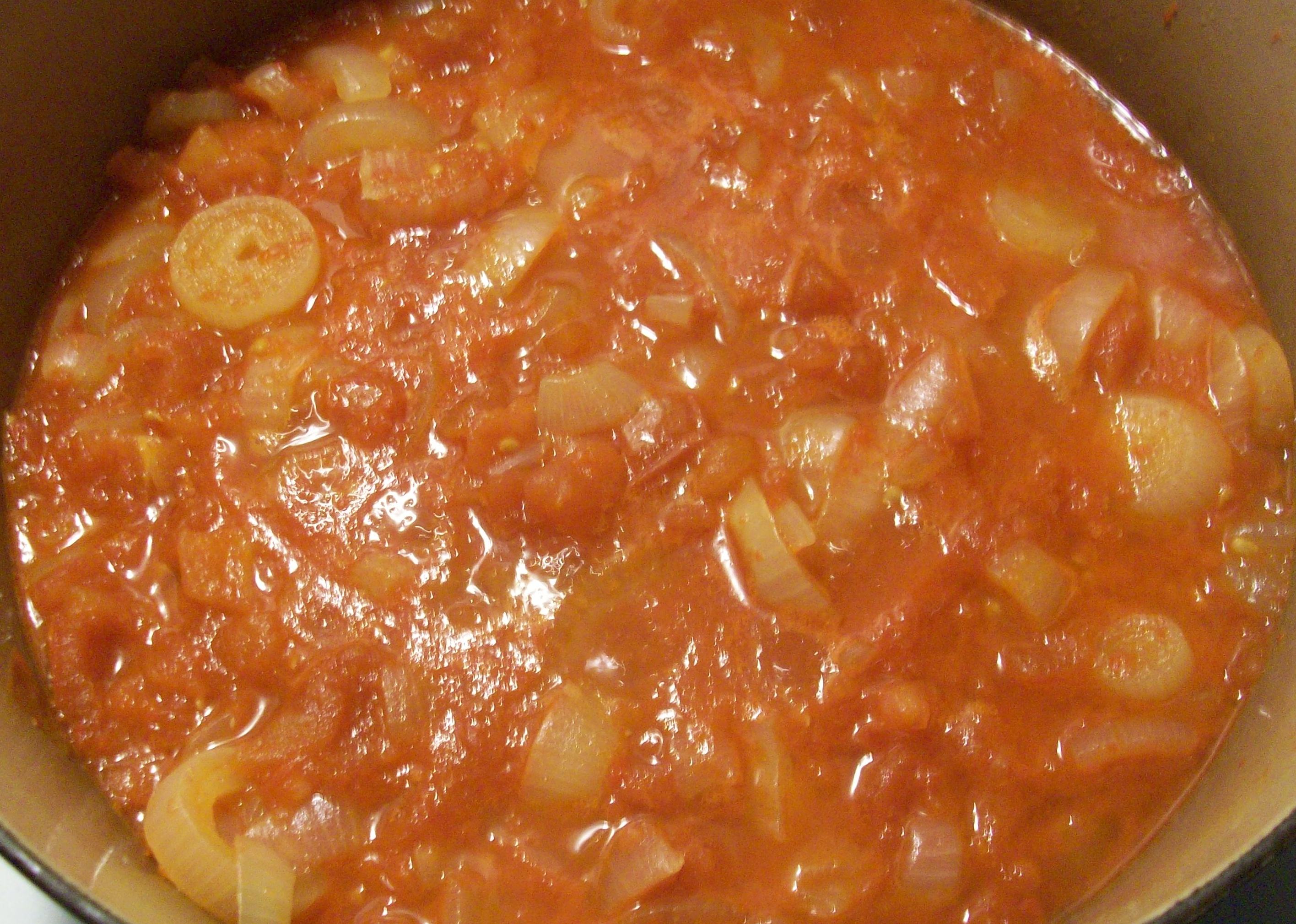
As we cleaned, I made soup using bits and pieces of leftover vegetables and pantry items. It was thick and savory — the way soup is supposed to taste.

The process for soup-making is simple.

Turn the heat to medium high and place a Dutch oven on the burner.

Drain the juice from a pint of canned, diced tomatoes into the Dutch oven and bring to a boil.

Add a generous amount of diced onions (2 cups or more), three or four peeled and sliced carrots, two stalks of sliced celery, and three bay leaves. Salt generously and steam-saute until the vegetables begin to soften.

Add the diced tomatoes.

Next steps depend upon what is on hand.

For this batch I put a quart of turnip broth from the pantry in the blender and added cooked Brussels sprout leaves, and fresh Swiss chard and kale, all from the ice box. I blended thoroughly and added the mixture to the Dutch oven.

Next was a can each of prepared black beans and whole corn from the grocery store.

I found an old box of marjoram in the spice rack and added what was left — about a tablespoon. They don’t sell marjoram loosely packed in boxes any more so it must have been 20 years old or more.

Peeled and diced three red potatoes from the counter and added them to the Dutch oven. I also added the thinly sliced the stalks of kale and Swiss chard.

From the pantry I took a cup of lentils, and a quarter cup each of quinoa and pearled barley and added them.

I submerged the vegetables in filtered water from the ice box.

The rest of the process was to bring to a boil, turn the heat down to a simmer, and cook until it is soup — adjusting seasonings until it tastes good, and making sure the vegetables are covered in liquid.

The effort produced enough for a meal with a gallon stored in the ice box in quart Mason jars. We’ll be eating on that until Christmas day.

Categories
Kitchen Garden

Thanksgiving Menu Planning

Vegetarian Thanksgiving 2013

“What do vegetarians have for Thanksgiving dinner?” a colleague at the home, farm and auto supply store asked this week.

The unspoken assertion was it is difficult to imagine Thanksgiving without turkey as the main course.

He noted, being positive, we could still have pumpkin pie for dessert.

We could, but won’t this year.

Our kitchen has been vegetarian since we married. A vegetarian kitchen doesn’t mean we both do without meat. I occasionally consume a meat dish while visiting with friends or at political events.

In 34 years we’ve never stopped at the butcher nor bought anything from the grocery store meat counter. Not even the popular rotisserie chicken has entered our doorway, nor the even more popular pepperoni pizza. By design we eschew meat products at home and haven’t suffered nutritionally.

That’s not to say I don’t know how to cook a chicken. During a stay at our daughter’s apartment in Colorado, I raided her ice box and cooked soup from a rotisserie chicken carcass and roasted chicken breasts with rice and a vegetable for a dinner as the sun set over Pike’s Peak.

My maternal grandmother worked as a cook both as a live-in maid and in the rectory of the Catholic Church where I was baptized. In her later years, she showed me how to bone a chicken. Without practice, it seems doubtful I could do it again without help.

What will Thanksgiving 2016 look like in Big Grove?

This year the CSA where I work offered a vegetable box for $30. That, along with items already around the house, will be the centerpiece for menu planning. Cost wise, that will be our only expense as everything else is on hand. This year’s estimate of the cost of Thanksgiving dinner is $49.87 for ten people, according to the American Farm Bureau Federation, so we will be eating well, but for much less.

If we use all of the menu ideas we came up with it will take us five hours to cook the meal and five hours to eat it. Like anyone with an abundant table, we’ll have plenty of leftovers.

The menu is not final, however, here’s what it looks like the day before the holiday:

Beverages: Wilson’s Orchard apple cider, Martinelli’s Sparkling Cider, Belgian beer, filtered water and coffee.

Appetizers: Baked pumpkin seeds, Crudites (cauliflower, broccoli, carrots), pickled vegetable plate (sweet and sour pickled cucumbers, pickled daikon radish, pickled red onions, pickled jalapeno peppers).

Salad course: Lettuce salad with fresh vegetables, purple cabbage coleslaw.

Bread: Sage-cheddar biscuits.

Main course: Frittata with organic eggs, braising greens, onions, garlic and thyme.

Side dishes: Steamed broccoli, rice pilaf with collard and Swiss chard, Roasted Brussels sprouts, Roasted vegetables (potatoes, carrots, onions, bell peppers), and Butternut squash  sweet potatoes.

Dessert: Apple crisp.

No matter how dark the night, there is plenty to be thankful for this year.

Let it begin with a Happy Thanksgiving.

After Action Report Nov. 26, 2016: The actual menu varied a little from the plan and I’ve annotated the changes by crossing off dishes not prepared and added those not listed in italics. I made the red cabbage coleslaw but forgot to serve it.

Categories
Home Life Kitchen Garden

Cooking Away Frustrations

Pumpkin Pancake Topped with Apple Butter and caramelized Apples
Pumpkin Pancake Topped with Apple Butter and Caramelized Apples

The weekend was a chance to get in the kitchen again.

When memories of a god-awful general election campaign persist, work is the best antidote.

I made a lot of dishes.

First up was a big pot of chili. Onion sorting has become a weekly thing and there was a whole tub of the same white onions to dice and cook in canned tomato juice for chili. I’ve written my chili recipe so many times I won’t repeat it here.

I halved and seeded a pie pumpkin and baked it in a 360 degree oven until fork tender. It made about four cups of pumpkin pulp, half of which I used to make pumpkin bread. The bread recipe was from The King Arthur Flour Bakers Companion cookbook except I omitted the nuts and chocolate chips. A slice of pumpkin bread went well with the chili for supper. There is a second loaf to take to the home, farm and auto supply store for the break room.

Roasted pumpkin seeds are crunchy and delicious especially while still warm. I separated seeds from the pumpkin guts and baked them with a little salt. It was hard not to eat them all.

After dropping my spouse at work, I went to the orchard to spend the $50 gift certificate received during our end of season party. I bought 19 pounds of Gold Rush apples, a long keeper and plenty delicious (apple joke). To make room for them in the ice box, I took the bowl of apples already there and peeled and sliced them for a simple caramelized apple dish. When it was done I put it in a plastic tub in the ice box.

Ice Box
Ice Box

Not to show off or anything, but here is what our ice box looked like when I returned from the orchard and put everything away.

The end of this spate of cooking came at breakfast Sunday morning when I made pumpkin pancakes topped with home made apple butter and the apple dish from Saturday warmed in the microwave oven. I made the batter in a bowl just used to bottle ground habañero and jalapeño peppers so the pancake had a kick.

Days of kitchen cooking seem rare as life accelerates toward year’s end. My advice is two things: grind your hot peppers in the garage, and when you feel blue, get to work. You’ll be glad you did both, especially the former.

Categories
Kitchen Garden

Season’s End

Kale
Kale

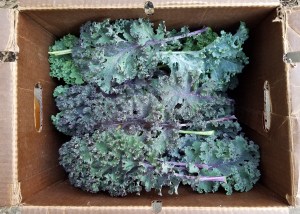
Yesterday’s harvest yielded kale, some cucumbers and hot peppers.

I sent another box of kale to the library for workers. It has been filled with kale countless times in recent years. It’s better quality than what’s available at grocery stores and they use it almost every day — good use for an abundant crop.

The aroma of Bangkok peppers in the dehydrator pervaded the kitchen air as I prepared a simple dinner of spaghetti with tomato sauce made of canned tomatoes, garlic, onion, basil, olive oil and oregano. I peeled and diced cucumbers to make a salad with Kalamata olives, feta cheese, olive oil and balsamic vinegar. There was fresh apple cider from the orchard.

I tasted the pickled red onions and decided to stop at two half-gallon jars. There are plenty to last until spring. Three crates of onions remain — more than enough for our small family.

The solace of kitchen work occupies hands and mind to help us forget what seems intolerable in society. At season’s end it is welcome relief.

Categories
Kitchen Garden

Vinegar Time

Apples
Apples

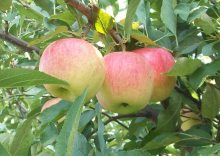
With the apple harvest comes an opportunity to make apple cider vinegar.

Since 2012, when I began to wake up to local food, I’ve posted about vinegar twice: Bottling Apple Cider Vinegar in 2013, and Making Vinegar in 2014.

Without a home apple crop, this year’s batch is a little different.

The continuum of vinegar making goes back a long time: it’s the mother. Mine was procured from a neighbor and has been present since I began home fermentation of apples. His mother of vinegar had been in the family since the 19th century when Iowa was first settled. Traces of vinegar have been found in Egyptian urns dated the third millennium BCE.

The recipe for vinegar is simple. Keep a container of vinegar with the mother in the pantry and add apple juice from time to time. Cover with a cotton cloth for ventilation and let it ferment. After the bacteria have converted sugars to alcohol, then alcohol to vinegar, it’s ready to bottle and use. Currently there is a gallon ready to use and a gallon just started this year. At least one jar never goes empty to preserve the mother.

My production is small compared to the orchard where I work on weekends. We both use the same mother, although he uses brewer’s yeast to hasten production of alcohol. My method, using apples from my back yard and no yeast, works as well but takes more time. Making vinegar is about time more than anything.

This year I stopped at a shop that caters to people who ferment their own beer and wine to ask about brewer’s yeast. The proprietor said I was the first customer to arrive asking about making vinegar. Not a lot of people make their own.

After studying a few things on the internet he recommended a yeast made by a major company that would produce about 14 percent alcohol. He said too much alcohol may kill the vinegar bacteria. Both of us thought the low end of alcohol production would not. The $0.99 packet I bought will ferment a lot of apple cider.

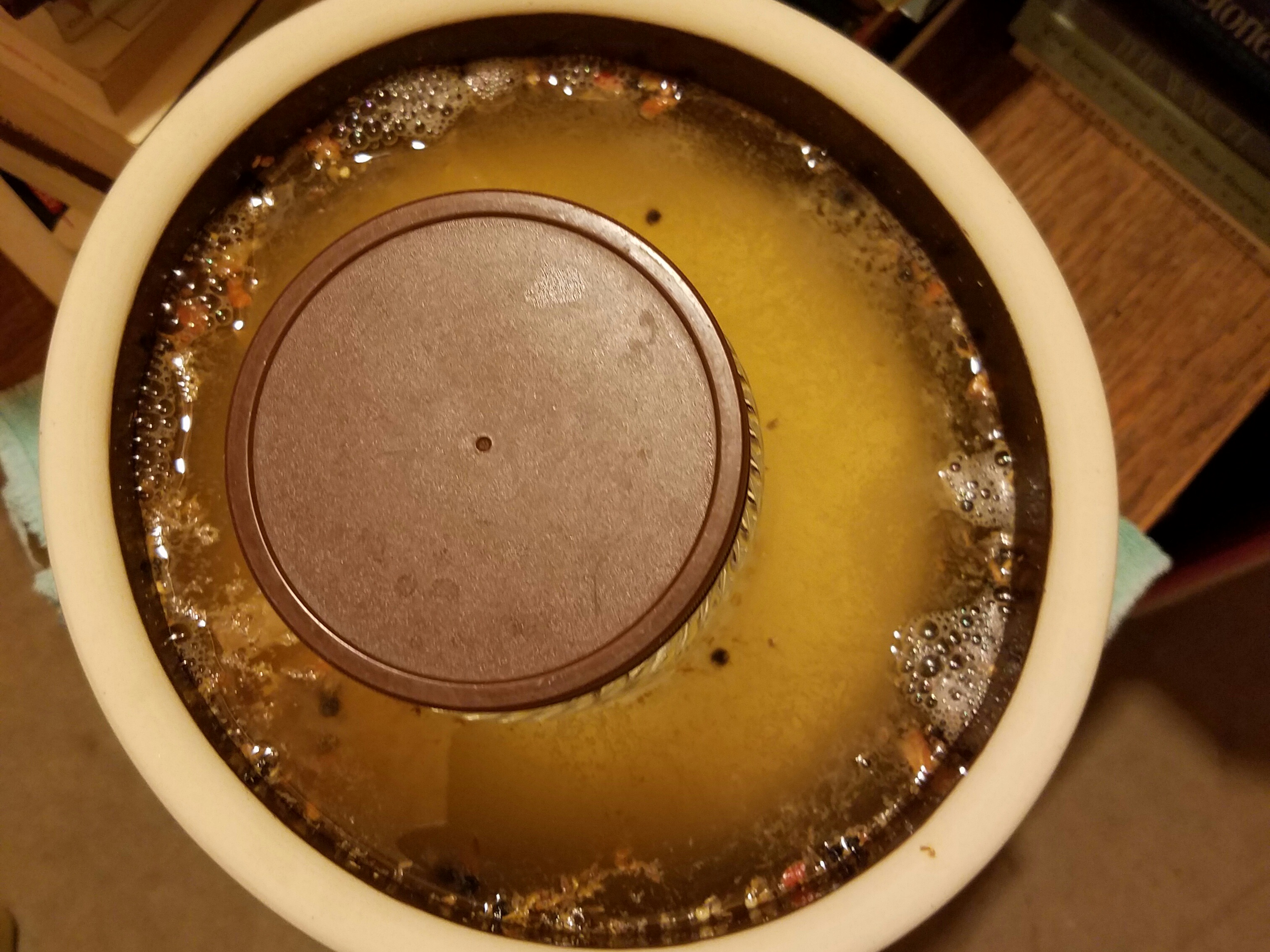
Without a crop at home, I’m using cider from where I work. It is flash pasteurized, which will allow my bacteria to drive the process. I hope it is a better result. I bought half-gallon Mason jars  for the project and have two started about 3 weeks apart.

I trimmed the mother with a pair of kitchen scissors and put part in the jar. I added a scant half gallon of cider and let it warm to room temperature. I added a 16th teaspoon of yeast which began producing alcohol within a couple of days. The liquid tastes more like hard cider today with hints of vinegar. The process appears to be working.

I organized and bottled last year’s production and am ready for winter. I’ll keep making it and making pickles and dressings with it.

Making apple cider vinegar is one way we emulate an agrarian life in a modern kitchen. It’s also how we sustain our lives in a turbulent world.

Categories
Home Life

Vacation – Hour 12

Soup Ingredients
Soup Ingredients

A political meet up, dinner using orchard-fresh apples, watching the presidential political debate on my phone, and five hours of sleep highlighted the first 12 of 96 hours of vacation this week.

I need to get more rest, but not now. Not today.

Awake and writing, soon to be picking detritus from the yard, I expect to spend most of the day outside. According to my weather widget, sunrise is three hours away with zero percent chance of precipitation until after sundown.

The beginning of soup is on the stove — three jars of tomato-y liquid from the ice box and a bag of onions. I’ll add vegetables and seasonings from the garden, ice box and pantry through the day, progressing toward a peasant’s meal tonight.

In the United States we aren’t peasants and homegrown vegetables owe fealty to no one. Raising vegetables is a revolt against those who would enslave us.

I paid my taxes so the land is ours… at least for now. Property rights are an American common denominator stronger than any political party. Having dispossessed those who lived here before, we are free until someone dispossesses us.

A long list of tasks resides on my phone. I left the device on the night stand while I bask in this window of freedom before sunup. Feeling the breeze from the lake, and for a brief moment, being myself against the wind — resisting for a while, then giving way to its cool waves in the predawn darkness.

Categories
Kitchen Garden

Red Bell Pepper Soup

Red Bell Pepper Soup

The abundance of tomatoes, bell peppers and onions is leading to a pot of soup featuring those ingredients.

There is no recipe — I used ingredients already in the ice box. I cut up a bag of onion seconds and sauteed them in extra virgin olive oil until translucent; poured in a quart and a half of diced tomatoes (drained); and added a scant pint of the pulp of red peppers cooked and separated with a food mill, also drained. I seasoned with salt and that’s it.

The mixture is simmering in my Dutch oven on medium heat. Once it is thoroughly cooked, I’ll take the stick blender to it and taste. After that, who knows?

The adventure is in the doing and learning. Because of the uniqueness of this season, the dish is hardly replicable.

Categories
Kitchen Garden

Poblanos, Onions and Pickles

Fermenting Dill Pickles

JOHNSON COUNTY, Iowa — In the margins of time between social engagements lives a local food movement available to all who seek it.

There is inadequate time in life’s span to become an enthusiast, however pursuit of local food culture is not only okay, it can be rewarded with meals that comfort more ways than imaginable.

While Jacque was in town with her sister, I made last night’s supper of seconds of poblano peppers and yellow onions from the farm, a couple of links of vegetarian sausage, and a variety of home made pickles.

After removing bad spots from the onions and peppers, I cut them into thin strips and piled them on the cutting board. I cut the sausages on the bias and browned them in a pan. Once finished, I removed them to a paper napkin sitting on a plate and began sauteing the onions and peppers in olive oil, seasoning with a bit of cilantro, granulated garlic, salt and pepper.

While the vegetables were cooking I arranged three kinds of pickles, sweet, dill and daikon radish in a bowl. Once the vegetable mix was finished I spooned it into the bowl beside the pickles and topped it with the cooked sausage. With a glass of iced water, it made a meal.

After dinner I went downstairs and checked the crock full of cucumbers. Fermentation bubbles had begun to appear after two days, indicating a successful pickling process. Patience is a key ingredient when making pickles. I hope I have enough of it on hand to make it 11 additional days when the dill pickles will be ready to eat.

Simple stir fries and pickles become a way of life when vegetables are available from the farm and garden in abundance. Cooking in the local food culture is an act of rebellion from a consumer culture that engendered us in the Western hemisphere. It represents taking control of our lives.

Do I always cook locally produced food at home? No. I pay attention to the seasonality of food and align with it as much as possible. I’ve found it makes for better ingredients and depending on the cook, for better eating.

There is more to the seasons of food than common affection for sweet corn and tomatoes. Learning more is a step toward living a better life and who doesn’t want to do that?

Categories
Environment

Can Hipsters Stomach The Truth About Avocados From Mexico

Avocado from Mexico

Can consumers buy avocados from Mexico at the grocery store, or in prepared guacamole with impunity?

Probably not.

Last week’s article “In Mexico, high avocado prices fueling deforestation” by Associated Press author Mark Stevenson explained why.

Americans’ love for avocados and rising prices for the highly exportable fruit are fueling the deforestation of central Mexico’s pine forests as farmers rapidly expand their orchards to feed demand.

Avocado trees flourish at about the same altitude and climate as the pine and fir forests in the mountains of Michoacan, the state that produces most of Mexico’s avocados. That has led farmers to wage a cat-and-mouse campaign to avoid authorities, thinning out the forests, planting young avocado trees under the forest canopy, and then gradually cutting back the forest as the trees grow to give them more sunlight.

“Even where they aren’t visibly cutting down forest, there are avocados growing underneath (the pine boughs), and sooner or later they’ll cut down the pines completely,” said Mario Tapia Vargas, a researcher at Mexico’s National Institute for Forestry, Farming and Fisheries Research.

Why does it matter?

Deforestation plays a key role in the release of greenhouse gases. Carbon stored in trees and other vegetation is released into the atmosphere as forests are converted to avocado plantations.

With the advance of climate change, securing adequate water to produce the fruit has increasingly been an issue in avocado growing regions. A video posted by the World Bank explained the problem and how farmers are coping. It’s pretty simple. In recent years there has been less rainfall in Michoacan, desiccating the soil. Farmers divert rainwater runoff to retention ponds for use during dry months. Avocados require twice the water of pine forests they replace, depriving downstream users of an essential resource.

If that’s not enough, these particular forests are part of the Monarch butterfly wintering grounds. Deforestation impedes the butterfly’s evolved life cycle.

You may have seen one of the web ads featuring celebrity chef Pati Jinich promoting avocado use for the trade association Avocados from Mexico. Here is an example:

(Editor’s Note: Sorry, the video was deleted from the Avocados from Mexico Website)

When encountering these ads, I found Jinich endearing and her tips helpful. That is, if I were a user of avocados, something she and the trade association is trying to change with the promotion. My experience with guacamole has been a tablespoon served on the side of Mexican food with other condiments, so not much.

One doesn’t always know what to do about stories like Stevenson’s. How extensive is the deforestation problem in avocado growing regions? How will downstream users react to deprivation of water from the mountains? How are workers treated on avocado plantations? Can we live without Monarch butterflies, and will another plot of forest gone really make the difference for this pressured species?

I don’t know, but here’s a relevant question raised by Joanna Blythman in The Guardian, “Can hipsters stomach the unpalatable truth about avocado toast?”

“When we pick up a fashionable import like avocado,” Blythman wrote, “we need to be sure that it not only benefits our personal health and well being, but also that of the communities that grow it.”

The issues around deforestation are well known. To the extent avocados add to the problem users should be driven to do something.

That may be as simple as asking the server to hold the guacamole.

~ Written for Blog for Iowa