Categories
Kitchen Garden

Summer Harvest – 2018

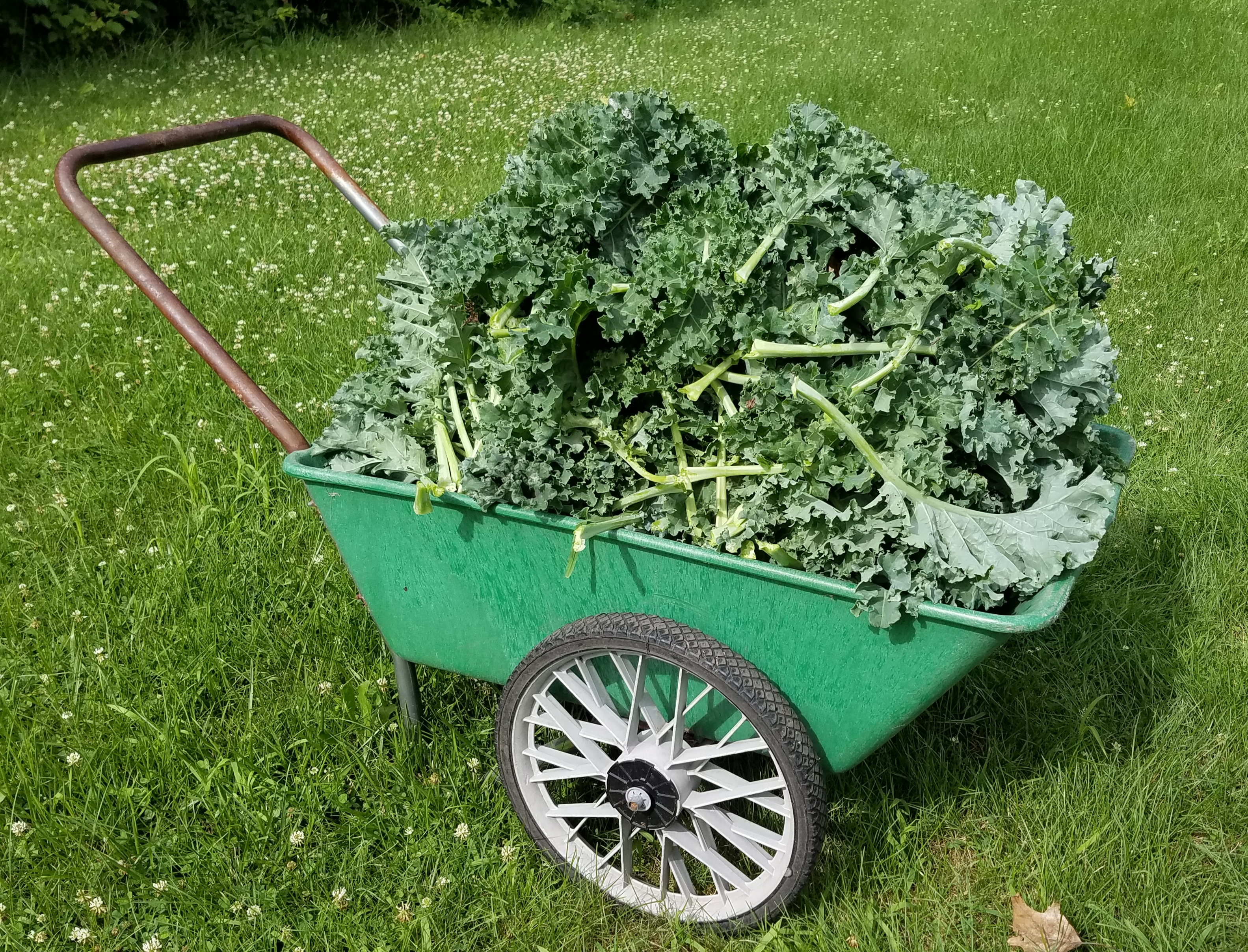
Cart of Kale

It has already been a good year for our garden. We’re just getting started.

Yesterday I picked first broccoli, along with cucumbers and cilantro. The ice box is jammed with garlic scapes, greens, beets, turnips, lettuce, sugar snap peas, celery, herbs and much more.

Yet to come are pears, eggplant, tomatoes, peppers, carrots, zucchini, and lots more. The challenge becomes figuring out what to do with the abundance through cooking, preserving and giving it away. It’s a nice challenge to face.

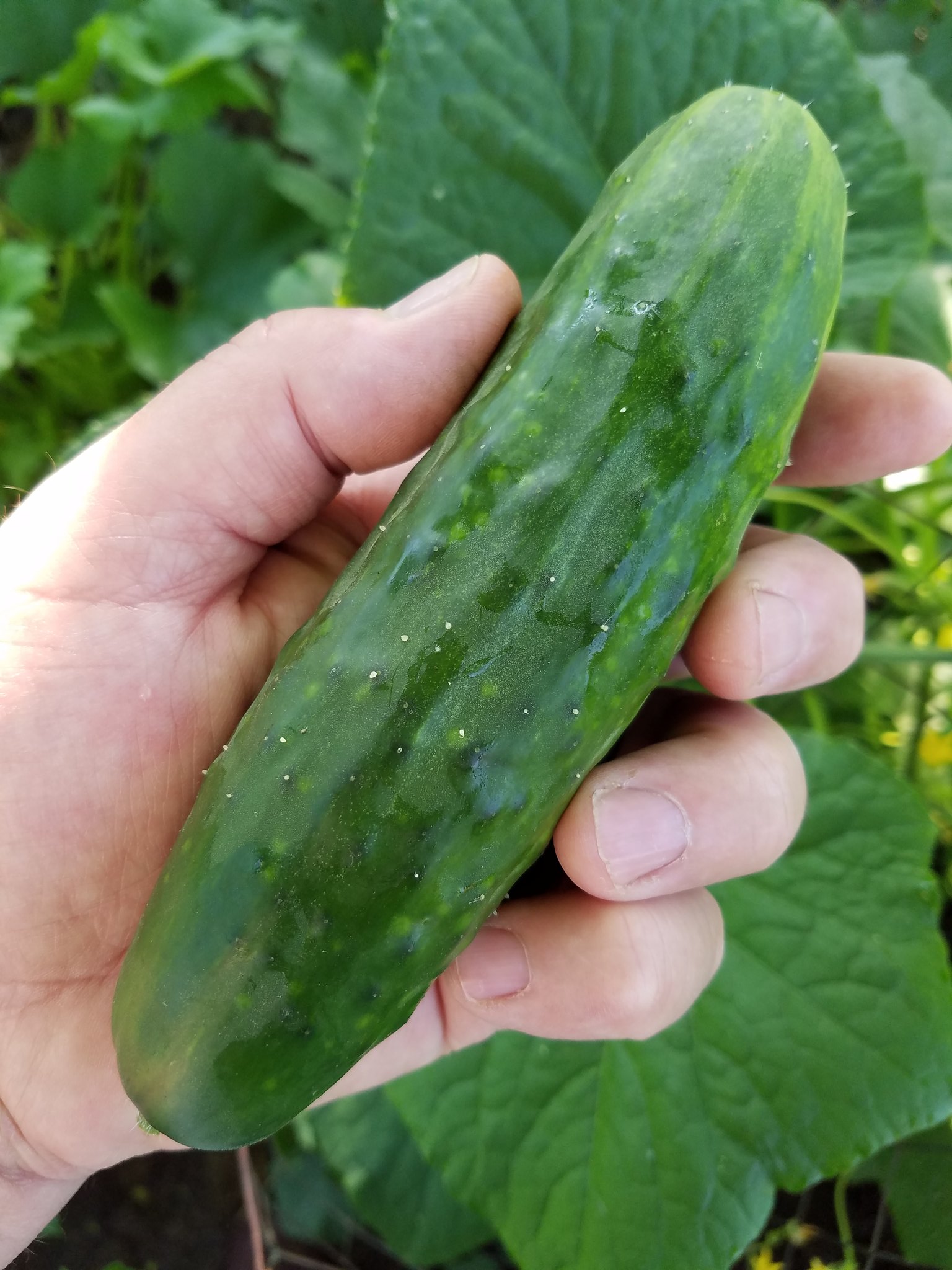
For dinner I made a simple salad with oddly shaped cucumbers from the garden. The recipe is easy: peel and chop cucumbers from the garden, four small ones; one cup Greek yogurt; two teaspoons finely chopped fresh dill; salt and pepper to taste. Combine ingredients in a mixing bowl and gently stir until fully incorporated. Refrigerate until dinner time. Served with a simple pasta dish, the flavor was excellent, the meal satisfying — perfect summer fare.

Our news is we found a plumber who fixed our ailing kitchen faucet. After 25 years of normal use the brass ring where the lever hooks to the valve had worn out and we couldn’t draw water. I examined the problem in the morning and determined since the pipes were soldered together, fixing it was beyond my skill level. I made three calls before getting a live person on the telephone. The plumber arrived within a couple of hours.

“As long as there is indoor plumbing there will be work for plumbers like me,” he said.

Once the repair was completed, we admired the new faucet… for more than a little while. It’s small things like running water in the kitchen that make our lives better. A brief interruption in service brought with it an appreciation of things we take for granted.

It rained overnight, vindicating my decision not to water the garden last night. Rain nourishes the landscape and can wash away our problems if we’ll let it. Knowing how to go with the flow of rainfall can be a source of constant joy.

Categories
Kitchen Garden Work Life Writing

Last Day of the Season 2018

Chicken at Sundog Farm

Beginning on Feb. 25, and 862 trays of soil blocks later, my 2018 farm work season ended today at Sundog Farm. I finished at Wild Woods Farm on Friday.

More than anything, farm work has been time with young people — doing the work and talking about crops, challenges, and everything else.

In my sixth year of soil blocking I kept up physically. I plan to do it again next year if able.

Now to take a break from farming until returning to Wilson’s Orchard for the fall season.

This will be the first summer in a long time we haven’t taken a share from the CSAs. Our garden is big enough to provide most vegetables and I’m confident of the yield. What we can’t get at home I’ll secure elsewhere. Getting enough to eat is never a problem when working in a local food system.

Next on the practical agenda is home repairs and cleaning. There is never a shortage of work for home owners.

It’s also an opportunity to resume writing. Each time I rejoin the project I lose track of everything else. Hours and days pass and like a coal miner I follow the seam wherever it goes. There is a lot more reading, thinking and organizing than writing at this point. I’ve forgotten more than I know about my own life and it can’t be re-lived, merely touched through a gauze woven of memory.

I began addressing the chronology. I’m not sure that will be the presentation. As I delve into the volumes of writing and artifacts collected since college a thematic approach seems better. It would be cultural aspects of growing up, education, work life, how we developed an ecology of living as a family, and my path toward social responsibility. It will also focus on what readers may find interesting.

Writing is exhilarating at a time when the rest of the world seems weary and worn down. What a great way to spend the rest of this summer.

Categories
Kitchen Garden Reviews

Summer Begins

First Marketmore Cucumber

A letter from our rural medical clinic reached me early this morning. I read every word it had to say.

I said, the letter reached me early this morning, I read every word it had to say.

Rural life ain’t nothing but the blues, how much longer can we live this way?

The physician I saw in April is moving his practice to Williamsburg — too far to drive for routine appointments. His replacement is an ARNP, which stands for advanced registered nurse practitioner. I read the definition but don’t understand what it means except we’re changing from two physicians to one… another nail in the coffin of rural health care.

We’re lucky to live close to the clinic’s hospital, and a large teaching hospital operates in the county seat. We won’t be deprived of care. I don’t look forward to changing physicians for the fourth time since leaving my transportation career.

I’ll try the new arrangement. What else is there to do?

This is the last weekend for soil blocking at the two CSA farms. After that, the farmers will make their own for the remaining fall share starts. I’m taking a break before returning to the orchard in August.

I finished reading The Shepherd’s Life: Modern Dispatches from an Ancient Landscape by James Rebanks before heading to the garden.

The shepherd went to Oxford, so it’s natural he would do something outside the normal range for a sheep herder. He’s been traveling and speaking to groups of farmers about his life in the Lake District of England. Last January in Ames, he spoke to members of Practical Farmers of Iowa at their annual convention. They made a YouTube of his speech. I haven’t viewed it yet.

What struck me about the book is the comparison with Iowa. Not necessarily what one might think.

On the one hand a well-settled place of William Wordsworth, Samuel Taylor Coleridge, Beatrix Potter and the Lake Poets. In front of us a landscape barely settled since the Black Hawk War of 1832. Any sense of ancient Iowa prairie is long gone and replaced with a grid of roads outlining row cropped fields and concentrated animal feeding operations. The long history of sheep herding in the Lake District served as a reminder most Iowa farmers are recent trespassers as agriculture and land use continue to evolve. There won’t always be soy and corn in what was once an ancient lake bed.

Rebanks informed my view of the annual cycle of sheep farmers. Now I know why some of my friends are so stressed during spring lambing. I’m sorry I missed the speech, and when spring farm work is done, I plan to spend the hour to watch it.

For the time being back to working on the garden to chase away these summertime blues.

Categories
Sustainability Writing

Patriotism

Still in Service

Patriotism does not belong to a political party. Veterans pay attention to where the country is going, engage in public discourse, and believe it is our responsibility to do so.

Patriotism, concerns itself with ethics, law, and devotion to the common good. As a young Army officer, I understood the meaning of patriotism in three words, “duty, honor, country.”

There is a new form of patriotism that is unacceptable: patriotism that proclaims “country first.” New patriotism concerns itself with moral responsibilities toward members of “our” group and by definition diminishes responsibilities toward non-members. New patriotism manifests itself in English only legislation, poor treatment of battlefield casualties, and blindness to the effects of war on foreign populations. New patriotism can accept extreme poverty, famine and the genocides in Darfur, Rwanda, Bosnia and Myanmar. New patriotism asks, “what’s in it for me?” without regard for the impacts on the rest of society.

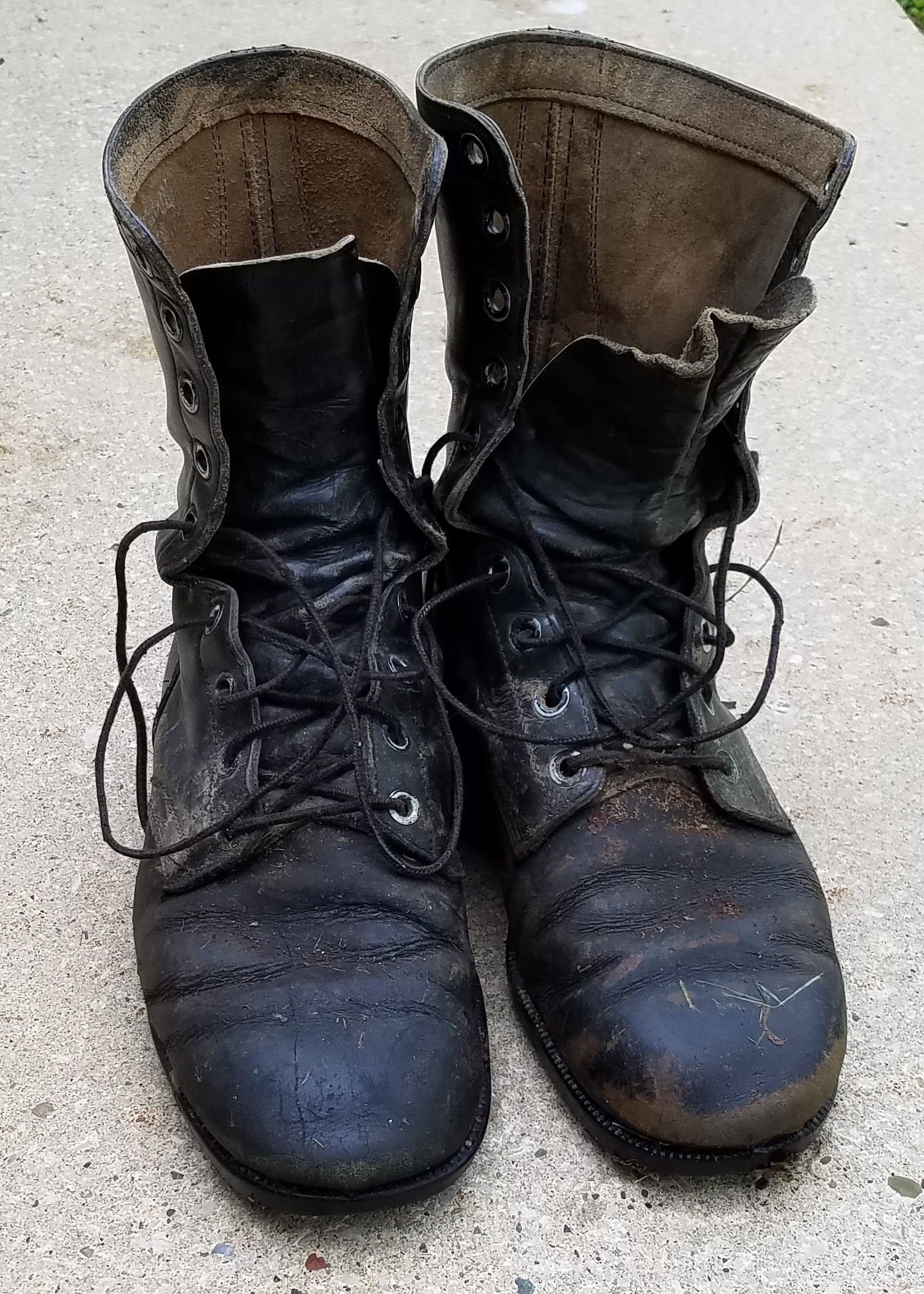
My uniform doesn’t fit, but I keep it in a trunk with my fatigues, compass and decorations. From time to time I get out my compass and am reassured that patriots will never lose their way in this complex and changing society. It is up to us to speak out and watch over the country, just as we did on diverse and distant borders long ago.

Our country needs us now as much as ever.

~ From a letter to the editor submitted to the Daily Iowan on Sept. 29, 2008.

Categories
Writing

Getting Started

On the Back Porch – Fillmore Street

I was born in a hospital established in 1869 by the Sisters of Mercy on Marquette Street in Davenport, Iowa. Marquette was one of the first streets laid out by city founder Antoine Le Claire.

I attended Kindergarten at Thomas Jefferson Elementary school at 1027 Marquette Street, and in 1959 our family purchased an American four-square home at 2025 Marquette Street, a block and a half from my birthplace on top of the hill, a block from the church where my parents wed and I was baptized and confirmed.

My parents married at Holy Family Catholic Church on Fillmore Street. According to Mother it was a quickly arranged ceremony with her brother serving as best man directly from work with butcher’s blood on his clothes. There were no photos of the newlyweds or wedding party.

The Sisters of Mercy and Le Claire provided an ever present background to life in my home town. I remember visiting the cemetery on River Drive where 1873 cholera victims were buried in a mass grave. Sisters of Mercy had tended the sick in a makeshift hospital at a downtown warehouse. That there was a “downtown” is attributable in part to the grid of streets Le Claire laid out in the old part of the city. Antoine Le Claire’s grave marker is prominent near the entrance to Mount Calvary Cemetery where many of my family members are buried.

Davenport was home until the death of my father in 1969 when I left to attend university in Fall 1970. I returned to Davenport for visits, for a couple of summers during college, after returning from an extended trip to Europe upon getting my B.A. in English, and after military service. Davenport was never again like it seemed during my early years. We don’t often have such brutal delineation in our lives as when Father died in an industrial accident. The times I considered returning permanently didn’t last.

Davenport and my life there defined who I am. It was not just the grid of streets where things were measured in blocks in the benevolent presence of nuns.

My earliest defining moment was the day, at age 3-1/2, when a swing-set set up in the basement of our Madison Street home collapsed and injured my head. My parents were horrified. I remember the pool of blood on the basement floor, holding the thumb of the ambulance driver on the ride to the hospital where I had been born, taking ether dripped into a funnel to anesthetize me for the stitches to mend my gashed head. I am lucky to be alive.

What I learned and came to believe through the injury and recovery in the hospital was that in a city there is an infrastructure of knowledge and caring to support us when things happen. I watched the routines of the hospital staff, the doctor checking up on me, changing room mates and bed linen, daily visits from my parents and the handling of my propensity to get out of bed and walk around. This experience assured me that although we are vulnerable, we are not alone.

Over the years, Doctor Kuhl would examine the scar on my forehead and talk about my recovery when I visited him in his office. Today, I don’t think of the scar, and suspect most people don’t even notice it. What I do think about is that while we are not alone, we must be part of a society that helps protect those who are most vulnerable.

When very young, I made a withdrawal from the bank of social responsibility and now the debt needs repaying. Who I became in life was partly attributable to my parents, however the influence of the Sisters of Mercy in a home town laid out by Antoine Le Claire is undeniable. It is also inescapable.

~ From a draft of a personal memoir about living in Iowa.

Categories
Kitchen Garden

Heat Advisory Blues

Rest Area in Polk County, Iowa

It seems like spring was never here.

Big Grove is under a heat advisory until 7 p.m. today. That means hot temperatures and high humidity creating a risk of heat-related illnesses. It barely cooled overnight so the day gets a head start on being oppressive.

There is a three hour gardening window before temperatures rise back into the 80s. As soon as the sun rises, I plan to harvest what’s ready and plant bell peppers and basil seedlings. There’s a lot of gardening and yard work to do. I’ll keep at it as long as I can.

The rest of today I’ll work inside — at my desk, in the kitchen, and folding laundry — getting ready for another busy week.

My shirt was drenched with sweat on the drive home from Des Moines yesterday. I made a pit stop at a state run rest area and bought a 20-ounce cherry Coke to drink on the way home. I can’t recall the last time I had one but couldn’t bear the thought of buying bottled water. Regretfully, I forgot my refillable water bottle at home.

I finished making and canning spring vegetable broth after arriving home. Seven new jars are on the shelf with three and a half more in the ice box, about three gallons. My target is to have two dozen quarts on hand, so another batch of seven will do it. There are plenty of turnip and beet greens plus kale for the broth.

We have a functioning air conditioner and will run it to cool down the house. It takes the edge off the heat and humidity and that’s positive. I learned the oppression of high heat and humidity during the drought of 2012. It felt like there was no escape. Today reminds me of that summer.

Light peeks around the curtain on the east side of my study. It’s time to get out in the garden for a while. And to contemplate what is next.

Categories
Living in Society

WYSIWYG – State Convention

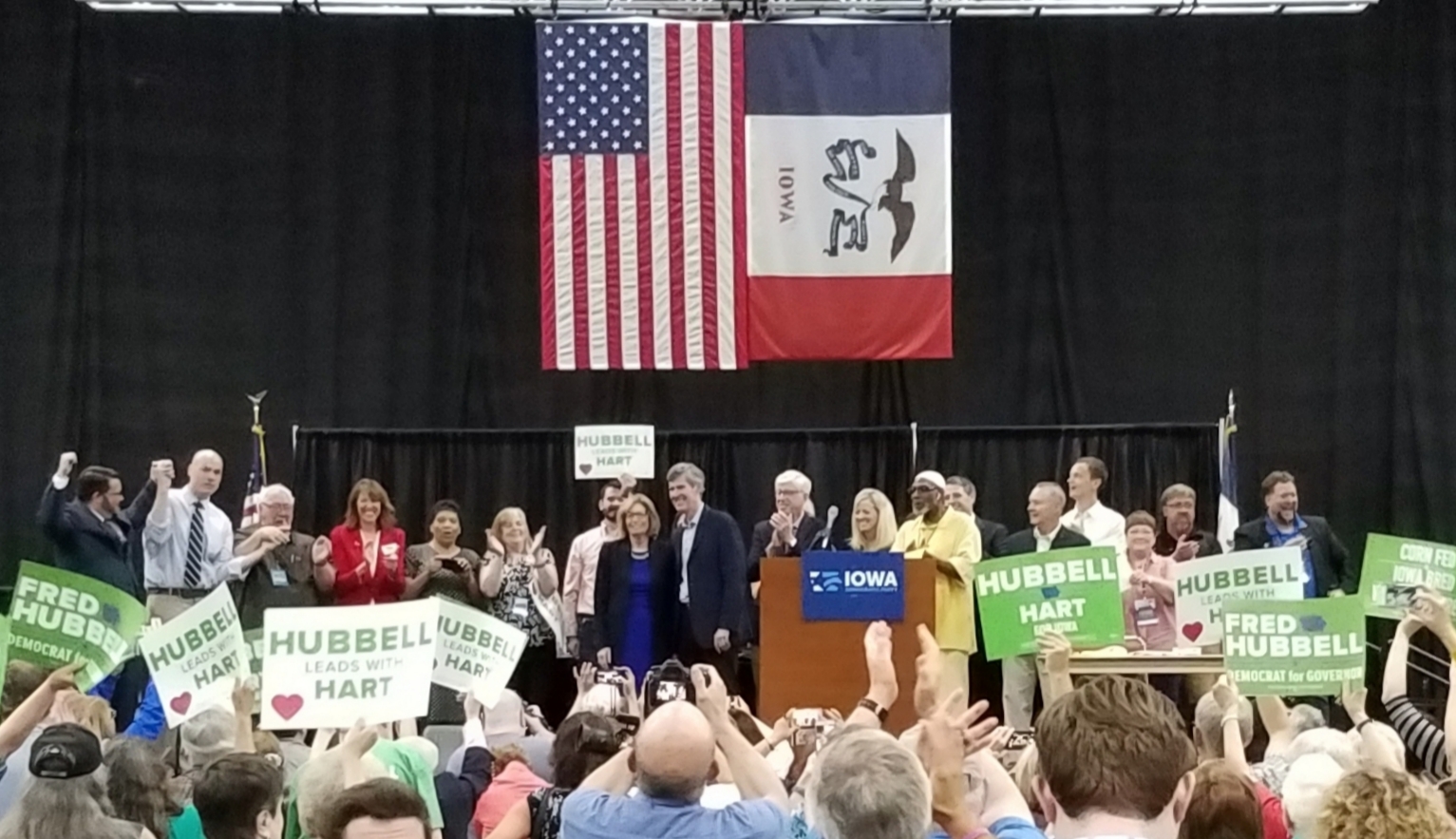
Slate Photo After the Speeches

I attended the Iowa Democratic Party state convention — unenthusiastically.

I went once before and remember leaving around 9 p.m. while delegates argued the platform. More the reason to stay home and work in the garden as platforms are virtually meaningless in a Democratically diverse state like Iowa.

I left home early enough to arrive in time for the veterans caucus and grab a cup of coffee at the Starbucks kiosk in HyVee Hall. I returned my credentials and vote clicker around 12:30 p.m. before “party business.”

What did I see? I’m not sure, but what you see is what you get. WYSIWYG.

The big, positive news — released before gavelling in — was gubernatorial candidate Fred Hubbell picked State Senator Rita Hart from Big Rock, Iowa as his running mate. I don’t know any Democrat who knows and doesn’t like Senator Hart. Conclusion? The nominating process was successful in picking a governor and lieutenant governor who are electable.

Party Chair Troy Price was energetic, enthusiastic and positive all rolled into one. Our delegates to the Democratic National Committee reported Iowa would likely remain the first caucus in the nation. In a new twist, Fourth Congressional District candidate J.D. “Standing Tall for All” Scholten read from a Bleeding Heartland post about how to win his district. Definitely some positives during the convention.

The convention ratified the slate of candidates and enabled them to tell delegates to knock on doors, make political phone calls, contribute money and a couple of other volunteer asks. To be honest, it got old hearing each speaker ask for the same thing. It made me wish I was out door knocking, at home writing a check, or in Johnson County walking in the pride parade with Congressman Dave Loebsack. Any of these would have been a better use of my time, and maybe was their subliminal message.

A couple things bothered me about the convention.

If memory serves, the official number of delegates seated was 781 (or was that 871?). Divide either by 594,198 active, registered Democrats as of June 1 and one can see this sliver of the party is not representative of the electorate that will choose a governor in November. We learned little about the electorate in this elite, inner-circle gathering. Maybe that’s not the point of a state convention. More likely I’m just not used to or don’t like breathing this kind of rarified air.

What matters more is transforming the party from primary to general election mode. The transmission gears ground a bit as the shift was made. The notable holdout is Cathy Glasson who has not endorsed the party’s nominee for governor. As a former candidate she owes the winner this much. Her campaign manager, Misty Rebik tweeted, “we are just getting started,” although that must be an inside joke as I’m not sure what it means. It is time to endorse and move on.

It is too early to be talking about a “blue wave.” See me after the general election. The convention served as a mile marker on the way to Nov. 6. Democrats dislike the Trump administration and the Republican Party of Iowa, but we’ll need many voters who are not Democrats to win in November. Scholten was one of a couple who mentioned this and he was reading from a blogger’s post. It served little purpose telling this group about waves of blue. They are already pumped up and well know there is plenty of work to do before a celebration.

Overall, the four and a half hours of the convention I saw was a good day for the state party. IDP needed that after the drubbing they took in 2016 under chair Andy McGuire.

There were mostly positives this morning. Now on to November!

Categories
Sustainability

My Lai 50 Years Later

Coralville Public Library, June 15, 2018

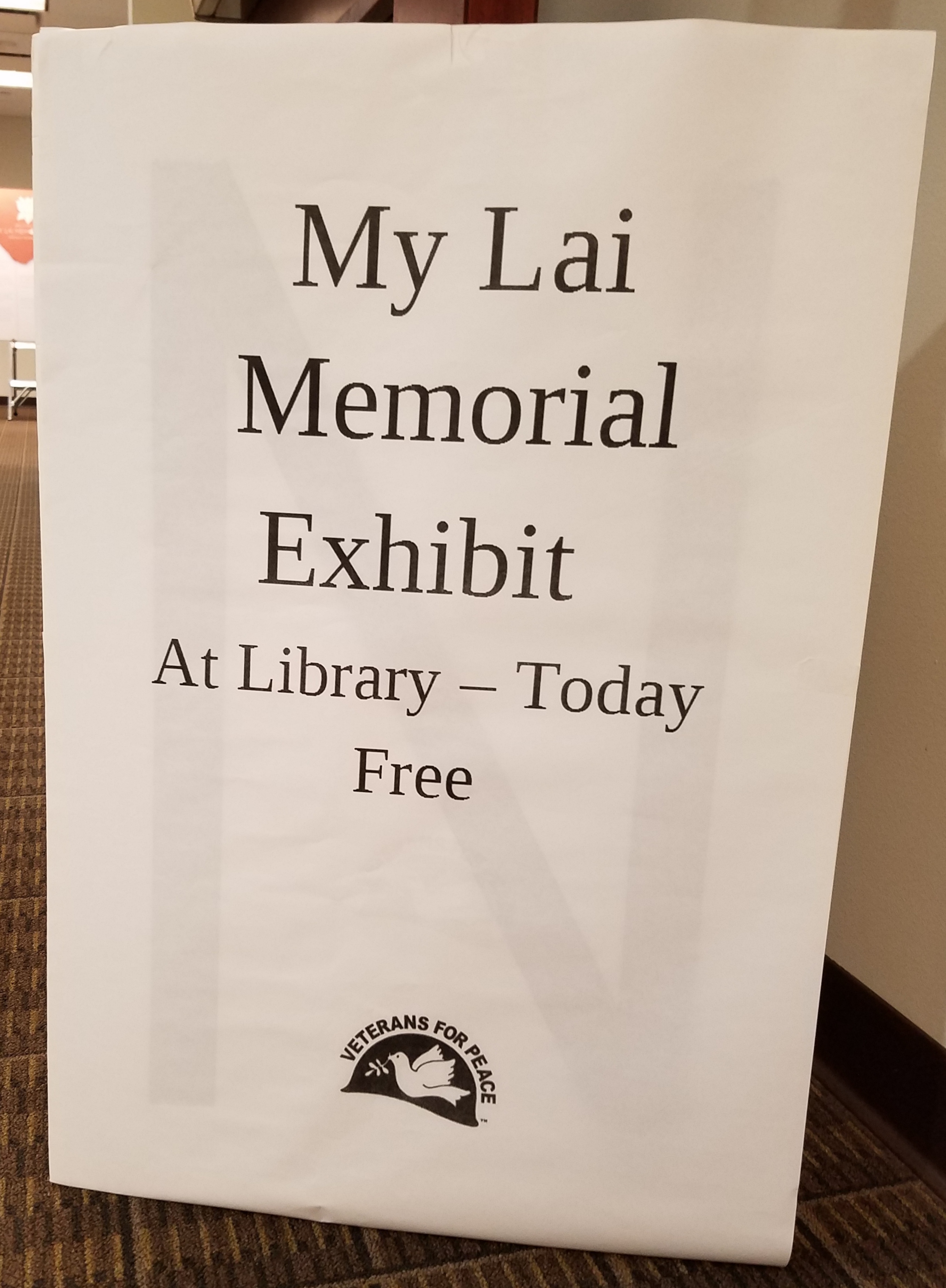
After a shift at the farm I drove to the Coralville Public Library to see the exhibit about the My Lai massacre on March 16, 1968.

Created by Mac MacDevitt, and sponsored by the Chicago chapter of Veterans for Peace, the exhibit consisted of a couple dozen tall panels with text, photographs and analysis related what happened over several hours during the Vietnam War.

My Lai, and Nixon’s pardon of William Calley, led to my personal participation in the anti-war movement while I was in high school and college, and then to my enlistment in the U.S. Army in October 1975.

Like any reasonable person I found the military action which killed men, women and children to be morally reprehensible and believed as a society we could do better than the soldiers of Charlie Company. My response was to make changes in the military through my participation.

Calley was the only person convicted of murder during the operation, although it is clear other crimes were committed. Nixon’s pardon reinforced what was commonly believed among service members — that Calley was “just following orders.” While I was in officer training school at Fort Benning, Georgia we debated the efficacy of Charlie Company’s actions that day. My peers sided with Calley.

“Progress, far from consisting in change, depends on retentiveness,” wrote Italian philosopher George Santayana.  “When change is absolute there remains no being to improve and no direction is set for possible improvement: and when experience is not retained, as among savages, infancy is perpetual. Those who cannot remember the past are condemned to repeat it.”

As I stood in my dirt covered jeans, T-shirt and farm shoes looking at the pastel panels I remembered My Lai. Society hasn’t forgotten about My Lai, its context in the Vietnam War, and the cover up afterward. The next generations never learned about it.

One role for veterans is to help us remember what happens in war. My Lai was the military at its worst. We can and should be better than that.

Categories
Living in Society

WYSIWYG – Primary Election

Rural Polling Place

A lot of pixel dust has been spilled about the meaning of the June 5 Iowa Democratic primary.

Read three people I follow Laura Belin, Pat Rynard and John Deeth for a perspective different from conventional news outlets. My take is simple. We are beginning to see aspects of the electorate that will shape the general election.

WYSIWYG — What you see is what you get.

What are we seeing? Here is a brief list from my perch in Senate District 37.

The minority of Democrats who participate in primaries played nice with each other most of the time. Keep that up and we’ll win in November. Many general election voters like it when people in the party play nice.

Democratic turnout was way more than expected, 176,700 votes. This is evidence what we heard at the caucus was not wrong, “we have to do something in November.” Not only did people say it, four months later they put their vote where their mouth is, beating the Democratic primary turnout in 2006 by about 20 percent.

Once the demographic information is available we’ll be able to do more numbers crunching. There really isn’t that much of a need. Results already tell the story. More voters participated in the process than in any previous Democratic primary election. What drove that? Three things: reactions the 87th Iowa General Assembly and a new president, combined with a highly qualified roster of Democratic gubernatorial candidates. To participate voters need something positive to attract them. Having good candidates shows what Democrats stand for. We had that in the primary, and I believe have that for the general election now that we know the results.

Fred Hubbell is our nominee for governor. He won a remarkable 55.5 percent (98,125 votes) of votes cast in a five-way race. It’s up to him to lead, and I believe he will. It’s up to the rest of Iowa Democratic activists to support, defend and vote for him if we want change in Iowa. There is no time for the bitter tears of losing a campaign. By this weekend’s state convention the mourning period is over. General election voters are likely to see Hubbell as qualified to be governor and that will encourage participation.

Events like the Democratic primary are an interface with the general election electorate as it is being created, long before most voters engage in general election campaigns. What you see is what you get and what I’m seeing is an electorate well on its way to being fully activated. I don’t understand the dynamics that produced the results of the June 5 primary, just like I don’t write on the internet using html code. I don’t need to. WYSIWYG.

When people participate in elections the results favor Democrats and that appears to be where we are heading.

Categories
Kitchen Garden

Farfalle with Arugula and Sugar Snap Peas

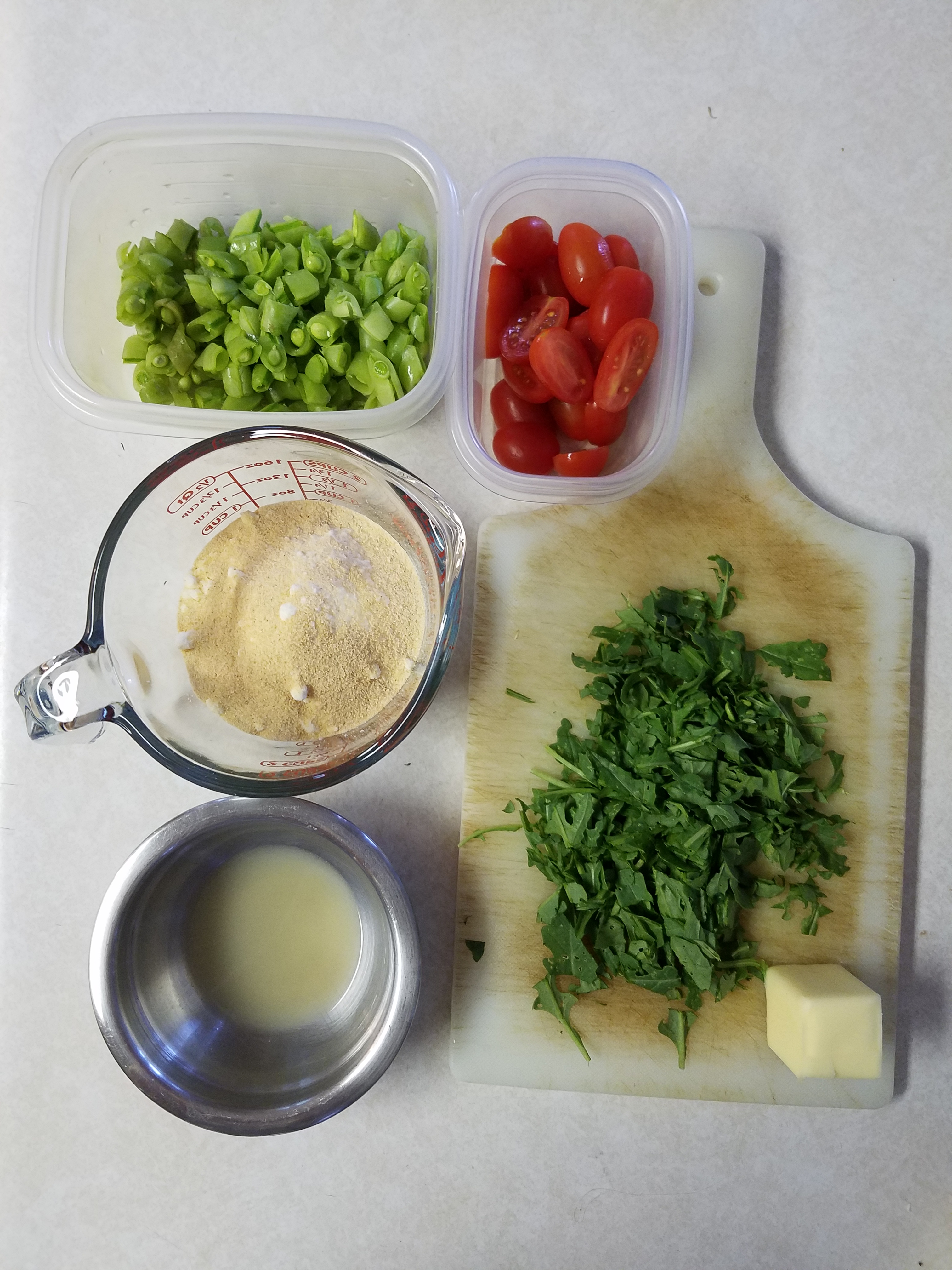
Dinner Ingredients

There is little point in growing a garden if one doesn’t use the produce.

Yesterday I made the first pick of arugula and sugar snap peas for a classic dish with farfalle.

Preparation is done while the pasta is cooking and the result makes the effort worth it.

Put six ounces of dry farfalle pasta on the boil for 12 minutes or until al dente.

While the pasta is cooking clean the sugar snap peas, removing the vein, and slice thinly. Next, roughly chop the arugula. Set both aside.

Cut ten grape tomatoes in half and set them aside. We get grape tomatoes from the warehouse club, although the first flowers are appearing on the tomato plants in the garden. It won’t be long before we have home grown cherry and grape tomatoes.

Remaining ingredients include a scant quarter cup of lemon juice, one cup Parmesan cheese, a generous tablespoon of granulated garlic, and 2 knobs of butter.

Cut the butter into small bits and place in a large bowl. Dump in the drained pasta and gently mix to melt the butter. Next add the lemon juice, peas and arugula and mix until incorporated. Finally, add the tomatoes, cheese and garlic mixture and mix together until the cheese coats all of the pasta. Salt and pepper to taste and serve. Makes 2-3 servings.

Seasonal side dishes include a lettuce salad with kohlrabi, spinach and kale or steamed asparagus.

I must be the worst food writer in the world as I neglected to take a photo of the finished dish. Suffice it to say it tasted like spring.