Categories
Living in Society

Chasing Presidential Candidates

Detail from the Internet Headline of the Monmouth University Poll, April 11, 2019

Our county-wide newspaper reported more than 900 people turned out to see and hear U.S. Senator Kamala Harris (D-CA) speak at the Iowa Memorial Union in Iowa City Wednesday night. Harris is running for president.

She is one of roughly two dozen presidential hopefuls courting Democrats in the run up to the 2020 Iowa precinct caucuses, which are first in the nation among presidential preference polling. In Iowa we don’t call it voting because we don’t want New Hampshire, which has a law requiring them to hold the first in the nation primary election, to get mad. According to the Des Moines Register, there have been about 300 candidate events like Harris’ this election cycle.

Vice President Mike Pence is scheduled to be in the Hawkeye State today, visiting the emblematic disaster wrought by government policy in the form of extreme weather and severe flooding made worse by global warming. Pence and his boss are also running for president and today’s disaster walk also serves as a campaign stop, that’s how base our politics has become.

I’m more interested in Democrats.

Iowa has not dealt with political hugster in chief, Joe Biden, who leads Democrats in the recent Monmouth University poll of 350 prospective caucus-goers.

I don’t see the support for Biden. While his 27 percent puts him in front of this murder of crows, it may be a ceiling, subject to being overtaken as the field consolidates. I also don’t believe my cohort wants someone our age as president. That polling calls were split 50-50, landline – mobile, favors a certain kind of sixty- or seventy-something. The kind that likes what is familiar whether Biden or Sanders. But what do I know? I didn’t ask 350 people and am limited by Dunbar’s Number. If curious about the horse race or this poll, click the image above.

Local elected officials seem to be chasing the presidential candidate selfie with gusto. A few electeds have declared for a single candidate, most have not. The sensible plan is to wait until another 300 candidate visits to Iowa have passed and decide by end of summer. Declaring too early can prove to be problematic, especially if the chosen one drops out early. If Iowa is to remain first in the nation, multiple candidate selfies make things seem welcoming and unbiased during the early days of the campaign.

I don’t feel a need to chase candidates to meet with or hear them in person. I understand how video services on the internet work and for the most part, adequate candidate video becomes available after key events. My personal interaction with candidates is important to personal story-telling. I’d like one or two more encounters to add to my repertory of hearing Julián Castro speak bathed in the light of mobile phones during a power outage (click here for my post on the Castro visit). Deciding by Labor Day allows plenty of time to work in my precinct for a chosen candidate. My current post about the Iowa caucuses can be found here.

All this candidate chasing is fine, but the main prize in 2020 will be the U.S. Senate seat currently held by our junior senator, Joni Ernst. According to news reports, she has $2.8 million campaign cash on hand for the election. Democrats haven’t picked a candidate to challenge Ernst and aren’t expected to finalize a decision until after the 2020 summer primary. We’re starting the race with shackles binding our ankles, but that doesn’t mean we can’t pull an upset. Regaining control of the U.S. Senate is essential to hopes of implementing a Democratic agenda in the federal government under a Democratic president.

When I look at the 24 candidates identified in the Monmouth University poll there are only a few about which I’m interested in hearing more. In no particular order, they are Castro, Elizabeth Warren, Pete Buttigieg, Amy Klobuchar and Jay Inslee. The ten with less than one percent support in the poll should read the writing on the wall and gracefully make their way to the exits. As for me, I’ll be seeking opportunities to post about the campaign as I attend more events, midst a life of staying active in society. Staying active is about a lot more than politics.
Categories
Work Life

Long Goodbye to Workforce

Embers

By July 3, the tenth anniversary of my departure from the logistics company, I hope to have my exit from the workforce defined.

I continue to work for pay and barter and am concerned with a loss of income those five jobs currently provide, although, not that much.

I’m ready to focus on work closer to home which pays in ways other then monetarily. Our needs have changed and so have I.

The reason our household is in this position is Social Security and Medicare. At 50 years into the workforce I continue to contribute to both, and the benefits provide a livable financial structure. The fact we’ve been responsible citizens helps as well.

It is time to move on.

That said, I enjoy my five jobs and the people I meet. The home, farm and auto supply store provides insight into low wage workers and the challenges of retail. The two farms where I soil block are quite different if my work is the same in both. I enjoy the farmers, workers and volunteers in each setting for different reasons. Work at the apple orchard has changed since my friend Jack first referred me there. The operation has gotten bigger, the number of revenue streams expanded. I’ve learned a lot about apple culture and the work appears to have run its course for me. My summer coverage of Blog for Iowa has been a time where I am required to put a post up five days a week. It has always provided a chance to think more about contemporary affairs and what it means to be a progressive Democrat.

The long goodbye from all of these jobs is already in process.

What will I do besides slow down my work outside home? That’s an open question, the answer to which depends on continued good health. For now, I am mentally active and undamaged by life’s stresses. Another human working to sustain a life in a turbulent world.

Categories
Kitchen Garden

Burn Pile

Burn Pile
First Spring Burn Pile

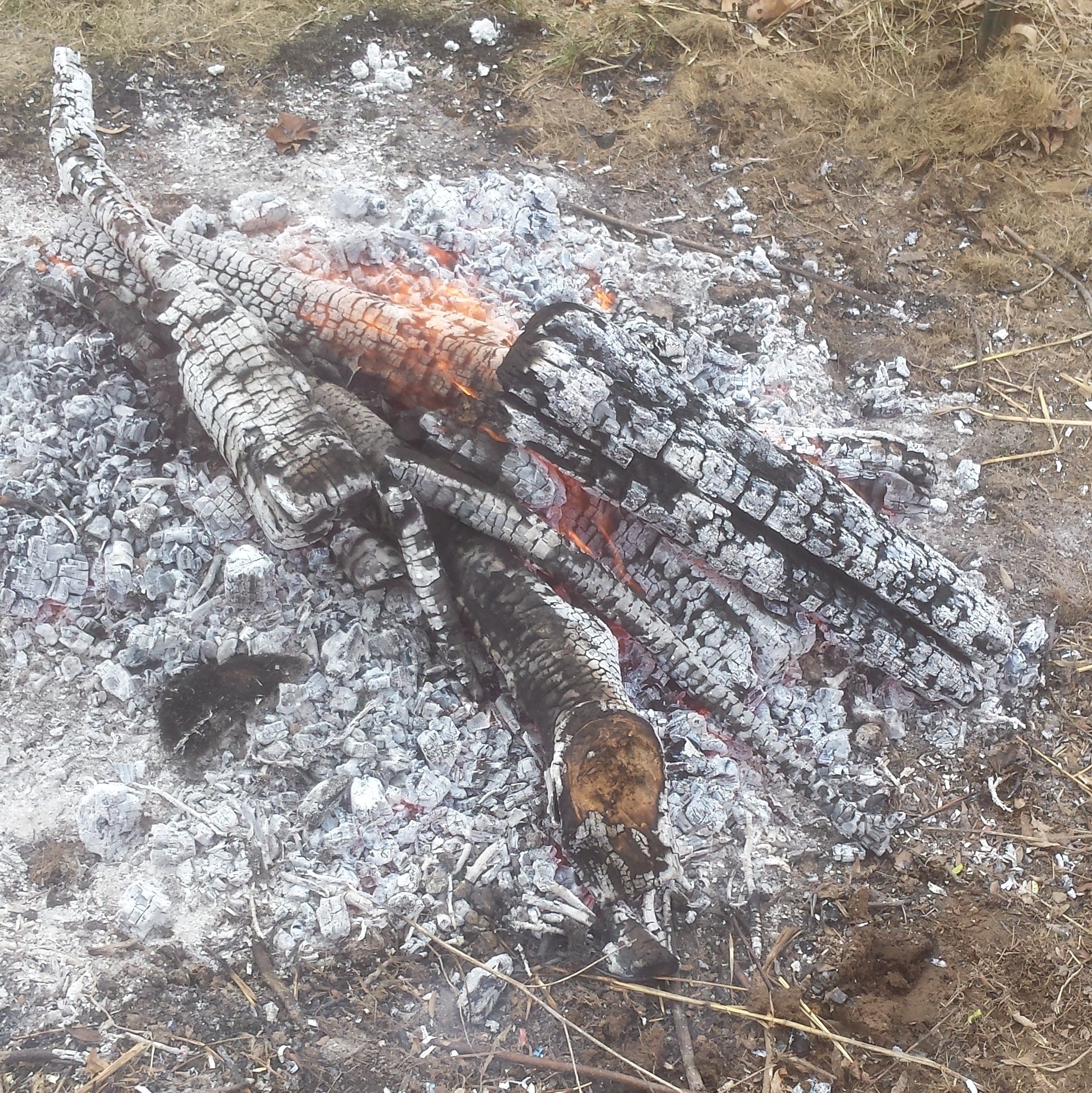
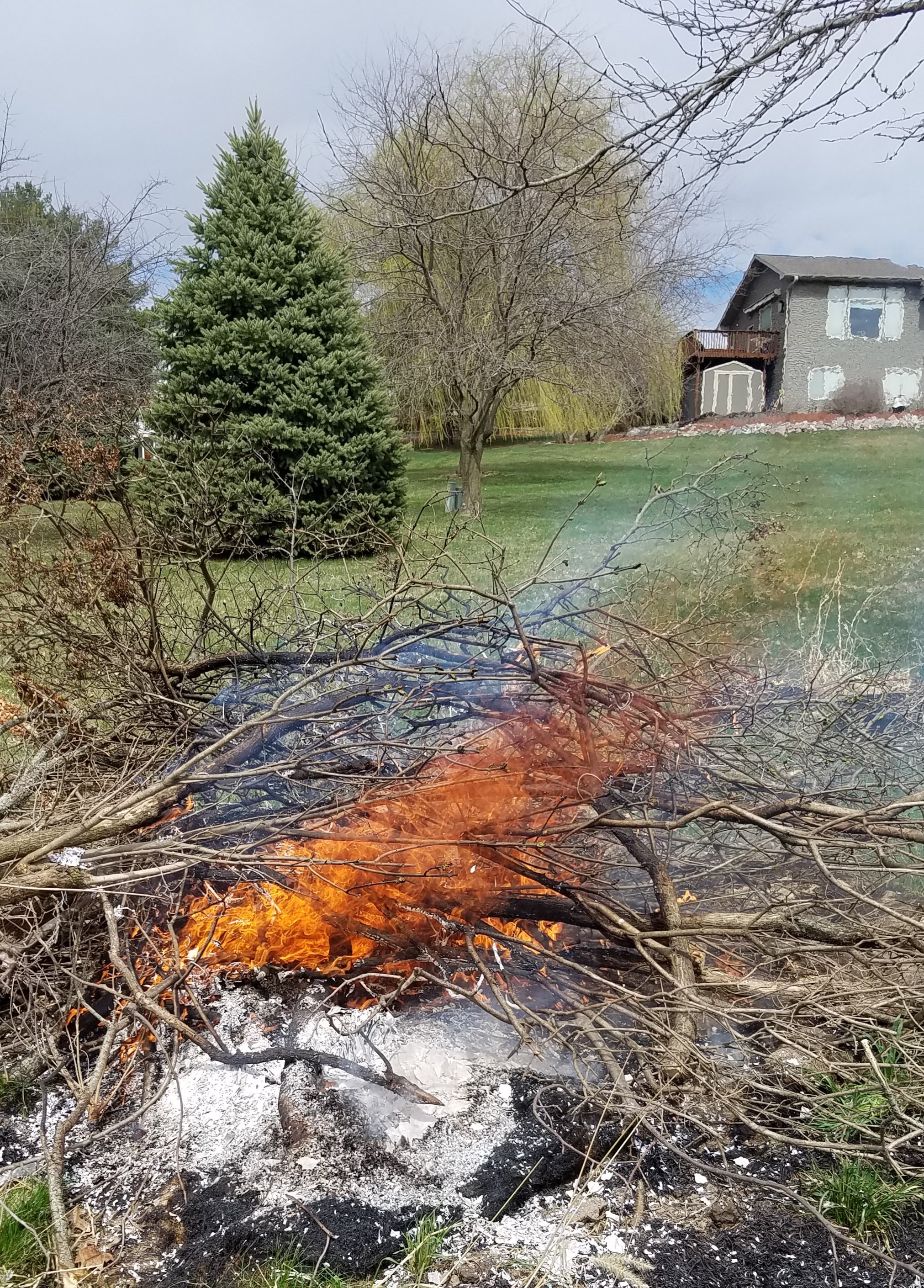
I lit the burn pile with two matches and a pile of scrap paper but the long branches didn’t all burn. In fact, most of them didn’t, except in the middle where fire took hold for a while then died out for want of something.

The the partly charred branches need reworking and another ignition after this morning’s rain. Since today is first of two days at the home, farm and auto supply store, it won’t be until Friday.

Yesterday I planted in the ground for the first time this season, using an experimental limited till method. I have so many seeds, if some fail, they can be replaced.The season is late, but still new, and I’m interested to see if the seeds germinate and dig roots.

I planted in the ground,

Lettuce:

Black Seeded Simpson, Ferry — Morse, 45 days.
Buttercrunch, Ferry — Morse, 70 days.
Mesclun Mix, Ferry — Morse, 40-80 days.

Sugar Snap Peas, Johnny’s Selected Seeds, 60 days.

Carrots: Bolero, Johnny’s Selected Seeds, 75 days.

Beets:

Detroit Dark Red, Seed Savers Exchange, 65 days.
Moneta, Johnny’s Selected Seeds. 46 days.
Merlin, Johnny’s Selected Seeds, 48 days.

Turnips:

Purple Top White Globe, Johnny’s Selected Seeds, 50 days.
Hakurei, Johnny’s Selected Seeds, 38 days.

The smallest of the plots is now planted and overnight rain will dampen everything down. Spring hope is in the ground.

Categories
Sustainability

No First Use

B-61 Nuclear Bombs

On Jan. 30, U.S. Senator Elizabeth Warren (D-MA) and U.S. House Armed Services Committee Chairman Adam Smith (D-WA) introduced companion bills in the 116th Congress to establish the policy of the United States to not use nuclear weapons first.

That’s the bill, 14 words, “It is the policy of the United States to not use nuclear weapons first.”

Sounds like a no-brainer for rational people. Nuclear weapons should never be used. Under what circumstances would our country ever consider using them first? No rational person could come up with a scenario to do so that would stand the light of public scrutiny.

Russian President Vladimir Putin said Russia would only use its nuclear weapons in response to an incoming missile attack. He acknowledged the global catastrophe that would result from a nuclear war. “We can’t be those who initiated it,” Putin said.

H.R. 921 has 25 house co-sponsors, all Democrats. S-272 has six co-sponsors including five Democrats and one Independent. None of the six members of the Iowa delegation to the 116th Congress has signed on as a co-sponsor. That is unfortunate.

The reason Iowa’s lack of co-sponsors on this no first use policy is unfortunate includes:

Iowa’s agricultural industry would be particularly hard hit in the aftermath of a limited nuclear war elsewhere in the world. Smoke and debris thrown into the upper atmosphere would disrupt the growing season. Crop yields in Iowa and other Midwestern states, as well as in other parts of the world, would plummet according to a 2012 study, due to declines in precipitation, solar radiation, growing season length, and average monthly temperature. As many as two billion people would be at risk of food insecurity.

There is no adequate medical response to a limited nuclear war. “We know from the International Committee of the Red Cross’s first-hand experience in Hiroshima in 1945 that the use of even a relatively small number of nuclear weapons would cause death, injury and destruction on a massive scale, that there would be no effective means of providing aid to the dying and wounded, and that those exposed to radiation would suffer life-long and fatal consequences to their health,” Kathleen Lawand, head of ICRC arms unit said.

Preparing for a limited nuclear war, one which should never be fought, is costly. The Trump administration is planning to spend more than a trillion dollars to upgrade the U.S. nuclear weapons complex, including improved weapons, delivery systems and labs. They are even considering development of so-called “low-yield” nuclear weapons which were phased out at the end of the Cold War. Those funds could be better used elsewhere or could even pay for tax cuts.

My ask is modest. The Iowa delegation to the 116th Congress should sign on as co-sponsors to the no first use bills. It is a rational first step in reducing global tensions surrounding the use of nuclear weapons. Those of us in the nuclear abolition community would ask for a lot more, but a no first use policy is something upon which people could agree without even considering more controversial aspects of a ban on nuclear weapons.

There is no cure for a nuclear war. We must prevent what we cannot cure.

Categories
Living in Society

Politics and First in the Nation Iowa

Iowa Caucus Goer

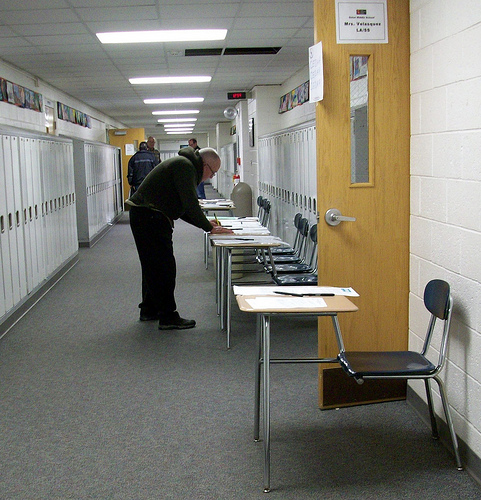
On Saturday the Iowa Democratic Party Central Committee addressed the complaint national media and other states have had about an opaqueness of our first in the nation precinct caucuses.

“This year we proposed the most significant changes to the Iowa Caucuses since 1972,” according to the IDP website. “We are confident that these proposed changes will make the Iowa Caucuses the most accessible, transparent, and successful caucuses ever.”

It looks like the state party will release raw support tallies (i.e. not votes) for the first time since Iowa rose to prominence in the wake of the disastrous 1968 Democratic National Convention in Chicago. The Chicago convention brought us Hubert H. Humphrey of Minnesota, the last nominee to emerge from a smoke-filled room.

My friend from the 2007-2008 John Edwards campaign David Redlawsk wrote the book (with others) on the Iowa Caucuses, Why Iowa? People don’t always buy the authors’ answers. I land with my friend and fellow Democrat John Deeth who settled for 10 percent and accepted the IDP changes.

As an Iowan more active than most in Democratic politics, I acknowledge the decreasing significance of what we do in the presidential horse race. While we get to see a number of presidential hopefuls, and garner media attention in the run up to caucus night, the early presidential nominating process includes not only the four early states — Iowa, New Hampshire, South Carolina and Nevada — but Super Tuesday (this time on March 3, 2020) when a number of states and U.S. territories hold their presidential primaries. The idea that Iowa would winnow the field of presidential hopefuls is less true than it was because of this.

Clearly there are more than two or three tickets out of Iowa this cycle as smart candidates are already campaigning in California, Texas, and other Super Tuesday states. If viable, they will continue at least that far. It is an easy prediction that the nomination will be winnowed down to two after Super Tuesday, and this year, maybe even to The One.

It’s also true that winning Iowa alone is not enough. John Edwards put almost all the chips on the table to win Iowa and when he came in second in delegate count, he had to scramble to cover South Carolina and Nevada with organizers. Whatever the tallies in the four early states, whatever number spinning takes place, a rationale for continuing has to be credible even with new momentum toward Super Tuesday.

I don’t know if any of them will be my final choice on caucus night.

The Democratic National Committee did the first funnel for us already by requiring participants in the first summer debate to secure at least 65,000 unique donors of any dollar amount. Some may grumble about money in politics or “insiders” controlling who’s viable and not, however, number of donations is a fair and transparent measure of viability. I gave small donations to eight candidates I’d like to see on the debate stage. I don’t know if any of them will be my final choice on caucus night.

The 2008 caucus, the closest to level of participation we might see in 2020, was a nightmare from my perspective. The room wasn’t big enough and I chose to both be a precinct captain for John Edwards and help my friend Bob run the event. Doing both proved to be impossible. We had only about 260 attendees.

We put the Edwards group in the hallway, partly because we had so many infirm and elderly in wheel chairs, but also because there wasn’t enough room in the main room to count. I had to count attendees multiple times, which got everyone mad at me, with accusations that my true purpose was to recruit more people for the Edwards camp. In the end, after the final alignment, Obama had 85 people, and Clinton and Edwards split the rest equally, requiring a coin toss to see who got an extra delegate. (Hillary won the coin toss). Once delegate assignments to the county convention were finished, the mass exodus left Bob and me struggling to fill our precinct’s allocated committee positions.

The Iowa caucuses in presidential years are not as much about organizing the party. There is a legitimate issue with finding enough rooms to adequately accommodate caucus-goers, so it would be great if people caucused virtually instead of showing up to name their candidate, then go home without further ado. To say the actual caucus helps organize the party is inaccurate, it doesn’t. If there wasn’t a shortage of people interested in training to run a caucus, I’d participate virtually and let go the reins.

Iowa retained first in the nation status this year partly because IDP was forced to listen and make the caucuses more inclusive and transparent. Having done that, we have an avalanche of presidential hopefuls arriving in the state. My main goal is to keep focus on what I believe is the prize (the contest for U.S. Senator) and avoid getting trampled by the donkey stampede. In my favor is experience, which will hopefully prevent me from picking unnecessary fights.

Categories
Kitchen Garden

Sound of Children Playing at the Farm

Two Pallets for the Garden

This week at the farm it was another light day of 21 trays of 120 seedling blocks. One of the seeders brought some children whose voices could be heard while they played with the farm dogs most of the time I was there.

My tray of kale in the greenhouse is ready to plant. The ground isn’t ready so I left it behind for a week. Space in the greenhouse is at a premium so planning where to plant needs to happen. I planted from seed:

Bell Peppers:

Snapper, Johnny’s Selected Seeds, 62 days green/82 days red.

Hot Peppers:

El Eden (Guajillo), Johnny’s Selected Seeds, 65 days green/85 days red.
Baron (Ancho), Johnny’s Selected Seeds, 65 days green/85 days red.
Serrano, Ferry — Morse, 73 days.
Jalapeno — Mild, Ferry — Morse, 72 days.
Jalapeno — Early, Burpee, 72 days.
Red Flame, Johnny’s Selected Seeds, 60 days green/80 days red.
Red Rocket, Johnny’s Selected Seeds, 55 days green/75 Days red.
Long Thin Cayenne, Ferry — Morse, 72 days.
Bangkok, Johnny’s Selected Seeds, 75 days green/95 days red.

Except for the rosemary, everything planted previously germinated. I now have 720 seedlings in the greenhouse.

The intent of many varieties of hot peppers is to have a single patch of two or three rows with a couple plants of each kind. Serrano and Jalapeno are for eating fresh. I’ll pickle some jalapenos. I’m experimenting with El Eden  (Guajillo) and Baron (Ancho) for drying and using in chili sauce, so I may plant a separate row of those two. Everything else is to dry and use as red pepper flakes or chili powder.

The cold, wet spring is making the coming week a crunch time to get started planting.

Categories
Kitchen Garden Writing

On a Warm Spring Day

Spring on Lake Macbride

Saturday was the first spring day with temperatures in the low 70s.

I spent a few hours raking and using the chainsaw, beginning yard clean up. More clean up remains but I’ve learned to take it easy until returning to better physical shape through the work.

I relished being outside at work so much. Excited to deploy the chainsaw, I forgot hearing protection until I was almost finished.

Neighbors hailed me from their yards and in passing by. The whole neighborhood seemed outside and alive. There was ice below matted leaves yet everything else indicated spring had definitely arrived.

Saturday had begun Friday by covering mixed beans with tap water to soak overnight.

Before sunrise I cooked the beans in homemade vegetable broth, then added carrots, celery, onion and bay leaves. The broth reduced so I added more — four quarts in all. It simmered all day yielding a deep brown color by supper time. A cup of soup with toasted bread, a small plate of cheese and pickles, and a glass of milk made the meal.

A week into April and nothing is planted in the ground. I surveyed the garden plots for a spot to plant peas and carrots and have ideas but no plan. I’m getting better with garden layout each year because of a shift from whimsically filling space to consideration of which plants go where and why. After yesterday there’s a lot of wood to cut for a burn pile, such cutting making space to think about sunlight, shade, soil health, animal traffic and mulch.

Such is the world of a gardener.

Categories
Sustainability

Does Nuclear Weapons Spending Make Sense?

Garage Sign

Does it make sense for our federal government to spend almost one and a half trillion dollars on a nuclear weapons system that should never be used?

No.

The Trump administration plan is to rebuild the entire American nuclear arsenal, including development of new, so-called “low-yield” nuclear weapons. During military training we prepared for deployment of such “tactical” weapons.

After spotting the signature flash or mushroom cloud of a nuclear detonation, while maneuvering among people’s farms, towns and businesses, we were to avert our eyes, find a low spot on the ground and cover ourselves as best we could with our poncho to prevent radioactive fallout from touching our skin and clothing. If we survived, we could go on fighting.

After the breakup of the Soviet Union, and elimination of tactical nuclear weapons, developing them again sounds crazy. We could build thousands of new community fire houses with that kind of money.

As Iowa ramps up for the first in the nation caucuses, we should ask presidential candidates, “Will you oppose current plans to spend upwards of one and a half trillion dollars on a plan to rebuild the entire American nuclear arsenal?”

Voters will likely welcome the responses.

~ Published in the Solon Economist on April 11, 2019.

Categories
Living in Society Writing

New Way of Seeing

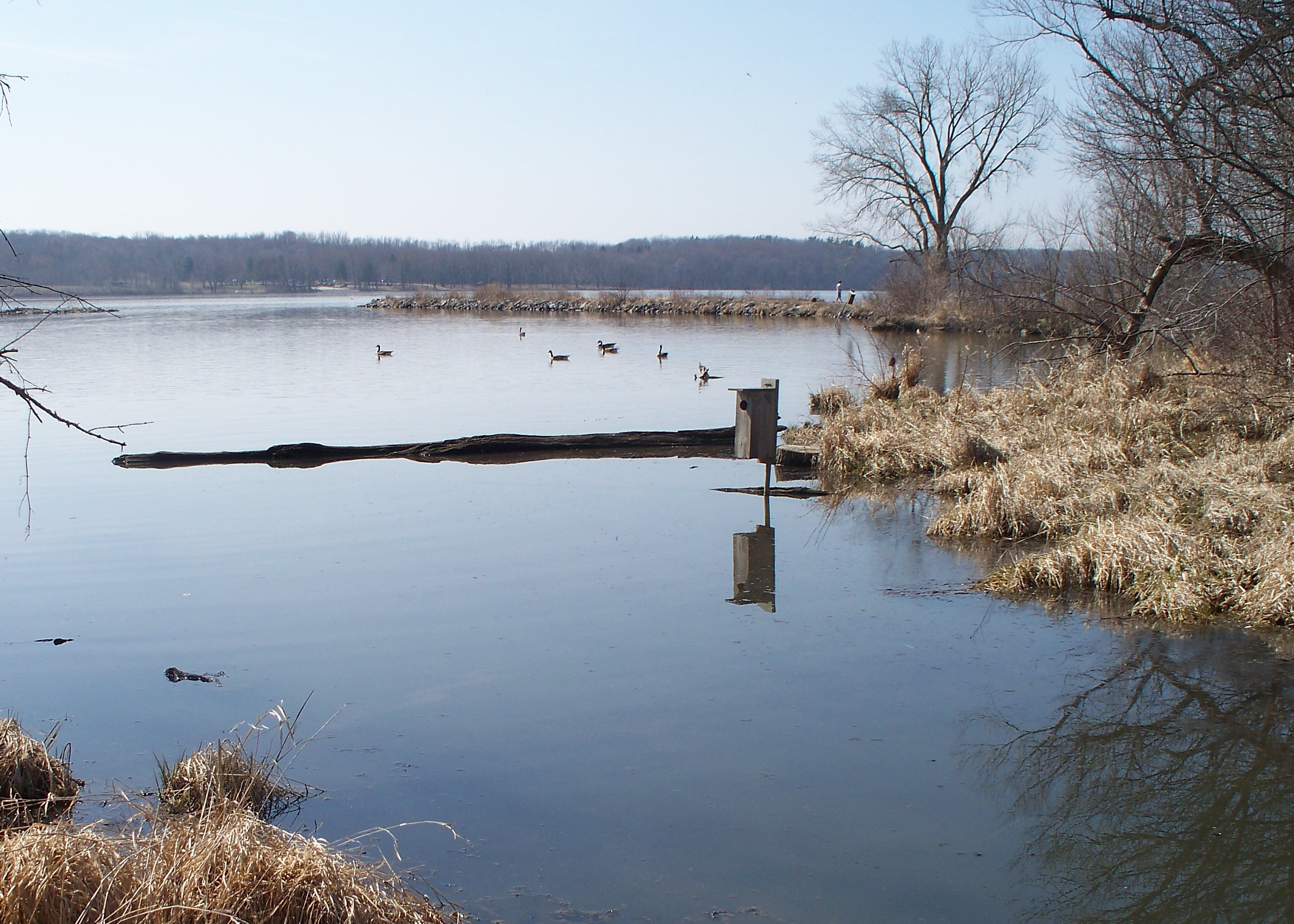
Flooded Wetland

I had an epiphany while reading Mayor Pete Buttigieg’s memoir, Shortest Way Home, the March release of which coincides with his presidential campaign.

In the first chapter he described growing up in South Bend, Indiana, a place I frequented while working in transportation at about the same time.

It was a stretch to understand Buttigieg’s new narrative of something I knew well during the late 1980s. My conclusion after finishing the first chapter was I feel too comfortable with people closer to my own age with similar experiences. Like it or not, aware of it or not, a new generation of Americans has arrived and is already making change in a society I increasingly recognize only in memory.

I don’t know Buttigieg’s presidential chances among a large field with many experienced politicians, but I know this: I’d better join younger people in their efforts to improve society or get out of the way.

I’ve written about the struggle of young farmers regarding land use in our county. Some of them have been addressing the county board of supervisors since 2013 about the 40-acre rule which defines a farm. If a farmer farms on less than 40-acres here, by definition, it is not a farm, and therefore, the financial remedies of the Iowa agricultural exemption are unavailable. Having advocated with the supervisors during the run up to the most recent five-year land use plan, they are making an end run around them for lack of accommodation, seeking a remedy from the state legislature. Whether they will be successful this year is uncertain, but eventually they will reshape the law to better fit their vision of contemporary farming.

Congressman Dave Loebsack is in the same cohort as me, about a year younger. A relatively small group of us joined together in Iowa City to open his first campaign office for the 2006 election. Together we beat a 30-year incumbent Republican in the general election. Over time there have been complaints that Loebsack is not progressive enough. If one looks at his actual positions and votes, and hears it from him personally as I’ve been able to do because of our long relationship, that seems ridiculous. However, the new generation will have their way, maybe not now, maybe not in an orderly way after Loebsack retires, but their patience with perceived grievances won’t be bottled up for long. As Buttigieg’s narrative of South Bend in the late 1980s instructs, there is a different way of seeing things and it is not the view of white guys like me.

After the decennial political redistricting in 2010 Bobby Kaufmann won the first election in newly formed House District 73. He has dominated the district ever since, despite efforts by Dick Schwab (2012), David Johnson (2014), and Jodi Clemens (2018) to win the seat. Like him or not, he is the face of the new Republican party in Iowa and a popular figure in the district and around Iowa. That’s not to say he’s popular among Democrats and progressives because he mostly isn’t. Because he won four back-to-back elections he rose in the legislature and became the gateway for constituents to get things done. Will he support all of our initiatives? No. Will he listen? I found the answer to be yes.

I no longer see life through the eyes of a thirty-something. However, I’m willing to set aside my biases and predispositions if I can and spend time with men and women in their 20s and 30s to work on common issues. It’s the lesson I’ve learned from Pete Buttigieg’s candidacy.

There is so much needed to improve our lives and old solutions no longer work. To find our way, we need something different, and better. Our hope lies with the thirty-somethings who have arrived — like it or not.

Categories
Writing

Imagining a Narrative

Early Spring Rhubarb at the Farm

It’s been difficult to imagine myself in a post worklife world.

When I left my last transportation job work no longer defined me. I could become something new and different. Ten years later work continues to occupy a role in my story. That’s not unusual in the United States. I also don’t think it is that good.

Mostly retired, a pensioner, I lack a forward-looking narrative. Living a life, working part time for wages, those are not worth narration. They are part of the human journey, the arc of which often seems uncertain.

So I drift… read and write. I will read and write as long as I’m able… and take care of necessities.

Framing a life in work was abandoned. The actuality of it proved harder than writing these words. If I spend time in public, outside the flickering light of lamps and screens… sunlight through the French door, I’ll want a narrative more than “I’m a pensioner.”

I like the word pensioner, yet it’s an unusual introduction. My pension is from Social Security, it is real, and it pays many of our expenses. It reflects more than 50 years of work, during which I contributed to the fund. “I am a pensioner” seems okay, but I wouldn’t lead with that because it sounds so awkward, so work-related. There is more to life than a reference to work that generated a pension.

I told a life story in my post Autobiography in 1,000 Words, which seems long for a personal narrative. I like the facts presented yet they doesn’t say who I am, who I’m trying to be. Maybe I’d better know that first.

Should I present as writer? People recognize me as such. I don’t like talking about writing projects, so no, I wouldn’t lead with that.

Should I present as a gardener? I garden and post about gardening in multiple places. Why does a personal narrative have to be about only one thing? It doesn’t.

To whom would I tell a personal narrative if developed? I think about Dunbar’s Number and the cognitive limits it suggests. If we only get 150 stable relationships because of physiological limits, why am I even worrying about a personal narrative? My 150 knows me and I know them. Isn’t that enough?

Last Saturday a group gathered at Old Brick in the county seat and discussed political advocacy. That’s where this post about personal narrative originated — I felt I needed an elevator speech as I introduced myself. We all need a brief chat about who we are when meeting people.

I am genuinely interested in meeting people and hope any conversations will be more about them rather than me. If I talk in terms of their interests, it’s because I’m curious about how people live their lives. I need to hold up my side of the conversation.

“Hi. I’m Paul, a pensioner from rural Johnson County. I spent 50 years in the work force and now I’m here talking to you. What’s your name?”

I don’t know, pretty lame. It’s a conversation starter, and could lead somewhere the way an ignition switch on an automobile begins a trip. It’s not flashy but may serve. Maybe that’s all that’s needed and I’m over thinking this. Maybe such a brief speech is enough.

The arc of life is bending toward the unknown — an opportunity to imagine what could be. Maybe that’s the narrative, at least it could be.