Categories
Living in Society

Politics In Isolation

Rural Polling Place

It must be hard for out of state political organizers to penetrate the shield of work, family and friends behind which many Iowans spend most of their time.

That’s especially true as the large field of presidential candidates self-sorts in the polls, resulting in what seems an inevitable field of Biden, Harris, Sanders and Warren. If they can gain traction through some sort of campaign breakthrough, maybe add Booker, Buttigieg, Klobuchar and one or two of the others people recognize. A recap of 20 Iowa polls from 538.com is here.

According to a June CNN poll 44 percent of primary voters had decided their first choice for president, with most of the rest saying their choice is subject to change. There is a long Iowa tradition of waiting until the last minute to decide for whom to caucus in presidential years. What plays a role this cycle is the common statement, “I support X, but will vote for whoever the party nominates because we have to beat Donald Trump.” Against this background, organizers have to identify voters to support their candidate, knowing minds could change in the more than six months until the Iowa caucuses. Based on my experience there will be a groundswell behind candidates who are perceived as potential caucus winners.

The basics of political organizing haven’t changed in a long time. My father explained how he organized for the 1960 campaign of John F. Kennedy. The union provided mimeographed 8-1/2 x 14 inch sheets with a blank grid of homes on it. Dad’s job was to contact people in each house on the blocks he was assigned, discuss the election with them, and record the results on the sheet. The completed sheets went back to the union hall. Dad had no trouble completing this work in a timely manner and he enjoyed meeting with neighbors. It was pretty basic, and of course Kennedy won that cycle.

Things are different in 2019. To be successful, candidates have longer range plans than contacting voters and dutifully recording their opinion in a database. For example, Elizabeth Warren has organizers holding “office hours,” working on art projects, tabling at farmers markets, attending local events, and working on farms. There may be some payoff to such activities in the form of signed commitment cards. What seems more important is outside organizers become part of the community. When we think of the candidate, we can put a face with that name and have a contact for outreach if there is a question. It is not just Warren using a longer term approach and candidates who don’t seem unlikely to gain traction.

There is also the money issue, which has rendered contact with most candidates via email, social media and other communications methods meaningless. People get it. Campaigns cost a lot and sending me three or four emails per day soliciting donations is a numbers game in which you hope to wear us down with repetition.

What makes this year different is the shield. It is hardening. In case you missed it, things are not great in America these days. Beginning with health care, including Medicaid, Medicare and the Patient Protection and Affordable Care Act, Republicans are trying their best to undo it all. The care provided in these programs has never been the best. Just ask someone who needs care or knows someone who does. At the same time, they represent something positive in our lives. Social Security is a target even though it is funded separately from the government and viable at least until 2034. Republicans also seek to break up the scientific approach to problem solving in USDA, EPA and other government agencies turning them more political. The Justice Department re-instated the death penalty this week. Government is becoming more political than it was. Post-World War II progressive initiatives are being rolled back.

Whatever the outcome of these long-standing Republican initiatives, voters are withdrawing into smaller, isolated communities where they protect their own interests first. As others have noted, this gives rise to an us vs. them view of the world with which political organizers have to work. People have become skeptical that participating in politics has much meaning and push back on politics except within their group. Under the shield, political discussions can be very active, but mostly among group members regarding their core concerns.

Community organizing remains an important aspect of penetrating the shield of isolation. Finding common ground with friends and neighbors and with others in the community, is no panacea, yet it remains a centerpiece of problem solving. The trouble is picking an action, and there has been little agreement in groups to which I belong or with which am familiar unless a problem is obvious and significant.

Behind the shield, behavior harkens back to tribal both in selection of targets for action and in attitudes and methodologies used to achieve them. If a community’s drinking water is sub-standard, members are likely to take action if they can. Politics? Not so much.

It is difficult to see how the Democratic presidential nominating process will turn out. What seems clear is voters’ disaffection with politics has created a type of isolation that requires a new kind of campaigning. Someone will be the Democratic nominee for president and a majority of Democratic voters will support him/her. However, the thrill is gone in primary campaigns among Democrats, which makes traditional, individual campaign strategies and tactics less useful in producing a winning candidate.

There are no easy answers. Hard work and grit will play a role as they always have. Voters will be canvassed as they have been for generations. To the extent campaign organizers don’t work to penetrate the shield, their efforts seem unlikely to produce a winner in the Iowa caucus.

In the meanwhile, summer is here and is fit distraction from political talk. Maybe people will engage outside their tribe when the new year begins. For now we need protection from the harsh summer of Trumpism.

~ Written for Blog for Iowa

Categories
Living in Society Social Commentary

Why Racism?

Thom Hartmann Photo Credit – Thom Hartmann Website

Racism is a feature of the Trump administration geared toward activating marginal voters who support his racist statements to get them to vote to elect Republicans, posits Thom Hartmann in the clip below.

“When Trump said this he knew exactly what he was saying,” Hartmann said on his eponymous program, referring to the president’s statement addressing four Democratic U.S. Congresswomen, “Why don’t they go back and help fix the totally broken and crime infested places from which they came.”

Hartmann explores racism related to the president’s comments, answering the questions “Why won’t the GOP comment on Donald Trump’s racist comments?” and “Has the GOP now moved so far to the right that this will get Trump re-elected?”

He suggests politics as we know it — each party’s base voting for their candidates with the middle or swing voters being targeted for conversion each election cycle — has been turned on its head by the president.

I don’t know if he’s right, but it’s food for thought as we enter a high summer of RAGBRAI, sweet corn, tomatoes and vacations.

~ Written for Blog for Iowa

Categories
Kitchen Garden

Waiting for Tomatoes

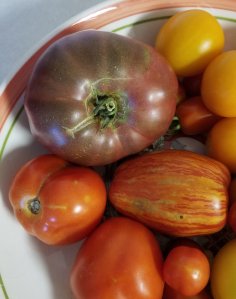
Bowl of Tomatoes July 30, 2019.

With late planting and heavy spring rain the garden has been a mixed bag. A highlight of every year is arrival of tomato season and planning the use of what I expect will be a good crop.

The first tomatoes have ripened, and now we wait for the slicers and plums.

We eat them fresh, give some away, and prepare canned sauce, juice and diced with the rest.

As my worklife slows down, it seems there is more work to do in the yard and garden. Growing tomatoes doesn’t seem like work.

My last summer post for Blog for Iowa runs Friday and I am ready for what’s next, including a return to my usual topics in this space. I cross post here what I write elsewhere so a trickle of BFIA articles will continue until they all have been posted.

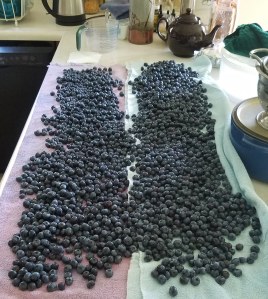
I begin work at the orchard this weekend for the seventh consecutive season. Hopefully we’ll have ripe apples and great conversations with our guests. It is blueberry season in Michigan and this weekend we will offer them fresh for the last time this year. We’re hoping Pristine, Jersey Mac and Viking get ripe by the weekend so our guests can pick them.

In July I signed up for a nutrition class paid for mostly by Medicare. The goal is to watch my blood sugar levels and develop better eating and exercise habits. A by-product of the classes has been losing ten percent of my body weight. I feel better and hope to stave off diseases of aging such as heart disease, stroke, diabetes, eyesight deterioration, influenza, pneumonia and the like. Fingers crossed. I still have a lot I want to do and good health is an important prerequisite.

As the sun ascends on another brilliant Iowa day the garden needs watering, and I want to get a trail walk in before leaving for the home, farm and auto supply store. There is a long to-do list needing attention as well. Thanks for reading.

Categories
Writing

What’s Wrong With Our Food System?

Drying 10 Pounds of Michigan Blueberries for Freezing

There is a strong argument nothing is wrong with our food system.

There is a strong argument everything is wrong with our food system.

To talk about a “food system” at all presumes a lot that may or may not be true.

It’s no secret large corporations increasingly control food production, distribution and marketing. Scalability is a key issue with providing nourishment for billions of people. The hand of large land owners, chemical companies, seed genetics companies, processors, banks, equipment manufacturers and consumer outlets runs throughout each household’s food ecology. Households have a food ecology even if they don’t speak of it using such fancy words. What appears at a meal is influenced at every point in the distribution chain by large corporations.

It’s also no secret farmers, especially small-scale farmers don’t earn a lot of money for their long hours each season. Neither do equipment manufacturing workers, seasonal farm help, truck drivers, grocery store workers, or restaurant workers. Whether one is a contractor for a large international meat-producing corporation or produces heirloom hogs for a meat locker, at the end of the day a diverse and ever changing personal economic structure is needed to ensure viability this year and in the near-term future. People struggle to make a living by farming alone.

At the same time, grocery stores are packed with food and if there remain some food deserts without one, enough food is produced in the United States to feed everyone. I met an executive from a large container manufacturing company when I worked in the Chicago Loop. He said the issue wasn’t having enough food, it was preserving and distributing what we already produce. That remains true, his statement representing another large corporation wanting a piece of the food supply action.

The deck is stacked against young farmers who want to produce food outside the mainstream. I’m thinking of friends that operate Community Supported Agriculture projects or grow specialty crops. Producing meat and vegetables for the local market has been a staple in society at least since medieval times. When there are a lack of well-paying jobs, or capital, if people have access to a piece of land for a season, attractive fruit and vegetables can be produced and sold at a margin that looks better because labor cost is removed from the calculus.

It goes without saying a farmer will work 60 or more hours a week, sometimes turning $100,000 per year in revenue derived from diverse sources (produce, livestock, grazing and retail sales) and living on a fraction of that. Land ownership? Only a small percentage of young farmers can afford to own land.

Consumers can afford a hodge-podgey food system with diverse sourcing, abundant supply, wide variety, and absence of much concern for how food arrived at our table. If corporations own equity in land, equipment and patented seed genetics, it’s hard to see that on our 9-inch dinner plate.

What matters more in this discussion is not whether a food system is good or bad, but whether that is even a thing. If each household develops its own food ecology, including best practices regarding water use, soil conservation, seed genetics and other resource use, that’s not good enough. If a food system exists, what it requires is scalability and that’s where corporations can and likely should play a role. Not evil corporations designed for extraction of resources and cash, but people joined together with common purpose regarding nourishing a growing population.

Asserting there is or isn’t a problem with our food system is itself a problem. It is much more fluid and undefined than that. Like vegetable farmers we need to accept each season for what it teaches us, hoping we can sustain ourselves for another season.

Additional Reading

Last Call for a Food Systems Revolution by Pallab Helder.

To Revive Rural America, We Must Fix Our Broken Food System by Austin Frerick.

World Hunger is on the Rise by Timothy A. Wise.

Twitter thread by Dr. Sarah Taber.

~ Written for Blog for Iowa

Categories
Living in Society Social Commentary

Data Points To Corporate Influence

U.S. Capitol, Washington, D.C.

Is the Ohio federal court’s recent release of Drug Enforcement Agency data about manufacture and distribution of oxycodone and hydrocodone pills significant?

Maybe.

I found last week’s Washington Post presentation of scrubbed data engaging for the ten minutes or so it took to drill down to Iowa and the county in which I live. Readers can do likewise by clicking here.

The data doesn’t change much. If anything, it confirms what I wrote in 2016:

Fanning the embers of opioid abuse into a raging wildfire serves the interests of Big Pharma and its minions in the U.S. Congress. The opioid epidemic represents another opportunity for corporations to mold government in a way that serves their interests.

According to data, Iowa took delivery of 562,927,414 of these pills manufactured by Actavis Pharma Inc., SpecGX LLC., and a few other companies between 2006 and 2012. They were delivered to Walgreens, Wal-Mart, Hy-Vee, and a number of other independent and chain pharmacies.

I live in Johnson County, which took delivery of 12,158,306 pills, or enough for everyone to have about one per month. Two days a week I drive by the Walgreens in Coralville which received the highest number of pills in the county. I had no idea, and in the long view, I’m not sure it’s significant. In part, the opioid epidemic is driven by availability and ease of access. The drug companies are making sure the pills are available.

There is a human aspect of the massive distribution of narcotics. The Washington Post intends to mine the data for stories beginning with those of southwestern Virginia where my father’s family first appeared in the 17th Century, and distribution of opioids was highest in the country. I haven’t enjoyed the coverage of Norton, Virginia and surrounding Wise County.

For comparison, Wise County took delivery of ten times the number of oxycodone and hydrocodone pills as Johnson County, Iowa, with the highest number delivered to Family Drug in Big Stone Gap. In Norton, Virginia, 306 pills per person were delivered according to the Washington Post. Dennis Boggs of Norton summarized the problem to the Washington Post. “There’s not a lot to do,” Boggs said. “It gives them something to do around here.” He was talking about using these legal narcotics.

“What they did legally to my state is criminal,” Senator Joe Manchin III (D-W.Va.) told the Post. “The companies, the distributors, were unconscionable. This was not a health plan. This was a targeted business plan. I cannot believe that we have not gone after them with criminal charges.”

Manchin has a point and it serves mine. Pharmaceutical companies are executing a business plan, one that includes substantial influence of the Congress. If the human misery of easy opioid availability is hard to take, look at it from a business standpoint. Companies are working an abstract plan designed to maximize revenue and profits within current regulatory framework. Once lobbyists have set the rules for prescription, manufacture and distribution of opioids like oxycodone and hydrocodone, such regulation turns out to be very little regulation at all, at least when it comes to protecting the public.

This distribution of oxycodone and hydrocodone is a different face on the same problem, the influence of corporations on our government. It is important not to be distracted by the drama.

Last year Governor Kim Reynolds signed HF 2377 into law. The law focuses on narcotics users and those who prescribe them in hope of reducing the number of opioid users in Iowa, according to the governor’s press release. The vote for the bill was unanimous in both the Iowa House and Senate. Given the comparatively low level of opioid pill distribution in Iowa, revealed by the Washington Post data, aren’t there other, bigger problems for political focus? Things like fixing Iowa’s disastrous privatization of Medicaid which impacts lives as well.

Data can measure the success or failure of HF 2377. What is hard is to measure the intent and human impact of large corporation business plans. The newly revealed data is pointing to corporations as the problem in the opioid crisis.

~ Written for Blog for Iowa

Categories
Environment

Planting Trees

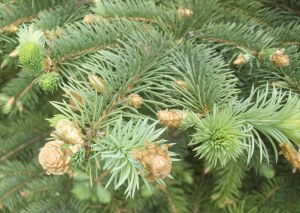
Blue Spruce Tree

This week I met someone who works with trees for a local municipality while working a shift at the home, farm and auto supply store.

We discussed several topics, including dealing with Japanese Beetles, tree species that thrive in Iowa, and the Emerald Ash Borer. He favored the River Birch tree.

The city had inventoried every ash tree on public property and had a plan to replace them when they inevitably become infected with the insect.

I asked with what species would the city replace ash trees? He mentioned Chestnut and Black Tupelo (a.k.a. Black Gum). We discussed the blight that eradicated the immense population of Chestnut trees in the Eastern United States and how genetics had improved the tree to resist the disease. He also mentioned the Black Gum tree is attractive, with a nice head, and grows comparatively quickly. The conversation drifted off into how people plan trees on their property and the challenges of establishing them on property with a limited number of spots. I returned to the rest of my work.

Growing trees is a long-term commitment. When we built our home only one tree, a mulberry, lived on our lot. We now have 15 with room for more. I’m not sure I want a chestnut, but a Black Gum sounds like a possibility.

Categories
Environment

A Climate Action for Every Iowan

Image of Earth 7-6-15 from DSCOVR (Deep Space Climate Observatory)

Iowa Public Television devoted its weekly Iowa Press program to climate change.

Dr. Gene Takle, Professor Emeritus at Iowa State University and Dr. David Courard-Hauri, Professor and Director of the Environmental Science and Policy Program at Drake University faced reporters David Pitt with Associated Press and Katarina Sostaric of Iowa Public Radio.

No new ground was broken in the 27-minute program because the nature of climate change as we experience it in Iowa is reasonably clear: it’s about moisture, too much in the spring, or too little during the growing season. World-wide warming atmosphere and oceans contribute significantly to extreme weather in Iowa.

Some don’t believe what goes on in Iowa falls into a broader trend or context. Courard-Hauri made an important point about this.

And one thing I’d add is that we focus a lot on this question and if you look at surveys it’s about 20 percent of the people who actively argue that climate change is not caused by people. And the majority of people either, well the majority of people believe the climate is changing, you can see it now, it’s at that level. And then the large majority are aware and concerned and so when we spend a lot of our time focusing on that really small minority, it’s a larger minority of lay people that (sic) it is scientists obviously, but if we spend a lot of time talking about that then I think we miss the fact that most people are wondering what can we be doing, what should we be doing?

What can we be doing about the climate crisis?

A few years ago State Senator Joe Bolkcom made the best case I’ve heard on what to do: join with like-minded people around a cause.

In a society where the myth of rugged individualism persists, and the expansion of media in the form of radio, television, smart phones and computers brought with it a new form of social isolation, that is hard to do. Do it we must and it’s not just me saying it. At some point the climate crisis becomes so obvious and threatening almost everyone wants to answer Courard-Hauri’s question.

An article by Cathy Brown at Yes! magazine last week pointed out there is a climate action for every type of activist.

“Susan Clayton, a professor of psychology and environmental studies at the College of Wooster, says getting involved with a group can help lift your climate-related anxiety and depression in three ways,” Brown wrote. “Working with like-minded folks can validate your concerns, give you needed social support, and help you move from feeling helpless to empowered.”

Bolkcom’s point was similar to Clayton: groups are more effective than individuals.

The reason I’m involved with environmental groups is to work on inter-generational issues. I won’t likely be around when the worst of the climate crisis hits but people I know and love will be. As I ease into retirement it is important to allocate some time to work on the issue.

When Iowa Public Television is doing a program on the climate crisis, the concerns are mainstream. While we expect a lot from our government, politicians need nudging from voters and that is where joining with others in our communities is important. As Brown’s article suggests, there is a way to get involved for every personality.

View Iowa Press episode on climate change here.

Read Cathy Brown’s article at Yes! magazine here.

Categories
Living in Society Reviews Social Commentary Writing

Parade and Fragments

Sprayer in the Solon Beef Days Parade

A summer parade in Iowa is a chance to showcase lives for the entire community.

Farmers, restaurateurs, insurance agents, bankers, retailers, construction companies, government organizations and more cleanup their equipment and parade it through town handing out treats and small gifts along the route.

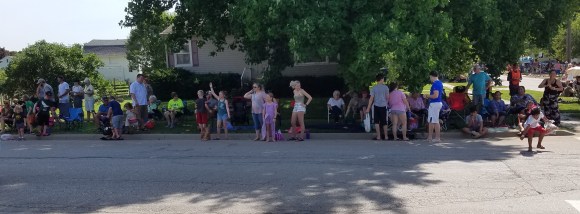
People line the street to watch, sitting on lawn chairs, standing under shade trees and chatting with friends on the sidewalk. It’s mostly for children yet adults get involved as well. Anyone can stand almost anything that marches by in the span of a couple of minutes.

Solon Beef Days Parade Watchers

I.

In 2013 our situation got dire. I had run out of money and held no job that paid enough. Not wanting to return to transportation, I took one low wage job after another to earn enough to get by. Most of the work involved standing on concrete floors, which precipitated a case of plantar fasciitis. Not only did my feet hurt, on a physician’s advice I gave up jogging after 37 years because of it. While the condition is resolved, it persisted until I left full-time work in 2018.

Expenses got delayed during this period, as did preventive health care. It wasn’t clear how tight money had been until I began taking Social Security benefits which brought relief.

II.

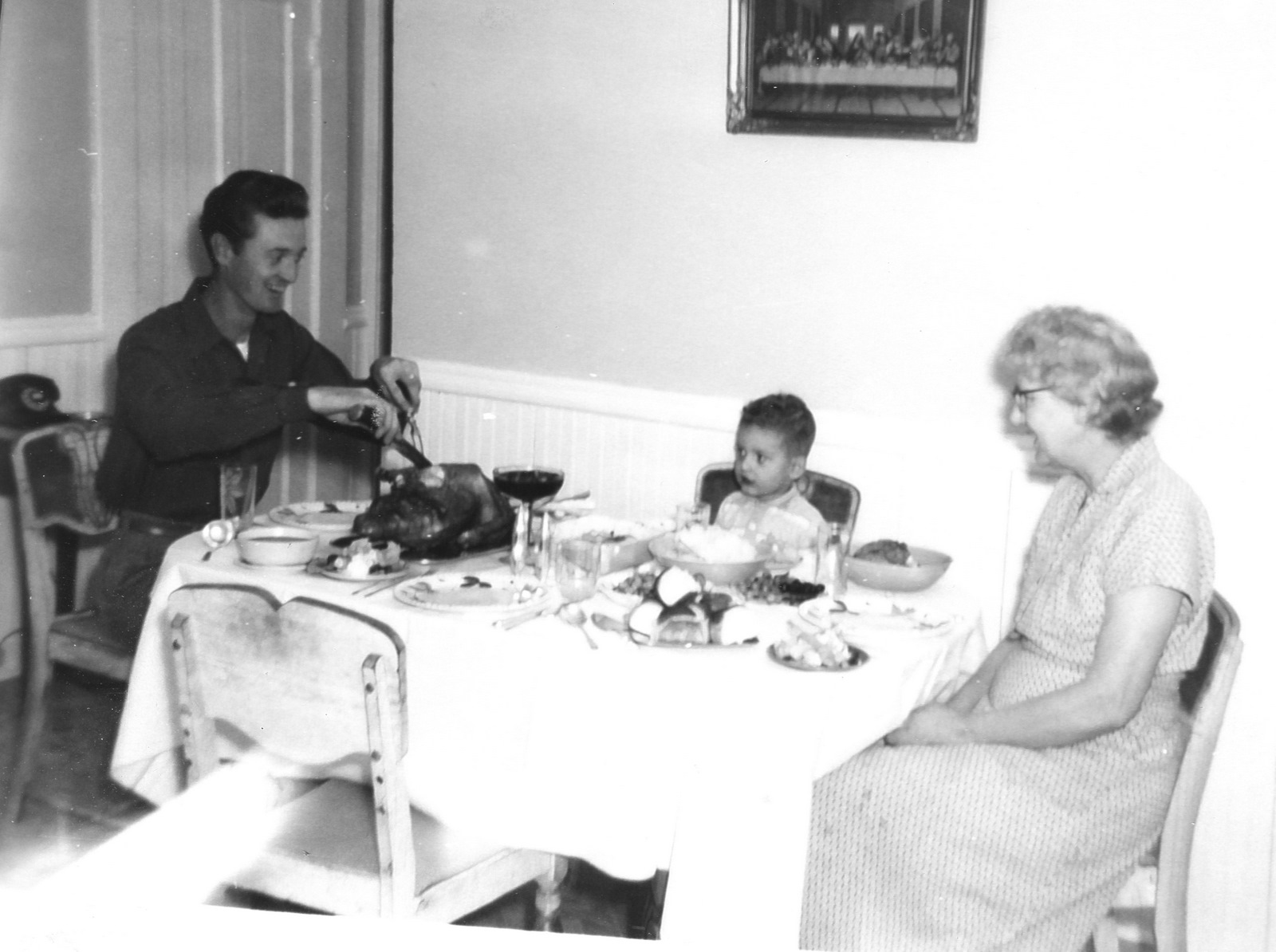
An Early Thanksgiving

The story begins with the proximity of relatives. Our maternal grandmother and grandfather made visits to our home. I never knew my paternal grandparents except in stories and photographs. As much as anything, my grandparent story is about my relationship with Grandmother from my earliest memories until she died Feb. 7, 1991.

We were lucky to have her with us for so long.

Grandmother had five children and 15 grandchildren. She spent more time with our family because of our proximity. She lived with us off and on during my early years, but eventually maintained her own apartment. In later life she lived at the Lend-A-Hand, a residence for women at the time, then moved to the Mississippi Hotel where she lived the last years of her life in an apartment until moving to the Kahl Home for a brief period. Grandmother had many sisters and a brother. We had a lot of relatives, or so it seemed.

III.

I read The Overstory by Richard Powers. It engaged in a way most fiction fails to do. The author must have spent an enormous amount of time researching trees, forests, and the culture around them. He wove them into a spellbinding narrative. I could go on gushing about the book, but just pick it up and read it. If you do, and are interested in the environment, I doubt there will be any regrets.

Categories
Environment

Getting Attention on Climate Change

Ed Fallon in His Garden

Ed Fallon is a friend of Blog for Iowa and we support what he does with his radio program and his advocacy against oil and natural gas pipelines in Iowa.

He caught the attention of Democrats in Cedar Rapids last weekend with a performance art piece, staged by his group Bold Iowa, in which three individuals posed in a gallows with a noose around their neck, standing on blocks of melting ice under a sign that said, “As the arctic melts the climate noose tightens.”

While many on social media and in-person viewers of the piece took a dim view of this direct action, if you know Ed at all, not thinking things through is a feature, not a bug of his work. There is no denying deterioration of the Greenland ice sheet, the Arctic, and the Antarctic ice shelves is a planetary problem that could cause environmental disruptions not seen in living human memory. Bold Iowa’s performance piece was successful in that social media was abuzz discussing its meaning and appropriateness. It was unsuccessful in that major media outlets did not appear to be covering it with the notable exception of the Cedar Rapids Gazette which ran a story on Wednesday framing the piece a racially callous because of its use of a noose, invoking for some an association with lynching in American history.

“We underestimated the way it may trigger folks who either are concerned about the rise in racism in this country, in many respects because of Donald Trump,” Fallon said in an interview with the Gazette. “And also people who were affected by a family member who maybe committed suicide by hanging. … Our focus is to get people to understand just how urgent of a situation climate change is. We really are at a point where human extinction is a possibility.”

In a July 16 email, Fallon wrote he planned to write a blog post about the incident while promoting his Fallon Forum podcast, saying,

Pascha Morgan joins (the Fallon Forum) to discuss Bold Iowa’s provocative performance art, which involved a gallows (representing the threat of extinction) and large blocks of ice (representing accelerated ice melt in the polar regions).

Bold Iowa’s action demanded that Democratic presidential candidates make human survival their first act as president. The banner above the gallows declared, “As the Arctic melts, the climate noose tightens.”

The action received some enthusiastic support. Yet despite what organizers thought was clear messaging, it also experienced some strong pushback. In addition to this week’s live on-air discussion, I’ll publish a more in-depth blog later this week, responding to criticism of the action and apologizing to people offended by the imagery.

Thursday, July 18, Fallon made a post titled An Error of Judgement on the Bold Iowa website. In it he apologized to people offended by the imagery of the noose and accepted full responsibility for what he called an error in judgement. The post also ran as an op-ed in this morning’s Cedar Rapids Gazette.

Our support for Ed Fallon’s work continues. If one reads Fallon’s book Marcher Walker Pilgrim: A Memoir from the Great March for Climate Action there is a clear sense of the haphazard way Fallon goes about planning direct action. The fact is people continue to talk about the performance art piece five days after it happened. To the extent fingers are pointing at Ed’s quirky and in this case considered yet somewhat tone-deaf approach to direct action as the problem, the performance art failed.

Listen to the Fallon Forum live Mondays, 11:00 – noon CT on La Reina KDLF 96.5 FM and 1260 AM in central Iowa. The program is also available on podcast later in the day at FallonForum.com.

~ Written for Blog for Iowa

Categories
Environment Living in Society

Algae and the Politics of Denial

Algae Bloom in Lake Erie, Oct. 5, 2011. Photo Credit – NASA Earth Observatory

During his July 8 speech on the environment, the president mentioned his administration’s fight with “toxic algae” in Florida 50 miles from his Mar-a-Lago resort.

Bruce Hrobak, a bait and tackle shop owner in Port St. Lucie, Fla. gave a testimonial at the event about the great job he thought the federal government did to help his business which was “devastated by toxic algae from Lake Okeechobee.” His praise was about more than the government.

“You jumping into this environment brings my heart to warmth, knowing that what you’re doing is going — is the truth,” Hrobak said. “It’s going wonderfully. My business in 2018 was so horrible, we — I own two stores — we closed several days a week because of, you know, the algae and people being frightened, if they were afraid to touch the water and everything. I have a marine mechanic — I just wanted to say really quickly — has a bad infection in his arm from the marine algae and stuff.”

Mr. Hrobak gushed about the attention his problem had received and mentioned his wife was yelling at him less because business was better this year. People laughed and applauded. Rhetorically anyway, Trump halted advance of the red tide.

Iowans are familiar with the problems of algal blooms. The nutrient-rich soup that comprises our lakes and streams has been a hindrance to public recreation. We’ve restricted access to public beaches and educated kayakers, swimmers and boaters about the dangers of exposure to blue-green algae and the microcystins they produce. Iowa’s response to the problem amounts to shrugging our shoulders.

The Iowa Department of Natural Resources doesn’t plan to follow new federal recommendations for beach water quality that could lead to more public warnings about toxins in the water, according to a June 20 Cedar Rapids Gazette article by Erin Jordan.

Instead of adopting federal standards for algal contamination, an Iowa Department of Natural Resources spokesperson told the Gazette, “The group does not agree with the formula and science used to develop the eight micrograms per liter for cyanotoxins microcystins standard.”

Arguing with science is the new normal for government doing what it wants. The other new normal is the president asserting he has addressed a problem when in fact he is ignoring it.

Mother Jones reported July 12 on a toxic algae problem not being adequately addressed by the administration:

In June, the National Oceanic and Atmospheric Administration projected a Massachusetts-sized dead zone would alight upon the Gulf of Mexico, driven by a vast algae bloom fed by fertilizer runoff from the upper Midwest. As the bloom decays, it sucks oxygen out of the water. As a result, as NOAA puts it, “habitats that would normally be teeming with life become, essentially, biological deserts.”

And on Thursday, NOAA predicted that Lake Erie, which provides drinking water to 11 million people, will also experience a massive harmful algae bloom, starting in late July. The bloom is fed largely by phosphorus runoff in the Maumee River basin in Ohio, where the land is dominated by corn and soybean farms as well as massive indoor hog farms. Phosphorus is a key nutrient for plant growth, and farmers apply it to fields in the form of fertilizer (which comes mainly from phosphate mines in Florida) and hog manure.

People argue in social media that algae blooms are a naturally occurring phenomenon, that they are nothing to worry about. While that is partly true, they do occur naturally, they are fed to grow very large by agricultural runoff. For political reasons, government won’t connect the dots and take action on the much larger issue of nutrient runoff.

“Science is a fundamental part of the country that we are,” Neil deGrasse Tyson said. “But in this the 21st century, when it comes time to make decisions about science, it seems to me people have lost the ability to judge what is true and what is not… When you have people who don’t know much about science standing in denial of it and rising to power, that is a recipe for the complete dismantling of our informed democracy.”

The president is addressing red algae in his back yard. What has he done about blue-green algae for the rest of us? He denied us a solution and distracted us from the problem. This while his minions in the audience for the speech stood and applauded.

We’ve go to do something better.

~ Written for Blog for Iowa