Categories
Home Life

Lifestyle Changes

Breakfast – Aug. 9, 2019

I took five sessions with a nutritionist and wellness professional, once individually and four times as part of a group. I email her questions and she quickly emails answers back.

Based mostly on blood test results, the clinic diagnosed me with Type II diabetes in May and like many, I immediately went into denial.

Listening to the professional — a person with lots of letters following her name on the business card she handed me — I’ve been able to lose 10 percent of body weight, exercise more, and feel better. Monday is a reality check as I have blood drawn for another test and a meeting with my care-giving team the following week.

Whether my diabetes can be controlled through lifestyle changes is an open question, the answer to which is I hope to avoid diabetes’s advancement and physiological deterioration. By finding it early, the diagnosis may be beaten back. Included in this sentiment is a bit of lingering denial that I have it, but I am less worried about that than other things.

When my then septuagenarian grandmother was diagnosed with diabetes I was in the U.S. Army, stationed in Mainz, Germany. One day without warning I received a large box from her with all of the instant pudding and gelatin desserts from her cupboard. She accumulated a trove of these small boxes during her food stamps shopping trips and felt she could no longer eat it and I could. Cookery was not my specialty then. I made and ate some of it, favoring the pudding. I don’t remember how much. I am about ten years younger than she was when she had her diagnosis.

The physician’s assistant made a short list of things I should do. I followed them as best I was able: a diabetes screening from an ophthalmologist, the nutrition classes, more exercise, and regular checkups. I avoided taking regular self-administered blood tests and medication, except for a daily low-dose aspirin. Based on the nutritionist’s recommendation, I started taking vitamin B-12, which seems to have improved my sleep. As a mostly ovo-lacto vegetarian I probably get enough B-12, but the supplement is inexpensive and the downside of taking it minimal. The nutritionist taught us about the USP label for dietary supplements and what it means.

The focus of counseling has been to count carbs and establish a carbohydrate budget for each meal, snacks, and for each day. Enjoy food more, including things culturally favored, but stay within the budget. That means one ear of sweet corn, two ounces of pasta, smaller portions of rice and noodles for meals. Nearly complete avoidance of simple sugars is recommended. When one of the group asked about something else — BMI, protein, weight loss or whatever — she steadfastly returned to the need to control glucose when diagnosed with diabetes. She acknowledged there were other weight and nutrition aspects to life, but we were there to learn about how to eat with our diagnosis. I’m trying to own “my diagnosis” but am not there yet.

I’m modifying my behavior although I could relapse at any moment. It hasn’t been easy. It may continue to be not-easy. As a gardener I have access to fresh vegetables that can fill my plate as in the photo of Friday morning’s breakfast. When I returned to work at the orchard, I told my supervisor I had to refrain from eating almost everything we make with the exception of apples. What will I do when winter comes? Near yesterday’s anniversary of the atomic bombing of Nagasaki, I’m thinking if it’s a nuclear winter I may not have to worry about it. However, using that as an excuse for denial of my diabetes diagnosis is pretty lame.

I’m pretty sure this won’t be the last impactful lifestyle change I have to make as I age. Big picture? I’m okay with that. It’s better than the alternative.
Categories
Writing

Six Weeks Until Autumn

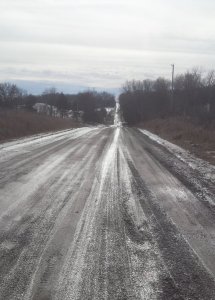
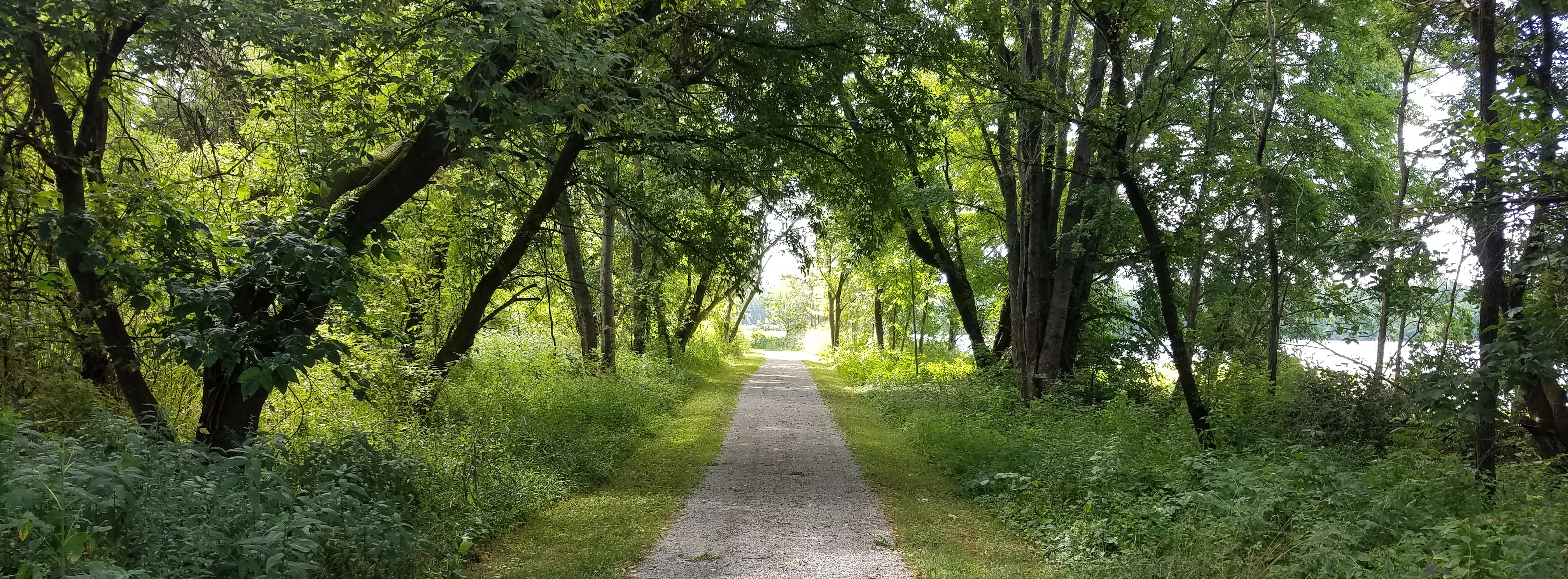
Lake Macbride State Park trail – Summer 2019

It’s time to move on. Yet… I would linger in this spectacularly Iowa summer.

It is a summer like those remembered from childhood. Long, warm days that stretch into a vanishing point. Cool nights to greet an early riser well before dawn. A never ending chance to find opportunity in a world which lies beyond the work-a-day society in which careers were spent.

No one can meaningfully say how many more of these days we’ll have before the atmosphere turns humid, making outdoors living unbearable. Despite the lack of rain, it’s been a good summer. A time to reap what we sowed and arrive into autumn.

A couple of things.

I’m tasting the first apples from two trees daily, evaluating sweetness and crunch, background color and appearance. While Japanese beetles invaded the leaves, there will be fruit for the kitchen. One doesn’t see apples like mine in grocery stores because they are small and imperfect from living in a pesticide-free environment. Commercial growers would have culled most of them for juice yet they are a main crop for the production of seasonal baked goods, cider vinegar, juice and applesauce if I need it. Picking and processing them will be a bigger project than usual.

Cucumbers, zucchini and yellow squash are winding down in the garden. Soon I’ll pull up the plants, till the soil and plant next year’s crop of garlic. I am only just learning how to cultivate garlic and looking forward to this second year of my own plants.

My bedside table got crowded with too many books so I need to set priorities for the rest of summer reading. Processing garden abundance will take time away from reading, so I expect to complete fewer books this month. I just started the novel Milkman by Anna Burns, which won the Man Booker Prize last year.

Tuesday colleagues from California met with U.S. Representative Adam Schiff (D-CA) who agreed to add his name to the list of sponsors of the No First Use Act introduced in January by Senator Elizabeth Warren (D-MA) and Representative Adam Smith (D-WA). The bill would establish by law it is the policy of the United States not to use nuclear weapons first, which is what most Americans believe. It was a positive step.

As it usually does, writing daily for Blog for Iowa while the editor was on summer hiatus inspired new interest in seeing the world through a progressive lens. The last of those posts appeared here this week, clearing the palate for new topics and better writing.

However, there are six more weeks of summer to enjoy.

Categories
Living in Society Social Commentary Sustainability

Anniversary No One Wants to Remember

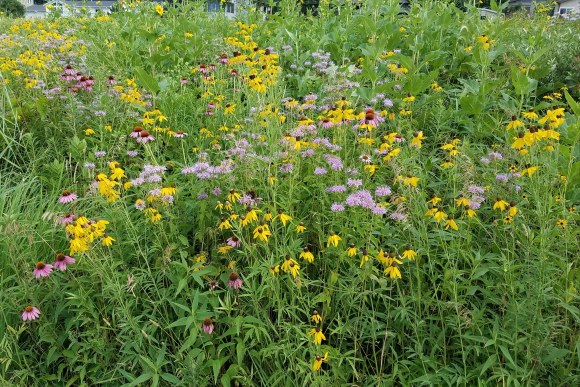
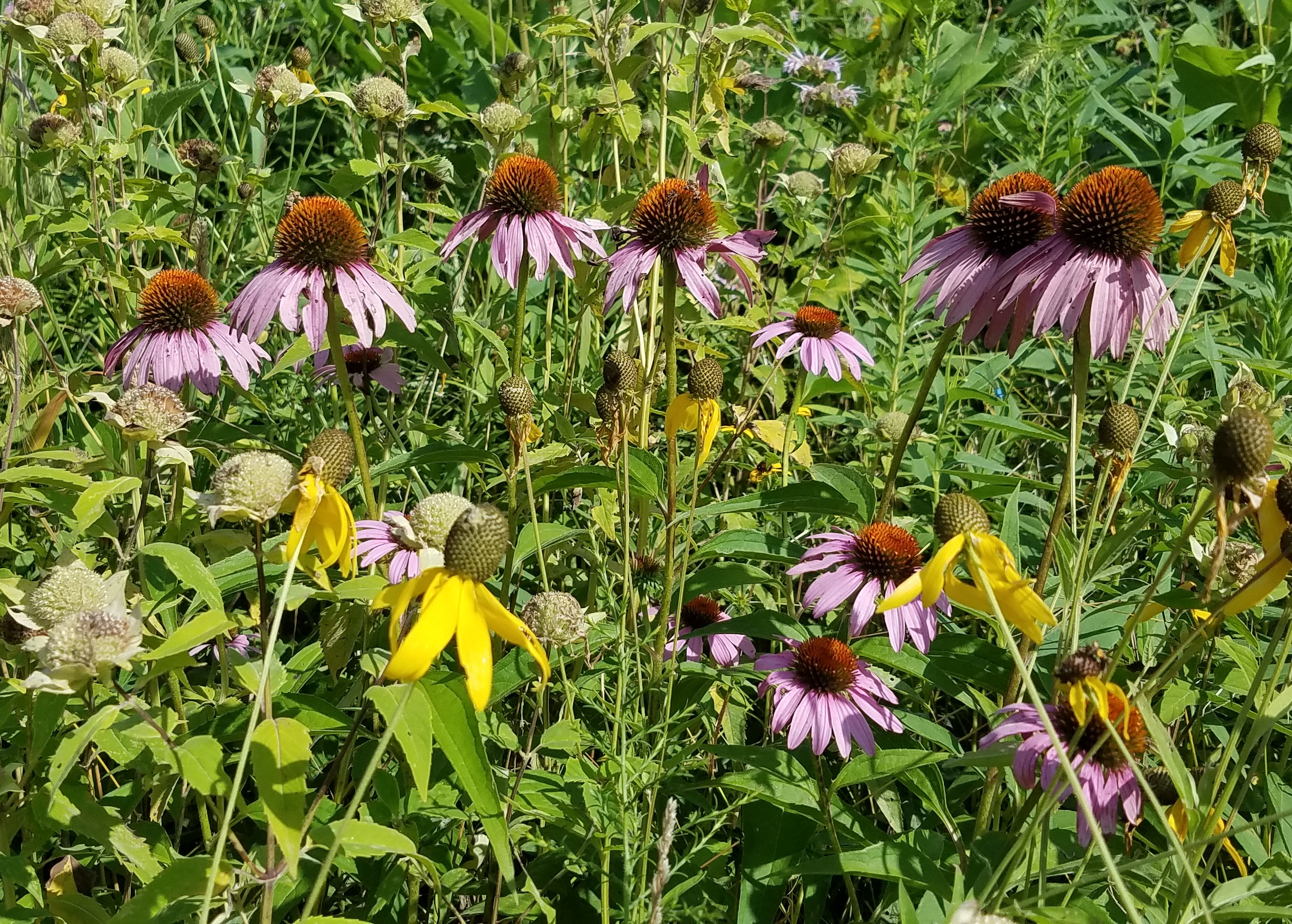
Wildflowers – Summer 2019

Friday will be the anniversary of one of the most sensational mass murders in United States history.

While the Aug. 9, 1945 atomic bombing of Nagasaki, Japan was far worse in terms of premeditation, number of human deaths, and physical destruction, I’m talking about the 50th anniversary of the murders of actress Sharon Tate and friends, followed the next night by the murders of Leno and Rosemary LaBianca.

I’d be willing to bet major news media coverage mentions the Tate-LaBianca murders and not Nagasaki. We’ll see grainy images of the late Charles Manson whose colleagues committed the crimes. Then the narrative will move on, perhaps to one of the president’s posts in social media, or some both-sider discussion of administration policy.

No one was prosecuted for the bombing of Nagasaki, even though it was the greater crime. Who will even remember Nagasaki other than nuclear abolition advocates and the few remaining people who were there?

Here is bomber co-pilot Fred Olivi’s account of his experience dropping the atomic bomb on Nagasaki:

Suddenly, the light of a thousand suns illuminated the cockpit. Even with my dark welder’s goggles, I winced and shut my eyes for a couple of seconds. I guessed we were about seven miles from “ground zero” and headed directly away from the target, yet the light blinded me for an instant. I had never experienced such an intense bluish light, maybe three or four times brighter than the sun shining above us.

I’ve never seen anything like it! Biggest explosion I’ve ever seen…This plume of smoke I’m seeing is hard to explain. A great white mass of flame is seething within the white mushroom shaped cloud. It has a pinkish, salmon color. The base is black and is breaking a little way down from the mushroom.

One would think the “light of a thousand suns” eclipses sensational coverage of a gruesome murder binge fifty years ago. We’ll see if major news outlets see it the same way on Friday.

Categories
Living in Society

Organizing the Organizers

Rural Newport Precinct

The Democratic Party seems on the brink of descent into a primal ooze as we now debate political staffers forming unions in campaigns. What’s there to debate?

Presidential candidate Pete Buttigieg gets the overarching policy right. “Freedom means the ability to organize in order to hold employers accountable and advocate for fair pay,” according to his website.

To the extent political campaigns employ anyone, those employees have a right to organize. That said, the articles, discussion and posturing about unions and campaign organizers organizing a union are a distraction from the need to defeat Donald Trump, hold the Democratic majority in the U.S. House of Representatives, and gain a majority in the U.S. Senate.

I have some questions about organizing the organizers.

Why?

Suzan Erem, who has been a consultant to labor unions, recently posted on Facebook, “no self-respecting union organizes workers whose jobs have at best an 18-month shelf life.”

Either an individual campaign provides a living wage and acceptable working conditions for employees or the candidate suffers the consequences in a primary election. If workers organize a union, the candidate should be willing to sign a contract quickly and get on with the campaign. When there are grievances, they should be timely addressed.

It is important to remember pay and benefits are not what leads talented people to work on a political campaign. The question of organizers unionizing should be a self-motivator for Democratic candidates. Employees have the choice to organize and it should mostly be part of the background noise of a campaign. It should be a non-issue.

Bandwidth?

“An unnamed person has alleged to a federal agency that the union representing some employees of Sen. Bernie Sanders’s presidential campaign did not properly address a grievance,” Sean Sullivan wrote in the Washington Post. A dispute between a labor union (United Food and Commercial Workers in this case) and a represented member is never good. When it escalates to the National Labor Relations Board, lawyers get involved.

As Sanders and his staff spend time and resources on this NLRB case and resolving any other grievances with their union, the clock continues to tick toward the Iowa Caucus and the dozen states with primaries and caucuses on or before Super Tuesday. Managing labor, organized or not, will take bandwidth.

When the union appears to botch the process as suggested in Sullivan’s article, it is a burden on everyone involved. Some other priority will be neglected while time is spent on this grievance. News outlets may pick up on the NLRB case and neglect covering candidate policy.

To What End?

The period of employment for paid campaign workers is relatively brief. Anyone who has worked on a campaign knows a lot of hours are involved. If it’s too much, why wouldn’t an employee go to their supervisor and ask for relief. If they are not satisfied with the way it is addressed, move on to what is next. It’s not like campaign organizing is a permanent career even if one is still working at it after beginning in the 2008 cycle.

Organizing a union is not always a speedy process. In the meanwhile, the election is just around the corner, after which employment ends for the most part and any union becomes moot. If the campaign is successful there may be another job in Washington, D.C. If it is unionized it would be a separate bargaining unit.

Most working people have an opinion about unions. I do too, and mine is multi-faceted. Unions have good intentions yet outcomes for rank and file members vary in efficacy. During a presidential campaign, especially during the primary/caucus portion of it, the main organizing has to be getting enough votes to get the candidate to the next stage whether it’s winning the primary or the general election. Organizing a union has to be done quickly and efficiently or it becomes a distraction.

~ Written for Blog for Iowa

Categories
Sustainability

Deteriorating Trust on Hiroshima Day

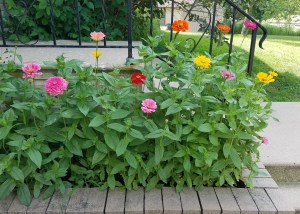
Summer flowers by the front door – August 2019

President Ronald Reagan famously said, “trust but verify,” about the 1987 Intermediate-Range Nuclear Forces Treaty (INF), quoting a Russian proverb.

The Trump administration believes Russia can’t be trusted, was in violation of the treaty, and formally withdrew last week. The Russian Federation accused the United States of being in violation and declared it was open to dialogue to resolve differences. It’s over now.

A background article on the INF by Kingston Reif of the Arms Control Association is here. Reif explains what our country has been doing to prepare for exiting the treaty, including exploration of options regarding new intermediate-range missiles capable of delivering nuclear bombs.

We knew we were in for the worst regarding foreign policy when Donald Trump won the 2016 general election. Our knowledge didn’t help us through the appointment of John Bolton as National Security Advisor, described as a malign influence on U.S. arms control and international security objectives. With Trump we entered a new arms race.

Last year, President Trump told reporters he wanted to work with Russian President Vladimir Putin “to discuss the arms race, which is getting out of control,” according to Daryl G. Kimball, executive director of the Arms Control Association. This seems all talk. Trump may be the first president since John F. Kennedy to fail to conclude any form of agreement with Russia regarding nuclear weapons. Without treaties, the door is open to a new and dangerous arms race, Kimball said.

In a time of America first, the administration has little appetite for elimination of nuclear weapons and wants more of them. They seem likely to let the New START Treaty expire and in so doing would create an arms control regime with no legally binding, verifiable limits on the U.S. or Russian nuclear arsenals for the first time in nearly half a century. Both countries are required to eliminate nuclear weapons by Article VI of the Non-Proliferation Treaty signed by 188 nations, the Holy See and the State of Palestine.

Dr. Maureen McCue, coordinator of Iowa Physicians for Social Responsibility, emailed a group of Iowans favoring nuclear abolition and her colleagues around the country this disheartening report:

At our booth at the county fair we spoke to almost 3,000 individuals and found that of all the issues and concerns out there, concern about nuclear weapons their costs, and risks was just not on the minds of very many.  On a list of seven concerns, it came in far to the bottom, dead last — even given the dangerous moves of this administration to increase spending on nuclear weapons updates and delivery systems… We live in dangerous times, but the opportunities to engage and educate a new generation are sorry lacking.

We must prevent what we cannot cure and eliminate nuclear weapons. The Trump administration seems intent on doing the opposite, opening the door to a new nuclear arms race. With every new nuclear weapon developed our likelihood of using them by intent or by accident increases. This is no kind of world to leave our children and grandchildren.

Aug. 6 is the 74th anniversary of the atomic bombing of Hiroshima, Japan. Who will notice what we should never forget?

Categories
Environment

Taking Seeds from the Prairie

Lake Macbride State Park, Summer 2019.

Is it wrong to collect seeds from a prairie restoration project for use in a home garden or another prairie restoration project?

I posed the question on social media. While the responses weren’t that many, they were a unanimous yes.

Not so fast!

“Stealing is stealing,” Cindy Crosby, author of The Tallgrass Prairie: An Introduction wrote.

A prairie manager I know was out for a stroll on his site when he came across a woman cutting buckets of blooms. Horrified, he said, “Lady, what are you doing?” She replied testily, “Well I tried to cut the flowers up by the visitors center for my party and they wouldn’t let me. So I came out here.”

Wildflowers will replenish themselves, right? Maybe and maybe not.

I asked our local state park ranger for his thoughts about harvesting seeds from prairie restoration areas. His response was speedy and made sense, “You are good to take seeds from the plants but just do not remove the plant itself and you will be ok.”

That’s good enough for me. I’ll be watching the patch of restored prairie for seed formation and try some of the varieties in our home garden.

Prairie used to cover more than 85 percent of Iowa land, according to the Neal Smith National Wildlife Refuge. Today less than one tenth of a percent of original tallgrass prairie remains in the state. A prairie restoration project, like the ones at Iowa state parks, is a work of human hands and culture.

People like Cindy Crosby have a personal investment in work they have done to restore prairie. Even if such restorations are anything but natural, and a constant struggle to keep invasive plants like garlic mustard at bay, they add cultural value in the form of habitat for plant and animal species and the narratives spun around them. We should tread lightly in their work, take what we need, and leave the rest.

Additional Reading:

Tuesdays in the Tallgrass, a blog by Cindy Crosby.

Tallgrass Conversations: In Search of the Prairie Spirit by Cindy Crosby and Thomas Dean.

Restoring the Tallgrass Prairie: An Illustrated Manual for Iowa and the Upper Midwest by Shirley Shirley.

~ Written for Blog for Iowa

Categories
Living in Society

State Auditor Rob Sand Speaks… Briefly

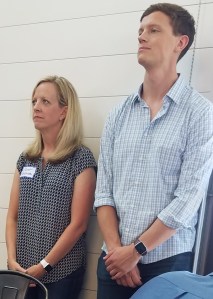
State Auditor Rob Sand and State Senator Janet Petersen waiting to go on stage at the Zach Wahls birthday fundraiser in rural Iowa on July 14, 2019

State Auditor Rob Sand spoke at the Zach Wahls birthday fundraiser in rural Johnson County on July 14. He was brief.

Sand’s brevity is becoming a feature of his political tenure. Those of us who hear a lot of political speeches appreciate his willingness to be brief, be brilliant, and then be done.

Blog for Iowa wanted to hear more from Sand so we asked him to participate in a questionnaire via email. He said yes. The questions and Sand’s responses follow, published without significant editing.

BFIA: What do you feel is most important about the first six months of your tenure as auditor? Why?

Sand: In just six months we have accomplished a lot of what we set out to do during the campaign. The office has never promoted efficiency, which I said I would do. Our new PIE initiative (public innovations and efficiencies) will do just that. In addition, very soon we have two individuals with law-enforcement experience starting in the office. I campaigned on the need for professional diversity in the office, and we are making it happen.

BFIA: In my previous article I pointed out the municipality that was dissatisfied with your predecessor’s annual audit of their books. How do you view the role of the state auditor’s office in helping counties and municipalities meet their statutory audit and financial review needs?

Sand: The most significant departure under my time in office will be that we will begin providing real assistance on efficiency and innovation. Historically, the office has not used its ability to do that. That changes now. We should always be doing everything we can to save taxpayer money.

BFIA: I noticed you are a hunter. How did that become a feature of your public appearances as auditor. What is your view of how Iowa DNR expends resources to support hunting and wildlife in the state?

Sand: I believe that most Iowans are interested in not just policy but also who you are as a person. I grew up hunting and fishing with my dad and still do it today, so it is a way for people to get to know me a little bit. Plus, there are endless puns is to be made about finding bucks.

While I have not done a specific review of DNR in my six months in office, I can tell you that the state needs to do a better job supporting hunting and fishing generally. There were a number of bills last year which were harming the ability to add public land for hunting or any other use.

BFIA: What do you like best about the job? Least?

Sand: Compared to prosecuting financial crime, which I was doing for seven years prior, it’s great to be able to wake up in the morning and work on making systems work better, and preventing bad before it happens. Prosecuting by its nature is entirely reacting to bad after it happens.

As for my least favorite part, I’m sure if I were a better politician I would tell you that every single moment is an honor. But since I’m honest, the part I like least are the trite and formalistic aspects of being an office executive from a paperwork and sign-off perspective. I prefer to dive in and do real work.

BFIA: What areas in state government seem ready to improve from an auditor’s viewpoint? Explain.

We are always on the lookout to make government more honest, operate with better integrity, and improve accountability. We also want to see improved efficiency. That applies to every part of government, and as soon as we stop looking for it or asking for it in one part, that’s where it will be needed most!

BFIA: What is your hope for the future of the state, from a personal standpoint.

Sand: I think we need a better focus on putting the public first. Partisanship needs to take a backseat.

A brief biography of Rob Sand can be found on his Wikipedia Page here.

~ Written for Blog for Iowa

Categories
Environment Kitchen Garden Writing

Summer Hump, August Heat

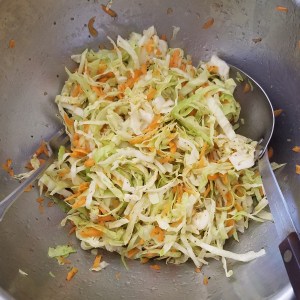
Mixing bowl with summer coleslaw made of local produce and my fermented apple cider vinegar.

Six weeks into summer 2019 we are over a hump, if not the halfway point.

I visited Paris in August 1974. It was hard to find a business open. Eschewing air conditioning we Americans find ubiquitous, Parisians fled the heat of August for the Mediterranean Coast and other breezy spots.

We could learn from that society.

My spouse visited her sister for the month of July. While she was gone I set the thermostat at 84 degrees compared to doing what we wanted in July 2018. The average monthly ambient temperature increased from 75 to 76 degrees Fahrenheit. Between running the air conditioner less and only one person active in the house, our electricity usage dropped by 37 percent in terms of kWh used. I appreciate the savings but I’d like her to return home more.

Summer in Big Grove Township has been reasonably nice with plenty of warm, sunny days, not enough rain, and an abundance from the garden. Friday the ditch had dried out enough I could mow the tall grass and get it looking more normal. The rabbit that lived there this year is likely frowning as rabbits do.

The yard grasses are in transition and need mowing, but not that much. I thought to do it yesterday and rolled up the garden hose near the house after watering in the morning. Not yet. Maybe today after my shift at the orchard. Maybe not as it is a low priority.

We planted our first garden in 1982 and grew or harvested something from our yard in the five places we lived since then. I’m getting better at it.

Cucumbers

We produced more cucumbers this year than we could eat and preserve. I determined a process using four varieties of seeds: two pickling, a Japanese-style cucumber and the utilitarian Marketmore. I made a gallon of fermented dill pickles as dill came in from my barter arrangement with Farmer Kate. The key to good pickles is the cucumber size. Once cucumbers get an inch in diameter they are too large for pickle making. Just don’t do it.

I made dishes of sliced cucumbers for potluck dinners, gave them away, and ate them as much as I could stand sliced raw, in mixed salads, and with lettuce greens when they were in season. There were plenty for sweet pickles but I overdid it last year and have more than a dozen leftover jars. I struck balance between the desire to use every bit of produce in the garden and how we eat them in season.

Tomatoes

As I posted a couple days ago, we are waiting for tomatoes. The cherries are coming in Jasper, Taxi, Matt’s Wild, Grape, White Cherry and Clementine. The White Cherry, Jasper and Matt’s Wild are surprisingly sweet and delicious. The single Early Girl and Black Krim plants produced fruit. I’ve had a couple Speckled Roma which I found to have tough skin.

This year as last, I planted the rows too close together. I crawled under the seven-foot indeterminate vines and inspected. A lot of good sized fruit waits to ripen under the foliage.

The plants have less blight this year than last. I don’t know why but two things are different. We had extremely cold weather last winter. Perhaps the cold killed some of it off. I also applied diatomaceous earth to the ground after tilling to keep down the crawling bugs that love tomatoes. Perhaps it had an effect on the blight. So far, so good and if all continues to go well, we will have plenty of tomatoes for fresh eating, canning and gifts to friends.

Green Beans

By now we’ve usually had green beans but there are hardly any on the plants. The foliage looks great. There are flowers. No beans. Other area gardeners are experiencing the same thing with a reduction in yield. I picked exactly two beans from a 15-foot row.

Apples

After nearly perfect pollination and fruit setting the invasion of Japanese beetles has the apple trees looking like dirty brown lace. I wait for the fruit’s background color to get right and have been tasting them every other day. The first of two varieties is getting close. Fingers crossed.

A friend sprayed his apple tree with Sevin to kill a Japanese Beetle infestation. The pesticide works although it contains carbaryl, a known carcinogen banned in some European countries. “Aren’t you worried about eating the fruit?” I asked. “Nah!” he said. I continue to refrain from using insecticides, which offer a temporary abatement to the detriment of the environment and apple eaters.

It’s a race to ripeness with popilla japonica. If bugs eat too many tree leaves, inadequate sugar is produced for fruit to ripen. If fruit gets ripe on the tree and they can penetrate the skin, they will mass on it and eat it. There appears to be enough green leaf left to absorb sunlight adequately to ripen the apples. I plan to pick them the minute I find them ripe and ferment the juice to make apple cider vinegar. The second variety, Red Delicious, is for eating out of hand, and everything else apple-related.

The Joni Mitchell song comes to mind, “Give me spots on my apples but leave me the birds and the bees.” In our garden there are plenty of apples and an abundance of birds and bees with whom I enjoy co-existing.

Categories
Living in Society Writing

When to Swallow the Red Pill

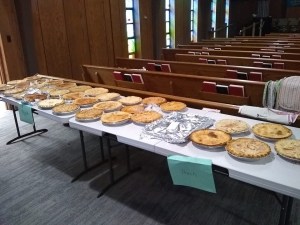
RAGBRAI riders stopped at the Norwalk Christian Church for pie. Photo Credit – Trish Nelson

Trish Nelson will be returning to the editor’s desk next week.

Among things she did while on hiatus was ride a couple days of RAGBRAI, posting this photograph of pies behind empty church pews. The image says something more although I’m at a loss to put words to it. It can speak for itself.

Time for me to go on hiatus for a while as well.

Tomorrow I return to the apple orchard where I work in the sales barn doing whatever is needed for the season. If I’m lucky, I’ll have great conversations with some of the thousands of guests who show up on a weekend. If I’m extra lucky, those conversations will be about apples, gardening and farming.

We political activists need to do our best work to elect a replacement for Dave Loebsack in the Second Congressional District and a U.S. Senator to make Joni Ernst a one-term senator. We also need to retain the hard-won seats of Cindy Axne in the third district and Abby Finkenauer in the first. If we have a candidate in the fourth district, there’s work to be done there as well. Those campaigns will have to wait until after the presidential preference in February, because a person can land only one plane at a time. I favor Rita Hart in the second district and Theresa Greenfield for U.S. Senate. There are no clinkers among those running in the primary.

As far as the Iowa caucus goes, I’m in the same boat as a lot of readers. I want to pick a candidate for president to work with after Labor Day. If I can’t decide which one by then, I may go to caucus uncommitted and join a group that needs one more person to be viable.

I expect to run our precinct caucus (because of a lack of volunteers) and don’t want to get into the unseemly discussions we had during the vote count in 2008. Being uncommitted would be a positive in that regard.

Democrats can’t afford to have winners and losers this cycle, so the pre-caucus dynamic is different from 2008 when there were 8-10 candidates for president and everyone worked hard for their guy or gal to be the one. The only thing that remains the same this cycle is Mike Gravel is running again. (Update: The afternoon of the day this was posted, Gravel suspended his presidential campaign).

Someone asked me who were my top three potential presidential candidates. I had to think, but came up with this answer:

Anyone other than Biden, Sanders, Warren and Harris needs a breakthrough by Labor Day (maybe Thanksgiving) to ouster these four poll leaders. Polls and second choices will drive the presidential preference Feb. 3.

If not this week, then soon, the less than one percenters will hopefully have made their point and gracefully exited the race to work on other Democratic priorities. I’m very sorry Senator Kirsten Gillibrand is in this group. She couldn’t get over the Franken blow back among Democrats I know and lost important donors. She is uncompromising on women’s rights.

Look at it this way. Once I figure out what/who I’m supporting I’ll swallow the red pill and follow the rabbit hole where it leads. With the primary in June, there’s plenty of time to work on Rita Hart and Theresa Greenfield after caucus.

Or look at it another way. If Warren had run in 2016, I would have worked hard to make her the nominee. I’m satisfied she’s not too old today. There’s no one else left in the top 4 besides Kamala Harris. I’m less than confident a woman can get elected in 2020. I don’t like most of the men.

So there’s my indecision. If I can’t decide by Labor Day I may not declare and throw my one preference to which ever group could be viable with it, except maybe Sanders.

The most important endgame is coming together once we have a nominee. Keeping the red pill in a waterproof vial for now.

Hope readers enjoy the rest of summer. Thanks for the clicks during the last five weeks.

~ Written for Blog for Iowa

Categories
Living in Society Social Commentary

Jimmy Carter and Prejudice Against Women

Jimmy Carter at the Iowa State Fair, August 1976 – Photo Credit – Des Moines Register

On Jan. 19, 1976, the day of the Iowa precinct caucuses that started Jimmy Carter on a path from relative obscurity to becoming the Democratic nominee for president, I was in U.S. Army Basic Training at Fort Jackson, S.C.

I didn’t really care who became president because anyone would be better than Richard Nixon.

As we now know, “Uncommitted” won the presidential preference that year getting 37 percent of the delegates with Carter coming in second with 28 percent. He became president and served for a single term from 1977 until 1981.

On July 19 Carter announced he was losing his religion. “Women and girls have been discriminated against for too long in a twisted interpretation of the word of God,” he said.

After six decades in the Southern Baptist Convention, at the point when leadership determined that women must be subservient to men, he decided to leave.

“At its most repugnant, the belief that women must be subjugated to the wishes of men excuses slavery, violence, forced prostitution, genital mutilation and national laws that omit rape as a crime,” Carter wrote. “But it also costs many millions of girls and women control over their own bodies and lives, and continues to deny them fair access to education, health, employment and influence within their own communities.”

The view that women are somehow inferior to men is not restricted to one religion or belief, he said.

Read Carter’s entire article in The Age here. What is the context for Carter losing his religion?

Earlier in July and before Carter’s letter, U.S. Secretary of State Mike Pompeo announced creation of the Commission on Unalienable Rights to examine the role of human rights in US foreign policy. It is expected the commission will be a vehicle to roll back protection of human rights in US diplomacy.

“What does it mean to say or claim that something is, in fact, a human right,” Pompeo said at the State Department according to CNN. “How do we know or how do we determine whether that claim that this or that is a human right, is it true, and therefore, ought it to be honored?”

“Words like ‘rights’ can be used for good or evil,” he said.

What is or isn’t a human right has been debated even though the Universal Declaration of Human Rights was adopted in 1948 by the United Nations. One can assume the same impetus that led Pompeo to embrace the Rapture is at work in this commission. I expect a new attack on women’s rights driven by the same prejudices Carter discusses in his letter.

At 94 years, Jimmy Carter continues to serve our nation and a global community. If there is justice God will forgive him for losing his religion to continue his efforts in pursuit of women’s rights.

~ Written for Blog for Iowa