In between kitchen duties of helping prepare our Thanksgiving meal, I spent time finalizing a seed order for the 2022 garden. Between Johnny’s Selected Seeds and Totally Tomatoes, I found most of what I needed to adjust the seed inventory before next year’s planting.
When our daughter left Iowa we lost our way during the holidays. Old habits fell away and Christmas decorations we displayed each year after Thanksgiving remain in storage as they have for the past several years. Given the changes, it is hard to determine the meaning of the end of year holidays. What they meant isn’t any longer. For the most part we embrace the change… and plan the next year’s garden, and other activities.
Behind these blog posts, a lot is happening related to my writing. Last winter’s work was one of getting words down on a page, an average of 1,218 per day during the first half of this year. This winter I’m putting together the structure and plugging drafts into slots on the narrative frame. I cleared a shelf which now contains a dozen empty three-ring binders. Inside them will go the draft book, along with key reference material. I hope to fill those binders during the coming months. I will have a better idea of what progress is possible after the first pass.
The days after Thanksgiving are a quiet time. We all need a break and thrive in peacefulness. On April 21, 1996 we bought our first home computer. During the last 25 years, we learned how to spend long periods of time in front of a computer screen. Most of that time is dull, yet occasionally we find something of interest. Something engaging is always a click away, or so we believe. The information comes at us so quickly on line. One story after another piles up, invoking rage, happiness, and joy, but seldom denouement or catharsis. When we are sitting, looking at a screen, we often get tense or anxious. Sometimes we are outraged, which causes us to stand up and converse with others, to let off steam, to slow things back down to a normal pace. We appreciate the relative quiet in between times.
This Thanksgiving weekend is an in between time. Now that seed orders are placed, the next main event will come along soon enough. It’s getting so I no longer look forward to “main events.” I would much rather be in between.
(Editor’s Note: The events in this retro post occurred on Friday, Nov. 25, 2011. I refer to my photo blog on Flickr, yet that has been deleted like all of my Yahoo accounts. I remember this home town adventure like it was yesterday. Many thanks to my friend Dan for taking the photos).
For a number of years, a grade school friend and I have been getting together in Davenport to talk and go to Blain’s Farm and Fleet the day after Thanksgiving. In a change of habits, except we did go to Farm and Fleet, we created a project to visit some of the places I have been posting about in my photo blog on Flickr and shoot photographs. We started at 8 a.m. when I picked him up at his parent’s home. A cup of coffee in tow, we got right to work, driving past his former home on Fillmore to my birthplace in this parking lot.
At My Birth Place
The parking lot is actually an upgrade from the vacant lot that sat for a number of years where the old Mercy Hospital was torn down. We both shared our experiences there, and then moved over to the church where I was baptized two blocks away.
Holy Family Church
When I secured a copy of my baptismal record to apply to the Bishop to attend seminary, I found they got my middle name wrong. In my experience in dealing with record keepers, this type of error occurs frequently. What is a person to do, as the wants of historical revisionists are not wanted by record clerks, most of the time. The historical record is what it is. After this, we continued South on Fillmore Street.
At the intersection with Locust Street, I pointed out the place where I heard JFK had been shot in Dallas. Continuing South on Fillmore we passed the duplex where I lived during my first year.
Fillmore Street Duplex
Continuing on, we came to the building where I attended grades two through six. It looks abandoned and the window in the room that was second grade was broken.
Broken Second Grade Window
We walked around the building and headed back to the church where I had parked my pickup truck.We drove by the former Geifman Foods, Northwest Bank and Trust and headed to Five Points where the Spudnut Shop used to be. It was gone, as were so many other neighborhood businesses from the old days.
We ended up by the old Turners Hall, which was a combination gymnasium and social club created by German immigrants and modeled after the Turnhalles in Germany. It too had fallen into disrepair.
Near the Turners Hall
Next we went to Fejervary Park which has long been a place for family gatherings. We checked out Mother Goose Land and Monkey Island and both looked to have renovations in progress. I found the stand of woods where my great grandmother’s family used to set out a picnic and converse in Polish.
Traditional Family Picnic Area
We drove past the place where my friend’s first house in Davenport had been located. It had been torn down. We drove past the Bishop’s old residence wondering if the Catholic Bishop still lived there. Next stop the place we moved after Fillmore Street at 919 Madison.
919 Madison Street
The hill is so steep on Madison I set the parking brake for the first time in over a year. We took lots of photos here, and the brick-paved street was particularly photogenic.
Madison Street
Next we drove downtown to River Drive past the old city cemetery where the cholera victims are buried in a mass grave. Turning left, we headed to Oscar Mayer.
Oscar Mayer Davenport Plant
I posted another photo of Oscar Mayer on my photoblog.
From here, East on River Drive, past KSTT Radio to where we lived behind the Wonder Bakery, now called Continental Baking. The house had been converted to a parking lot. Leaving there, we drove to Mississippi Avenue and stopped at the building where I had an apartment before leaving for the Army. I lived in the apartment in the second floor, far right window.
Apartment on Mississippi Avenue
As long as we were in the area, we stopped by the apartment on Walling Court where I lived with a high school friend while I was waiting to enter the seminary. It is located near where the jazz musician Bix Beiderbecke was born. From here, we wove our way around Grand and Farnum to Central Park and then the Village Inn on Harrison where we stopped, drank a cup of coffee and had bagels while we loaded the photos on my computer and reviewed them.
From here we went to Farm and Fleet and browsed the farm clothing. My friend bought some tins of popcorn for work presents and we dropped them back at his parents home where the women of the family were having a wedding shower. Threatened with our lives for intruding on the long planned, all female event, we headed over to the other family house, a few blocks away, where the men were gathered watching the Hawkeye v. Corn Husker football game, eating Kielbasa, bologna and ham salad sandwiches and drinking Kamikazes. We had lunch and I headed back to Big Grove around 1 p.m. It was a day about as good as they get.
Let’s be clear about Carbon Capture and Sequestration: it is an unproven technology to enable fossil fuel use when society should be turning away and leaving fossil fuels in the ground. Among the problems with the technology is our government supports it to the tune of $8.5 billion in the Infrastructure Investment and Jobs Act recently signed into law by President Joe Biden. There is more money for CCS in the Build Back Better Act as currently written. Why would our government do that?
The answer is a familiar one. Oil, gas and coal interests have too much invested to let go of their extraction and distribution operations. During negotiations between the White House and U.S. Senator Joe Manchin, support for CCS was included in both bills. Manchin’s vote was needed to pass the legislation.
In addition to funding CCS technology, the Biden administration appointed a prominent supporter of it, Brad Crabtree, a coal ally and longtime carbon capture advocate, to serve as the Department of Energy’s Assistant Secretary for Fossil Energy and Carbon Management. While negotiations over the infrastructure bills were private, Manchin is said to have had a hand in Crabtree’s nomination. Oil, gas and coal advocates let loose a loud cheer of approval upon the announcement.
The question is whether substantial government investment in CCS via the infrastructure bills was a poison pill for environmentalists. Only a few people are asking that question here in Iowa, and fewer still knew what was in the bills. Inclusion of CCS was apparently not too toxic for environmental hawks in the U.S. Congress as it was accepted as part of the sausage-making process of creating legislation.
The partisan lines are clearly drawn. The Republican view of climate action is “with innovative technologies, fossil fuels can and should be a major part of the global solution.” Most Democrats “support increased domestic renewable energy development, including wind and solar power farms, in an effort to reduce carbon pollution. The party’s platform calls for an ‘all of the above’ energy policy including clean energy, natural gas, and domestic oil, while wanting to become energy independent.” It’s no wonder CCS made it into the first infrastructure law, and will into the second if it is passed by the Congress.
The Iowa governor’s task force on carbon sequestration quickly led to Iowa going all-in on the technology, with two proposed Iowa projects. The Iowa Sierra Club opposes them.
We want real climate solutions – not greenwashing schemes!
Iowa has two new pipeline proposals. Both are centered around Carbon Capture and Storage (CCS). The lines would carry captured carbon from ethanol plants. CCS is very complicated but when you boil it down, the basic premise is that it captures the carbon and stores it underground (CCS) or it captures the carbon and uses it for industrial purposes. Both Summit and Navigator pipelines claim that they are going to permanently store the CO2 underground, but we have strong evidence that Summit will use the CO2 for Enhanced Oil Recovery (EOR). EOR is the process of pumping CO2 into dwindling oil fields to get the last bit of oil out of the ground. The two pipelines in Iowa are being offered as false climate solutions, especially if they will be utilized for enhanced oil recovery and extending the life of coal-fired power plants and the ethanol industry.
We already know the solutions to our climate crisis – we must end our dependence on fossil fuels and invest in solar, wind, battery storage, conservation and efficiency!
Days of the week have been differentiated. Defining a “week” with no work outside home seems essential to emerging from the ongoing coronavirus pandemic. Where are we on the pandemic?
According to CDC, less than 10 people died of COVID-19 in our county during the last seven day period. The actual numbers were “suppressed” on their website. The rate of admission to hospitals for COVID-19 is three per day for the same period. Our county has a high level of community transmission of the virus compared to most other counties in Iowa which are described as “substantial.” The percentage of positive tests for COVID-19 is on an upswing and expected to get worse as the end of year holidays are upon us. The county health department encourages us to get vaccinated if we aren’t, and to get a booster shot before December if we are eligible. The vaccine is available on a walk-in basis at pharmacies. We appear to have reached a period of stasis in the pandemic.
Some days of the week are better defined than others. Mondays are about catching up on desk work and starting new projects. Wednesdays are for shopping in person if needed. Fridays are for finishing up the week’s work, and the weekend is back to being the weekend with less travel and most activities occurring at home. Without effort on my part days would have continued to blend into an endless series of indistinguishable sunrises and sunsets. It is important to impose structure on our lives, so I have.
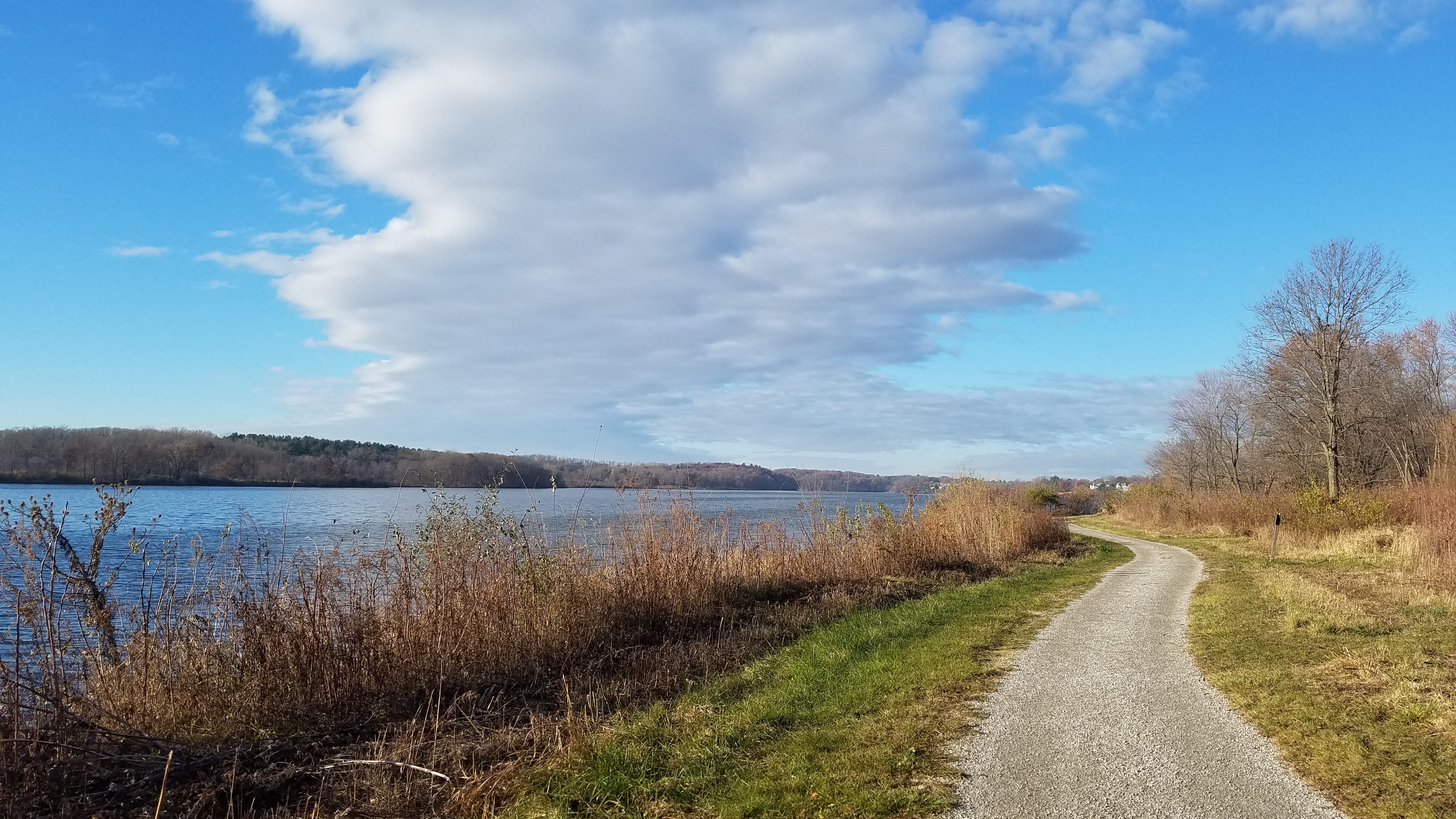
Every day I attempt to exercise. Of late, most of it was walking on the state park trail. When we chose to build our home here, proximity to the state park was an attractive feature. Not only is the trail well-maintained, the abundance of wildlife can be astounding. Waterfowl and birds alone are a constant source of wonder. The point is the exercise, though, and the trail serves.
We don’t know if or when the coronavirus pandemic will end. What you see is what you get, I suppose. Maybe it is over and we just haven’t said so. I plan to continue to wear a mask in public, especially when shopping, long after the threat of COVID-19 has diminished. There are plenty of other colds, viruses and contagions to avoid. If this is an eccentricity of the elderly, then so be it. I embrace it. I’m at a point where I don’t care that much how people view my appearance. I do want to fit in when in social settings, but there are lines to be drawn. I have plenty of N-95 masks.
The weather has been delightful this fall, with more temperate, clear days than we deserve. I’m planning to hike the trail again today, partly for the exercise, and partly to see the activity of a society of people and wildlife in transition. Here’s hoping there is change for the better.
Iowa City political event during the 2010 campaign. Note U.S. flag incorrectly displayed. We fixed it before the event began.
Voting and politics have been part of my life since the earliest days. I remember discussing Dwight Eisenhower with my parents. He was a Republican and we didn’t like him for that. When he started building the Interstate Highway System, it had a direct impact on our lives. We revised our position to say he wasn’t so bad and looked forward to cutting down the time it took to drive to my aunt and uncle’s home in Nashville, Tennessee.
Harry Truman was president when I was born. I have no memory of him in that role. I recall seeing news footage of Truman taking a walk from his retirement home in Independence, Missouri. Mostly, I reference his memoirs to see what he had to say about decisions he made as president. I’ve read the passage about his decision to drop the atomic bomb several times.
Father campaigned for John F. Kennedy in 1960. He had mimeographed canvass sheets he got at the union hall and diligently filled in the names of everyone on our block and how they would vote. When he finished our block, he worked on nearby ones. Kennedy lost Iowa to Richard Nixon and, as we know, won the general election.
The 1964 election of Lyndon B. Johnson framed the way I thought Democrats should govern. LBJ had a big majority in the legislature and was able to pass legislation. In his book The Vantage Point: Perspectives of the Presidency 1963-1969 he listed them inside the front cover. It’s a long list. If his political legacy is tainted by the war in Vietnam, it is dominated by many policies and legislation that changed the United States for the better. I was shocked when Hubert Humphrey failed to win the 1968 election as I felt he was cut in the LBJ mold and would be a great successor. Nixon beat Humphrey 301-191 in the Electoral College. It wasn’t even close.
I have nothing good to say about the Nixon years. 1972 was the first year I was eligible to vote and I don’t recall if I did vote for George McGovern. I remember some confusion about whether I could vote in Iowa City, where I attended university, or whether I had to vote at home. I recently wrote about the 1972 election and McGovern here. Nixon was a liar and it was with a sigh of relief I welcomed his resignation in 1974. I didn’t care who was president. Gerald Ford? Fine.
I didn’t vote in the 1976 election as I was engaged in military training. We were rid of Nixon, so I didn’t much care who was elected. My thinking was “America, figure it out.” From my perch in Mainz, West Germany I thought Carter was doing an okay job. I felt he was unjustly criticized for lack of support for the military when I saw the results of his policy and spending not far from my caserne. During a major field exercise in which I participated, our commanding officer would travel back to the states each week to provide an update to the White House. I saw some of the ideas we discussed in a tent in Germany turned into policy in Washington. It was a heady feeling.
Reagan was the beginning of the decline of America’s greatness with its focus on reducing the power of the central government, favoring the rich. Maybe we were just receiving a comeuppance after the LBJ years. The Reagan administration began overturning reforms of the New Deal, something that would persist with every subsequent Republican president. Each played a role in dismantling the social fabric we had come to depend upon. The years since then left us with with hyper-partisanship and a flow of wealth to a small percentage of people.
My early years, through exiting the military in 1979, were formative. It would be difficult to write about the politics as a separate topic in an autobiography. The challenge is to incorporate these stories in the flow of the book without having them dominate. Figuring this out is where I am this Monday morning.
It is a weird, in-between time in Big Grove Township. Since the beginning of the pandemic it’s been quiet. As people turn inward to family and friends for the end of year holidays it is quieter still.
Quiet is good. We need it to have a belief the world remains malleable. That it is possible to step into society anew. That reason will prevail. I need to have hope. Quiet helps yet it is not enough.
I hiked on the state park trail to the sound of weapons discharge. The season is ducks, geese and other waterfowl. I couldn’t tell the distance yet the shots sounded like they were coming from the reservoir or the Iowa River. I have not been a hunter, although I understand the interest in getting together with friends and doing things outdoors. Being in the military was the closest I had to what hunters experience. Live and let live, I say. That is, except for the geese and other wildlife.
I went to the orchard to get Gold Rush apples. The owner was there and we chatted about the new Iowa house district. We’re not sure how things will shake out, what with the eclipsing of reason by something akin to emotional ranting. In addition to being a long way from most towns in Iowa County, there are only 2,490 Democrats out of 10,783 registered voters there. If we are to win the district, the votes will have to come from Johnson County. I’m laying low on politics until I get the lay of the land in the new district. In addition to Gold Rush, I bought Honeycrisp and Golden Russet. The orchard had an overall great year, the best ever he said.
Jennifer Rubin wrote an article for the Washington Post titled, “It’s not ‘polarization.’ We suffer from Republican radicalization.” In it she writes,
While it’s true that the country is more deeply divided along partisan lines than it has been in the past, it is wrong to suggest a symmetrical devolution into irrational hatred. The polarization argument too often treats both sides as equally worthy of blame, characterizing the problem as a sort of free-floating affliction (e.g., “lack of trust”). This blurs the distinction between a Democratic Party that is marginally more progressive in policy positions than it was a decade ago, and a Republican Party that routinely lies, courts violence and seeks to define America as a White Christian nation.
Washington Post, Nov. 18, 2021, Jennifer Rubin.
I don’t know if this will blow over. I don’t think it will. Yet I’m going to lay low until we figure out an approach to resolving the problems. I believe reason will prevail, although reason is on the ropes at present and needs our help. There is no roadmap of which I’m aware. There was a bumper crop of apples, though.
Reverse side: Stella Marrs, P.O. Box 2273, Olympia, WA 98507.
I plugged in the grow light for the first time since summer to move a flat of Ajuga plants indoors. We reclaimed them from the yard, where they spread and spread, all the way down to the drainage ditch. We transferred them from my father-in-law’s home before he died in the 1990s. At the nursery Ajuga plants are quite expensive, maybe $6 per pot. We’ll have plenty at no cost but our labor if we take care of them. They grow like weeds.
On Thanksgiving I plan to lay out the 2022 garden and prepare the first seed order. Second seed order, actually, as I already have the onions and shallots to start in late December. I hope to clear the dining room table and sit down to consider what seeds we have and what we want to grow in consultation with my spouse. It could be a family tradition, one that means something special. We’ll see how it goes as I don’t want to get ahead of myself.
We are not big on year-end holidays and usually spend them by ourselves. Once we make that decision each year, everything hinges on how we feel. There is a slate of phone calls, emails and the like. Being a vegetarian household, the deer, geese and wild turkeys are safe from us as the meat culture is absent. Most people would call what we eat “side dishes.” At a point long ago we reviewed the nutritional values and found we had a well-balanced, if nontraditional Thanksgiving meal.
I don’t know where I got this postcard yet I like it. I do garden organically, although I gave in and started using composted chicken manure as fertilizer. It improved the yield. I don’t use manufactured herbicides or insecticides, organic ones work fine. I get organic seeds when I can find them. To see the face of the farmer, I look in a mirror.
Friday morning there was a partial eclipse of the full moon. It looked awesome set in a bed of bright stars. I couldn’t get a decently framed photo so I didn’t take any. Memory will have to serve.
We have provisioned up for Thanksgiving and have everything we need. If the orchard releases Gold Rush apples today, I’ll go get some along with a half gallon of cider. If the Gold Rush are not available, I’ll stay home and make my own cider for Thanksgiving. I saved enough garden apples in case I needed them.
With the holiday season upon us, the rush to year’s end has begun. 2021 is almost over and we are ready to begin again. I’m here for that. I’m looking forward to another gardening year.
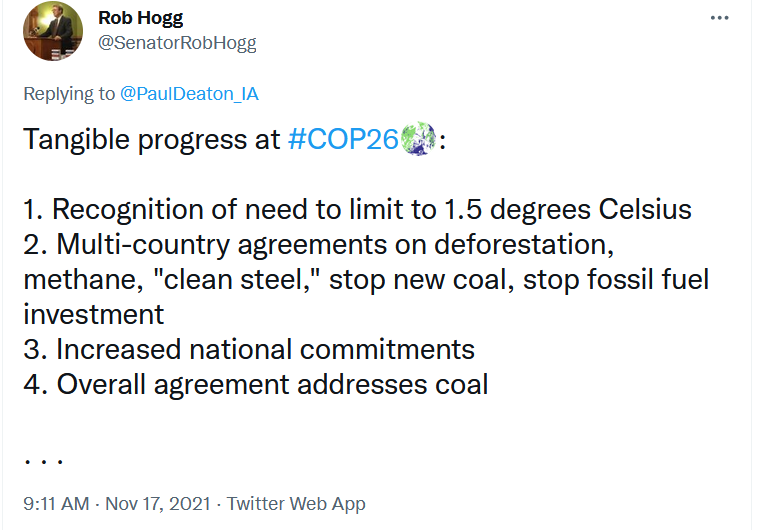
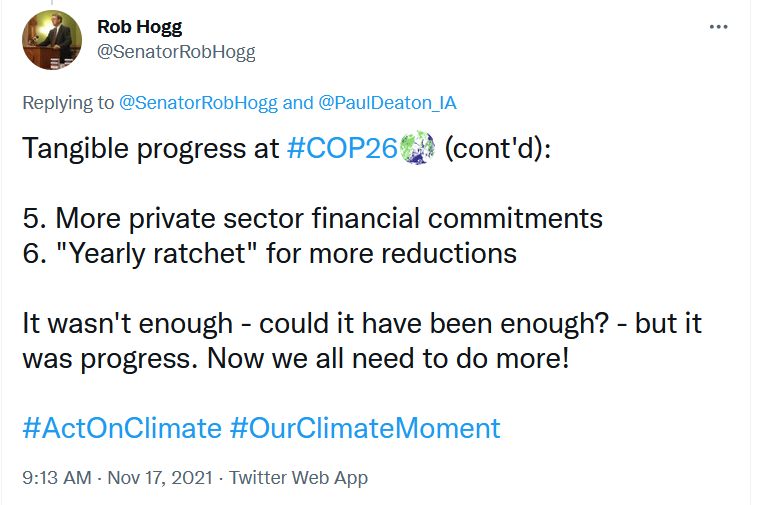
The 26th Conference of the Parties in Glasgow, Scotland seemed like a dud. My friend Rob Hogg corrected me on Twitter, posting:
So there were some positive developments. I’m reminded that zero countries is the number living up to their 2015 commitments to reduce greenhouse gases at COP 21 in Paris, France. It is difficult to let go the negativity when it comes to our collective lack of action on climate change.
On a video call a friend asked if we had installed solar panels to generate electricity for our home. I know our financial condition well enough to say it is unlikely we will because of the up front capital expense. We are doing okay financially yet know our limits.
“When it comes to climate change, we can’t afford to go backward—or even stay where we are,” former president Barack Obama said. “If we are going to act on the scale that’s required to combat this climate crisis, we all need to step up and meet this moment together.”
What does “together” mean? It means governments and a select group of non-governmental organizations and rich people that have the means to address climate change at scale. Behind Obama’s statement is the assumption we live in a democracy. Increasingly, we don’t, as floods of dark money buy our government, including the court system. An individual’s local actions matter, yet they are not enough, especially if one is the only person on the block generating electricity from solar panels.
Former Vice President Al Gore weighed in on COP 26:
Statement from Former US Vice President Al Gore on the Outcome of COP 26
“The Glasgow Climate Pact and the pledges made at COP 26 move the global community forward in our urgent work to address the climate crisis and limit global temperature rise to 1.5°C, but we know this progress, while meaningful, is not enough. We must move faster to deliver a just transition away from fossil fuels and toward a cleaner and more equitable future for our planet.
The progress achieved in the lead-up to and at COP 26 was only possible because of the power of people – young and old – using their voices to demand action.
Thanks to that advocacy, for the first time in 26 negotiations, leaders at COP 26 agreed to language that calls for a phase down of coal power and fossil fuel subsidies – a critically important step forward. Even more important, the deal significantly accelerates the timeline for nations to revisit and strengthen their net zero goals, calling for updates from every nation by the end of next year and a global convening by the UN Secretary General in 2023 to focus on more ambitious goals for cutting emissions dramatically by 2030. But despite that progress, there is much more that must be done – especially to deliver meaningful climate finance for both mitigation and adaptation to developing nations.
Ultimately, the outcome of COP 26 shows us that it has never been more important to hold our leaders accountable to their words and pledges. Advocates for climate action cannot – and must not – let up.
Six years ago, the Paris Agreement set a clear direction of travel that is moving the world away from greenhouse gas pollution and toward a sustainable future. The deal reached at COP 26 reflects the progress we’ve made in the intervening years and shows that the global community of nations is now in agreement that the era of inaction on the climate crisis must come to a swift end.”
Now is the time for government leaders, policymakers, business leaders, consumers, and activists in every nation to redouble their efforts and use the Glasgow Climate Pact as a springboard from which to drive bold action that will keep the goals of the Paris Agreement alive.”
It’s easy to become overwhelmed by the scale of the climate change problem. It is a problem, although against all reasonable efforts to educate, even that is in question for many people.
I wrote to my federal elected officials about how climate change impacted my life. I heard back from Rep. Miller-Meeks and Senator Grassley and am assessing their responses. I’m using my voice to raise the issue with my federal elected officials. Their response falls flat.
We have the tools we need to solve the climate crisis. That seems certain. Yet a society that is interested in supporting the richest among us more than taking care of each other is morally bankrupt.
The latest revelations about the Trump administration’s efforts to manipulate the Centers for Disease Control and Prevention at the beginning of the coronavirus pandemic are evidence that the highest office in government was willing to use mass-death as a political weapon at a cost of hundreds of thousands of lives. What kind of human can support that? Yet Trump flags fly unabated in our neighborhood. It is clear the previous administration was going to do nothing about the climate crisis. If they get back in office after the 2024 elections, they will set about undoing what Biden got started to address climate change and more.
In this context it is important to ask, “What will it take on climate change?” From these quotations and more, we know it will take action on a scale only governments can provide. Yet we can’t be reduced to helping political candidates we favor get elected. There is something more at stake. Regardless who holds political office, governments must act on climate change. There will come a time, and soon, when it will become obvious to even the most prominent naysayers we have to act. So we keep plugging away and hope we are not already too late.
Like most people, I want a decent meal when it is time to eat. In 2012, I launched a major study of the local food scene and was not disappointed in the results coming into and out of our kitchen. By working at a number of farms, growing and expanding our home garden, and participating in legislative advocacy, I learned so much about where food originates and conditions which engender growth of a variety of fruit and vegetables.
The impact of local food systems on our home life reached its peak in development of the kitchen garden idea. Now that the work is finished, I have less interest in writing regularly about food. It is an assumed part of a background against which I pursue other interests. I’ve learned what it means to know the face of the farmer. I maintain an interest in doing so. I just won’t write about it as often. Mainly, others are doing a better job of writing about our food system.
Food is basic to a life. It is not the most important thing. I am glad for the work I did, yet I feel it is finished. It is time to concentrate on more important aspects of life. It is time to keep a focus on life closer to home.







 Journey Home
You must be logged in to post a comment.