At seventy years life looks different… going forward, I mean.
There’s no changing anything that was done. We revisit the past partly for discivery, and to put new spin on it. That’s human nature and it is okay, yet not always good. Despite our revisions, we possess an outlook toward understanding who we are now in context of the past.
Things are clarifying while working on my autobiography. I don’t believe my whole story has been told so I keep at it. Even when it is finished and out there, I expect few will read it. The story is to help our child understand who I was if they have interest. They have separate memories to nurture.
What are the things that made a difference in my life? There are not that many.
I was born to a family that valued my presence.
Despite familial value, I was injured and hospitalized at age three due to an easily preventable home safety hazard.
Father died in an industrial accident when I was 17 years old.
The company where father worked awarded me a college scholarship that paid most of my expenses.
For 12 weeks I traveled in Europe after college graduation.
After the Vietnam War, I enlisted in the military and lived in West Germany for three years.
Married in 1982.
Started a career in transportation and logistics that lasted 25 years, as well as into my last paid job.
A child was born in 1985.
Moved to Indiana and then back to Iowa.
Had financial means to retire from transportation at age 57.
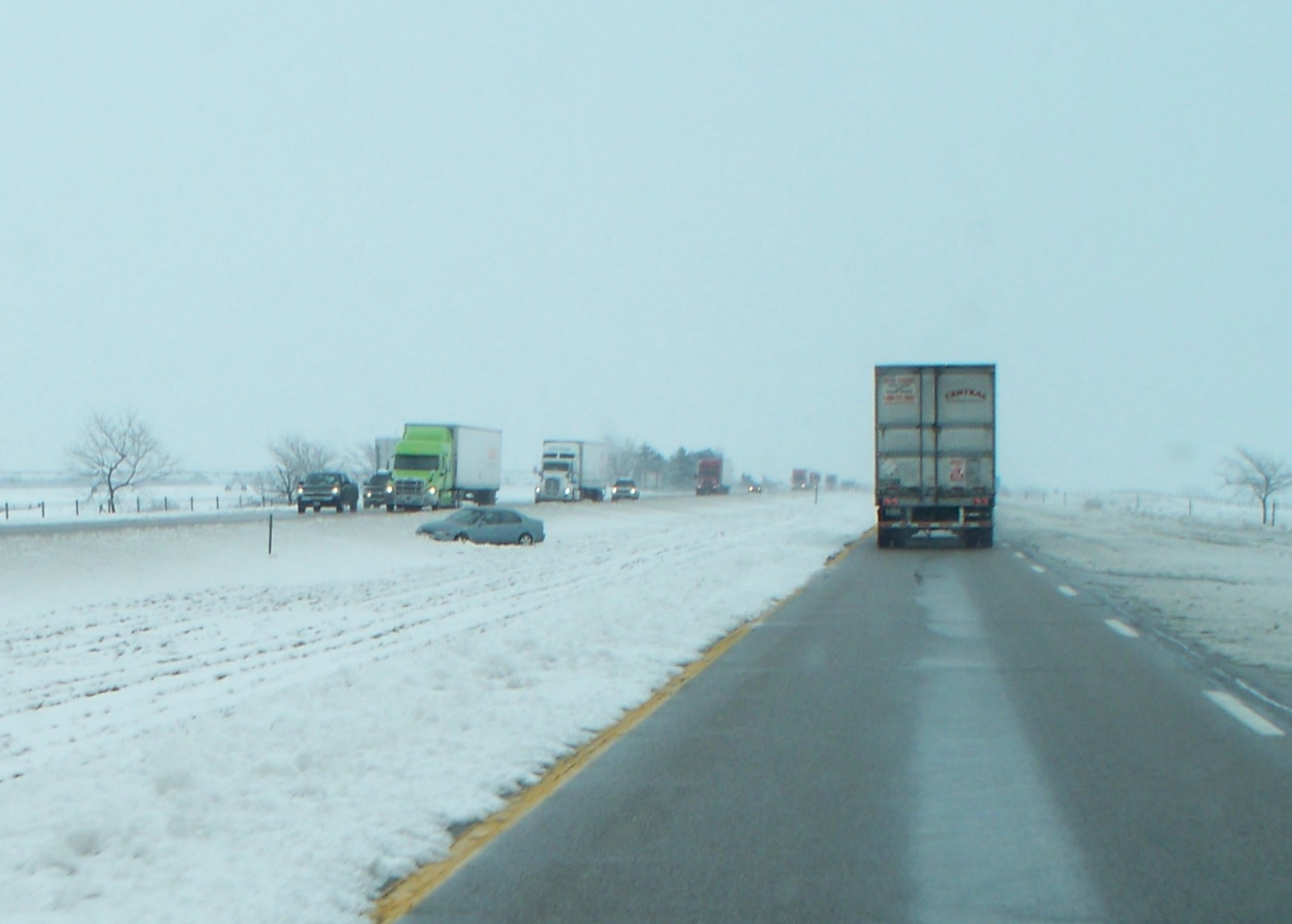
Experienced extreme weather and the coronavirus pandemic.
My birthday is later this month yet I wanted to gain perspective by making this list. The next ten years, should I be so lucky, will be a time of contributing to society while at the same time receding from view so others can step forward. I don’t know that any major milestones lie ahead yet I’m confident I will do useful things with my remaining time.
It has been a life with its troubles. It has been a life well lived.
Yesterday’s news was workers at Kellogg’s cereal plant in Memphis, and at plants in three other cities, rejected the company’s terms during contract negotiations. In response, the company posted this statement on its website:
The prolonged work stoppage has left us no choice but to hire permanent replacement employees in positions vacated by striking workers.
Long-time readers of this blog may know my beliefs about unions are complex. I’ve been on all sides of the negotiating table, from being a union employee or part of a business unit that attempted to organize a union, to being part of management of union employees or business units that attempted to organize. In my work recruiting truck drivers I once crossed an unrelated picket line in Flint, Michigan to do my work. Nonetheless, in 2021 I am sympathetic to unions, private sector unions particularly. When people called for a boycott of Kellogg’s consumer products, I wanted to help.
A challenge I have is that of the hundreds of products Kellogg’s produces and sells, only two in one brand, MorningStar Farms®, are something we regularly buy. We will stop purchasing them immediately, although there is enough already in the freezer to last for a long strike. There are plenty of other protein sources in our vegetarian diet. Kellogg’s and others in the distribution chain will lose about $20 per month in revenue from our household.
The trouble for striking workers is the company is within its rights to hire replacement workers. Whatever outrage people are able to muster, it doesn’t matter to the company’s desire to continue using their investment in these plants to produce products. For the most part, consumers are not paying attention to this labor dispute and their consumption patterns are expected to persist.
Part of the reason for a lack of attention from consumers is since the 1970s U.S. cereal sales have declined as consumers choose more protein-based breakfast options or skipped an early morning meal completely. In our household, if we buy cereal for breakfast, it is organic steel cut oats which does not come from one of the major cereal manufacturers. I typically eat oatmeal during winter. Striking workers have additional problems to face than whether or not to accept Kellogg’s contract.
Our family boycotted grapes when Cesar Chavez and Dolores Huerta called for it in the 1960s. That strike of farm workers over working conditions went on for five years. The Kellogg’s strike was called in October, with a decision to hire replacement workers this week, indicating how quickly the company is willing and able to move.
Kellogg’s operates a global supply chain in which many parts are unseen by a local plant worker. The company could easily shift cereal production to Mexico as others have done. From a global perspective this would be a minor adjustment in the supply chain.
The teeth have been removed from boycotts of consumer products. While admittedly unusual in my shopping patterns, during most trips to the store I don’t go down the aisles where Kellogg’s products are sold. As a result of the coronavirus pandemic, many people don’t browse the way they did previously while shopping. They get what they know specifically, except for in the produce department where a shopper must pay attention to quality. This behavior has implications for workers at Kellogg’s and other processed food manufacturers.
Our small outpost of support for striking Kellogg’s workers will continue as long as the strike lasts. If the company does hire replacement workers, we can move on and not purchase any of their products again. We’ll miss our recipe crumbles, yet not that much.
Editor’s Note: News the strike with Kellogg’s ended reached us Dec. 21, 2021. Happy Holidays to all.
The language used by supporters of carbon capture and sequestration in Iowa is very specific. Not only doesn’t it include the words “climate change,” it specifically avoids mentioning it. This is a long-standing practice among major agricultural groups.
As mentioned last week, Iowa is primarily a production landscape for hogs, cattle, corn and beans where our water, air and land have been and continue to be used like an open sewer. The major agricultural groups are the Iowa Pork Producers Association, the Cattlemen’s Association, the Iowa Corn Growers Association, and the Iowa Soybean Association. Agricultural Iowa is about business at a distance from the meme farmers are the original environmentalists. To them, carbon capture is about business, not reducing greenhouse gas emissions or stewardship of the environment.
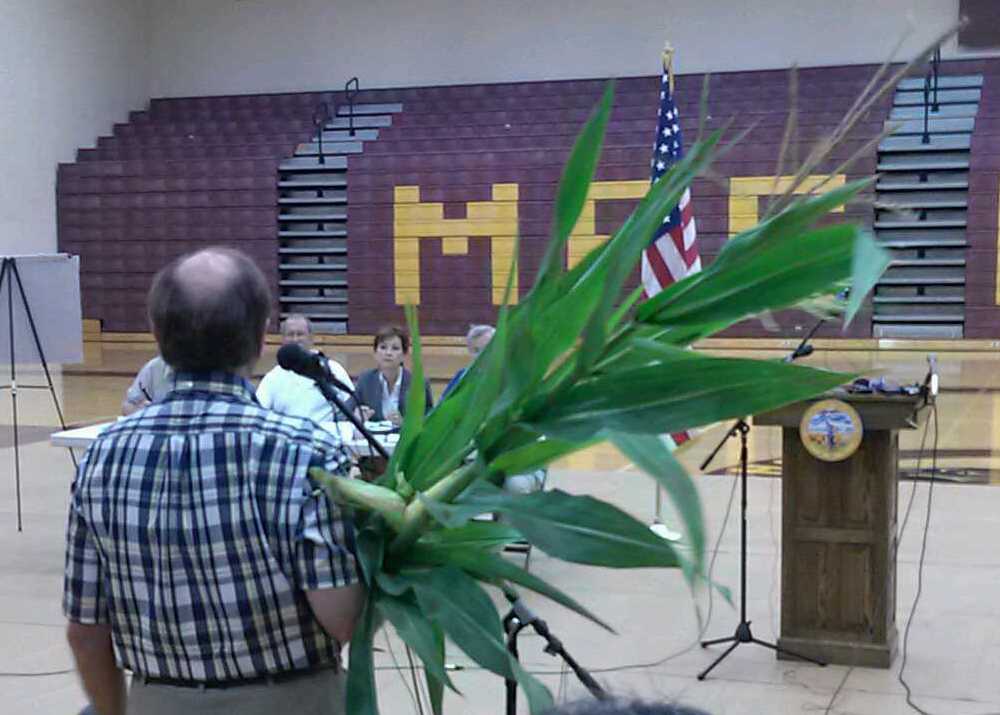
Representatives of these agricultural associations showed up in Mount Pleasant, Iowa during the 2012 drought. Governor Terry Branstad and Lieutenant Governor Kim Reynolds heard their report. The words “climate change” were absent from public discussion of the drought.
The eight hundred pound gorilla in the Mount Pleasant High School Gymnasium today was the subject of climate change. Governor Terry Branstad called for a public discussion on drought conditions in Iowa and all of the governmental players were there: USDA, Iowa Department of Natural Resources, Iowa Department of Agriculture and Land Stewardship, Iowa Department of Homeland Security and Emergency Management and the Farm Services Administration. The phrase “climate change,” or any analysis of causation for the current drought was absent from the public discussion. This was a meeting about row crop agriculture and related agricultural producers and it was intended to deal with the as-is situation. The obvious problem, as Mark Schouten of Homeland Security and Emergency Response put it, “you can’t snap your fingers and make it rain.”
The eight hundred pound gorilla has returned to Iowa as the Iowa Utilities Board hears the case for Summit and Navigator to implement carbon capture and sequestration systems which include hundreds of miles of buried pipeline. The language is familiar in its avoidance of discussion of climate change.
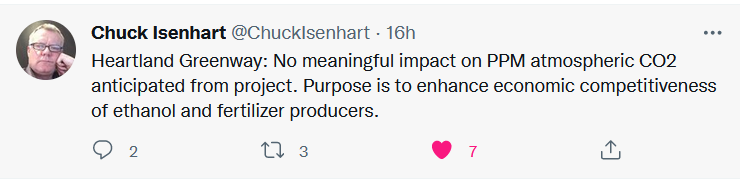
On Monday, Rep. Chuck Isenhart attended a public information meeting held by the Iowa Utilities Board for the Navigator project in Manchester. He used Twitter to relay news from the meeting. If landowners were most concerned with restoration of land productivity in the event the CO2 pipeline crossed their property, following is a main point about the absence of climate change from the discussion:
While the project as proposed would offset the CO2 equivalent of 34.7 million barrels of oil annually, according to Isenhart, “No meaningful impact on PPM atmospheric CO2 anticipated from project.” What is the project about if not reducing greenhouse gases like CO2? “Economic competitiveness of ethanol and fertilizer producers.”
States like California and Oregon have already begun to move toward a low carbon economy, including debate on whether ethanol is a “low carbon fuel.” Let me settle it this way. Summit and Navigator are spending more than a billion dollars to ship condensed CO2 from ethanol and fertilizer plants and bury it deep geological formations. Seems like a lot of carbon dioxide production to me. Why are they doing that?
The delay by the Biden administration in release of volume requirements in the Renewable Fuel Standard for 2021 and 2022.
The ethanol industry suffered major setbacks in court with the loss of year-round E15 and at the Supreme Court on a small-refinery exemptions case.
In response to policies like the Renewable Fuel Standard, California Low Carbon Fuel Standard, and Oregon Clean Fuels Program.
President Biden rejoined the 2015 Paris Agreement.
The debate among environmentalists is whether a decarbonized economy reaches net zero emissions or zero emissions. In either case, pairing ethanol and fertilizer production with CCS doesn’t meet the requirements.
The more study of the matter, the clearer it becomes that the Summit and Navigator projects are about making ethanol “competitive” should the economy decarbonize. It is a big hedge against a government directive to eliminate the financial and policy incentives to produce corn for ethanol.
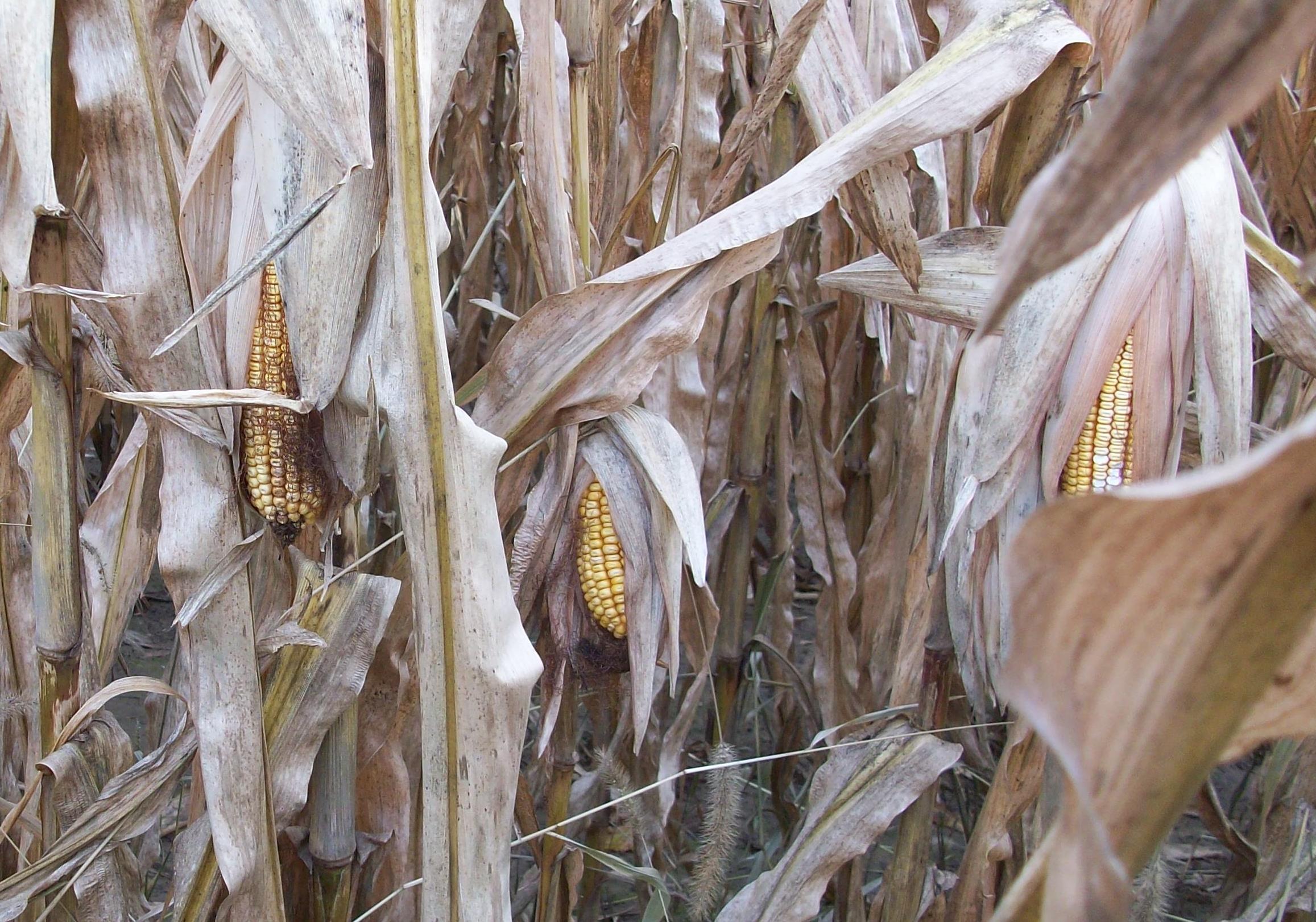
Opposing production of corn ethanol is not a popular position in Iowa because more than half of corn raised is feed stock for ethanol. However, it is the right position.
Miller-Meeks attended COP26, but her record on climate isn’t promising
To address global carbon pollution everyone must get involved. Even Republicans understand this. In response to the climate crisis, and to political pressure, Republican Congressman John R. Curtis (UT-03) launched a “Conservative Climate Caucus” last June. My member of Congress, Rep. Mariannette Miller-Meeks joined.
Solutions to the climate crisis will take government at all levels. In the United States, only the federal government has the reach to take effective national action which could impact the globe.
To my surprise, Miller-Meeks showed up at the 26th Conference of the Parties in Glasgow, Scotland, where she participated in a podcast with other caucus members extolling the positions of conservatives on climate.
“As a member of the Conservative Climate Caucus this issue is important to my colleagues and myself,” she wrote me in an email.
Well okay. Welcome aboard, I think.
Miller-Meeks’ votes against the Infrastructure and Investment Jobs Act and the Build Back Better Act, both of which address the climate crisis, indicate she is not really on board with federal climate action.
For a Republican to admit they have a problem is the first step toward recovery. Let’s hope Miller-Meeks can resist her addiction to D.C. talking points and do something positive to address carbon pollution.
~ Published in Little Village Magazine Dec. 6, 2021, Iowa City Press Citizen on Dec. 8, 2021, Cedar Rapids Gazette on Dec. 11, 2021.
On walkabout I saw the damage to the Mulberry tree. From the stain emitting from the cracked trunk, we can tell it was trauma. I suspect it was damaged during the Aug. 10, 2020 derecho. Because the damage faces Northeast, away from the house, it wasn’t noticed until now.
I’ll observe the progress of the wound to see how it goes. I believe the tree is a goner, yet will let nature take it’s course. I’m in no hurry to take it down with a chainsaw.
While the mulberry was a junk tree presumably from a seed dropped by a bird sitting on a length of rebar left by a surveyor as a property marker, it has been with us for our whole time here.
It produced berries, mostly for birds, and there may be more crops ahead. It is the last of two volunteer trees growing here when we bought the lot.
If it dies or falls apart I won’t replace it with another. It’s trunk grew to straddle my lot and two adjacent ones. It’s better to keep trees on my side of the line. One should not rush into tree management. Decisions made today are consequential for years to come. Sometimes we make the wrong decisions as I have.
After a quarter century, I’m getting to know the lot we developed. It is time to get outdoors and spend more time in the environment in which we live. Even if that means little more than walking in the yard.
I added a walkabout to my daily routine. Once the sun rises, and after I finish daily writing, I leave by the garage door and walk the property line of our 0.62 acre. Each day I saw something unanticipated.
The condition of trees, activities of squirrels and birds, and windblown trash deposited on our lawn. The walkabout provides an opportunity to take stock of our land and consider what needs doing, what should be left alone. I’m discovering a lot of neglected work.
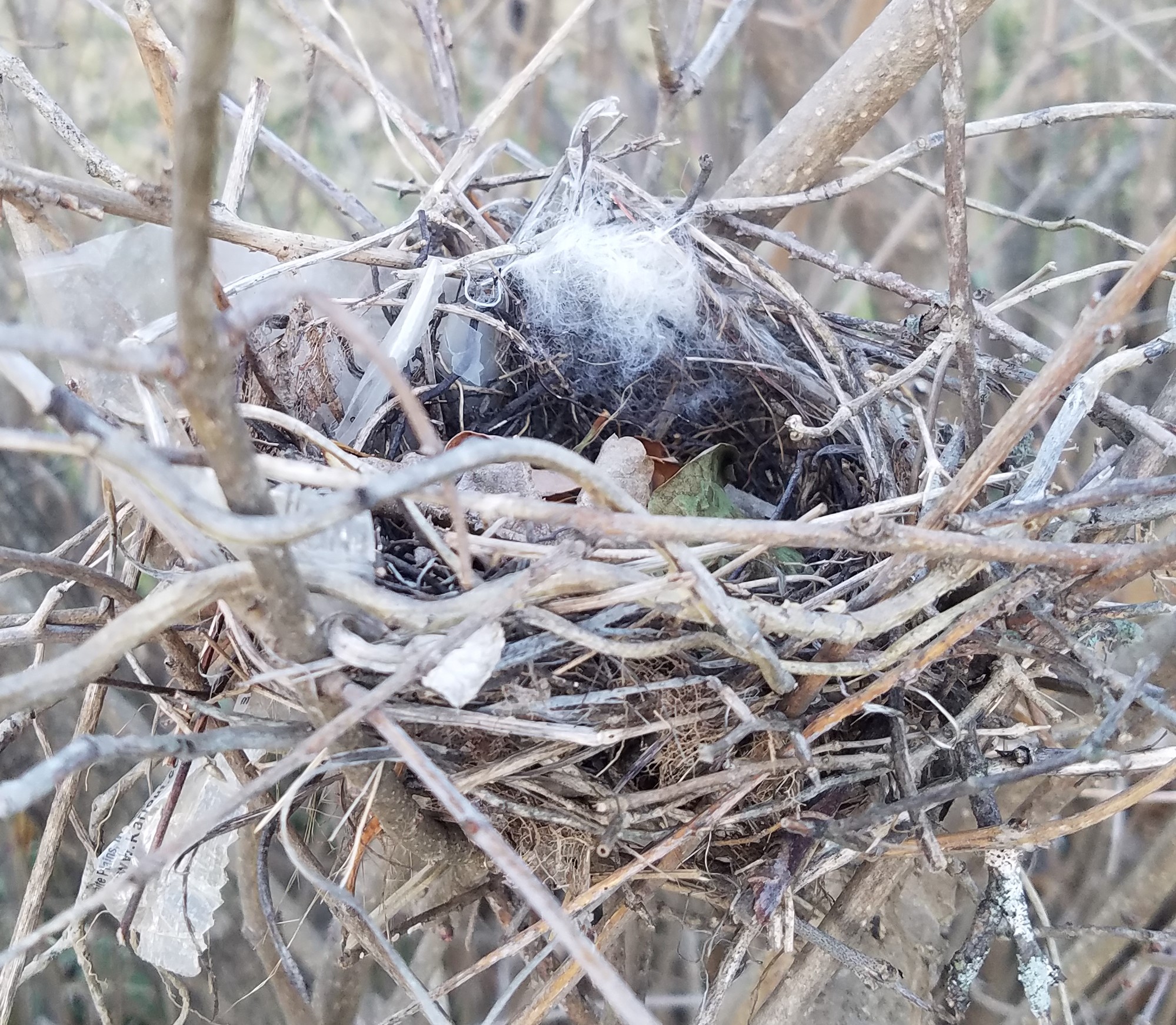
There are at least three bird nests I’ve found. I’m amazed at how they take found objects and craft them. Anything pliable seems a likely building material, including plastic wrap and bits of fiber. I don’t remove the nests unless they fall from the tree or bush. For the most part they are woven into live branches with a sense of permanency.
I’d forgotten how large our yard is and how many distinct landscapes are in it. As we head into winter the walkabouts will be a time for observing, thinking, and planning our landscape. I don’t know how I went so long without this as part of each day.
2021 has been a great year of progress in the kitchen garden. As the seed orders find their way to us via U.S. Postal Service, some reflection on the positives seems in order.
Apples
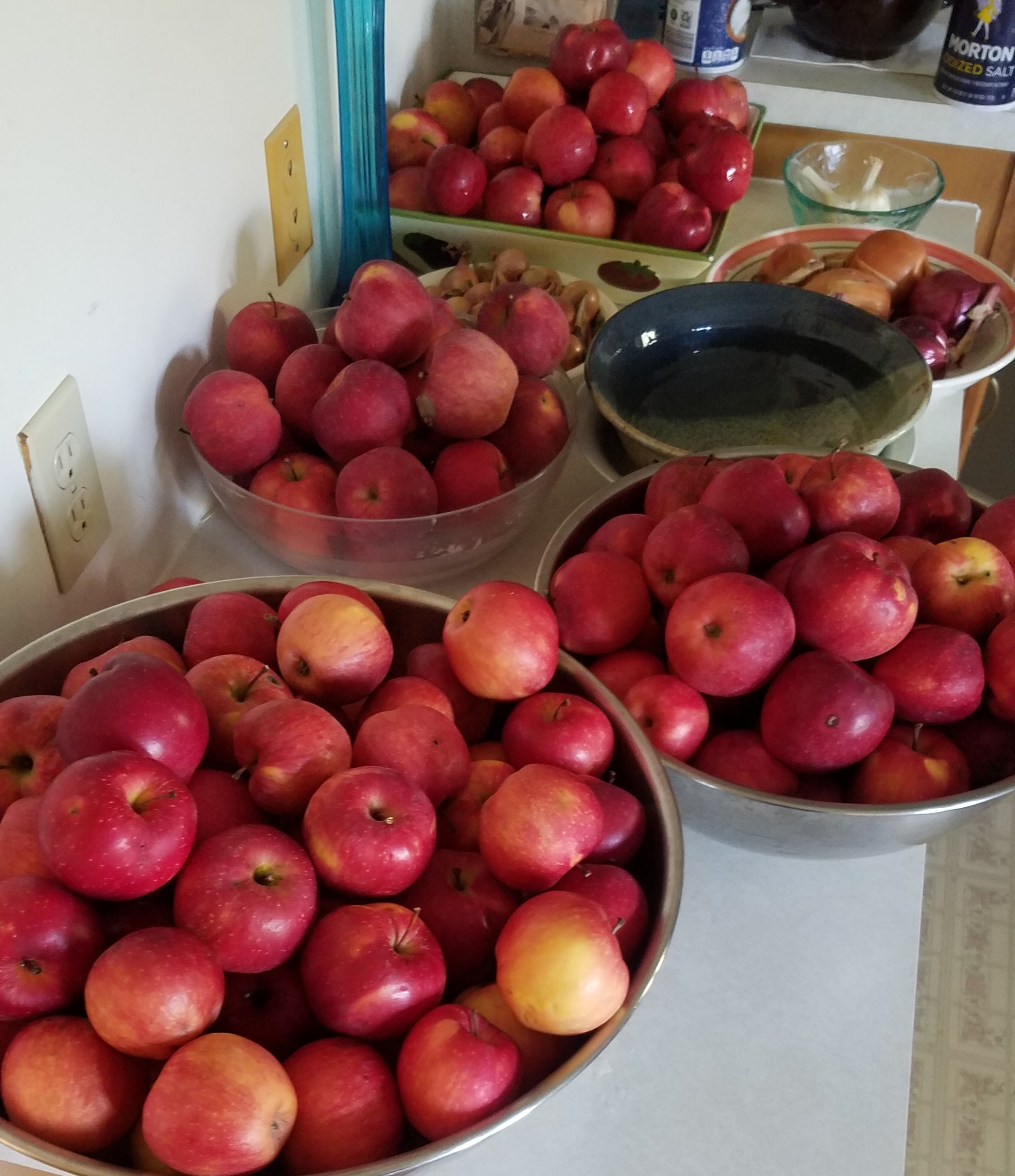
This has been one of the best years for apples. In our yard the three legacy trees bore abundantly and we used them for everything we needed. At the orchard (by this I mean Wilson’s Orchard and Farm, where I worked from 2013 until 2019) there was an abundant crop to supplement the two varieties that yielded here. The pantry is loaded with everything we need in terms of processed apples. We should have enough apple butter, applesauce, dried apples and cider vinegar to last two years until the next big crop. If our trees bear next year, that will be a bonus.
We had enough to take what we needed, let our neighbors pick some, and plenty for the deer once we harvested the best ones. The combination between our trees and a nearby commercial orchard meant we didn’t have to buy a single apple from the grocery store.
Vegetable broth
Each garden year begins with a couple dozen quart jars of vegetable broth. As I grow a diverse number of greens, I switch which ones dominate. Turnip greens have produced a consistently tasty broth, yet they all are good. We use this broth to cook rice, in soups, and as an alternative to using oil when frying vegetables for some dishes.
Guajillo Chilies
It took a few years but the integration of Guajillo Chilies into our cooking is complete. The main product is a cooked and preserved pepper combined with garlic, salt and apple cider vinegar in a food processor. Once the fresh chilies are gone, this becomes the main way I use chilies in cooking. I tried the technique with jalapeno peppers and while a little hotter, it also serves for our culinary needs.
Polish-style Soup
When growing up, Mom’s cooking was pretty “American.” That is, outside the occasional Polish-style ravioli brought home from visits to LaSalle, Illinois, Polish heritage cooking was absent. That was also true of memories of my maternal Grandmother who often found paid work as a cook in settings where American cooking prevailed. It was discovery of the cook book Treasured Polish Recipes for Americans by the Polanie Club that enabled me to come to terms with my heritage.
Based on studies of the soup chapter, I developed a consistent soup recipe that uses vegetables grown in our garden. The ingredients in the book were the same as what I have been growing for years. The main characteristics of the soups are they are thickened with barley, I add lentils as a source of protein, and use onions, celery, broccoli stem, parsley, grated zucchini and other frozen vegetables from the growing season. I use whatever greens are in season, and frozen kale if they are not. I also add potatoes, turnips, and whatever root vegetables are on hand. Settling on a soup recipe has been a long time coming.
Sweet Bell Peppers
After years of experimentation I finally produced enough bell peppers to eat raw, use in cooking, and preserve in the freezer. This was a watershed year.
Tomatoes
I grew the largest number of tomato plants ever and had plenty to eat fresh, can, freeze, and give away. The main successes were:
Developing a method to extract moisture and freeze the pulp into small servings using a cupcake pan was a breakthrough. The idea is to use a couple of tomato “buttons” to make pizza sauce for our weekly, home made pizza. I use them in everything to add a small amount of tomato sauce when needed.
I learned to grow enough Roma tomatoes so I can use them to can whole. I’m still working off a backlog of preserved tomatoes, but the system is in place for growing to match canning needs. Romas are the best to can whole.
Our local food bank welcomed my extra tomatoes. My weekly seasonal donations took the pressure off of using tomatoes in a timely manner.
I grew a wider variety of tomatoes this season, maybe 25-30 varieties. The benefit was I discovered some new favorites and we had tomatoes for every dish throughout the season.
I can extra liquid from tomatoes if I don’t use it fresh. I try to use everything and the canned liquid goes into soups.
I planted earlier than my peers in the local food movement and because of that, I had tomatoes earlier than they did. I risked frost only once or twice and using old bed sheets to cover the plants, was able to make it through without damage.
Squash, eggplant and cucumbers
I’m pleased with the way the squash came out. There was plenty of zucchini, and pumpkins and acorn squash produced beautiful fruit that tasted good. A little goes a long way with zucchini and I grew and preserved enough for soup all winter. I also froze cooked pumpkin flesh in one cup sized buttons to use in pumpkin bread.
A little eggplant goes a long way for us. I had six or seven varieties of seeds and planted some of each. I’m looking for enough to make one or two eggplant Parmesans and roasted rounds for the freezer. I had plenty this year.
The cucumber crop wasn’t as big as we’d like although it produced enough for plenty of canned sweet pickles to last us until next year. I’m on the way to striking a balance of varieties to meet our needs and this will be an ongoing experiment.
Garlic
The garlic crop was the biggest yet with large heads, about 75 of them. The disease that was prevalent last year was absent this year. That’s because I was particularly diligent to pick clean cloves for seed. The main uses are fresh in cooking and in the prepared chili sauces mentioned above. I still harvest enough green garlic from the volunteer patch I planted decades ago.
Celery
There was a new celery seed this year and it produced a better crop. We eat celery fresh in season and use it in cooking. The extra gets sliced in soup style and stir fry style and we produced a lot of it this year. We’ll be eating it all winter.
Greens Patch
I set aside a plot for cooking greens and the concept proved to be useful. We had greens for the entire season. The main change was cutting back the number of kale plants and planting chard , collards and mustard as alternatives. I also grew several kinds of cruciferous vegetables like kohlrabi and bok choy. I plan to further develop this concept.
Onions
I grew seven varieties of onions and shallots and would term it a success. It is the second year of having a big crop and the quality was quite good. I used a mixture of plants I started from seed and starts from the seed store. The starts from the seed store, along with the shallots, did the best. The challenge is picking storage varieties and then using the shorter storing onions first. This all worked out in 2021.
Herbs
I successfully grew parsley for the first time. There was plenty of it to use fresh and I used the cupcake pan method to freeze some in water to add to soups during winter. I also had plenty of chives, savory, rosemary and basil. I froze many parsley stems for use in winter cooking. I feel more confident after this season and will likely expand my herb growing next season.
Row Cover
I bartered for some row cover and used it to grow an eight foot row of lettuce and herbs. It made a huge difference. It enabled succession planting in a way I hadn’t had before. More planning is in order for 2022 to make row covered vegetables a bigger part of the garden.
When we took the land after the 1832 Black Hawk Purchase, it was decimated to make neatly cut rectangles of farmland. People are used to that now. Today Iowa farmland is used mostly as a production landscape for hogs, cattle, corn and beans. For too long, Iowa’s air, water and land have been used like an open sewer to support these operations. Farmers are used to what they know and don’t want to change. That’s true for people besides farmers.
Iowa is not an empty place where someone can do what they want with the land. A utility should not be able to build pipelines and transmission lines, or construct large-scale wind farms and solar arrays with impunity. The current crop of Iowa farmers is possessive of the right to their land and to use it as they see fit. They believe they know better than government what works here and what doesn’t. They don’t want infringement on their rights. The myth of farmers as the original environmentalists persists despite evidence to the contrary.
When solutions to the climate crisis require cooperation between large corporations and Iowa farmers there is resistance.
The new carbon capture and sequestration proposals of Summit Carbon Solutions and Navigator CO2 Ventures will confront these well-established beliefs. Even though a prominent farmer, Bruce Rastetter, is behind Summit, the rollout will follow a path familiar to anyone who knows the history of electricity transmission lines and oil pipelines here. Farmers will push back.
Donnelle Eller of Gannett stated the obvious about Summit in Monday’s Iowa City Press Citizen, “The company, a spinoff of Bruce Rastetter’s Alden-based Summit Agricultural Group, says the project would help ethanol and other energy-intensive ag industries remain viable as the nation seeks to cut greenhouse gas emissions in half by 2030 to address climate change.” The Iowa governor spoke about a low carbon economy, but failed to mention climate change or how CCS fits in such a framework. This underscores a key problem with CCS. They are just out there and bottom line, it’s backers don’t give a hoot about climate change. It’s another opportunity for capital investment which could yield big profits.
The sides are already lining up for this fight.
Opponents of CO2 pipelines have also been opponents of the Rock Island Clean Line and the Dakota Access Pipeline. Rural Iowans do not speak of one mind on this yet a common theme is big money, not farmers, are behind these transmission schemes. They claim the voices of farmers are not being heard. They also claim climate change is a lie.
What is the purpose of CCS if not to address climate change? That’s the wrong question. These projects are about investing capital to get a return on investment. If the government is a source of start-up capital, more’s the better for investors. The words “climate change” aren’t needed in this transaction.
“The world must reach net-zero CO2 emissions by 2050 in order to achieve the 1.5 degree Celsius global average temperature increase limit,” according to Summit’s website. “A dramatic increase in carbon capture and storage (CCS) is crucial to achieving net-zero CO2 emissions.”
The second sentence is unlikely to be accurate. The problem is Summit and Navigator seek to change nothing about industrial use of fossil fuels. They seek a profit from ethanol plants and other CO2 emitters who keep on doing what they are doing now. CCS has become a gigantic boondoggle instead of a solution to climate change.
“Climate and other environmental and public safety concerns about CO2 pipelines are important,” Ed Fallon wrote in a Nov. 11 email. “But as with Dakota Access Pipeline, in terms of mobilizing the broadest possible coalition of opponents, the strongest argument is the abuse of eminent domain.”
In a filing with the Iowa Utilities Board, Janna Swanson, whose land the Summit pipeline would cross, had this to say about the project and climate change:
There are a whole bunch of plans to mine our tax money for revenue and the excuse is Climate Change. When using that as an excuse then any action against humans is justified.
Summit Carbon Solutions will want the right of eminent domain. They will say that because of Climate Change that their business model is for public use.
When one paints with that wide of a brush then no one’s property is off limits for anything. No one has rights.
Let’s be clear. Summit and Navigator are in the CCS business to make money, as much of it as they can. Comments like Swanson’s are setting up climate change as a talking point instead of the reality of extreme weather it is and that must be dealt with.
It is early in the process yet already many comments have been made to the Iowa Utilities Board regarding the potential CCS proposals of Summit and Navigator. If you’d like to make a comment, here’s the information.
Written comments or objections to the proposed pipeline can be filed electronically using the IUB’s Open Docket Comment Form, by email to customer@iub.iowa.gov, or by postal mail to the Iowa Utilities Board, Attn: Docket No. HLP-2021-0003 (Navigator) and/or Docket No. HLP-2021-0001 (Summit) , 1375 E. Court Ave., Des Moines, IA 50319.
The downside of the CCS approval process is it turns rural Iowans against a second science-based phenomenon. Only 56.5 percent of Iowans are fully vaccinated against the coronavirus. There is no inoculation against extreme weather made worse by climate change that Iowans already experience.
Beginning today, I’m spending less writing time here and more on other projects. Due to the coronavirus pandemic, I’ve gone long stretches of posting every day. The uninterrupted string of posts may end soon, even if the pandemic doesn’t.
I’ll continue to cross post from other platforms, although my main work lies elsewhere, at least until spring.
Now that the end of year holidays kicked off with Thanksgiving, I’m ready to go. However you celebrate year’s end, have a good one.
Thank you for reading Journey Home. Hope to see you on the other side.
Finn Harries and All Gore at the Climate Reality Project leadership training in Cedar Rapids, Iowa on May 7, 2015. Photo Credit: Finn Harries Twitter account.
In 2015, Finn Harries sat at our table during former vice president Al Gore’s Inconvenient Truth presentation in Cedar Rapids. I didn’t know his history as a YouTuber with his identical twin brother Jack. I was assigned as his mentor during the training yet Finn didn’t need a mentor to work on the climate crisis.
Friday, Nov. 26, Finn Harries made this statement on Instagram after attending COP26 in Glasgow, Scotland:
One of the responses I often hear from older people when I talk about the work I do is “your generation gives me hope”… but this is the wrong way to think about how we go about tackling the climate crisis. In effect, this is the same strategy that has got us so deep into this mess… just passing the problem down to the next generation. What’s different this time is that we don’t have enough time to wait for our generation to be in institutional seats of power… we don’t have any time at all. So we’re flipping it around. We’re passing the problem back, up to those who can actually instigate change. Our role as young activists is to hold people in positions of power to account. To make sure they do what they’ve said they will do. In this way, we all have a critical role to play.
Harries is right. It will take all of us to make a difference during the climate crisis. In the U.S. we are not doing enough to hold people in positions of power to account.
According to a recent Washington Post – ABC News poll, “A clear majority of adults say that warming is a serious problem, but the share — 67 percent — is about the same as it was seven years ago, when alarms raised by climate scientists were less pronounced than they are now.” What will move the public opinion needle and lead to effective climate action?
In Iowa, the effects of climate change are clear. I outlined some of them in a letter to my federal elected officials. What are the two Carbon Capture and Sequestration pipelines to transport liquefied CO2 from Iowa to North Dakota and Illinois but a response to the need to reduce CO2 emissions into the atmosphere? Our political leaders don’t even acknowledge the climate crisis while supporting CO2 removal from the atmosphere.
We do have a critical role to play to prevent the worst effects of global warming. Implementing a solution will require us all.
Here is the YouTube video Finn’s brother Jack Harries made for the Conference of the Parties 26 in Glasgow, Scotland. It features an interview with former president Barack Obama. Young people like the Harries twins are not buying much malarkey. We, as a society, need to act.




 Journey Home
You must be logged in to post a comment.