Holy Family Catholic Church, Davenport, Iowa on July 28, 2013 – Wikimedia Commons.
When Mother brought me home from being born to Fillmore Street, the major institutions in our neighborhood – health care, church, and school – were well established.
On Dec. 7, 1869, the first patient was admitted to Mercy Hospital at Marquette and Lombard Streets, situated on what was then the outskirts of Davenport. The hospital had been home to the Academy of the Immaculate Conception of the Blessed Virgin Mary, established in 1859. Parents were unwilling to send students so far from the city center and the Academy moved. The property was placed on the market for sale, and then given to the Sisters of Mercy to start a hospital. Over the years there had been substantial expansion of the hospital.
Holy Family Catholic Church was established August 18, 1897 when the Diocese of Davenport, the Right Reverend Bishop Henry Cosgrove, appointed Father Loras J. Enright as pastor. Like Mercy Hospital, Holy Family was situated on the outskirts of Davenport, surrounded by farmland. Following is a lightly edited excerpt from the current church website:
In 1898, the first Holy Family Church was built. It almost immediately proved to be too small for the needs of the congregation. That same year, the present church building was begun. Its basement served as the church for almost 10 years. The entire church building was completed in 1909.
Before the turn of the century, the original church building was utilized as a two-room schoolhouse. It remained the education center of the parish until 1944 when the Right Reverend Monsignor T.V. Lawlor, Holy Family’s second pastor from 1943 until 1961, purchased the old Jackson public school for Holy Family students.
My maternal grandmother was a devout Catholic, despite being excommunicated. Her religion infused our home life before my brother and sister were born. The Sisters of Mercy and the relationship between the Catholic Church and early Davenport settlers provided an ever-present background to life in my hometown. Our family visited the cemetery on River Drive where 1873 cholera victims were buried in a mass grave. Sisters of Mercy tended the sick at the time in a makeshift hospital at a downtown warehouse. Antoine LeClaire’s grave marker is prominent near the entrance to Mount Calvary Cemetery where many of my family members are buried. In the mid-20th Century, there were multiple obvious connections to the city’s 19th Century foundations.
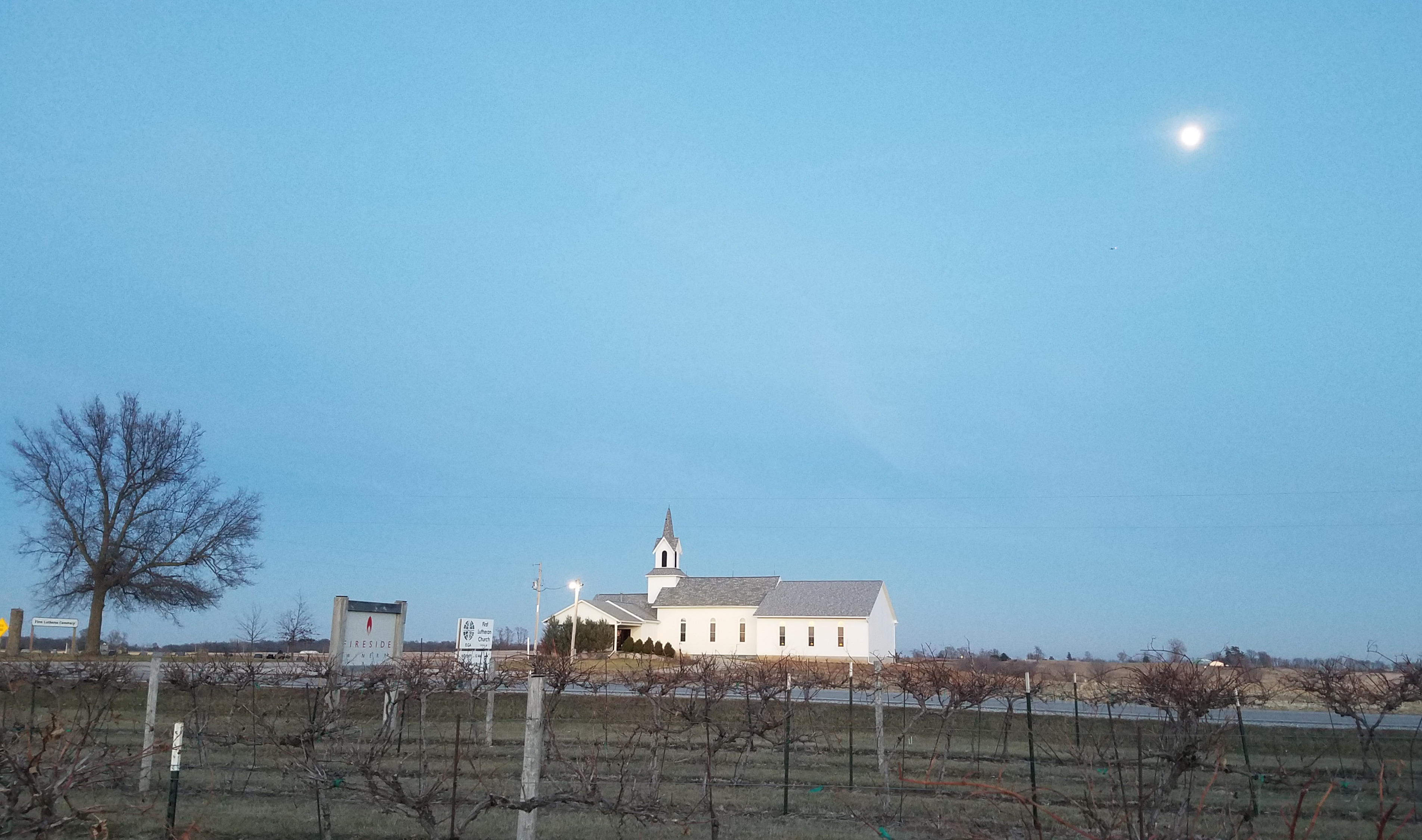
First Lutheran Church with moon rise near Marengo, Iowa.
It took 42 minutes to reach Fireside Winery near Marengo where a group of political friends gathered for the first time since the midterm elections. Among topics discussed were the value of pedicures, local spa experiences, and nail salons. We talked about the election as well.
It was a long drive to get there, yet also important to stay engaged. Iowa County has half the votes in my Iowa House District.
In 2016, before redistricting, our current Republican state representative ran unopposed. In 2024 we may run a candidate again in the new district, although the strength of the Republican’s win was such it may discourage Democratic candidates considering a run. It only makes sense to run to win.
It was good to be among people with common interests. I refrained from drinking any wine at the gathering as I have given up drinking alcohol and driving. It turns out conversation is just as good without it. Drunken me would likely have rejected conversation about getting a pedicure. Now I’m considering getting one.
Fall colors along the long, mostly straight road from Ely Blacktop to the Highway 151 junction are captivating. Most row crops are in the bin with shades of yellow and brown dominating fields. Leaves on deciduous trees have mostly fallen. Traffic was light. It was a good afternoon to appreciate a long drive.
What did I do all year? I am at the point in retirement I had to look. One day blends into the next and I lose track of the calendar.
There is no ending the coronavirus pandemic. The governor extended the state’s Public Health Disaster Emergency Proclamation on Feb. 3, announcing it will expire at 11:59 p.m. on Tuesday, Feb. 15. After that, the coronavirus becomes normalized in daily, routine public health operations, she said. By declaring the pandemic normalized, the governor washed her hands of it. We are on our own. I still wear a protective KN-95 mask when among large groups of people, mostly when grocery shopping.
I got more involved with politics than I wanted to be. I volunteered to be an alternate member of the county central committee from our precinct. The two people who replaced me did not continue for another term so I’m back to being our single, main representative. I attended the county, district and state conventions, and participated in a number of events, phone calls and meetings for varied candidates. I worked as a poll watcher at the Big Grove Precinct polling place on election day. My main work of postcard-writing, door knocking, and events was for the Kevin Kinney campaign for state senator. I continued the long-standing personal tradition of stuffing envelopes, this time for the Christina Bohannan campaign. Politics beyond county offices was a bust this year.
Our last old automobile wore out. The 2002 Subaru broke some things for which we could not get new repair parts. It was a safety issue, so we donated it to Iowa Public Radio and bought a used 2019 Chevy Spark. I would have driven the old car for a while longer if we could have gotten parts. I like the new car’s fuel economy and tight turning radius.
In March, my sister-in-law moved to Des Moines for a new job. In July, our child moved to a new apartment in the Chicago area. We helped with both moves. That is a big task for septuagenarians yet we did the best we could. They appreciated the help.
We spent about $3,000 on “home operations.” About half of that was hiring a contractor to remove stumps and cut back our overgrown lilac bushes. The other big expense was repairing the yard tractor. All of the equipment I use around the house is getting old and in coming years will need repaired or replaced. Just this week we had to replace a fan in the furnace. After almost 30 years, it was developing the sound of failure.
I continue to serve on our home owners association board and as a sewer district trustee. I wanted to exit this work in June, yet there was no one to step up and do it. There is responsibility in complying with regulations pertaining to public water and sewer systems, so it is a non-trivial job. We do the best we can. I understand this water system management is part of living outside city limits and someone has to do the work.
Most of my time was spent writing, reading, cooking and gardening. I began devoting 30 minutes per day to downsizing some of our possessions. Am hoping slow and steady gets this done. I find going through and getting rid of belongings provides new energy for projects.
I seek opportunities to socialize and would do more if I could figure a way. Plain truth is once a person is “retired” they become less of a public entity and less important as younger folks assume responsibility in society. I’m okay with fading away once the need for my services ends. When it comes to community work, though, there may never be an end.
Coming out of the pandemic has been a long process yet that’s where we are. The last three years have been punk times. I’m ready for some new plans and fresh energy. I’m confident about finding both.
Yesterday the Rules and Bylaws Committee of the Democratic National Committee voted to advance a series of first in the nation states for the 2024 presidential nominating calendar. Iowa was not one of them. The plan includes South Carolina first, followed by New Hampshire and Nevada the following week, then Georgia, then Michigan. The plan is expected to be approved by the DNC early next year.
If one didn’t know Iowa was to be booted from the early states, they have not been paying attention.
Iowa and New Hampshire, both of which have state laws requiring them to go first, are considering next steps. If either state chooses to disregard DNC and changes the schedule, there are penalties, including losing delegates at the Democratic National Convention. Delegates are the whole point of the nominating process. There may be state penalties for failure to go first, but let’s face it, any state could pass such a law and who would enforce it? What will happen next in Iowa is presently unknown.
In 1968, the Democratic National Convention was a disaster in several ways.
Outside the convention hall, anti-war demonstrators protesting the Vietnam War roamed Chicago streets. The Chicago police department, under the direction of Mayor Richard J. Daly, used force in an attempt to maintain control.
During the evening of Aug. 28, 1968, with the police riot in full swing on Michigan Avenue in front of the Democratic party’s convention headquarters, the Conrad Hilton hotel, television networks broadcast live as the anti-war protesters began the now-iconic chant “The whole world is watching.”
1968 Democratic National Convention protests, Wikipedia.
At home, I saw televised news reports from Michigan Avenue. A friend was inside the Conrad Hilton with Harold Hughes who ran for president that year. He hoped the nomination of Hubert Humphrey, in a smoke filled room away from the convention, was something that would never again happen. South Dakota Senator George McGovern was assigned the task of re-designing the nominating calendar and process, which he did. We have been operating under the McGovern plan ever since.
Most Americans of voting age participate in presidential politics. Here is a brief summary of my memories. Consider it my farewell gift to the Iowa caucus.
Harry Truman: I was 13 months old when Harry Truman left office. I have no living memory of his administration.
Dwight D. Eisenhower: Our family didn’t like having a Republican president yet were thankful for his plan to build the Interstate Highway System. I recall talking about how it was designed so that military vehicles hauling missiles could travel under the roads and bridges that crossed the Interstates. We didn’t like Eisenhower yet accepted that his credentials during World War II yielded a competent chief executive.
John F. Kennedy: Father worked on the Kennedy campaign and shared some of that with me. If there was a Camelot, I’m over that now. I wrote previously about this. Click here to read that post.
Lyndon Baines Johnson: I stuffed envelopes for the 1964 Johnson campaign at the Democratic office in downtown Davenport. I came to expect that all elections would be like the Johnson landslide. I was young.
Hubert Humphrey: Based on conversations with my father, I felt the Humphrey nomination was tainted. Partly, I didn’t understand how the convention got so out of hand. I resented the corruption evident in Chicago Mayor Daly. Richard Nixon won in 1968.
George McGovern: My main memory of McGovern’s campaign was a rally before election day at the University of Iowa Pentacrest. I don’t remember if I voted. I wrote more extensively about the 1972 election here. Richard Nixon won reelection.
Jimmy Carter: I was in between finishing Officer Candidate School at Fort Benning, Georgia and traveling to my first assignment in Mainz, Germany during the 1976 presidential election. After Nixon’s resignation in disgrace, I literally didn’t care who was elected president that year.
Ted Kennedy: Turns out I didn’t care for Jimmy Carter enough to support him for a second term. I caucused for Ted Kennedy in Davenport and he wasn’t viable. I declined to join my union friends with the Carter group and went home.
George McGovern: My spouse and I caucused for George McGovern in 1984. We attended a forum in Des Moines where he, Walter Mondale, Jesse Jackson, Fritz Hollings and others appeared. At the precinct caucus, I joined the platform committee and was selected to go to the county convention as a McGovern delegate. It was my first taste of Johnson County politics.
Michael Dukakis: We lived in Lake County, Indiana in 1988. I remember saying to myself during the June primary election, “Who’s bright idea was running Dukakis?” He lost to George H.W. Bush.
Bill Clinton: Still in Indiana in 1992, I supported Bill Clinton. I took our daughter into the voting booth so she could press Clinton’s name on the touch-screen voting device for me. I didn’t devote a lot of time to Clinton’s campaign or to politics. Back in Iowa for the 1996 election, I continued to be inactive in politics. I judged Clinton could be nominated without my help and didn’t attend the precinct caucus. Clinton won Iowa 50.26 percent to Robert Dole’s 39.92 percent.
Al Gore: I skipped the caucuses in 1996 as I believed Al Gore would win the nomination without me. He did, and as we know, the U.S. Supreme Court stopped ballot counting in Florida during the general election, giving the win to George W. Bush.
John Kerry: I quickly came to believe the George W. Bush administration was the worst. In the first days after the Sept. 11, 2001 terrorist attack, I rallied around the president. It didn’t last long. I wrote about my transition here. All three in our family attended the 2004 caucus in Big Grove Precinct together and caucused for John Kerry. I helped run the caucus as secretary that cycle. I joined the Democratic central committee again and worked on the Kerry campaign. I also decided that after his performance in the Whitewater controversy, long-time U.S. Representative Jim Leach had to go. In 2006 we elected Dave Loebsack to the Congress.
John Edwards: Despite all the negativity that came out about John Edwards after his last presidential campaign, I have no regrets having worked to make him the Democratic nominee in 2008. I spent time with him, his wife Elizabeth, and their children. This precinct caucus was the best attended in my almost 30 years living in Big Grove Township — about 260 people. I served as caucus secretary again and it was challenging to make a count. There wasn’t enough room in the school cafeteria and some of the voters stretched out into the hallway. I recall Edwards had a contingent from the care center in wheelchairs and on gurneys. In the end, Hillary Clinton and John Edwards tied and Clinton won the coin toss. Barack Obama got the most delegates and won the general election.
Barack Obama: During the 2012 precinct caucuses I led two precincts other than my own: Cedar and Graham. The caucus began with live video of Obama, then we broke into precinct groups. Noone was willing to lead the caucus among the eight people in each of two precincts. I convinced a friend to be secretary. Obama’s reelection was not a given yet his campaign was thorough enough to win a second term.
Hillary Clinton: I led the Clinton delegation to the 2016 precinct caucus. We had so many delegates we could send some to the Martin O’Malley group to make them viable and deprive Bernie Sanders of a delegate. I decided being a Clinton leader took precedence over running the caucus. It was a good decision. As we know now, Clinton won the nomination and lost the general.
Elizabeth Warren: I led my own caucus for the second time in 2020, supporting Elizabeth Warren for the nomination. I was well organized and the process proceeded smoothly. We split our four delegates with one each to Warren, Amy Klobuchar, Pete Buttigieg and Joe Biden. Biden placed fourth in Iowa. It wasn’t until South Carolina that the Biden train started to roll out of the station. Buttigieg won Iowa by a small margin yet any momentum was halted by a computer failure in the application we used to report our results. This disaster was likely a prime catalyst for removing Iowa from early in the nominating process this week.
Joe Biden: Joe Biden hasn’t announced whether he will run for president in 2024. One assumes he is in good health and will live long enough to serve a second term. If the DNC is successful in removing Iowa from the early states, as it appears they will be, presidential politics will be a lot different in Iowa. I hope it will be better.
Our county Democratic party held the first central committee meeting after the 2020 midterms on Dec. 1. I wouldn’t describe it as positive. It was a meeting without hope.
As expected, candidates for the Iowa legislature with districts contained within county boundaries won. So did the statewide Democratic candidates, yet only in Johnson County. Democrats, as has been widely reported, lost all statewide races except state auditor.
Someone on the first district central committee reported there is a concern among central committee members about a lack of leadership from the Iowa Democratic Party. Not sure if we are at “heads will roll” stage.
Locally, we raised a lot of money, yet failed to give it to candidates before the election. We had $32,000 in the bank after election day, a mortal sin. Could that have made a difference in some of the races we lost? We’ll never know.
County chair Ed Cranston said we had a goal of creating a 35,000 vote margin for Democrats in the county election. Our U.S. Senate candidate Michael Franken got a margin of 27,130. Cranston acknowledged a need to determine why we fell so far short of our goal. All we know at this point is no preference voters were neither adequately targeted, nor did they turn out in needed numbers. Numbers are being crunched, he said.
A former county party chair made a motion to move toward in-person meetings in January and February. About two dozen people participated in the Dec. 1 meeting via Zoom. The motion was voted down as committee members recognized the value of enabling as many people as possible to participate in the rebuilding process. In my one minute speech against the motion, I said it was discriminatory against disabled persons to suggest members must show up in person. The motion was a form of ableism, I said. Most of those participating via Zoom voted against the motion.
The central committee in a large county like ours has become less relevant to the political process. Whether we meet in hybrid form, in person, or virtually, no one has any good ideas about what needs to be done going forward. Emphasis on “good.”
This cycle we lacked a state coordinated campaign and didn’t know what to do with that freedom. With yesterday’s leak from the Biden team that the president was recommending early states be comprised of South Carolina, Georgia, New Hampshire, Nevada, and Michigan, Iowa will be even more isolated if that holds. That’s not all bad. It would be better if we had a plan for political life after the caucuses.
That’s right. The reality of the Iowa caucus is it’s over.
Last night the Biden administration hosted President of France Emmanuel Jean-Michel Frédéric Macron in its first state dinner. I hope no one got sick with all the fancy food. I mean, regular people don’t eat lobster and such like that. On the plus side, Biden held only one state dinner since the inauguration. Now back to work for the president and for the rest of us trying to stay relevant. The party is over.
It is my minority opinion that avocados should be avoided in the United States. Don’t buy them, don’t eat them. The fruit has become popular, and because of it, Mexican growers can’t keep up with demand. This creates a problem.
To meet surging demand in the U.S., farmers in Mexico have cut down swaths of forest in the western state of Michoacán, one of the most important ecosystems in the country. By some estimates, as many as 20,000 acres of forest — the area of more than 15,000 American football fields — are cut down each year and replaced with avocado plantations. The rapid expansion of orchards will threaten forests in Mexico for years to come.
Dishes like guacamole, avocado toast and smoothies taste delicious. Refined oil from the fruit is popular among foodies and nutritionists because of its unsaturated fats. By one estimate, sports fans eat through 105 million pounds of avocados on Super Bowl Sunday. The deforestation problem is directly related to such consumer demand.
The immediate catalyst for this post was a project to reduce my cookbook collection. I found many recipes for guacamole and felt we needed a reminder to moderate consumption and address the deforestation their popularity causes. I can hear long-time readers asking, “Didn’t you cover this before?” Yes, I did in the post titled, “Can Hipsters Stomach the Truth about Avocados from Mexico?” Not much has changed.
What can consumers do about deforestation which creates high-margin avocado plantations? Solutions are complicated. Ecosystem Marketplace outlines some of the challenges here. In the meanwhile, go light on the guacamole and avocado toast, and find another oil for cooking.
It is something we can do to contribute to efforts to solve the climate crisis.
View of Trail Ridge Estates on Thursday, Sept. 30, 2021.
SOLON, Iowa. — It is no surprise a year into development of Trail Ridge Estates by the Watts Group additional public costs are being identified. The first is environmental.
The Cedar Rapids Gazette reported yesterday the Watts Group was fined $3,000 by Iowa Department of Natural Resources for pumping construction runoff into a storm drain that leads to Lake Macbride. I note the Watts Group built the storm drain after developing what was previously a farm field. Such environmental pollution is part and parcel of a development this size. The lake is already feeling pressure from development and this additional loss of farmland has an impact. The matter was settled by the parties in a consent order signed Oct. 25.
What will cost more is the recently announced $25 million school bond expected to go to voters this spring. Trail Ridge Estates will contribute directly to area growth and the requirement for more classroom space in the school system.
The district, like the town of Solon, has seen a steady increase in enrollment since 2014, and anticipates planned housing developments — with another 500 new residential units — to bring additional families in to the district. Solon schools’ current enrollment is 1,450 and is expected to increase by about 350 to 750 students over the next 10 years, depending on how quickly new housing developments take shape.
The farm field in development was planted mostly in corn and soybeans, so converting it into housing is no significant loss to the food system.
Trail Ridge Estates was annexed to the City of Solon and will contribute to significant growth, maybe 50 percent more than the 2020 U.S. Census count of 3,018. What may get missed in this news is the area is evolving from what it was when we moved here into something new: a more expensive, environmentally compromised place to live. While promoters of the bond issue say it won’t increase taxes, how can it not increase expense as the school system grows to match population? The district will eventually see increased costs as a result of this development.
We will welcome more information on the bond issue. I plan to study it closely yet will likely vote for the bond. Public schools are endemic to thriving communities and we want our nearby city to thrive.
Today is the third day of renewed effort on my autobiography. Since last winter, I lost my place. Searching for it led me down a different path, one of considering structure different from the chronological timeline I wrote last year. There are considerations.
The first part was written in chronological sequence, which is okay and will likely persist. I tell a story from history, memory, and a few artifacts from the first two decades of my life. This part of the writing was engaging. My parents and maternal grandparents did not tell a single narrative of how they came to be in the Quad Cities by 1950. My grandfather did not live there. I didn’t know my paternal grandparents who both died before I was born. Every tale about the past came in asynchronous short stories. The few times any longer narrative was woven, mostly in writing by Mother, it seemed imbued with interpretation rather than facts. If I pieced the stories together in a new narrative there would be significant gaps and flaws, both mine and theirs. Getting a chance to write my story may have biases, yet by making it mine, the narrative is more complete and satisfying.
As I begin the 2022-2023 winter writing project I need to finish the narrative I started, yet want to break it and present different threads going forward in time. There are natural breaks which I will call “pivot points.” A pivot point was a time when, in a specific place, I considered my options and made a decision about where I would take my life. Here is my current reckoning of these pivot points as I navigate through this winter’s writing.
Leaving Davenport
Most young people make a decision in high school whether to graduate and what to do next. This was complicated for me by the death of Father during my junior year. There was never a question about finishing high school. It was going to university that hung in the balance after he died.
I had begun to look at options my junior year and had discussions about them with Mother and Father. I was on a trajectory to attend University, yet Father’s death brought a pause in moving forward.
I remember the conversation with Mother clearly. It took place during daylight in the living room where she sat on the couch and I sat on the chair next to where we kept the telephone. I explained I was willing to give up university in order to stay in Davenport and help her get through the loss of Father. In no uncertain terms she told me to leave and I did.
Living at Five Points
Before I left for military service I put my belongings into storage. Some were at Mother’s house, some in storage with a moving company before the advent of commercial storage units, and I took a small amount of belongings with me based on a conversation with my Army recruiter. When I returned from Germany I got an apartment near Five Points in Davenport to figure things out. I reunited most of my belongings, including a considerable number of new ones brought back from Germany.
I reconnected with friends who stayed in Davenport. We had one of the few parties of my life at Five Points. I cooked a lasagna dinner on Nov. 25, 1979 and we sampled wine mostly from the Rheingau region of Germany where I lived. I was a terrible cook yet dinner was eaten. At the end of the evening, I cut up my military ID card recognizing it was the official last day of my active service. We toasted the event with shots of Jägermeister.
At Five Points I felt like youthful times were ending and weighed what to do next. I decided life in Davenport was not for me and that was that. I was eligible for the G.I. Bill, applied and was accepted to graduate school, and in Summer 1980, moved to Iowa City and never looked back to my home town.
Marriage
After finishing graduate school in May 1981 I went on a trip down south to visit friends from the military. I evaluated returning to military service and decided visiting those who stayed after their initial enlistment would give me an idea of what it was like. I drove my yellow Chevy pickup to Fort Benning, Georgia, Fort Rucker, Alabama, and then to Houston where I stayed with a buddy who went to work for Exxon Oil Company. After the trip, I decided to stay in Iowa City and find a job.
At 30 years old, I recognized that I hadn’t found a mate, and would be unlikely to do so unless I worked at it more than I did. Iowa City offered the best opportunity in the state for people like me, so I got an apartment on Market Street and found a job. It was a complicated time, yet one of the main decisions was to settle in and see if marriage would be possible. We married on Dec. 18, 1982. I remember being at the church like it was yesterday.
Empty Nest
When our child left home in 2007 for a year-long internship with the Walt Disney Company in Orlando it set things in motion to be who I am today. My interest in the paid work I had been doing since 1984 waned. I wanted more from life. With our child a two-day car trip from home, I began to look at options. On July 3, 2009 I left work for the transportation and logistics company that employed me for almost 25 years.
Transportation and logistics has been part of who I am from the time I got my first newspaper route in grade school until I left paid work at the home, farm and auto supply store permanently during the pandemic. The decision to end it as a career in 2009, while still young, was hard to make. I’m glad I did it. The company bought me one of those big sheet cakes and I brought cupcakes baked by a neighbor working from home the next day. I got a phone call from the owner, and looked around at what I helped build for the last time.
I remember sitting in the car in the parking lot after my shift. I sat for a while in that moment. I turned around and exited the parking lot the back way, an exit I had never before used. That pivot made the difference in who I am.
Hard to say if this is a final list of pivot points. As always, writing a post helps me formalize what had been vague notions floating through my consciousness for a while. Now I better figure out where I left off last winter.
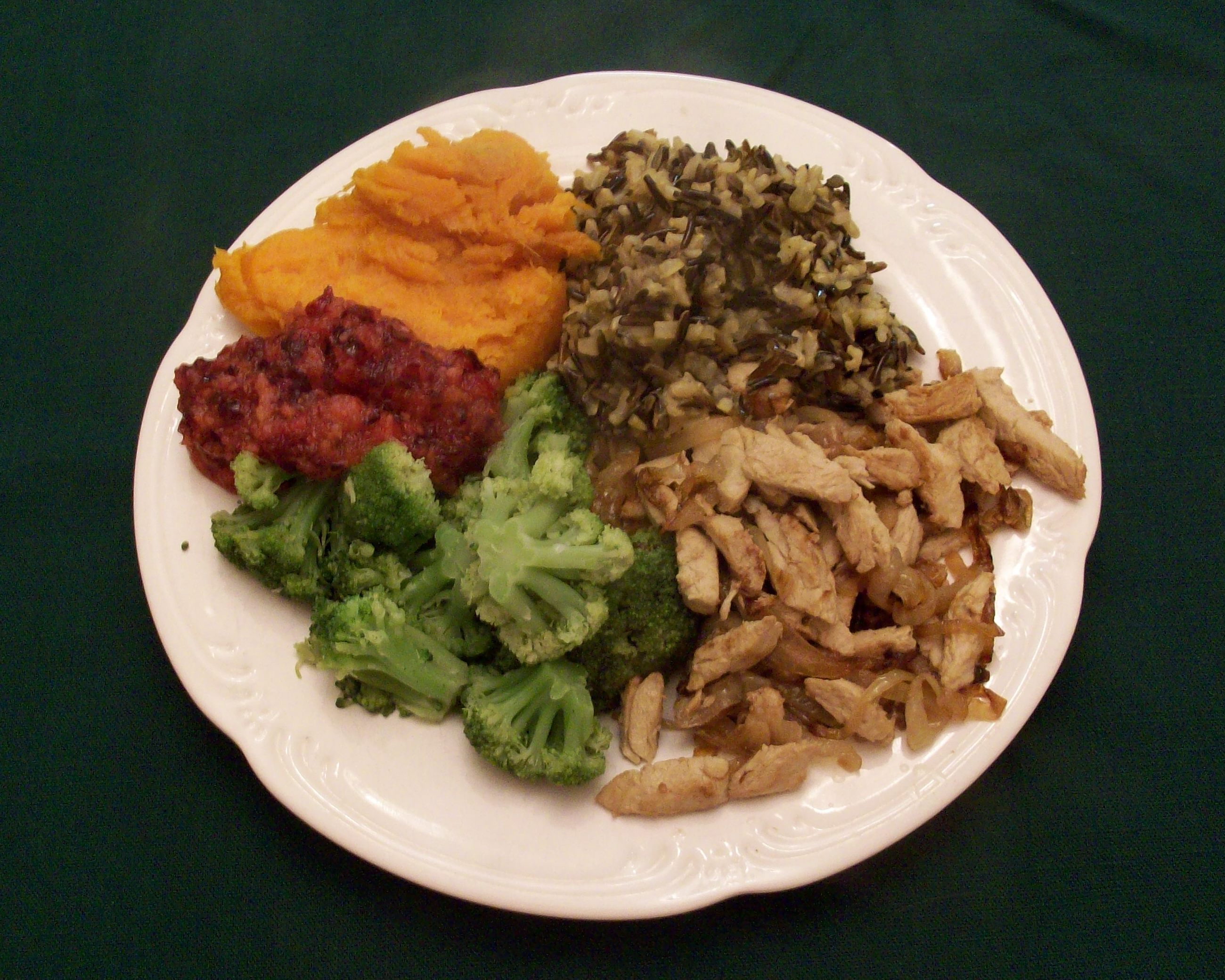
Vegetarian Thanksgiving dinner from a previous year.
Everyone invited to our holiday gathering was under the weather so we cancelled Saturday’s in-person event and video-conferenced. As we spoke, tissues were passed around and microphones muted while participants took care of sinus congestion. It was sub-optimal, yet worthwhile. Ours is a small family, so we are flexible. Those who tested for COVID-19 were negative.
We have plenty of uncooked leftover food. Enough so this week’s provisioning run will be extra light coming home.
I met a friend for breakfast on Friday at the Tipton Family Restaurant. It was our first in-person meeting since the coronavirus pandemic was declared in March 2020. We picked Tipton because it is the midpoint between where I live and he was staying. The restaurant gets three stars, yet to be clear, it is not on the Michelin star scale. Breakfast was fine as was our conversation and walk along the main street.
The rest of the long weekend was highlighted by cooking. We ate simple fare on Thanksgiving, a veggie burger patty with two sides. On Saturday I changed my dried bean recipe from baked beans to bean soup along with vegan cornbread. Sunday I made a pizza for lunch. Since pizza is mostly a delivery mechanism for melted cheese, and I haven’t found a way to make palatable vegan pizza, it was pizza for one. I incorporated home grown red pepper flakes into the sauce. I was sneezing for about ten minutes afterward.
At some point we will make the full holiday meal that includes wild rice, baked sweet potatoes, baked beans, scones and cranberry relish. We don’t know when that will be. Taking the big meal out of Thanksgiving changes the tenor of the holiday. We are okay with that.
What went wrong for Democrats in the 2022 midterm election? A lot. How do we fix it? The first reaction, and I believe the wrong one, is to throw the bums out.
I like Ross Wilburn, Iowa Democratic Party chairman and have since he was the Iowa City mayor. I agree with the idea that if he can’t perform as state party chair — and the lack of Democratic wins during the recent election cycle makes a case that he can’t — we should replace him. There are three parts to this and they don’t lead us there.
First, Democratic core activists like the groups with which I associate were very busy with political work for a year before the November election. Whatever analysis we or others might make about the mechanics of the campaign (Vote Builder, money, coordinated campaign, messaging) it doesn’t detract from the fact our core active Democrats were busy working to get our candidates elected.
Second, the state central committee, which elects the party chair, is increasingly irrelevant. Our last days of glory were in 2006 and 2008. It has been a long, dry season ever since. The biggest change in the state central committee has been the rise of Bernie Sanders supporters who wanted to change everything for the better. They won their elections to the central committee, yet I’m not seeing change we need. The last two cycles have really rotted. Maybe they should be replaced as well.
Third, the problem in replacing folks on the state central committee, and how they organized the 2020 and 2022 cycles particularly, is millennials and Gen-Z voters are not stepping up to help campaigns the way my generation was accustomed to doing. I noted in a previous post, contrary to the national trend, they were the ones who found reasons not to vote on Nov. 8. Instead, they are packing their bags and leaving the state permanently. This is part of a broader dynamic. Changing members of the central committee can be fine, yet it doesn’t address the brain drain ongoing in Iowa. This is an unrecognized, real-world consequence that costs the party. People who leave the state to better themselves seem most often to be, if not always, Democratic voters.
A Republican strength is it targets young Iowans who attend community college, get married, raise a traditional family, and settle down close to where they were born. The culture of this is stifling, yet some folks in those generations thrive in it, have multiple children, and buy McMansions to withdraw into church, school and family. For the most part, they are not Democrats.
Making do in this bleak Iowa cultural landscape seems unlikely for young people who have more ambition and are willing to trade what they know for a chance at something better. They will leave the state and never look back.
I’m not sure changing the party chair addresses this core problem. That’s why I’m not anxious for major changes in the state central committee.
For a minute, let’s go into the Wayback Machine. After Wilburn was elected in 2021, The Des Moines Register reported,
Wilburn said he would begin the party’s rebuilding efforts by creating a three-election-cycle strategic roadmap; improving candidate and local leadership development; working to become a better asset to county parties and other constituency groups; and improving the party’s use of data.
State Rep. Ross Wilburn elected to lead Iowa Democratic Party as chairman by Brianne Pfannenstiel, Des Moines Register, Jan. 23, 2021.
What of that plan? To my knowledge, that was the only public mention of it. On its face, it’s one cycle down and two to go. From my perch, candidate development seemed very good. There were great candidates fielded, like Kevin Kinney, who didn’t win their elections. This part was successful, even if the results were disappointing.
I’m not sure how the state party became a better asset to county parties. Here in Johnson County, we had freedom to structure a campaign the way we wanted. It appeared we had enough paid staff and resources to conduct operations. Statewide candidates were frequently present. We weren’t successful in the most Democratic County, yet there should be valuable lessons to learn. The biggest lesson should be found in answering the question why did we fall about 4,700 votes short of our 32,000 Democratic margin goal?
As far as improving the party’s use of data, all I heard as election day approached was that we were focused on turning out likely Democratic voters who previously voted only in presidential years. We had the data to target those folks, yet not enough of them voted. As I have written, my precinct turnout, among Democrats and Republicans was significantly less than 2018 and 2020. Part of that is erosion of Democratic registrations yet turnout in both parties was down. Three cycles equals six years, so hopefully the state central committee is busy analyzing data to figure out what went wrong during the first two.
During previous election cycles, I wrote my analysis of the election quickly, soon after the polls closed and results were known. It seems essential we take our time this cycle to examine the results carefully and thoroughly. I plan to live in Iowa for a long time, and would like to see more Democratic wins. 2023 will be the first time I’ve had a Republican state senator since we moved here in 1993.
Things have been better when Democrats had a say in our governance. We are a distance from that being the case again. During the Thanksgiving holiday weekend, part of the celebration has been coming to terms with that reality.








 Journey Home

You must be logged in to post a comment.