Categories
Kitchen Garden Writing

Working in the High Tunnel

In the High Tunnel
In the High Tunnel

RURAL CEDAR TOWNSHIP— We soil-blocked the rest of the seed trays in the greenhouse yesterday, and planting is well underway at the CSA. My weekly work sessions give me a snapshot of  what is a much broader amount of activity in local food production. The experience is paying dividends in understanding the cycle of growth to support the market.

Used this to prepare the bed
Cultivator

For the first time, I worked in the high tunnel, preparing a bed for planting. High tunnels extend the growing season, producing vegetables for an early or late crop. They also serve to mitigate risk of cool temperatures, and of disease and pests. On a farm, margins mean everything, and high tunnels create an opportunity to increase them. They also create the ability for new customer offerings in the form of a spring or fall share.

My life is richer for working in a limited way on a CSA farm. It is a way of life that survives on the cusp of an agricultural landscape dominated by row crop agriculture. Like the high tunnel, the work is around the margins, and there are plenty of those for local food to be a vital force.

Categories
Kitchen Garden Writing

Thunderstorm at the Farm

RURAL CEDAR TOWNSHIP— It was raining on me while I was unloading large bags of soil mix near the greenhouse when the phone in my back pocket rang. They were calling from the house to tell me that with all of the thunder and lightning, it wasn’t safe for me to be working outside. I should come to the house.

The severe weather warning on the country music radio station reported hail and rain to be worst in Kalona, Frytown, Washington and the southwest corner of Johnson County. It was heading our way. I figured we would be safe in the greenhouse, but unloaded the rest of the bags, parked my car and headed inside with to wait out the storm with the rest of the crew.

In the country, a thunderstorm can be perceived as a massive formation of clouds stretching from horizon to horizon, covering us like a large bowl. It is a perspective one can’t get within in a large cluster of homes, or in town. A sense that the storm has its own integrity, producing rain, lightning and thunder— a dominant force of nature— a commanding presence that covers us. One shouldn’t argue with that, however much confidence we have in our own endurance. There was fresh coffee and apple pie inside— and conversation. We re-scheduled the crew for tomorrow.

It was a gully washer. When we built our home, the construction project leader, who was a retired farmer, cut a number of swales in the slope around our house with a 1949 Ford tractor. When it really rains, we can see Lyle’s handiwork all around us, as the swales fill with water and our basement stays dry. The rain flows around us to the ditch and lake below us.

The rain continued into the early afternoon. The ground needs the moisture, and we need protection from the lightning. It would be better if the planting was done, but that is not how this growing season is unfolding.

Categories
Writing

Bottling Apple Cider Vinegar

Apple Cider Vinegar
Apple Cider Vinegar

LAKE MACBRIDE— The aroma of evaporating apple cider filled the pantry for months. Today it was time for the sampling and the apple cider vinegar came out delicious. A renewable ingredient for our kitchen was born today.

Unlike anything I have tasted before, with an initial taste of apple followed by the twang of the vinegar, I’ll look forward to using it in salad dressings— bottle-by-bottle. If there is enough, the golden liquid will also be used to make apple butter during the harvest season.

When we talk about local food, this is it. The mother of vinegar came from a neighbor who said it has been in their family for more than a hundred years. The apples came from the back yard. Renewing the recipe is easy— just add more fresh apple juice to what’s left in the container.

Sometimes things work out better than we had planned.

Categories
Writing

The Customer is Always Right — but they lie

Veggie Burger
Veggie Burger

LAKE MACBRIDE— A friend worked at a fast food restaurant and spoke about their policy of replacing food items that were wrong when the order was prepared. For example, if a person asked for a burger with no pickles, and pickles were found when the package was opened. The restaurant replaced such items without hesitation, and free of charge. After all, he said, “the customer is always right.” He added, “…but they lie.” Customers frequently abuse the well-known make it right policy to get extra food. He knew because of his experience of properly preparing an order, only to have the customer return with half-eaten food, wanting a replacement for reasons that can only be described as lame.

Complaints are up at large franchise fast food restaurants, and given the scale of some operators, it is no surprise. In order to run a global restaurant business, with thousands of outlets, a company has to focus on the service delivery process. There is plenty of room for deviation from corporate standard operating procedures.

A focus on process means well-defined procedures for everything. With high employee turnover, some believe if the service delivery process is bulletproof, any employee, with limited experience, can step in with minimal training, and make sandwiches that delivery corporate quality.

Customers learn to work such delivery systems to their advantage. My friend was just calling out what in other social circles is an accepted practice of getting what one can from society without ethical concerns.

It may be a bit scandalous to say, but often the customer is not right. It is one thing for a starving person to work the system to get an extra sandwich from a company that can afford to provide one. It is quite another to go through life expecting that what are exceptions should become rules for exploiting businesses for personal gain. Whatever is wrong with corporate businesses, there is something more fundamentally wrong with a culture that produces both employees that are rude and deceitful customers. It is tough to blame that on corporations.

As a business owner, it can be comforting to focus on process. It is abstract, and works toward efficiency, employee safety and improved margins. But not everyone owns a business, and that leaves those of us in the fray of daily restaurant operations to fend for ourselves.

Bad customer service and deceitful customers are two sides of the same problem. Some of us are loathe to complain about service, because of the time it takes  and the negativity it can introduce into daily life. The customer who lies about a sandwich order for personal gain is an example of what is worst in society. The idea that we are not in life together, but that it is each individual for him or herself, any semblance of a moral compass abandoned.

We are on our own in society, emphasis on our. There is a proper place for honesty in our relations with people. It is something we can and should work on everyday, even in ubiquitous settings like fast food restaurants.

Categories
Work Life Writing

Sustaining a Creative Life

Barn WallLAKE MACBRIDE— Today, the key element in sustaining a creative life in Big Grove Township is magnesium sulfate, or Epsom salt. A thirty minute foot bath provides a form of relief few other things can provide. I recommend it, although for the most part, people already know about it, and for some it works, for others, not so much. Well-cared for feet are something we take for granted, but shouldn’t, because they are an important foundation to creativity.

When I was at university, I shared a house with a constantly changing group of creative people. We had our own rooms, and shared the living room, bathroom, and kitchen. Every once in a while we had a joint clean up activity, although housekeeping was not a priority. My contribution was to attempt to keep the kitchen clean, and recall doing a lot of everyone else’s dishes. I didn’t mind and enjoyed seeing pots and pans my grandmother had given me mixed in with everyone else’s kitchen gear.

Writers, poets, musicians, artists, a drum maker, a publisher, an aquarium builder, a travel guide and emerald seller, an auto mechanic, and guests of all kinds passed through the doors of that place. Some found notoriety in what would later become the city of literature, but mostly, people were not well known, except to each other.

I briefly shared my room with some buddies from Davenport. One went on to become a librarian. Another, who practiced martial arts, moved to California, and eventually got a credit on the Hollywood movie “The Matrix.”

A woman arrived halfway through my stay. She found a part time job, and spent every morning at a table in the entryway writing. As an early riser, I often ran into her, but tried not to interrupt. She hooked up with a poet, and eventually left with him for California, taking one of my grandmother’s saucepans with them on the train. I don’t think we called it hooking up during the early 1970s.

Later, the poet was known to sit at a typewriter with a gallon of cheap wine and write until he finished the bottle. This lifestyle is said to have led to his early death. I don’t know what happened to her.

That house was a place to camp out while pursuing other things. For me it was finishing a mandatory, but uninspiring bachelor’s degree. It was there I spent a morning tie-dying T-shirts while listening to my commencement address on the radio. I declined a job offer from the Oscar Mayer Company, which had provided a four year scholarship. When the summer ended, my sparse belongings went into storage, I took what money I had, converted it to American Express traveler’s checks, and went to Europe with my backpack for what began without a plan, but ended being twelve weeks of youth hostels, art museums and train rides. My backpack was stolen when I arrived in France, and that is another story.

There is no defined path to sustaining a creative life. Instead, we secure food, shelter and clothing, protect our health and well-being if we are able, and go on living. If we are creative, it is that spark of interest in society that sustains us, or can, if we recognize it— and Epsom salt and other common elements to help ease the pain of living.

Categories
Writing

Urban Eggs

Chicken Feeding
Chicken Feeding

LAKE MACBRIDE— The smell of ammonia wafting between two houses was my first experience with urban chickens. Not good. The situation in Des Moines encompassed the arguments whether or not communities should permit people who live in cities to keep chickens.

Keeping chickens is a simple, if somewhat expensive way to produce food for the table. At the same time, some urban folk are caught up in their city life, so much so they don’t make time for the basic work of keeping chickens. Ammonia in the air is not good when people live close to each other, even if home grown eggs are pretty good.

Urban eggs and the chickens that lay them, are the epitome of bourgeois. Such chicken keepers are usually not impoverished. If anything, they can afford the extra expense of making a cage and providing litter and feed required to raise them. These home-based enterprises are status symbols: a material interest in pursuit of respectability among peers. Very boutique-like, and the definition of bourgeois.

I say live and let live, but cast a skeptical eye on people who would do better to purchase specially grown eggs from their local food market, than cloud the air among city dwellers with their inattention to things that matter, like changing chicken litter adequately.

Categories
Kitchen Garden Writing

Knowing our Farmers

Germinated Seeds
Germinated Seeds

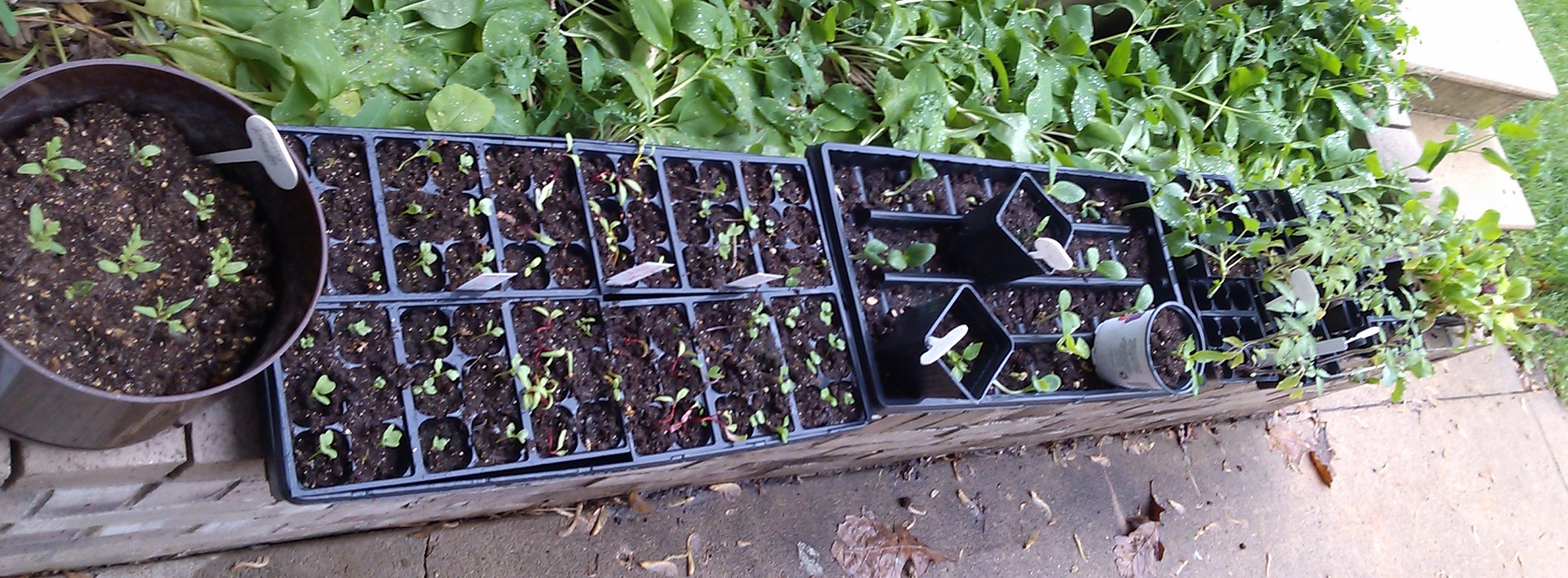
RURAL CEDAR TOWNSHIP— The seeds I planted last week had sprouted when I returned to the farm for shift number two. The work was easier this time and I finished quickly. I used a water bottle to stay hydrated, and it helped a lot. The greenhouse is starting to fill with the flats of seedlings for three growers who use the space.

Even though it was only my second day of making soil blocks, the skill had been learned, and I trained another worker.

The CSA where I work is not organic. “We can’t afford that,” said the producer. This attitude is common among vegetable growers, and while some equivocate, saying they use “organic practices,” the truth is the discussion about organic is based on penetrating markets. While it is not mentioned much anymore, the purpose of Community Supported Agriculture is to know your grower, and how they raise vegetables. It requires the buyer to have a depth of knowledge beyond fungible commodities. Being part of a CSA is about more than just the weekly share of vegetables, even if our consumer culture focuses on that aspect of the arrangement.
Seedlings
Most consumers don’t have time to know the farmer, and buy food at the grocery store. Maybe there is an alternative, and while labor intensive, it starts on farms like this one.

Categories
Home Life Writing

On Our Own

Main Street
Main Street

LAKE MACBRIDE— Unexpectedly, as the automatic garage door opened, the rural mail contractor was pulling up the driveway in his SUV to leave the box that contained my last 1,610 posts, written in a fever since 2008. They didn’t seem like much for the investment in time and resources. I thanked him for the delivery and walked into the garage and closed the door.

Within a few minutes the box was opened on my writing table, the volumes examined, then in place on the bookshelf with the previous iterations of this blog. Familiar with the work, it was time to turn to other things.

It was foggy on Sunday as I left the newspaper to return home. The new lamp posts faded from view down Main Street. I focused on traffic, instead of a distant view obscured by weather. The new crosswalk was comforting— the brick-like impressions guiding me across Highway One and toward the vehicle which would carry me home via Main Street, then Highway 382, going west out of town.

It is hard to imagine the landscape without roads and pathways. Harder still to believe it is possible to step off main traveled roads. Yet, in the fog of morning, after the snow has been melted by rainfall, we think we can make our own path— and sometimes do.

At times like these we are on our own, hard pressed to explain how or why— making it hard for others to provide succor, even when succor is needed. In a turbulent world, full of beaten paths and depleted resources, we make choices and ask, is all vanity, or is it possible that if the earth shall abide forever, we shall too?

With this refreshed blog comes a challenge, the same challenge as before, to sustain our lives on the prairie, but with it, something different. It is an edgy feeling— an urgency. That before long, our time to make a difference will have elapsed and our relevance in society faded like the vanishing point on Main Street that morning. By beginning again, there is new hope, a fresh view. There is a belief we can depart from la vie quotidian and sustain a life when people seem caught in a vortex of desperate conformity. It doesn’t have to be that way, especially once we realize we are on our own.

Categories
Writing

Brownies and the New Format

LAKE MACBRIDE— Last night I made brownies for the first time since I can remember. I saw the box of baking cocoa, the recipe on the package, and knew we had all the ingredients in the house. They came out very well, light and chewy, so I copied the recipe into my red book.

Have been preparing my new blog on a test site, and here is a very tentative snapshot of what it will look like. More to come as it develops.

Draft Blog HEader
Draft Blog Header