I walked due east from the garden along the utility easement to access a 25-acre stand of woods at the point where deer enter.
Deer are a constant presence in the neighborhood, especially during apple season, and I try to live in harmony with them by understanding what they will and won’t eat, and by using fences on the garden.
After dining, deer run across the same open space I walked to the wood line.
Based on the condition of the undergrowth, few humans visit the woods except around the edges. The main pathways are those made by deer and the brush is so thick I’m not sure how they get through. In 25 years of living here, there has been little interest in using the woods and I’ve hiked them less than half a dozen times.
Unnamed Creek, June 18, 2019.
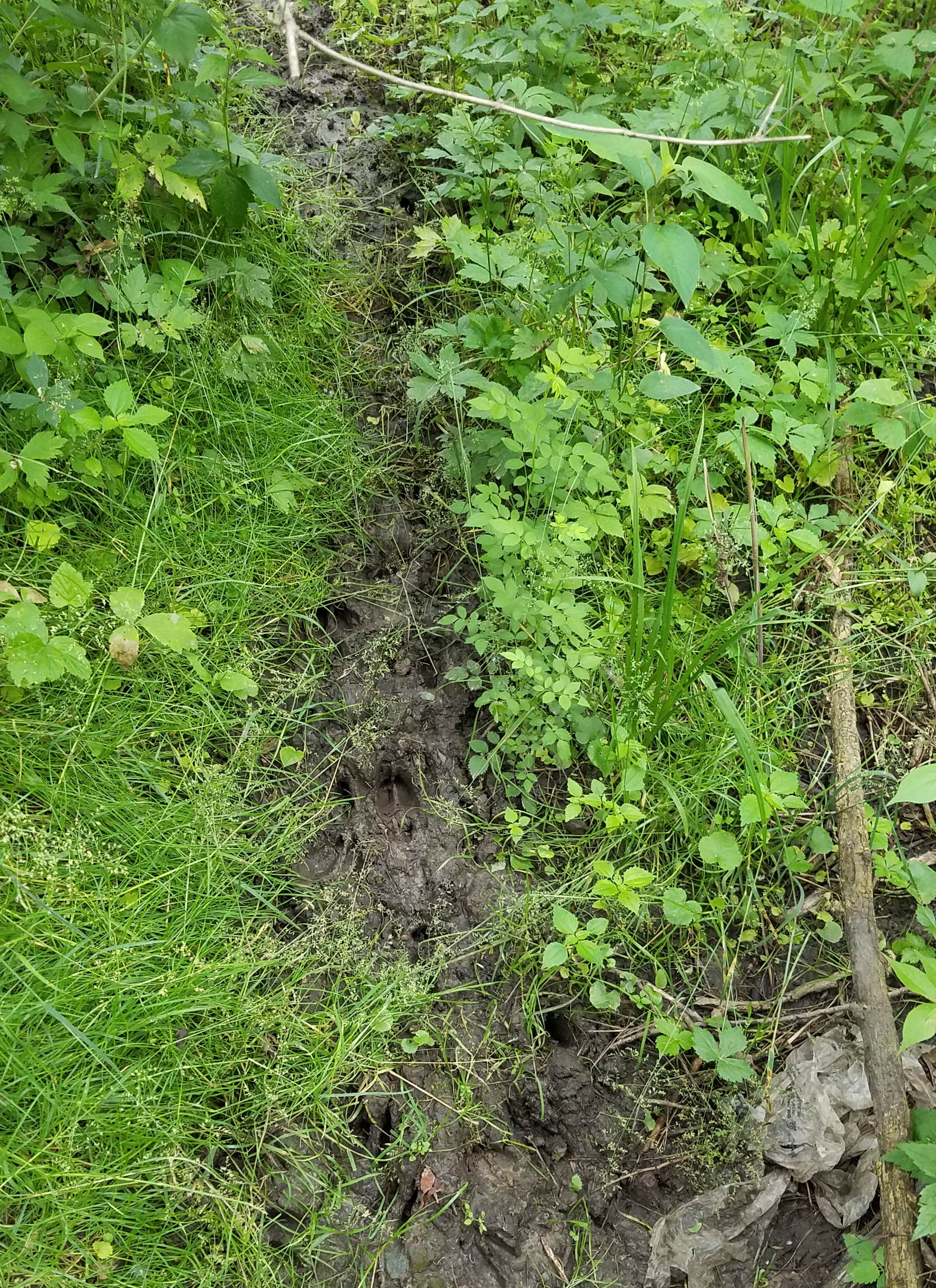
I walked a deer path on the west bank of an unnamed creek up hill to the pond created by a now forgotten farmer. It was sweaty work and good exercise. I’ve studied the woods on maps for years and there was never a sense of being lost despite the claustrophobic feeling the thick undergrowth created.
The county planning and zoning commission requires our development to maintain a certain amount of open space so the woods can’t be developed with housing. If our association members had an interest in using the woods more, the deer paths could be upgraded to walking paths and mapped out. There has been little interest so it has become a habitat for wildlife.
If we were to develop the woods as a recreational area, there would be little money for it, so the work would be by volunteers. There would be a lot of work to do. Numerous native species of plants exist there, and identification and preservation seems important. The canopy is relatively thick and consideration should be given to long-term forest health. That might mean thinning some mature trees so younger saplings can grow. There are a lot of fallen branches which could be chipped into mulch to pave pathways. It could turn into a really big project. As busy as everyone is, I’m not sure who would volunteer and I know almost everyone in the association.
Native Fern, June 18, 2019.
Suffice it to spend an hour or so hiking the woods once in a while. It takes effort to forget the manicured lawns and gardens to focus on what is in front of us in the woods. By the time I reached the top of the hill, I had forgotten whatever seemed important when I left the garden to focus on finding my way, and then my way home.
It occurred to me that even though the association owns the woods, that ownership is only loosely so. I mean the woods will continue to develop as it has, enabling brief and specific glimpses into what used to be when Iowa was mostly tallgrass prairie. We are visitors on Earth, and that for a short while. Ownership is a cultural concept unknown to the plants and animals that live in the woods. No one truly owns the woods despite legal documents so indicating.
If I want to understand my relationship with wildlife better, I need to spend more time in those woods. Maybe during another hike in the near future.
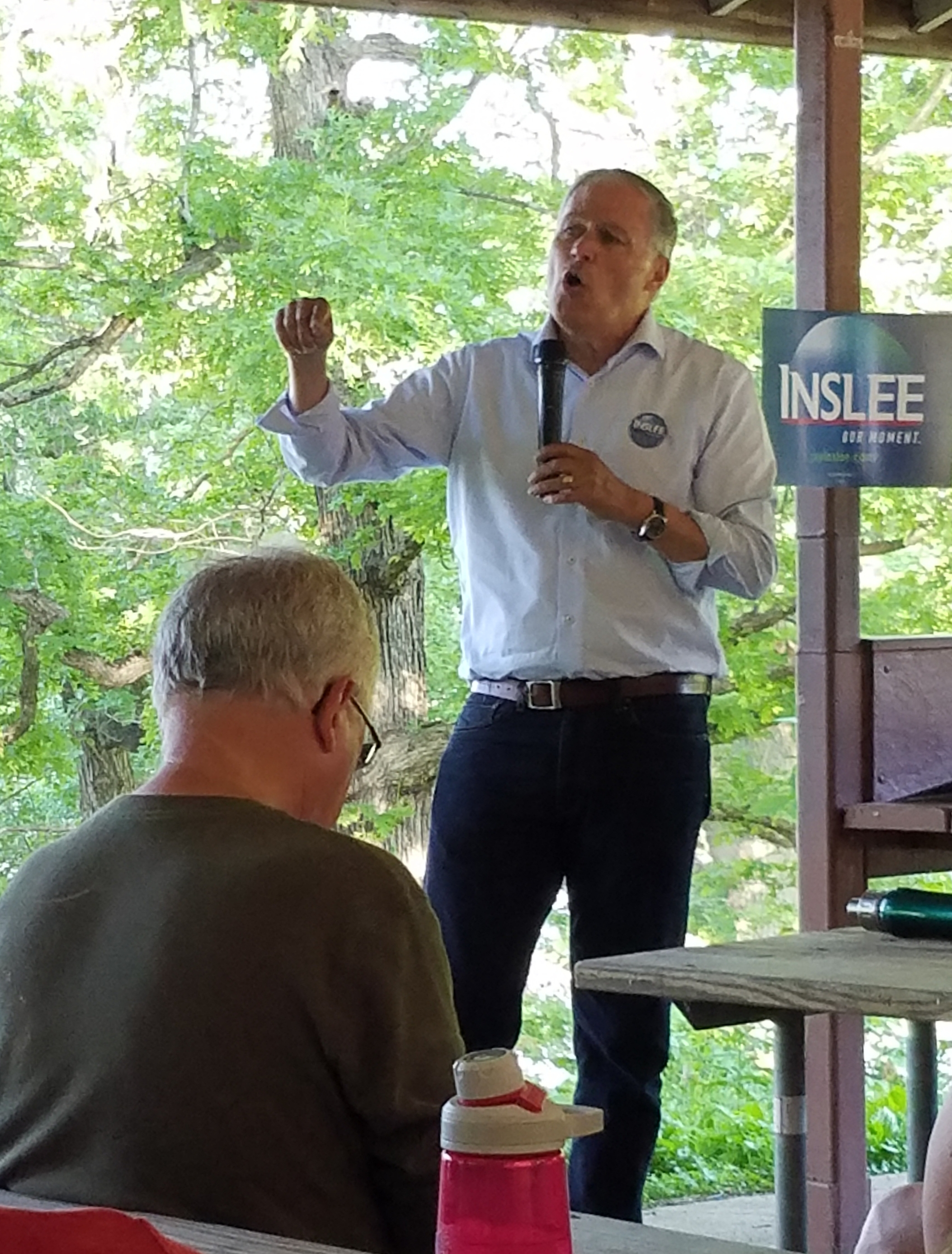
Governor Jay Inslee at Ellis Park in Cedar Rapids, Iowa, June 8, 2019.
CEDAR RAPIDS, Iowa — Saturday afternoon I drove to the Overlook Pavilion in Ellis Park where State Senator Rob Hogg had organized a “climate conversation” with Washington Governor Jay Inslee who is an announced candidate for president.
Hogg reminded us of the 2008 Cedar River flooding. The river was visible behind him.
It is hard to forget the 2008 flood that devastated Iowa’s second largest city. On my way to the event I compared flooding levels of the Atherton Wetland on Ely Blacktop which had been covered with flood water in 2008. From the center of Cedar Rapids I used First Street Southwest, which runs next to the Cedar River, to find the park. On the eastern bank someone had built a flood wall. An earthen berm restricted the view of the river on some parts of First Street. The low-lying area had been inundated in 2008 causing damage to more than 5,000 homes, evacuation of 25,000 people, and roughly $4 billion dollars damage. The flood was made worse by climate change.
In his introductory remarks, Senator Hogg recognized elected officials and organizations present and encouraged the almost 200 attendees to engage in the Iowa caucus process of meeting with presidential candidates. Hogg added later, “with the spirit of citizenship, we can bring Americans together for climate action we so urgently need and the many climate solutions that work.”
Governor Inslee began his remarks with the reason he seeks to defeat climate change, his grandchildren. “We have a moral obligation to the young people of America to defeat climate change,” he said. Noting last week’s atmospheric carbon dioxide concentration was 414.42 ppm (only slightly less than the record (415.70) set May 15), he added, “It is time to act on climate.”
Defeating climate change would be the first priority for an Inslee administration, the governor said. It was a “predicate for success” in all policy areas. If addressing climate change is not job one it won’t get done.
Inslee split from environmental groups like Citizen’s Climate Lobby when he said he did not support a tax on carbon. He favors regulatory reform to reduce carbon emissions. Based on his experience in Washington State, voters are unlikely to accept such a tax, he said.
Inslee asked for help in two areas of his campaign.
While he met the qualifications to participate in the first two debates being hosted by the Democratic National Committee, he has not met the 130,000 donor threshold to participate in the third and fourth. He encouraged those present to donate one dollar or more to his campaign and ask friends and family to do likewise.
Inslee wants the Democratic National Committee to devote one candidate debate to climate change so every participating candidate can lay out their plan to defeat it for voters to see. The request has been rejected, making supporting Inslee the best way to make sure the topic is covered during the debates, he said. Holding a climate change debate outside those sanctioned by DNC is not an option.
“It is the DNC’s job to organize the debate schedule, and the ground rules on unsanctioned debates were made clear with all the candidates, including Governor Inslee, and media partners months ago,” DNC spokesperson Xochitl Hinojosa told Mother Jones. The DNC welcomes candidates to join issue-specific forums instead.
The thrust of the conversation was Inslee has a positive progressive record in Washington State and wants to take that success to Washington, D.C. To learn more about Governor Jay Inslee, visit his website at JayInslee.com.
The Inslee campaign posted video of the event here.
I’ve been wanting to try the Impossible™ Burger and will have to wait.
I met a group of friends at a restaurant Friday where Impossible™ was printed on the menu. Since Burger King® decided to offer the plant-based burger nation-wide, smaller restaurants haven’t been able to get it according to our server.
The kitchen did have a Beyond Burger®, which I tried and was satisfied by my pub grub-style meal of a burger, coleslaw and Stella Artois®.
The reason I mention this is the American Farm Bureau Federation was running down products like these burgers for being “ultraprocessed.” In a June 4 blog post, author Teresa Bjork invoked reality to straighten people out,
In reality, meat and milk imitators are ultraprocessed foods. They are made from a long list of ingredients, including sodium and added flavors and colors, to improve their taste and nutrition.
One suspects increased availability of veggie burgers, and the Burger King® marketing decision, is taking a bite out of cattle producer market share. Likewise, the reason ovo-lacto vegetarians like fake meat is not for the salt content, but for how it fits into our lifestyle as comfort food. No matter how bad things may get for us personally, we want the sensation of eating foods that are traditional in our culture. Let’s cut to the chase.
The single biggest way to reduce our impact on Earth is to avoid consuming meat and dairy. Maintaining herds of livestock is a land use policy that encourages the ongoing mass extinction by taking land thus depriving other species of habitat.
“Meat and dairy provide just 18 percent of calories and 37 percent of protein, (using) the vast majority – 83 percent – of farmland and producing 60 percent of agriculture’s greenhouse gas emissions,” according to the Guardian.
We can do better than that.
It’s no secret people should consume less processed food, particularly simple sugars and carbohydrates, for dietary reasons. For the Farm Bureau to favor meat and dairy production of their members is also not surprising. What is fake here is not the burgers, it’s the straw-man argument to protect what Farm Bureau sees as its own interests.
From time to time many Iowans crave a tasty burger. Getting one without politicizing it may be impossible.
I don’t intend to get alarmist on fair readers with dire predictions of the end of the world as we know it. Even though doomsday stories are quite popular, and climate science is, well science, there is another issue.
In our weird, wet spring weather we believe we have climate change figured out. Instead of planting our potatoes on Good Friday, now we’ll plant them in early June as the ground dries out and all will be hunky-dory. That’s a problem.
Science: Around 1850, physicist John Tyndall discovered that carbon dioxide traps heat in our atmosphere, producing the greenhouse effect, which enables all of creation as we know it to live on Earth.
Also science: As greenhouse gas emissions increased after World War II, our atmosphere warmed significantly. A warmer atmosphere holds more water vapor. As we discovered, water vapor laden atmosphere can unleash torrents of rain on Iowa and elsewhere. There’s photographic evidence!
Suddenly we’ve gotten all climate-changey. Every severe weather event is declared to be made worse because of climate change. Maybe it is although the complexity of our climate doesn’t lend itself to such simple statements.
What makes this problematic is in a culture where we appreciate detective work that goes into finding a villain, assigning blame, and making them pay with social shunning or other consequences, there is no single antagonist with climate change. We are all antagonists which makes a pretty boring story.
Iowans may believe climate change brought us a new normal of wet springs. What the science is telling us about climate change is there is no normal as we define the word. The minute we believe we have climate change figured out a new twist should be expected.
It is time to Act on Climate.
~ Published in the June 13, 2019 edition of the Solon Economist
I ran into a couple of neighbors at the well house while receiving a shipment of chlorine for our water treatment plant. They were checking to see if the dehumidifiers had dried out the well pit after the rain. They had.
We got to talking about the wet spring, polar vortex and the weather generally and predicted we’ll be going into drought next. None of us were kidding.
Other than that I spent the day in our yard and garden. I finished planting the fourth of seven plots and have about a third of number five in. As long as the weather holds I’ll keep after it. The soil is a combo of dry and muddy which is the best we can do this spring.
It’s been five days since I left the property with my car. Spiders made a web in the wheel well.
I planted these seeds in the fourth plot on June 3:
I’ve never grown okra before, so fingers crossed. For the plant to be productive, once it starts fruiting, pods are to be picked once they are three inches long. Gotta get from seed to plant before I worry too much about that. The two rows of beans are a lot. The main purpose is to increase soil nitrogen for next year… and of course we’ll eat or preserve them. It’s the first time planting red beans for drying and storage. I have seedlings of cilantro and parsley, so this patch is for later on, assuming they germinate. There are never enough carrots.
Monday breakfast of scrambled eggs and sauteed bok choy with spring garlic, topped with green onions (scallions).
I picked the first green onions and used them for breakfast. There is a lot going on outside.
I left some of the volunteer garlic in the ground so we can get scapes. If my garlic stock from last year lasts, I’ll plant them as seed later in the summer to supplement the volunteers.
I inspected the apple trees and they fruited nicely. Apples form clusters of five blossoms which get pollinated if we’re lucky. When the fruit forms and starts tipping up, and the calyx closes, you know there will be a fruit. When we get to this point it is the time to cull the extra or non-productive fruits so the ones left will get decently sized. Because this pollination persisted for so long, I believe nature took care of the culling for me and rejected later pollination because the fruits are nicely spaced on the lower branches. That would be your folk-apple theory.
I’ll have to check in with the chief apple officer at the orchard when I next see him. I hope that’s soon.
Ideas about how to cook are ubiquitous. Everyone — family, friends, neighbors, co-workers, chefs, dish washers, dieticians and scientists — has something to say about it. Almost everyone cooks. Talk about cooking can be devilishly engaging. Are there things we can do in our kitchen to mitigate the effects of the climate crisis?
It’s not clear how climate change impacts cooking once we get in the kitchen. We should minimize the use of water, electricity and natural gas while cooking. Many are and everyone should be doing so. Maybe that’s the point. Cooking is so common it’s hard to distinguish one process from another when it come to mitigating the effects of the climate crisis.
We recently lived through a rise in manufacture and consumption of pre-cooked and processed meals and ingredients, increased the amount of food grown closer to home, and changed consumer behavior due to national health scares originating in large farm fields in California, Arizona and Florida. Our collective actions to mitigate the effects of climate change, whether in the kitchen or elsewhere, matter in a time of hegemony of fossil fuels culture. For most, spending time cooking is when we nourish ourselves and practice culture that helps us deal with the complexities of a turbulent world. Cooking helps us focus on what we can control.
Inputs
Inputs set the stage for cooking. The focus is often on where ingredients originate and their environmental cost. That remains important yet I also refer to the framing of our lives in society, including land use, construction practices, kitchen configuration, water sourcing, energy sourcing, and education. All of these are inputs to cooking as they are to how we live our lives.
I’ve written about the importance of sourcing as much food as we can locally. My advice is get to know the face of the farmer where possible, and read the ingredient and nutrition labels on anything else.
If one has space, time and the ability, grow some of your own food. Not only can it taste better, time spent in a garden is enough exercise to avoid a trip to the gym or grocery store. Over our years in Big Grove I’ve developed a kitchen garden where what we eat and cook has become synchronous with seasonally available foods.
A cook includes ingredients grown or made a long distance from home where they offer something unique. Nutmeg and black pepper are examples of spices that serve a vital purpose but are not available locally. When the choice is learn to live without them or accept them for what they are, cooks will choose them as long as they are available. I don’t question that impulse.
Assembling and preparing ingredients on a counter t0 mix, saute, fry, steam, grill or bake them into a meal is fundamental. How much water, electricity and natural gas we use is part of background noise: important but seldom the focus of attention except when we configure our kitchen. Seeking energy efficient appliances and a faucet aerator are basic. Once a kitchen is configured few additional changes seem likely. Many of us don’t have the opportunity to configure a kitchen, especially when living in an apartment.
Simple practices like selection of cookware that retains heat, avoiding long preheating of the oven, keeping the oven door mostly closed while baking, and washing vegetables in a bowl instead of under running water have impacts.
A significant aspect of climate-friendly cooking is buying ingredients in a way that avoids food waste. Have a meal plan and buy only what’s needed for it. Plan to use up what’s in the ice box before it goes rotten when planning meals. These practices should be taught in the K-12 school system.
Our household eschews meat and meat products and has since we married in 1982. I’m an omnivore (just barely) and don’t understand the aversion to going meatless. Production of meat contributes to global warming and even if it is only one “meatless Monday” per week, reduction of meat consumption is basic enough that every household can do something.
Outputs
Cooking in our household is an irregular attempt to make something from ingredients that arrive unevenly over time. Cooking is about output, mostly what we serve for meals from our efforts. It is also about how we use what’s generated from the kitchen, including food waste, food storage and cooking by-products like carrot peels and pasta water.
I am a fan of Tamar Adler’s An Everlasting Meal: Cooking with Economy and Grace. Shortly after I read the book in 2011 I spent time generating the next meal from the previous one as she suggests. Adler presents an example of how cooking can be an efficient process that produces delicious meals. While her book is not about climate change, by being an efficient cook less resources are required and it can be better for the climate as well as our pocketbooks… and taste buds.
Our refuse company picks up weekly but we seldom put both containers at the end of the driveway. We could do better in reducing waste but in the kitchen every scrap leftover from inputs and meal production is put to use. We save leftovers for following meals. When there is excess produce we freeze or can it. Because we have a kitchen garden there is never enough compost so organic material goes into a stainless steel bucket, then out to a household waste composter near the garden. Using the results of kitchen production has become a part of a life that would seem weird if we didn’t do it.
Conclusion
The climate crisis is real, it is happening now, and the potential for global warming to harm us and our society is ever present. Cooking is ubiquitous, and determining ways to cook efficiently and with a smaller carbon footprint is as important as many things we do to mitigate the effects of climate change. It is not everything. It is something.
On Feb. 19 I submitted a vacation request for today and tomorrow at the home, farm and auto supply store so I could finish planting the garden if I hadn’t already.
Paid vacation is one of several perquisites of working for a mid-sized retail company. Such perks are a reason I linger there, even though I’d rather spend more time at home in my garden and kitchen.
As we now know, planting is behind during what may become the wettest Iowa spring in recorded history. People aren’t freaking out yet. Many I know, including all the farmers, are on edge. A lot is at stake when one’s livelihood is built around planting and growing foodstuffs. Non-farming people feel the oppressive weather as well. The continuing rain is not normal for east-central Iowa. I’m not sure my garden will get planted the way I expected in February when I submitted my vacation request.
Yesterday at Kate’s farm a thunderstorm rolled in and we moved the seeding operation into the barn. One doesn’t want to be inside a metal-framed greenhouse during a lightning strike. At home I left my trays of seedlings outside when I went to work and they survived the storm in good shape. I moved them into the garage as rain started again. There have been a lot of thunderstorms locally, which when combined with the recent polar vortex, heavy snowfall, rapid snow melt and wild temperature swings, indicate this isn’t a one-off weather event.
Around 1850, physicist John Tyndall discovered carbon dioxide traps heat in our atmosphere, producing the greenhouse effect, which enables all of creation as we know it to live on Earth. This and other scientific facts about physics, chemistry and biology are the foundation of analytical models that predict future behavior of the climate and its consequences for humans. As Katharine Hayhoe, an atmospheric scientist and professor of political science at Texas Tech University, posted yesterday in social media, “climate models are (not) some type of statistical random number generator.” The science of the climate crisis is the same science that explains why airplanes fly and stoves heat food. It’s science.
Consider the displeasure with which the administration greeted the Fourth U.S. National Climate Assessment which predicted dire consequences for sentient beings in coming years if greenhouse gas emissions continue the way they have been going. The president’s advisors now seek to change how the assessment is done, arbitrarily shortening the window of concern to a near horizon of 20 years. I’ve never seen an ostrich stick its head in the sand, but this is what it would look like. There is no scientific reason to shorten the horizon for considering the effects of the climate crisis in climate models.
I didn’t know what to expect in 2013 when I attended Al Gore’s training to join the Climate Reality Leadership Corps in Chicago. Among the benefits was by understanding the basic science of global warming it became easier to cope with the crisis unfolding in front of us now.
The reality is climate change is real if we have the education and awareness to understand what we are seeing. It is not only about science. As Carlos Castaneda suggested when a reporter questioned him about discrepancies in his personal history, “To ask me to verify my life by giving you my statistics … is like using science to validate sorcery.” So it is with our politics. Scientific facts do not address the politicization of science to serve interests that are indefensible in light of our commonality.
Mother Nature has been the victim of humans living on Earth, of that there is no question. Brutalized and violated, who can mend her broken body? I don’t know if it’s possible, there is no Denis Mukwege for her unless it can be all of us together. Who am I kidding?
The sun is rising after the latest thunderstorm moved on toward the Great Lakes. I’ll put seedlings outside again and hope for a break in the weather long enough to work the soil. While farmers need a good week of dry weather to get crops in the ground, I can make do with less.
I feel good about today but then I am human. Most of us can’t see but six inches beyond our nose, try though we might. To sustain our lives we must do a better job of living now while working toward a better future — despite the setbacks of our politics. What choice do we have?
Gardening is one of the most popular activities on the planet. Whether one lives in an apartment, in a single-family home, or on a farm, local food and flower production can be satisfying on multiple levels. A garden can be a source of nourishment, beauty, exercise, learning, and personal satisfaction. Gardening helps us to be sociable because almost everyone grows something or appreciates those who do.
Gardening is also a way of mitigating the effects of the climate crisis.
The Climate Reality Project posteda list of things gardeners can do to act on climate. They are easy to incorporate into a garden’s daily work. Here’s my take on their list.
Reduce or eliminate synthetic fertilizers
A few years ago I began using composted chicken manure to supplement compost from my bins. The resulting vegetables were dramatically better. This is the kind of fertilizer my local food farmer friends use and it is acceptable for certified organic crop production.
We don’t ask a lot of questions about where the chicken manure originates, and maybe we should, but Iowa ranks first in the United States for egg production with 57.5 million laying hens according to the Iowa Poultry Association. With an 18.2:1 chicken to human ratio, chicken manure is an abundant resource.
There are plenty of reasons to be wary of synthetic fertilizers, according to the Climate Reality Project. Chemical runoff from haphazardly applied fertilizer can drain into streams and lakes, making its way to our water supplies. They can disrupt naturally occurring soil ecosystems, and are a temporary solution to a long-term solvable problem.
When it comes to the climate crisis, fertilizer manufacturing is the issue.
“Four to six tons of carbon are typically emitted into the atmosphere per ton of nitrogen manufactured,” according to Dr. David Wolfe, professor of plant and soil ecology in the School of Integrative Plant Science at Cornell University.
Gardeners should be more conservative about nitrogen use in the garden. Using composted chicken manure to improve soil nitrogen levels can produce great results and avoid the greenhouse gas emissions of synthetic fertilizers.
Plant Trees and other perennials
When we built our home in 1993 there were two volunteer trees on our lot, a mulberry which remains in the northeast corner, and another that died and was replaced with a blue spruce grown from a seven inch seedling. In all I planted 17 of 18 trees here, of which 15 remain. We also have three patches of mature lilac bushes.
Atmospheric CO2 Levels
The benefit of planting trees is they remove carbon dioxide from the atmosphere and store it. Because of their long life and size, they store more carbon than other plants. Scientific data shows the impact of trees on our atmosphere. The NOAA Earth System Research Laboratory at Mauna Loa, Hawaii measures carbon dioxide levels in the atmosphere. Last Saturday, the level of atmospheric CO2 rose to 415.25 parts per million, higher than it has been since humans evolved. Click on the chart of monthly CO2 levels and you can see the impact of deciduous trees. While the overall level continues to rise, as the world greens up in spring, CO2 levels predictably, consistently fall. When leaves fall from the trees, CO2 levels rise again. The thing about planting trees is do it once and the focus can turn to other things.
Trees offer cool shade in the summer and protection from winter winds, so a well-placed tree can reduce emissions and energy bills associated with heating and cooling a home. Fruit trees provide an added bonus for gardeners.
Reduce water use
Science explains that the warmer temperatures associated with the climate crisis increase the rate of water evaporation into the atmosphere, drying out some areas and then falling as excess precipitation in others. This can lead to a cycle of water misuse in ever-drier areas, and plant diseases in regions where average annual precipitation is on the rise. In Iowa we have seen all of that, with the record drought of 2012, and severe flooding that got within 100 yards of our home in 2008.
Lawn and garden watering is estimated to account for 30 percent of all residential water use in the U.S., according to the EPA, and that number “can be much higher in drier parts of the country and in more water-intensive landscapes.” And as much as 50 percent of it is lost to evaporation, wind, or runoff. Water conservation is everyone’s business. I’m not sure why anyone would water a lawn, except maybe a golf course. I don’t play golf. It is better to let a lawn survive in varying temperatures and moisture levels. Thus far in Iowa that’s been possible.
I don’t use an irrigation system or sprinkler in my garden. To ensure adequate moisture to sustain plants in seven plots, I use grass clippings as mulch. Often there are not enough clippings so I’ve been experimenting with plastic sheeting for peppers, cucumbers and broccoli. I have successfully re-used the plastic for multiple years. I use a garden hose to water at the base of the plants and do so sparingly.
“Less frequent, deep watering also encourages deeper root growth to areas where the soil stays moist longer,” according to the Cornell Cooperative Extension. “If supplemental water is determined to be necessary at a specific time and location, be sure to use no more than is needed and minimize your use of potable water.”
Focus on soil health
I have gardened non-stop since we moved into a rented duplex after our 1982 marriage. I have gotten better at gardening, but the biggest improvements came after we ceased being renters and bought our own homes, first in Lake County, Indiana, and then in Johnson County, Iowa. Owning our home enabled me to better consider soil health and long-term investing in it.
When we moved here the living layer of top soil had been removed and sold by the developer, leaving a hard, heavy surface devoid of earthworms and other visible life forms. Gardening, by its nature, must address soil health because if there is no life in the soil, fruit and vegetables won’t grow as well. This is the lesson of row crop agriculture where the best soil has eroded and what remains is supplemented with synthetic fertilizers and other inputs to create an artificial environment for plant growth and pest control.
The story of climate change’s impact on soil health is mostly about changing precipitation patterns, according to the Climate Reality Project.
Extreme downpours can lead to runoff and erosion, stripping healthy soil of key nutrients needed to sustain agriculture. On the other end of the spectrum, frequent droughts can kill off the vital living soil ecosystems necessary to grow healthy crops – and of course, plants can’t grow without water either.
What a gardener wants is soil rich in microorganisms that will sustain plant life through drought and heavy rains. After years of work composting and working our garden plots we can see plenty of earthworms. They are the most visible aspect of a rich miniature biome that sequesters carbon and stores water to make irrigation less needed. Healthy soil helps a garden survive short-term drought and heavy rains by sustaining moisture in the ground near plant roots.
Not many gardeners I know use cover crops, but that is an option to increase soil health. Like most, I add compost in the spring before tillage until the bins are empty.
Reduce tillage
Over the years my relationship with gasoline powered tillers has been inconsistent. A low- or no-till approach to gardening can plays a big role in building the soil organic matter. The reason is simple, when you rototill the ground, you break up the soil ecosystem.
“At its most basic, no-till gardening is the practice of growing produce without disturbing the soil through tillage or plowing,” according to the Climate Reality Project. “In addition to locking up more carbon in the soil, this approach dramatically cuts back on fossil-fuel use in gardening. After all, gasoline-powered garden tools are emitters of CO2.”
The best way to say it is I’m in transition regarding tillage. I have always turned over all the soil in a plot with a spade. What varied over time was whether or not I used a tiller. Sometimes a rented or borrowed a large rototiller to do everything at once, sometimes I used a smaller sized tiller inherited from our father-in-law’s estate, and now I break up the soil with a hoe and rake. I’ve been changing my way of thinking.
Last year I made a tomato plot but instead of turning the entire plot over and breaking the clods of soil down with a hoe and rake, I made two-foot lanes for the tomatoes. The production was excellent. Not tilling the entire plot leaves some of the soil structure in place and in the long term, that’s better for soil health.
This is an ongoing experiment, but the obvious conclusion is less tillage is better.
Opt for hand tools
My main garden tools are shovels, a hoe, rakes, a post driver, and a bucket of hand tools. Eliminating use of a rototiller was an important step in reducing emissions and using the spade, hoe and garden rake to break up the soil provides exercise. I also plant crops in four waves: early (kale, broccoli, peas, carrots, beets, radishes), succession planting (spinach, onions, leeks, herbs, beans and celery), tomatoes, and late (cucumbers, zucchini, squash, eggplant and peppers). Spreading planting over weeks helps make the physical labor of using hand tools more tolerable.
With a large garden and yard it proved difficult to make the battery-powered trimmer work: I kept running out of charge. When it broke, I got a new gasoline-powered trimmer. I also use my gasoline-powered mower and a chain saw. I used less than five gallons of gasoline between the lawn mower, chain saw and trimmer this year. Not perfect, but consistent with a practice to reduce the amount of garden emissions.
Part of my strategy of lawn maintenance is to avoid the use of chemicals completely and mow less often, maybe once every three or four weeks. The benefit of this practice is the lawn becomes a habitat for local flora and fauna. The downside is I don’t get enough grass clippings in a season for mulch. After years of the practice, the neighbors haven’t complained.
Conclusion
The climate crisis is real, it is now, and we have to do something about it. The lesson I learned from being a member of the Climate Reality Leadership Corps is there are many way to contribute to solutions in our daily lives. Among the things we do in a day, mitigating the effects of climate change must be one of them. We are all in this together and even a gardener can do something to help.
A thin haze dimmed reflected light from the moon. Thin enough to allow dots of starlight to penetrate the atmosphere and with moonlight illuminate the neighborhood.
The haze was just enough to know it was there.
I moved trays of kale, broccoli and parsley seedlings from the garage to a pallet near the driveway in the hazed light of a waxing gibbous moon.
Today is the 50th Earth Day.
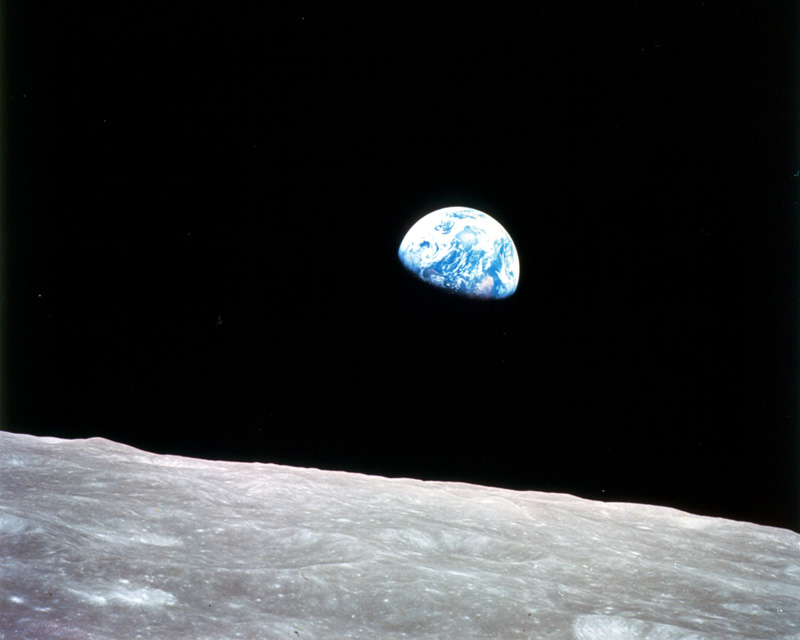
Earth Day is less about a view of night’s starry presence than it is about seeing Earth as a whole. Few times in our history has a photo of Earth made such a difference in so many lives as Earthrise taken by astronaut Bill Anders. It sparked the movement that brought us Earth Day which continues to this day.
We humans have not been the best stewards of Earth since April 22, 1970.
Early Years
Vague notions of ascendancy were taught by our grade school teachers. In the seventh grade I was segregated from neighborhood friends to join a college-bound group of peers in a special classroom. I entered the National Honor Society in high school and when I graduated in 1970 had no clue what I wanted to be. I knew I was college bound, not because I wanted that, but because the nuns said I should be. That I finished college at all was miraculous. I felt a sense of relief as President Nixon appeared to heed a shared need to do something about the environment. When he created the Clean Air Act (1970), and then the Clean Water Act (1972) I felt Earth Day had done its job.
Military Service
When I left Iowa in 1976 for basic training at Fort Jackson, S.C. I had little idea of what being a military officer meant. I knew the Vietnam War was over and I wanted to serve as my father had. The context was a paternal grandfather went to prison for draft evasion during World War II. Given a choice, I would serve. Among other things, military service taught me the environmental cost of war.
The environment has long been a silent casualty of war and armed conflict. From the contamination of land and the destruction of forests to the plunder of natural resources and the collapse of management systems, the environmental consequences of war are often widespread and devastating. ~ Ban Ki-moon, UN secretary general
Oil consumption and related carbon emissions are significant contributing factors to degradation of our atmosphere. The use of depleted uranium in military ordnance, notably during the 1991 Gulf War, created a complex array of environmental problems including introduction of carcinogens into the environment. We destroyed Iraqi infrastructure, including water and sewer systems, and contaminated surrounding ecosystems. The use of defoliant Agent Orange in Vietnam created sickness among soldiers and decimated biodiversity in the country’s tropical rain forests. We should include potential use of nuclear weapons which studies have shown, in a limited nuclear war, could create a nuclear winter making 2 billion people food insecure.
Awareness of the military’s environmental problems is a lesson learned.
Worklife
I worked 25 years in the transportation business, including an 18-month stint with Amoco Oil Company in Chicago. What goes almost unnoticed as part of background noise in modern society is the amount of fossil fuels burned by trucking, railroad and ocean-going transport vehicles. When I was maintenance director for a large trucking firm, I spent $25 million per year purchasing diesel fuel for our vehicles. That doesn’t count fuel burned by our affiliate companies which used independent contractors who fueled their own semi-tractor trailers. The fundamental dynamic during this period was I needed a job to support our family and given what I perceived as a lack of opportunity after college and military service I took what I could find, staying there for most of my professional career. I traded the environment for financial security. My main concerns were job performance and getting ahead. The nuns in grade school didn’t adequately prepare me for this kind of worklife. Environmental issues were off the table.
Retirement
When I left transportation ten years ago the climate crisis became more real.
In 2013 I participated in The Climate Reality Project conference in Chicago, taught by former Vice President Al Gore. It made a difference to learn the science of climate change and in the following months I began presenting the information learned in public speaking, in letters and articles in the newspaper and in my daily life.
We entered a period of politicization of everything. Facts ceased to matter. Income inequality worsened and the U.S. government seemed owned by the richest people. The scientific facts about climate change became a political choice: do you or don’t you believe the science of climate change?
Climate change is real and is impacting our lives now. Even banks are seeing how it can impact their business. From an open letter from the Governor of Bank of England Mark Carney, Governor of Banque de France François Villeroy de Galhau and Chair of the Network for Greening the Financial Services Frank Elderson:
The catastrophic effects of climate change are already visible around the world. From blistering heatwaves in North America to typhoons in south-east Asia and droughts in Africa and Australia, no country or community is immune. These events damage infrastructure and private property, negatively affect health, decrease productivity and destroy wealth. And they are extremely costly: insured losses have risen five-fold in the past three decades. The enormous human and financial costs of climate change are having a devastating effect on our collective well being.
The authors call for an orderly transition to a low-carbon economy. “The stakes are undoubtedly high,” the authors wrote. “But the commitment of all actors in the financial system to act on these recommendations will help avoid a climate-driven ‘Minsky moment’ – the term we use to refer to a sudden collapse in asset prices.” In other words, the climate change bubble could burst.
The Future
Less than 24 hours remain in this 50th Earth Day, a brief moment in Earth history. Whatever humans do, the earth will be fine. It’s human life and society that’s at risk. My takeaway from 50 years of considering Anders’ image of Earth against a background of the immensity of space is the same as when I first saw it: we humans are all in this together. It is going to take more than Earth Day to bring political will to act on climate.
Hiroshima, Japan after U.S. Nuclear Attack. Photo Credit: The Telegraph
I’m mad about nuclear weapons spending.
The Trump administration plans to spend far more than President Obama on the U.S. nuclear weapons complex. Depending on time frame, the administration will see Obama’s trillion dollars and raise it another half trillion.
Why do we continue to spend money at all on a weapons system we are required by treaty to eliminate? Why do we spend money on weapons that should never be used?
I’m mad and that’s not the half of it.
I’m mad at President Harry Truman for dropping the atomic bomb on Hiroshima at the end of World War II. I read Truman’s explanation in his memoir, Year of Decisions, and understand he thought it was a good idea. However, after Hiroshima, when our government understood the destructive capacity of nuclear weapons, dropping a second on Nagasaki was criminal.
I’m mad at the greatest generation for failure to comply with Article VI of the Non-Proliferation Treaty which was signed in 1968 and went into effect two years later. By now, we should be finished with nuclear weapons. The treaty binds us as follows:
Each of the Parties to the Treaty undertakes to pursue negotiations in good faith on effective measures relating to cessation of the nuclear arms race at an early date and to nuclear disarmament, and on a Treaty on general and complete disarmament under strict and effective international control.
The United States and Russia continue to hold the largest number of nuclear weapons even though reductions were made through treaty negotiations. Treaties are being dismantled by the current administration. If nuclear states had disarmed as the Non-Proliferation Treaty compels us, we wouldn’t even be having this conversation.
I’m mad at my generation of baby boomers. As the torch of nuclear non-proliferation was passed to us, my cohort chose to focus instead on personal liberation and financial well-being.
There was a resurgence of interest in non-proliferation during the nuclear freeze movement in the 1980s. This global advocacy contributed to negotiation of the INF Treaty between the United States and Soviet Union on the elimination of their intermediate-range and shorter-range missiles. It was signed by President Reagan and Soviet General Secretary Gorbachev on Dec. 8, 1987. The current administration announced plans to abandon the INF Treaty.
Why am I so mad? The problem of the existence of nuclear weapons should have been solved soon after society found their destructive capacity. I don’t want to pass that problem along to our daughter and her generation.
Our community has outgrown our fire station and tax levies aren’t sufficient to build a new one. Fire fighters are determined to raise the funds and implore us to “fill the boot” they leave at local businesses. If we had eliminated nuclear weapons, we might have enough money to build thousands of fire stations. Where are our priorities?
As a society we must create a nuclear weapons free world. There is no cure for a nuclear war. We must prevent what we cannot cure.
~Published on May 5, 2019 as a guest opinion to the Cedar Rapids Gazette






 Journey Home
You must be logged in to post a comment.