I stood outside in early morning darkness where there was a refreshing yet decidedly warm breeze.
The overnight low was 80 degrees Fahrenheit. I’m not sure if that’s warm enough to hinder apple production but scientists believe at some point failure to cool adequately at night does impact taste and texture.
They don’t fully understand the impact of climate change on apple production. For the home fruit grower it’s one more thing for concern.
The breeze dissipated with arriving sun. The forecast is clear and hot with ambient temperatures rising to the mid-nineties. We’re getting used to the heat, especially after the 2012 drought.
After sunup I went to an apple tree, picked one and ate it. The sugars are beginning to form but it is still a “green” apple.
Tonight begins the two-day festival in the small city near which we live. The ambient temperature is expected to peak around 6 p.m. when things are just getting going. Tomorrow is the parade through town when it’s pushing 90 degrees. I’m not sure it is a good idea to attend this year so am skipping the famous hay bale toss tonight and will re-evaluate the parade in the morning. A friend from across the lakes in Big Grove Township is running for sheriff so I want to be there to support him.
It’s blazing hot! We have an air conditioner and refrigerator with an ice maker that both work. There are also three bushels of vegetables that need processing. There will be plenty of inside work to keep me busy now that the heat is here.
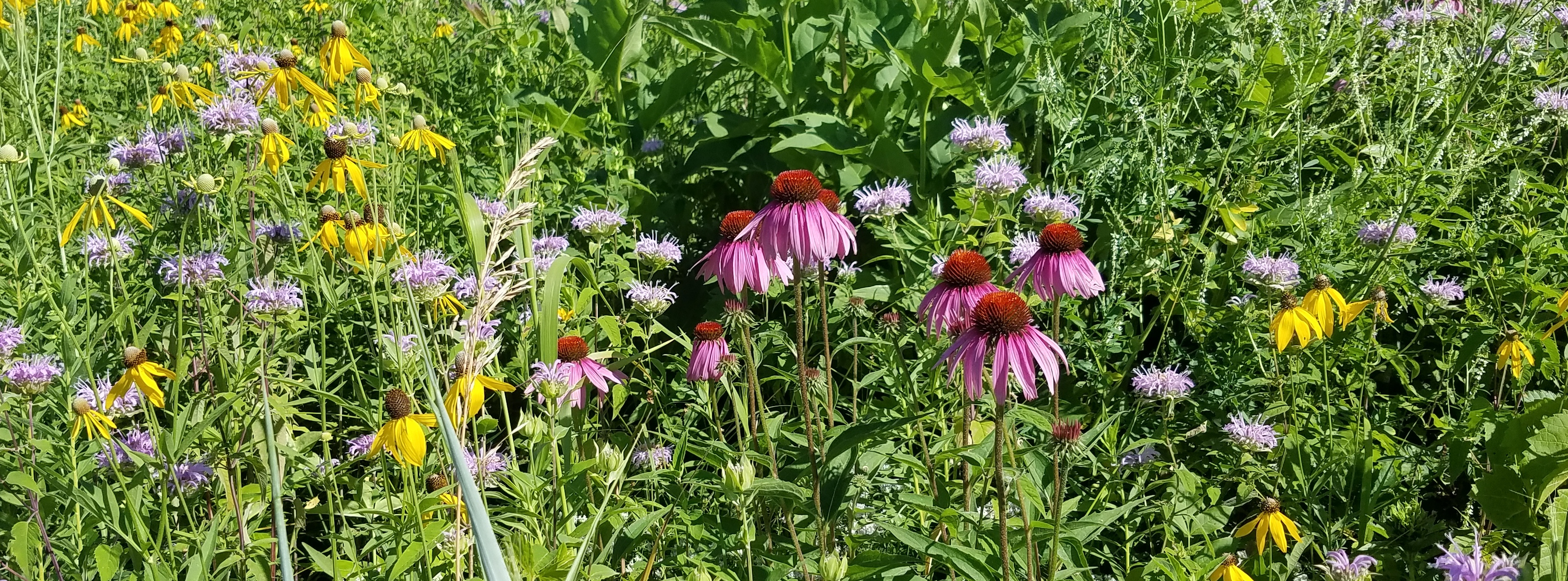
Prairie Restoration Area at Lake Macbride State Park
Each time I walk on the state park trail there are different wildflowers in bloom. Today’s offering was some of my favorites.
After returning from the day’s exercise, I mowed the front yard and couldn’t make out the line where the back yard started. Grass apparently wasn’t tall or thick enough to need cutting so I stopped and put the mower away until there would be enough to use as mulch.
I raked what few grass clippings there were for the garden, checked the moisture in the last few seedlings, and went inside to spend the rest of the day as temperatures climbed toward 90 degrees. We’re to have several days like this without rain.
We enjoy sunny days while we can. The restored prairie shows its pleasure in them with wildflowers in bloom.
On a fine summer day conditions were perfect to harvest hay and garlic.
My CSA friends recruited volunteers to bring in the garlic and across the county farmers were baling hay in large round and small rectangular bales.
On Independence Day farmers came to town to buy cultivators, salt blocks, pumps, feed, big pedestal fans, bedding (for horses), air compressor parts, nuts and bolts, and other stuff of life. At the home, farm and auto supply store we also sold a lot of propane, grills and kayaks, but that was not to farmers, as a farmer plans his/her kayaking and grilling ahead of time.
The rain has been good enough my garden doesn’t need much watering. Predatory insects are noticeably in abeyance, I suspect because of the polar vortex and extremely cold temperatures last winter. Tomatoes look as good as they have in years. It is already hard to use all the cucumbers. There will be green beans, okra, hot peppers, eggplant, squash, kale, carrots and more by the time August is finished.
We love summer.
Actually, we love life even in the extreme weather brought on by our own assault on nature. That we have perfect conditions for haying and garlic harvesting may well be an anomaly going forward. It was enjoyable this year and will be for however long it lasts.
I viewed the president’s speech on the environment on YouTube. It was not about climate change, human-made or other. In fact, the speeches by the president and about half a dozen others were devoid of any mention of the science of climate change, or solutions to solve the climate crisis.
I feel certain the bait shop owner from Florida has seen improvement in his local environment by the administration’s work on red algae. His speech was unprepared and somewhat random, but a slice of Americana available for public consumption and that, maybe, was the point. There was praise for the president from his staff, including the despised Andrew Wheeler, current head of the Environmental Protection Agency. If one adds up everything in the 56 -minute event, if we didn’t know the science of climate change, it would be believable. The climate crisis was absent from the environment Trump depicted and that is the problem with the Trump administration.
What bothered me the most, as it does any time I listen to the president, it’s the assertion that covers up a lie. Wheeler was bragging on how many super fund sites have been deleted from the list. Were they actually cleaned up or just declared clean and deleted?
I agree with Al Gore’s analysis:
Sometimes it’s hard to tell the origin of hot weather. Is it coming from Anthropogenic climate change, or from politicians in Washington, D.C.? Maybe a little of both.
The combination of advancing age and a world heated by human-made global warming has me looking for ways to cope.
When temperatures are forecast above 90 degrees Fahrenheit with high humidity I get my outside work done early then head into the house. I keep the thermostat at 83 degrees so as not to use too much electricity, but to take the edge off the hot, humid days. I manage to sustain my sanity.
I used to work outside in blistering weather until beginning to black out. It is a concession to age that I refrain from scheduling work to spite such conditions. Mother Nature always wins.
If the political failure to address global warming takes us all out, I can live with that. The extinction of humans would be fair if everyone goes together. Such fatalism serves no useful purpose if there is still a chance to slow greenhouse gas emissions and eliminate the use of fossil fuels that power our economy. What choice do we really have but to go on living? Part of that has to be political advocacy.
If we are individuals in the Anthropocene, we are doomed already. One has to wonder what Ayn Rand would have to say about the prospect of an end to humanity. One supposes as long as government doesn’t tax individuals and corporations she’d be okay with it. Although, she too signed up for Medicare and Social Security.
2019 has been a time of personal rebuilding. I made it across a career finish line and it took time for life to settle. I signed up for Medicare, then Social Security, and have begun to take better care of myself and effect repairs around the house. I spend a significant amount of time at home where reading, writing, gardening, yard work and cooking take a majority of my time. Something will be next.
I know what part of it is. The 2020 general election looms large in our efforts to engage the government in addressing the climate crisis. How to impact the election is complicated. In part I plan to band together with like-minded citizens and work for candidates, Democratic candidates for the most part. Everything from president down to township trustee requires positive change. There is more than politics.
It starts with taking care of ourselves but cannot end with the individual. That’s the outlook that brought us to today. What we know is government’s reduction of taxes and deregulation of business have played out in front of us. They fail to address the core issue: our survival in a turbulent world. What seems important is answering the question what role should government play in our lives? Finding a new answer is essential while living in the Anthropocene.
With recent moves to reduce the number of government advisory panels, overturn the Obama administration’s clean power plan, and increase the speed with which logging permits are approved in national forests, the Trump administration plows the field of deregulation in a way libertarians and conservatives could previously only dream about.
They have gone too far.
Even with regard to mitigating the impact of the climate crisis, the fossil fuel industry indicated the world is proceeding on an unsustainable path. According to the BP Statistical Review of World Energy 2019.
There is a growing mismatch between societal demands for action on climate change and the actual pace of progress, with energy demand and carbon emissions growing at their fastest rate for years. The world is on an unsustainable path.
In a special message to the Congress on Feb. 8, 1965, President Lyndon Johnson said,
Air pollution is no longer confined to isolated places. This generation has altered the composition of the atmosphere on a global scale through radioactive materials and a steady increase in carbon dioxide from the burning of fossil fuels.
A group of scientists explained to Johnson that burning fossil fuels could cause climate change, according to Naomi Oreskes and Erik Conway in their 2010 book Merchants of Doubt. “Most thought that changes were far off in the future,” they wrote.
In 2019 we see the effects of climate change in real time. We are living them.
Johnson signed hundreds of conservation and environmental measures during his tenure, developing the strongest record for the environment of any president. In so doing, he laid the legal foundations for how we protect the nation’s land, water and air.
Given time I believe Republicans will destroy the Johnson era legal foundation while their leader is lying to the American people about the quality of our air and water in a way that conflicts with our personal experience.
“We have among the cleanest and sharpest — crystal clean, you’ve heard me say, I want crystal clean — air and water anywhere on Earth,” President Trump said at a June 18 campaign rally in Florida. “Our air and water are the cleanest they’ve ever been by far.”
The science of climate change — that carbon dioxide and other gaseous emissions warm the atmosphere creating the greenhouse effect that enables life on Earth — has never been in doubt. It’s science and as Neil deGrasse Tyson recently said, “When you have an established scientific emergent truth it is true whether or not you believe in it.”
When Trump lies and repeats his lies over and over again, believers and followers will set aside what is in their best interests, what is plainly visible in objective reality, and parrot his words. It creates turbulence in society, an argument about things which there is no arguing, and delays political action that should have been taken years ago. It creates doubt.
Now we have a climate crisis.
Environmental advocates don’t agree on the path to resolving the climate crisis, in fact there are broad divisions. Some favor a carbon fee and dividend as a means of reducing carbon dioxide emissions. Others want geoengineering, a deliberate large-scale intervention in the Earth’s natural systems, to counteract climate change. Others want to keep fossil fuels in the ground and convert our electrical grid to sustainable, renewable electricity generation. Others favor implementing nuclear power as a way to get to zero emissions with electricity generation. There is no agreement about specific strategies and tactics to use.
What remains from the divisions is an elemental truth, we have to do something to mitigate the effects of climate change. While assertions like those of our president and his administration create doubt about the use of political action regarding climate change, doubt no more. We have to do something and soon.
If you’d like to learn more about the climate crisis I recommend David Wallace-Wells recent book The Uninhabitable Earth: Life After Warming. It is a comprehensive look at the diversity of the climate crisis. My advice is read his book then get involved with climate action.
The garden was muddy making it difficult to plant… so I waited.
For exercise I took a walk on the state park trail, 20 minutes out and 20 minutes back… with stops for photos.
Wildflower
Although the pace was slow, I could feel the benefit of the walk. It energized me to install the deer fence around the tomatoes and perform a few garden chores before an afternoon thunder storm.
I picked turnips and sugar snap peas from the garden. The first Japanese beetles have arrived. The six-foot stakes worked well to protect the tomato plot from deer who eat the top shoots if they can get to them. It makes a significant difference in yield. Almost everything looks good.
With season’s end of soil blocking tomorrow comes blank space to fill… or not. I’ll do something but let go of filling every moment with intentional action a while back.
One of the most profound things I studied in art history was horror vacui, or fear of the empty. We looked at photos of Greek vases where every space of the surface had images on it. The human tendency is to fill everything the way a person gets a tattoo or two and ends up with a full sleeve. Fear of the empty. It is more creative and more difficult to leave spaces blank. Letting go the obsession to engage every chance to express ourselves frees us to produce better work.
A gardener gets time to think about things like this… and watch the arrival of Japanese beetles, and vegetables planted with one’s own hands grow in sunlight, and devise unique solutions like my deer fence.
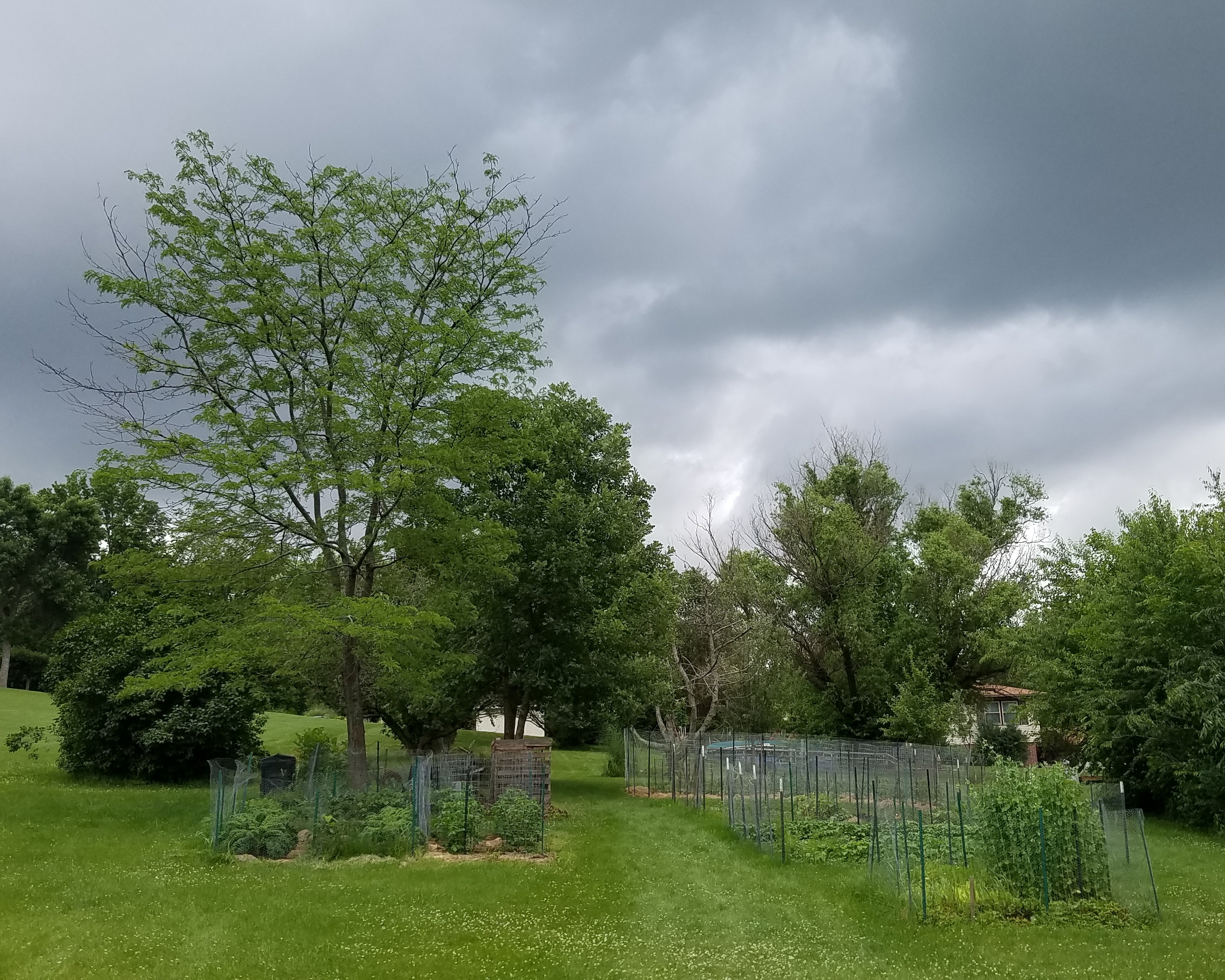
Some days we have to stand back and look at what we’ve built:
I walked due east from the garden along the utility easement to access a 25-acre stand of woods at the point where deer enter.
Deer are a constant presence in the neighborhood, especially during apple season, and I try to live in harmony with them by understanding what they will and won’t eat, and by using fences on the garden.
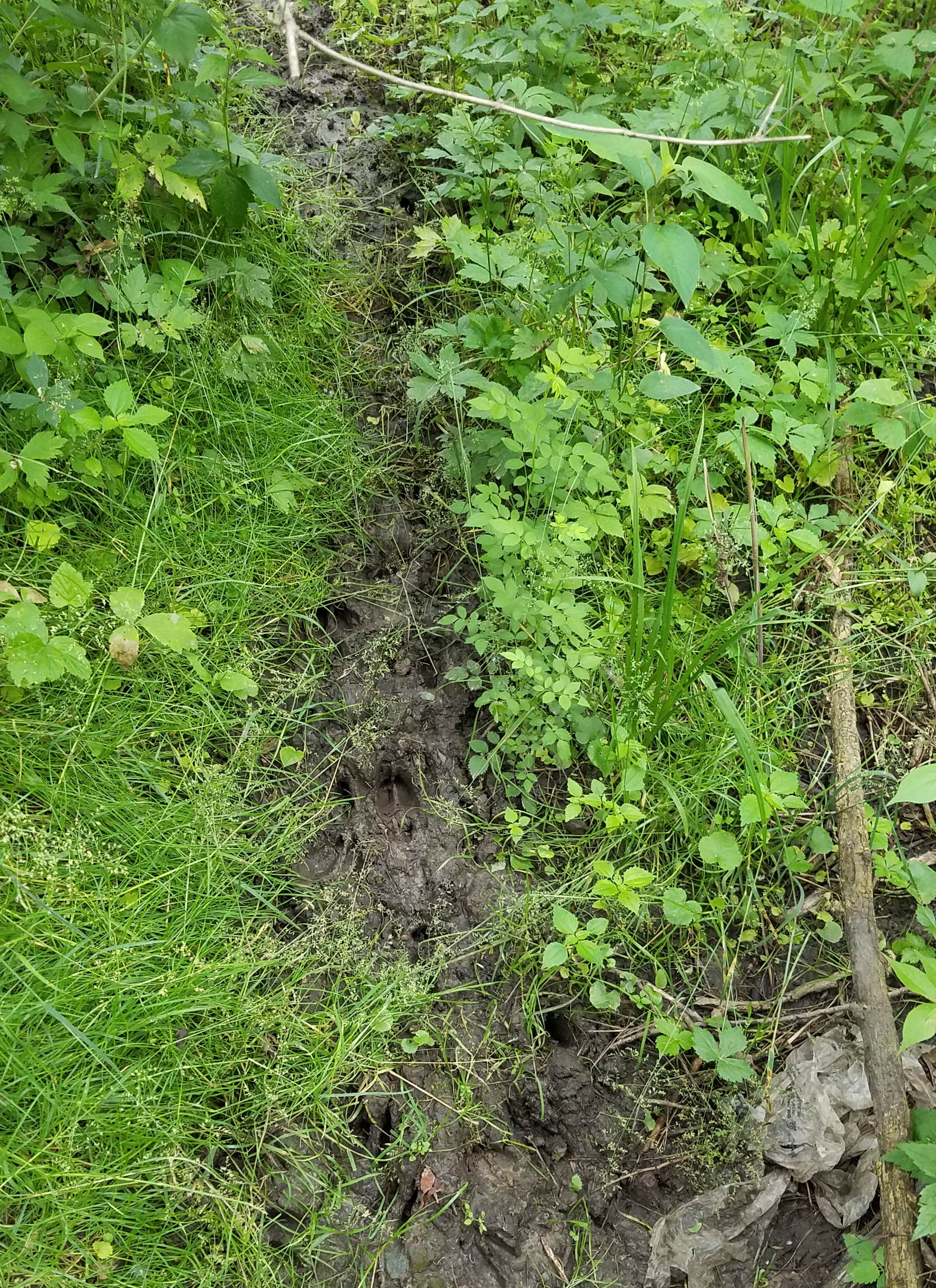
After dining, deer run across the same open space I walked to the wood line.
Based on the condition of the undergrowth, few humans visit the woods except around the edges. The main pathways are those made by deer and the brush is so thick I’m not sure how they get through. In 25 years of living here, there has been little interest in using the woods and I’ve hiked them less than half a dozen times.
Unnamed Creek, June 18, 2019.
I walked a deer path on the west bank of an unnamed creek up hill to the pond created by a now forgotten farmer. It was sweaty work and good exercise. I’ve studied the woods on maps for years and there was never a sense of being lost despite the claustrophobic feeling the thick undergrowth created.
The county planning and zoning commission requires our development to maintain a certain amount of open space so the woods can’t be developed with housing. If our association members had an interest in using the woods more, the deer paths could be upgraded to walking paths and mapped out. There has been little interest so it has become a habitat for wildlife.
If we were to develop the woods as a recreational area, there would be little money for it, so the work would be by volunteers. There would be a lot of work to do. Numerous native species of plants exist there, and identification and preservation seems important. The canopy is relatively thick and consideration should be given to long-term forest health. That might mean thinning some mature trees so younger saplings can grow. There are a lot of fallen branches which could be chipped into mulch to pave pathways. It could turn into a really big project. As busy as everyone is, I’m not sure who would volunteer and I know almost everyone in the association.
Native Fern, June 18, 2019.
Suffice it to spend an hour or so hiking the woods once in a while. It takes effort to forget the manicured lawns and gardens to focus on what is in front of us in the woods. By the time I reached the top of the hill, I had forgotten whatever seemed important when I left the garden to focus on finding my way, and then my way home.
It occurred to me that even though the association owns the woods, that ownership is only loosely so. I mean the woods will continue to develop as it has, enabling brief and specific glimpses into what used to be when Iowa was mostly tallgrass prairie. We are visitors on Earth, and that for a short while. Ownership is a cultural concept unknown to the plants and animals that live in the woods. No one truly owns the woods despite legal documents so indicating.
If I want to understand my relationship with wildlife better, I need to spend more time in those woods. Maybe during another hike in the near future.
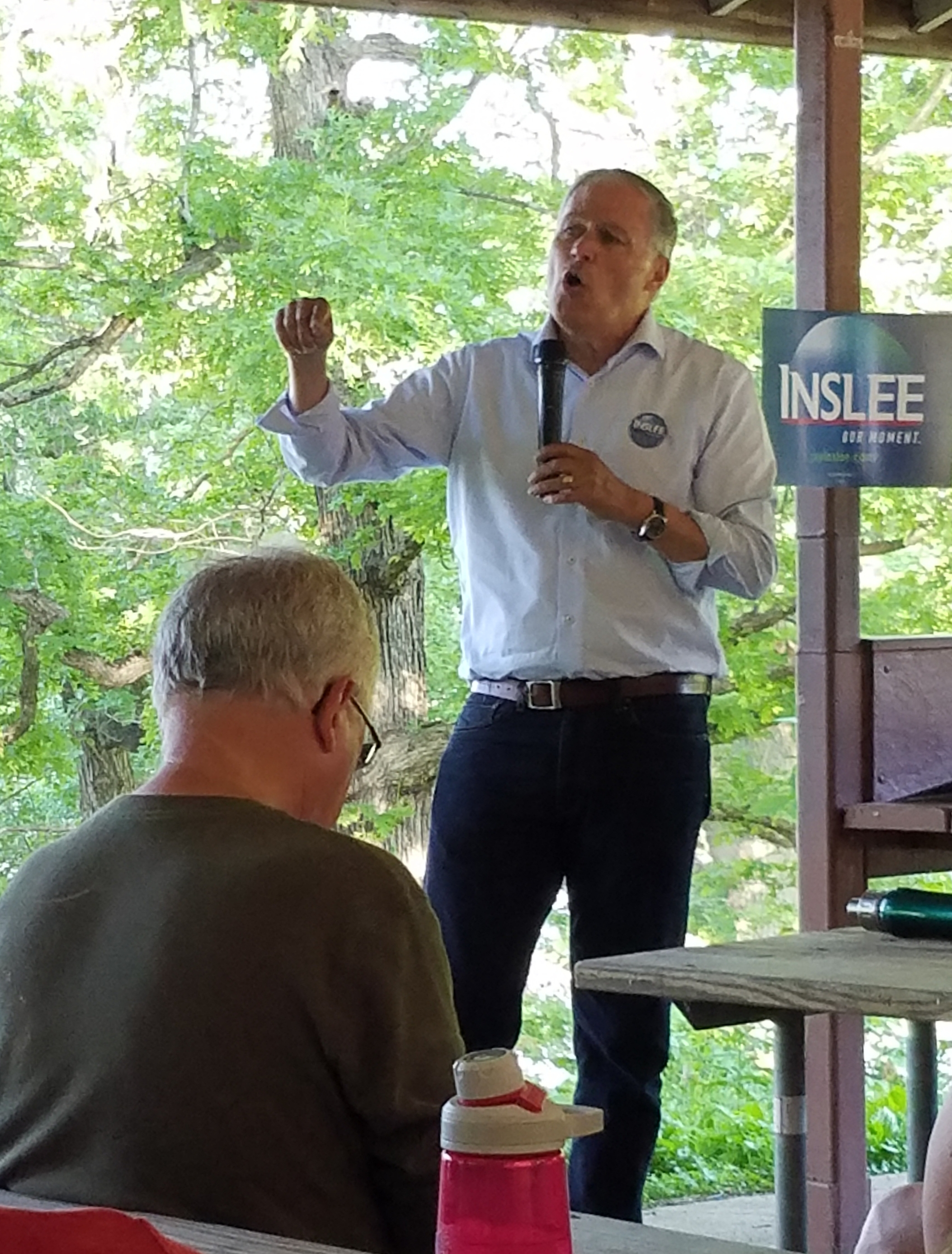
Governor Jay Inslee at Ellis Park in Cedar Rapids, Iowa, June 8, 2019.
CEDAR RAPIDS, Iowa — Saturday afternoon I drove to the Overlook Pavilion in Ellis Park where State Senator Rob Hogg had organized a “climate conversation” with Washington Governor Jay Inslee who is an announced candidate for president.
Hogg reminded us of the 2008 Cedar River flooding. The river was visible behind him.
It is hard to forget the 2008 flood that devastated Iowa’s second largest city. On my way to the event I compared flooding levels of the Atherton Wetland on Ely Blacktop which had been covered with flood water in 2008. From the center of Cedar Rapids I used First Street Southwest, which runs next to the Cedar River, to find the park. On the eastern bank someone had built a flood wall. An earthen berm restricted the view of the river on some parts of First Street. The low-lying area had been inundated in 2008 causing damage to more than 5,000 homes, evacuation of 25,000 people, and roughly $4 billion dollars damage. The flood was made worse by climate change.
In his introductory remarks, Senator Hogg recognized elected officials and organizations present and encouraged the almost 200 attendees to engage in the Iowa caucus process of meeting with presidential candidates. Hogg added later, “with the spirit of citizenship, we can bring Americans together for climate action we so urgently need and the many climate solutions that work.”
Governor Inslee began his remarks with the reason he seeks to defeat climate change, his grandchildren. “We have a moral obligation to the young people of America to defeat climate change,” he said. Noting last week’s atmospheric carbon dioxide concentration was 414.42 ppm (only slightly less than the record (415.70) set May 15), he added, “It is time to act on climate.”
Defeating climate change would be the first priority for an Inslee administration, the governor said. It was a “predicate for success” in all policy areas. If addressing climate change is not job one it won’t get done.
Inslee split from environmental groups like Citizen’s Climate Lobby when he said he did not support a tax on carbon. He favors regulatory reform to reduce carbon emissions. Based on his experience in Washington State, voters are unlikely to accept such a tax, he said.
Inslee asked for help in two areas of his campaign.
While he met the qualifications to participate in the first two debates being hosted by the Democratic National Committee, he has not met the 130,000 donor threshold to participate in the third and fourth. He encouraged those present to donate one dollar or more to his campaign and ask friends and family to do likewise.
Inslee wants the Democratic National Committee to devote one candidate debate to climate change so every participating candidate can lay out their plan to defeat it for voters to see. The request has been rejected, making supporting Inslee the best way to make sure the topic is covered during the debates, he said. Holding a climate change debate outside those sanctioned by DNC is not an option.
“It is the DNC’s job to organize the debate schedule, and the ground rules on unsanctioned debates were made clear with all the candidates, including Governor Inslee, and media partners months ago,” DNC spokesperson Xochitl Hinojosa told Mother Jones. The DNC welcomes candidates to join issue-specific forums instead.
The thrust of the conversation was Inslee has a positive progressive record in Washington State and wants to take that success to Washington, D.C. To learn more about Governor Jay Inslee, visit his website at JayInslee.com.
The Inslee campaign posted video of the event here.
I’ve been wanting to try the Impossible™ Burger and will have to wait.
I met a group of friends at a restaurant Friday where Impossible™ was printed on the menu. Since Burger King® decided to offer the plant-based burger nation-wide, smaller restaurants haven’t been able to get it according to our server.
The kitchen did have a Beyond Burger®, which I tried and was satisfied by my pub grub-style meal of a burger, coleslaw and Stella Artois®.
The reason I mention this is the American Farm Bureau Federation was running down products like these burgers for being “ultraprocessed.” In a June 4 blog post, author Teresa Bjork invoked reality to straighten people out,
In reality, meat and milk imitators are ultraprocessed foods. They are made from a long list of ingredients, including sodium and added flavors and colors, to improve their taste and nutrition.
One suspects increased availability of veggie burgers, and the Burger King® marketing decision, is taking a bite out of cattle producer market share. Likewise, the reason ovo-lacto vegetarians like fake meat is not for the salt content, but for how it fits into our lifestyle as comfort food. No matter how bad things may get for us personally, we want the sensation of eating foods that are traditional in our culture. Let’s cut to the chase.
The single biggest way to reduce our impact on Earth is to avoid consuming meat and dairy. Maintaining herds of livestock is a land use policy that encourages the ongoing mass extinction by taking land thus depriving other species of habitat.
“Meat and dairy provide just 18 percent of calories and 37 percent of protein, (using) the vast majority – 83 percent – of farmland and producing 60 percent of agriculture’s greenhouse gas emissions,” according to the Guardian.
We can do better than that.
It’s no secret people should consume less processed food, particularly simple sugars and carbohydrates, for dietary reasons. For the Farm Bureau to favor meat and dairy production of their members is also not surprising. What is fake here is not the burgers, it’s the straw-man argument to protect what Farm Bureau sees as its own interests.
From time to time many Iowans crave a tasty burger. Getting one without politicizing it may be impossible.
I don’t intend to get alarmist on fair readers with dire predictions of the end of the world as we know it. Even though doomsday stories are quite popular, and climate science is, well science, there is another issue.
In our weird, wet spring weather we believe we have climate change figured out. Instead of planting our potatoes on Good Friday, now we’ll plant them in early June as the ground dries out and all will be hunky-dory. That’s a problem.
Science: Around 1850, physicist John Tyndall discovered that carbon dioxide traps heat in our atmosphere, producing the greenhouse effect, which enables all of creation as we know it to live on Earth.
Also science: As greenhouse gas emissions increased after World War II, our atmosphere warmed significantly. A warmer atmosphere holds more water vapor. As we discovered, water vapor laden atmosphere can unleash torrents of rain on Iowa and elsewhere. There’s photographic evidence!
Suddenly we’ve gotten all climate-changey. Every severe weather event is declared to be made worse because of climate change. Maybe it is although the complexity of our climate doesn’t lend itself to such simple statements.
What makes this problematic is in a culture where we appreciate detective work that goes into finding a villain, assigning blame, and making them pay with social shunning or other consequences, there is no single antagonist with climate change. We are all antagonists which makes a pretty boring story.
Iowans may believe climate change brought us a new normal of wet springs. What the science is telling us about climate change is there is no normal as we define the word. The minute we believe we have climate change figured out a new twist should be expected.
It is time to Act on Climate.
~ Published in the June 13, 2019 edition of the Solon Economist








 Journey Home
You must be logged in to post a comment.