My message about the Nov. 5 school board election is simple. Learn about the candidates and vote!
It has been difficult to determine which of six school board candidates is best qualified. All of them would bring something to the job and each expressed a strong desire to improve the Solon School District. There aren’t any clinkers among them.
When three of the current board members were elected in 2017 only 498 people voted according to the Johnson County Auditor. 10 percent of registered voters is not enough to validate the kind of support needed to meet the challenges of district facilities and staffing in coming years. We each, young and old, have a stake in this election and should engage in the choice before us.
I hope you will show your Spartan spirit by researching the candidates and voting for two of the six candidates you believe are best qualified to join the school board on or before Nov. 5.
Thanks for reading. To view the series of posts about the Solon School Board election, click on this link to the tag 2019 SSB Election.
~ Published in the Oct. 24, 2019 edition of the Solon Economist
At what point do the achievements and momentum of a local school board yield to change many perceive is needed?
The large number of candidates on the Nov. 5 ballot, six candidates for two seats, suggests the time is now.
I’ve heard from all six via email and telephone. My impression is each of them is sincere in their stated goal of making the district as good as it can be for our children. In the Solon School District we have done many things right.
In recent years, Solon built a new high school, a new middle school, and a new intermediate school, all with little controversy. Athletic fields are expansive and the recently finished Solon Center for the Arts is a first class facility.
Compare that to the Iowa City Community School District where its master facilities plan, which I covered for the North Liberty Leader, has been fraught with controversy. Emblematic is the ongoing debate over what to do with Hoover Elementary School. The issue was on the November ballot after many public comments, legal battles, and sundry frustrations. The Iowa Supreme Court ruled Oct. 18 the issue is not to be on the ballot two weeks after early voting began. Solon is no Iowa City. Solon did facilities right in a community where there is living memory of people who attended the one-room school house on Highway One.
The main sticking point in the community has to do with the way teachers were treated by administration in the recent contract negotiations.
Word on the street is the administration favors two candidates: Adam Haluska and Jennifer Stahle. Haluska was first elected to the Solon School board in 2015. Stahle is a long-time area resident who is also involved as a volunteer with the schools. Both Haluska and Stahle have qualifications relevant to being a school board member. If I get confirmation from another source I’ll have more to say about the administration’s role in favoring candidates for the board that governs them.
In different ways, each of the four remaining candidates either points to the conflict between the administration and teachers over contract changes as a motivation for running for office, or politely says they would like to improve transparency and/or communication between the groups. Even if Haluska and Stahle are not favored by the administration, the field of candidates appears to divide into two camps: candidates that want to build on progress already made, and one that favors changes in the relationships between administration, teachers and students.
It is difficult to see whether voter turnout will be any different Nov. 5 than in 2017 when about 10 percent of registered voters (498 voters) turned out for the school board election. Views of people with whom I discuss voting for school board have been a mixed bag. Some said they aren’t engaged in the school board election and don’t plan to be. Others would vote if encouraged but don’t know any of the candidates, including the incumbent. There are twenty-somethings, some with young children, for whom voting is something they just don’t do. If candidates rally their constituencies around a get out the vote campaign, any of the six could sway the election results due to what I see as another low turnout election.
I plan a deep dive into the candidates once the Solon Economist publishes its candidate survey results. They ran the article about city council candidates in yesterday’s edition, so we are expecting to see school board next week.
Thanks for reading. To view the series of posts, click on this link to the tag 2019 SSB Election.
Six candidates announced campaigns for two seats on the Solon Community School District board of directors. The election is Nov. 5.
Terms of current board members Adam Haluska and Jim Hauer expire this year. Haluska is seeking reelection, Hauer is not.
Information about the candidates is scarce. This is the first of a couple of posts intended to share information discovered to help determine for whom I will vote.
The all-male school board came under criticism for implementation of the collective bargaining law signed by Governor Terry Branstad on Feb. 17, 2017. On March 13, Aimee Breaux of the Iowa City Press Citizen reported on a confrontational school board meeting using this lede:
Solon school officials should brace for teachers leaving the district if management insists on reducing insurance stipends, teachers union members warned during a particularly tense contract negotiation.
Teachers did leave the district and those contract negotiations remain an open wound.
School board elections are decided by a small slice of the electorate. 498 district voters, 10.05 percent of registered voters, decided the 2017 race that elected Tim Brown, Rick Jedlicka and Dan Coons to the current board with terms expiring in 2021. Low voter turnout means personal networking plays a greater role in candidate support than during a general election with paid advertisements. Networking information is not often public. In the past, groups in the community have been able to activate voters to support their favored candidates. There is no reason to believe networking will play a lesser role on Nov. 5.
This cycle, information will be available in a special article in the Solon Economist. “We will do our standard question and answer interviews prior to the election,” editor Doug Lindner wrote in an email. Some candidates told me via email they are working on the questionnaire. The article is expected in next week’s edition.
There will also be a public candidate forum hosted by the Solon Education Association and Solon Parent Teacher Organization on Tuesday, Oct. 22, from 6:30 until 8 p.m. at Palmer House Stable in Solon.
Yesterday I emailed the same information request to all six candidates, as follows:
School board candidates,
I’m seeking information about you to help me decide which two candidates to support in the Nov. 5 election.
Please take a few moments to reply to this email about your candidacy. I’d like a response by Friday, Oct. 18.
I didn’t see any information about your campaign in a Google search. If you have a campaign site, please provide a link.
Why are you running?
How would you like to change the direction of the board, if at all?
Please provide a brief resume of your skills and qualifications.
Have you ever held elected office previously? If so, which one?
I do plan to vote so any response will be helpful. Thanks in advance for your cooperation.
Regards, Paul
Thus far I’ve heard from three candidates, and hope to hear from them all before publishing results of my query.
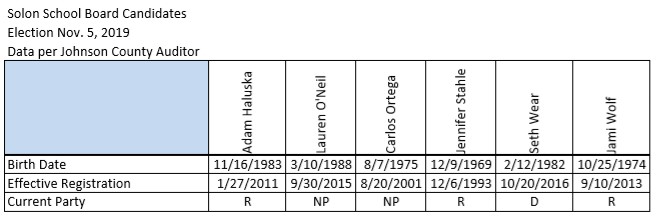
Here’s who is running in this non-partisan race.
Note the election is framed as non-partisan, and many of us look for what skills candidates bring to the office more than party preference. Voters often have to compromise their partisanship in a school board election to pick the best of the field. I voted for Republican Adam Haluska when he was elected in 2015 for that reason. This year’s election is a new field of candidates and incumbency is not necessarily positive after the contract negotiations. I’ll take a look at what Haluska did on the board.
Finally, I mentioned the current all-male board. Voters told me they would like to see women on the school board. My position is we should vote for the best qualified candidates regardless of gender. If female candidates offer the best outcomes for the school board, they should be given fair consideration. If they represent the best of the six, they should be elected. Determining who is “best” is part of what I’m doing with these posts.
Thanks for reading. The current plan is posts about responses to my query, analysis of the public record of the incumbent, analysis of the Solon Economist article, and a post about what happens at the candidate forum.
To view the series of posts, click on this link to the tag 2019 SSB Election.
Daylight remained as I drove into the driveway after a shift at the orchard.
If the garden appeared scorched by the previous night’s first frost, some tomato plants survived and the kale looked resilient.
The weather forecast is a couple of days without rain. I scheduled garlic planting for Tuesday when the ground should be dry enough. Fingers crossed I get a crop in this year.
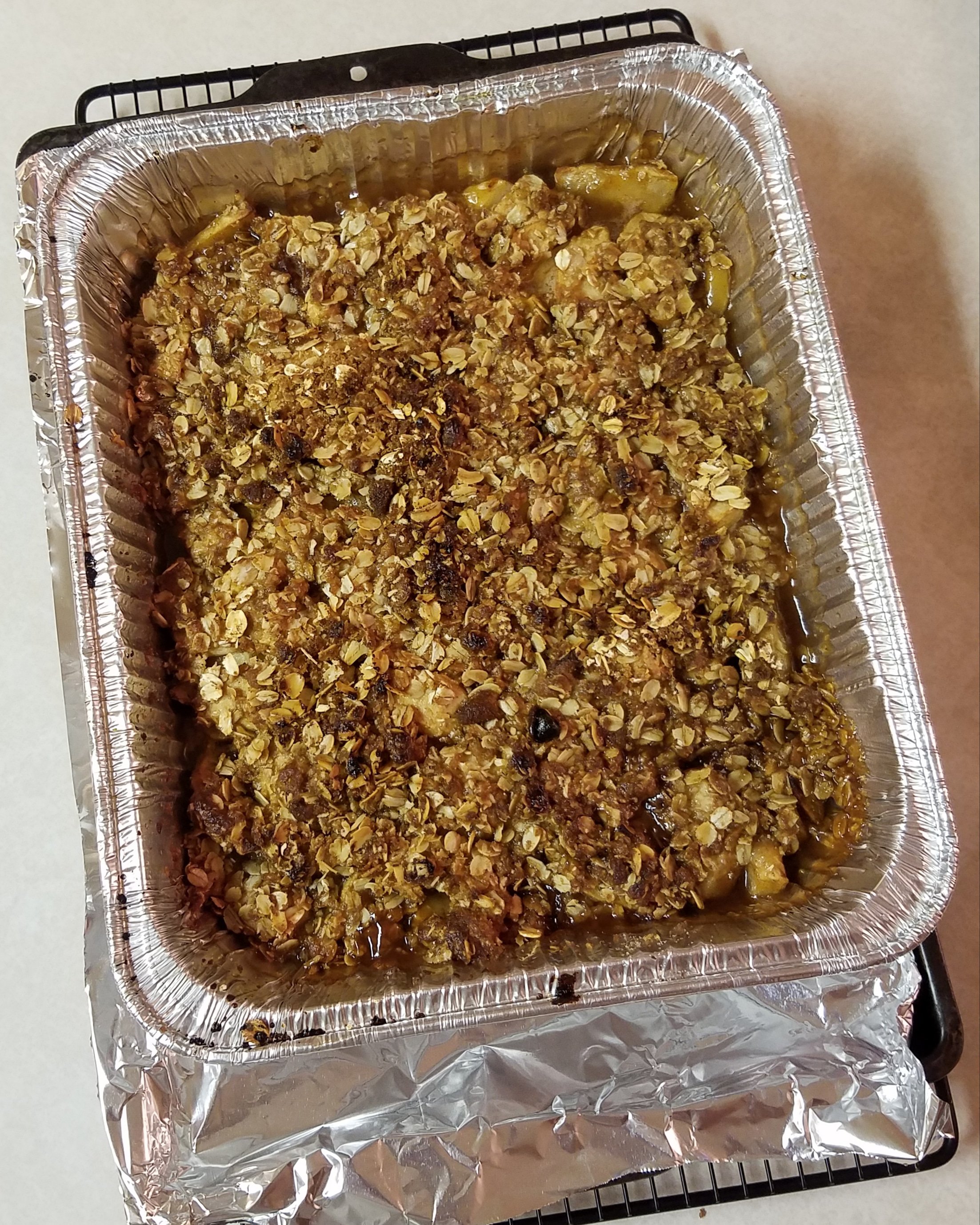
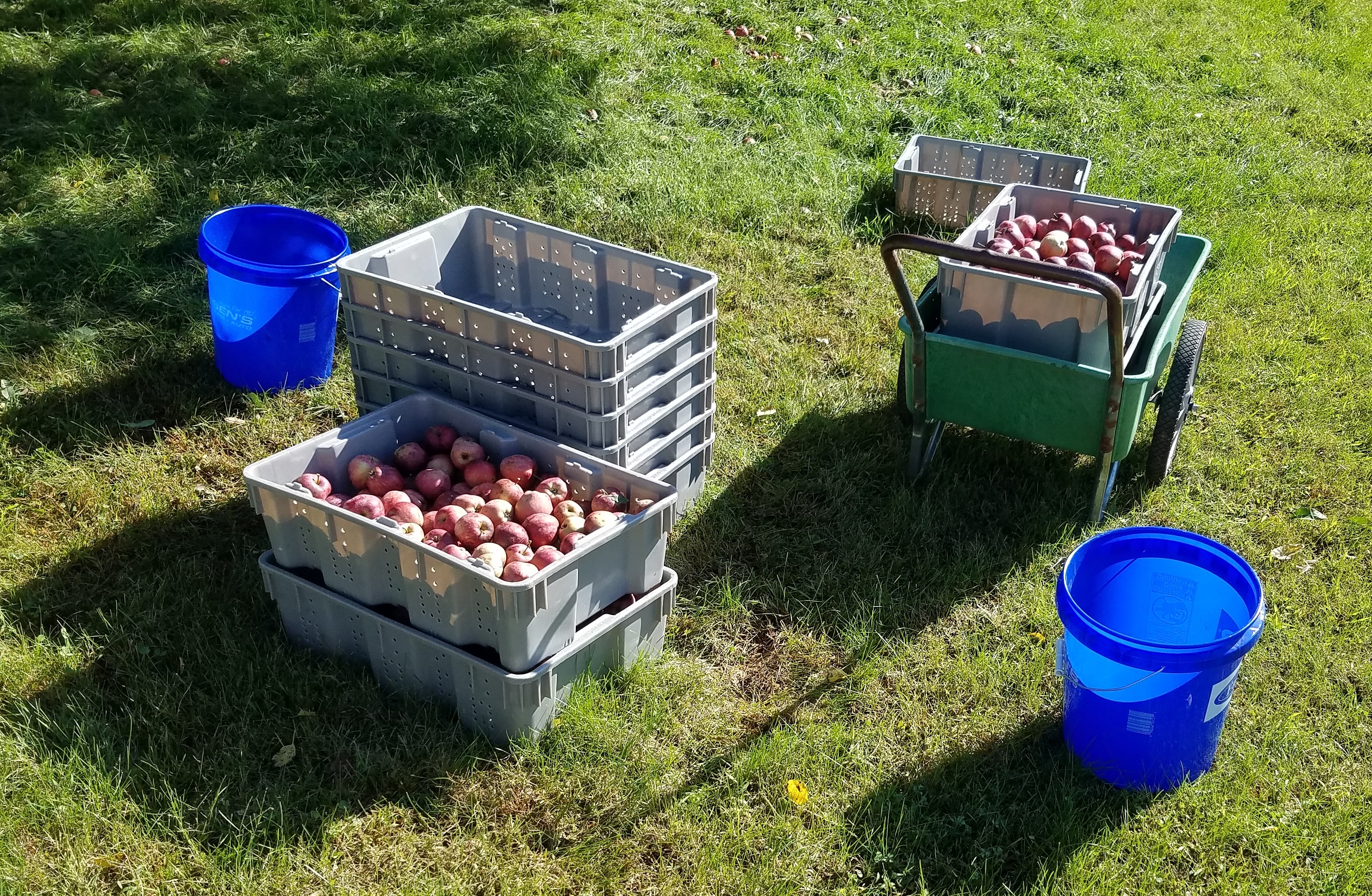
I picked another bushel of fully ripened Red Delicious apples yesterday morning. This morning I used apples knocked down and damaged during the picking process to make an apple crisp for the county party’s fall fundraiser. In September I bought 30 aluminum food service trays for potlucks. This was the fifth one used.
We were busy at the orchard Saturday. Because of rainy weekends there is a pent up demand for the u-pick apple experience. I was tired at the end of my shift. I fixed eggplant Parmesan for dinner and could go no further. I was so tired I left the dishes to clean this morning. If there was any doubt, autumn has definitely arrived.
Hot peppers gleaned from the garden before the first frost.
When we had insufficient income to pay bills few errands were run.
We made almost no home repairs, delayed maintenance on everything, and minimized activities that required resources not on hand.
Now that our retirement income is set, and supplemented with a couple of extra jobs, I can afford to run errands. Yesterday I did so for the first time in a while.
The day began in the kitchen. Using onions and Swiss chard from the farm I made frittata for breakfast. Next, I sliced apples and filled the dehydrator. Sunday is the county party’s fall barbecue so I tested a recipe for applesauce cake to see if it would fit in the foil pans I bought for potlucks. The recipe fit without modification. In between this cookery I managed to glean the garden, bringing in peppers and tomatoes that would be damaged by frost. The kale looks really good right now and a freeze would make it taste better.
I cut five pieces of applesauce cake, put them on a plate, covered with foil, then delivered them to the public library while still warm. The librarian was making tea so the timing was perfect.
Next stop was the orchard where I hiked half an hour up and down hills, picking five varieties of apples: Regent, Crimson Crisp, Mutsu, Fuji, and New York 315. I also got some Snow Sweet and Honeycrisp in the sales barn. The season is about over yet there are lots of apples remaining on the trees.
From the orchard I drove to the recycling center in the parking lot of the former Hy-Vee supermarket on North Dodge Street. This is my go-to place for paper and magazine recycling. With our new clean-up project we are getting rid of lots of old magazines, too many for the curbside bin.
I pulled into nearby Hy-Vee where I bought organic celery and a packet of Morningstar Farms Recipe Crumbles for a pot of chili planned over the weekend. I’d been discussing nutritional yeast with one of the orchard owners so I bought a small container of Bragg’s brand to try it. The recipe we discussed was serving boiled or baked potatoes with a sprinkling of nutritional yeast and a dollop of yogurt. I’m now one step closer to trying it. They did not have the organic mayonnaise I sought, so I continued to Trader Joe’s.
Trader Joe’s is a store on the island that is the Iowa River Landing. This 180-acre mixed use development borders on the weird side. An arena is being built there and there are high rise apartment buildings, a hotel, a university-affiliated clinic and retail outlets. Despite having a range of activities, there is no sense of community at Iowa River Landing. I picked up two jars of organic mayonnaise and two of French Dijon Mustard. Staff was very friendly.
Westward to a big box home improvement store where I sought a replacement baseboard register for one of the bathrooms. Borrowing a tape measure from staff, I found the one I needed. On the way out I made an impulse purchase of a small bottle of 50:1 fuel mix for my trimmer. Expensive, but the right fuel is important for high-speed, small engines. My trimmer has been repaired twice since I purchased it so paying extra for proper fuel.
Final stop on the loop of the county seat was a drug store where I bought sundries, then drove home through three roundabouts and over two lakes.
Later that afternoon we went to the public library where Jacque delivered a book project she’d been working on as a volunteer and picked up the next. While she reviewed things with staff, I browsed the used book cart to see what was available.
I eschewed community cookbooks this time (how many of those can a person digest?) and bought good copies of a couple of works on my reading list. I also bought Do Androids Dream of Electric Sheep? by Philip K. Dick and In Her Kitchen: Stories and Recipes from Grandmas Around the World by Gabriele Galimberti, the latter of which I read last night. What a marvelous book of women’s stories, recipes, and photos of the women with their ingredients facing a photo of the dish they created.
Moving from low wages to an adequate retirement income won’t make us rich, except in the ability to get out, run errands, visit with friends, and buy things we need to sustain our lives in a turbulent world.
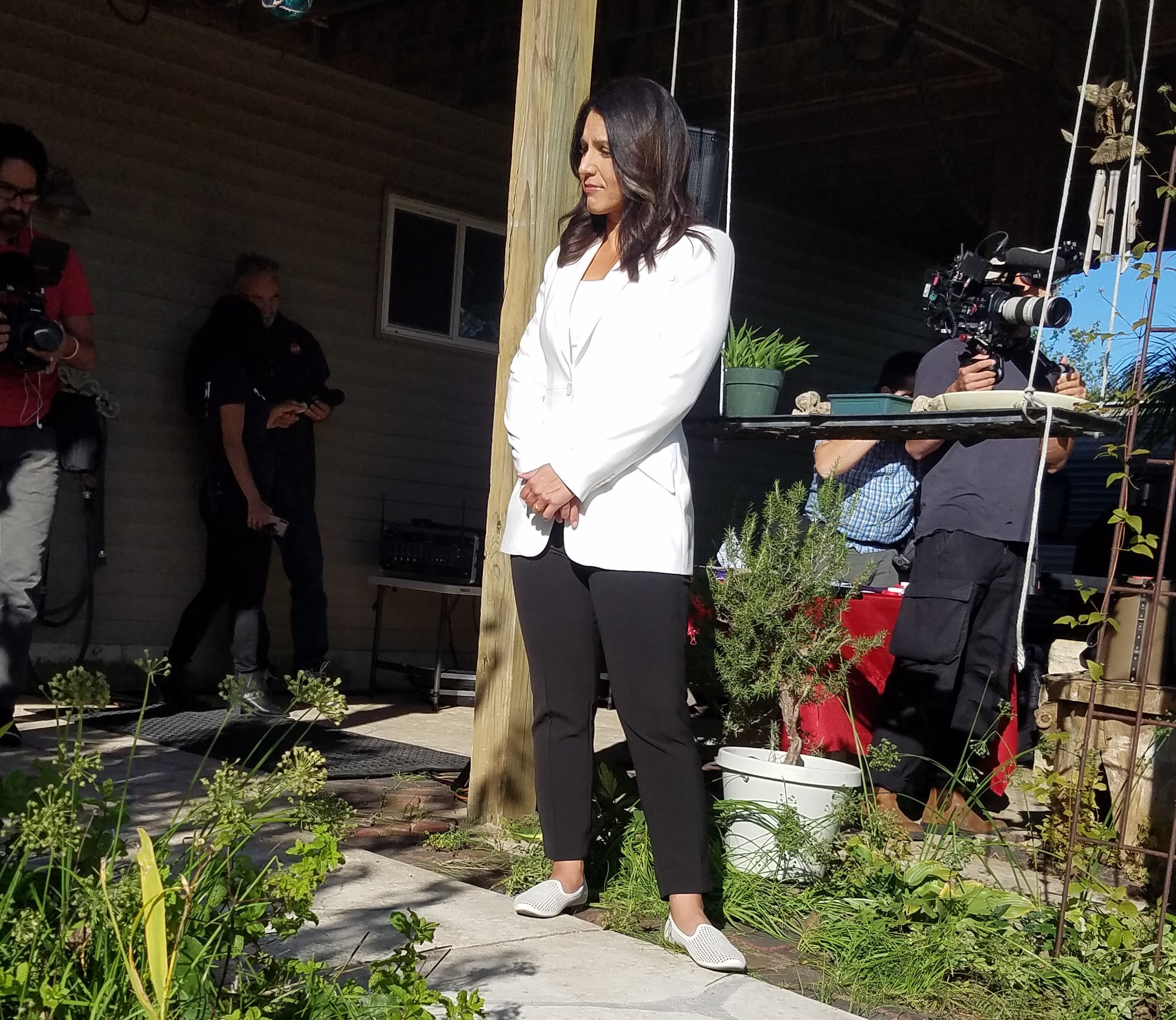
BIG GROVE TOWNSHIP — On Tuesday a neighbor hosted presidential candidate Tulsi Gabbard at his home.
On a large patio facing Lake Macbride, about 40 people gathered to hear what the candidate from Hawaii had to say. That is, 25 regular people along with sundry staff, volunteers, journalists, photographers, and videographers.
I invited the editor of our local paper, The Solon Economist, and he attended.
What’s newsworthy is it was the only presidential campaign event to be held in Big Grove Township, and one of only two in the Solon area this cycle.
As a neighbor, I baked an apple crisp to serve at the event using Northern Spy, Macoun, and Red Delicious apples picked at home and at the orchard. My neighbor supports Gabbard because of her views on defense department spending. I was recognized for my apple work.
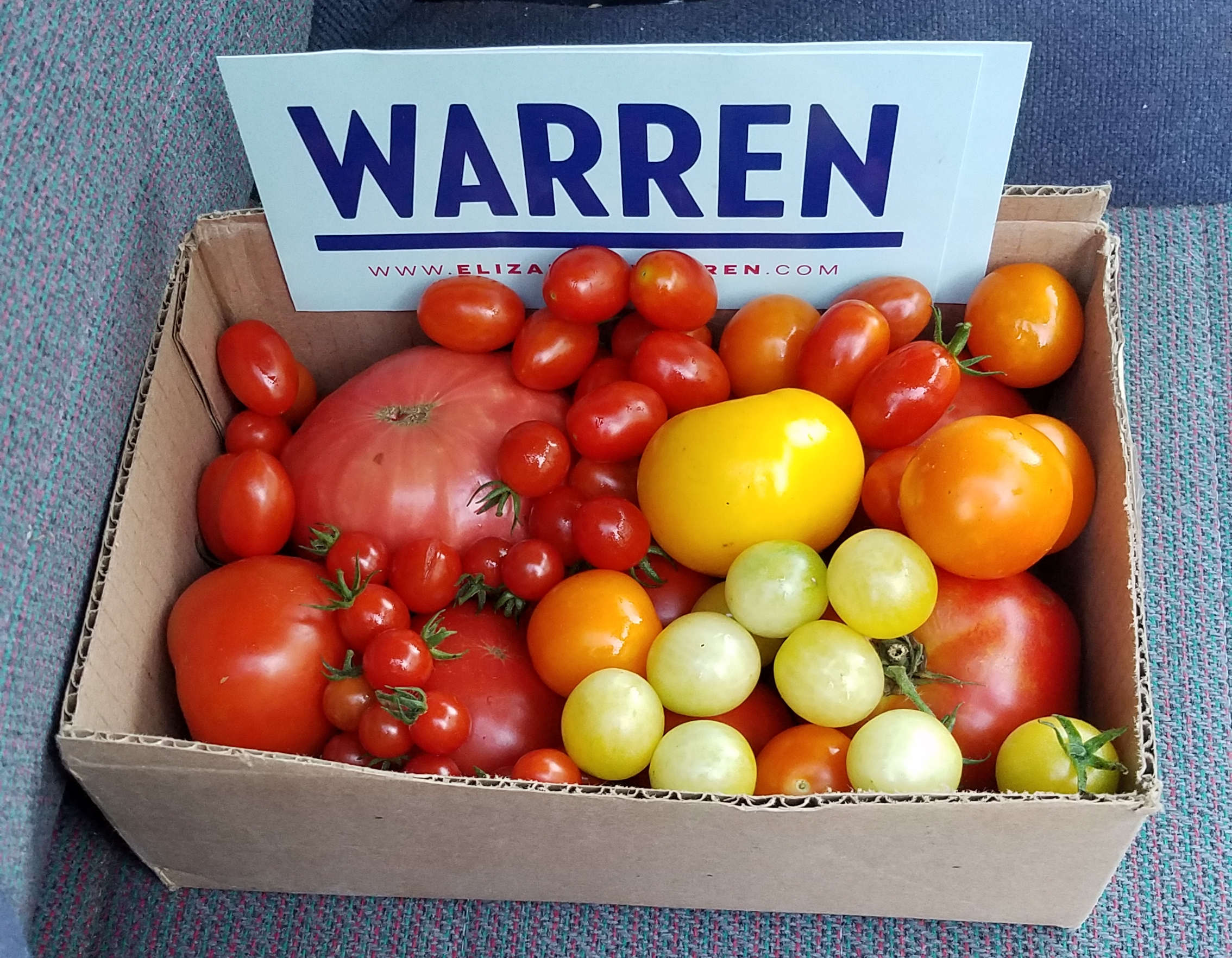
I met Gabbard the summer of 2016 at Congressman Dave Loebsack’s Brews and BBQ fundraiser a few miles away. She has yet to make a memorable impression, although I don’t feel negativity toward her as I did when I met Bernie Sanders in 2014. The brief speech under sunny skies was not enough to have me remove the Elizabeth Warren bumper sticker from my car.
It was a unique event in our neighborhood and I was glad to be part of it. Any time a sitting member of congress shows up here it is worth the time to listen and learn.
James Q. Lynch of the Cedar Rapids Gazette posted an article about the event here.
Now that Elizabeth Warren’s presidential candidacy is gaining traction among Democratic voters, in fund raising, and in a number of political polls, the knives are out.
The arguments against her seem without merit, although, like it or not de-bunked arguments often drive our politics in the 21st Century.
There are two main arguments advanced to harm Warren’s candidacy, the first is she is a woman.
Who will be the first woman elected president? None of us knows the answer and if the results of the 2016 election mean anything, it was a triumph of male dominance and an American patriarchy of moneyed interests that elected our current president. People often say Hillary Clinton was a bad candidate, however, I disagree. Whatever flaws her campaign had, she did the work and won the popular vote. Campaigns are always clearer in the rear-view mirror. If she’d approached a few states differently she might have won the Electoral College as well as the popular vote. There are no do-overs in national politics so the results of 2016 were the results.
I spend part of my time discussing politics with progressive Democrats. What gets said in private conversations is the United States is not ready to elect a female president. In both women and men it is a deeply held belief. My retort is if Democrats don’t run a female candidate we’ll never elect a woman president. Is Elizabeth Warren electable?
Johnson County Supervisor Rod Sullivan, a Warren supporter, laid out the argument de-bunking the idea a candidate is “electable” in an Aug. 20 letter to the editor of the Cedar Rapids Gazette titled “Electability is a Sham.”
“’Electability’ is not real,” Sullivan wrote. “It is a creation of pundits — pundits whose predictions are about 80 percent wrong. ‘Electability’ can only be measured after the fact — did the person in question get elected? Anyone who pretends to know something about ‘electability’ before an election is simply a fraud.”
It is time for Democrats to get over the idea a woman can’t be elected president by picking the candidate most closely aligned with our values regardless of gender.
The second argument often advanced to damage Warren’s candidacy is she is too liberal, another media-driven piece of buncombe.
I recently had coffee with David Redlawsk, Soles professor of political science at the University of Delaware. According to his official website, Redlawsk’s expertise includes being a political psychologist who studies voter behavior and emotion. He focuses on how voters process political information to make their decisions. He’s teaching this semester at the University of Iowa while studying the Iowa caucus process.
I’ve known Redlawsk since he was treasurer of Democrat Dave Loebsack’s first congressional campaign. What he said over coffee last week was similar to what he said back in 2006. The majority of liberals and conservatives will vote for the Democratic or Republican nominee for president respectively regardless of the nominee. This leaves a small slice, maybe 10 percent, who are persuadable and could determine the election outcome. This is a mainstream belief about elections and while Redlawsk was more nuanced, there is relevance to the 2020 presidential contest.
Enter the media. Over the weekend the Washington Post published an article by Michael Scherer and Matt Viser titled “Uncertainty takes over the lead in the Democratic presidential race.” In it, they quote former New Orleans mayor Mitch Landrieu on Warren:
“She has a plan for everything except for how to beat Donald Trump. That needs to get tested,” Landrieu said. “She says she can do all these things. There’s a thing called political reality. . . Aspiration is wonderful, but you can’t eat aspiration for lunch and send your kids to college on it. That’s a fundamental decision that Democratic primary voters need to make a decision on.”
As Redlawsk mentioned, liberals and Democrats will vote for Warren in substantial numbers in a match up with Donald J. Trump should she be the nominee. Most politically aware voters recall that Barack Obama struggled to get parts of his agenda done despite the brief period when Democrats held a majority in the U.S. House of Representatives and a filibuster-proof majority in the Senate. Whatever plans Elizabeth Warren has, and one of her taglines is “I have a plan for that,” there is a political reality as Landrieu mentioned. That’s not significant because it would be true for any Democratic nominee as it was when Obama won the presidency in 2008.
If someone came up with a reasonable argument when Elizabeth Warren should not be the 2020 Democratic nominee for president, I’d listen. In the meanwhile, I’ll persist in supporting her.
I picked low-hanging fruit from the Red Delicious apple tree last week. All that’s left is dangling red orbs high above the reach of my 20-foot ladder plus 10-foot picker.
Most of those apples will fall to the ground for deer and wildlife food.
I blame the nursery person who grafted this supposed “semi-dwarf” cultivar on the root stock. Either something was wrong from the git-go or the cultivar grew around the root stock and made it’s own roots in its 24 years since planting. The tree has produced in abundance — an investment that repaid itself many times over. I’m happy with the hundreds of pounds of apples I was able to harvest this year, even if I couldn’t reach every one of them.
It rained all day Saturday so I stayed home from the orchard. When touching base with my supervisor mid-morning, more staff than customers were in the sales barn. I used the day for house work, cleaning the kitchen, doing laundry, organizing recycling, processing the last batch of tomato sauce, cooking reading and writing. I also took a nap.
The rain is suppressing my orchard paycheck with take home pay down 30 percent compared to last year. Nonetheless, with good health, Social Security, and my spouse’s small pension we are doing alright financially. I can spend some of the apple money on books and political work.
Friday a copy of What I Stand On: The Collected Essays of Wendell Berry 1969-2017 arrived via letter carrier. It will make excellent winter reading.
This week I purchased some items for our political organizing office in the county seat: paper towels, trash bags, paper cups and the like. I baked a large apple crisp which was used at yesterday’s volunteer training. I also contributed to Brad Kunkel’s campaign. He’s running for Johnson County Sheriff in a contested primary next June and is purchasing his “cowboy cards” this week. These are reasons we work an extra job even if the weather keeps the amount down.
A neighbor is hosting 2020 presidential candidate Rep. Tulsi Gabbard next week, so I offered baked goods with apples for the event. I noticed one of the school board candidates will be in attendance. I support Elizabeth Warren, but I’m going because that’s what neighboring means.
With cooler overnight temperatures, the season is turning to fall in earnest. Soon I’ll glean the garden and prepare a bed for garlic planting. If it ever dries out I’ll collect grass clippings for mulch next year. I see a brush fire in the works to return the dead fuel of plants and trees to minerals for next year’s garden.
October is looking to be busy so I have to be organized, which is no hill for a climber. If only I could climb up and get those last dangling apples. The third month of apple season is another part of sustaining a life in a turbulent world.
Stew of potatoes, eggplant, tomato, black beans and vegetables.
Who wants to reinvent home cooking every time they enter the kitchen?
Here’s a better question, how can I work to be present in the kitchen and produce tasty, nutritious food for our family?
While I have a strong memory of Mother’s cooking, I don’t recall many of the dishes. For me, home food begins in 1959 when we moved to Northwest Davenport where I lived at home until going to university in 1970. During those years Mom cooked what I believed was standard fare for working class people. If there was a typical dinner, it included beef or chicken as a main course, potatoes or rice, and a vegetable. Sometimes there was dessert. Dad got a discount at the butcher shop co-located at the meat packing plant where he worked. He brought home mostly beef and pork products, and we had plenty. Memorable tastes include liver and onions, beef vegetable soup served on white rice, and usual fare of hamburgers, grilled cheese and meat loaf. It was a staple cuisine that tasted good and provided nourishment.
When I became mostly ovo-lacto vegetarian in 1982, traditions associated with Mom’s cooking went out the window except when we visited her. I started cooking while I was in college and like most beginning home cooks was not very good at it. I recall serving Mother tuna and noodle casserole during the visit she made to my small apartment. I used her recipe, which included canned tuna and condensed mushroom soup. We got through the meal, one of the few during my life where she came to my place for dinner. I liked the dish with its savory richness. Today, I wouldn’t use tuna because of my mostly vegetarianism, but also because of over fishing of the species combined with the use of slave labor to harvest it in waters off Asia.
There is a utopian impulse in American society in which groups of people separate from social traditions and strike out anew. In that sense, a cook has a choice. Should we learn and perpetuate cooking traditions in our kitchen or improvise new meal solutions against a perceived and newly created blank slate? My choice is to make a cuisine from an ecology of food I identified and help create that borrows from everywhere to create new dishes. I may write a cook book to record the journey, but have little interest in creating traditions. A tasty, nutritious meal is enough.
In retirement for 16 months, I’ve found we have become increasingly isolated from society. Even though we rarely use the television set, I now understand the archetypal image of retired man yelling at the TV from a chair. It is harder than imagined to get out of the house for anything other than my part time jobs. The new paradigm has been good for our marriage and provides a natural break for utopian culinary endeavors.
The meal began with weighing out a pound of small potatoes from my barter arrangement with Farmer Kate. When I brought them to the kitchen, I didn’t know what I would do with them.
While looking through the weedy, end of season garden, I found three large Galine eggplants behind the foliage. I picked them and brought them inside.
On the counter was a good supply of garlic and cherry tomatoes. In the ice box was half a Vidalia onion, the last of the fresh garden celery, part of a bell pepper, some leftover black beans, and jars of thick tomato juice.
There was a meal in these ingredients.
After cleaning and trimming the potatoes I put them in a large sauce pan and covered them with tomato juice. My tomato juice is very thick due to a process I developed to use excess tomato water while canning. I brought the mixture to a boil then turned it down to simmer until the potatoes were fork tender.
I cut the eggplant with skin on into large chunks, soaked the pieces in room temperature tap water for 30 minutes, dredged them in flour, then fried them in two tablespoons extra virgin olive oil until browned on all sides.
In the Dutch oven I cooked the onion, bell pepper, celery and garlic in a tablespoon of extra virgin olive oil on high heat until tender. The only seasoning used was sea salt.
When the potatoes were done, I dumped the whole pan into the Dutch Oven, added the black beans and some cherry tomatoes, then added the eggplant. I scraped the bottom of the frying pan into the Dutch oven with a spatula to get all the flour and oil mixture and thicken the sauce.
I turned the heat to medium low and warmed until everything was evenly heated and the sauce thickened.
In retrospect, I could have added some frozen okra and seasoned it with red or green hot peppers. We keep the spicy dial turned to low in shared meals. It made four servings and was satisfying.
Humans consume only so many vegetables. 20 percent of an estimated 20,000 species of edible plants represent 90 percent of our food. Others may have made dishes similar to this potato eggplant stew. Each ingredient, each technique and each vegetable has its own detailed and unique history. There are a finite number of ways to pull them together into a tasty, nutritious dish. Improvisational cooking need not be unique, just as utopian living works to meet the same human needs as the rest of society. As a seasoned home cook, I no longer have to reinvent things. At the same time, improvising based on available ingredients renews our interest in cuisine.
Lest my silence be interpreted as acceptance of the 45th president and his administration’s actions in the run up to the 2016 election and during his tenure as president, let me make it clear.
Donald J. Trump should be removed from office as soon as is practical.
I don’t know if the current news about his work to get Ukraine to “do him a favor” will prove to be impeachable. What is certain is if it isn’t, he will do or has done something else that is.
The man has taken a wrecking ball to society and our government and I don’t believe our lives will be the same post-Trump. We’ll make the best of it when Democrats inevitably return to power, although some of the damage is permanent. Removal from office can’t come soon enough.
It isn’t just the president. He has the backing of moneyed interests to accomplish the agenda they want and have wanted since Franklin Delano Roosevelt was in office. The president is not skilled enough to come up with such a detailed, well-coordinated agenda on his own. He continues to be the yes-man for all that right-wing conservatives have asked in return for helping him rise to power.
The road back to power is difficult for reasonable people, including Democrats. Most I know seek out common sense in what the president is attempting to do. There is no sense to it. What we find is the incoherent raving of a man subject to right-wing power beyond his control. To make sense of it is also to unintentionally make a case for his actions when there seldom is one, at least one perceptible from the media circus.
There has been so much news this month I haven’t been able to keep up. I remember feeling this when Watergate began to break. I’ll do now what I did then: Let sh*t fall for a while and hope reporters and elected officials do their work. The main question I have is whether Congress will produce meaningful Articles of Impeachment from the coming Ukraine investigations. I hope so but it’s not assured and the president will fight them as best he can.
The pace of breaking news prevents me from processing it before the next brick falls. What else can I do?
What will convince enough people to remove the president from office? How will dissatisfaction with his performance register on the national agenda? What can rank and file voters do to raise meaningful awareness of this pressing need?
I don’t have answers yet, but behind my food and politics posts, I’ll be working on them.





 Journey Home
You must be logged in to post a comment.