Categories
Living in Society

Iowa Caucus in Big Grove

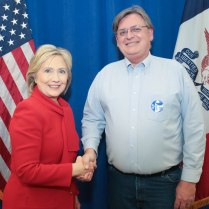
With Hillary Clinton Jan. 24, 2016

Iowa Democrats did their job at the Feb. 1 first in the nation political caucuses.

The field was winnowed from six candidates (Chafee, Clinton, Lessig, O’Malley, Sanders and Webb) to two (Clinton and Sanders), giving Hillary Clinton a narrow, historic victory.

Our precinct played a role, and not an insignificant one, in producing that victory.

Hillary Clinton was the first woman to win the Iowa caucus — another glass ceiling broken. The caucus results are close. How close? It’s a matter of a couple of delegates with all but one of the state’s 1,683 precincts reporting, according to the Iowa Democratic Party. It is unclear whether the Sanders campaign will request a recount, but I doubt it. There are bigger fish to fry.

Iowa also played a role in setting which issues would be front and center in the 2016 presidential election. Even the anti-billionaire money in politics candidate Bernie Sanders gave an unintended nod to billionaire Tom Steyer’s advocacy to put climate action on the front burner of the contest. While issues aren’t the same as the horse race, they matter and Iowa matters in defining them.

The caucuses will be analyzed in great detail in the next 48 hours, so I have only a couple of things to add.

I begin with the lesson learned while attending the Democracy for America training in elections: winning an election is getting 50 percent of the vote plus one. The DFA method puts what happened in our precinct into higher relief, as through planning and competent execution of the tactical plan, our team for Hillary turned out more voters than expected, and provided Martin O’Malley his only delegate from Johnson County, and one of the few he got in the state. By giving O’Malley a delegate, it was taken from the Bernie Sanders group, giving Clinton a 2-1 victory over Sanders in Big Grove precinct. In a tight race, that one delegate mattered.

Here are the numbers.

Big Grove turned out 165 voters this cycle. We turned out 92 people for Clinton, the same number Obama had in 2008. In 2008, there were 75 Clinton supporters, a tie with John Edwards, and Clinton won the second delegate that year with a coin toss. For perspective, we turned out 242 during the six-way race Obama won in 2008. Our turnout last night was 69.2 percent of 2008’s record. Clinton had 56 percent of people at the caucus last night compared to 38 percent for Obama in 2008.

At the first alignment I reported these numbers to the Clinton campaign:

Clinton – 92
Sanders – 57
O’Malley – 10
Uncommitted – 6

This count would split the delegates two for Clinton and two for Sanders, with O’Malley not being viable. At the second alignment we sent our negotiating team to talk to O’Malley, with the Sanders representatives standing next to ours.

To get a third delegate we had one option. We needed to take people from Sanders and they were holding firm except for three people who moved to O’Malley. I did the analysis, ratified it with our team, and determined that by giving O’Malley 12 people their team would be viable and the delegate would come from Sanders.

I explained our proposal to the Clinton group and it was easy to get 12 volunteers to go to the O’Malley camp, since they understood the logic, if not the byzantine methodology. We executed the tactic, producing the following report to the Clinton campaign.

Clinton – 80
Sanders – 56
O’Malley – 25
Uncommitted – 0

Standing next to my neighbor and caucus chair, he phoned in two delegates for Clinton, one for O’Malley and one for Sanders to the state party system. This was our fourth presidential caucus working together and we were the last to leave the Middle School.

I haven’t digested everything that happened last night, although I was proud of the effort team Hillary put forward in our precinct. We ended up door knocking our entire precinct on Sunday, and that last minute extra effort had to have made a difference in turnout and the final result.

From here, let the pundits, bloggers and news reporters tell their story. The 2016 Iowa caucuses are in the books, and it is up to the remaining 49 states to decide who our Democratic nominee will be.

Whoever that is, I’ll feel comfortable going back to this year’s caucus attendees to ask for help in the general election campaign. No unity party needed here.


Categories
Juke Box

Juke Box — Who’s Gonna Build Your Wall

Categories
Living in Society

Rural Door Knocking

Saint Mary's Church, Newport Road, Johnson County, Iowa
Saint Mary’s Church, Newport Road, Johnson County, Iowa

There is plenty of time to think about things when door knocking a rural precinct. Houses are spread out, and typically there is a long walk from the road to the dwelling. Sometimes you can’t even find where people live on a farmstead, or the family moved away.

I had a finger wave and waved back.One couple stopped to ask me what I was doing at a friend’s house. Society is palpable even if there aren’t many people around. Politics here is more about the county than the president.

Rural Newport Precinct
Rural Newport Township

One woman saw me coming from the street  and said to the elderly man sitting on the front porch, “tell him you can’t hear.” Turned out I’d bought straw from this farm several years ago and we had more in common than expected. We had a good chat although I never got to speak to my target, the octogenarian mother inside. “We’re not caucusers,” one said. They dislike the party business part of the caucus and would likely vote in a primary if there were one.

Everyone has made up their mind on this walk list. I’m glad I went out. What I thought about most is how personal politics was to most of the people I met today. It’s like fresh cut firewood one person was burning in an open pit, the smell permeating my clothing and getting into my lungs. It would be a mistake to say we aren’t all connected. And that’s a hope we should share for getting through these turbulent times.

Categories
Home Life Kitchen Garden Writing

On Our Own Into 2016

Garage Sign
Garage Sign

“Publishers are not accountable to the laws of heaven and earth in any country and regardless of my opinion, editors and publishers will print what they will.”

I wrote this in a letter to the editor of the Quad City Times in 1980 reacting to a popular feature section called Soundoff.

“(It is) little more than a vanity press for many of the writers,” I wrote. “It gets pictures, letters and opinions into print as a final goal; shouldn’t there be more to public voicing of opinion than that?”

This is more applicable today than it was three and a half decades ago.

What I learned in graduate school is the same statement can be applied to almost everything written in public. Reflecting on the Times experiment to make their pages more open to comments and retain readership, chaos reigned. What has changed since then is the emphasis on viewpoint in media — corporate, social or self published — which has been formalized. It’s not all good.

As I turn to the hard yet fun work of writing this year, I plan to journal my experiences in the food system here. Four years from full retirement, there are bills to pay and a life to live. I may pick other topics from time to time. I need to make the best use of every moment.

I’m writing off line as much as I can. While I don’t like to work for free as long as there is less cash than budget, I may occasionally post about those creative endeavors.

Thanks for reading this blog. Check out the tag cloud for your interests. I hope readers will be back often.

Categories
Living in Society Social Commentary

We’re Going Home — Hamburg Inn No. 2

Hamburg InnWith yesterday’s announcement Hamburg Inn No. 2 is being sold by 68 year-old David Panther, another chapter in the long exodus of sixty-somethings from Iowa City’s public stage is closing.

With growth and a burgeoning new population, long time aspects of Iowa City iconography have changed and are changing. Old is giving way to new.

I more miss Hamburg Inn No. 1 on Iowa Avenue than any changes at No. 2 on Linn might bring. Arriving in Iowa City in 1970 to attend college, I had a notion I could experience every business and cultural institution in town and become a part of city social life. Hamburg Inn No. 1 was part of that. Like so many others, I left after graduation from the university, but remember fondly what the city was then.

My recent awareness of the exodus of sixty-somethings began with closure of Murphy Brookfield Books and the retirement of Riverside Theatre co-founders Ron Clark and Jodi Hovland. Hamburg Inn is another among many changes from what Iowa City grew up to be after the 1960s. Some businesses, like The Mill, made a successful transition. Others have not.

Why should we care? After all, change is the only constant in a transient city like Iowa City. It is made so by the University of Iowa: a primary driver of almost everything. It is partly nostalgia driven by personal memories and change in the world which increase in importance as we near the end of life’s span. There’s little reason to cling to the past instead of embracing the new. Opportunity also belongs mostly to the young, so some of us are going home.

I’ve never eaten a pie shake at Hamburg Inn, and until recently wasn’t aware they served such a dessert. It has been breakfast with our daughter or a friend that drew me there of late. The last political event I attended at the Hamburg Inn was with Chet Culver during his last campaign. Culver didn’t appear to have a clue how to get re-elected and the stop did little to enhance his chances.

Life will continue with the best intentions, which is what I’m reading in the news. The operation will continue at Hamburg Inn No. 2 and importantly, people will keep their jobs. I read Panther will be retained by the new owners for a year as a consultant. According to the Warren Buffett playbook for business acquisition retaining current managers is important to a smooth and profitable transition. I wish everyone well.

Details of the sale aren’t quite worked out, according to news reports. We should embrace the change and give the new owners a chance or two as they continue the effort in its new form. If new management focuses on the quality of food and customer service they should be alright. A different, and new chapter in the life of an aging Iowa City scene being reborn.

Categories
Living in Society

Iowa Caucus — 8 Days Out

Caucus-goer
Caucus-goer

Stuff is getting real as we enter the last days before the first in the nation Iowa caucuses on Feb. 1.

The Democratic race has been somewhat dull and uninspiring. Set aside the hubris-imbued early drop-outs (Lincoln Chafee and Jim Webb), those in the race, Hillary Clinton, Martin O’Malley and Bernie Sanders, bring little we don’t already know to the political discussion.

Although there are differences between the candidates, the 2016 election is about one thing: retaining a Democrat in the office of president. Err… two things… funding the Democratic campaign effort with cash in donor poor states like Iowa being the other. People tend to forget the latter because by and large few engage in party work other than during the final days before elections.

The good news is recent analysis showing Iowa is expected to retain four congressional seats after the 2020 census. The other news is our races for congress will continue to be competitive. With three of four seats being held by Republicans, 2016 will be pivotal in determining whether Democrats can retain the second district and maybe pick up first and third if the planets align, we recognize the opportunity, and execute upon it. Democratic chances to pick up a seat or two diminish outside the presidential election years. We will have to work smart and hard to keep what we have and maybe add one or two Democratic congress members in 2016.

The U.S. Senate? Unless incumbent candidate Chuck Grassley does something radically different for him, he holds the upper hand before the November general election. A well financed insurgent campaign could end his too long run. State Senator Rob Hogg offers the best hope for doing that among the three current contenders in the June 7 Democratic primary. Retreads Bob Krause and Tom Fiegen are also running with little change since they were last defeated in their primary with Democrat Roxanne Conlin. Fiegen has gone all in trying to grab the coattails of Bernie Sanders. Whether that will work, whether more detailed positions than appear on his website, especially his position regarding a woman’s right to choose, would gain traction among voters in the general election is an open question.

Eight days from the Iowa Caucus, the Democratic presidential race is too close to call.

This is a season of pollsters, and clouds have risen above the two leading Democratic candidates for president. Like with our warming planet, the political atmosphere absorbs more moisture because it is warmer, and when turbulence and precipitation come, it may be a gully-washer, clearing the field.

I don’t want to be dismissive of O’Malley, but what else is there to do? The gent has no chance of winning the Democratic nomination for president. I expect him to drop out on or before Super Tuesday. Prove me wrong on that, maybe say a prayer to Our Lady of Guadalupe for a miracle.

Hillary Clinton’s main challenge is whether or not voters find her trustworthy. Along with that is the unspoken (at least in public) issue of her female gender.

As the Des Moines Register pointed out in yesterday’s endorsement of Clinton, “no other candidate can match the depth or breadth of her knowledge and experience.” This harkens back to September when I decided to support Clinton for president, in part because of her knowledge and experience. Along with her global advocacy for women and children, and the potential to appoint multiple Supreme Court Justices, my decision was practical: pick the candidate with the best qualifications for the job. As others have pointed out, the practical vs. idealistic discussion is one voters are having. Based on people I talk with, the number of realists and idealists seems about even today.

We won’t hear so much about the fact Clinton is female, but opposition to a female president runs deep, not only near where I live, but across Iowa and the country. Expect this to come up during the general election, but whispering has already begun.

As far as being trustworthy, WYSIWYG with Clinton. She is unlike the Republican field in the Greek Drama politics has become in the corporate and social media. She wears a complex wardrobe of masks asserting her policy positions. If one looks behind the masks, at her core she is a Democrat, and likely a better pick than her husband was back in 1992.

What about Bernie Sanders? When I met him at a Johnson County Democrats event in 2014 I liked everything I heard. The Des Moines Register endorsement of Hillary Clinton lays out the case against Sanders — the unanswered question of how he might gain traction for his policy ideas in the stalemated political partner that is the U.S. Congress. He has had no answers to this criticism other than the need for a political revolution.

Like with Clinton, a whisper campaign about Sanders has begun, and can be expected to increase should he win the Democratic nomination. There are two things: “he’s a socialist,” and “he’s a Jew.”

Sanders describes himself as a “Democratic socialist,” but expect this to get morphed into “socialist” or the more disparaging “communist” in the general election. This is less whisper campaign than a reflection of Sanders unwillingness to embrace conventional politics. I believe we can weather the storm on this one should Sanders be the nominee. I’d like it more if he signed up for the Democratic party other than as its potential nominee, but elections are about compromise. I’ll let go of that one.

What has been written about less than I am hearing is American antisemitism that has been problematic since the nation’s inception. Wikipedia characterizes the current issue as follows:

An ABC News report in 2007 recounted that about six percent of Americans reported some feelings of prejudice against Jews. According to surveys by the Anti-Defamation League, antisemitism is rejected by clear majorities of Americans, with 64 percent of them lauding Jews’ cultural contributions to the nation in 2011, but a minority holding hateful views of Jews remain, with 19 percent of Americans supporting the antisemitic canard that Jews co-control Wall Street in 2011.

Wall Street and campaign finance reform have already become a topic among Democrats, and is expected to remain through the November election. Canard or no, if 19 percent believe Jews co-control Wall Street, the question is what percentage is in play regarding a specific vote for president. Antisemitism is real, and may be a factor if Sanders is the nominee. I’m already hearing talk about it.

As recent polls have indicated, Sanders, like Clinton, is electable against a Republican opponent. What those of us who can remember know is the margin of victory will be close in the 2016 presidential race. If the Anti-Defamation League’s analysis is accurate, Sander’s religion may come into play enough to swing the election. For me, it’s not an issue in the caucus, but then politically active Iowans are more open minded than in other states, especially in the electorate for the general election. Democrats are already talking about Sanders’ religion as a liability.

I’ve been fighting the good fight for Hillary Clinton and will until the tally is made at our caucus. I’ll support the Democratic candidate nominated July 25 in Philadelphia. Some questions will be answered Feb. 1 and eight days out which ones they are is obscured by noise in the corporate and social media.

Categories
Milestones

Three Recent Cancer Victims

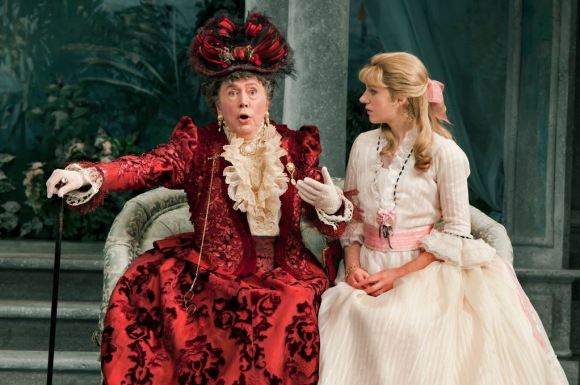
Mr. Bedford, left, as Lady Bracknell and Charlotte Parry as Cecily Cardew in “The Importance of Being Earnest,” a 2010 production at the American Airlines Theater. (Photo Credit: New York Times
Brian Bedford, left, as Lady Bracknell and Charlotte Parry as Cecily Cardew in “The Importance of Being Earnest,” a 2010 production at the American Airlines Theater. (Photo Credit: New York Times)

The recent passing of David Bowie, Alan Rickman and Brian Bedford, all from cancer, reminds us that no matter the place people hold in our imagination we are grounded in a humanity that can be taken from us equally.

They will be missed.

I know least about David Bowie. He was one of many rock and roll stars who came up at the same time, some of which I followed and some I didn’t. He falls from space into the latter category midst a grab bag of male artists that includes Eric Clapton, Mick Jagger, Prince, Freddy Mercury, George Harrison and others.

What distinguished Bowie was less his music than the creation of asset-backed securities from it. In 1997 he gave up the financial rights to his catalog of 25 record albums produced before 1990 in favor of a lump sum of $55 million, creating “Bowie bonds.” Intellectual property rights securitization, while little known, was one of Bowie’s many innovations. After a ten-year period without default, the rights to revenues reverted back to Bowie. For more about David Bowie, read the New York Times obituary.

The death of English actor and director Alan Rickman is more personal. It has been a running family joke that I recognized Alan Rickman from his portrayal of Hans Gruber in the film Die Hard, knowing full well that others in the family were enamored of his performances in Sense and Sensibility and as Severus Snape in the Harry Potter films. There was a lot more to Rickman than his characters. Would that I had learned more while he was living. Read the New York Times obituary here.

Finally, Brian Bedford whom we know from the Stratford Festival of Canada. At 80, he was closest to living the full span. I was endeared to him because he came up in classical theater. We saw his one-man performance of “The Lunatic the Lover and the Poet” at Stratford.

Our daughter sought out the actor for a brief moment after the play. Actors are quite adept at quickly slipping out the back, but no match for her. She returned after a brief conversation with an autographed program.

Already memories of them are beginning to fade, along with so much about the time in which we grew up. It seems fitting to remember one more time.

Categories
Living in Society Social Commentary

Society in Decline?

Sunrise Over Lake MacBride
Sunrise Over Lake Macbride

How does one recognize society is in decline? We participants probably can’t.

In 1540 conquistador Hernando de Soto sent a messenger to Quigaltam, supreme leader of a people whose ancestors had built mounds and lived in the Mississippi River basin for 700 years, to say, “the son of the sun” expected his people to obey him and do him service.

“With respect to what he said about being the son of the sun,” Quigaltam responded through the messenger, “let him dry up the great river and he would believe him.” [1]

While neither party knew it at the time, this incident was part of the beginning of the end of a civilization and a 350-year war between cultures. It ended with the more familiar massacre at Wounded Knee on the Pine Ridge Reservation in South Dakota, Dec. 29, 1890.

If modern society — the one cultured in North America by immigrants — has reached its zenith, and it’s all downhill from here, the methods of knowing it are elusive if not impossible. Life comes into a sharper focus when our perspective spans multiple centuries.

Earth has its troubles. Improvements in public health enabled population growth resulting in 7.4 billion people on earth today. Deforestation to harvest timber, grow crops and build cities is changing a long-standing environmental equilibrium. The rise of industrial society and its reliance on fossil fuels has changed the makeup of the atmosphere and contributed to global warming that in turn is changing climate patterns we have come to rely upon. People are increasingly connected by a world-wide communications network. They both say a lot more and have nothing to say. None of this is new, and the earth will likely be fine — achieving a new equilibrium that considers and incorporates all these changes.

What’s new is the rise of lamentations about how the old values are in decline. Families are not what we believe they were, politicians and religious leaders are corrupt, corporations only out to make a buck, the rich get richer and the rest of us are left on our own. If one buys into this paradigm society may well be perceived to be in decline.

I don’t believe it is and here’s why.

As long as there is clean air and water, a place to live and an opportunity to earn a living, there is hope for society. All of this is under pressure from multiple sources today, but like the polar vortex chilling the atmosphere this morning it’s only temporary.

There will be whiners and complainers, but William Faulkner said best what I would during his 1950 Nobel Prize speech.

I believe that man will not merely endure: he will prevail. He is immortal, not because he alone among creatures has an inexhaustible voice, but because he has a soul, a spirit capable of compassion and sacrifice and endurance. The poet’s, the writer’s, duty is to write about these things. It is his privilege to help man endure by lifting his heart, by reminding him of the courage and honor and hope and pride and compassion and pity and sacrifice which have been the glory of his past. The poet’s voice need not merely be the record of man, it can be one of the props, the pillars to help him endure and prevail.

Is society in decline? The better question is what can we do to contribute to its rise? The age of humans is not over. Despite our problems we must have hope the progress started long ago is far from over. How else can we go on living?

[1] Old Man River: The Mississippi River in North American History by Paul Schneider. Henry Holt & Company, 2013.

Categories
Living in Society

Hillary and the Polar Vortex

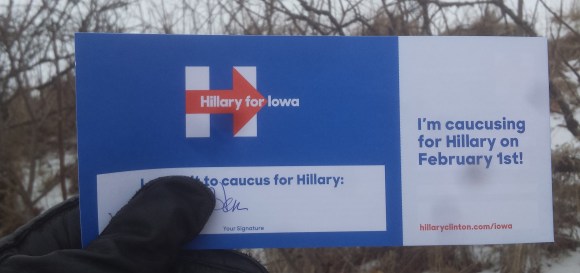
Hillary Caucus Card
Hillary Clinton Caucus Card

BIG GROVE TOWNSHIP, Iowa — The ambient temperature dipped below zero degrees overnight, signaling the arrival of the polar vortex. Soon it will be time to prune the apple trees — most likely next weekend.

I worked a door knocking shift for the Hillary Clinton campaign on Saturday. While a lot of people weren’t home, those who were are ready for the 2016 general election campaign.

It was unanimous the Democratic party must work together to elect the person nominated for president at the Democratic National Convention the week of July 25, 2016.

At three weeks until the Feb. 1 Iowa political caucuses the tenor of this year’s build up has been much different from past cycles.

One person professed to be in throes of existential questions about the future of our country. He was an outlier. Everyone else was confident about for whom they would caucus and why. My targeted walk list identified Hillary supporters and some Bernie leaners. To a person they recognized a need to prevent Republicans from winning the White House. I invited Hillary supporters to seek me out at the caucus, and encouraged the rest to participate and then unify behind our candidate for the fall campaign. It was a much easier sell than in previous cycles.

My interactions with campaign staff and volunteers for the three remaining Democratic campaigns has been professional at a much higher level than in previous cycles. Partly there is a professional class of political consultants, activists, fund raisers, corporate media correspondents, bloggers and supporters that has matured. These folks have stepped up their game with systematization of the process of identifying and building supporter networks. The rest of the change is that with money in politics, each of the campaigns has effectively reached out to voters, and mostly in a professional manner which is the result of specific training. This cycle’s presidential primary campaign has been like the roll out of a new project by a giant corporation, and that includes the Bernie Sanders campaign which eschews corporate influence. The end result has been a modern democratization of national politics.

With the increased use and maturity of social media in politics, I’m finding commonalities between people that no one specifically engineered or engendered but will influence the fall campaign and the next presidency. Much of what I’m seeing is good news for Democrats, and better news for our country.

I told the outlier he’d better stick with the Democrats if he wants any of his priorities to get worked on in Washington. He smiled at the prospect of that.

Categories
Work Life

Into Winter 2016

Sunrise
Sunrise

One week into my new job at the home, farm and auto supply store I believe I can make it.

I move a lot of 40 pound bags of pet food, 50 pound bags of bulk grains and 70 pound sand tubes, providing upper body exercise without straining my back or shoulders. I can do the work.

While the rest of the ten grand needed to finance this year’s adventure remains elusive, I am confident of finding it. Thing is, the rest of life can’t wait until I do.

Because of three things, January will be about politics: the beginning of the Iowa Legislature’s second session of the 86th General Assembly, the impending Feb. 1 Iowa political caucuses, and President Obama’s last State of the Union Address next Tuesday. Any available time will be spent on political activity.

That said, priority one remains getting back to consistent, daily work on creative projects, beginning with a return to writing 1,000 words per day. The way days progress, mornings offer the best time to get that done. Evenings have been a mixed bag of meetings, shopping, cooking and existential errands. As the sun sets later, there will be more opportunity for activities that require physical activity, including work at a second job when I find it.

Despite challenges, I am hopeful. Such hope being enough to stave off the grim reaper for yet another year.