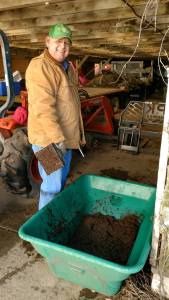
First Day of Soil Blocking 2018 Photo Credit – Maja Black
As one makes one’s bed, so one finds it. ~ French Proverb ca. 1590
Today is my last day as a full-time employee at the home, farm and auto supply store. Reducing my schedule from five to two days a week should free time to work on other projects. At least that’s the hope.
We built a home in Big Grove and made it ours. I walked the lot lines before we broke ground and sat on the dirt high wall after the lower level was dug. We hooked up utilities, installed a door between the garage and residence, and moved in all on the same day in August 1993. No regrets.
Almost 25 years later our home needs updating and some maintenance. We’ve been spending our time living more than working here. Today’s transition will change that and I’m looking forward to it.
Fifty years ago I began working part time after high school at a department store. Despite how American business evolved since then, I made it across the finish line. I’m still here. We’re still here.
Now comes the downsizing, reducing and recycling — a frugality characterized by the fact we haven’t generated enough trash to set out our curb side receptacle in three weeks.
There will be industry as I’ve mentioned previously in these posts. However, one focal point is rebuilding stamina needed to work more hours each day. It’s not really retirement.
We never know what will happen to us. We make plans. We stay busy as best we are able. We contribute to a greater good if we can. We hope.
As I head through the door this morning I don’t know what today will bring. I’ll sleep tonight and wake up to a tomorrow that begins like so many others have.
Someone broke the law to leak information about the county’s potential purchase of property with conservation bond money.
In a closed session of the full board of supervisors, with five staff members present, one or more of them broke the trust of being invited by leaking information about property the conservation board was considering for purchase. He or she broke the law.
The news made its way to the Solon Economist last week in the form of a letter written by two grey-haired Iowa City liberals. They made a case against a potential purchase most of us hadn’t heard about. Their biased opinions fill otherwise empty space about this topic. The letter raised questions about how they got their information.
“Someone flagrantly broke the law,” wrote Supervisor Rod Sullivan on his weekly blog. “She or he ought to face consequences. This was not an accidental slip. This was a purposeful, devious violation of the law.”
I’m all for a robust debate of how the county spends our tax dollars. If last week’s letter is true, I question whether buying the property is an appropriate way to spend conservation bond money.
However, I support the rule of law and the leaker should be sought out and receive due process for committing a crime.
Early and illegal notice about conservation fund spending did not benefit public discussion one bit.
~ Published in the Solon Economist on March 15, 2018
“Good navigators are always skeptical, not of the presences of things, but of what they see and understand. Good navigators are almost always lost.” ~Robert Finley
Green up has begun and everything seems ready to pop — even if it isn’t.
My usage of “green up” comes from the 1936 film The Trail of the Lonesome Pine,” in which June Tolliver said, “I ain’t marrying till green up,” delaying pending nuptials between her and cousin Dave Tolliver until after hog killing time. Waiting until green up is cause to delay not only weddings, but needed chores, engagement in society, and anything and everything until ambient temperatures warm and spring is in the air. It’s a lame excuse but we keep hoping it will work out after green up.
Demands on my time increased as tenure as a full-time employee at the home, farm and auto supply store draws to a close in seven days. If I’m lucky, and only partly as a result of planning, the most important things will fall into place. There’s also a lot not planned.
I hope to transform how to look at the world. Beginning March 18, my worklife will devote 56 hours each week to writing, food ecology and paid work. It’s a lot but I hope to increase that to 80 hours or more. Will determine if that’s possible in the process.
What I know is there’s much left to accomplish. That said, I don’t keep a bucket list. When young I meticulously kept a to-do list which helped my rise to a middle level of performance and productivity. The to-do list was always there, and rarely did I remove something without addressing it. I use no such device any more. I eschew lists. I abhor them. I can live my life without them and will.
What I hope is to continue to evaluate what and how I see in the world. It’s an imperfect process, one that requires attention and energy. Like green up it’s a path toward life’s potential. As June Tolliver found in the film, the unexpected can come into view. We must break the cycles of tradition and habit in order to see it.
Your vote on the acquisition of Dick Schwab’s property will make it easy for me to determine for whom to vote in this year’s June primary and who to support going forward.
I know the property involved better than most and have worked and spent time with Dick there. In my discussions with him he made it clear he would donate the property to what is now the Bur Oak Trust. I don’t know what changed his mind, but it is human to reap a profit and I’m not surprised he seeks a buyer as he makes his exit from Johnson County.
Maybe I misunderstood his intent. I’m human too.
It is not clear what portions of his property are included in this transaction, as I just found out about it in the newspaper tonight. It isn’t clear what exactly is proposed.
The fact is what I know of this property is well developed and does not seem a good use of the limited conservation bond funds set aside. I hope and expect you to vote no on the acquisition of this property using conservation bond money.
I don’t usually weigh in on your activities, but this one is important enough for me to do so.
BIG GROVE TOWNSHIP — It’s a little crazy for a 66 year old male to make plans.
It would be easy to “go on the draw” as people I know have done. This framing comes from relatives and friends in Appalachia, where my father’s family came up, who found a way to collect a monthly payment from the government in the post-FDR era. It seems universal in American society to expect the rewards of a life of work and trouble in order to take it easy. Going on the draw has a subtext of relinquishing part of the self-reliance that has come to characterize being American.
There is plenty in society to engage our mind, heart and soul, without adding a layer to it. Social groups abound. Paid and volunteer work create human relationships. There’s shopping, movies and restaurants. Central to many are public libraries — one of the few remaining places with no expectation patrons have money. As much as I’d like to self-identify as a “retiree” and take advantage of all this, the feeling “I want,” as Saul Bellow aptly described it in Henderson the Rain King, nags at me. We may not know what we seek, but are always looking.
Is it hubris? Ecclesiastes instructs.
Vanity of vanities, saith the Preacher, vanity of vanities; all is vanity.
What profit hath a man of all his labor which he taketh under the sun?
One generation passeth away, and another generation cometh: but the earth abideth for ever. (Ecclesiastes 1, 2-4, King James)
When we live our bodies break down from use. We are broken through trauma, physical and emotional. What we need more than treatment for symptoms is healing. Such healing falls to the care of a network of family and friends who look after us when we are broken. Health care is so often more about family and friends, home remedies and rest, than the health care and health insurance which takes an increasing proportion of our income.
Once we accept the underlying fragility of the human condition, many make plans and that’s positive. Our lives have meaning only if we find it in useful, social activity. Once we cease engagement in life and society, the truth that we might die tonight is rendered moot.
Asian Greens in Scrambled Eggs with Vermont Cheese and Pickled Bits and Pieces
After tangling with a schedule to reduce hours at the home, farm and auto supply store I concluded there were only three immutable weekly activities: writing (26 hours), paid work (16 hours), and farm work (12 hours).
Add an hour of prep time before work outside the home and these three activities fill 69 percent of available weekly hours. Everything else must fall in place behind these priorities. It is a rigid frame on which to hang everything else.
It’s already a 54-hour work week.
What’s missing is community organizing, the rest of food ecology, and home maintenance, all of which need to be squeezed into the remaining hours each week. Developing capacity to be more productive is part of this. It necessarily means doing better than using artificial stimulants or shoddy work in any activity area. It’s a plan.
It is time to use up fresh onions, garlic and potatoes, then rotate the canned goods so oldest jars are consumed first.
Winter means soup, casseroles, pasta and hearty meals made from pantry and ice box ingredients.
As the ambient temperature warms, we are ready to move into the new year’s fresh food cycle. But not so fast!
There are egg sandwiches, chili mac and soups to be made before spring buds.
I donned my LaCrosse rubber boots and toured the yard and garden.
The ground is too hard to plant lettuce. Garlic is not up. The only bit of sprouting green was flowers I transplanted from Indiana. Tips of green were frosted on those that emerged. A thick layer of sand lies on the side of the road. Time to sweep it up and save it for next winter.
At 13 days until the transformation of worklife, I’m spending time organizing time and tasks.
To be successful means purging old habits and developing new. The work seems much harder than it should be. While working at the home, farm and auto supply store I’ve developed some questionable habits around internet usage, resting and eating. They produced the current result, so they were not all bad. One only gets so many chances to start over.
There are two problems with my transformation. First, I’m limited to 12 hours per day of primary activity. Not everything I want to do will fit. Second, I’m not used to working 12-hour days. To get things done, I need to ramp up. The situation is complicated by keeping two days of paid work in the mix. We’ll find a use for the money, but I’ll also need to figure out how to get more productivity out of a day to meet overall goals.
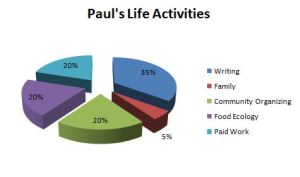
Paul’s Pie
Drawing the pie chart was fairly simple. Making that fit among rigid schedules of paid work, writing and farm work has proven to be challenging. Where I suspect this will end is with a hard schedule that includes writing, food ecology and paid work, leaving everything else flexible.
I’m committed to this now, so no turning back.
The week of the county party central committee turns into a session of drinking politics from a fire hose. As you can see in the pie chart, community organizing gets a 20 percent allocation of time and politics is a subset of that. I’ve limited myself to one social event per week and expect most of those to be related to politics for the next couple of months. I learned a couple of things:
Rep. Dave Jacoby explaining plan to run 100 Democrats for 100 House seats.
Iowa House Democrats are planning to run 100 candidates for 100 seats in the midterm elections. We don’t usually run everywhere, so that makes this year different.
In the governor’s race, Democrats are working to win the primary. With seven announced candidates at the beginning of the filing period we’ll see if everyone files and if there is anyone else. It takes 35 percent of votes cast to win the primary. Cathy Glasson’s campaign is playing a side bet that the governor candidate will be chosen at the state convention with no one getting enough votes to win outright. The campaign claims to have won 30 percent of delegates at the caucus, which may or may not translate into 30 percent at the state convention after counties pick their delegates at the March 24 county conventions. 30 percent seems unlikely to win at the convention.
There are still too many geezers like me on the central committee. I’d gladly step aside and let someone else take my seat, but the truth is these women, millennials and newly registered voters who are supposedly playing a key role in the midterms don’t come to the meetings, don’t want the job. It’s a truism that flying at 30,000 feet, political strategists come up with all manner of demographic projections about the electorate. Our local elections of everyone up and down the ticket are made at a distance of six inches in front of our noses, rendering strategist musings moot.
Cold and frosty as the ground is today I can justify another day indoors to file our tax returns, work on community organizing and get caught up on everything else. However, it won’t be long before lettuce and potato planting. Next Sunday I start my first trays of seedlings in the greenhouse.
There’s everything spring brings and for which we yearn.
My supervisor at the home, farm and auto supply store unexpectedly called me to the office and offered a salary commensurate with the work I do.
“Commensurate with the work,” means closer to the average wages for the position as defined in the Bureau of Labor Statistics Occupational Outlook Handbook, which lists a job closely matching what I do.
He would convince me to either stay or continue working part time. I said I’d consider the offer and respond this week.
In every job I’ve held since leaving for military service, I’ve become a valued member of the team. In many cases, mostly when I worked for a large transportation and logistics company, I was replaced with two people after resigning. I understand the value of my work.
People have reasons for taking lowly paid work. This is especially true in my county, where there are numerous job opportunities for anyone willing to work. People take a low-wage job to generate income then move on to something better. We all have our reasons.
I took work at the home, farm and auto supply store and stayed because they offered a family health insurance plan to cover us until Medicare. Now that both of us are on Medicare, that reason was eclipsed by a desire to do other things. We have delayed gardening, talking, writing, reading, repairing and retooling our home for too long. That’s reason to retire March 16 while still young enough to accomplish some of that.
Opening the question whether to leave is also about security. Financial security partly, but physical health, being accepted in society, and the ability to live a life free from worry. The offer moved security to the front burner after simmering from the initial math of planning our retirement.
We are never completely secure. If a catastrophe happens in a life, people will invest everything they own to recover and return to a semblance of normal. Such normality is the endgame, especially in Iowa. Complete security does not appeal to people like me. I’m still a risk taker and know my limits.
I don’t know my answer and will mull it while soil-blocking at the farm. I did the math and the extra income would help pay down some of our debt. It is a bird in hand against the unknown of how could we generate extra funds in retirement. It would come with a cost I’m not sure is worth the price.
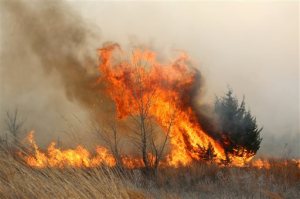
Kansas Grass Fire. Photo Credit: Travis Morisse/The Hutchinson News via AP
I’d go back to Kansas for a visit.
More specifically, I’d like to see the Eisenhower Presidential Library in Abilene.
Not that I like Ike or have many memories of his administration. He was president at a time when our family was unsettled. After we moved to a permanent home in 1959, my neighborhood friends were consumed with talk about World War II, including Eisenhower, because so many we knew had been in the war. Eisenhower was of that era which was eclipsed by John F. Kennedy, Lyndon Johnson and Richard Nixon. I don’t recall Nixon speaking much to Eisenhower as the aging soldier faded into history in 1969.
In 2007 I traveled to Kansas on business. It was a hopeless sales call that mustered some of our logistics company’s best talent for a whim. During nights in Parsons and Wichita I posted about Kansas and the demise of coal-fired electricity there. Political uncertainty about greenhouse gas emissions was killing capital investment in new coal plants in Wyoming and Kansas.
I’d return to Wichita to see where the Kochs came up. I doubt I could walk up to Charles Koch’s front door and find him home, but I’d make a special side trip enroute to Abilene to see Wichita through that frame.
Today, “Kansas” and “the Koch Brothers” have become talismans for too many Democrats.
I don’t see positive value in comparisons of legislation Iowa Republicans are considering to what happened in Kansas. Iowa is not Kansas and that is exactly how Republicans will use this comparison against our Democratic candidates.
The people of Kansas elected and re-elected Governor Sam Brownback knowing his history better than we do. His tenure is described on Wikipedia:
Brownback was elected governor of Kansas in 2010 and took office in January 2011. As governor, Brownback initiated what he called a “red-state experiment”—dramatic cuts in income tax rates, intended to bring economic growth. He signed into law one of the largest income tax cuts in Kansas history. The tax cuts caused state revenues to fall by hundreds of millions of dollars and created large budget shortfalls. A major budget deficit led to budget cuts in areas including education and transportation. While Kansas’s economy has performed reasonably well since the cuts were passed, the economies of neighboring states have done as well if not better. In the run-up to the 2014 gubernatorial election, over 100 former and current Kansas Republican officials criticized Brownback’s leadership and endorsed his Democratic opponent, Paul Davis. Brownback was reelected in a close race with a plurality, a margin of 3.7 percent. In June 2017, the Kansas legislature rolled back Brownback’s tax cuts and enacted tax increases.
In a repudiation of the federal Patient Protection and Affordable Care Act, Brownback in 2013 turned down a $31.5 million grant from the U.S. Department of Health and Human Services to set up a public health insurance exchange for Kansas. Also in 2013, he signed a bill that blocked tax breaks for abortion providers, banned sex-selection abortions, and declared that life begins at fertilization.
Are there comparisons to be made with Kansas? Of course.
However, Iowa Democrats should be ever cognizant the budget problems in this state were created by the largess of Governor Branstad, Republicans and Democrats in handing out tax credits that contributed to the last two years’ revenue shortfalls. In addition, Branstad enacted a sales tax exemption for many businesses. In retrospect, he must not have had a clue how large a decrease in tax revenue it would create. My point here is Iowa made its own problems before Republicans controlled the governor’s office and both chambers of the legislature. In that respect, we are not like Kansas. As gubernatorial candidate Ross Wilburn keeps telling us, “Let’s be Iowa.”
Regarding the Koch Brothers, Iowa Democrats need to give it up. Every Iowa Republican who has been attacked for taking Koch Brothers’ money has credibly denied it, even members of the American Legislative Exchange Council and Americans for Prosperity, two Koch-backed entities. That’s not to say the influence is absent, just that Democrats are losing this messaging struggle. Jane Meyer’s recent book, Dark Money: The Hidden History of the Billionaires Behind the Rise of the Radical Right tells the story of dark money in politics, including the role Charles and David Koch play. It is way more complicated than a single family advancing its agenda. To create a totemic relationship with the Koch Brothers or Kansas is the wrong framework to win voters and elections in Iowa politics.
The people I know who live in Kansas, including family members, don’t have issues with the state. Like all of us, they are working to sustain their culture in a turbulent world.
I get the fact raising “the Koch Brothers” and “Kansas” is a form of confirmation bias among Democratic activists. However, as Senate District 37 candidate Zach Wahls posted on twitter last night, “It’s a reference that, in my experience, tends to work among Dem activists – but it’s a head scratcher among non-activists.”
Driving through ranch and mining country along Interstate 76, large square bales of hay are stacked four high as a windbreak around feedlots. The harvest is in and irrigation rigs idle.
On the distant horizon are wind turbines, It’s difficult to see if their blades are turning. Empty coal trains are on the move and motor traffic was light. Cloud formations played against an azure sky coming into Colorado.
As we exited to the Denver bypass, an enormous flock of birds descended onto a surface of water. We too were intending to settle for the night in Colorado Springs.
The Antlers was opened a couple of years after the founding of Colorado Springs in 1871, situated with a view of the mountains and close to downtown. It was and is a resort designed to be away from the rough and tumble of the mining community and daily life. There were not a lot of cars in the adjacent self-park garage, and the hotel staff has been personable and helpful. It has been quiet during our stay.
At the end of 2008, the patterns of our lives feel played out.
Getting through the year marks us as survivors, pragmatists, realists and as individuals pitted against a society that rebukes our endeavors to rise above the trivial and petty. There are powerful interests at work.
As individuals we can cope through focus on family and friends and by renewing our efforts to take actions that result in improvement of our life in society. Our hope is that after the family retreat, and we head back home through rural Colorado, Nebraska and Iowa, there will be a new opportunity to repair the society in which we have been participants for much longer than there have been retreats in the Colorado mountains.
From this mile high view, it does not look like we will miss many of the events of 2008. It was a year of reality staring us in the face, and was not always pretty.
Will we make something of the coming days, or will we resemble revelers at a ball, donning a mask to look through the rigid certainties of the maker’s design. We must work toward the former with all of our energy as we return home to the next work.
~ An earlier version first posted December 31, 2008.






 Journey Home
You must be logged in to post a comment.