It’s raining as I type on the keyboard. Rain is to relent and I hope it does because one of the farmers for whom I work is getting married today.
In our small family there are not many celebrations. I’m not sure what to do at a wedding, although I’ll figure it out by 3:30 p.m. today.
Jacque is steering me in the right direction. We bought a gift on line and had it sent to the bride’s home. She is making a card. She suggested I refrain from going directly from the orchard in my work clothes as I had planned to do. I looked through the closet to find something to wear and there was my blue shirt and a pair of slacks. I have a pair of dress shoes left over from when I worked in the Chicago loop. I need to pick a tie. My navy blue blazer still fits. Special things for a special day. I’ll change in the employee rest room at the orchard then head down to the county seat for the ceremony. Civilization at work.
It’s still raining.
Since my first retirement nine years ago I’ve kept track of significant activities.
I keep a balance sheet, a list of books I’ve read recently, and record every event, meeting and significant encounter with people outside immediate family who are part of my world.
Early on there was a purpose to this, although I’m not sure now what it was. Three full binders later, I’m ready to give up tracking things so closely. My last full report was in December 2017 as my Social Security pension began. My second retirement seems opportunity enough to let go of details and focus on main tasks at hand. Things like weddings, funerals, birthdays, housekeeping and the like. I expect I’ll get better at it.
September begins the turn toward winter. The garden is in late summer production so there are tomatoes, celery, cucumbers, winter squash, green beans, eggplant and peppers coming in, requiring processing. Fruit is also coming in from the orchards with pears, apples and peaches lined up on the counter waiting to eat. Cooking has taken a fresh flavor with local food dominating most menus. Cucumber salad is happening daily and we’re not tired of it… yet.
2018 is proving to be a year of transition. So aren’t they all?
I’ve been planning garlic planting in late September and haven’t decided whether to use the cloves I grew as seed or to get more from the farm. I picked a place for them and once the cucumbers are done I’ll prep the soil. I think I know the answer. At some point we have to live on our own — I’ll use the cloves I grew this year, hoping they multiply and eventually become self-sustaining. I’m confident they will.
The Author with Veterans the Iowa State Fair Veterans Day Parade, Aug. 17, 2009.
The 2018 midterms are going to be a pisser and nothing indicates the bitter intensity of the upcoming electoral contest like publicly shunning the Iowa Democratic Veterans Caucus.
Whether or not there should be a veterans caucus, and a state central committee seat for veterans, is an open question. So few people participate in this caucus — and there are tens of thousands of Democratic veterans — the Iowa Democratic Veterans Caucus is not representative of any but a select few veterans’ views. That’s a problem.
However, thanks to the Reynolds administration, which ejected the group from participation in the State Fair veterans day parade, there may be a renewed interest in the caucus. The Iowa Democratic Party has certainly been more interested, making political hay out of the public shunning. The IDVC itself has been fund raising with twitter posts over the brouhaha.
Any veteran should know what I posted on twitter:
Truth be told EVERY veterans group that was at the parades I participated in had a political axe to grind. The idea veterans parades are apolitical is bunkum.
If we are going to shun veterans groups from the State Fair veterans day parade for political affiliations, let’s start with the American Legion which has a registered lobbyist in Des Moines.
I’ve written many times about being a veteran and this rings true today:
When I left the 2nd Battalion, 87th Infantry, and the Robert E. Lee Barracks in Mainz-Gonsenheim, Germany, I returned my service revolver to the arms room and never looked back. It was with a sense of duty, family tradition and adventure that I had entered the post Vietnam Army. My enlistment was finished, I resigned my commission and like many soldiers turned civilian, my main interest was in getting back to “normal,” whatever that was.
Many veterans are Iowans and it was wrong for the Reynolds administration to begin politicizing the State Fair veterans day parade. She attempted to dodge responsibility, but how is that possible for a sitting governor?
I thought I’d gotten back to normal after my military service. Thanks to this Republican government I need to talk more about my time in the military and the Democratic values so many of my colleagues then held. It’s something I’d much rather let lay, but in an election where everything is politicized, to walk away from it would be neglecting my own responsibilities. That’s something a soldier rarely does.
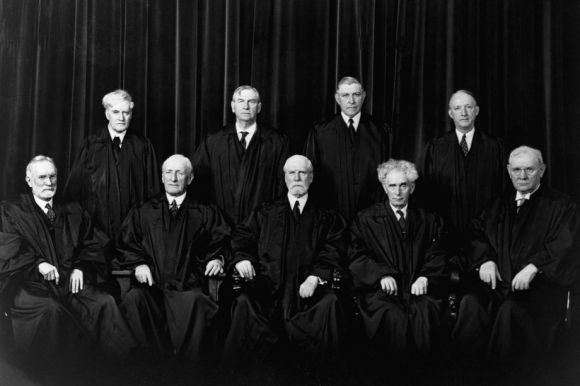
Justices of the U.S. Supreme Court, 1937-38 term. Sitting, from left to right, Justices Sutherland and McReynolds, Chief Justice Hughes, Justices Brandeis and Butler. Standing, left to right, Justices Cardozo, Stone, Roberts, and Black. Photo Credit – Getty Images
Poor Jeff Sessions seemed overworked at an event in Des Moines last week. Sessions is the 84th Attorney General of the United States and apparently a snowflake.
In a room full of judges and lawyers Sessions assailed the judicial branch of government for obstructing the 45th president’s agenda, according to an article in the Aug. 17 Cedar Rapids Gazette. Executive branchers seem to believe their agenda is the only important part of governance and all others should bow down in obeyance.
The flurry of executive orders, proclamations, memoranda, nominations and appointments issued by this president have created a massive workload to hear Sessions tell it. That’s not to mention the lawsuits filed to protect citizens from the troop of marauding grifters the Trump cabinet has proven to be.
Sessions enumerated concerns about his health and some anxiety:
“I may have withdrawal symptoms when this thing is over. The constant criticism kind of wakes you up in the morning. ‘What are they going to say today,’” Sessions was quoted as saying in the Gazette article. “I’ve got lawyers, 100,000 people in the Department of Justice who represent all these federal agencies with all their millions of employees and I’m expected to know everything that’s happening. And when it doesn’t get right, they’re going to put me in jail. That’s kind of sometimes the way I feel about it.”
Poor peanut. Being attorney general is hard.
The 2016 general election was as much about the judiciary as the executive branch. Not only did the Republican Senate obstruct the nomination of Merrick Garland to the U.S. Supreme Court by President Obama, the current president will appoint two and maybe more associate justices cut from a conservative mold. In addition, the administration is populating the federal judiciary with judges vetted for conservative views. Even if the current judiciary favors Democrats, Trump’s minions are working to change that.
There is a long tail on the process — it will be no relief for the attorney general.
Perhaps most telling in the Trumpian storm of executive orders and deregulation is on Aug. 16, a federal judge “issued a nationwide injunction against the EPA’s delay of the 2015 Water of the U.S. rule, which extended federal safeguards to 2 million miles of streams and 20 million acres of wetlands, securing the drinking water of more than 117 million Americans,” according to Huffington Post. WOTUS has been the bane of regulation for U.S. Senator Joni Ernst who has been resisting it since first proposed during the Obama administration. Not so fast General Sessions. more work for you to do. There are laws on the books and the judiciary said in this case you and your boss have to follow them.
I don’t know what people do under pressure in Alabama where Jeff Sessions was born. However, Democratic President Harry Truman has some advice: “If you can’t take the heat, get out of the kitchen.”
Jefferson Beauregard Sessions III should quit whining and get to work. If it’s too much, resign. Some Alabama peckerwood that reveres his namesakes would no doubt welcome him back. Many of us are already working toward a replacement in 2021.
Despite significant decreases in staff and other expenses, many newspapers crank out stories relevant to our daily lives.
For example, Jason Clayworth and Brianne Pfannenstiel published a full-page article about Democratic gubernatorial candidate Fred Hubbell’s tenure at Younkers in the Gannett newspapers on Monday. I don’t know how many people will read the article but the fact newspapers crank out copy for Iowans addicted to politics says something positive about the fourth estate, even if having to re-litigate the quotes attributable to the Iowa GOP is somewhat annoying.
Also on Monday, the Cedar Rapids Gazette had front page, above the fold coverage of 2020 Democratic presidential candidate John Delaney’s completion of a 99-county tour of Iowa. Delaney won’t likely be our next president but having the field to himself gives him name recognition he won’t be able to get once more Democrats jump into the presidential race.
I’m told newspapers run non-political stories as well.
Blog for Iowa encourages people who read newspaper coverage on line to subscribe. Without paid readership advertisers won’t buy ads. Without revenue, newspapers will cease to exist. If newspapers cease to exist… well that would be a much different bag of cats. In fact, I predict cats and dogs is all you will read about. While personal, funny, sad, and sometimes delightful, a story about pets is not news.
There may be no saving larger newspapers. As we’ve seen in our county, large news organizations are consolidating, and local coverage has been stripped from daily ink. Instead of getting the Iowa City Press Citizen, most people here read the Cedar Rapids Gazette because of its breadth and depth of coverage. There isn’t even a Sunday edition of the Press Citizen here, and the opinion page runs only a couple of times a week. Team Gannett produces valuable coverage, but it is not local. It is not enough.
Small, local papers with subscriptions of a thousand readers are doing well in Iowa, so if your community has one, spend the nominal annual fee and subscribe. It’s a great place to start and coverage of city council, school board and community activities is second to none. Even though your large local paper may be on the decline, subscribe. I prefer digital so I don’t have to recycle the newsprint. But either way would be better than the alternative.
Thomas Jefferson is reputed to have said, “Were it left to me to decide if we should have a government without newspapers, or newspapers without a government, I should not hesitate a moment to prefer the latter.”
Just imagine what our lives would be like with government but no newspapers. Subscribe.
A pall fell on Iowa as the family prepares for tomorrow’s funeral of Mollie Tibbetts, the 20 year-old college student who was murdered near Brooklyn, Iowa.
Many of us feel a connection to her whether we knew her or not. She went jogging and never came back. We grieve with her family and friends.
Many, including the 45th president, seek to politicize her death. We can’t let that stand. We won’t let it stand. May she rest in peace.
Tragic summers are part of living in Iowa.
While the current midterm election cycle will continue toward its fall conclusion, we live our lives outside of politics. The politics I have come to know recalls a few triumphant moments: Lyndon Johnson’s 1964 re-election; Dave Loebsack’s 2006 election; and maybe Barack Obama’s 2008 election. So few celebrations in the wicked world and none of them perfect. Politics is not why we go on living.
Set aside our work and endeavors to make society better, and what’s left? For some of us it is a deep and abiding love of life — including its comedic and tragic drama. If we tell ourselves stories to live, what story will we tell about this summer so we can go on living?
Division among us makes it harder to craft a narrative for holding back tears — tears of loneliness, of sadness for the loss. Tears unexpectedly salty and wet pulled down by gravity to our tongue. Impartial tears of grief. I am heartened by the idea there is no other side, just one country of which we are all a part.
In the wee hours of morning lightning and thunder preceded rain. I couldn’t sleep. I got up to get a drink of water from the kitchen and felt dizzy walking down the hall. I drank a few ounces and went back to bed, sleeping fitfully.
I’m still tired yet ready to go, ready to take on what’s next. To make the next effort worthy of a life, honorable to our predecessors and invigorating for who’s next. Despite summer’s tragedy we look forward to winter, and ultimately to spring and the chance to renew our lives.
In this moment it’s hard to contemplate the garden’s bounty. Even though it is hard, we will persevere and make something of it. A meal for today and ingredients for the future. What else will we do in the face of tragedy but go on living?
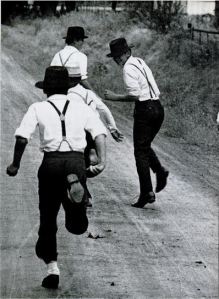
Amish Boys Near Kalona by John Zielinski. Photo Credit – Life Magazine Oct. 24, 1969
The Iowa Republican argument for spending $53 million dollars to support private schools and home schooling programs during the 2017-2018 school year is giving parents options.
“There’s been a trend to slowly put some dollars towards people who are choosing different options,” state Rep. Walt Rogers (R-Cedar Falls) said in a July 18 article in the Iowa City Press Citizen. “I would say that’s a good thing. We want to give as many options for parents and students as we possibly can.”
Rogers is chair of the Iowa House education committee which has overseen spending half a billion state dollars for private schooling since 2008.
This annual expenditure should be on the budgetary chopping block.
It is important that children are not left behind in society. For a long time state government helped private education efforts with tuition and textbook tax credits, busing, teaching assistance, and access to extra-curricular activities for home schooled children. Some of that should continue, although $53 million per year seems like too much given the lean fiscal diet forced on public schools.
When I attended parochial grade and high schools I believed the Catholic parish to which our family belonged made the contributions that paid all school expenses. I came up in the late 1950s and 1960s and contributing to the schools was a regular topic at Sunday Mass. The main way I recall government contributing was in donating surplus food to our school lunch program. There may have been other contributions, but we felt we were on our own. That’s a reality of starting and running a private school.
When I think of home schooling I recall the conflict between Iowa officials and the Amish community near Kalona over children attending public schools. National news outlets covered the story in the 1960s, and eventually the Amish community retained control over the process. Home schooling has changed since then and a lot more people and communities want to home school or encourage it.
This budget debate is not about options. Generating options is not state government’s role. The financial assistance to private and home schools by government has been on autopilot since the 1960s and created a process that obscures the lines between public and private education when it comes to public financial contributions to private schools and home schools. While contributing more state dollars to education than ever, government is under funding public schools, not even keeping up with the cost of inflation. Something’s got to give. It should be private schools rather than forcing public school teacher layoffs and school consolidation.
I don’t presume to have the answer, except to elect a Democratic Iowa House to buffer against the worst parts of the Republican agenda regarding private and home schooling. What we are doing now isn’t working. It is time for change.
On page A5 of Tuesday’s Cedar Rapids Gazette was the headline “75 shot in Chicago last weekend.”
From 3 p.m. Friday until 6 a.m. Monday 12 people were killed and 63 wounded, mostly on the south and west sides of the city.
It seems like a lot, even for a large city. Shootings in Cedar Rapids are frequent, but not like this. Is the headline a call to do something about gun violence?
Chicago law enforcement attributed the shootings to gangs who shoot into summer crowds at night, according to the news story. The shootings appear to be random, and ongoing. At least 1,700 people have been shot in Chicago this year. It is one tough city.
In the early 1990s I attended a session of arraignment court near the Washington Park neighborhood on the south side. It was an eye opener. Case after case came before the judge: shootings, domestic violence, assault, petty theft, sexual assault — plaintiffs were bandaged and bruised by incidents that provoked the court appearance. The public defender would lose track of his clients and which case was being heard. It was a chaotic meat grinder.
Experiences like these lead me somewhere besides lack of gun control as the core problem regarding social violence. The lightning rod has been the National Rifle Association.
Progressives found a certain amount of glee in the recent story in Rolling Stone titled “The NRA Says It’s in Deep Financial Trouble, May Be ‘Unable to Exist.’” The NRA is the poster child for what’s wrong about gun culture in the United States.
“The National Rifle Association uses its enormous lobbying power to stymie legislative debate and block most constructive gun legislation,” Ralph Scharnau recently wrote. “Thus even very moderate provisions fail to pass or even get out of committee.”
As a society Americans are not good at controlling violence. That includes our elected officials.
Chicago stands as an example the solution to gun violence is not only gun control. I’m not alone in believing that. The World Health Organization proposes violence be treated as a public health problem, outlining four basic approaches:
Uncovering as much basic knowledge as possible about all the aspects of violence through systematically collecting data on the magnitude, scope, characteristics and consequences of violence at local, national and international levels.
Investigating why violence occurs – that is, conducting research to determine the causes and correlates of violence; the factors that increase or decrease the risk for violence; and the factors that might be modifiable through interventions.
Exploring ways to prevent violence, using the information from the above, by designing, implementing, monitoring and evaluating interventions.
Implementing interventions that appear promising, widely disseminating information and determining the cost-effectiveness of programs.
Hasn’t this work been done? Yes it has. WHO produced a list of ten evidence-based strategies for preventing violence.
Increase safe, stable, and nurturing relationships between children and their parents and caretakers;
Reduce availability and misuse of alcohol;
Reduce access to lethal means, such as guns, knives,and pesticides (often used to commit suicide, especially in low-and middle-income countries);
Improve life skills and enhance opportunities for children and youth;
Promote gender equality and empower women;
Change cultural norms that support violence;
Improve criminal justice systems;
Improve social welfare systems;
Reduce social distance between conflicting groups;
Reduce economic inequality and concentrated poverty.
Will a public health approach to preventing gun violence work? I don’t know, but what we are doing now — hammering the NRA and elected officials — isn’t. It’s time to try something else.
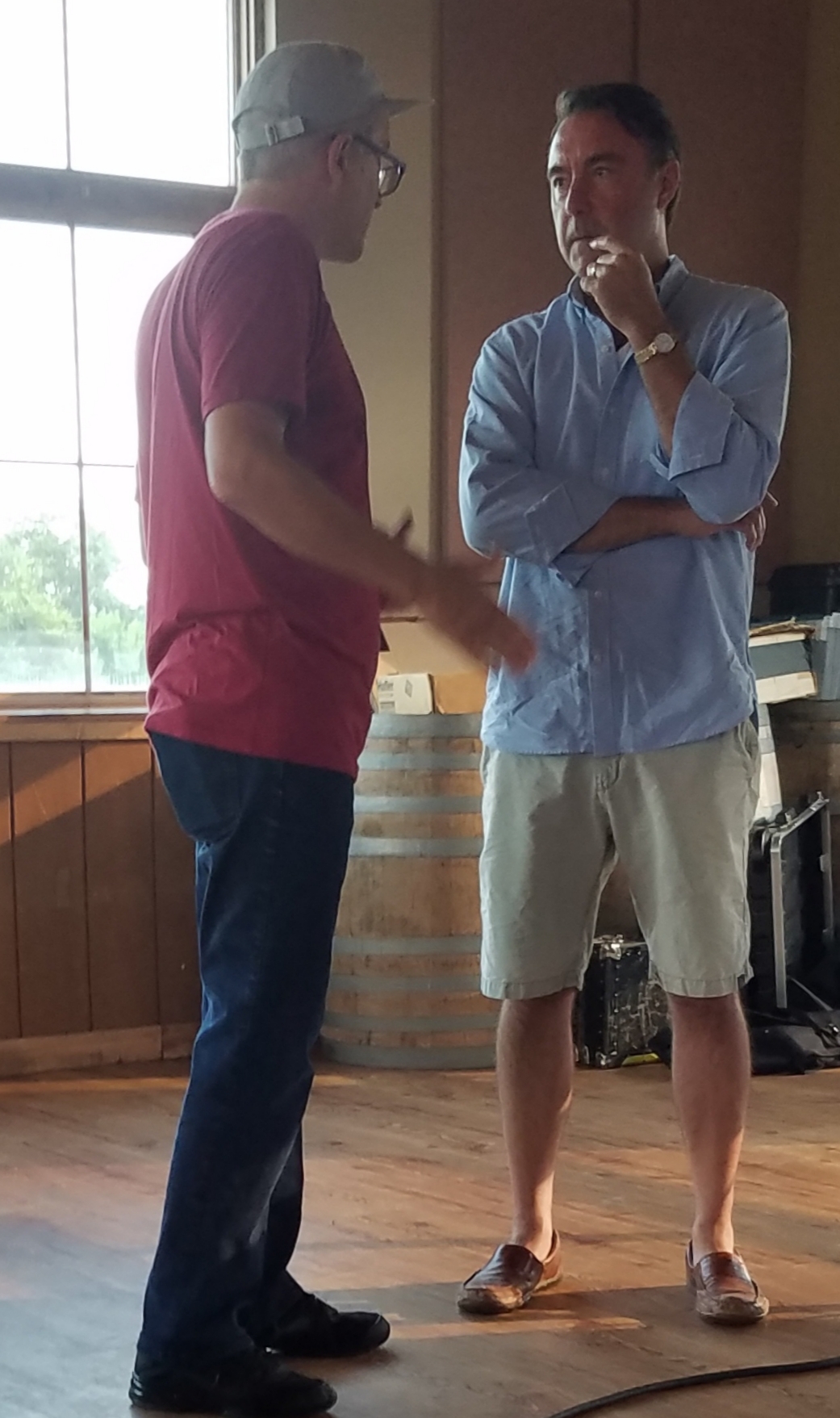
Ben Keiffer (L) and Dr. Christopher Peters chatting at Pints and Politics event, Thursday, Aug. 9, 2018
In an effort to get outside my comfort zone I tried something new. I went to a media event called “Pints and Politics” at the Cedar Ridge Winery and Distillery in Swisher Thursday after my shift at the home, farm and auto supply store.
The Cedar Rapids Gazette hosts Pints and Politics in which their columnists and reporters form a panel and answer audience questions. People drink alcoholic beverages and talk about politics. That is, most people. I drank about two pints of water before the show started and discussed a case with a lawyer I know who was there. I felt uncomfortable among the crowd of people mostly in my cohort of sixty somethings. Many seemed like they had retired with not enough to do. One presumes they read newspapers and listen to the radio. More than 200 people arrived for the forum.
Iowa Public Radio glommed on to Pints and Politics and makes an edition from the raw materials for their weekday program River to River with Ben Keiffer. Keiffer drank a beer and handed out a few Post-It pads with the Iowa Public Radio logo on them. These will be handy for dispatches to my spouse to be left on the refrigerator with information about our ongoing conflict with the spiders assuming control of our house. The Gazette, being a newspaper under duress in an on line world, had no such useful perquisites.
I attended the event Thursday and listened to the edited version on the radio Friday.
The panelists were Todd Dorman and Adam Sullivan, both columnists for the Gazette, and Joyce Russell, statehouse reporter for Iowa Public Radio. The two people I know best, Lynda Waddington and James Q. Lynch of the Gazette, while in adverts for the event, were both absent. I follow the work of the panelists. While Russell is a journalist, I’m not sure what one calls columnists. The word “pundit” was used several times during the event and the appellation will serve.
The event was rigged from the git-go to serve existing media narratives. Audience members submitted written questions to the panel and many more than could be asked were collected. This made the question editing process the driver in how the panel proceeded. The topics Keiffer chose were what’s already in the news: the Iowa Supreme Court hearing oral arguments on the state’s voter suppression law that day; President Trump’s recent visit to Peosta; and others. The radio version should be posted soon here. 2020 presidential candidate John Delaney announced completion of visits to all 99 Iowa Counties. Dorman suggested as a reward that his likeness be carved in butter and displayed at the Iowa State Fair.
I’m not sure what I expected and maybe that’s the point of trying something new. I did not know many attendees, and most of those I did were conservatives. Democratic Rep. Amy Nielsen was there. Cedar Ridge Winery and Distillery is in her district. Republican congressional candidate Dr. Christopher Peters was present working the crowd. Once Peters found out Rep. Rod Blum declined an opportunity to appear on River to River he made clear to Keiffer he had no reservations about appearing on the program. There was a table full of Libertarians, about proportional in number to the percentage of the general population. The rest of the audience leaned Democratic.
Adam Sullivan stood out on the panel simply because he talked so much. He served as a useful foil for more Democratic audience members to express their belief in status quo politics driven by media narratives. Russell is a professional, as are they all. The three of them all tried to get along. In the background I might have heard a “both sides” or two, but maybe that is confirmation bias whispering in my ear.
The most significant media narrative related to how elections are decided. I posted this on twitter Friday while listening to the radio.
Panelists agreed with Dorman we are in an election where issues not that important. “Persuasion stuff is kind of dead,” he said. Rile up the base on both sides. Get who you can of whoever is left. I’m not sure that’s the case, although here’s an example of media that believe it.
I want to emphasize 1. I’ve heard this before during recent election cycles, and 2. based on my experience this cycle, I don’t believe for one minute this is how the 2018 midterms are rolling out. Repeating this narrative is not as important as the fact people believe it. Based on reports I get from the field, the narrative is bankrupt and the panelists didn’t seem to be aware. That disconnect is important.
While attendees passed a pleasant two hours, I was decidedly unsettled by the experience. As I drove east along 120th Street in my 21 year old vehicle, the sun was moving toward the horizon. I turned north at the Ely Blacktop to get an ice cream at Dan and Debbie’s Creamery before heading south and home. What unsettled me was not the media personalities, or the people in Swisher. It was knowledge of the amount of work to overcome the tainted media narratives which were promulgated.
I get it that news writers need a hook and consumers of news need to understand it. A lot of fish were caught during Pints and Politics but the pool wasn’t very deep. I’m thankful for a new experience, but I doubt I’ll be returning to a media event like this.
Congressman Dave Loebsack in the Solon Beef Days parade
You don’t need to be a political insider to understand Dave Loebsack’s days in the U.S. House of Representatives are getting numbered.
Loebsack seems likely to dispatch with power his second time opponent, Chris Peters from Coralville, this year. He could continue to run for Congress for several more terms. I think he should continue to run and would be willing to chip in to buy a wheelchair to get him to the floor to vote should he become infirm as he ages. It’s not about me.
What about when Dave decides to put away his running shoes? He reaches the Social Security Administration’s “full retirement age” later this year.
Will he start a third career? Will he run for the U.S. Senate? Will he continue to serve in the U.S. House? Will he kick back with his retirement packages from Cornell College and the House and take it easy? Any of those is possible and only Dave knows. I don’t care to speculate about his plans.
The risk Second District voters face when Dave moves on is an open seat becomes more vulnerable to a Republican takeover. Dave created a trove of institutional political knowledge about the district since first being elected in 2006. Presumably he will be willing and able to help a potential successor learn what he’s learned. As we saw in 2014, Tom Harkin’s departure from the U.S. Senate did not go well for Democrats. Harkin knew the political landscape of the state as well as anyone and that didn’t help Democrats win his seat.
Loebsack’s first election to the House was a reaction to the incumbency of Jim Leach, and a repudiation of President George W. Bush. When Bush was reelected in 2004, Democratic voters were activated for change. Leach, partly through his participation as House Banking Committee chair during the Whitewater investigation of the Clintons, caught shrapnel from the wave election that was 2006. Those of us making political telephone calls at the time heard voters ready for a change. There were enough of them to tip the scales to a Loebsack win. Those dynamics don’t exist today.
Loebsack has been able to survive the Republican resurgence during the last four cycles. That doesn’t mean a potential successor will get elected. Voters don’t change that much but political dynamics get reset in an open race. I expect the first election once Dave announces retirement will be a barn burner.
Who could replace Dave Loebsack? A few names have been suggested, but it’s been scuttlebutt, gossip and wishful thinking thus far. It makes sense for a potential candidate to have deep grassroots political experience as Loebsack did, or significant service in the Iowa legislature. However, the electorate seems to be moving out of the age of reason into darker territory. Presently, that’s not a question on the minds of many Democrats I know. We just feel Dave will always be available, regardless of reality, reason and logic.
Loebsack reaches full retirement age on Dec. 23. He may not be ready to retire from the House, and many Democrats, including the author, would like to see him seek another term in 2020. However, the day is coming and preparation to find a successor should begin if it hasn’t already. What is that process? I don’t know. If it’s an open race, anyone could run, and several probably will.
For now, the work is to reelect Dave Loebsack in 2018 and give him some help in the other Iowa Congressional Districts. That’s what many of us will be doing over the next three months with an eye toward the future.
During a brief appearance at Northeast Iowa Community College in Peosta on July 26, President Trump claimed a trade breakthrough with European allies.
“We just opened up Europe for you,” he said.
Not so fast!
On Saturday, European Union Commission President Jean-Claude Juncker, who met with Trump, said trade talks almost collapsed over U.S. agricultural demands.
Agricultural trade will remain off the table in any trade talks between the U.S. and EU, Juncker said, according to Deutsche Welle. A European commitment to buy more U.S. soybeans is driven by market conditions.
Europe is the second largest importer of soybeans after China and prices are low because of the U.S. trade war with China. In other words, after market conditions driven by the president beat the price of soybeans down, Europe sees a bargain. It is hard to fathom how Trump sees Europe “opened up” under these conditions. Granted Iowa farmers planted more acres in soybeans this year, but the president’s statement can only be seen as political posturing in advance of the 2018 midterm elections and everyone should know it.
There is a more significant problem with “opening up” Europe for agricultural trade — the issue of genetically modified organisms.
There are very few genetically modified crops grown in Europe compared to the U.S., according to a July 27 New York Times article. The reason is in 2001, the EU issued a directive about GMOs. From the early stages of research to the marketplace, these products would have to pass a series of tests for environmental risks and human safety. The consequence of the directive in Europe is few farmers produce GMO crops.
In the U.S., neither the USDA nor the National Academy of Sciences is concerned that GMO crops have any impact on consumers different from non-GMO crops, despite a slate of regulations. Driven by science, farmers embrace GMO crops because of their acceptance in the U.S. marketplace combined with the attributes of genetically modified seeds. Regardless of science, increasing the amount of GMO crops exported to Europe seems unlikely given the fact many European countries have banned GMOs.
Shorter version of Trump’s statement, “Farmers, here’s a bone.”
It’s hard to see how help for Iowa farmers will materialize from current discussions with Europe. The irony of increased soybean sales to Europe after Trump’s trade war beat down prices as something positive seems lost on his true believers. They may swallow this hook, line and sinker, but other sentient beings should not. It is another deception from a president with an unending supply of deceit.







 Journey Home
You must be logged in to post a comment.